
What Is a Comprehensive Assessment in Home Health?
A complete guide to comprehensive assessments in home health: required content, current Medicare timing, OASIS-E2, clinician responsibility, care planning, documentation errors, and a practical checklist.
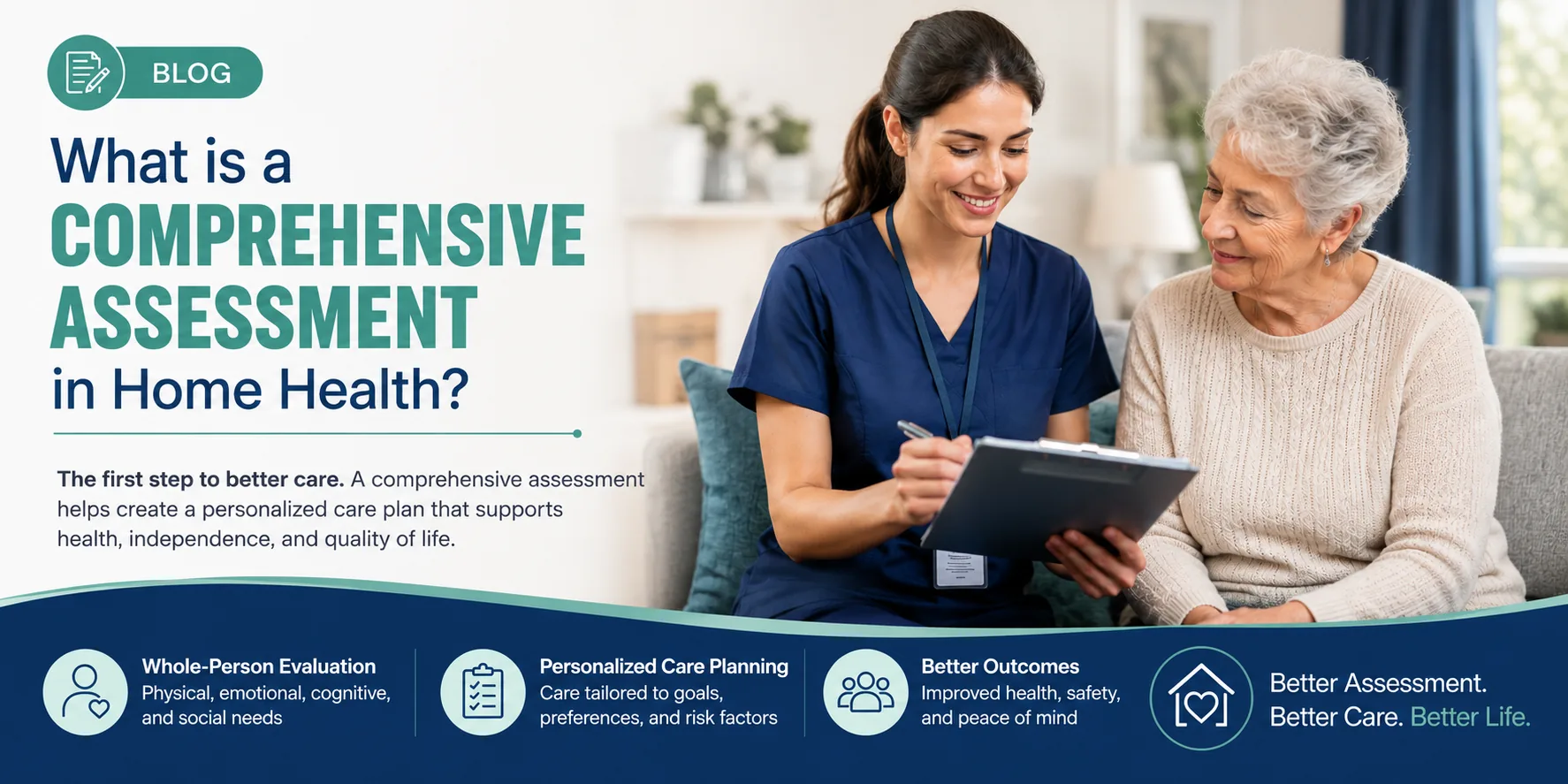
Key Takeaways
- A comprehensive assessment is a patient-specific evaluation of clinical, functional, cognitive, psychosocial, medication, safety, caregiver, and care-planning needs, not simply an OASIS form.
- Under 42 CFR § 484.55, the comprehensive assessment must be completed no later than five calendar days after Start of Care and updated at required milestones or when the patient's condition warrants.
- OASIS-E2 is the current OASIS version, effective April 1, 2026, and its applicable items are incorporated into the broader comprehensive assessment.
- Assessment findings should flow into an individualized plan of care through a clear chain: need, goal, intervention, progress, and reassessment.
- AI can help capture and organize assessment documentation, but the qualified clinician remains responsible for accuracy, clinical relevance, and final review.
A comprehensive assessment in home health is a patient-specific clinical assessment used to establish a complete picture of the patient's condition, needs, risks, strengths, goals, preferences, functional status, and continuing need for home health services.
For Medicare-certified home health agencies, the comprehensive assessment is a foundation of the patient's episode of care. It helps the care team understand what is happening with the patient, what services are needed, what risks must be addressed, and what outcomes the patient and care team are working toward.
Most importantly, the assessment should lead to an individualized plan of care that reflects the patient's actual needs. It is more than completing an OASIS form or filling out a nursing template; it is the clinical foundation for understanding the patient and planning appropriate home health care.
🩺 Quick answer: A comprehensive home health assessment brings together the patient's current health, function, cognition, psychosocial status, medications, home safety, caregiver support, goals, preferences, skilled needs, and applicable OASIS information to guide an individualized plan of care.
Why Is a Comprehensive Assessment Important in Home Health?
Home health clinicians care for patients in their own homes, where clinical conditions, functional limitations, caregiver support, and environmental risks can all affect outcomes. A diagnosis alone rarely tells the entire story.
A patient with heart failure, for example, may also have difficulty walking to the bathroom, recent medication changes, limited understanding of the new regimen, a history of falls, inadequate caregiver support, difficulty preparing meals, environmental hazards, or trouble following the prescribed treatment plan.
What does the patient need? → What skilled services are appropriate? → What goals should be established? → What interventions should be provided? → How will progress be evaluated?
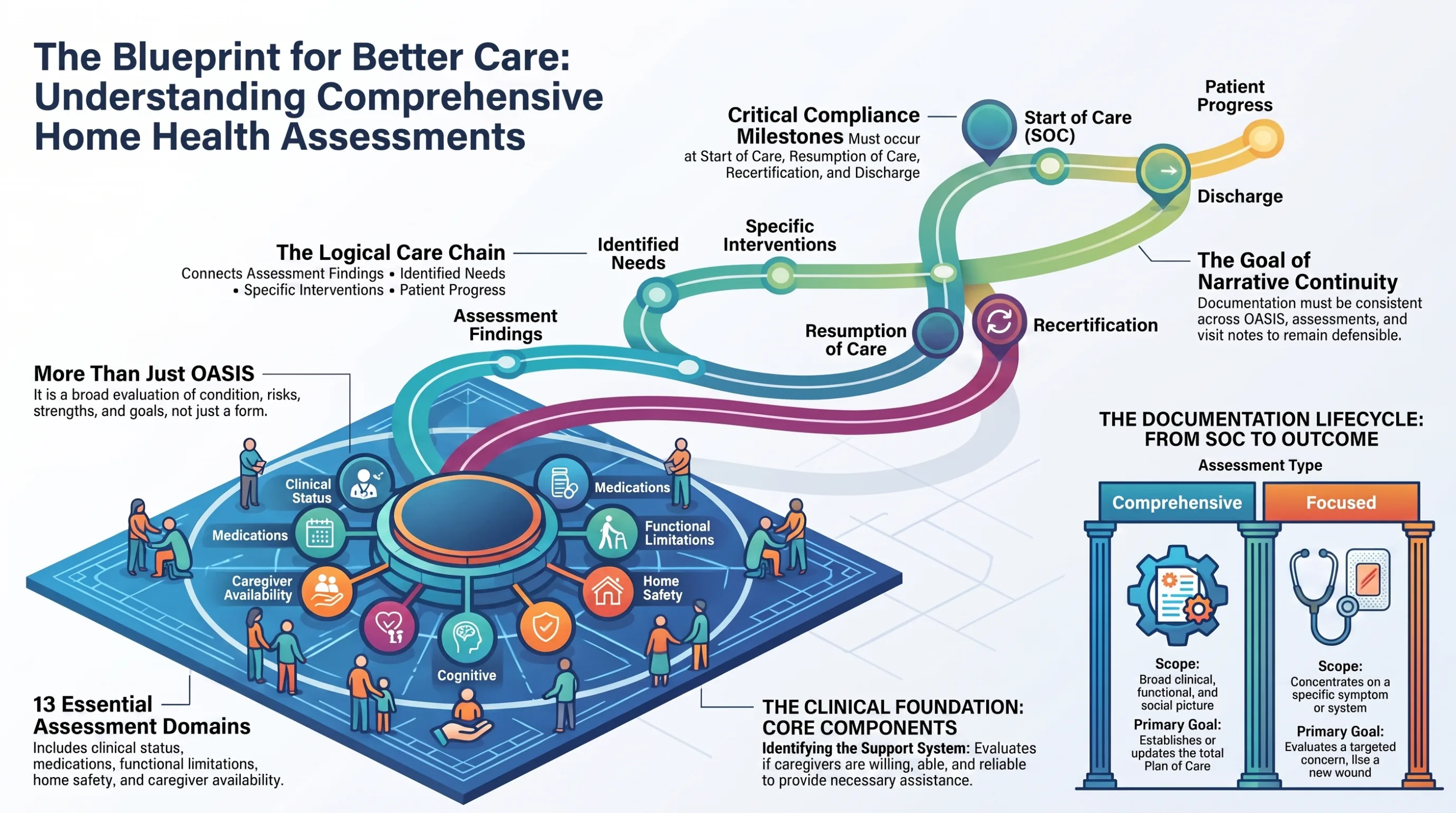
A comprehensive assessment connects the whole clinical picture to patient-specific interventions, progress, reassessment, and outcomes.
Is OASIS the Same as a Comprehensive Assessment?
No. This distinction is important for clinicians and home health leaders.
OASIS is part of the applicable comprehensive assessment process; it is not automatically synonymous with the entire assessment. The broader assessment considers the patient's clinical picture, needs, strengths, goals, preferences, caregiver situation, continuing need for home care, and relevant medical, nursing, rehabilitation, social, and discharge-planning needs.
Learn more in our complete OASIS-E2 guide.
Comprehensive assessment → Clinical picture, needs, risks, strengths, and goals → Applicable OASIS information → Individualized plan of care → Skilled services and ongoing monitoring
What Does a Comprehensive Home Health Assessment Include?
There is not a single checklist that looks exactly the same for every patient. The assessment should be patient-specific and appropriate to the patient's condition and circumstances.
Under 42 CFR § 484.55, it must accurately reflect the patient's status and include required clinical and care-planning information.
1. Medical History and Current Clinical Condition
Review the patient's relevant medical background and current condition: primary and secondary diagnoses, recent hospitalization or procedures, medical history, current symptoms, orders, allergies, changes in health status, prior complications, and the reason for home health services. The objective is not to reproduce the entire medical record; it is to establish the information needed to understand the patient's current needs.
2. Physical and Clinical Assessment
Evaluate physical status based on the patient's condition and the scope of the assessment. This may include vital signs, pain, cardiovascular and respiratory status, neurological status, skin integrity and wounds, mobility, elimination, nutrition and hydration, and other relevant systems.
Weak: Patient stable. Assessment completed.
Stronger: Patient reports increased fatigue with ambulation since returning home. Respiratory status assessed and vital signs obtained.
Patient denies acute chest pain. Findings reviewed in relation to current plan of care.
3. Functional Status
Consider what the patient can actually do, not simply the diagnoses on the referral. Relevant areas may include ambulation, transfers, bathing, dressing, toileting, eating, grooming, meal preparation, medication management, assistive-device use, and the ability to navigate the home.
4. Cognitive and Psychosocial Status
Assess the patient's ability to understand and participate in care, including orientation, memory, communication, ability to follow instructions, mood, behavior, cognitive limitations, medication understanding, and recognition of changes in condition. Consider social support, emotional concerns, living situation, access to resources, transportation, medication or supply access, and communication barriers.
5. Medication Profile and Medication Management
Medication assessment is especially important during transitions of care. Review current medications, dose and frequency, recent changes, new and discontinued drugs, discrepancies, adherence concerns, patient understanding, ability to self-manage, side effects, adverse reactions, and clinically significant interactions or duplication.
A patient returning home after hospitalization may have several medication changes. The assessment is an opportunity to identify discrepancies and determine whether education, coordination, or follow-up is needed.
See our guide to long-standing vs. new medication documentation.
6. Home Environment and Safety
Home health clinicians see the patient's actual living environment. Assess fall hazards, unsafe stairs, lighting, bathroom safety, pathways, equipment, accessibility, fire or other safety concerns, environmental barriers, and necessary supplies.
Clinically relevant findings should lead to appropriate interventions, education, referrals, or plan-of-care updates.
7. Fall Risk
Consider previous falls, gait instability, weakness, dizziness, medication-related risks, assistive-device use, vision limitations, cognition, and environmental hazards. Connect the finding to what happened next.
⚠️ Finding: Patient has difficulty transferring from bed to standing. Intervention: Reviewed safe transfer technique and assistive-device use. Response: Patient demonstrated the technique with verbal prompting. Plan: Continue monitoring transfer safety and reinforce education.
8. Skin and Wound Status
For patients with wounds or risk of skin breakdown, establish an appropriate baseline. Depending on the wound, document location, measurements, wound bed, drainage, odor, periwound condition, pain, relevant signs or symptoms, treatment, patient response, and change from prior findings.
9. Nutrition and Hydration
Consider appetite, food and fluid intake, weight changes, difficulty preparing meals, swallowing concerns, dietary restrictions, access to food, and caregiver assistance. Connect relevant findings to appropriate interventions and follow-up.
10. Caregiver Assessment
Identify available supports and assess whether caregivers are willing, able, reliable, able to understand instructions, and available when assistance is required. A caregiver's presence does not automatically mean that the patient has adequate support.
11. Patient Strengths, Goals, and Preferences
A comprehensive assessment is not only about problems. Capture the patient's strengths, personal goals, care preferences, abilities, motivators, and priorities.
A goal such as safely walking to the kitchen independently provides meaningful context for therapy, nursing education, and care planning.
12. Homebound Status and Continuing Need for Home Health
For applicable Medicare services, document patient-specific circumstances supporting eligibility, including homebound status and the continuing need for covered home health services. A generic statement such as Patient is homebound does not explain the patient's actual condition or the assistance required to leave home.
13. Skilled Need and Medical Necessity
Show the clinical reasoning behind the service: Patient condition → Clinical problem → Skilled need → Intervention → Expected outcome. For example: Patient has difficulty managing a newly changed medication regimen following hospital discharge. Skilled nursing is required for medication reconciliation, education, monitoring, and coordination related to the identified medication-management needs.
How the Comprehensive Assessment Drives the Plan of Care
The assessment and plan of care should tell the same patient story. 42 CFR § 484.60 requires the individualized plan of care to specify the care and services needed to meet patient-specific needs identified in the comprehensive assessment.
If the assessment identifies difficulty ambulating safely and a history of falls, the plan should appropriately address that finding through fall-prevention interventions, therapy involvement when indicated, patient and caregiver education, and monitoring.
Assessment → Identified need → Goal → Intervention → Progress → Reassessment
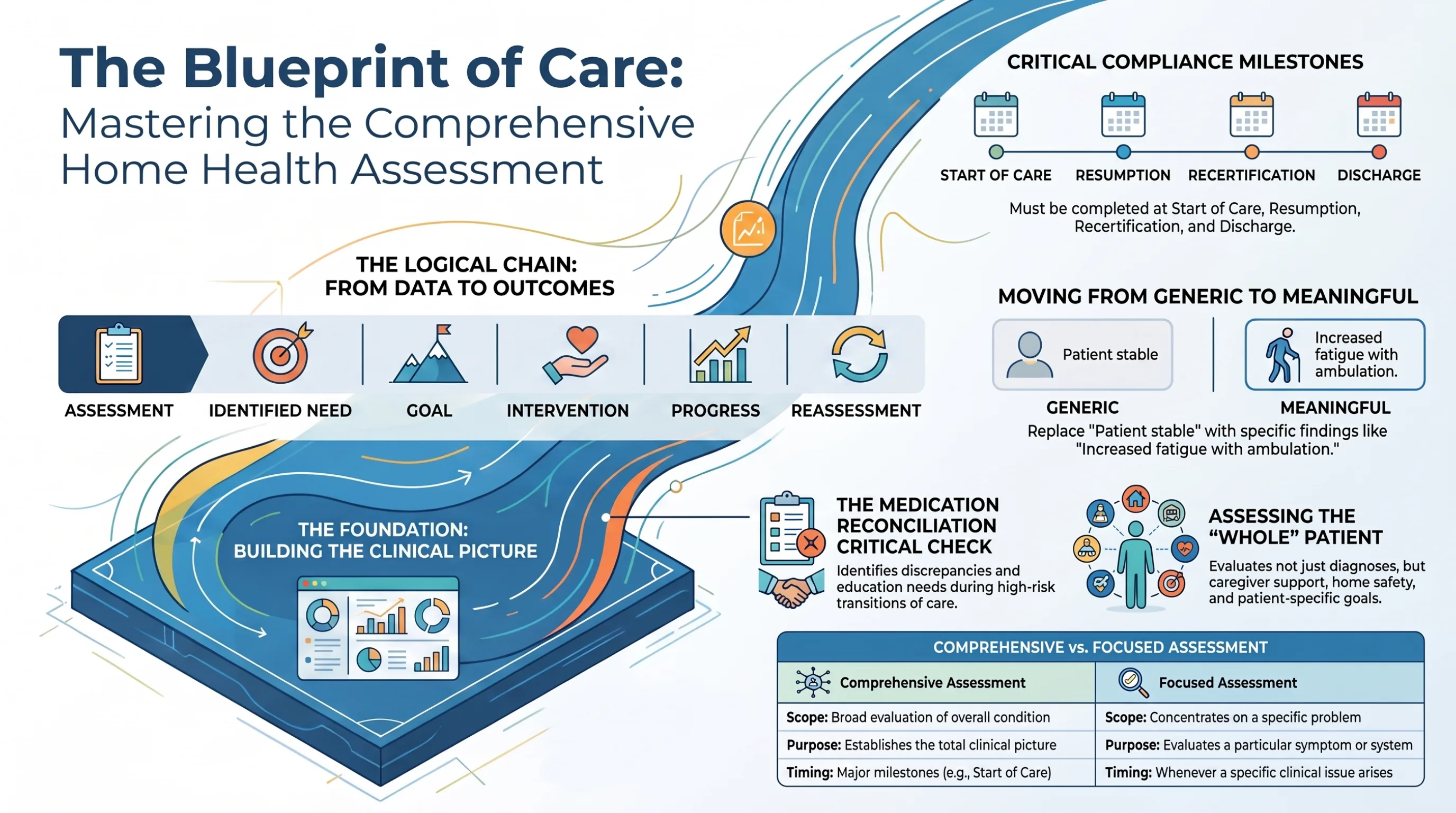
Strong documentation turns assessment data into an internally consistent story across goals, interventions, progress, and reassessment.
When Must a Comprehensive Assessment Be Completed?
Current federal requirements establish specific assessment windows. Under 42 CFR § 484.55, the initial assessment visit must occur within 48 hours of referral, within 48 hours of the patient's return home, or on the physician- or allowed-practitioner-ordered Start of Care date.
The comprehensive assessment must be completed consistently with the patient's immediate needs and no later than five calendar days after Start of Care.
The comprehensive assessment must be updated as often as the patient's condition warrants because of a major improvement or decline, and at least during the last five days of every 60-day period beginning with SOC, within 48 hours after qualifying return home from a hospital admission or on the ordered resumption date, and at discharge. Agencies should use the current regulation and CMS guidance when operationalizing these timeframes.
📅 Operational reminder: The Start of Care date is not simply the referral date. Workflows should distinguish referral, the ordered SOC date, the initial assessment visit, and completion of the comprehensive assessment.
SOC, ROC, Recertification, and Discharge
Start of Care (SOC)
SOC establishes the baseline and supports the initial plan of care. Capture current condition, needs, risks, function, medications, caregiver situation, goals, and other applicable assessment information.
See the SOC documentation workflow.
Resumption of Care (ROC)
ROC becomes relevant after a qualifying interruption such as an inpatient stay. Determine what changed and whether the existing plan remains appropriate.
Review SOC vs. ROC vs. recertification for a practical comparison.
Recertification
During the required update cycle, reassess current needs and whether continued services remain appropriate. Documentation should reflect the patient's present status instead of repeating the original assessment.
Discharge
At discharge, document current status, progress, remaining needs, and the circumstances surrounding the end of services so the record supports an appropriate transition or follow-up.
When Is Reassessment Necessary?
A significant improvement or decline may require reassessment and review of the plan of care. Examples include hospitalization, a significant symptom change, a new wound, major medication change, functional decline or improvement, a new safety concern, or a change in caregiver support.
Documentation should reflect the patient's current condition rather than preserve an outdated baseline.
Who Can Complete a Comprehensive Assessment?
Under current 42 CFR § 484.55, an RN generally completes the comprehensive assessment. When physical therapy, speech-language pathology, or occupational therapy is the only ordered service, the corresponding qualified therapist may complete it.
The current rule also permits an occupational therapist to complete the assessment for a Medicare patient when OT is ordered with another qualifying rehabilitation therapy service that establishes program eligibility.
Other team members may contribute observations, but the integrated assessment remains the responsibility of the qualified clinician completing it. Agencies should also verify current state scope-of-practice rules and organizational policies.
Comprehensive Assessment vs. Focused Assessment
| Comprehensive assessment | Focused assessment |
|---|---|
| Broad evaluation of overall condition and needs | Concentrates on a specific problem or concern |
| Establishes or updates the broader clinical picture | Evaluates a particular symptom, system, or condition |
| Considers clinical, functional, medication, psychosocial, caregiver, and safety factors | Scope is defined by the clinical concern |
| Supports broader care planning | Supports a targeted clinical intervention |
| Occurs at required episode milestones and when condition warrants | Occurs whenever a particular clinical issue requires assessment |
For example, a patient with heart failure may receive a comprehensive assessment covering medications, respiratory status, edema, mobility, nutrition, caregiver support, safety, and disease-management needs. If the patient later develops increased shortness of breath, the clinician may perform a focused respiratory assessment of that specific concern.
Common Comprehensive Assessment Documentation Errors
1. Treating OASIS as the Entire Assessment
OASIS is an important component of applicable workflows, but it does not replace the broader clinical assessment.
2. Using Generic Statements
Statements such as Patient stable provide little useful clinical information. Describe relevant findings and context.
3. Copying the Previous Assessment
Copy-forward documentation can preserve outdated symptoms, medications, vital signs, function, wounds, caregiver circumstances, responses, or care plans. Verify current information before signing.
4. Missing Caregiver Limitations
Daughter assists patient does not explain the caregiver's actual availability, willingness, or ability to provide the required assistance.
5. Identifying a Problem Without Addressing It
Finding → Intervention → Response → Plan
6. Failing to Update the Plan of Care
When clinically significant changes occur, review and revise the plan as appropriate so it reflects the updated comprehensive assessment.
7. Inconsistent Documentation
A major quality and compliance concern arises when OASIS, the comprehensive assessment, the plan of care, and visit notes tell different stories. The record should present a consistent, defensible patient narrative.
Comprehensive Assessment and Survey Readiness
Potential survey-readiness problems include late assessments, missed update windows, incomplete clinical information, weak medical-necessity support, poor caregiver documentation, inconsistent OASIS and narrative findings, and plans of care that do not address identified needs.
A reviewer should be able to follow the patient's story: What was the condition? What needs were identified?
What services were ordered? What did the clinician do?
How did the patient respond? Was the plan updated when circumstances changed?
Comprehensive Home Health Assessment Checklist
Use this as an internal review framework and adapt it to the patient, payer, discipline, current regulation, OASIS guidance, state rules, and agency policy.
Patient and Clinical Information
- Patient information and relevant medical history verified.
- Current diagnoses and reason for home health identified.
- Vital signs, symptoms, pain, and relevant physical findings assessed.
- Skin, wound, nutrition, hydration, and disease-specific findings addressed when applicable.
Medication Management
- Current medications and recent changes reviewed.
- Potential discrepancies, adverse effects, interactions, duplication, or adherence concerns addressed.
- Patient and caregiver understanding and ability to manage assessed.
- Relevant education and follow-up documented.
Function, Cognition, and Psychosocial Needs
- Mobility, transfers, ADLs, assistive devices, and functional limitations assessed.
- Cognitive status, communication, mood, and relevant psychosocial needs considered.
- Social support, resources, and barriers identified.
Caregiver and Home Environment
- Caregiver willingness, ability, availability, and schedule assessed.
- Fall hazards, accessibility, equipment, environmental risks, and safety concerns reviewed.
Patient-Centered Planning and Compliance
- Patient strengths, goals, preferences, care needs, and discharge considerations documented.
- Applicable OASIS-E2 items incorporated.
- Homebound status and continuing need supported when applicable.
- Skilled need and medical necessity connected to patient-specific findings.
- Assessment and plan of care are consistent.
- Qualified clinician reviewed and completed the assessment within the applicable timeframe.
How AI Can Support Comprehensive Assessment Documentation
AI-assisted documentation tools can help organize the large amount of information captured during or after a home health visit. Depending on the technology, AI may support voice capture, transcription, structured note generation, information organization, potential missing-information checks, medication extraction, documentation-quality review, and drafting patient-specific narratives.
🤝 AI should support, not replace, clinical judgment. The responsible clinician must review AI-generated content for accuracy, completeness, clinical relevance, patient specificity, and consistency with the care actually provided.
Learn how human-in-the-loop review keeps clinicians in control of AI-assisted documentation.
Comprehensive Home Health Assessment Example
Consider a patient recently discharged after hospitalization for a heart-failure exacerbation.
| Assessment area | Patient-specific finding |
|---|---|
| Clinical status | Patient reports increased fatigue since returning home; lower-extremity edema is present; relevant vital signs and cardiopulmonary findings are assessed. |
| Medication profile | A new medication was prescribed after discharge; reconciliation identifies the change and uncertainty about the dosing schedule. |
| Functional status | Patient ambulates with a walker and requires assistance for certain activities. |
| Home environment | Patient has difficulty safely navigating stairs to reach the bathroom. |
| Caregiver | The patient's daughter provides assistance but is not continuously available. |
| Patient goal | Patient wants to resume walking safely and independently inside the home. |
| Skilled need | Skilled nursing is needed for assessment, medication education, monitoring, and care coordination based on identified needs. |
| Plan | Findings are incorporated into the individualized plan of care with appropriate interventions and follow-up. |
The central principle is simple: the assessment should connect the patient's condition to the services, goals, interventions, and outcomes being documented.
Key Takeaway
A comprehensive assessment is much more than a form, checklist, or OASIS submission. It creates a complete, patient-specific picture of condition + function + medications + safety + caregiver support + goals + preferences + skilled need.
That picture should flow logically into the plan of care → skilled services → visit documentation → reassessment → outcomes. The strongest documentation is not necessarily the longest; it is accurate, individualized, clinically meaningful, internally consistent, and connected to the care provided.
Why Trust Our Experts?
Home health documentation sits at the intersection of clinical practice, Medicare requirements, OASIS, reimbursement, compliance, and patient care. Because requirements change, operational and regulatory decisions should always be validated against current official guidance.
- Clinically informed: Written around real-world home health assessment and documentation workflows.
- Compliance-aware: Considers Medicare, OASIS, assessment, plan-of-care, and documentation principles.
- Patient-centered: Emphasizes individualized documentation rather than generic or copy-forward narratives.
- Human-reviewed: AI can assist documentation workflows, but clinical responsibility remains with the appropriate healthcare professional.
- Source-conscious: Regulatory requirements are checked against current CMS and federal sources.
ℹ️ Disclaimer: This article is for educational and informational purposes only. Requirements may vary by patient circumstances, discipline, payer, state, agency policy, and applicable federal regulation. It is not legal, clinical, coding, billing, or compliance advice. Verify current requirements with CMS, applicable OASIS guidance, Medicare Administrative Contractors, state authorities, and payer policies.
References and Recommended Resources
- 42 CFR § 484.55—Comprehensive assessment of patients.
- 42 CFR § 484.60—Care planning and coordination.
- CMS OASIS-E2 User Manuals.
- CMS OASIS Data Sets.
- CMS Home Health Quality Reporting Program.
- CMS Medicare Benefit Policy Manual, Chapter 7—Home Health Services.
- CMS Home Health Agency Information Center.
Home Health Documentation Playbook
The complete guide to OASIS-E, Medicare compliance, PDGM, and AI-assisted documentation. Learn how top agencies reduce documentation time without sacrificing compliance.
Bottom Line
A comprehensive home health assessment creates the complete, patient-specific clinical picture that connects condition, function, medications, safety, caregiver support, goals, preferences, and skilled need to an individualized plan of care.
Inside Home Health Podcast
What Makes OASIS Documentation So Difficult?

Arvind Sarin is the founder of Copper Digital. For the past year he has spent three days a week inside a 500+ census Texas home health agency, building AI documentation that finishes OASIS and visit notes the same day, with a nurse reviewing and approving every note. He writes about home health documentation, OASIS, Medicare compliance, and applying AI responsibly in clinical workflows.
Frequently asked
Frequently asked questions
A comprehensive assessment is a broad, patient-specific evaluation of the patient's clinical condition, functional status, cognition, psychosocial needs, medications, safety, caregiver support, goals, preferences, and continuing need for home health services.
Join the conversation
Leave a comment
No comments yet. Be the first to share your thoughts.
Related reading
What Is OASIS-E2? A Complete Guide for Home Health Agencies
A practical guide to OASIS-E2: assessment changes, time points, quality and payment uses, EHR and iQIES readiness, and AI support that keeps clinicians in control.
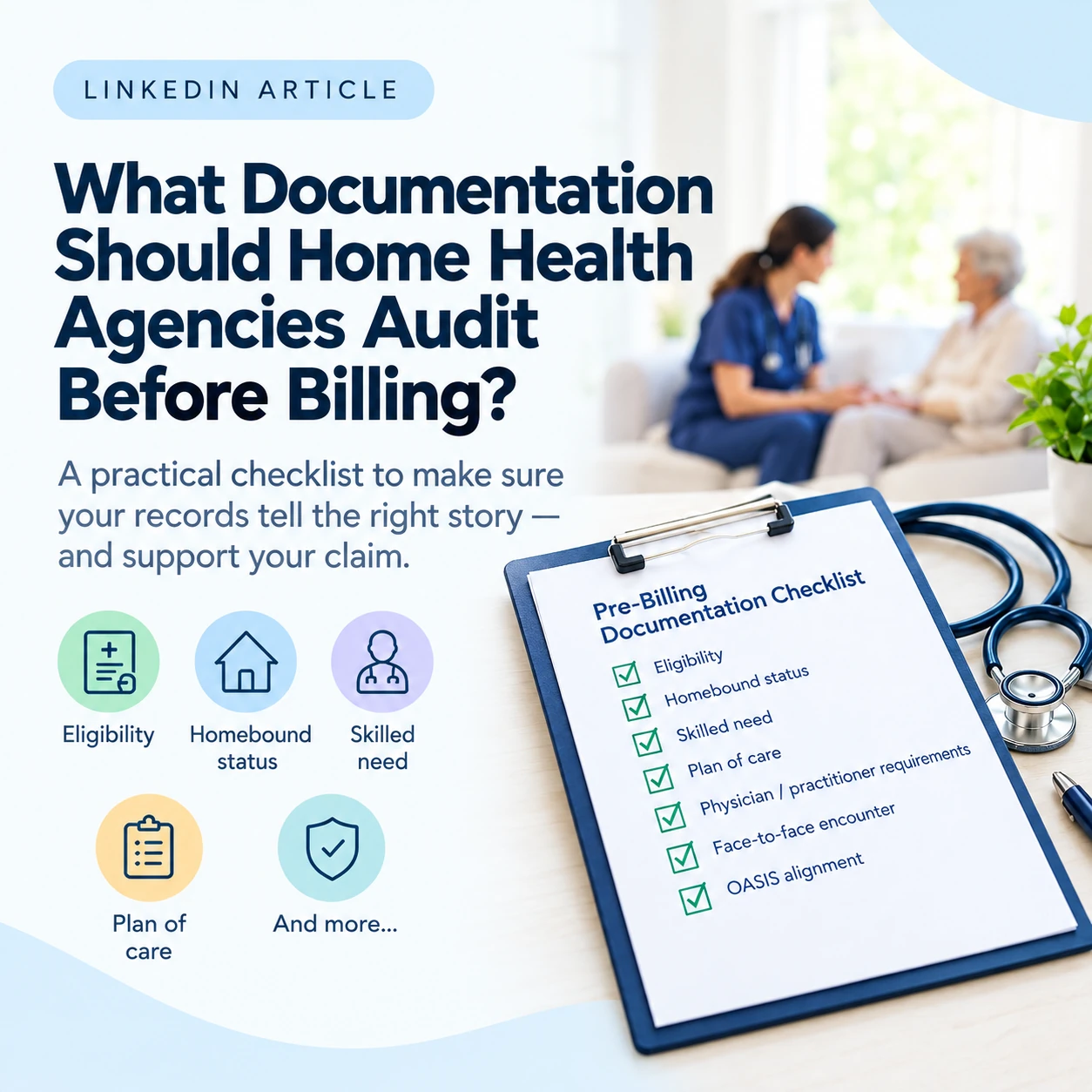
What Documentation Should Home Health Agencies Audit Before Billing?
Before billing, confirm that eligibility, medical necessity, orders, OASIS-E2, coding, and visit documentation tell a consistent story and support the services on the claim.
What Is a CMS Provider Validation Survey for Home Health Agencies?
A CMS provider validation survey checks whether a deemed-status home health agency actually meets Medicare health and safety requirements. Here is what CMS reviews and how an HHA can stay ready.