
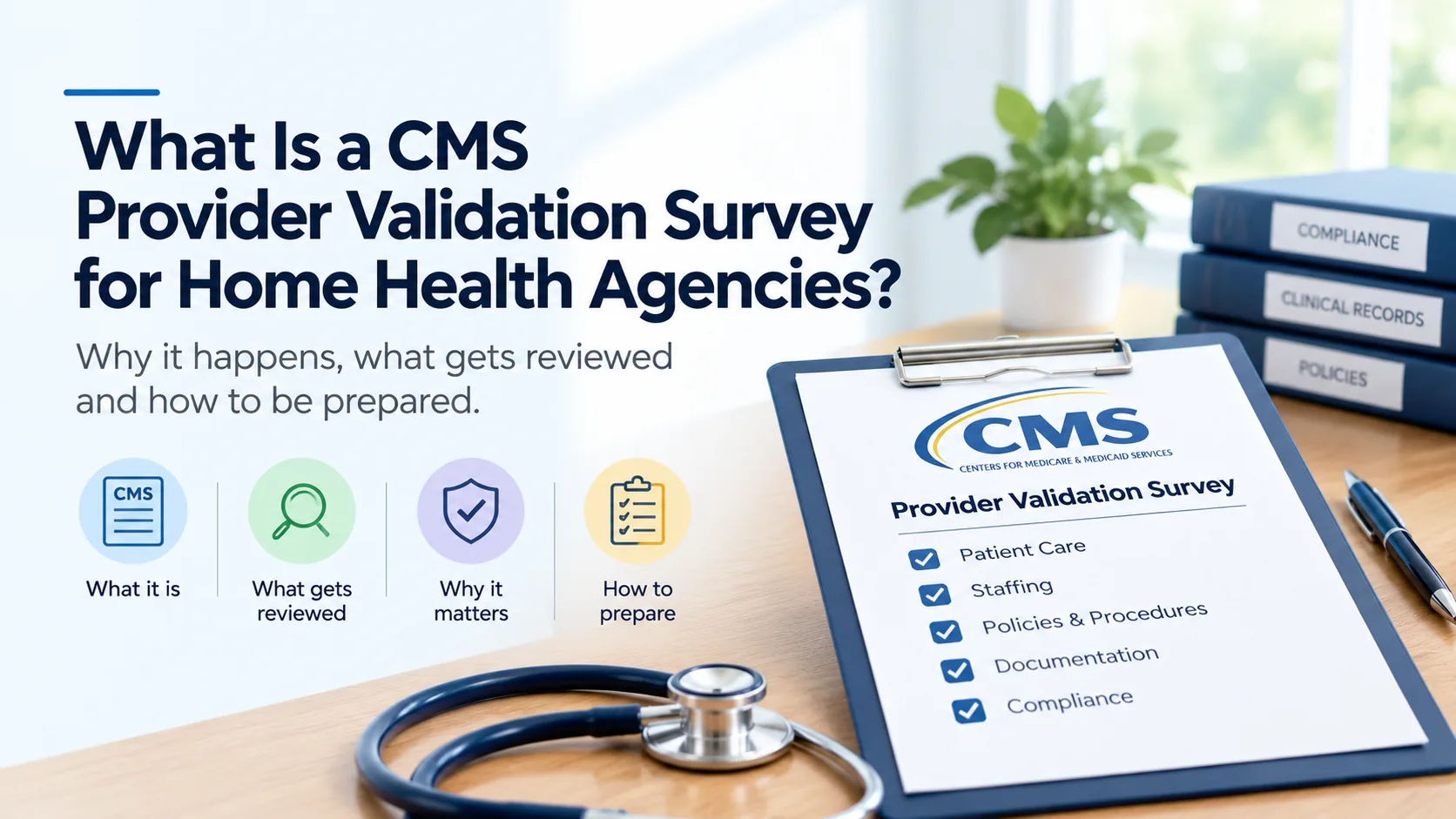
What Is a CMS Provider Validation Survey for Home Health Agencies?
A CMS provider validation survey checks whether a deemed-status home health agency actually meets Medicare health and safety requirements. Here is what CMS reviews and how an HHA can stay ready.
Key Takeaways
- A CMS provider validation survey is a health-and-safety survey of a deemed-status HHA, not a Medicare provider-enrollment site visit.
- CMS uses validation surveys to independently assess compliance and evaluate how effectively approved Accreditation Organizations identify noncompliance.
- Representative sample surveys are full surveys; substantial allegation surveys focus on CMS-authorized conditions related to a credible complaint.
- Validation surveys are unannounced, and traditional sample surveys are generally conducted within 60 calendar days of the accreditation survey end date.
- Surveyors may review OASIS, assessments, plans of care, clinical records, QAPI, infection control, emergency preparedness, personnel, and agency operations.
- Condition-level deficiencies can cause an HHA to lose deemed status and move under State Survey Agency jurisdiction.
✓ Quick answer: A CMS provider validation survey is an unannounced CMS-authorized survey used to determine whether a Medicare-deemed home health agency is actually meeting applicable Medicare health and safety requirements. It also helps CMS evaluate the effectiveness of the accreditation and deemed-status process.
ℹ️ Terminology note: This article covers a CMS/state validation survey of an accredited HHA with deemed status. It is different from a Medicare provider-enrollment site visit, which verifies enrollment information and a provider's reported location. See our separate guide to preparing for a CMS provider enrollment site visit.
What Is a CMS Provider Validation Survey for a Home Health Agency?
A CMS provider validation survey is used to validate whether a Medicare-deemed home health agency is meeting applicable Medicare health and safety requirements.
CMS-approved Accreditation Organizations can survey HHAs and recommend them for deemed status. CMS then recognizes the agency as meeting applicable Medicare participation requirements through the accreditation pathway.
CMS can use validation surveys to assess whether the accreditation process is effectively identifying compliance with Medicare requirements.
For home health agencies, validation surveys follow the applicable HHA survey protocols and Conditions of Participation. CMS explains that HHA surveys determine whether noncompliance should be cited based on applicable statutes, regulations, and observations of the agency's performance or practices.
Why Does CMS Conduct Validation Surveys of Home Health Agencies?
The primary purpose is to evaluate the effectiveness of CMS-approved accreditation programs and independently validate compliance with Medicare requirements.
CMS's State Operations Manual describes representative sample validation surveys as a way to determine whether a provider or supplier deemed compliant through accreditation is, in fact, meeting Medicare health and safety requirements. Accreditation therefore does not place an HHA outside CMS oversight.
→ The oversight path: Accreditation → deemed status → potential CMS/state validation survey
Which Home Health Agencies Can Receive a Validation Survey?
Validation surveys primarily apply to HHAs participating in Medicare through a CMS-approved deemed-status accreditation pathway. CMS recognizes HHAs among its certified deemed programs.
Form CMS-2802C, the authorization form for an HHA validation survey, includes fields identifying whether the agency is currently deemed by ACHC, CHAP, or The Joint Commission.
Is a CMS Validation Survey the Same as a Regular Home Health Survey?
Not exactly. A regular HHA survey may determine compliance with Medicare Conditions of Participation.
A validation survey also serves an oversight purpose: CMS uses it to validate the accreditation and deemed-status process or investigate a substantial allegation involving a deemed provider.
| Validation survey type | Why it happens | Typical scope |
|---|---|---|
| Representative sample | The HHA is selected to evaluate the accreditation process | A full validation survey using Medicare certification-survey protocols |
| Substantial allegation | CMS receives a credible allegation that could support condition-level noncompliance | The CMS-authorized conditions related to the allegation and the agency's current compliance |
What Is a Representative Sample Validation Survey?
A representative sample validation survey is a full survey of a selected deemed HHA. The purpose is broader than investigating one isolated concern.
CMS uses the sample process to determine whether an agency deemed compliant through accreditation is meeting applicable Medicare conditions.
Form CMS-2802C directs the State Survey Agency to conduct a full validation survey for a sample-selected HHA by following the protocols and procedures for a Medicare certification survey. An agency should therefore prepare for a broad review rather than assume only one department or record will be examined.
What Is a Substantial Allegation Validation Survey?
A substantial allegation validation survey follows a credible allegation that, if substantiated, could result in a condition-level deficiency. CMS authorizes the survey and identifies the conditions to assess based on the nature of the complaint.
Form CMS-2802C provides different initiation timeframes depending on whether potential immediate jeopardy is involved. The survey cannot be reduced to reviewing only the record associated with the allegation; the State Survey Agency evaluates the agency's current compliance with each CMS-authorized condition.
When Can a CMS Validation Survey Occur After Accreditation?
For a traditional representative sample validation survey, CMS uses a 60-calendar-day timeframe following the scheduled end date of the Accreditation Organization's survey. Form CMS-2802C directs the State Survey Agency to complete the full survey within that period for the sample-based process.
CMS can also conduct mid-cycle validation surveys that are not tied to a preceding accreditation survey. The 60-day period is not a notice period, and it is not the only circumstance in which validation can occur.
What Does a CMS Validation Surveyor Review?
A validation survey can address the Medicare Conditions of Participation applicable to an HHA. Form CMS-2802C identifies the following review areas:
- Release of patient-identifiable information.
- OASIS data reporting.
- Patient rights.
- Comprehensive patient assessment.
- Care planning, coordination of services, and quality of care.
- Quality Assessment and Performance Improvement (QAPI).
- Infection prevention and control.
- Skilled professional services.
- Home health aide services.
- Emergency preparedness.
- Organization and administration of services.
- Clinical record contents.
- Personnel qualifications.
- Compliance with applicable federal, state, and local laws related to patient health and safety.
The current HHA Interpretive Guidelines in State Operations Manual Appendix B provide surveyors with regulatory language, survey tags, procedures, and probes for evaluating compliance.
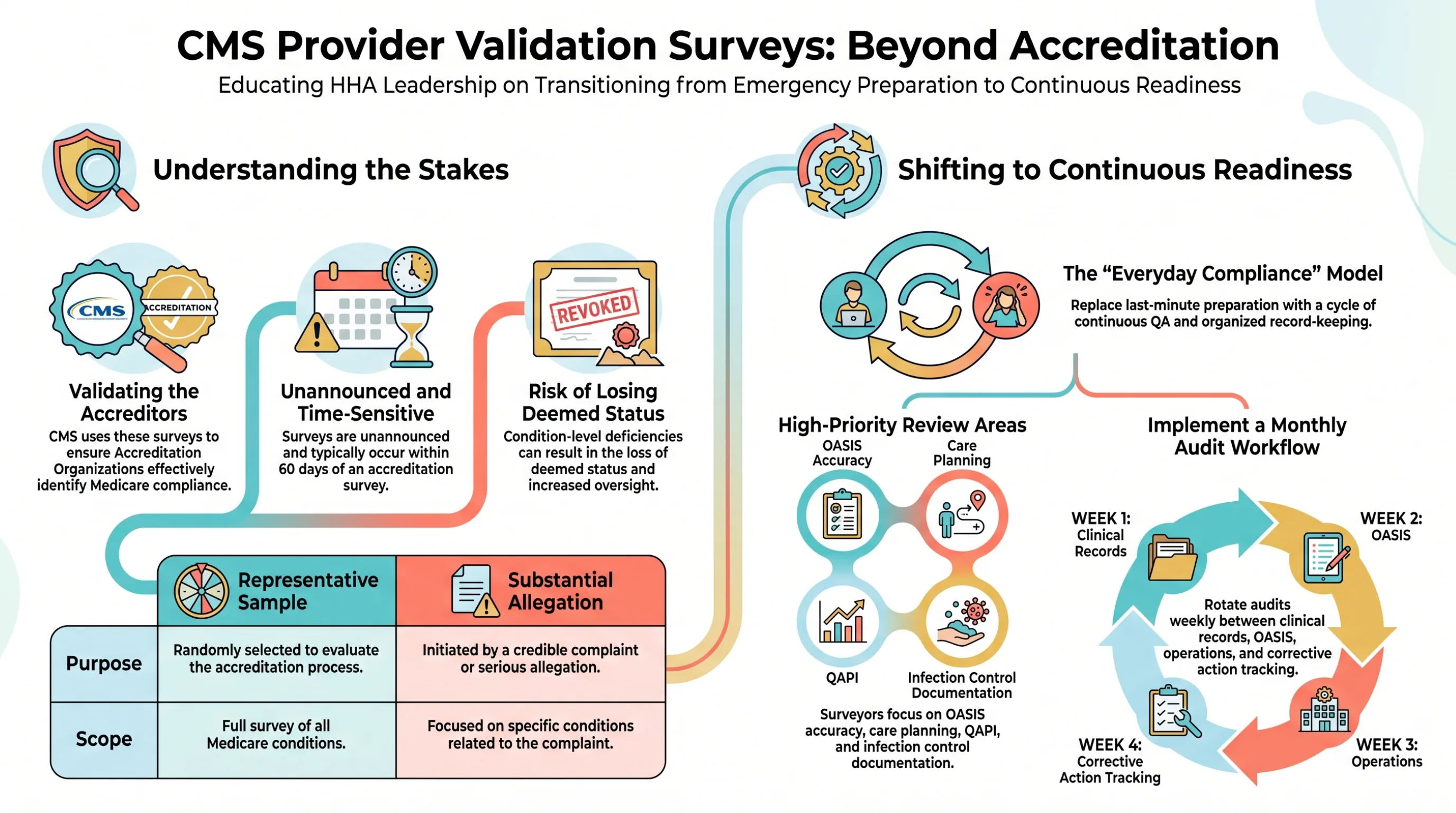
CMS validation surveys test more than accreditation paperwork. Continuous readiness connects clinical records, OASIS, operations, QAPI, infection control, and corrective action tracking.
What Records Can Surveyors Review During a Validation Survey?
The review is not limited to one document type. Depending on the survey scope and applicable requirements, surveyors may evaluate:
- Patient clinical records.
- Comprehensive assessments and OASIS information.
- Plans of care and orders.
- Visit and skilled-service documentation.
- Home health aide documentation.
- Medication-related documentation.
- Care coordination records.
- Patient rights documentation.
- QAPI records.
- Infection prevention and control documentation.
- Emergency preparedness documentation.
- Personnel records.
- Agency policies and procedures.
The central principle is alignment: the agency's actual practices should match its written policies and Medicare requirements. CMS bases HHA deficiencies on violations of statutes or regulations and observations of agency performance or practices.
What Does a Surveyor Look for in Home Health Clinical Records?
Surveyors look for evidence that the agency provides and documents care in accordance with applicable requirements. They may assess whether:
- The patient's assessment supports the plan of care.
- Services are appropriately ordered and provided.
- The clinical record supports skilled services.
- Care is coordinated among relevant providers.
- Required assessments are completed.
- OASIS requirements are followed.
- The record accurately reflects the care provided.
- Patient rights are addressed.
- Required communications occur.
- Staff follow agency policies and procedures.
? A practical review sequence is: What did the agency say it would do? → What did staff actually do? → What does the record show?
Does a CMS Validation Survey Review OASIS Compliance?
Yes. Form CMS-2802C specifically lists §484.45, Reporting OASIS Data, among the HHA survey areas.
Agencies should be ready to demonstrate that their OASIS processes follow applicable CMS requirements.
- Assessment completion.
- Data accuracy and internal consistency.
- Timeliness and transmission.
- Clinical documentation supporting assessment responses.
- Staff responsibilities and competency.
- Quality review.
For a broader explanation of the assessment itself, see What Is OASIS-E in Home Health?.
Can a Validation Survey Result in a Deficiency Citation?
Yes. CMS conducts HHA surveys to determine whether a citation of noncompliance is appropriate.
The level and consequences of a finding depend on the requirement, severity, and CMS survey and enforcement process.
For deemed providers and suppliers, CMS guidance states that one or more condition-level deficiencies identified during a validation survey can cause the provider to lose deemed status and move under State Survey Agency jurisdiction. A validation survey is therefore a substantive compliance event, not simply another accreditation check.
Can a Home Health Agency Lose Deemed Status?
Yes, when the validation process establishes condition-level noncompliance. The exact enforcement path depends on the survey findings and applicable CMS procedures.
- An isolated deficiency.
- Standard-level noncompliance.
- Condition-level noncompliance.
- Immediate jeopardy.
- Corrective action requirements.
These terms have different regulatory implications. Our guide to what happens when a home health or hospice agency fails a survey explains the operational response in more detail.
Are CMS Validation Surveys Announced in Advance?
No. CMS's State Operations Manual states that validation surveys are unannounced.
Survey readiness must therefore be an ongoing operational process, not a project that begins after a notice arrives.
✓ Strong readiness model: Everyday compliance → continuous QA → organized records → staff readiness → survey readiness
How Should an HHA Prepare for a CMS Validation Survey?
The most effective preparation is to build survey readiness into everyday operations. A recurring compliance review should cover the following areas.
Clinical documentation
Review whether records consistently connect the assessment, orders, plan of care, skilled services, patient progress, care coordination, and discharge or transfer information.
OASIS
Check timeliness, completeness, internal consistency, supporting clinical documentation, transmission processes, staff competency, and quality review.
Personnel
Verify that personnel files contain documentation required by applicable regulations and agency processes, and that staff responsibilities match qualifications and job descriptions.
Policies and procedures
Compare written policies with real workflows. A policy that says one thing while staff routinely do something else creates a compliance gap.
QAPI
Make sure the agency can show that quality improvement is active, data-informed, connected to identified issues, and followed through to corrective action.
Infection prevention and emergency preparedness
Review current policies, staff practices, education, documentation, emergency procedures, testing, and evidence that required processes are operational.
Accreditation Survey vs. CMS Validation Survey
| Feature | Accreditation survey | CMS validation survey |
|---|---|---|
| Conducted by | CMS-approved Accreditation Organization | Generally a State Survey Agency under CMS authority |
| Main purpose | Evaluate compliance for accreditation and deemed status | Validate compliance and evaluate the accreditation process |
| Applies to | Agencies seeking or maintaining accreditation | Selected deemed agencies and certain complaint situations |
| Selection | Accreditation cycle and AO process | Representative sample, mid-cycle selection, or substantial allegation |
| Advance notice | Depends on the AO's process | Unannounced |
| Scope | Applicable AO survey standards | Medicare requirements and HHA survey protocols |
| CMS relationship | AO acts under CMS-approved deeming authority | CMS oversight of deemed status and the survey process |
CMS recognizes accreditation as one pathway for demonstrating compliance with Medicare health and safety requirements. State Survey Agencies can still conduct validation surveys of deemed providers.
Does Accreditation Protect an HHA From CMS Oversight?
No. Accreditation through a CMS-approved AO can provide deemed status, but CMS retains oversight of the accreditation process.
The validation program exists specifically to evaluate whether deemed providers meet Medicare requirements and whether the accreditation process identifies noncompliance effectively.
How Can Agencies Make Survey Readiness Continuous?
A practical monthly workflow rotates through high-risk areas while maintaining clear ownership and evidence of follow-through:
- Week 1: Clinical record audit. Review a sample of active and recently discharged patient records.
- Week 2: OASIS and documentation review. Check assessment accuracy, supporting documentation, and workflow consistency.
- Week 3: Operations and compliance review. Review QAPI, infection prevention, emergency preparedness, personnel, and policies.
- Week 4: Corrective action review. Track gaps, assign owners, document corrective actions, and verify completion.
This workflow creates a record of ongoing compliance activity and helps leadership identify recurring operational problems before they become survey findings.
How Can AI Support CMS Validation Survey Readiness?
AI can help compliance and clinical teams find, organize, compare, and review documentation. It can reduce manual work, but it should not independently determine that an agency is compliant.
- Find patient records associated with a requirement.
- Organize clinical documentation chronologically.
- Surface missing or potentially incomplete documentation.
- Identify inconsistencies across notes.
- Compare documentation against internal checklists.
- Organize evidence for QA review.
- Flag records that require human attention.
- Create summaries for internal compliance reviews.
- Track corrective-action documentation.
✓ Responsible workflow: AI surfaces → human reviews → compliance team validates → agency acts
Can Copper AI Help With CMS Survey Readiness?
Copper AI can support the documentation and review work that occurs before a home health survey. A workflow can help an agency select records, organize clinical documentation, surface missing information, identify inconsistencies, route items for review, and document corrective action.
For clinical records, AI can bring together OASIS, visit notes, orders, care plans, medication documentation, discharge documentation, patient information, and other relevant records. The purpose is not to have AI declare an agency survey-ready.
It is to reduce the manual work required to find and review evidence while keeping clinical and compliance professionals in control.
What Should an HHA Do if a Validation Survey Finds a Problem?
The response depends on the nature and severity of the finding. Agencies should:
- Understand exactly which requirement was cited.
- Review the evidence supporting the finding.
- Determine whether the issue is isolated or systemic.
- Identify affected patients, records, or processes.
- Develop the required corrective action.
- Assign responsibility and completion dates.
- Monitor whether the corrective action resolves the underlying problem.
- Incorporate recurring issues into QAPI where appropriate.
The goal is not merely to fix one chart. If a finding reveals a workflow problem, leadership should determine why it occurred and whether the same issue exists elsewhere.
What Is the Key Takeaway?
A CMS provider validation survey is not simply another accreditation survey. It is part of CMS's oversight of Medicare-deemed providers and Accreditation Organizations.
A survey-ready HHA should be able to demonstrate that its policies, workflows, patient care, documentation, and quality processes align with applicable Medicare requirements. Because validation surveys are unannounced, readiness is best treated as an ongoing operational discipline, not a last-minute project.
Official CMS Sources and Further Reading
- CMS Home Health Agency survey and certification guidance.
- Form CMS-2802C: Authorization for State Agency HHA Validation Survey.
- State Operations Manual Appendix B: Guidance to Surveyors for HHAs.
- CMS State Operations Manual.
- CMS Accrediting Organizations and deemed-status programs.
- What happens during a home health survey home visit.
- How to respond to a Medicare ADR.
ℹ️ Disclaimer: This article provides general educational information and is not legal, accreditation, clinical, or compliance advice. Survey scope and applicable requirements can vary. Follow current CMS instructions, your state's requirements, your Accreditation Organization's standards, and qualified professional guidance for your agency's circumstances.
What Should I Document? 100 OASIS Situations Home Health Nurses Face Every Day
100 real OASIS scenarios, worked end to end — clinical situation, common mistake, better approach, and key takeaway. Built around OASIS-E2 (effective April 1, 2026) to turn what you assess into accurate, defensible documentation.
Bottom Line
A CMS provider validation survey independently tests whether a deemed-status home health agency meets Medicare requirements, so the strongest preparation is continuous alignment among policy, practice, patient care, documentation, and quality oversight.
Inside Home Health Podcast
Watch the Podcast: Star Agency or Compliance Disaster? Understanding Home Health Ratings

Arvind Sarin is the founder of Copper Digital. He works inside home health agencies to build AI documentation workflows that help clinicians finish OASIS and visit notes sooner, with a nurse reviewing and approving every note. He writes about home health documentation, Medicare compliance, and applying AI responsibly in clinical workflows.
Frequently asked
Frequently asked questions
It is a CMS-authorized survey used to validate whether a Medicare-deemed home health agency meets applicable Medicare health and safety requirements and to evaluate the effectiveness of the accreditation and deemed-status process.
Join the conversation
Leave a comment
No comments yet. Be the first to share your thoughts.
Related reading
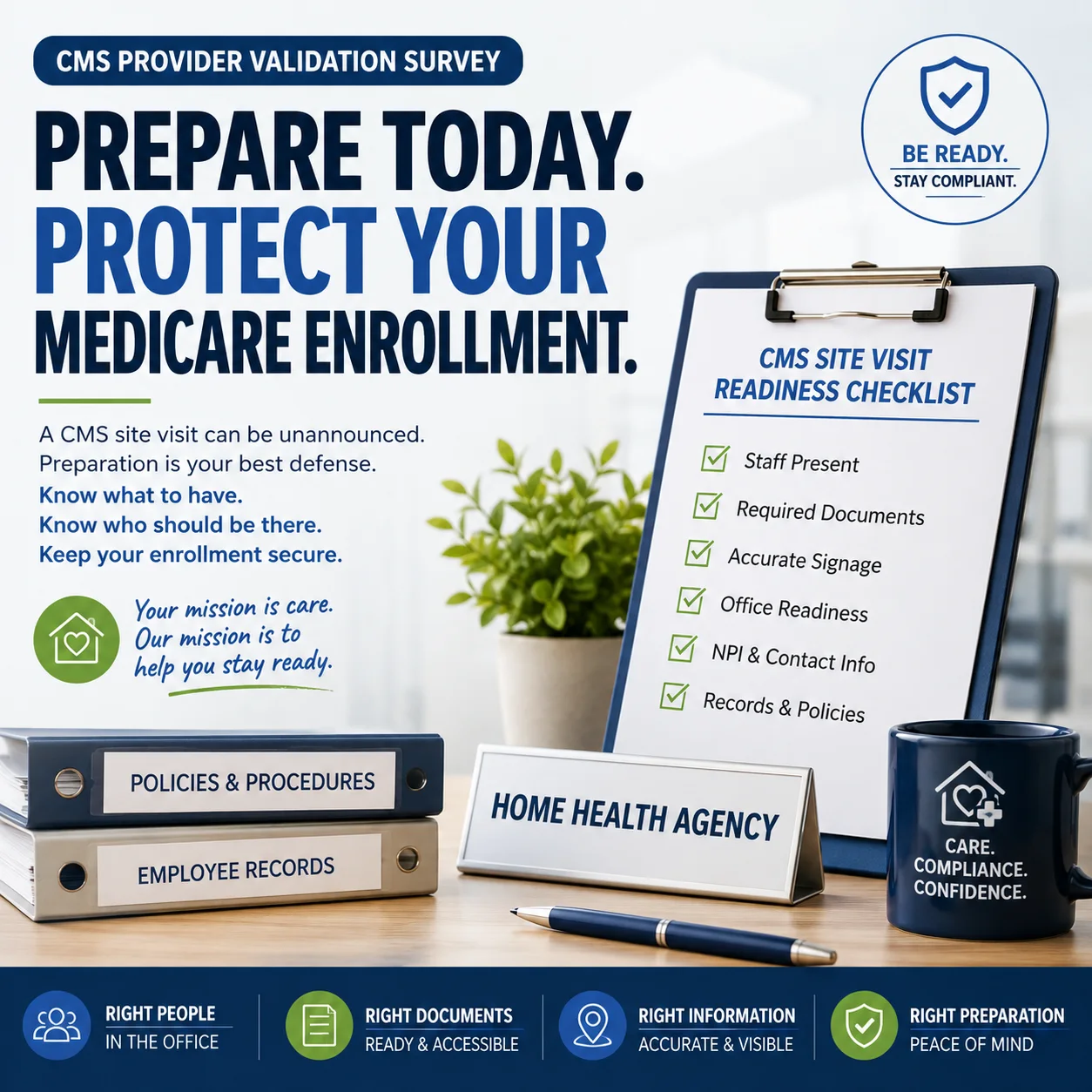
How Should Medicare Home Health Agencies Prepare for a CMS Provider Validation Survey?
A CMS provider enrollment site visit may be unannounced. Prepare your people, office, records, signage, and enrollment information before an inspector arrives.

What Really Happens During a Survey Home Visit for Home Health?
A home health survey visit lets a surveyor observe care in the patient's home and compare real-world practice with the plan of care, clinical record, agency policies, and Medicare requirements.
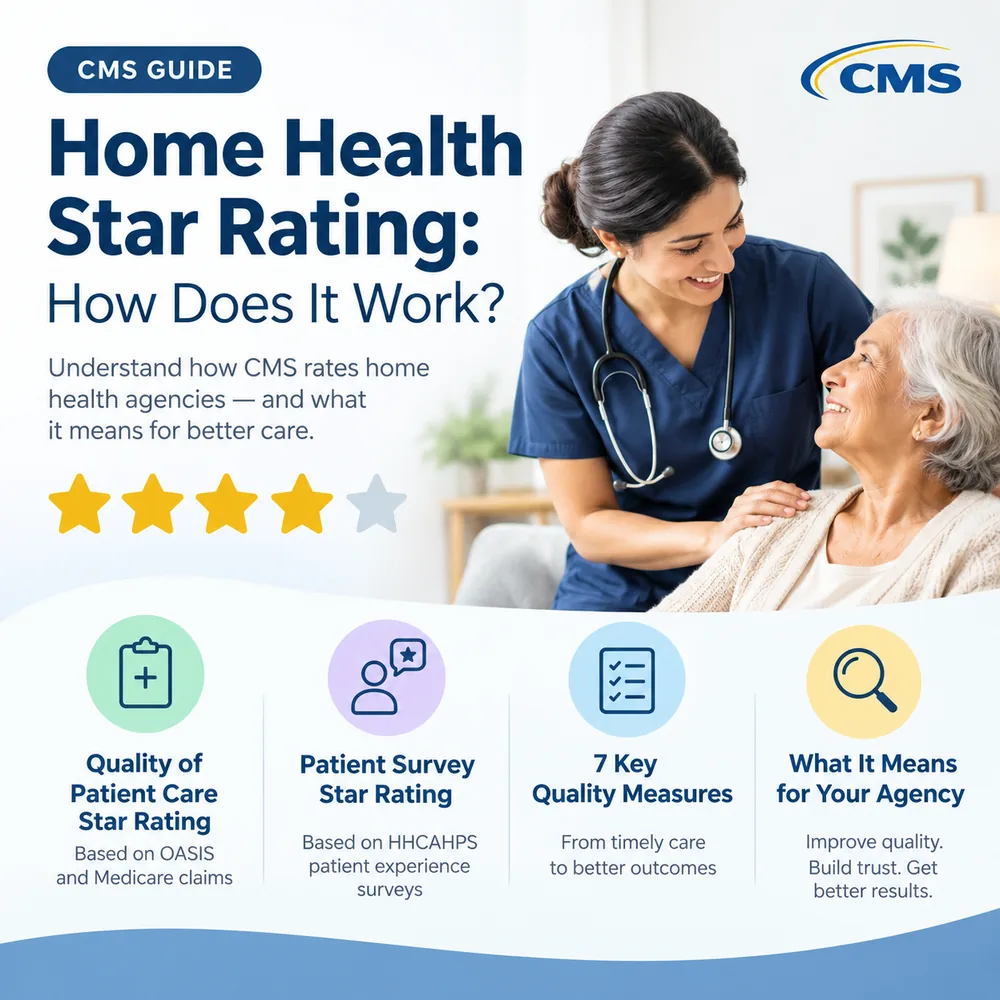
Home Health Star Rating: How Does It Work?
CMS publishes two separate Home Health Star Ratings on Care Compare. Learn what each rating measures, how OASIS and HHCAHPS affect the scores, and what agencies can improve.