
Home Health Documentation Templates With Examples
A complete guide to home health documentation templates, with practical examples for skilled nursing visits, OASIS, SOC, ROC, recertification, wounds, medications, care plans, and compliance.
Key Takeaways
- Use a template to guide the note. Keep each patient's story unique.
- Show the condition, skilled care, response, change, and next step.
- Use a separate layout for SOC, ROC, recertification, discharge, wounds, medicines, and each discipline.
- Write what you saw. Avoid vague phrases such as 'patient stable' or 'education provided.'
- AI can draft and organize the note. A clinician must check every record.
Home health documentation is more than completing a form after a patient visit. It creates the clinical record of what was assessed, what care was provided, how the patient responded, and what needs to happen next.
For home health nurses, therapists, aides, clinicians, and agency leaders, well-designed home health documentation templates can make this process more structured and consistent while helping care teams communicate effectively.
A useful template can organize patient information, assessments, care plans, medications, vital signs, interventions, patient education, and follow-up information in one place.
📋 A template should standardize the documentation process, not standardize the patient's story. Every note still needs to reflect the patient's actual condition, services provided, clinical findings, response to treatment, and changes from previous visits.
This guide explains what home health documentation templates should contain and provides practical examples for common workflows, including skilled nursing visits, OASIS, wounds, medications, care plans, and discharge.
Quick Answer: What Is a Home Health Documentation Template?
A home health documentation template is a structured framework used by home health professionals to document patient assessments, interventions, medications, education, care coordination, progress, and follow-up during care delivered in the patient's home.
A comprehensive template may include:
- Patient and visit information.
- Initial or ongoing assessment.
- Vital signs, symptoms, and clinical findings.
- Medication information.
- Skilled interventions and patient response.
- Patient and caregiver education.
- Care-plan goals.
- Communication with providers.
- Changes in condition and follow-up plans.
- Required legal and compliance information.
Patient assessment, care plans, medication management, vital signs, nursing interventions, provider communication, incident reporting, and compliance documentation are core components of a useful clinical record.
Why Are Home Health Documentation Templates Important?
Home health clinicians have to document care while also managing patient needs in an environment that is less controlled than a hospital or clinic. A structured template can reduce the risk of leaving important information out and give the care team a consistent framework for recording patient information.
Standardized documentation supports continuity of care and communication between healthcare professionals. For example, documenting wound care and medication response in a consistent format allows another provider to understand the patient's progress without searching through disorganized notes.
Templates can help agencies:
- Improve documentation consistency.
- Organize clinical information.
- Reduce repetitive manual work.
- Improve communication between clinicians.
- Track patient progress and support care-plan updates.
- Identify missing information.
- Create a more standardized workflow.
- Support applicable regulatory and payer requirements.
However, templates should always be used as a framework rather than a substitute for clinical judgment.
What Should Be Included in a Home Health Documentation Template?
A strong template should make it easy for clinicians to document what happened, why it happened, what was done, what the patient experienced, and what happens next.
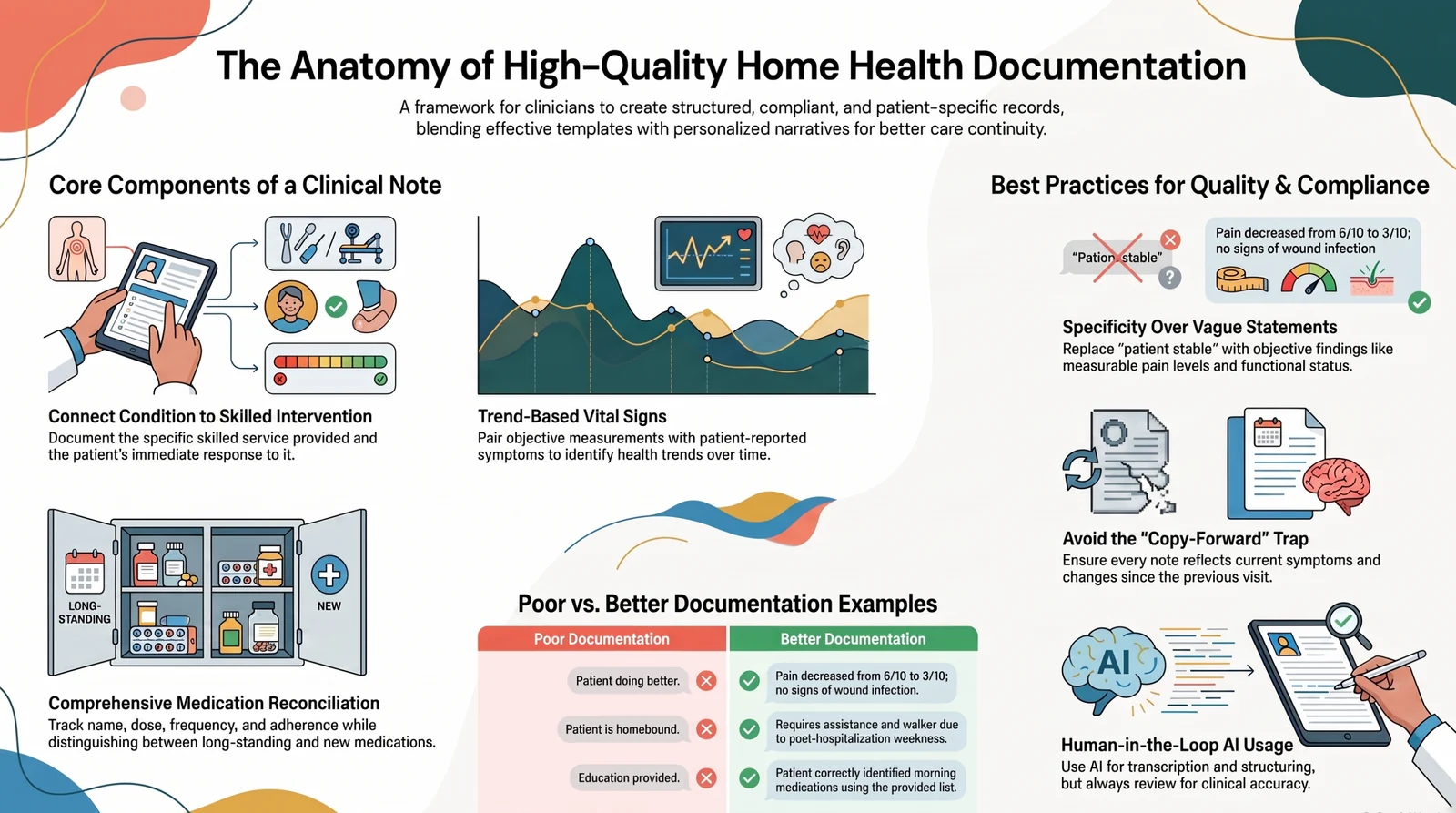
High-quality documentation combines a consistent structure with objective findings, patient-specific context, and human clinical review.
1. Patient Information and Initial Assessment
The first section should establish who the patient is and provide the clinical context for the visit. Depending on the document and agency workflow, this may include patient name, date of birth, relevant contact information, emergency contact, medical history, primary and secondary diagnoses, current clinical concerns, home environment, baseline functional status, and relevant assessment findings.
Example: Patient alert and oriented. Reports increased fatigue over the past three days.
Ambulation remains at baseline with walker. No new falls reported.
Patient reports increased difficulty managing medications independently.
This is more useful than Patient stable because it gives the next clinician information they can act on.
2. Care Plan and Treatment Goals
A documentation template should connect the patient's current condition to the care plan. Include identified problems, short- and long-term goals, planned interventions, patient-specific needs, caregiver involvement, progress toward goals, and changes requiring care-plan modification.
Example: Problem: Reduced mobility following hospitalization. Goal: Patient will safely ambulate from bedroom to bathroom using prescribed assistive device with appropriate assistance.
Intervention: Nurse reinforces fall-prevention strategies and reviews safe use of walker. Response: Patient correctly demonstrates walker positioning and verbalizes two fall-prevention strategies.
3. Medication Documentation and Reconciliation
Medication documentation is one of the most important components of home health documentation. A medication section may include medication name, dose, route, frequency, indication, recent changes, adherence, side effects, patient or caregiver understanding, discrepancies, and provider notification.
Templates can distinguish between medications the patient has taken consistently and those recently started or changed. For a long-standing medication, document current use, response, adherence, and recurring concerns.
For a new medication, capture the change, clinical context, relevant monitoring, education, and patient or caregiver understanding. See the complete guide to long-standing vs. new medication documentation.
4. Vital Signs and Symptom Tracking
Common fields include blood pressure, heart rate, respiratory rate, temperature, oxygen saturation, pain, weight when clinically relevant, blood glucose when applicable, and other patient-specific measurements. Simply recording numbers is not always enough; documentation should help clinicians recognize changes and trends over time.
Example: Previous visit: BP 128/76. Current visit: BP 154/88.
Patient reports new headache beginning this morning. The combination of objective findings and patient-reported symptoms provides more clinical context than vitals normal.
5. Skilled Nursing Visit Documentation
A skilled nursing visit note should clearly describe the reason for the visit and the skilled services provided.
| Section | What to document |
|---|---|
| Visit information | Date, visit type, reason for visit, relevant diagnosis |
| Assessment | General condition, vital signs, respiratory and cardiovascular findings, pain, skin or wound findings, functional status, relevant symptoms |
| Skilled intervention | Wound care, medication management, IV therapy, catheter care, disease-management education, assessment and monitoring, other skilled services |
| Patient response | Tolerance, understanding, return demonstration, symptoms following intervention, progress toward goals |
| Plan | Next visit, continued interventions, follow-up, and provider communication when necessary |
6. OASIS Documentation
For Medicare-certified home health agencies, OASIS documentation is a major component of the clinical and payment workflow. Templates used around OASIS should help clinicians organize the information required for Start of Care (SOC), Resumption of Care (ROC), recertification, discharge, and other applicable assessments.
⚠️ An OASIS assessment is not simply another visit note. OASIS captures standardized assessment information, while visit documentation describes the care delivered during a particular encounter. A documentation system should support both without treating them as interchangeable.
Use templates to organize OASIS-related documentation, but always follow applicable CMS requirements, assessment guidance, and the current OASIS manual.
7. Start of Care (SOC) Documentation Template
The Start of Care establishes the patient's baseline and begins the home health episode. A SOC framework may include referral information, diagnoses, reason for home health, medical history, medication reconciliation, functional assessment, home environment, safety risks, patient or caregiver support, skilled needs, initial goals, care-plan information, OASIS assessment information, and provider communication.
The SOC record should create a clear picture of why the patient requires home health and what the agency plans to accomplish.
8. Resumption of Care (ROC) Documentation
A Resumption of Care occurs when home health services resume after an interruption such as hospitalization, when applicable. Documentation should focus on what changed since the previous episode or assessment: reason for interruption, new diagnoses, medication and symptom changes, functional changes, new wounds, changes in caregiver support or the care plan, new orders, and follow-up requirements.
The key is to document the current patient status rather than simply copying information from the earlier episode.
9. Recertification Documentation
Recertification documentation should demonstrate the patient's ongoing needs and the rationale for continued services, consistent with applicable requirements. A template can organize current condition, progress toward goals, remaining deficits, ongoing skilled needs, changes in condition, continued interventions, updated goals, provider communication, and the updated plan of care.
What was the patient's condition? → What has changed? → What remains unresolved? → Why is continued care needed?
10. Discharge Documentation
A home health discharge template can summarize the reason for discharge, current condition, goals achieved or partially achieved, remaining needs, medication status, education, follow-up recommendations, referrals, provider communication, and discharge instructions. A good discharge note should help another clinician understand what happened during the episode and what the patient needs after home health services end.
11. Wound Care Documentation Template
Wound care requires detailed, consistent documentation because wound characteristics can change significantly between visits. A template can include wound location, type or etiology, length, width, depth, wound bed, drainage, odor, periwound condition, pain, signs of infection, dressing or treatment, patient tolerance, education, change from the previous assessment, and provider notification when appropriate.
Example: Wound: Right lower leg. Measurements: 2.0 cm × 1.5 cm × 0.2 cm.
Drainage: Small amount of serous drainage. Periwound: Mild erythema; no increased warmth noted.
Intervention: Dressing changed according to plan of care. Response: Patient tolerated procedure without difficulty.
This provides considerably more clinical information than Wound looks better.
12. Medication Reconciliation Documentation Template
Medication reconciliation should provide a structured way to identify discrepancies and document medication changes.
| Field | Documentation |
|---|---|
| Medication | Name |
| Dose | Current prescribed dose |
| Route | Oral, topical, etc. |
| Frequency | Prescribed frequency |
| Indication | Reason for medication |
| Status | Current, new, or discontinued |
| Adherence | Whether the patient is taking it as prescribed |
| Side effects | Patient-reported effects |
| Education | Education provided |
| Discrepancy | Any discrepancy identified |
| Follow-up | Provider notified and action taken |
13. Patient Education Documentation
Patient education should document more than the fact that education provided. Consider the topic taught, information provided, patient or caregiver understanding, questions asked, return demonstration where applicable, barriers to understanding, and follow-up education needed.
Weak: Education provided regarding medications.
Stronger: Reviewed medication schedule with patient and caregiver. Patient correctly identified morning and evening medications using medication list.
Caregiver verbalized understanding of dosing schedule. Reinforcement planned at next visit.
14. Care Plan Documentation
The care plan should connect the patient's problems, goals, interventions, and expected outcomes. A simple structure is: Problem → Goal → Intervention → Frequency → Expected Outcome → Progress. This makes the documentation easier for multiple members of the care team to understand and follow.
15. Homebound Status Documentation
For applicable Medicare home health cases, documentation should support the patient's homebound status using patient-specific facts. Avoid relying on vague statements such as Patient is homebound.
Example: Patient requires assistance and an assistive device to leave the residence because of impaired mobility and weakness following recent hospitalization. The exact documentation should reflect the patient's actual circumstances and applicable payer requirements.
16. Medical Necessity and Skilled Need
One of the most important questions documentation should answer is: Why was skilled home health care necessary for this patient? A useful structure is: Patient condition → Skilled need → Intervention → Patient response → Ongoing need or plan.
Example: Condition: Patient has difficulty independently managing a newly prescribed medication regimen. Skilled need: Nursing assessment and medication-management education required.
Intervention: Nurse reviewed medication schedule and identified discrepancy between discharge instructions and medication bottle. Response: Patient and caregiver verbalized understanding after reconciliation.
Plan: Continue medication-management monitoring and follow up regarding provider clarification.
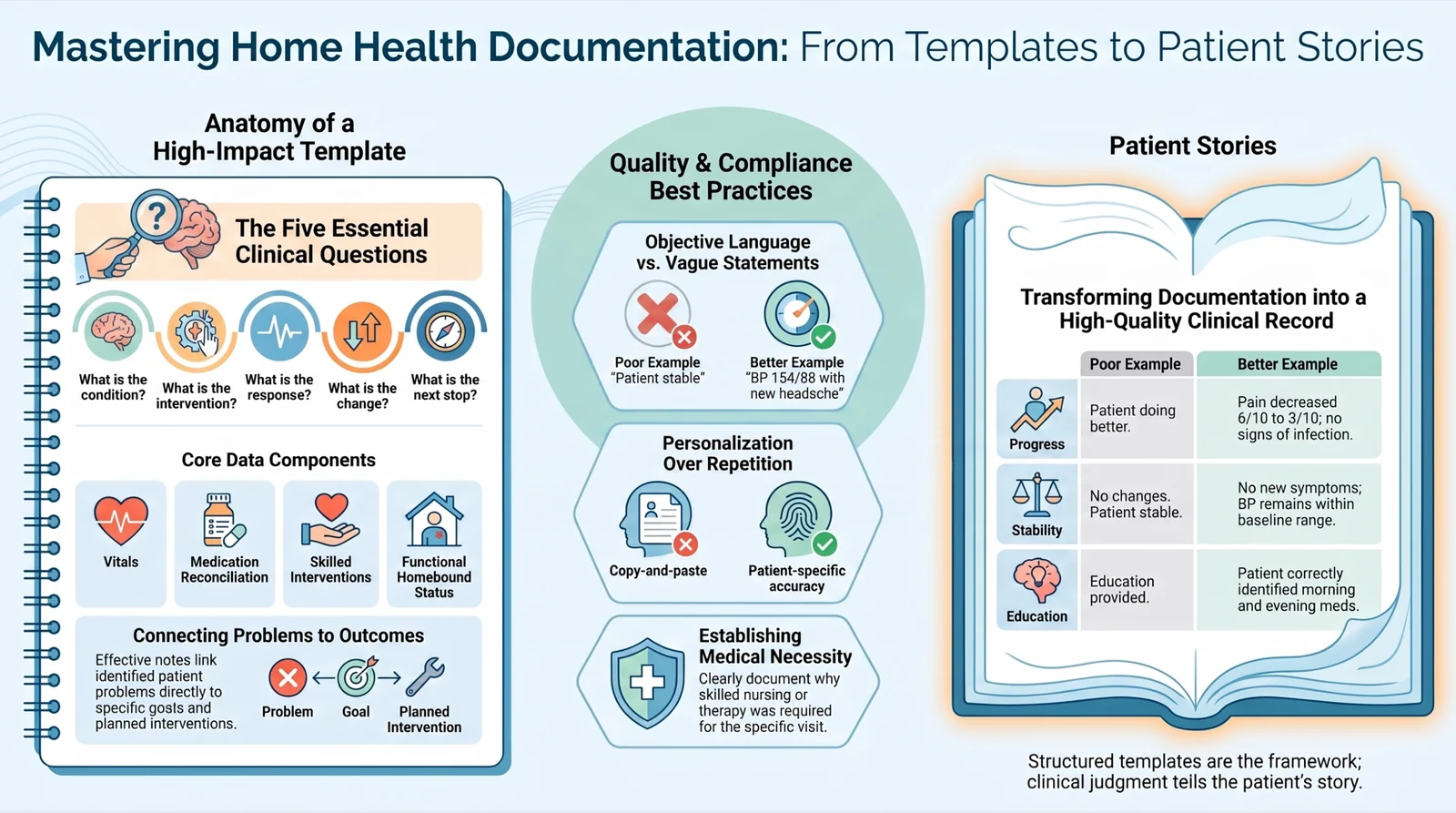
Structured templates are the framework; clinical judgment tells the patient's story.
17. Documentation by Discipline
Different disciplines require different documentation structures. A single generic template may not work equally well for every discipline.
| Discipline | Common documentation areas |
|---|---|
| Skilled Nursing | Assessment, medications, wounds, disease management, skilled interventions |
| Physical Therapy | Mobility, strength, gait, balance, therapeutic interventions, progress |
| Occupational Therapy | ADLs, functional limitations, adaptive strategies, interventions |
| Speech-Language Pathology | Communication, cognition, swallowing, treatment response |
| Home Health Aide | Personal care, ADLs, observations, changes reported |
| Medical Social Work | Psychosocial needs, resources, counseling, care coordination |
18. Incident Documentation
Home health agencies may need specific documentation for falls, medication-related incidents, adverse reactions, injuries, changes in condition, and safety events. Document what happened and when, what was observed, the patient's condition, immediate actions, who was notified, follow-up actions, and preventive measures when applicable.
19. Communication and Care Coordination
Home health care frequently involves communication among nurses, physicians, therapists, caregivers, specialists, and other professionals. A communication section should capture who was contacted, date and time, reason, information communicated, orders or recommendations received, follow-up required, and the responsible party.
20. Legal, Privacy, and Compliance Documentation
Documentation templates may contain fields related to consent, patient rights, privacy, HIPAA-related processes, required acknowledgments, signatures, dates and times, and other applicable regulatory requirements.
21. Good Documentation vs. Poor Documentation: Examples
One of the easiest ways to improve documentation is to replace vague statements with specific observations.
| Area | Poor documentation | Better documentation |
|---|---|---|
| Patient progress | Patient doing better. | Patient reports pain decreased from 6/10 to 3/10 following medication. No visible signs of infection at wound site. Dressing intact. |
| Patient stability | No changes. Patient stable. | No new symptoms reported. BP remains within patient's recent baseline range. Ambulation unchanged from previous visit. |
| Education | Education provided. | Patient correctly identified morning and evening medications using the medication list. |
22. Avoid Copy-and-Paste Documentation
Templates can save time, but copy-forward documentation can create its own risks. A template should make documentation easier to personalize, not easier to duplicate.
Before signing a note, verify current symptoms, vital signs, medications, wound status, interventions, response, changes since the previous visit, current care plan, and provider communication.
If a patient's condition changes, the documentation should change with it. Copy-forward errors are among the top documentation errors in home health.
23. Best Practices for Using Home Health Documentation Templates
Customize templates for the patient
No two patients are identical. A template should allow clinicians to add patient-specific information and specialized fields when necessary.
For example, a nurse caring for a patient with Parkinson's disease may need additional fields for tremors, mobility, and functional changes.
Avoid unnecessary repetition
Templates can use structured fields for routine information while leaving space for meaningful clinical observations. The goal isn't to document more; the goal is to document what matters.
Use objective language
Document measurable findings whenever possible. Instead of Patient appears worse, use *Patient reports increased shortness of breath with ambulation compared with previous visit.
Respiratory rate increased from previous documented baseline.*
Make the template easy to complete
If a template requires excessive scrolling, repetitive typing, or unnecessary fields, clinicians may spend more time fighting the system than documenting care. Templates should fit the actual workflow.
24. AI and Digital Home Health Documentation Templates
Digital tools and AI can help streamline documentation through auto-populated fields, suggested phrasing, and speech-to-text. A digital workflow can capture information through voice, convert speech to text, structure information into templates, identify missing information, reduce repetitive typing, generate draft documentation, and standardize note structure.
AI-generated documentation should not be treated as automatically correct. A clinician should review the record for accuracy, completeness, clinical context, patient-specific details, incorrect assumptions, missing information, appropriate terminology, and consistency with the care actually provided.
🤝 AI should assist documentation, not replace clinical judgment. Learn why human-in-the-loop oversight matters for clinical documentation and compare an AI documentation agent with an ambient scribe.
25. What Are the Most Common Types of Home Health Documentation Templates?
| Template | Primary use |
|---|---|
| Home Health Nurse Documentation Template | Patient visits, assessments, physical findings, and medication-related information |
| Home Care Narrative Documentation Template | Patient information, medications, allergies, history, home environment, assessment, and plan of care |
| Medication Administration Record (MAR) | Medication administration tracking |
| Wound Care Documentation Template | Wound characteristics, treatment, and response |
| ADL Documentation Template | Activities of daily living and functional support |
| Nursing Progress Note | Patient status, interventions, progress, and ongoing care |
Free Home Health Documentation Template Checklist
Use this basic checklist as a framework, then customize it for the patient, discipline, payer, and agency workflow.
Patient and Visit Information
- Patient name and date of birth.
- Relevant contact information and emergency contact.
- Date and visit type.
- Reason for visit.
Assessment
- General condition.
- Vital signs.
- Symptoms.
- Physical findings.
- Functional status.
Medications
- Name, dose, route, and frequency.
- Changes.
- Adherence.
- Side effects.
Skilled Intervention and Education
- Intervention performed.
- Clinical rationale.
- Patient response.
- Topic and education provided.
- Patient or caregiver understanding.
- Return demonstration when applicable.
Care Coordination and Plan
- Provider communication.
- Orders and referrals.
- Next visit.
- Ongoing interventions and goals.
- Follow-up needs.
📘 Free resource: Go deeper with the Home Health Documentation Playbook, a 232-page guide to OASIS-E, Medicare compliance, PDGM, and AI-assisted documentation, with 150+ point-of-care checklists.
Final Takeaway
A good home health documentation template should do more than provide blank fields. It should help clinicians answer five fundamental questions:
- What is the patient's current condition?
- What skilled care was provided?
- How did the patient respond?
- What changed since the previous visit?
- What needs to happen next?
The best templates balance standardization with personalization. They make routine documentation easier while preserving the clinical details that matter.
Digital and AI-enabled documentation can further reduce manual work through voice capture, transcription, structured templates, and missing-information checks. But technology should remain an assistant.
The clinician's assessment, judgment, review, and final approval remain central to producing an accurate clinical record.
🎓 Go deeper with peers. Join the Home Health Mastermind Skool community for practical training on documentation workflows, OASIS accuracy, compliance, and reducing charting burden without sacrificing clinical quality.
Why Trust Our Experts?
Home health documentation sits at the intersection of clinical care, compliance, reimbursement, and operational workflows. Content on this topic should be reviewed against current payer and regulatory guidance before being used to make operational or clinical decisions.
For agency leaders, the goal isn't simply to create more documentation. It is to create accurate, patient-specific, timely, and clinically meaningful documentation that supports the care actually delivered.
- Clinically informed: Focused on real-world home health documentation workflows.
- Compliance-aware: Regulatory and payer requirements should always be checked against current official guidance.
- Patient-specific: Templates should structure documentation without encouraging generic copy-and-paste notes.
- Human-reviewed: AI-assisted documentation should be reviewed by the responsible clinician before finalization.
- Educational: This content is intended to educate, not replace clinical, coding, billing, legal, or compliance advice.
ℹ️ Disclaimer: This article is for educational and informational purposes only. Home health documentation requirements can vary based on patient circumstances, discipline, payer, state requirements, agency policies, and applicable federal regulations. Always verify current requirements with the appropriate payer, CMS guidance, OASIS instructions, and regulatory authorities before relying on a template for clinical, billing, or compliance purposes.
What Should I Document? 100 OASIS Situations Home Health Nurses Face Every Day
100 real OASIS scenarios, worked end to end — clinical situation, common mistake, better approach, and key takeaway. Built around OASIS-E2 (effective April 1, 2026) to turn what you assess into accurate, defensible documentation.
Bottom Line
A strong template makes routine work easier. It still shows what changed, what skilled care was given, how the patient responded, and what happens next.

Arvind Sarin is the founder of Copper Digital. For the past year he has spent three days a week inside a 500+ census Texas home health agency, building AI documentation that finishes OASIS and visit notes the same day, with a nurse reviewing and approving every note. He writes about home health documentation, OASIS, Medicare compliance, and applying AI responsibly in clinical workflows.
Frequently asked
Frequently asked questions
A home health documentation template is a structured form or framework used to organize clinical information from care delivered in the patient's home. It can include patient information, assessments, medications, interventions, care plans, education, and follow-up.
Join the conversation
Leave a comment
No comments yet. Be the first to share your thoughts.
Related reading
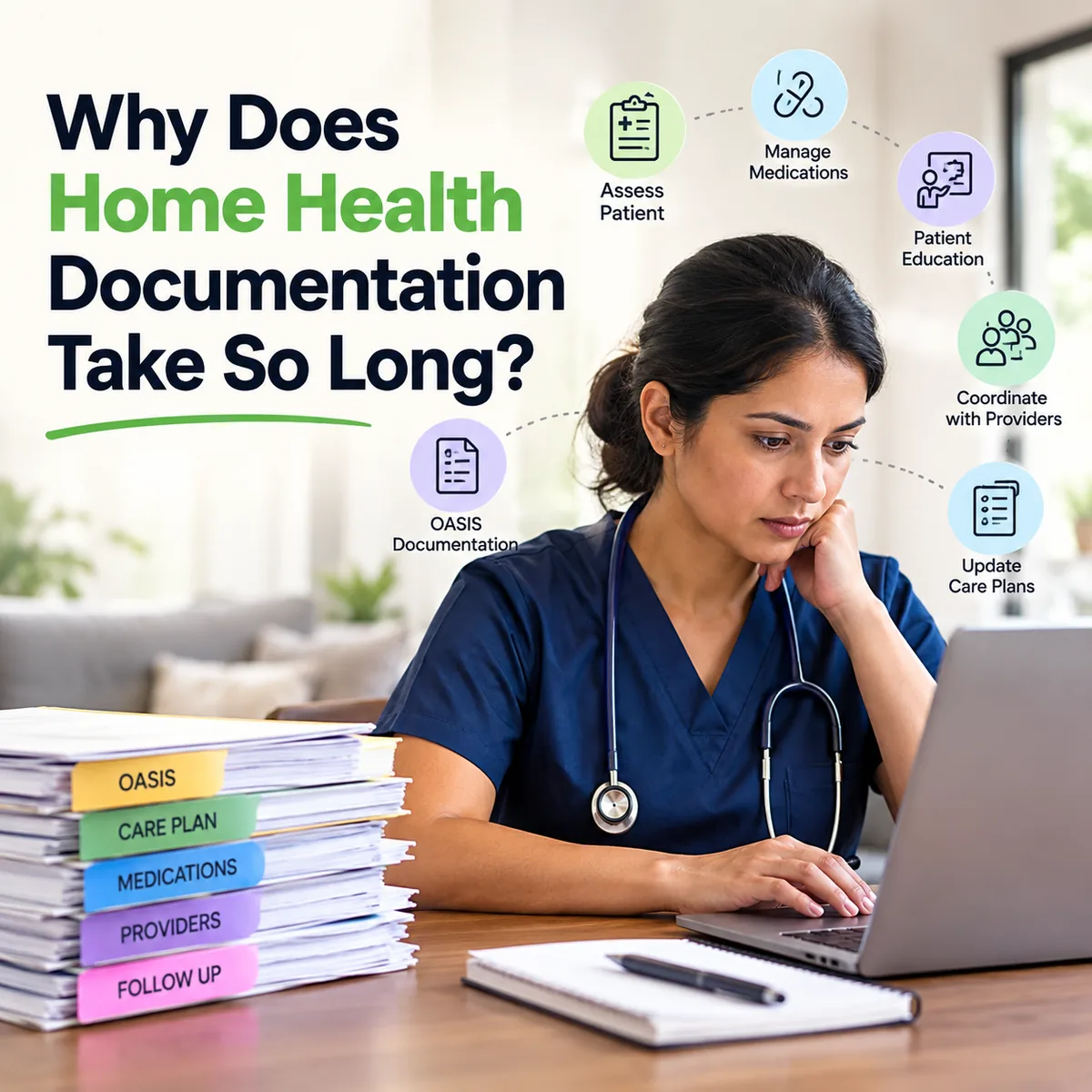
Why Does Home Health Documentation Take So Long?
Home health nurses don't just document a visit. They assess, manage medications, educate, coordinate, update care plans, and complete OASIS, then document it all. Documentation takes so long because it's spread across an entire workflow, where information is captured, checked, entered, updated, and sometimes entered again.
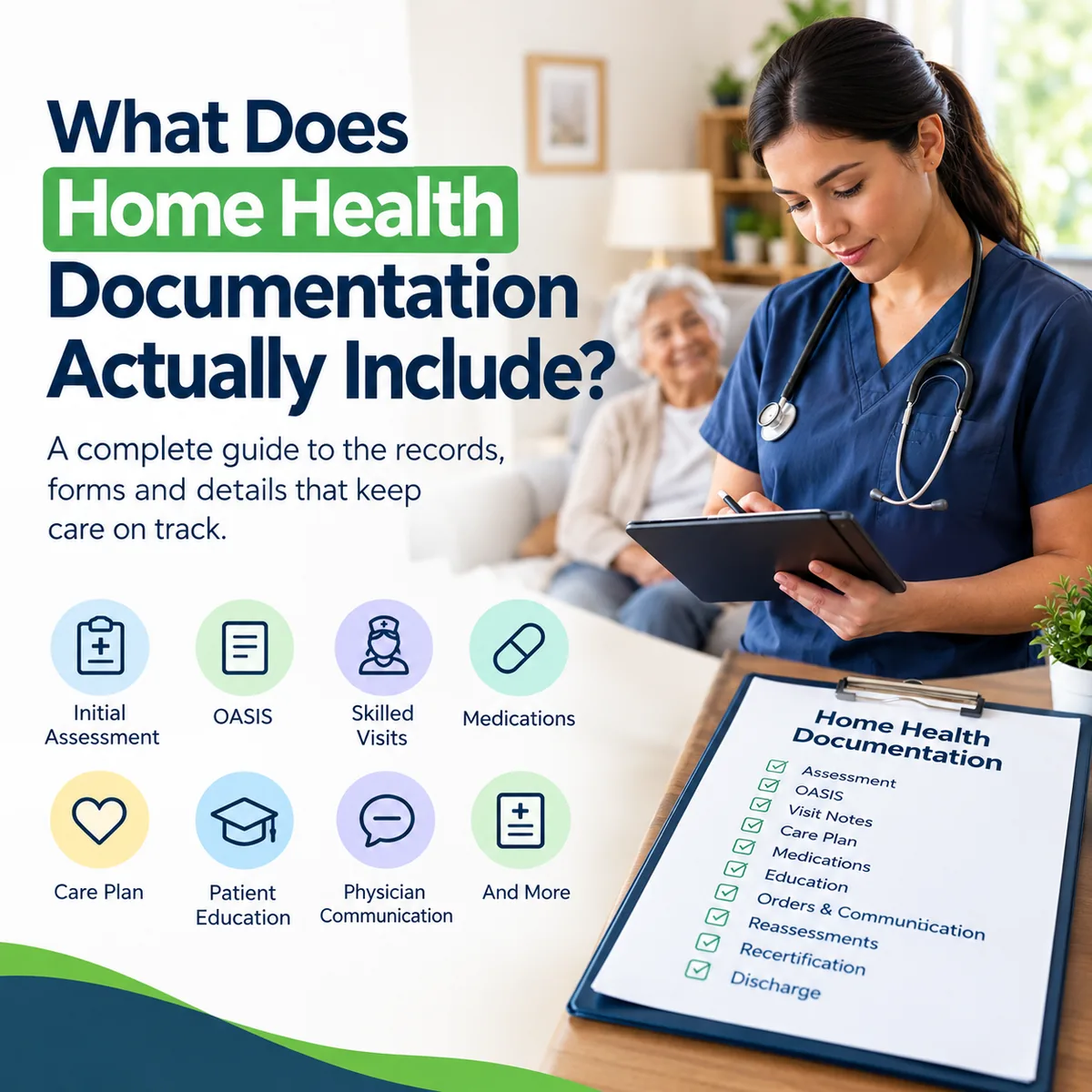
What Does Home Health Documentation Actually Include?
Home health documentation is much more than a visit note. Across an episode it spans the initial assessment, OASIS, skilled visits, medications, the care plan, education, physician communication, orders, reassessments, recertification, and discharge: each piece is part of the patient's larger story of care.
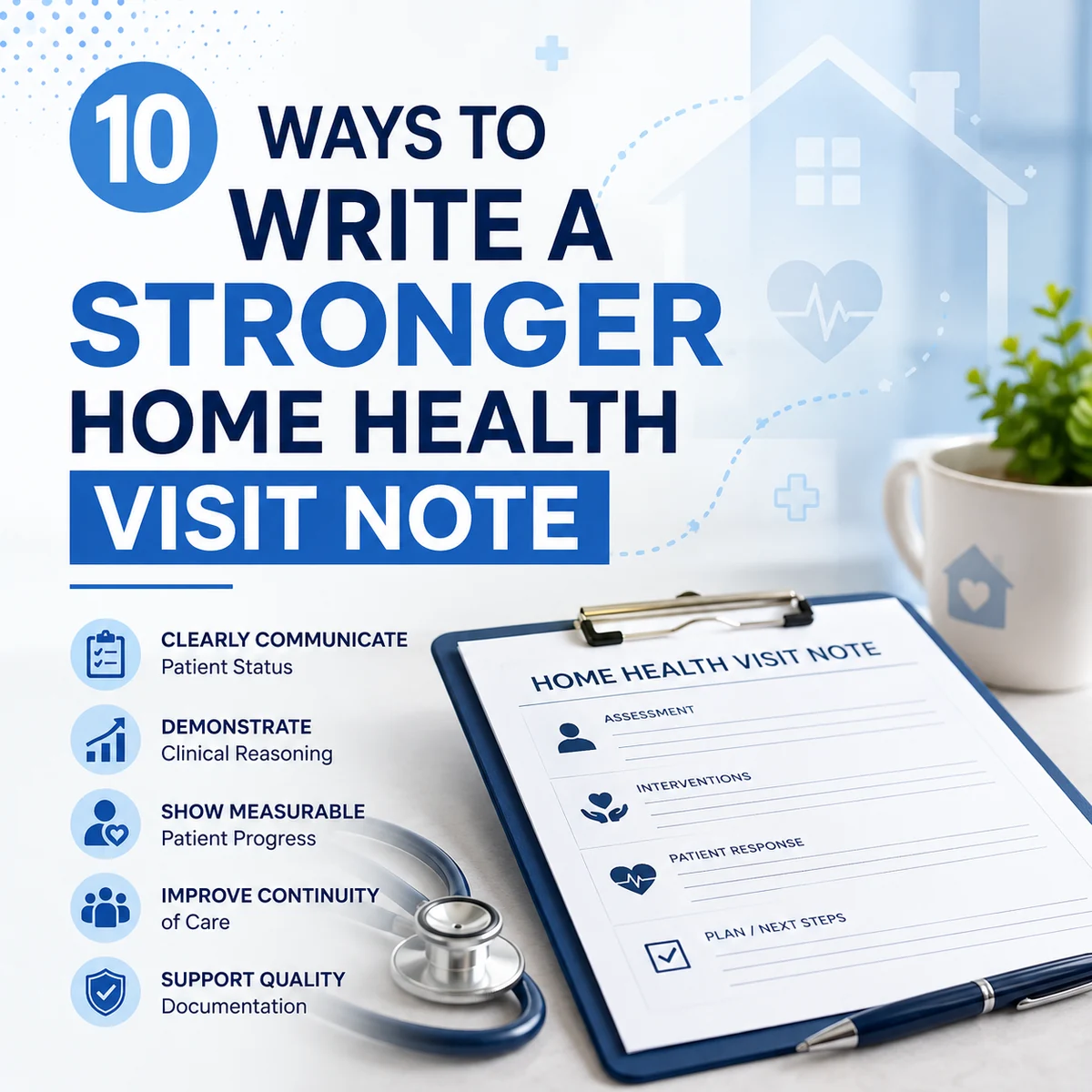
10 Ways to Write a Stronger Home Health Visit Note
A strong home health visit note creates a clear clinical narrative, what was assessed, what changed, what skilled care was provided and why, how the patient responded, and what happens next, not just a record that a task was completed. This guide gives 10 practical ways to write stronger notes, weak-vs-strong examples across nursing, therapy, and education, common mistakes to avoid, and a simple Assess → Interpret → Intervene → Evaluate → Plan framework.