
Why Does Home Health Documentation Take So Long?
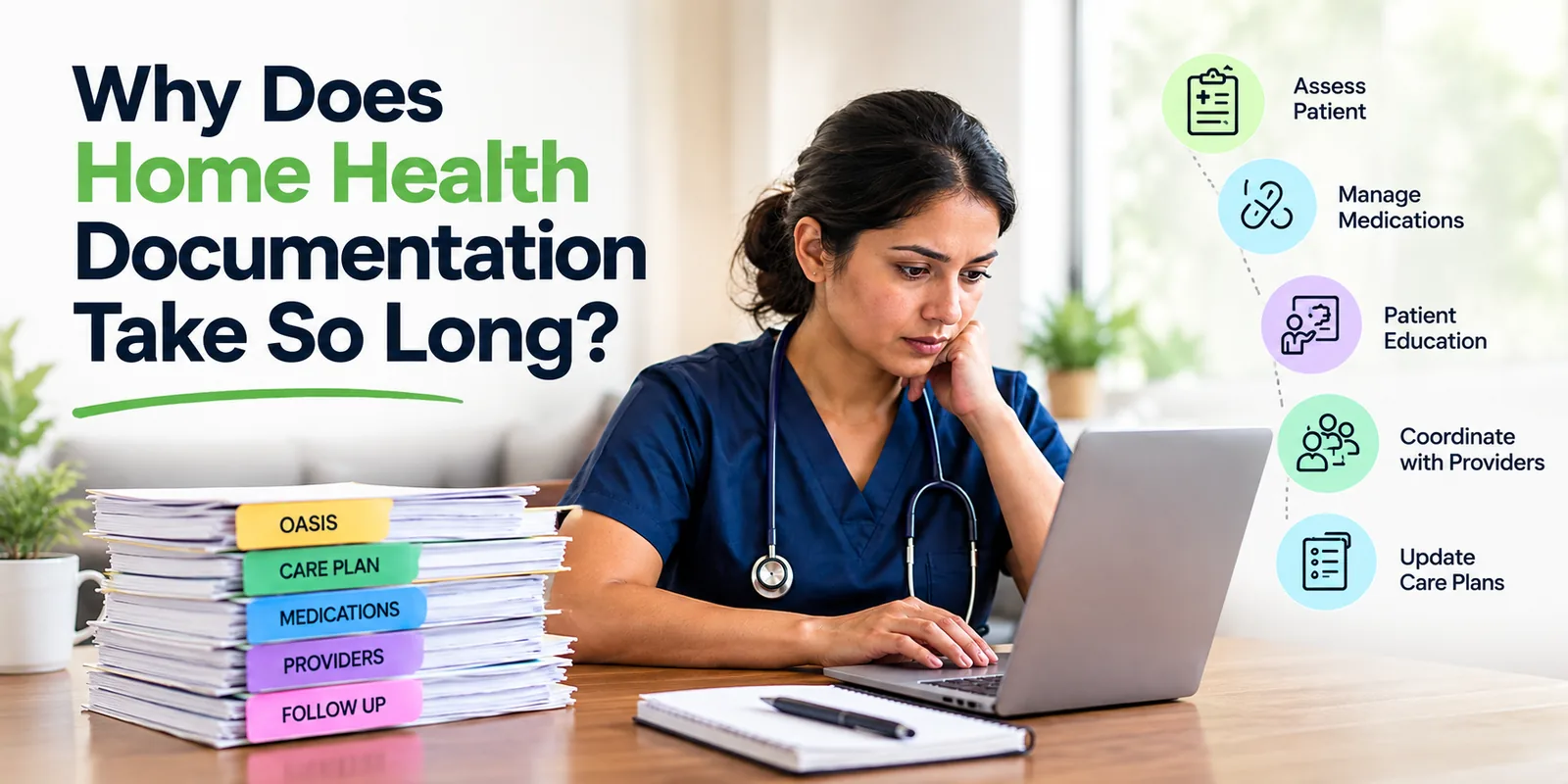
Home health nurses don't just document a visit. They assess, manage medications, educate, coordinate, update care plans, and complete OASIS, then document it all. Documentation takes so long because it's spread across an entire workflow, where information is captured, checked, entered, updated, and sometimes entered again.
Key Takeaways
- Home health documentation is not one task; it's a series of connected tasks that happen before, during, and after patient care.
- The burden is often a workflow problem, not a typing problem: much of the time goes to finding, checking, organizing, and re-entering information.
- There is no single documentation-minutes number; time varies by patient complexity, visit type, discipline, OASIS requirements, EMR usability, and more.
- Documentation often continues after the nurse leaves the home, creating a "Visit → Drive → Chart → Recheck → Finish later" second shift.
- One missing detail can trigger searching, calls, corrections, and rework, so the goal is to avoid creating rework, not just to type faster.
- AI's biggest opportunity isn't "write the note"; it's reducing the number of steps required to produce accurate documentation while keeping the clinician in control.
✓ Quick answer: Home health documentation takes so long because it isn't a single task. It's spread across an entire workflow, where the same information often has to be captured, checked, entered, updated, and sometimes entered again. The burden is frequently a workflow problem, not simply a matter of "too much charting."
Home health nurses don't just document a visit. They assess the patient, manage medications, provide education, coordinate with providers, update care plans, complete OASIS-related documentation, and make sure the record accurately reflects what happened in the home.
Then they have to document it all.
So, why does home health documentation take so long? The answer isn't simply that there is "too much charting." The bigger issue is that documentation is spread across an entire workflow, with information often needing to be captured, checked, entered, updated, and sometimes entered again.
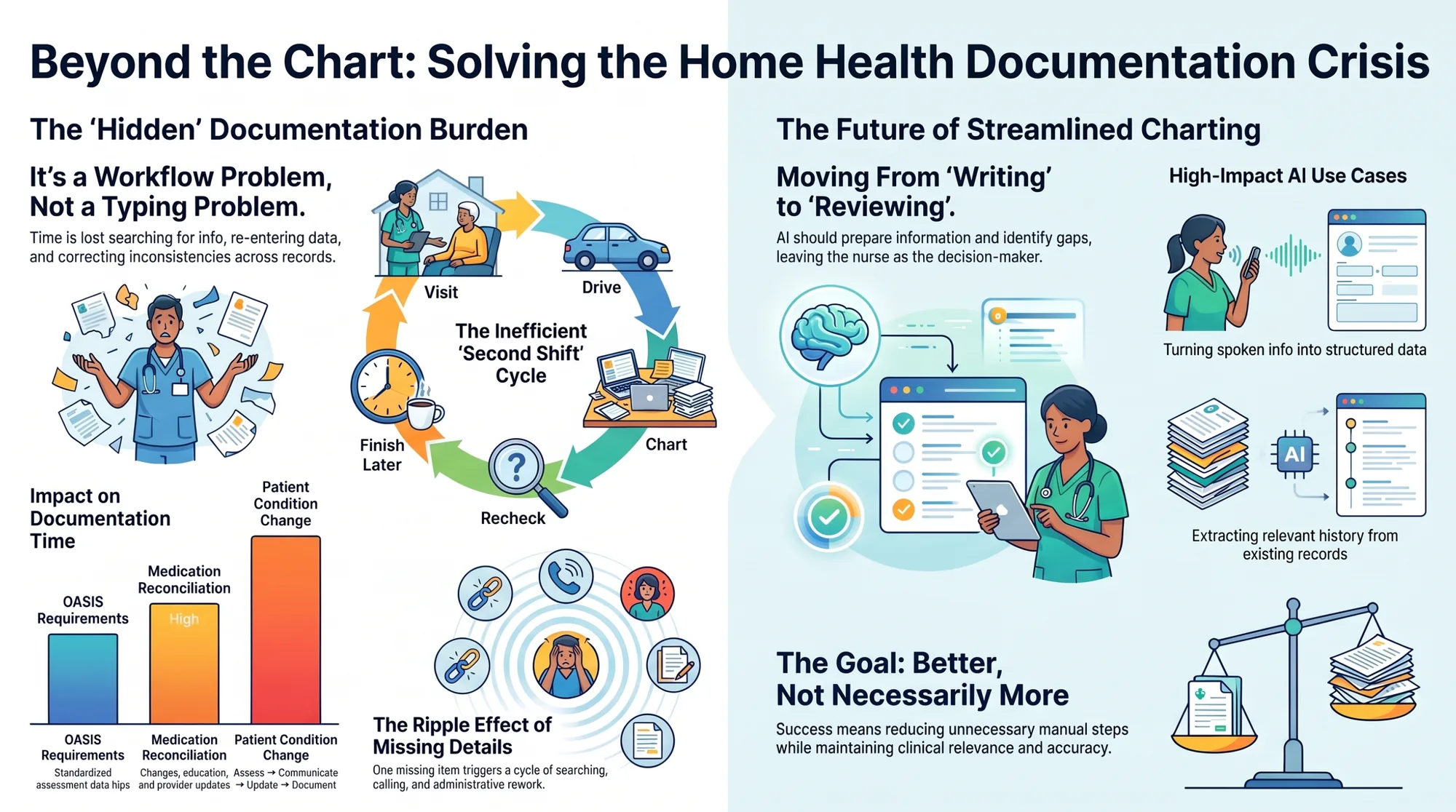
The hidden documentation burden is a workflow problem, not a typing problem. The "second shift" cycle of visit, drive, chart, recheck, and finish later gives way to a future where AI prepares and organizes information while the nurse stays the decision-maker.
What Makes Home Health Documentation So Time-Consuming?
Home health documentation is not one task. It is a series of connected tasks that happen before, during, and after patient care.
A nurse may need to:
- Review the patient's history.
- Assess the patient.
- Document findings.
- Complete required assessment items.
- Reconcile medications.
- Document interventions.
- Record patient and caregiver education.
- Update the plan of care.
- Communicate with physicians or other providers.
- Document changes in condition.
- Check for missing information.
- Correct inconsistencies.
- Complete required follow-up documentation.
Each individual task may seem manageable. Together, they can create a significant documentation burden.
Is Home Health Documentation Just About Writing Notes?
No. Writing the actual note is only one part of the work.
A significant amount of documentation time can go into finding, checking, organizing, and entering information. For example, a clinician may already know what happened during a visit but still need to:
- Find the right information in the patient's record.
- Determine where it needs to be documented.
- Enter the information.
- Check that it is complete.
- Make sure it doesn't conflict with other documentation.
- Return later to finish anything that was missed.
That means documentation burden isn't always a typing problem. It can be a workflow problem.
For a full breakdown of what the record covers, see what home health documentation actually includes.
How Much Documentation Does a Home Health Nurse Have to Complete?
There isn't one universal number of minutes that applies to every home health nurse or every visit. Documentation time varies based on:
- Patient complexity.
- Visit type.
- Discipline.
- OASIS requirements.
- Changes in patient condition.
- Medication complexity.
- Care coordination.
- Agency workflows.
- EMR usability.
- Payer and regulatory requirements.
- Clinician experience.
A routine visit and a start of care are not equivalent documentation tasks. The same is true for recertification, reassessment, and discharge.
For the research on how this adds up, see how much of a nursing shift is spent on documentation.
Why Does OASIS Add to Home Health Documentation?
OASIS is a standardized assessment dataset used in Medicare-certified home health for applicable patients. It requires clinicians to collect and document specific information about the patient's condition and functional status at applicable assessment time points.
The complexity isn't simply the number of questions. Clinicians have to understand what each item is asking, gather the relevant information, apply the appropriate response, and make sure the assessment reflects the patient's actual condition.
CMS's current OASIS-E2 guidance applies beginning April 1, 2026. That makes OASIS an important part of the broader documentation workflow, but it is only one part of home health documentation.
See what OASIS-E is in home health for more.
Why Does Documentation Continue After the Nurse Leaves the Patient's Home?
Because the visit isn't necessarily the end of the documentation workflow. A nurse may leave the patient's home knowing the clinical work is complete but still have documentation to finish.
That can create a familiar cycle:
Visit → Drive → Chart → Recheck → Finish later, instead of Visit → Care → Chart → Done.
When documentation is pushed to later in the day, it can also mean the clinician has to reconstruct details from memory, notes, messages, or other sources.
Why Is Re-Entering Information Such a Problem?
Because the same patient information can appear in multiple parts of the workflow. A clinician may document information during an assessment and then need to reference or enter related information elsewhere.
The problem isn't necessarily that every repeated field is unnecessary. The problem is when clinicians are doing repetitive work that technology could reasonably help organize, extract, or carry forward.
The more manual repetition there is, the more opportunities there are for:
- Errors.
- Inconsistencies.
- Missing information.
- Delays.
- Rework.
How Do Medication Documentation and Care Coordination Add to the Burden?
Home health care doesn't happen in isolation. Clinicians may need to document medication changes, reconciliation, patient education, communication with family members, and updates shared with physicians or other members of the care team.
A change in the patient's condition can create additional work because the nurse may need to:
Observe → Assess → Communicate → Receive instructions → Update care → Document.
The documentation therefore expands as the care coordination becomes more complex.
Why Can Documentation Feel Like Work After the Work Is Done?
Because documentation is often treated as something that happens after patient care rather than something integrated into the care workflow. The nurse has already driven to the home, assessed the patient, performed the required care, answered questions, educated the patient, and coordinated with others.
Then the documentation begins.
This is one reason documentation can feel like a second shift. The clinical work may be finished, but the administrative work isn't.
How Do Missing or Incomplete Details Create More Documentation Work?
A missing piece of information doesn't always mean a quick correction. It can lead to:
- Searching through previous records.
- Calling or messaging someone.
- Reopening documentation.
- Clarifying an order.
- Correcting a note.
- Updating another part of the record.
- Rechecking information before submission.
One missed detail can therefore create several additional steps. The goal shouldn't only be to help nurses write faster.
It should also be to help them avoid creating rework in the first place.
How Does Documentation Affect a Nurse's Time?
Every minute spent searching, entering, correcting, or reviewing documentation is time that cannot be spent doing something else. That doesn't mean documentation isn't important.
It is. The question is whether every step required to produce accurate documentation is necessary.
There is a difference between necessary documentation and necessary documentation plus unnecessary administrative work around it. That distinction matters when agencies think about improving documentation workflows.
Why Can't Home Health Agencies Simply Reduce Documentation Requirements?
Because much of home health documentation exists for legitimate clinical, regulatory, quality, communication, and payment-related reasons. The answer isn't to eliminate information that clinicians and care teams actually need.
The better question is: how can the required work be completed with fewer unnecessary steps?
That could mean better information capture, less duplicate entry, easier access to existing information, stronger workflow design, and better integration between systems.
What Does Better Home Health Documentation Look Like?
Better documentation isn't necessarily more documentation. It should be:
- Accurate.
- Complete.
- Timely.
- Clinically relevant.
- Easy to review.
- Consistent with the patient's condition.
- Connected to the plan of care.
- Accessible to the appropriate care team.
And ideally, it shouldn't require the clinician to spend unnecessary time fighting the documentation system.
Can AI Reduce Home Health Documentation Time?
AI can potentially reduce parts of the documentation workload. For example, AI can assist with:
- Extracting information from existing records.
- Turning spoken information into structured documentation.
- Drafting visit notes.
- Summarizing patient information.
- Identifying missing information.
- Flagging inconsistencies.
- Organizing assessment information.
- Reducing repetitive data entry.
But "AI writes the note" is only one possible use case. A bigger opportunity is using AI to reduce the number of steps required to create accurate documentation.
Should AI Automatically Complete Home Health Documentation?
Not necessarily. Healthcare documentation requires context and clinical judgment.
A useful AI workflow can prepare information, identify gaps, organize documentation, and generate a draft while keeping the clinician involved in review and decision-making.
The goal isn't to make the nurse a passive approver. It is to remove repetitive work while keeping appropriate human oversight, the core idea behind human-in-the-loop AI in healthcare.
What Should Home Health Agencies Look for in AI Documentation Tools?
Instead of asking only "Can it write a note?" agencies can ask:
- Can it capture information during or immediately after the visit?
- Can it reduce duplicate entry?
- Can it pull relevant information from existing records?
- Can it identify missing or conflicting information?
- Can clinicians review and correct the output?
- Does it integrate with the existing EMR workflow?
- Does it create an audit trail?
- Does it protect patient information appropriately?
- Does it reduce steps rather than add new ones?
That last question is especially important. If an AI tool gives a nurse a faster note but adds five new steps to the workflow, the documentation problem hasn't really disappeared.
It has moved. Handling patient information here also depends on HIPAA-compliant AI documentation practices.
Can AI Actually Give Nurses Time Back?
That depends on how the technology is implemented. If AI simply produces another draft that a nurse has to copy, paste, verify, edit, and move into another system, the time savings may be limited.
If it reduces searching, repetitive entry, documentation rework, and other administrative steps, the impact can be much more meaningful.
The measure shouldn't simply be "How fast can AI generate a note?" A better question is: "How much work did the nurse no longer have to do?"
What Is the Real Problem With Home Health Documentation?
The problem isn't that nurses document. Documentation is essential to patient care and healthcare operations.
The problem is when producing that documentation requires too much manual, repetitive, fragmented work.
The future of home health documentation shouldn't be about making nurses better at spending time in an EMR. It should be about making the documentation workflow require less unnecessary work in the first place: less searching, less re-entering, less checking, less fixing, and more time with the patient.
What Should I Document? 100 OASIS Situations Home Health Nurses Face Every Day
100 real OASIS scenarios, worked end to end — clinical situation, common mistake, better approach, and key takeaway. Built around OASIS-E2 (effective April 1, 2026) to turn what you assess into accurate, defensible documentation.
Bottom Line
The problem isn't that nurses document; documentation is essential to patient care and operations. The problem is when producing it requires too much manual, repetitive, fragmented work. The future of home health documentation shouldn't be about making nurses better at spending time in an EMR; it should be about making the workflow require less unnecessary work: less searching, less re-entering, less checking, less fixing, and more time with the patient.
Inside Home Health Podcast
What Makes OASIS Documentation So DIFFICULT?

Arvind Sarin is the founder of Copper Digital. For the past year he has spent three days a week inside a 500+ census Texas home health agency, building AI documentation that finishes OASIS and visit notes the same day, with a nurse reviewing and approving every note. He writes about home health documentation, OASIS, Medicare compliance, and applying AI responsibly in clinical workflows.
Frequently asked
Frequently asked questions
Home health documentation involves much more than writing a visit note. Clinicians may need to assess the patient, document findings, complete OASIS-related requirements, reconcile medications, record education, communicate with providers, update the plan of care, and check for missing or inconsistent information. The time adds up across the entire workflow.
Join the conversation
Leave a comment
No comments yet. Be the first to share your thoughts.
Related reading
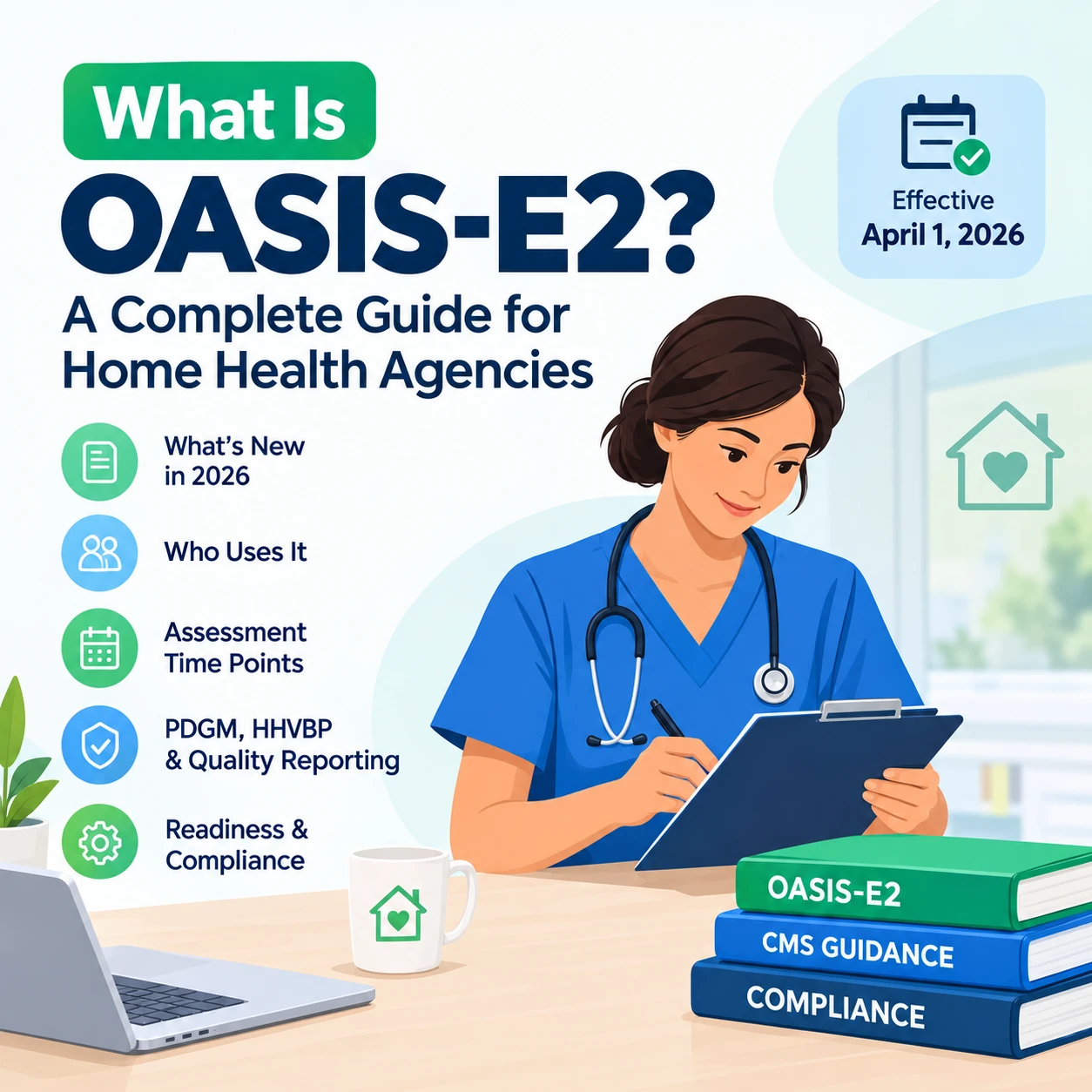
What Is OASIS-E2? A Complete Guide for Home Health Agencies
A practical guide to OASIS-E2: assessment changes, time points, quality and payment uses, EHR and iQIES readiness, and AI support that keeps clinicians in control.
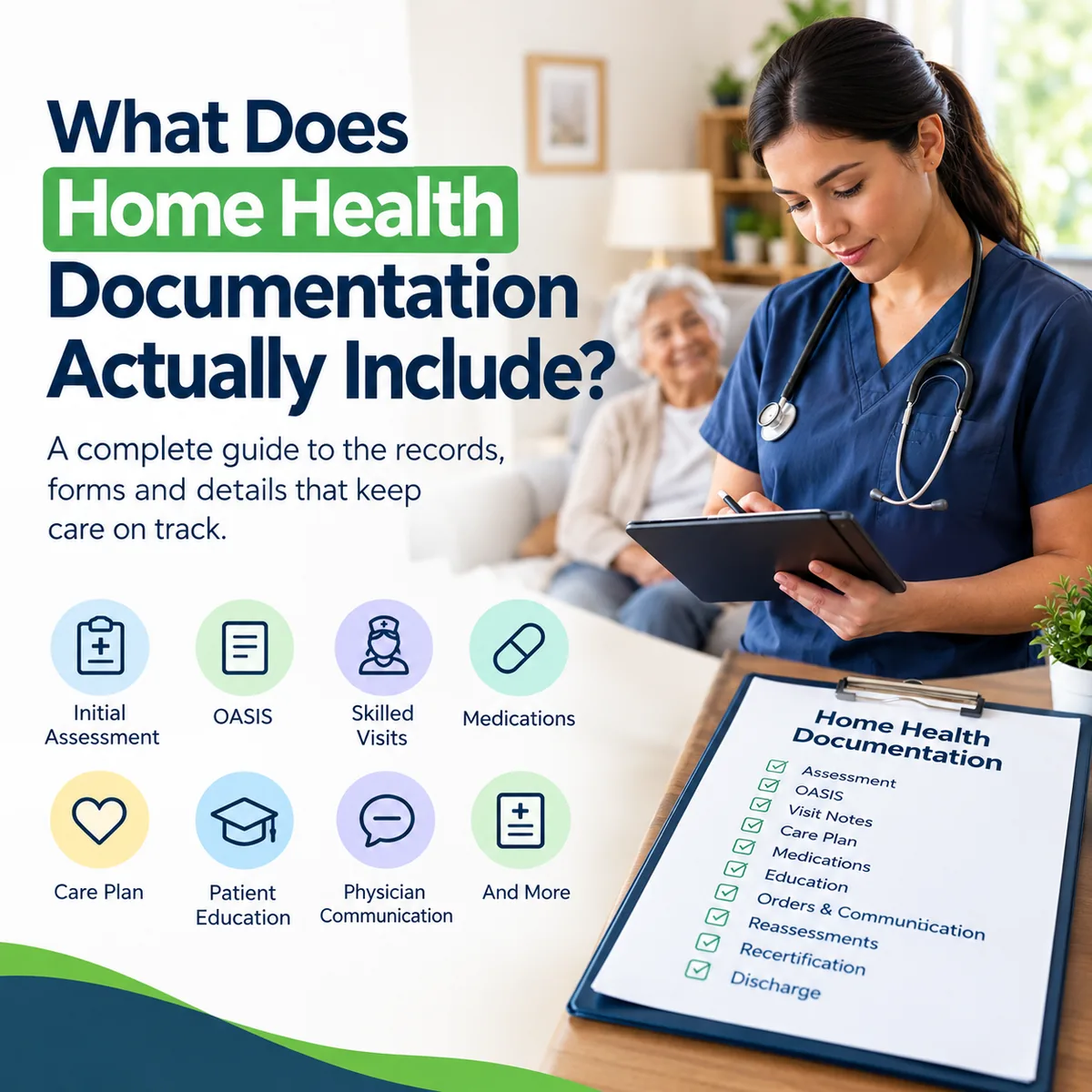
What Does Home Health Documentation Actually Include?
Home health documentation is much more than a visit note. Across an episode it spans the initial assessment, OASIS, skilled visits, medications, the care plan, education, physician communication, orders, reassessments, recertification, and discharge: each piece is part of the patient's larger story of care.
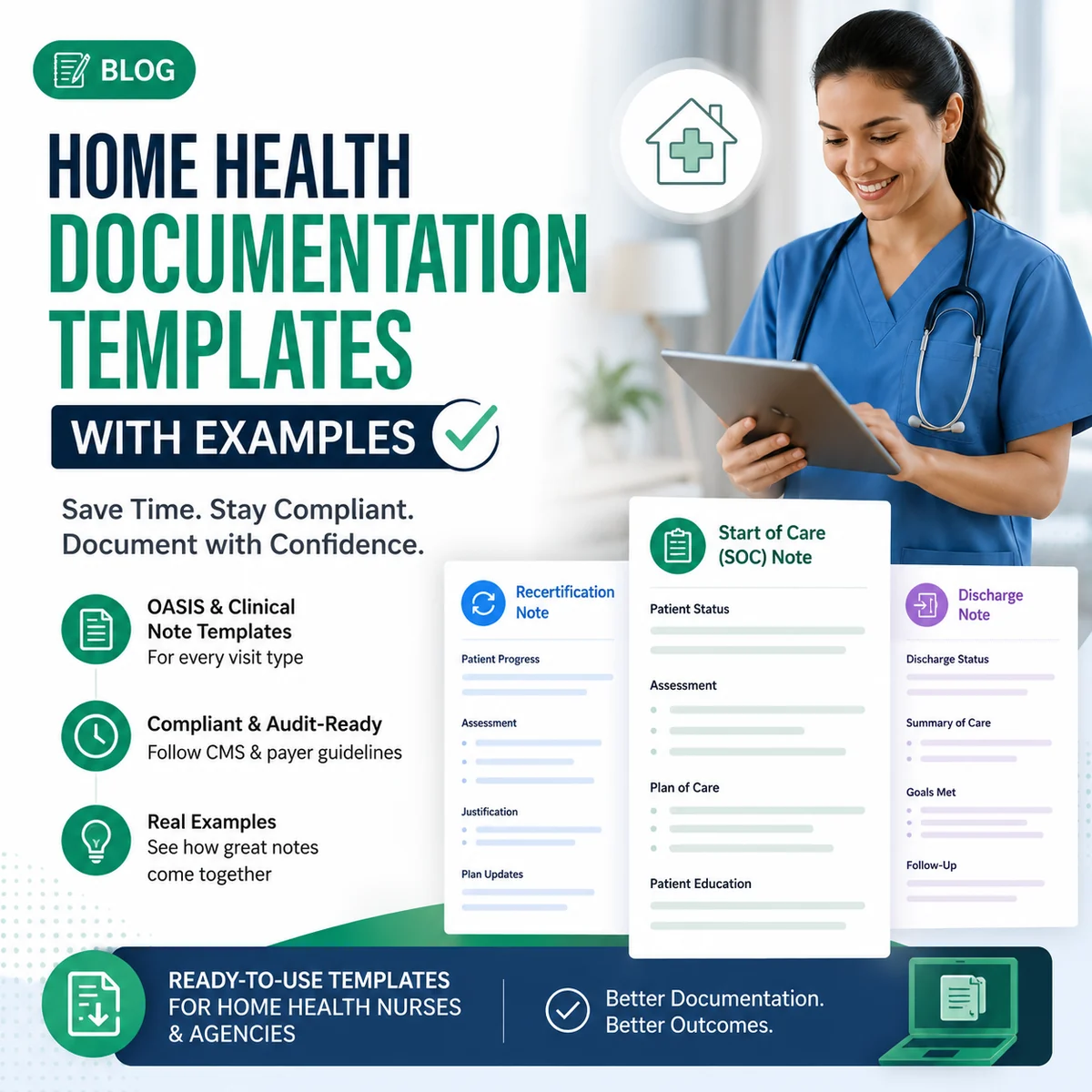
Home Health Documentation Templates With Examples
A complete guide to home health documentation templates, with practical examples for skilled nursing visits, OASIS, SOC, ROC, recertification, wounds, medications, care plans, and compliance.