
Why Is Your Home Health or Hospice Agency Losing Referrals Before the Start of Care?
A referral is not an admission. Learn where referrals stall between intake and Start of Care, and how ownership, visibility, and follow-up can prevent avoidable losses.
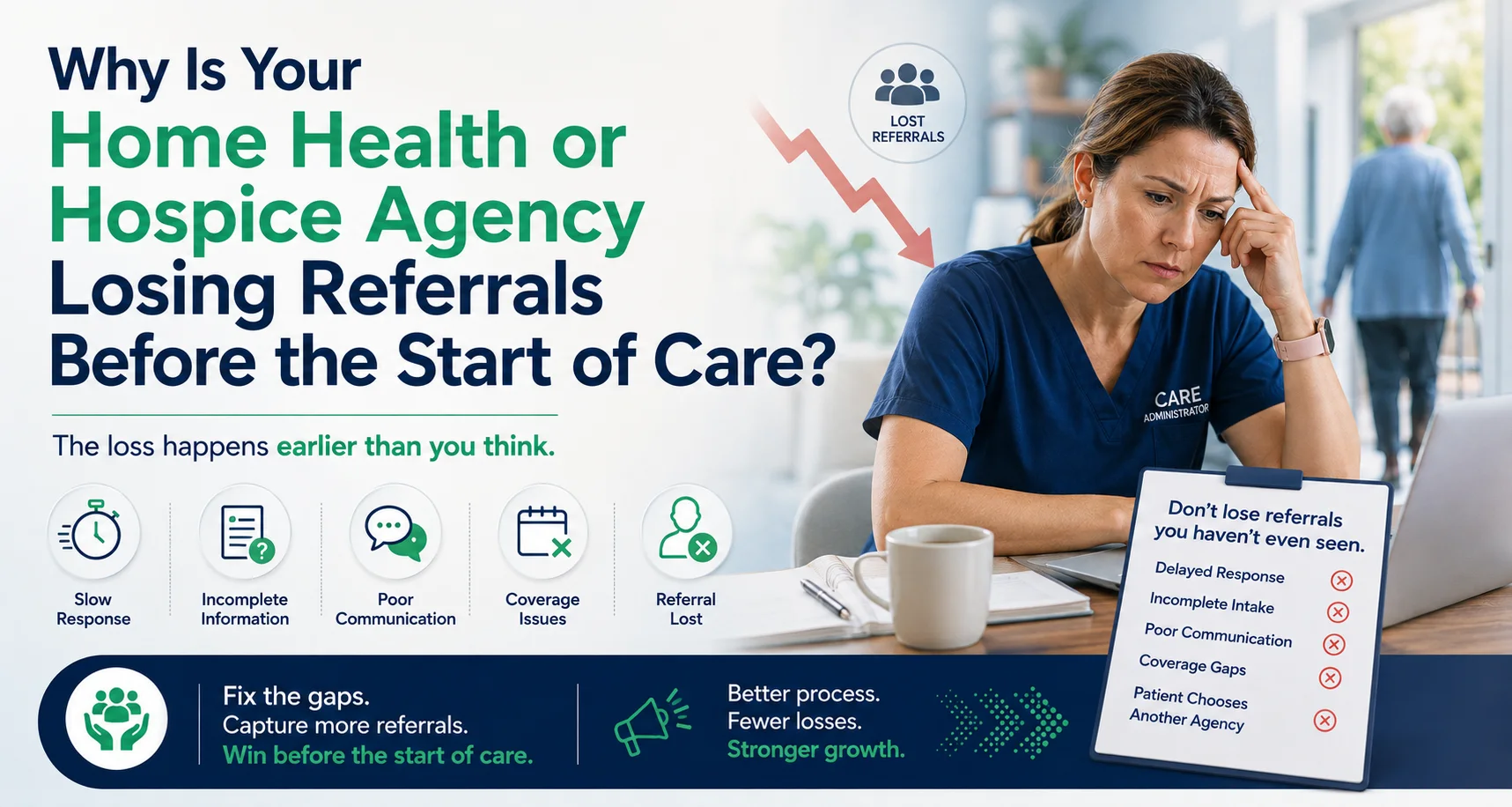
Key Takeaways
- A referral is an opportunity; an admission happens only after the referral successfully reaches a completed Start of Care.
- Many losses occur after a referral arrives, through missing information, slow follow-up, unclear ownership, staffing gaps, or poor communication.
- Spreadsheets are not automatically the problem, but they become risky when they act as an unofficial system without aging, alerts, owners, and next actions.
- Agencies should measure referral-to-SOC conversion, response time, aging, acceptance, time to SOC, and specific loss reasons.
- A structured workflow reduces dependence on individual employees repeatedly rescuing stalled referrals.
- Automation can surface missing information and stalled work, but people should remain responsible for clinical and patient-specific decisions.
A referral is sent to your agency.
Your intake team receives it. The patient expects services to begin soon.
Then something happens.
A document is missing. A phone call isn't returned.
Someone assumes someone else is handling it. The referral sits in a spreadsheet.
Another agency admits the patient first.
By the time anyone realizes what happened, the opportunity is gone. This occurs more often than many home health and hospice agencies realize.
💡 Your referral problem may not be a referral-generation problem. In many cases, the breakdown happens after the referral arrives but before the Start of Care (SOC) is scheduled or completed.
An agency can invest heavily in marketing and referral relationships while still losing admissions because its internal referral-to-admission process isn't designed to keep referrals moving.
The Referral Isn't the Finish Line
One of the biggest misconceptions in home health growth is treating a referral as an admission. They are not the same thing.
A referral is an opportunity. An admission is the result of moving that opportunity through multiple operational steps.
Referral received → reviewed → information verified → missing information resolved → patient contacted → accepted → staffing confirmed → SOC scheduled → SOC completed
Every arrow represents a potential point of failure. If your agency tracks only how many referrals arrive, you may have no visibility into where those referrals disappear.
The better question is: Where exactly are we losing referrals between receipt and Start of Care?
Why Do Agencies Track Referrals in Spreadsheets?
A surprisingly common answer is Excel or Google Sheets. Early-stage referrals often do not contain enough information to create a complete patient chart in the electronic medical record (EMR).
A referral may initially include only the patient's name, phone number, diagnosis, and referring provider information. The agency may not yet have:
- Insurance verification.
- Complete physician documentation.
- Full demographic information.
- All required clinical records.
- Final admission information.
Agencies therefore may maintain an external tracker until they know whether the patient will be admitted. There is nothing inherently wrong with a spreadsheet.
The problem begins when the spreadsheet becomes the unofficial referral management system. As volume grows, statuses go stale, older rows get buried, multiple people make changes, and follow-up is missed.
The core issue is not the spreadsheet itself. It is the lack of visibility and accountability around each referral.
How Communication Breakdowns Cause Referrals to Stall
One of the most common referral problems is not technology. It is communication.
Imagine that a physician's office sends a referral without a required signature. Intake calls the office, reaches voicemail, and leaves a message.
Meanwhile, the marketer has a strong relationship with the physician's medical assistant and could potentially help obtain the missing item, but no one tells the marketer.
Two days later, the marketer visits the office and still does not know the referral is unresolved. Intake believes it handled the issue, the marketer believes there is nothing to handle, and leadership sees only that admissions are down.
Meanwhile, the referral remains stalled.
Why Intake Is an Undervalued Role in Home Health and Hospice
Referral → patient → admission → revenue
Intake sits directly in the middle of that sequence. Its responsibilities may include:
- Reviewing referrals.
- Verifying documentation.
- Contacting patients.
- Coordinating with physicians.
- Communicating with referral sources and marketers.
- Coordinating with clinical leadership.
- Moving appropriate referrals toward admission.
That makes intake much more than paperwork processing. Intake manages the early stages of the agency's admission and revenue pipeline.
When the intake process is unclear, overloaded, or reactive, the consequences spread. Referral partners wait for updates, patients wait for follow-up, marketers lose visibility, clinical teams receive incomplete information, and leaders see fewer admissions without understanding why.
The Hidden Problem: Reactive Referral Management
When there is no structured referral workflow, employees often compensate by trying harder. Someone notices a stuck referral and makes another call.
A marketer drives to a physician's office. A director of nursing stays late to review referrals.
Intake spends the evening chasing records.
The immediate issue gets solved, but the underlying system does not change. This creates what some leaders call hero culture.
What Is Hero Culture in Home Health?
Hero culture happens when an agency depends on individual employees repeatedly rescuing broken processes.
- A marketer drives across town to obtain a physician signature.
- A director of nursing reviews referrals late at night.
- Intake staff stay late to locate missing documentation.
- A team member calls multiple people just to determine where a referral went.
These employees may be deeply committed, but the organization should not need a hero each time a referral gets stuck. Over time, the pattern can create burnout, inconsistency, errors, poor visibility, dependence on specific employees, and difficulty scaling.
Where Are Your Referrals Actually Getting Lost?
Before investing more in referral generation, leadership should examine the existing pipeline. Start with these questions.
Are referrals consistently waiting on documentation?
Identify which documents are most often missing, who owns the follow-up, and how long each item remains outstanding.
Are referral sources asking marketers for updates?
If marketers frequently hear, “What happened with that patient?” the agency may have an internal visibility problem.
Do you know why referrals do not become admissions?
“Lost” is a status, not a useful reason. Track whether the referral was:
- Declined by the patient.
- Sent to another agency.
- Outside the service area.
- Unable to be staffed.
- Missing documentation.
- Delayed by eligibility issues.
- Withdrawn.
- Unable to reach the patient.
- Delayed for another operational reason.
Can you see where every referral currently sits?
If leadership must call three people to answer that question, the workflow probably needs improvement.
Questions Every Home Health Leader Should Ask
- Where are referrals tracked before a patient chart is created: in a spreadsheet, inbox, portal, shared drive, EMR, or multiple systems?
- Who owns an incomplete referral?
- How are marketers notified when their referral needs follow-up?
- Does information flow back to the person who owns the referral relationship?
- How does the team know when a referral has gone stale?
- How does leadership know why referrals are being lost?
Referral Tracking Should Be More Than a List of Names
A useful workflow should show more than the patient's name, referral source, and received date. It should make the whole journey visible.
| Referral | Status | Owner | Next action | Aging |
|---|---|---|---|---|
| Patient A | Missing order | Intake | Contact physician | 4 hours |
| Patient B | Accepted | Intake | Schedule SOC | 2 hours |
| Patient C | Patient contact pending | Intake | Call patient | 6 hours |
| Patient D | Staffing pending | Clinical | Assign RN | 1 day |
| Patient E | Lost | Intake | Record reason | Closed |
The objective is not to create more administrative work. It is to ensure that no referral disappears without someone knowing why.
Why Referral-to-SOC Conversion Matters
Suppose your agency receives 500 referrals and celebrates the higher volume, but only 300 result in completed Starts of Care. What happened to the other 200?
Without that answer, you cannot accurately judge how well the referral strategy is working.
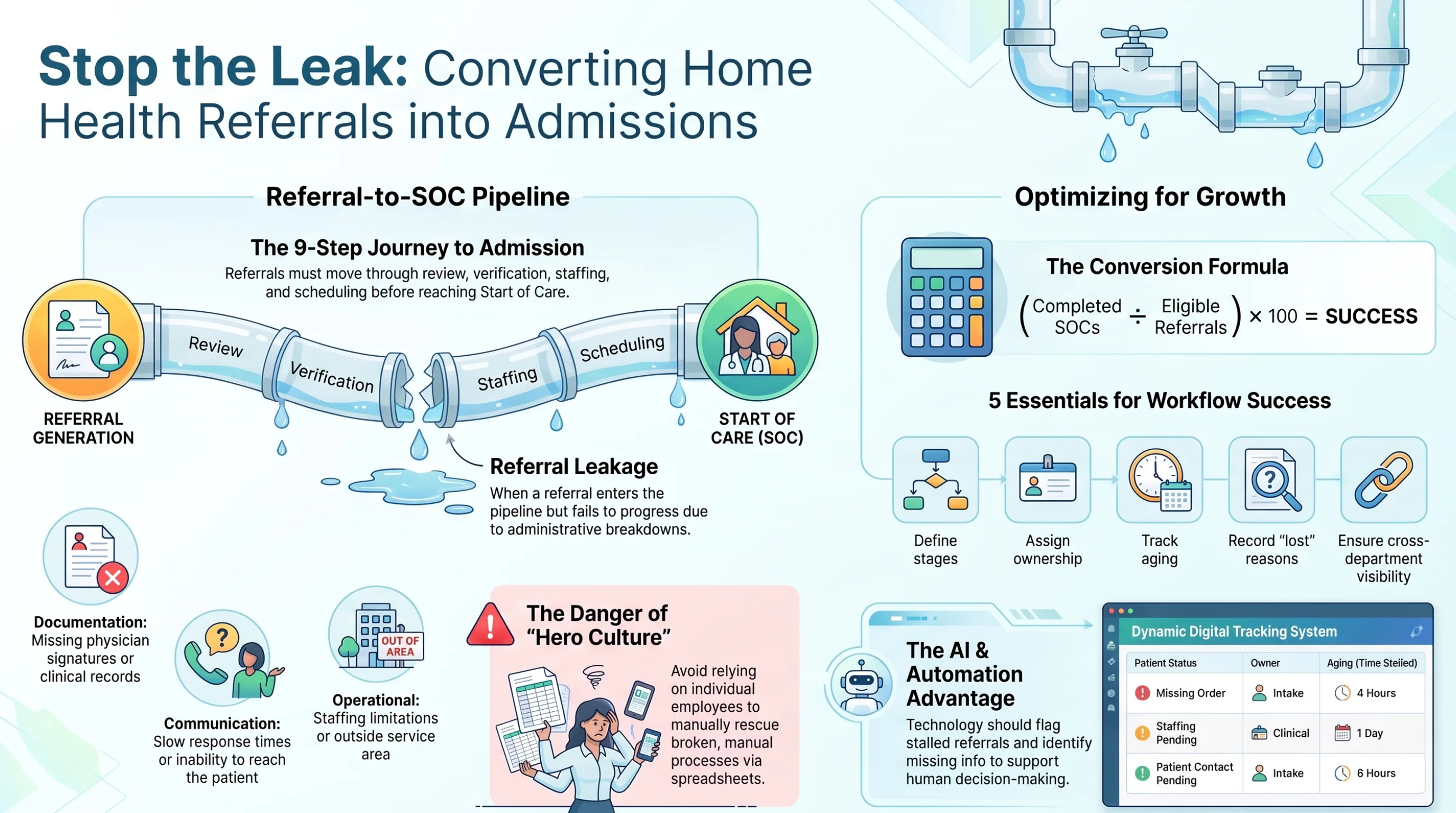
A referral pipeline should expose where work stalls between generation, review, verification, staffing, scheduling, and completed Start of Care.
Referral-to-SOC conversion rate
Completed SOCs ÷ eligible referrals × 100
Referral response time
How long does it take from receiving a referral to recording the first meaningful action?
Acceptance rate
What percentage of appropriate referrals does the agency accept?
Time to Start of Care
How long does it take from referral receipt to a completed SOC?
Referral aging
How many unresolved referrals have aged one day, two days, or three or more days?
Lost-referral reasons
Why did the referral fail to become an admission? A controlled list of reasons turns losses into operational insight.
Together, these measures help leadership identify whether the problem is marketing, intake, staffing, communication, or another operational constraint.
Why Improving Intake Can Improve Patient Care
Referral management is not only about revenue. It is also about connecting patients to appropriate care efficiently.
- Patients can receive needed services sooner.
- Referral partners gain confidence that patients are being handled appropriately.
- Staff spend less time chasing preventable emergencies.
- Leadership gains visibility into the admission pipeline.
The goal is not to pressure teams to accept every referral. It is to prevent appropriate referrals from being lost because of avoidable administrative breakdowns.
Your Referral Growth Problem May Already Be Inside the Agency
Agencies may assume they need more referrals and invest in marketing, networking, physician visits, hospital relationships, and new referral partnerships.
But if the agency already receives healthy volume and loses referrals inside intake, generating more may simply create more opportunities to lose. The first question should be: Are we converting the referrals we already have?
How to Build a Better Home Health Referral Workflow
- Define every stage. Document what happens from referral receipt through completed SOC.
- Assign ownership. Give every referral one person responsible for moving it forward.
- Create standard statuses. Make sure every department uses the same terminology.
- Track aging. Make any referral that has not moved visible.
- Document the next action. Record what must happen next, not only the current status.
- Create cross-department visibility. Intake, marketing, clinical leadership, and operations should not see isolated pieces of the referral.
- Track why referrals are lost. Turn preventable losses into actionable data.
- Review the pipeline regularly. Examine stalled and lost referrals, not only total volume.
Can AI Help Prevent Lost Home Health Referrals?
AI and automation can help agencies create visibility across the referral workflow. Depending on the system, technology may help:
- Extract information from referral documents.
- Identify missing information.
- Organize incoming referrals.
- Flag stalled referrals and prioritize follow-up.
- Notify the appropriate team member.
- Track referral aging.
- Summarize referral information.
- Identify recurring reasons for lost referrals.
- Surface workflow bottlenecks.
Instead of relying on someone to scan a spreadsheet, a workflow could surface: Referral received, missing physician documentation, no follow-up recorded, Referral accepted, SOC not scheduled, or Referral pending, no activity for 24 hours.
🤝 The goal is not to replace intake staff. It is to give them better visibility and fewer manual tracking tasks. People should remain responsible for important clinical, operational, and patient-specific decisions.
A Simple Referral Workflow Audit
Take a recent, representative group of referrals and categorize each one by the furthest stage it reached:
- Received: How many referrals entered the agency?
- Reviewed: How many were reviewed promptly?
- Accepted: How many appropriate referrals were accepted?
- Patient contact: How many patients were successfully contacted?
- Scheduled: How many had an SOC scheduled?
- Completed: How many actually reached SOC?
- Lost: How many did not, and why?
Then compare stage-to-stage drop-off, aging, ownership, and documented loss reasons. The largest controllable drop-off is a practical place to begin improvement.
Home Health Referral Management Checklist
Use these questions during your next leadership or intake meeting:
- Do we have one system of record for incoming referrals?
- Can we see every referral's current status?
- Does every referral have an owner and a next action?
- Can we identify referrals waiting on documentation?
- Do marketers know when their referrals need follow-up?
- Can intake quickly communicate issues to clinical leadership?
- Do we track referral aging and stalled work?
- Do we record specific lost-referral reasons?
- Do we measure referral-to-SOC conversion and response time?
- Are we relying on individual employees to rescue referrals?
- Do referral sources receive appropriate updates?
- Can leadership see the entire referral-to-admission pipeline?
If several answers are no, you may have a referral workflow problem, not a referral-generation problem.
Final Takeaway
More referrals do not automatically mean more admissions. If your agency receives referrals but does not convert enough into Starts of Care, the problem may be hiding inside the workflow.
Referral → intake → communication → documentation → follow-up → scheduling → SOC
Look for where the process slows down, ownership becomes unclear, information disappears, or employees must become heroes. The opportunity for growth may not be another hundred referrals; it may be the referrals already sitting in your pipeline.
Why Trust Our Experts?
Home health and hospice referral management involves operational, clinical, and patient-care considerations. This educational guidance should be adapted to each agency's policies, payer requirements, service area, staffing model, and applicable regulations.
- Industry-informed: Addresses real-world referral, intake, marketing, and admission workflow challenges.
- Operations-focused: Looks beyond volume to the processes that determine whether referrals become admissions.
- Patient-centered: Emphasizes timely access to appropriate care rather than simply maximizing conversion.
- Technology-aware: Shows where automation can improve visibility while keeping people involved in important decisions.
- Actionable: Provides concrete questions, metrics, and workflow checkpoints.
ℹ️ Disclaimer: This article is intended for educational and informational purposes only and does not constitute legal, financial, clinical, compliance, or professional advice. Agencies should evaluate referral processes under applicable federal and state requirements, payer policies, contractual obligations, agency policies, and individual patient circumstances.
What Should I Document? 100 OASIS Situations Home Health Nurses Face Every Day
100 real OASIS scenarios, worked end to end — clinical situation, common mistake, better approach, and key takeaway. Built around OASIS-E2 (effective April 1, 2026) to turn what you assess into accurate, defensible documentation.
Watch on YouTube
Related videos
What's the Future of Home Health EMR?
The Hidden Spreadsheet Error That's Causing the Nursing Shortage
Bottom Line
Before spending more to generate referrals, determine whether the referrals already entering your agency are moving through intake, acceptance, scheduling, and completed Start of Care, or disappearing inside the workflow.

Arvind Sarin is the founder of Copper Digital. For the past year he has spent three days a week inside a 500+ census Texas home health agency, building AI documentation that finishes OASIS and visit notes the same day, with a nurse reviewing and approving every note. He writes about home health documentation, OASIS, Medicare compliance, and applying AI responsibly in clinical workflows.
Frequently asked
Frequently asked questions
Common causes include missing documentation, communication breakdowns, unclear ownership, slow follow-up, poor visibility, staffing limitations, patient decisions, and referrals becoming buried in manual tracking systems.
Join the conversation
Leave a comment
No comments yet. Be the first to share your thoughts.
Related reading
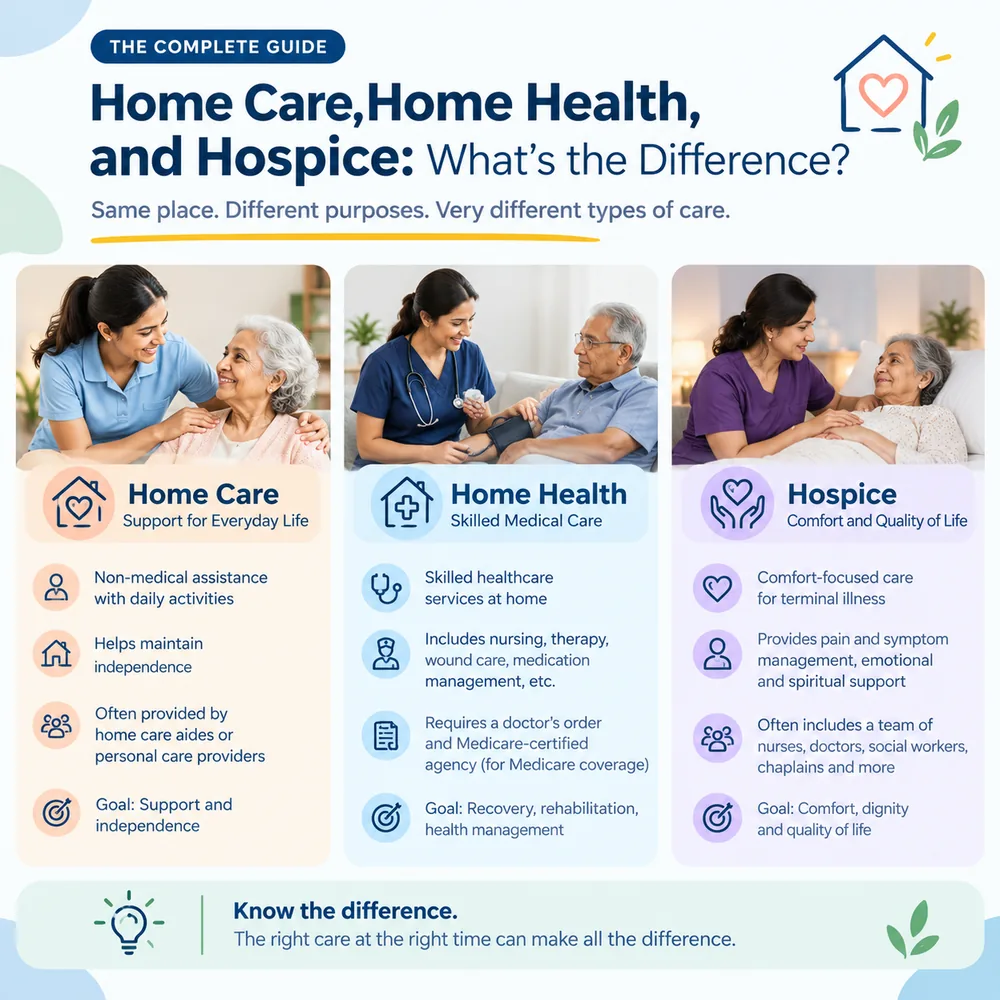
Home Care, Home Health, and Hospice: What's the Difference?
Home care supports daily life, home health provides skilled healthcare, and hospice focuses on comfort for terminal illness. Compare the services, eligibility, coverage, and goals of each model.

Where Home Health Fits in the Care Continuum: A Nurse's Map
When a discharge planner says home health, most families hear help is coming. What they get is a skilled nurse working from day one toward making herself unnecessary. Kathy Duckett, RN, maps the American care continuum, and the one question that determines where a patient actually belongs.
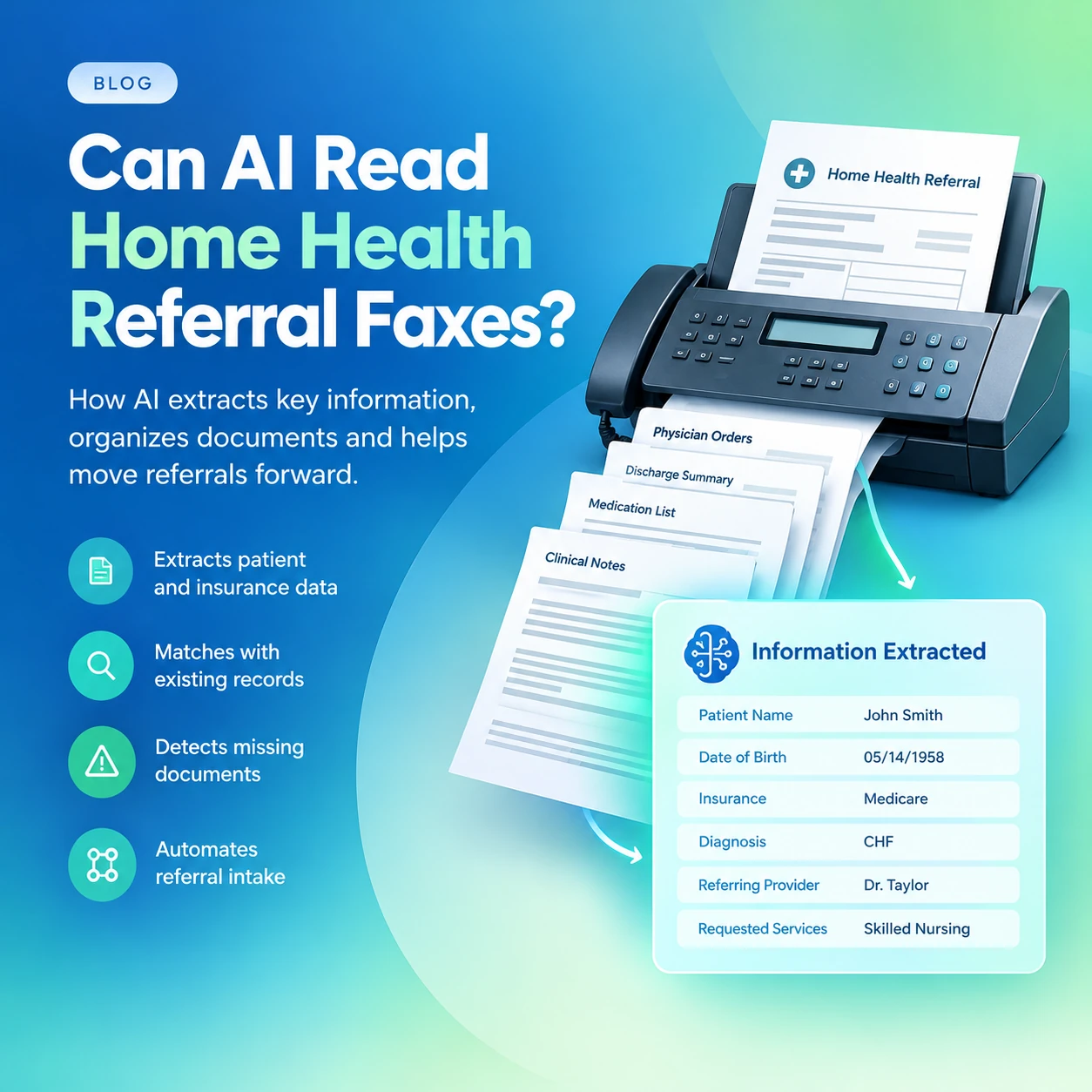
Can AI Read Home Health Referral Faxes?
How AI reads referral faxes, extracts patient information, flags missing records, supports patient matching, and routes home health intake tasks for human review.