
Can AI Read Home Health Referral Faxes?
How AI reads referral faxes, extracts patient information, flags missing records, supports patient matching, and routes home health intake tasks for human review.
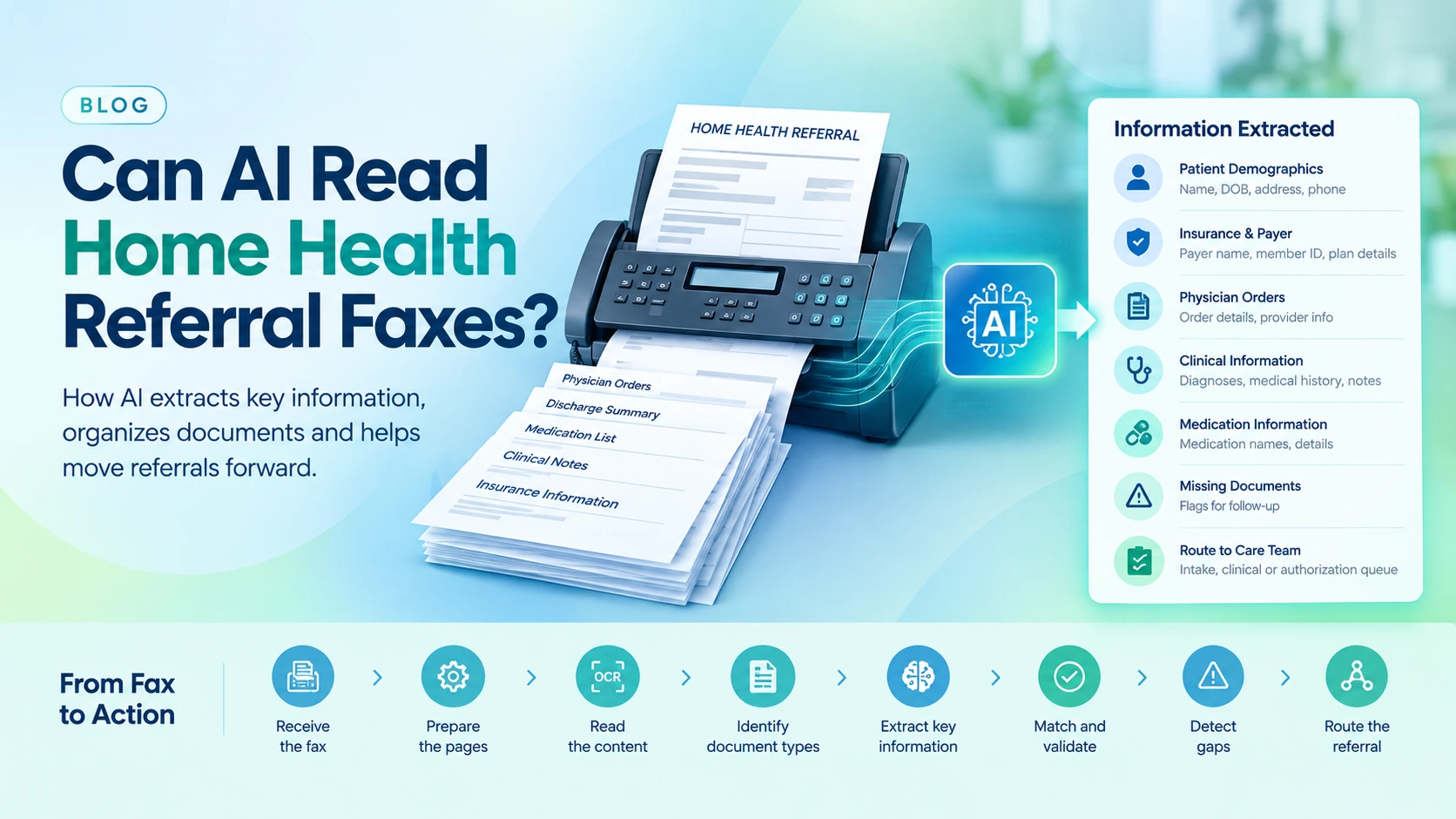
Key Takeaways
- AI can classify referral faxes, extract key fields, flag gaps, and route work, depending on the system and source quality.
- Test long packets, handwriting, blurry scans, and conflicting patient identifiers using representative documents.
- Preserve source-page references and route uncertain information and patient matches for staff review.
- Extracting a diagnosis, order, or homebound-status statement does not independently establish eligibility.
- Evaluate integrations, security safeguards, review workflows, and actual time savings before adopting a platform.
Can AI Read Home Health Referral Faxes?
Yes. AI can read many home health referral faxes, extract relevant information, organize documents, identify potential gaps, and route referrals to the appropriate team.
The results depend on the quality of the fax, the complexity of the documents, and the capabilities of the software.
Home health agencies often receive referrals through fax, electronic fax services, hospital portals, and other systems. A single referral packet may contain dozens of pages, including physician orders, discharge summaries, medication lists, clinical notes, insurance information, and supporting records.
Someone has to open those documents, find the relevant information, enter details into an intake system, identify missing records, and coordinate follow-up.
AI-powered fax processing can automate parts of this work. Instead of treating each fax as an image that staff must read manually, the technology can turn documents into structured information and help move referrals through an intake workflow.
But there is an important distinction: AI reading a referral does not mean the referral is complete, the patient is eligible, or the requested services are approved. Those questions require additional verification and, where appropriate, clinical review.
How Does AI Read Home Health Referral Faxes?
AI fax processing often uses a combination of Intelligent Document Processing (IDP), Optical Character Recognition (OCR), Natural Language Processing (NLP), and other AI techniques.
Each technology contributes to a different part of the process.
- OCR converts text in scanned documents into machine-readable text.
- NLP helps interpret the words and relationships in the extracted text.
- Document classification identifies the type and purpose of each document.
- AI-based information extraction locates specific fields and organizes them into structured records.
- Workflow automation routes information, flags exceptions, and triggers follow-up tasks.
A typical workflow looks like this:
- Receive the fax: Capture an incoming fax as a PDF, scanned image, or multi-page document.
- Prepare the pages: Correct orientation, improve image readability where possible, and separate documents when needed.
- Read the content: Use OCR or AI vision to extract visible text.
- Identify document types: Distinguish physician orders, discharge summaries, clinical notes, insurance records, and other attachments.
- Extract key information: Identify patient demographics, diagnoses, provider details, dates, and other configured fields.
- Match and validate: Compare extracted information with existing records and flag potential inconsistencies.
- Detect gaps: Identify expected fields or documents that were not found.
- Route the referral: Send the referral or unresolved items to the appropriate intake, clinical, or authorization queue.
The exact capabilities vary by vendor. Agencies should confirm which steps are automated and which still require staff involvement.
What Information Can AI Extract From Home Health Referral Faxes?
AI can be configured to extract a range of administrative and clinical information from incoming referral packets.
| Information category | Examples of extractable information |
|---|---|
| Patient demographics | Name, date of birth, address, phone number |
| Insurance and payer | Payer name, member identifiers, plan details visible in the document |
| Referral details | Referral source, referral date, requested services |
| Provider information | Referring provider, ordering practitioner, contact details |
| Clinical information | Diagnoses, relevant medical history, clinical notes |
| Physician orders | Order details, dates, provider information |
| Hospital records | Discharge date, discharge summary, transition-of-care information |
| Medication information | Medication names and other visible details |
| Eligibility-related documentation | Notes potentially relevant to homebound status, skilled need, and face-to-face encounters |
Not every field will be available in every referral. Some details may be missing, illegible, or spread across several documents.
For example, AI may extract a diagnosis from a discharge summary and identify a physician order on another page. The system can organize these details for staff to review, but the extracted information must still be checked for accuracy and context.
A diagnosis code or a note mentioning homebound status does not independently establish Medicare eligibility.
Can AI Read Long Home Health Referral Faxes With 40, 60, or 100 Pages?
AI can process long, multi-page referral packets when the chosen solution supports that document volume and complexity.
The challenge is not simply reading more pages. A 100-page fax may include duplicate records, unrelated attachments, multiple clinical notes, handwritten additions, and documents from several providers.
AI-powered document processing can help by:
- Separating a large packet into individual documents.
- Identifying relevant pages and document types.
- Locating patient details across multiple records.
- Detecting potential duplicate pages or repeated documents.
- Extracting information without requiring staff to search each page manually.
- Preserving page references so staff can verify where a field came from.
Imagine an agency receiving a 60-page hospital discharge packet. The packet includes a discharge summary, progress notes, medication records, physician orders, and therapy documentation.
AI can help categorize the packet and surface information relevant to intake instead of requiring staff to start at page one and manually search the entire file.
However, agencies should verify that the system processes the full packet. A tool that reads the first several pages but misses an important order near the end may leave the referral incomplete.
Can AI Read Blurry Faxes and Handwritten Physician Notes?
AI can sometimes extract information from blurry scans and handwritten notes, but accuracy varies with document quality and the capabilities of the system.
Common challenges include faded text, skewed pages, cut-off margins, handwriting, stamps, overlapping text, and low-resolution images.
AI-powered systems may use image correction, handwriting recognition, and contextual interpretation to improve extraction. These capabilities can help, but they cannot reliably recover information that is not visible or unambiguously readable.
For home health agencies, the safest approach is to flag uncertain information instead of silently filling in the gaps.
For example, if a handwritten order contains an unclear service or date, the system should identify the uncertainty and route it for verification rather than guess what the practitioner intended.
Patient identifiers, physician orders, diagnoses, and other consequential fields deserve particular attention. A value that looks plausible can still be wrong.
What Is the Difference Between OCR and Intelligent Document Processing?
OCR and Intelligent Document Processing serve related but different purposes.
OCR reads text. IDP helps turn documents into usable information and workflows.
OCR may extract all the words from a fax without identifying which ones represent the patient name, discharge date, or ordering provider.
IDP combines text extraction with document classification, field recognition, contextual analysis, and other processing capabilities to organize information according to the document's purpose.
For example, a referral packet may contain a hospital admission date, an order date, and a discharge date. Basic OCR can capture all three values.
A more advanced document-processing system may identify what each date represents and place it in the appropriate field.
The distinction matters because home health intake is not just a text-reading task. It requires organizing information from different documents so staff can determine what is available, what is missing, and what needs follow-up.
How Does AI Match Incoming Faxes to Existing Patients and Detect Duplicates?
Patient matching and deduplication help prevent incoming documents from being attached to the wrong record or creating unnecessary duplicate charts.
AI-enabled systems can compare information such as patient name, date of birth, contact details, and other available identifiers against existing records.
Based on the system's matching rules, it may:
- Identify a likely match to an existing patient.
- Flag inconsistent demographics.
- Detect possible duplicate referrals.
- Identify documents that may belong to an existing episode of care.
- Route uncertain matches for staff review.
For example, an agency might receive a new referral for a patient already in its electronic health record (EHR). The system can flag the possible match so staff can determine whether the document belongs to an existing record or represents a genuinely new referral or episode.
Patient matching is not the same as automatically merging records. Similar names or matching dates of birth may not be sufficient to establish identity.
Uncertain matches should be resolved before records are combined or documents are attached.
Can AI Identify Missing Documents in a Home Health Referral?
Yes. AI can compare the documents and information it finds against a checklist configured for the agency's intake process.
Depending on the referral type and applicable requirements, that checklist might include physician orders, a discharge summary, relevant clinical notes, insurance details, or face-to-face encounter documentation.
Some workflows may also expect a History and Physical (H&P) or other supporting records. Whether a particular document is necessary depends on the case, agency process, and applicable payer requirements.
AI can flag situations such as:
- An expected document was not found in the packet.
- A required field could not be extracted.
- A signature or date appears to be missing.
- Patient details conflict across documents.
- A page is unreadable or incomplete.
- Supporting documentation may need additional review.
These are screening signals, not definitive compliance findings. A missing document in the incoming fax may already exist elsewhere in the patient's record, and the absence of a particular document does not automatically mean the patient is ineligible.
The system should make the gap visible, identify the information that needs follow-up, and allow staff to resolve it.
How Can AI Automatically Route Referrals to Intake, Billing, and Clinical Teams?
Once a referral has been read and classified, AI-powered workflow automation can direct it to the team responsible for the next step.
For example:
- Intake: New referrals that need initial review or patient matching.
- Clinical review: Referrals with unclear skilled-care needs or documentation requiring clinical assessment.
- Billing or authorization: Items requiring payer verification, authorization follow-up, or other financial workflow checks.
- Document follow-up: Referrals with missing orders, unreadable records, or unresolved information.
- Scheduling: Referrals that have reached the appropriate stage for scheduling under the agency's workflow.
Routing rules can be based on document type, extracted fields, referral status, or configured business rules.
This reduces the need for staff to manually forward documents and repeatedly explain what needs to happen next.
The system should also track ownership and status so that a referral does not disappear into a shared inbox. Important clinical or eligibility decisions should remain with the appropriate reviewers rather than being made solely by a routing rule.
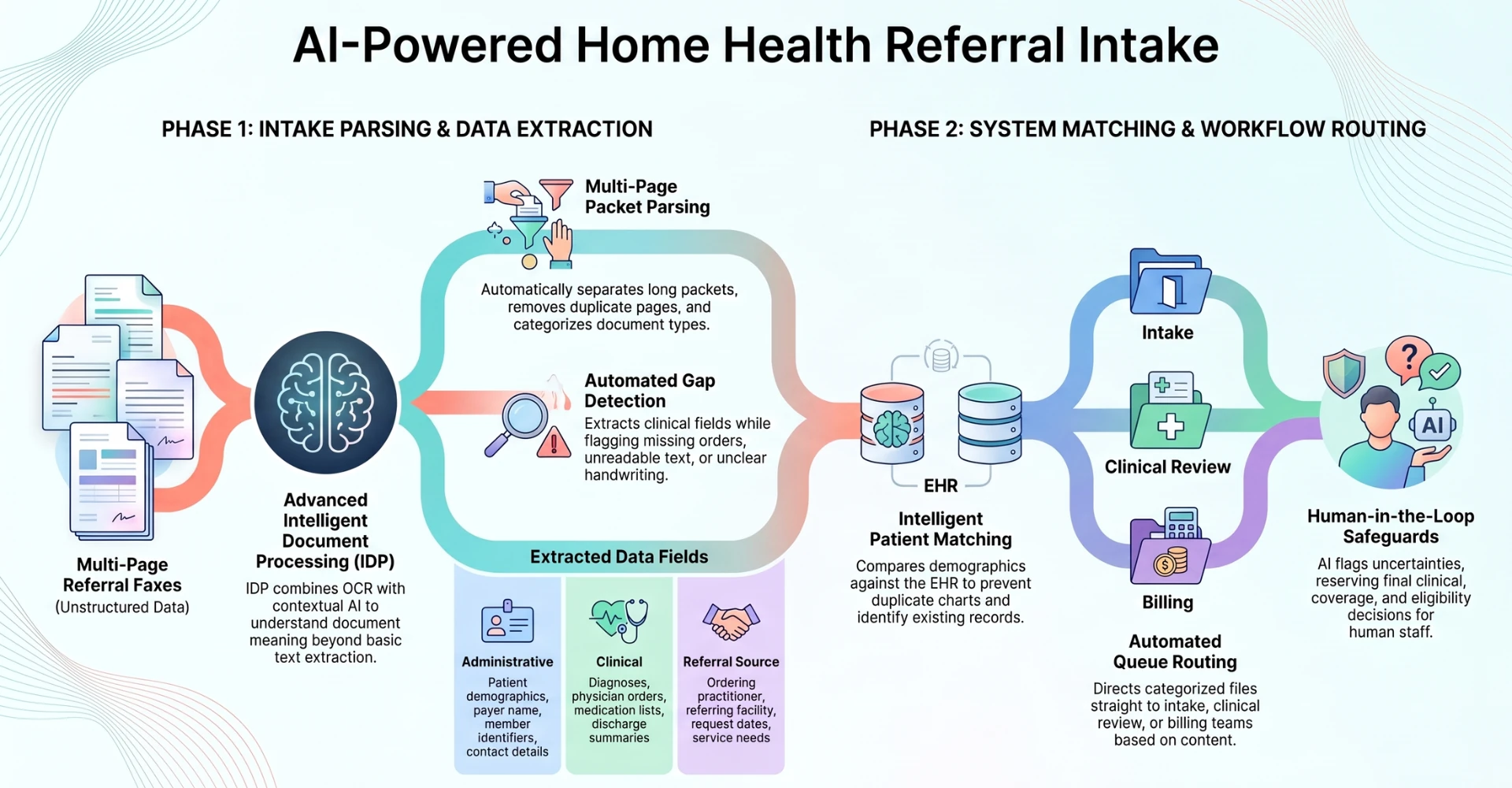
Capabilities vary by system. Uncertain data and patient matches require review; clinical, coverage, and eligibility decisions remain with the appropriate staff.
How Does AI Fax Processing Fit Into the Home Health Referral Intake Workflow?
AI fax processing delivers the most value when it connects to the entire referral intake process rather than stopping after text extraction.
A connected workflow may include these stages:
- Referral receipt: Capture the incoming fax and record when it arrived.
- Document classification: Identify and separate the documents in the packet.
- Patient matching: Compare patient details with existing records and flag potential duplicates.
- Information extraction: Populate structured fields with details from the documents.
- Completeness checks: Identify missing fields, expected documents, and inconsistencies.
- Insurance and authorization workflow: Route coverage or authorization checks to the appropriate team.
- Clinical review: Escalate clinical questions and documentation concerns.
- System update: Transfer approved information and documents to the relevant intake platform or EHR, where supported.
- Follow-up tracking: Record outstanding requests, assigned owners, and completed tasks.
Integration matters. If staff still need to copy every extracted field manually into another system, some of the administrative burden remains.
Before selecting a solution, agencies should confirm which systems it integrates with, whether it can transfer structured data as well as documents, and whether staff can verify information before it is saved.
Which AI Fax and Referral Platforms Should Home Health Agencies Evaluate?
Several healthcare technology vendors offer fax automation, document extraction, or AI-powered referral management. Their capabilities and intended customers differ, so agencies should evaluate them against their specific home health workflow.
Examples of platforms to investigate, based on publicly described product capabilities. Inclusion is not an endorsement or a guarantee of compatibility with every home health EMR.
What does Commure Orchestrator offer?
Commure Orchestrator is an AI-powered referral management and patient intake platform. Commure describes capabilities for automating referral intake, routing, eligibility workflows, and coordination across connected healthcare systems.
Home health agencies should confirm whether the product supports their specific referral sources, intake requirements, and EMR environment before considering implementation.
What does ReferralMD SmartFax AI offer?
ReferralMD SmartFax AI describes capabilities for processing inbound faxes, extracting patient and provider details, classifying documents, matching patient records, and routing referral information to referral workflows or connected EHRs.
Agencies should verify the supported integrations and determine which steps are automated, which require review, and how the solution handles home health-specific documentation.
What does Medsender offer?
Medsender's fax and document automation describes AI capabilities for reading, categorizing, and routing incoming documents, identifying patients, and supporting EHR-connected workflows.
Agencies should validate the available integrations, accuracy on their own referral packets, and suitability for their operational and compliance requirements.
How should agencies compare these platforms?
Instead of choosing a product based on a general claim that it can read faxes, ask vendors to demonstrate the workflow using representative referral packets.
Compare:
- Support for long, multi-page documents.
- Extraction accuracy for key patient and referral fields.
- Patient matching and duplicate detection.
- Missing-document and exception handling.
- Routing and task assignment.
- Integration with the agency's existing EMR or intake platform.
- Human review and correction workflows.
- Security controls, contractual arrangements, and audit trails.
- Pricing, implementation effort, and ongoing support.
Important: A platform designed for general medical practices or specialty referrals may not automatically support every home health workflow. Confirm compatibility with the agency's actual systems and requirements rather than assuming it.
Is AI Fax Processing HIPAA-Compliant?
AI fax processing is not automatically HIPAA-compliant simply because it is marketed for healthcare.
When a vendor creates, receives, maintains, or transmits protected health information (PHI) on behalf of a HIPAA-covered entity in a way that makes the vendor a business associate, HIPAA generally requires an appropriate business associate agreement (BAA) and applicable safeguards.
The U.S. Department of Health and Human Services explains these obligations in its Business Associates guidance.
Before implementing an AI fax-processing tool, agencies should evaluate:
- Business associate arrangements: Determine whether a BAA is required and ensure the appropriate agreement is in place.
- Access controls: Restrict PHI access to authorized personnel.
- Encryption: Review protections for data in transit and at rest.
- Data retention: Understand how original faxes, extracted data, and logs are stored and deleted.
- Third-party processing: Determine whether information is sent to other AI providers or subcontractors and how it is protected.
- Audit trails: Check whether relevant access, changes, and workflow actions can be traced.
- Error management: Establish a process for correcting incorrect data and handling exceptions.
A BAA is an important contractual safeguard where required, but it does not by itself prove that the entire technology deployment meets every applicable HIPAA obligation.
Agencies should not send PHI to a general-purpose AI service without first confirming that the service and its use are appropriate for the information involved.
How Can Home Health Agencies Measure the ROI of AI Fax Automation?
The return on investment depends on how much manual work the technology removes, how accurately it processes documents, and how well it fits into the agency's existing workflow.
Agencies can measure:
- Average staff time spent processing each referral.
- Time spent locating and entering patient information.
- Percentage of extracted fields that are correct.
- Percentage of referrals requiring manual correction.
- Number of potential duplicate records flagged and resolved.
- Time required to identify and resolve missing documents.
- Time from referral receipt to initial review.
- Amount of repeated data entry and manual forwarding.
- Software, integration, training, and support costs.
For example, a system might extract demographics quickly but still require staff to review every field and manually upload each document. Its actual time savings may therefore be lower than the initial demonstration suggests.
A meaningful ROI assessment compares the complete workflow before and after implementation, including exceptions, corrections, follow-up, and ongoing system costs.
Agencies should use their own pilot results rather than assume that vendor-reported accuracy or time savings will apply equally to their documents.
What Are the Limitations of AI in Home Health Referral Fax Processing?
AI can reduce repetitive document work, but several limitations need to be considered.
Poor source quality: Unreadable or cut-off information may not be recoverable.
Incorrect extraction: AI may misread identifiers, dates, medication details, or provider information.
Context errors: A system may extract a statement without recognizing that it refers to a historical condition rather than the patient's current status.
Patient matching errors: Similar names and incomplete identifiers can lead to false matches.
Incomplete packets: AI cannot retrieve a document that was never received unless the workflow connects to another source or requests it.
Eligibility complexity: Finding relevant words in a referral does not establish that all applicable coverage requirements have been satisfied.
Integration gaps: A system may extract information successfully but still require manual work to transfer it into the agency's software.
The best systems make uncertainty visible, preserve source references, support corrections, and route unresolved questions to the appropriate person.
Can AI Replace Home Health Intake Staff?
AI can automate parts of the intake process, but agencies should not assume that fax automation eliminates the need for intake staff.
Technology can help classify documents, extract information, compare records, detect potential gaps, and route tasks. Staff may still need to resolve patient mismatches, request missing documentation, verify coverage details, coordinate with referral sources, and escalate clinical questions.
A practical approach is to automate repetitive, rules-based tasks while allowing staff to focus on exceptions and decisions that require judgment.
The goal is not simply to make the fax disappear. It is to make the work that follows the fax easier to manage.
What Should Home Health Agencies Look for in an AI Fax Processing Solution?
A strong solution should do more than convert a fax into text. It should help transform unstructured documents into accurate, traceable, and actionable referral information.
Before choosing a vendor, ask:
- Can it process the entire multi-page packet?
- Can it identify and separate different document types?
- Can it extract key patient, provider, insurance, and clinical fields?
- Can it compare incoming data with existing patient records?
- Does it flag uncertain matches instead of automatically merging them?
- Can it identify missing fields and documents based on configurable rules?
- Can staff trace extracted information back to its source page?
- Does it integrate with the agency's current EMR and referral workflow?
- Are exceptions easy to review and correct?
- Are appropriate security controls and contractual safeguards available?
- Can the vendor demonstrate measurable results on the agency's own documents?
A pilot using real-world, appropriately protected referral examples can reveal more than a generic product demonstration. Include clean scans, blurry faxes, handwritten notes, duplicate pages, conflicting identifiers, and long packets.
What Is the Future of AI in Home Health Referral Intake?
AI is creating opportunities to move home health referral intake from manual document handling toward more connected workflows.
Instead of simply storing incoming faxes, agencies can use AI to organize information, match patient records, flag potential gaps, and route work to the right team. When connected to appropriate systems, this can reduce repeated data entry and make referral status easier to track.
The value depends on accurate extraction, appropriate integrations, well-designed exception handling, and responsible human review.
The important question is not just whether AI can read a home health referral fax. It is whether it can turn that fax into accurate, traceable information that helps the agency move the referral forward.
Related reading
Home Health Documentation Playbook
The complete guide to OASIS-E, Medicare compliance, PDGM, and AI-assisted documentation. Learn how top agencies reduce documentation time without sacrificing compliance.
Bottom Line
AI can turn referral faxes into structured, traceable information and reduce repetitive intake work. Its value depends on accurate extraction, practical integration, and human review of uncertain information and consequential decisions.
Inside Home Health Podcast
Most Healthcare AI Startups Are Building the Wrong Product | Dr. Sarah Matt

Arvind Sarin is the founder of Copper Digital. He works inside home health agencies to build AI documentation workflows that help clinicians finish OASIS and visit notes sooner, with a nurse reviewing and approving every note. He writes about home health documentation, Medicare compliance, and applying AI responsibly in clinical workflows.
Frequently asked
Frequently asked questions
AI can automate parts of the process, including document classification, data extraction, patient matching support, missing-information checks, and workflow routing. The degree of automation depends on the system and the agency's configuration.
Join the conversation
Leave a comment
No comments yet. Be the first to share your thoughts.
Related reading
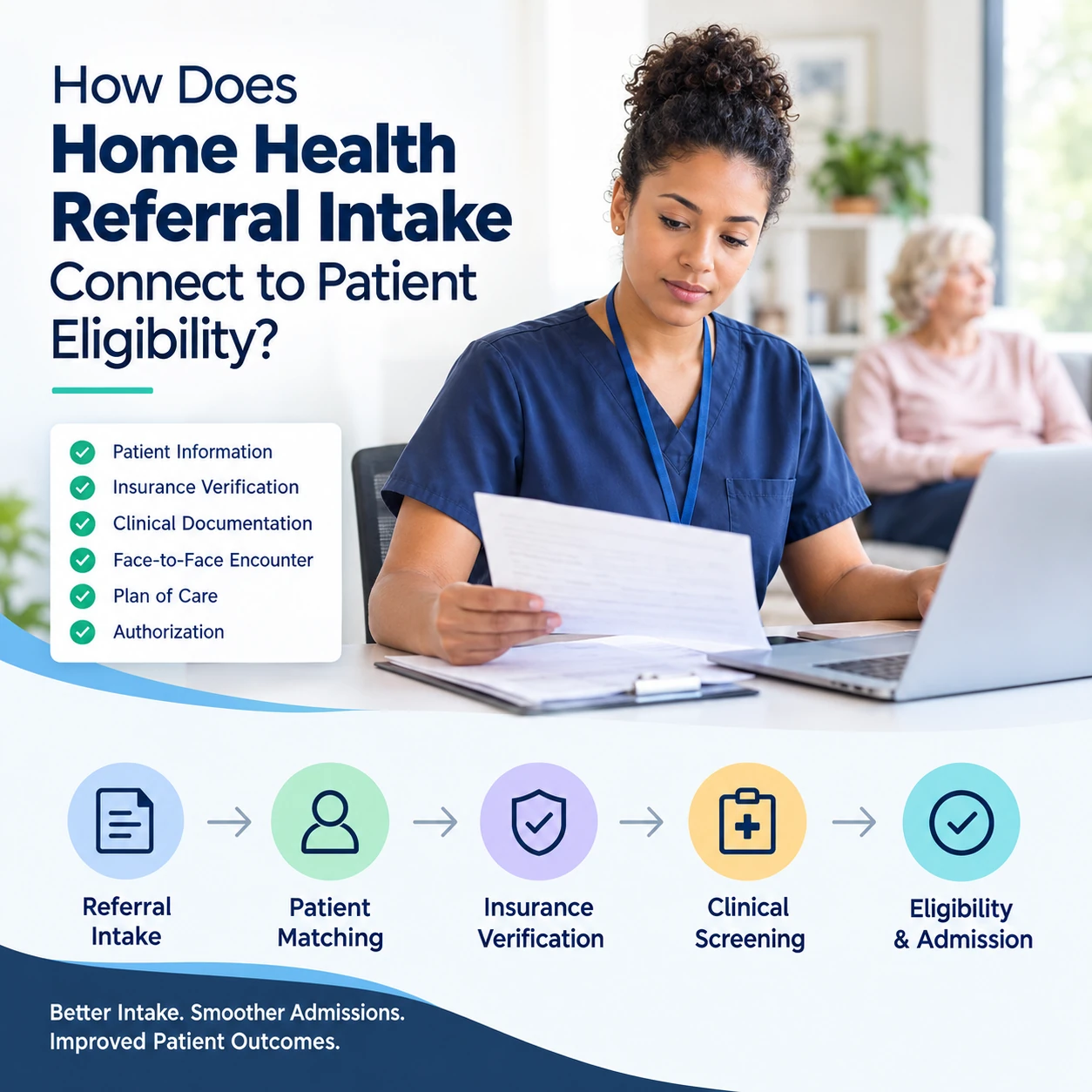
How Does Home Health Referral Intake Connect to Patient Eligibility?
How referral intake connects patient matching, insurance verification, clinical screening, face-to-face documentation, authorization, and the requirements for home health admission.
Top Features to Look for in Home Health Documentation Software
A practical guide to evaluating home health documentation software, including OASIS support, mobile charting, EMR integration, QA, security, workflow automation, and clinician-reviewed AI.
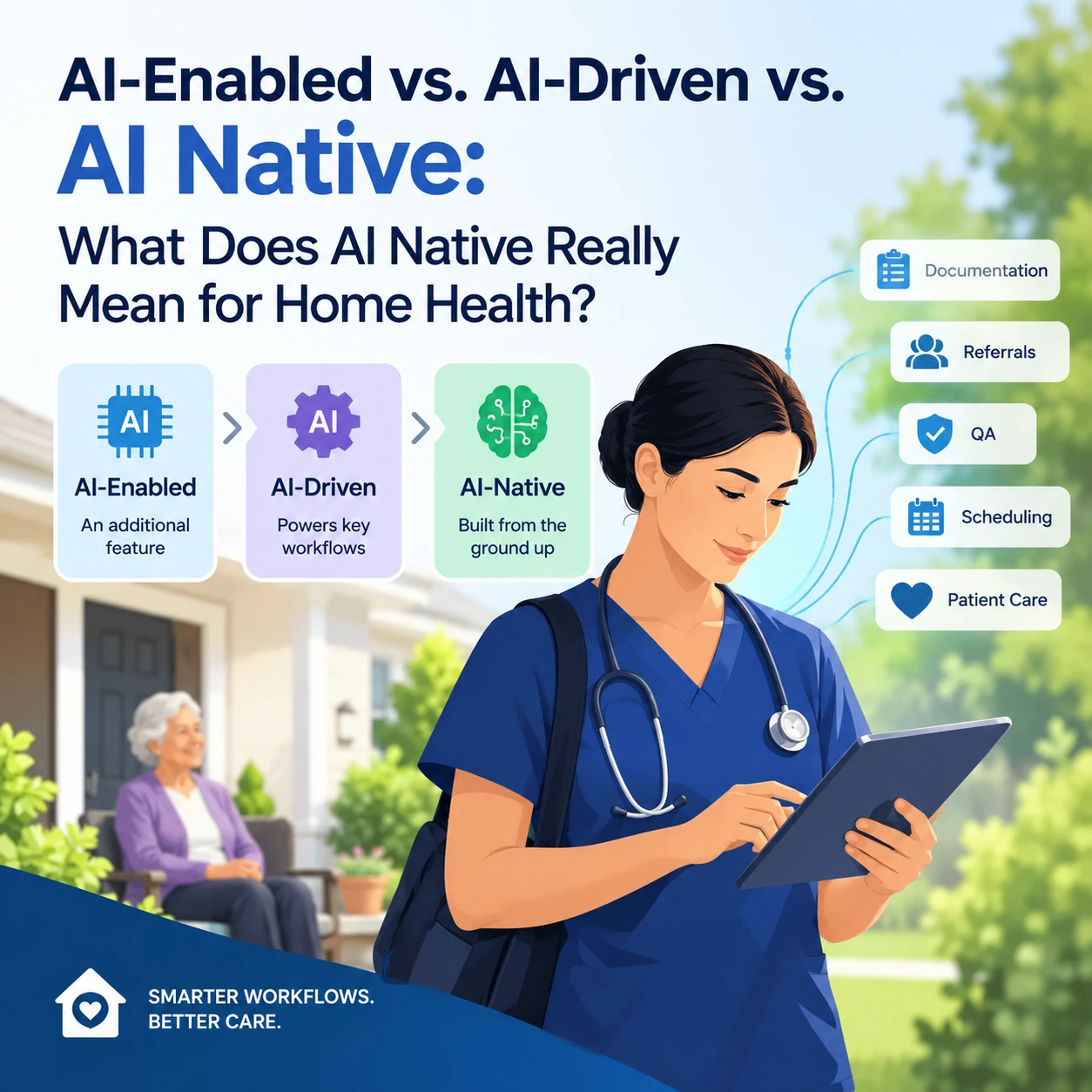
AI-Enabled vs. AI-Driven vs. AI Native: What Does AI Native Really Mean for Home Health?
Understand the difference between AI-enabled, AI-driven, and AI-native home health software—and how to evaluate architecture, connected workflows, governance, and real work reduction.