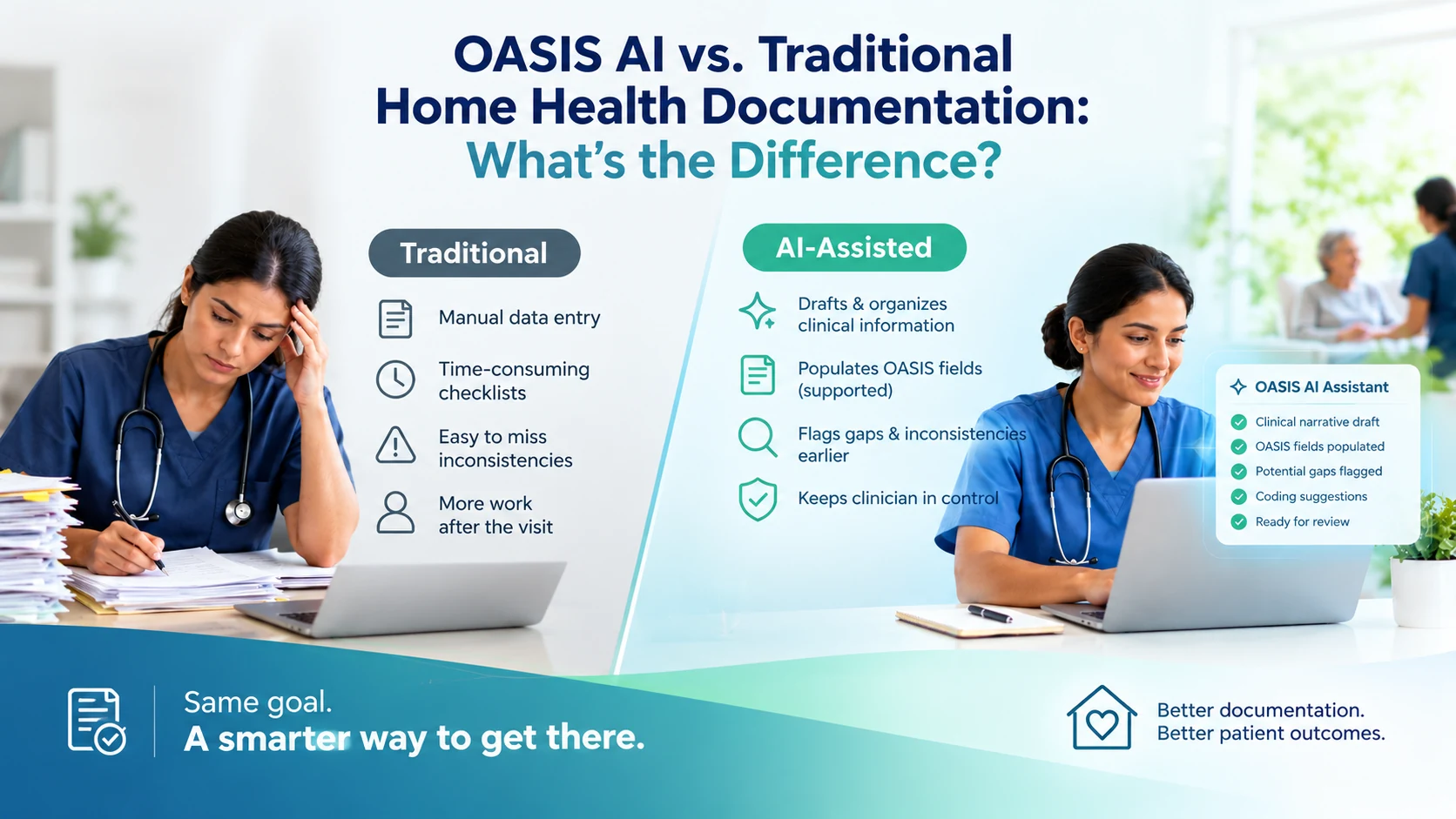
Home health documentation is about more than completing forms. Nurses must capture the patient’s clinical condition, functional abilities, skilled needs, and other assessment details while ensuring the documentation tells a consistent, accurate story.
For many agencies, the traditional process involves manually entering information into the electronic health record (EHR), completing OASIS assessments, and reviewing documentation for missing information or inconsistencies. Much of this work may continue after the patient visit has ended.
OASIS AI documentation offers another approach. Depending on the platform, artificial intelligence can help organize clinical information, draft assessment narratives, populate supported fields, and flag potential documentation gaps for review.
The difference is not simply how quickly a note gets written. It is how information moves from the patient encounter to a completed, reviewed assessment.
What Is OASIS AI Documentation?
OASIS AI documentation uses artificial intelligence to assist with creating, organizing, and reviewing documentation for the Outcome and Assessment Information Set (OASIS) in home health care.
Depending on the software, these capabilities may include:
- Converting spoken clinical information into structured notes.
- Drafting clinical narratives from information gathered during a visit.
- Organizing relevant patient information for OASIS assessments.
- Identifying potentially missing documentation.
- Flagging inconsistencies between assessment responses and clinical narratives.
- Supporting diagnosis coding workflows through code suggestions.
- Preparing documentation for clinician review and approval.
Not every AI documentation tool offers all these features. An ambient AI scribe, for example, may primarily convert a conversation into a note, while a broader documentation platform may support additional assessment and quality-review workflows.
For home health agencies, the distinction matters because OASIS documentation requires more than transcription. The system must help organize clinically relevant information without inventing findings or making unsupported clinical determinations.
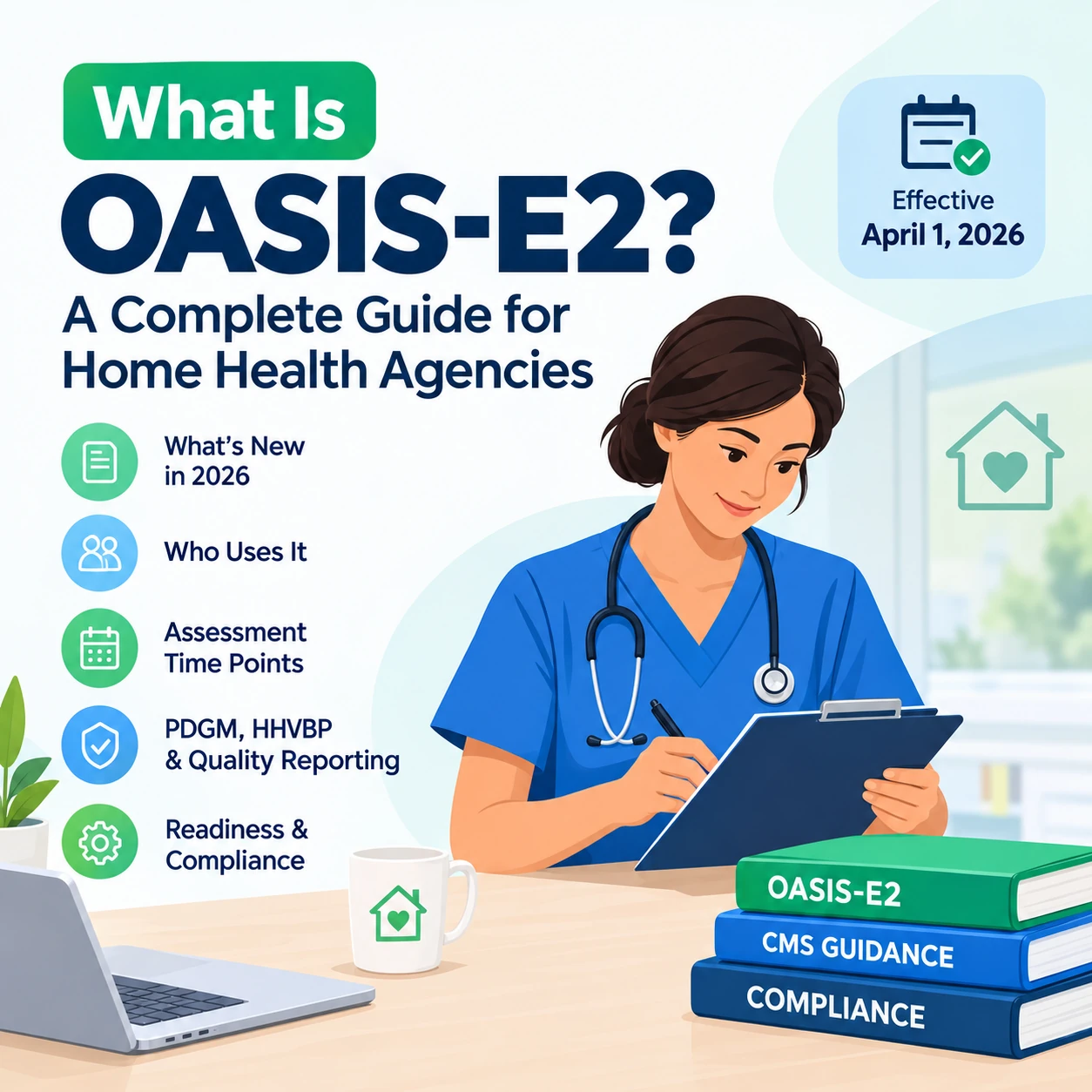
CMS’s current OASIS-E2 guidance and data specifications should remain the reference point for applicable assessment requirements. OASIS-E2 became effective April 1, 2026.
Reference: CMS OASIS user manuals and OASIS data specifications.
How Is OASIS AI Documentation Different From Traditional Documentation?
The primary difference is how much of the documentation workflow is supported by automation.
Traditional documentation generally relies on clinicians entering information into the EHR, completing assessment fields, and checking the record manually or through separate quality-review processes. AI-assisted documentation can help draft and organize information and, where supported, identify potential gaps before the assessment is finalized.
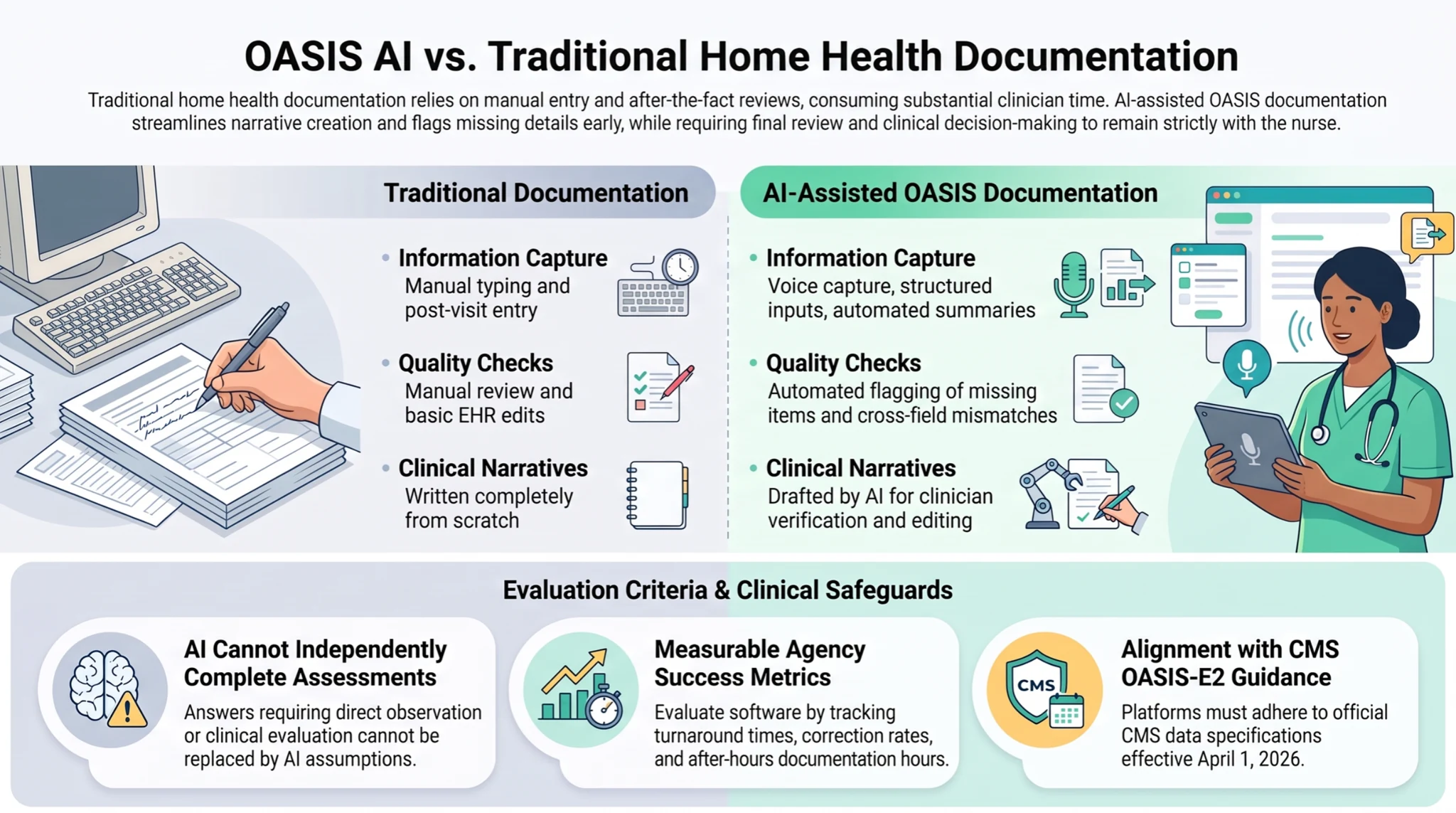
| Area | Traditional documentation | AI-assisted OASIS documentation |
|---|---|---|
| Information capture | Manual entry, typing, and clinician notes | May use voice capture, structured inputs, and other supported sources |
| Clinical narratives | Written or edited manually | Drafted or organized by AI for clinician review |
| OASIS fields | Entered and selected by the clinician | May assist with supported fields using available clinical information |
| Documentation checks | Manual review and configured EHR edits | May flag potential gaps or inconsistencies earlier in the workflow |
| Coding support | Manual coding workflows and existing tools | May provide coding suggestions, depending on the platform |
| Final approval | Clinician review | Clinician review remains essential |
The important qualification is that AI capabilities vary by product. Agencies should evaluate what a platform actually does rather than assume that every tool marketed as an AI scribe can complete OASIS-specific workflows.
Can AI Complete OASIS Assessments Automatically?
AI can assist with drafting and organizing parts of an OASIS assessment, but it should not independently determine clinical answers that require professional assessment and judgment.
For example, an AI tool may organize information about a patient’s mobility, medication history, or reported symptoms. It may also identify relevant details that the clinician can consider when completing the assessment.
However, information captured in a conversation does not necessarily establish the answer to an OASIS item. Some responses require direct observation, clinical evaluation, clarification, or information from other parts of the record.
A responsible AI workflow should therefore:
- Use information available from appropriate sources.
- Distinguish documented facts from assumptions or missing information.
- Flag questions that require clarification rather than inventing an answer.
- Allow the clinician to correct or complete the draft.
- Preserve clinician responsibility for the final assessment.
The goal is to reduce repetitive documentation work while keeping clinical decisions with the qualified professional.
How Does AI Help Improve OASIS Documentation Quality?
AI can support documentation quality by helping clinicians identify potential omissions and inconsistencies before finalizing an assessment.
For example, a clinical narrative may describe a patient’s functional abilities in a way that appears inconsistent with a selected assessment response. A documentation tool with appropriate validation capabilities may flag the discrepancy for review.
This can help direct attention to issues such as:
- Missing details needed to support a response.
- Conflicting statements across sections of the record.
- Incomplete clinical narratives.
- Potential mismatches between documented findings and selected assessment items.
- Information that needs clarification before the assessment is finalized.
These alerts are prompts for review, not proof that an assessment is incorrect. A mismatch may have a legitimate clinical explanation, and an AI system can also generate inaccurate suggestions.
AI-assisted checks should complement, not replace, clinician judgment, established quality assurance processes, and applicable CMS guidance.
Does OASIS AI Documentation Save Nurses Time?
OASIS AI documentation can reduce the amount of manual typing, repetitive data entry, and administrative rework required to complete an assessment. The actual time saved depends on the tool, the complexity of the patient encounter, the quality of the information captured, and how well the software fits the agency’s workflow.
Consider a traditional workflow in which a nurse completes a visit, remembers important details, enters information into the EHR, and then revisits the assessment when quality assurance identifies a missing or inconsistent item.
An AI-assisted workflow may draft parts of the documentation from available information and flag potential gaps before submission. The nurse can then review the draft, correct errors, and complete the assessment.
The potential benefit is not that every assessment becomes automatic. It is that the clinician may spend less time starting from a blank page and correcting avoidable documentation problems.
Agencies evaluating these tools should measure:
- Time from visit completion to finalized documentation.
- Time spent reviewing and correcting AI-generated drafts.
- Frequency of documentation returned for correction.
- Amount of documentation completed after scheduled working hours.
- Time from completed documentation to quality review and billing readiness.
These measures provide a more meaningful picture of operational impact than a general claim about minutes saved per assessment.
Can OASIS AI Reduce Documentation Errors and Compliance Risks?
AI can help identify potential documentation issues, but it cannot guarantee error-free assessments, compliance, or claim payment.
Traditional workflows may rely on clinician checks, EHR validation rules, and quality assurance reviews. AI tools can add another layer of assistance by examining supported information and surfacing potential contradictions or gaps.
However, automated checks have limitations. A system may overlook a problem, flag a valid clinical difference, or suggest information that does not adequately reflect the patient’s condition.
Home health agencies should evaluate whether their chosen solution:
- Supports the applicable OASIS version and assessment requirements.
- Identifies the source of information used to generate a draft.
- Flags uncertainty and missing information clearly.
- Maintains an appropriate clinician review and approval process.
- Fits the agency’s existing quality assurance and documentation policies.
- Provides suitable access controls and safeguards for patient information.
AI should help clinicians produce clearer, better-supported documentation. It should not be treated as a substitute for compliance oversight or a guarantee against audits, denials, or other reimbursement problems.
What Should Home Health Agencies Look for in OASIS AI Software?
Home health agencies should assess AI documentation software based on its actual capabilities, clinical safeguards, workflow fit, and measurable results.
Before choosing a solution, ask vendors the following questions:
1. Does it support OASIS-specific workflows?
Confirm which assessment types and documentation tasks are supported. Do not assume that a general-purpose medical AI scribe can handle home health-specific requirements.
2. Can it identify potential documentation gaps?
Ask whether the software checks for missing information, conflicting narratives, and other issues relevant to the agency’s quality-review process.
3. Does it distinguish suggestions from clinical decisions?
The system should make it clear when information is incomplete or when a clinician must make a determination.
4. Does it fit the existing EHR workflow?
Understand how information moves into the agency’s current system, what requires manual transfer, and whether staff must maintain duplicate workflows.
5. Can the agency measure the results?
Track documentation turnaround time, correction rates, review workload, and clinician experience before and after implementation.
6. How is patient information protected?
Evaluate access controls, data handling, retention, vendor agreements, and the organization’s applicable privacy and security requirements.
The right solution should address the specific documentation bottlenecks an agency experiences, rather than simply adding another tool for nurses to manage.
Is OASIS AI Better Than Traditional Home Health Documentation?
OASIS AI can be useful when an agency needs to reduce repetitive data entry, organize clinical information, and identify potential documentation gaps. Traditional documentation workflows still provide direct clinician control and may be sufficient for agencies with manageable documentation volumes and effective existing processes.
For many agencies, the most practical approach is a combination of both: AI assists with drafting and review, while clinicians verify the information, make clinical determinations, and approve the final record.
The better choice depends on the agency’s current workflow, documentation challenges, technology environment, and ability to implement appropriate oversight.
Ultimately, successful OASIS AI adoption should be measured by whether it helps produce accurate, complete, clinically supported documentation with less avoidable administrative work, not by how much of the assessment the software claims to automate.