
Texas Home Health Payer Contracting Playbook
A practical guide for agency owners and administrators in Dallas-Fort Worth and Houston
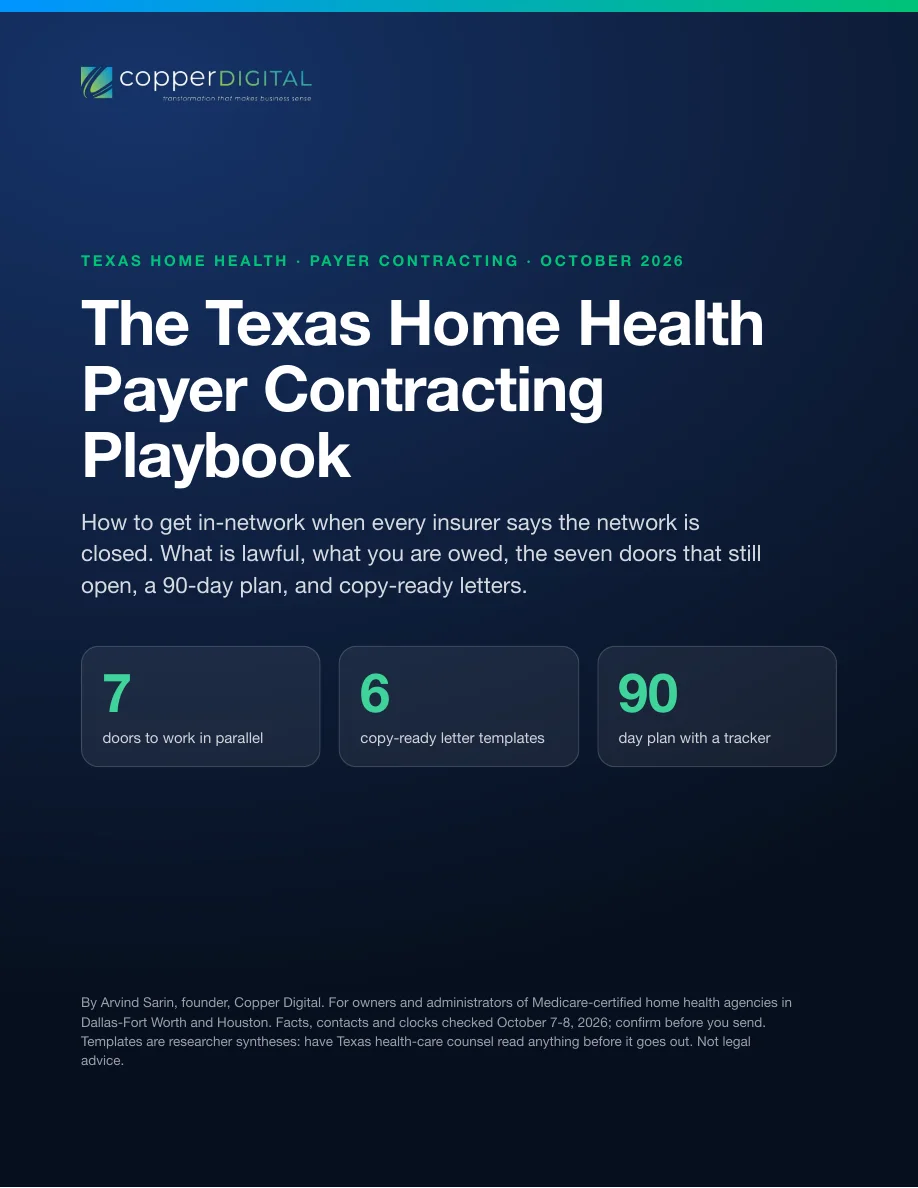
When a Texas payer says “our network is closed,” it doesn’t mean every door is shut. This playbook explores three paths to pursue payer contracts, access referral networks, and secure out-of-network payments. Learn which three numbers payers check first, and how to build a stronger case for your agency.
- 27pages
- 7routes to explore
- 6letter templates
- 90day action plan
Companion video
Watch the Video: Texas Home Health Payer Contracting
A companion video to the Texas Home Health Payer Contracting Playbook, exploring payer contracting for Texas home health agencies. Use it alongside the playbook’s checklists, payer maps, and letter templates.
Get the Free PlaybookWhy this playbook
A closed-network response is a starting point for investigation, not a promise that a contract is available. This playbook organizes seven routes to explore across payer contracting, referral access, and potential out-of-network payment, supported by an evidence packet and a 90-day action plan.
What’s inside
12 sections, from first response to follow-through
Start with the network context, then use the payer maps, evidence checklist, and templates to prepare your next conversation. The playbook includes a separate section explaining what could not be verified.
Understand the network and your options
- 1The problem in one page
- 2Why “closed” is lawful, and who really gates the network
- 3The seven doors, in priority order
- 4The payer maps
Build your case and plan your outreach
- 5The three numbers to fix before you apply
- 6The packet checklist
- 7The 90-day plan and the tracker
- 8Templates, short form
Evaluate the economics and the evidence
- 9The economics: rates, break-even, red flags, and when to walk away
- 10Five mistakes the record shows
- 11What we could not verify
- 12Sources
What you’ll gain
What you’ll learn about payer contracting
Understand why Medicare Advantage and other payer networks may decline new agency applications.
Identify the contracting decision-maker and distinguish network capacity, credentialing, and economic issues.
Explore payer applications, delegated networks, hospital discharge lists, and referral opportunities.
Review out-of-network payment, exceptions, veterans’ community care, and workers’ compensation options.
Prepare hospitalization, discharge-to-community, and HHCAHPS performance information for payer discussions.
Build an evidence-based contracting packet and organize follow-up with a 90-day plan.
Key takeaways
- Work the seven routes in parallel, while confirming the requirements for the specific payer, product, and service area.
- Separate network contracting from patient-specific authorization and payment requests.
- Support requests with verified performance information, capacity, and privacy-reviewed evidence.
- Evaluate offers against your own costs; the playbook does not guarantee contracts, referrals, or payment.
Get the complete playbook — free
27 pages, seven routes to explore, six letter templates, and a 90-day action plan. No payment required.
eBook FAQ
Frequently Asked Questions About Texas Home Health Insurance Contracts
Medicare Advantage plans may limit their provider networks when they believe they have enough agencies to serve members. A closed network can also mean the agency applied through the wrong channel, has incomplete credentials, or has an existing contract issue.