
What Is an ABN in Home Health & Hospice? Complete Guide With Billing Instructions
A patient wants to continue care, but Medicare may not pay for it. Who owes the bill? That's where the Advance Beneficiary Notice of Noncoverage (ABN), Form CMS-R-131, comes in. Here's when it's required in home health and hospice, what makes it valid, the beneficiary's three choices, and how to bill it correctly.

Key Takeaways
- An ABN (Advance Beneficiary Notice of Noncoverage, Form CMS-R-131) informs an Original Medicare beneficiary of expected noncoverage and, when valid, transfers potential financial liability.
- It applies to Original Medicare Fee-for-Service only; Medicare Advantage plans have their own notice and billing rules.
- In home health, an ABN may be required when the patient isn't homebound, doesn't need intermittent skilled care, or the service isn't reasonable and necessary; hospice ABN use is very limited (three CMS situations).
- An ABN must be issued before the potentially noncovered service, using the current CMS form, with the reason, estimated cost, and the beneficiary's option documented.
- A signed ABN does not automatically mean patient liability or an automatic GA modifier; GA, GX, GY, and GZ each have distinct purposes, and Part A claims use occurrence code 32 for the ABN date.
- An ABN is not the same as an HHCCN (plan-of-care change) or a NOMNC (services ending); using the wrong notice is a common, costly mistake.
✓ Quick answer: An ABN (Advance Beneficiary Notice of Noncoverage, Form CMS-R-131) is a Medicare notice used when an Original Medicare beneficiary may receive a service that Medicare is expected not to cover in the specific circumstances. The agency must determine whether the ABN requirement applies, issue the current form before the service, explain the potential noncoverage, document the beneficiary's choice, and follow the correct billing rules.
A patient wants to continue receiving care, but Medicare may not pay for it. Who is responsible for the bill?
That is where the Advance Beneficiary Notice of Noncoverage (ABN) can become important.
For home health agencies and hospices, an ABN is more than a form that says Medicare may not pay. It is a specific Medicare beneficiary notice used in applicable situations to inform an Original Medicare beneficiary of expected noncoverage and, when the requirements are met, transfer potential financial liability to the beneficiary.
For agencies, the important questions are when an ABN is actually required, what makes it valid, when it should be issued, what happens if the patient refuses to sign, which beneficiary option to select, how to bill the claim, and when GA, GX, GY, or GZ should be used.
ℹ️ Important: This article focuses on Original Medicare Fee-for-Service. Medicare Advantage and other payer arrangements have different notice and billing requirements. CMS's ABN applies to Original Medicare FFS beneficiaries.
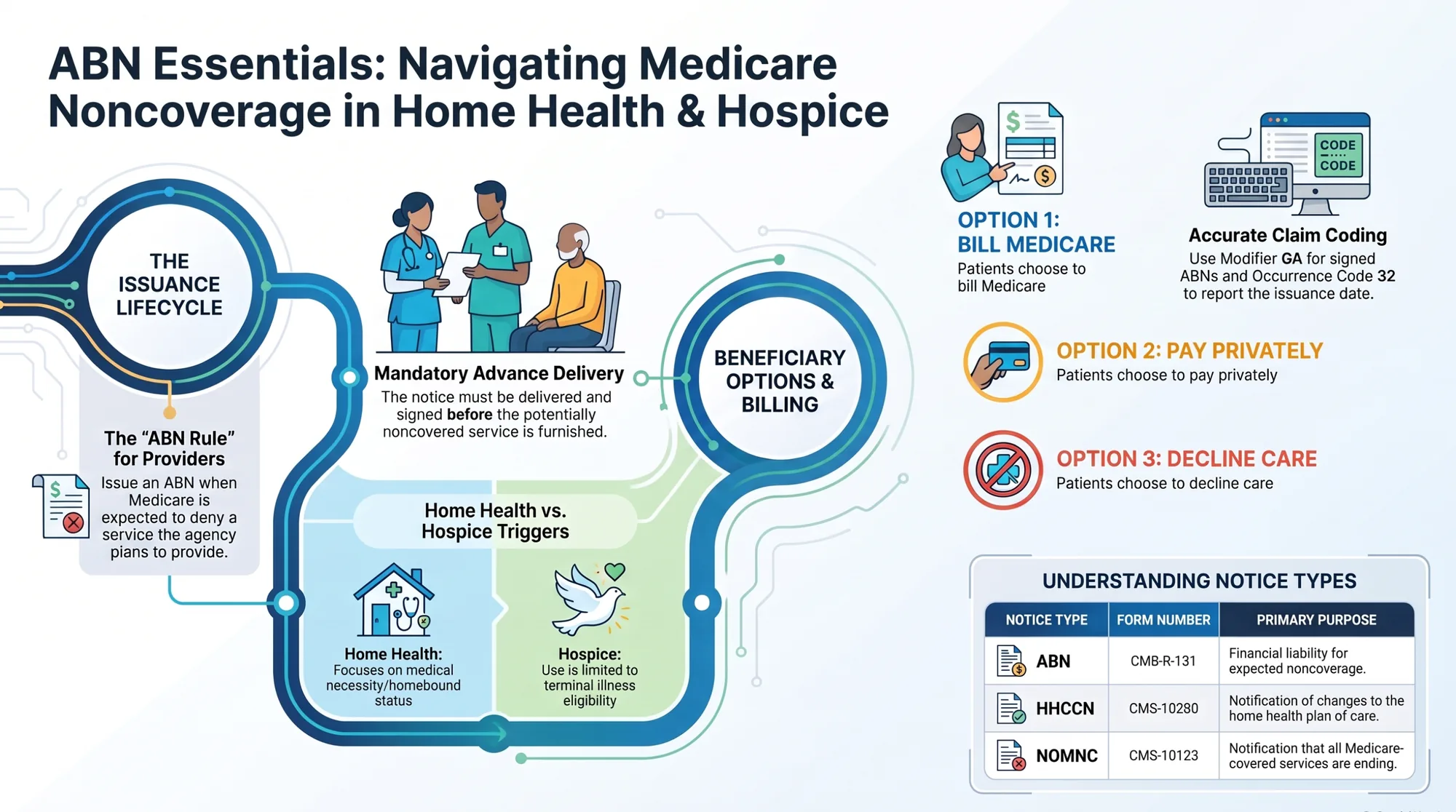
ABN essentials: issue the notice before the potentially noncovered service, understand the home-health vs hospice triggers, give the beneficiary three options, and code the claim correctly (modifier GA, occurrence code 32). The ABN, HHCCN, and NOMNC each serve a different purpose.
What Does ABN Stand for in Medicare?
ABN stands for Advance Beneficiary Notice of Noncoverage. The official Medicare form is Form CMS-R-131.
The ABN is issued to an Original Medicare beneficiary when a provider, including a home health agency or hospice, expects Medicare to deny payment for an item, service, or care that Medicare generally covers but may not cover in the particular situation. Its purpose is to inform the beneficiary and, when applicable, transfer potential financial liability.
CMS updated its ABN materials in April 2026, including the form and tutorial. Agencies should therefore use the current CMS-approved form rather than an older version saved internally.
What Is the Basic ABN Rule for Home Health and Hospice?
The basic concept is: Medicare may deny the service, and the agency expects to provide the service anyway, so the agency must determine whether an ABN is required. For example, imagine a home health patient has reached the goals of physical therapy but wants to continue receiving additional therapy visits.
If Medicare is expected to deny those additional services, the agency needs to determine whether an ABN is required and, if so, issue it according to CMS requirements before providing the applicable service.
The ABN is therefore not about refusing care. It is about giving the beneficiary information about potential financial responsibility before the potentially noncovered care is provided.
When Is an ABN Required in Home Health?
CMS's current ABN guidance specifically identifies home health situations in which an ABN may be required, including when:
- The beneficiary is not confined to the home.
- The beneficiary does not need intermittent skilled nursing care.
- The service is not reasonable and necessary.
- Other applicable Medicare coverage requirements are not met.
A common practical example is a patient who wants to continue therapy after the Medicare-covered clinical need has ended. However, agencies should not assume that every service Medicare may not pay for automatically requires an ABN.
The reason for expected noncoverage matters.
What Is a Common Home Health ABN Example?
Consider this situation: a patient has achieved the established goals of physical therapy, and the clinician determines that additional skilled therapy is no longer medically reasonable and necessary under Medicare's coverage requirements. The patient, however, wants to continue receiving therapy for personal preference or comfort.
If the agency plans to provide the additional service and the applicable ABN requirements are met, the agency should provide the ABN before furnishing the potentially noncovered care. The patient can then make an informed choice about whether to receive the service.
When Is an ABN Required in Hospice?
Hospice ABN use is much more limited than many agencies assume. CMS states that mandatory ABN use for hospice is limited to three principal situations:
- The beneficiary is determined not to be terminally ill.
- A specific item or service billed separately from the hospice payment is not reasonable and necessary.
- The level of hospice care is determined not to be reasonable or medically necessary for management of the terminal illness or related conditions.
This means agencies should not treat an ABN as a routine admission notice for every noncovered hospice item or service. Hospice has additional beneficiary communication requirements, and the correct notice depends on the situation.
Is an ABN Commonly Issued at Hospice Admission?
Not as a general rule. CMS states that mandatory use of the ABN is very limited for hospices.
One circumstance in which a hospice ABN may be required is when the beneficiary is determined not to be terminally ill under the applicable Medicare hospice requirements.
Hospice agencies should therefore distinguish between the ABN, other hospice beneficiary communications, notices concerning noncovered items or services, and notices associated with termination of Medicare-covered care. The ABN should not be used as a catch-all hospice noncoverage notice.
What Makes an ABN Valid?
CMS's ABN guidance identifies several requirements for a valid notice. The agency should:
- Use the current CMS-approved ABN form.
- Complete the form fully.
- Clearly identify the service or care involved.
- Explain why Medicare is expected not to pay.
- Provide the applicable estimated cost.
- Explain the beneficiary's options.
- Ensure the beneficiary understands the notice.
- Obtain the beneficiary's signature and date, or appropriately document a refusal.
- Give the beneficiary a copy.
- Retain the completed notice in the agency's records.
CMS's ABN tutorial specifically emphasizes using the current approved form, completing the entire form, ensuring the patient understands the notice, and obtaining the patient's signature.
When Should an ABN Be Issued?
An ABN is an advance notice. It should generally be delivered before the potentially noncovered service is provided when the applicable requirements are triggered.
The timing matters because the purpose is to allow the beneficiary to make an informed decision before receiving care that may result in financial responsibility.
⚠️ Simple rule: Do not provide the potentially noncovered service first and try to fix the notice later. A retroactive notice may not provide the intended beneficiary-liability protection.
What Should Be Written on the ABN?
The ABN should tell the beneficiary what service or care may not be covered, why Medicare may not pay, how much the beneficiary may have to pay, what options are available, and how the beneficiary can make a decision. The reason should be specific to the patient's situation.
For example, instead of "Medicare may not cover this service," a more useful explanation would identify the actual coverage issue, such as: "Medicare may not cover additional therapy because the service is not considered medically reasonable and necessary under the applicable coverage requirements." The agency should use wording that accurately reflects the applicable Medicare coverage issue.
How Long Does an ABN Remain Valid?
An ABN is not automatically a permanent authorization for every future service. CMS guidance indicates that an ABN can remain effective when there is no change in the care described on the ABN, the individual's health status that would require a change in treatment, or the applicable Medicare coverage guidelines for the item or service.
If one of those circumstances changes, the agency should reassess whether a new ABN is required.
What Are the Three Beneficiary Choices on an ABN?
The beneficiary generally has three choices on the ABN.
| Option | What it means |
|---|---|
| Option 1 | Receive the service and ask the agency to bill Medicare. |
| Option 2 | Receive the service but not have the agency bill Medicare. |
| Option 3 | Decline the service. |
The beneficiary's selection should be documented on the ABN. The purpose is to allow the beneficiary to make an informed decision rather than simply obtain a signature.
What Happens If the Beneficiary Chooses to Bill Medicare?
Under Option 1, the beneficiary elects to receive the service and have the agency submit the claim to Medicare. If Medicare denies the claim and the ABN was properly issued, the beneficiary may be financially responsible under the applicable Medicare rules.
The agency should then follow the appropriate claim-submission and billing requirements. A signed ABN does not guarantee that Medicare will deny the claim or that the beneficiary will automatically owe the estimated amount.
What Happens If the Beneficiary Wants to Pay Privately?
Under Option 2, the beneficiary elects to receive the service without having the agency bill Medicare. The agency should follow applicable Medicare and billing requirements concerning private payment.
A signed ABN should not be treated as a blanket authorization to collect any amount in any circumstance. The exact billing arrangement should be consistent with the beneficiary's election and applicable Medicare rules.
What Happens If the Beneficiary Declines the Service?
Under Option 3, the beneficiary declines the potentially noncovered service. The agency should document the decision according to its policies and applicable requirements.
What Happens If the Beneficiary Refuses to Sign the ABN?
A beneficiary can refuse to sign an ABN. The agency should document the refusal according to CMS requirements.
In applicable situations, a witness may be required to document that the notice was presented and the beneficiary refused to sign. A refusal does not simply mean the agency should write "patient refused" and move on.
The agency should retain evidence that:
- The ABN was presented.
- The beneficiary had an opportunity to review it.
- The beneficiary refused to sign.
- The refusal was properly documented.
- Any applicable witness requirement was satisfied.
CMS billing guidance also recognizes circumstances in which the GA modifier may be used on an assigned claim when the beneficiary refuses to sign, and the refusal is properly witnessed.
What Should the Agency Keep in the Patient Record?
A strong ABN record should include the completed ABN, date issued, service or care described, reason for expected noncoverage, estimated cost, the beneficiary's selected option, signature and date (when applicable), documentation of refusal (when applicable), witness information (when applicable), a copy provided to the beneficiary, relevant clinical documentation, related billing information, the subsequent Medicare determination, and any applicable refund or adjustment documentation.
What Happens If an Agency Does Not Issue a Required ABN?
If an agency was required to issue an ABN but failed to do so properly, it may lose the ability to transfer financial liability to the beneficiary. In practical terms, the agency may have to absorb the cost of a denied service rather than bill the beneficiary.
Repeated ABN problems can also carry broader compliance consequences, including additional review and patterns of noncompliance. However, agencies should not assume that every ABN error automatically triggers an ADR, prepayment review, or provider termination.
Those are separate Medicare compliance processes, as covered in our beginner's guide to Medicare ADRs.
Can ABN Errors Lead to Medicare Compliance Problems?
Potentially. Repeated errors involving beneficiary notices, billing, or financial liability can create compliance concerns and may contribute to additional scrutiny.
For an agency, the bigger issue is often the pattern: an incorrect notice leads to incorrect billing, which leads to a beneficiary-liability problem, then a claim review, and potentially additional compliance scrutiny. That is why ABN management should be treated as part of the agency's overall compliance and billing process.
What Is the Difference Between an ABN and an HHCCN?
The ABN and HHCCN serve different purposes.
| Feature | ABN | HHCCN |
|---|---|---|
| Full name | Advance Beneficiary Notice of Noncoverage | Home Health Change of Care Notice |
| Form | CMS-R-131 | CMS-10280 |
| Main purpose | Potential financial liability for expected Medicare noncoverage | Notification of applicable home health plan-of-care changes |
| Used by | Providers including HHAs and hospices in applicable situations | Home health agencies |
| Key issue | Medicare payment / noncoverage | Reduction, termination, or change in home health services |
| Can one replace the other? | No | No |
CMS states that HHAs use the HHCCN to notify Original Medicare beneficiaries of applicable plan-of-care changes, including reductions or terminations of items or services.
What Is the Difference Between an ABN and a NOMNC?
The NOMNC, or Notice of Medicare Non-Coverage, serves a different purpose from the ABN. The ABN addresses potential financial liability when Medicare is expected not to pay in an applicable situation.
The NOMNC is associated with ending Medicare-covered services under applicable termination-of-services rules. CMS identifies the ABN, HHCCN, NOMNC, and DENC as separate beneficiary notices.
Which Medicare Notice Should a Home Health Agency Use?
A simple way to think about the notices is:
| Situation | Potential notice |
|---|---|
| Medicare may not pay for a normally covered service in this specific situation | ABN (CMS-R-131) |
| HHA is reducing or terminating services under applicable plan-of-care circumstances | HHCCN (CMS-10280) |
| Medicare-covered services are ending under applicable termination rules | NOMNC |
| Beneficiary needs the applicable detailed explanation after a noncoverage determination | DENC, when applicable |
The exact notice depends on the circumstances and applicable Medicare requirements.
Which Medicare Notice Should a Hospice Use?
Hospice should not assume that every noncovered service requires an ABN. CMS's mandatory hospice ABN situations are limited to: the beneficiary is not terminally ill; a separately billed item or service is not reasonable and necessary; or the hospice level of care is not reasonable and necessary for management of the terminal illness or related conditions.
Other hospice beneficiary communications may apply depending on the situation.
What Is the ABN Billing Process for Home Health and Hospice?
The billing workflow can be summarized as:
Identify potential noncoverage → determine whether an ABN is required → complete current CMS-R-131 → issue the ABN before the applicable service → explain the notice to the beneficiary → beneficiary selects an option → document signature or properly documented refusal → provide beneficiary a copy → provide the service if applicable → submit the claim using applicable Medicare billing rules → retain the ABN and supporting records.
The key is that the ABN itself and the claim are two connected but separate compliance steps.
What Is Modifier GA?
Modifier GA indicates that a required ABN has been issued when the provider expects Medicare to deny the service under applicable reasonable-and-necessary provisions. CMS describes GA as the waiver-of-liability statement issued as required by payer policy.
For applicable Part A claims, CMS guidance also associates the ABN with occurrence code 32 and the ABN date.
⚠️ Important: A signed ABN does not mean GA should automatically be appended to every claim. The modifier depends on the applicable claim and Medicare billing circumstances.
What Is Occurrence Code 32?
Occurrence code 32 identifies the date the ABN was issued on applicable Part A claims. CMS billing guidance states that when applicable Part A claims are submitted, occurrence code 32 and the date of the ABN are required.
The billing team should therefore make sure that the ABN was actually issued, the date is accurate, the claim corresponds to the ABN, and the applicable modifier and occurrence-code requirements are satisfied.
What Are GA, GX, GY, and GZ Modifiers?
These modifiers are often grouped together, but they have different purposes.
| Modifier | General purpose |
|---|---|
| GA | Required ABN is on file for an anticipated denial under applicable reasonable-and-necessary provisions |
| GX | Voluntary notice of liability issued when an ABN is not required but was provided |
| GY | Item/service is statutorily excluded or does not fall within a Medicare benefit category |
| GZ | Provider expects denial for lack of reasonable and necessary coverage but did not obtain an ABN |
CMS provides these distinctions in its Medicare billing guidance. Do not choose a modifier simply because a service "probably won't be paid." The specific reason for denial and the applicable Medicare billing rules determine which modifier, if any, is appropriate.
How Does Hospice ABN Billing Work?
Hospice billing requires additional care because hospice services are generally paid under the Medicare Part A hospice benefit and bundled payment structure. For example, CMS has specific instructions concerning hospice levels of care and separately billable services.
In certain hospice situations involving an ABN, billing may involve the ABN, applicable occurrence code 32, the date the ABN was issued, the applicable claim and billing instructions, and review by the Medicare contractor.
CMS's Claims Processing Manual specifically addresses ABN use for hospice and states that mandatory hospice ABN use is limited. Hospice billing teams should therefore avoid applying ordinary outpatient ABN billing assumptions to every hospice claim.
Can an ABN Be Used for Medicare Advantage?
No. The CMS ABN is for Original Medicare Fee-for-Service.
CMS's Beneficiary Notices Initiative specifically identifies the ABN under Original Medicare FFS. Medicare Advantage plans have their own beneficiary-notice and billing requirements.
Is an ABN Required for Every Noncovered Service?
No. This is an important distinction.
An ABN is generally associated with services Medicare usually covers but expects to deny in the specific circumstances. Services that are categorically excluded from Medicare coverage or outside a Medicare benefit category can have different rules.
For those situations, the agency should determine whether a voluntary notice or another billing mechanism is appropriate rather than assuming that a mandatory ABN is required. CMS's billing guidance distinguishes statutory exclusions from services expected to be denied as not reasonable and necessary.
What Happens If Medicare Pays After an ABN Is Issued?
A signed ABN does not guarantee that Medicare will deny a claim. If Medicare ultimately pays, the agency must follow the applicable Medicare billing and payment rules, including any required adjustment or refund.
The beneficiary's financial responsibility should therefore not be treated as automatic simply because an ABN was signed.
What Are Common ABN Mistakes?
Common mistakes include:
- Using an outdated CMS-R-131.
- Issuing the ABN after the service was provided.
- Leaving required fields incomplete.
- Using vague wording.
- Failing to explain why Medicare may not pay.
- Failing to provide an estimated cost.
- Not explaining the beneficiary's options.
- Failing to document understanding.
- Failing to document a refusal properly.
- Not giving the beneficiary a copy.
- Not retaining the agency copy.
- Automatically using GA whenever an ABN is signed.
- Confusing the ABN with the HHCCN.
- Confusing the ABN with the NOMNC.
- Treating hospice ABNs as routine admission notices.
- Failing to connect the ABN documentation with the claim.
What Should Agencies Check Before Billing a Claim Involving an ABN?
A practical internal checklist is:
Before the service
- Is an ABN actually required?
- Is the current CMS-R-131 being used?
- Is the service clearly described?
- Is the reason for expected noncoverage accurate?
- Is the estimated cost included?
- Has the ABN been issued before the applicable service?
With the beneficiary
- Was the notice explained?
- Does the beneficiary understand it?
- Which option did the beneficiary select?
- Was the form signed and dated?
- If refused, was the refusal properly documented?
After the notice
- Was the beneficiary given a copy?
- Is the agency copy retained?
- Does the clinical record support the reason for noncoverage?
- Does the claim reflect the applicable billing requirements?
- Is the correct modifier applicable?
- Is occurrence code 32 applicable?
- Is the ABN linked to the claim?
This turns the ABN from a one-time form into a documented workflow.
Can Technology Help Manage ABNs?
Yes. Technology can help agencies identify potential ABN situations, track ABN issuance, store completed forms, track beneficiary selections, connect ABNs to patient records, surface missing documentation, track claim status, maintain audit trails, remind staff about required follow-up, and retrieve the ABN during an ADR or other review.
The goal is not simply to digitize the form. The bigger opportunity is to connect the clinical documentation, beneficiary notice, billing, claim, and audit trail.
Can AI Help With ABN Management?
AI can potentially assist with administrative work around ABNs. For example, AI could help flag records where documentation appears inconsistent with the planned service, identify potentially missing information, organize supporting documentation, or surface records for staff review.
But AI should not independently decide that an ABN is legally required or automatically determine beneficiary liability. The final decision should follow current Medicare rules and appropriate human review, the same human-in-the-loop principle that applies across clinical and administrative AI, handled under HIPAA-compliant AI documentation practices.
Why Does ABN Documentation Matter During an ADR?
If a claim is later selected for an Additional Documentation Request, the agency may need to demonstrate what happened around the service and billing decision. A well-maintained record can connect the clinical documentation, the ABN, the beneficiary decision, the claim, and the payment determination.
That is why agencies should retain the original ABN and supporting documentation rather than treating the form as disposable paperwork.
What Is the Simplest Way to Remember ABN Rules?
Think of an ABN as: Medicare may not pay, so tell the beneficiary in advance, explain why, show the potential cost, let the beneficiary choose, document the choice, and bill correctly. And remember:
- An ABN is not an HHCCN.
- An ABN is not a NOMNC.
- A signed ABN is not automatic patient liability.
- A signed ABN is not an automatic GA modifier.
The correct notice and billing treatment depend on why Medicare may not pay and what Medicare benefit or service is involved.
Home Health Documentation Playbook
The complete guide to OASIS-E, Medicare compliance, PDGM, and AI-assisted documentation. Learn how top agencies reduce documentation time without sacrificing compliance.
Bottom Line
Think of an ABN as: Medicare may not pay, so tell the beneficiary in advance, explain why, show the potential cost, let them choose, document the choice, and bill correctly. Remember that an ABN is not an HHCCN or a NOMNC, a signed ABN is not automatic patient liability, and a signed ABN is not an automatic GA modifier. The correct notice and billing depend on why Medicare may not pay and which Medicare benefit is involved.
Inside Home Health Podcast
How AI Can Give Clinicians Their Time Back

Arvind Sarin is the founder of Copper Digital. For the past year he has spent three days a week inside a 500+ census Texas home health agency, building AI documentation that finishes OASIS and visit notes the same day, with a nurse reviewing and approving every note. He writes about home health documentation, OASIS, Medicare compliance, and applying AI responsibly in clinical workflows.
Frequently asked
Frequently asked questions
ABN stands for Advance Beneficiary Notice of Noncoverage. It is Form CMS-R-131 and is used for Original Medicare beneficiaries when Medicare payment is expected to be denied in applicable circumstances.
Join the conversation
Leave a comment
No comments yet. Be the first to share your thoughts.
Related reading
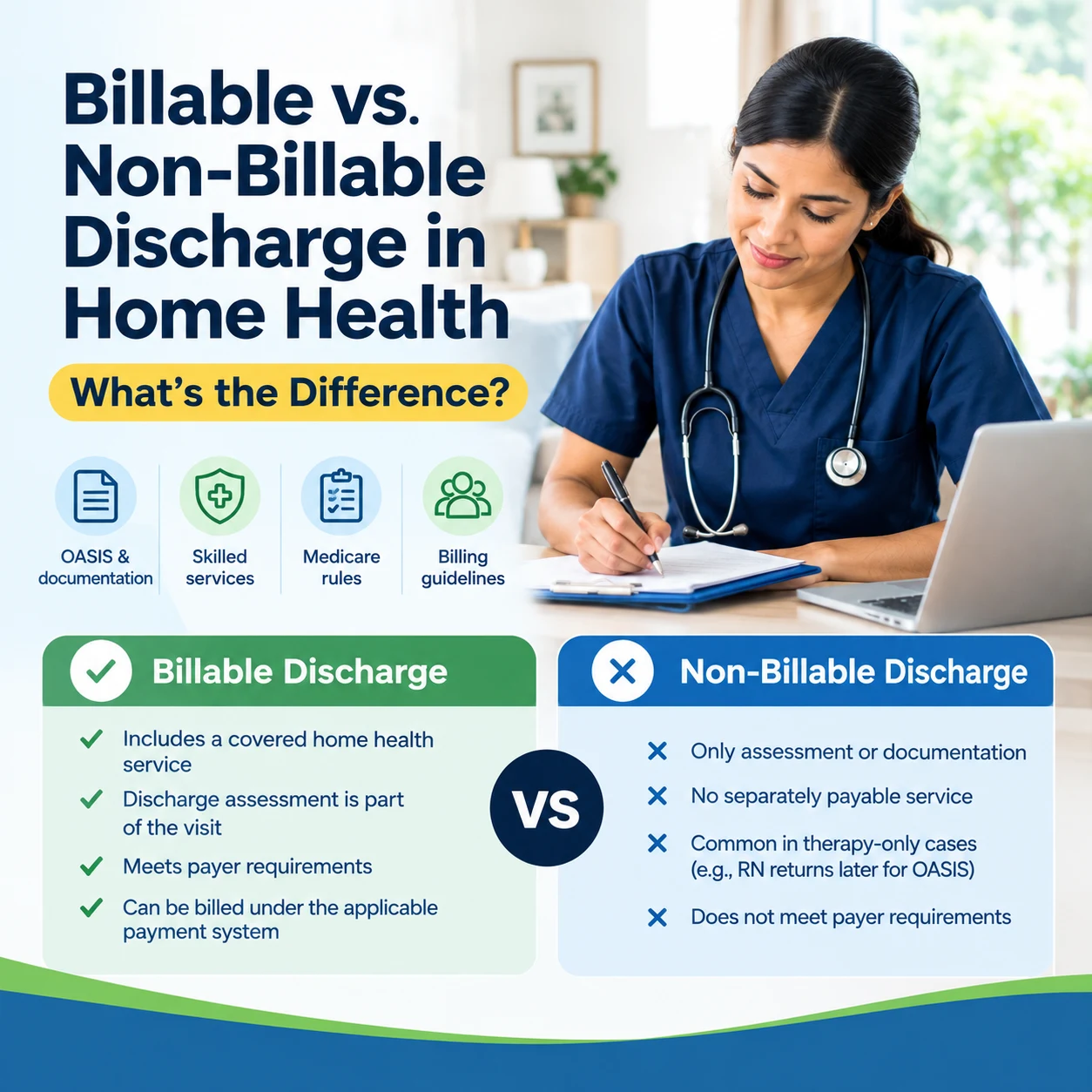
Billable vs. Non-Billable Discharge in Home Health: What's the Difference?
A discharge OASIS does not automatically make a home health visit billable. Learn how covered skilled services, payer rules, documentation, and the final clinician determine whether a discharge encounter may be payable.
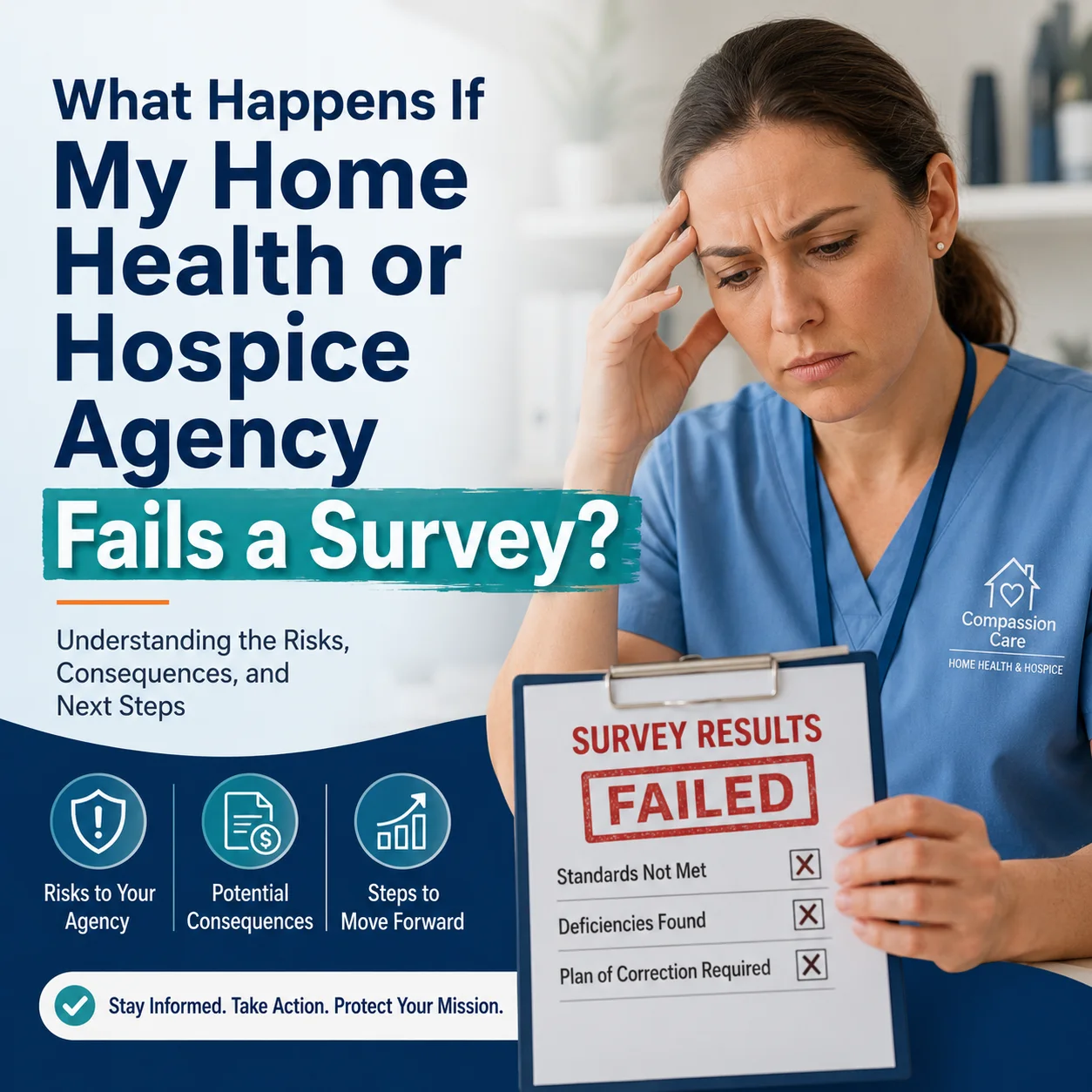
What Happens If My Home Health or Hospice Agency Fails a Survey?
A survey deficiency does not automatically mean closure. Learn what happens next, how corrective action works, and when survey problems can threaten Medicare participation.

What Documentation Should Home Health Agencies Audit Before Billing?
Before billing, confirm that eligibility, medical necessity, orders, OASIS-E2, coding, and visit documentation tell a consistent story and support the services on the claim.