
Billable vs. Non-Billable Discharge in Home Health: What's the Difference?
A discharge OASIS does not automatically make a home health visit billable. Learn how covered skilled services, payer rules, documentation, and the final clinician determine whether a discharge encounter may be payable.
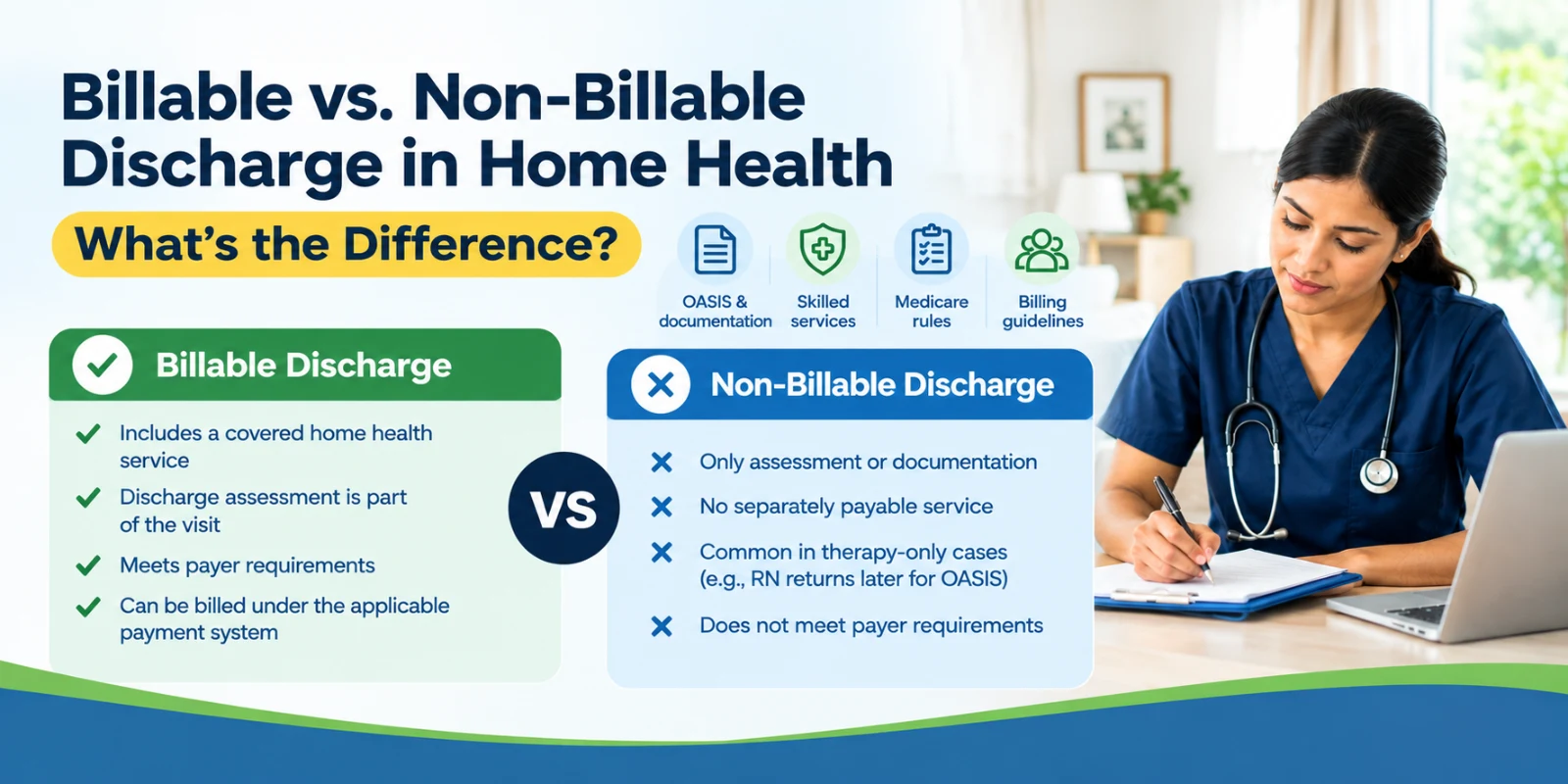
Key Takeaways
- A discharge assessment or OASIS does not, by itself, make a home health encounter billable.
- A billable discharge encounter generally includes a covered clinical service that meets the payer's requirements.
- An assessment-only or documentation-only encounter is generally non-billable when no payable covered service is provided.
- In a therapy-only case, CMS allows the final therapist to complete the discharge comprehensive assessment when qualified.
- If an RN returns after the final therapy visit solely to complete the discharge assessment, CMS identifies that RN visit as non-billable.
- Agencies should separate clinical discharge, OASIS completion, documentation, and billing review in their workflows.
✓ Quick answer: A home health discharge encounter may be billable when the clinician provides a covered, payable service and completes the discharge assessment as part of that visit. Completing a discharge OASIS alone does not make an encounter billable. Payer rules and the documented service determine payment.
Home health discharge brings clinical care, OASIS requirements, documentation, scheduling, and billing together. Those workflows are related, but they are not the same.
The clearest way to distinguish a billable discharge encounter from a non-billable one is to ask what covered service was actually provided and whether the encounter satisfies the applicable payer's requirements.
What Is a Billable Discharge in Home Health?
A billable discharge generally refers to a discharge visit in which the clinician provides a covered, reimbursable home health service in addition to completing required discharge-related assessment and documentation. The important distinction is that the discharge assessment or OASIS itself is not what makes the visit billable.
For Medicare home health, payment generally operates through the applicable home health payment system rather than separate payment for every assessment task. CMS explains that the Home Health Prospective Payment System uses adjusted 30-day period payments, with per-visit payment applying to qualifying low-utilization periods that do not meet the visit threshold.
? Ask this question: Was a covered, payable home health service actually provided during the visit, and did that service meet the payer's requirements? That is more useful than simply asking whether a discharge OASIS was completed.
What Is a Non-Billable Discharge in Home Health?
A non-billable discharge visit is generally an encounter performed for assessment, documentation, coordination, or administrative purposes when no separately payable covered service is provided. One important CMS example involves therapy-only cases.
If a therapist is the last skilled clinician providing care and the agency's policy is for an RN to return afterward solely to complete the discharge comprehensive assessment and OASIS, CMS's final OASIS-E2 guidance identifies the RN discharge-assessment visit as non-billable. Completing OASIS does not automatically make a visit billable; the agency must determine whether a covered service was delivered during the encounter.
Is a Home Health Discharge OASIS Visit Always Billable?
No. Billable status depends on what occurs during the visit and what the payer requires.
CMS's OASIS guidance describes situations in which an RN performs a discharge comprehensive assessment after the last therapy visit and treats that RN encounter as non-billable.
When the clinician providing the final skilled service conducts the discharge assessment as part of that covered visit, however, the assessment can be incorporated into the clinical encounter. The key issue is not simply, Was OASIS completed? It is, What service was actually provided during the encounter?
When Can a Home Health Discharge Visit Be Billable?
A discharge visit may be billable when the clinician performs a covered service that meets the applicable payer's requirements and completes the discharge assessment as part of that encounter. For example, a final skilled nursing visit may include:
- Assessment of the patient's current condition.
- A skilled intervention within the plan of care.
- Medication or disease-management education.
- Assessment of the patient's response to treatment.
- Patient or caregiver teaching.
- Evaluation of goals and progress.
- Discharge planning.
- Required discharge assessment documentation.
If the visit includes a covered skilled service, the agency can evaluate the encounter under the payer's billing rules. CMS states that Medicare home health services must meet eligibility, skilled-need, plan-of-care, and documentation requirements.
When Is a Home Health Discharge Visit Non-Billable?
A discharge visit is generally non-billable when the clinician performs an assessment or documentation task without providing a payable covered service. A common example is: therapist completes the final skilled visit → patient is ready for discharge → RN returns later only to complete the discharge assessment or OASIS.
CMS identifies that RN visit as non-billable when the agency has chosen this workflow for a therapy-only case. Other situations that require careful review include:
- The patient no longer meets coverage requirements.
- The encounter is solely for administrative purposes.
- The clinician completes documentation without providing a covered service.
- The payer's rules do not allow the encounter to be billed.
- The visit does not meet the applicable skilled-service requirements.
- The patient refuses the service or the planned clinical service cannot be performed.
The agency should always check the patient's payer, plan of care, orders, clinical circumstances, and current billing requirements before assigning the final billing treatment.
Does Completing OASIS Make a Discharge Visit Billable?
No. OASIS is an assessment instrument.
Completing an OASIS discharge assessment does not, by itself, turn an encounter into a payable visit. The final OASIS-E2 guidance is effective April 1, 2026 and continues to distinguish assessment requirements from reimbursement.
! Avoid this assumption: Assessment = billable visit. Use this test instead: Covered clinical service + applicable payer requirements = potentially billable encounter.
Can the Last Skilled Clinician Complete the Discharge OASIS?
Yes. CMS guidance allows the therapist to conduct the discharge comprehensive assessment, including OASIS when applicable, when the therapist is the last skilled provider in a therapy-only case.
This can eliminate an additional RN visit performed solely to complete the discharge assessment.
For agencies, this distinction can affect scheduling, clinician utilization, patient experience, documentation workload, visit planning, and billing accuracy. The agency's policies, clinician qualifications, payer requirements, and the patient's clinical circumstances still need to be considered.
Can an RN Complete a Discharge OASIS After the Last Therapy Visit?
Yes, but the encounter may be non-billable. CMS specifically addresses a workflow in which an RN completes the discharge comprehensive assessment after the therapist's final visit.
The RN can perform the assessment, but CMS identifies that RN visit as non-billable when the RN returns solely for that purpose. Under the cited OASIS guidance, the discharge assessment should be completed within two days of the discharge date.
Does a Discharge Visit Have to Be a Separate Visit?
Not necessarily. The discharge assessment can be incorporated into an appropriate final skilled visit when the clinician providing the final service is qualified to complete the required assessment.
CMS guidance allows a therapist to conduct the discharge comprehensive assessment in a therapy-only case or when that therapist is the last skilled care provider.
Before automatically scheduling another RN visit, the team should determine:
- Who is providing the final skilled service?
- Who is qualified to complete the discharge assessment?
- What does the plan of care require?
- What does the payer require?
- Does the encounter include a covered service?
- Is an additional visit clinically necessary?
What Is the Difference Between a Billable and Non-Billable Discharge?
| Factor | Billable discharge encounter | Non-billable discharge encounter |
|---|---|---|
| Covered clinical service | Provided, when required | Not provided |
| Discharge assessment | May be completed | May be completed |
| OASIS | May be completed | May be completed |
| Payment | May be payable under applicable payer rules | Not payable as a covered visit |
| Example | Final skilled nursing visit includes the discharge assessment | RN returns solely to complete discharge OASIS after the final therapy visit |
| Main consideration | Covered service plus payer requirements | Assessment or documentation without a payable service |
This comparison is intentionally simplified. Payer-specific rules can change the billing treatment, so agencies should not use a generic discharge category as a substitute for reviewing the applicable requirements.
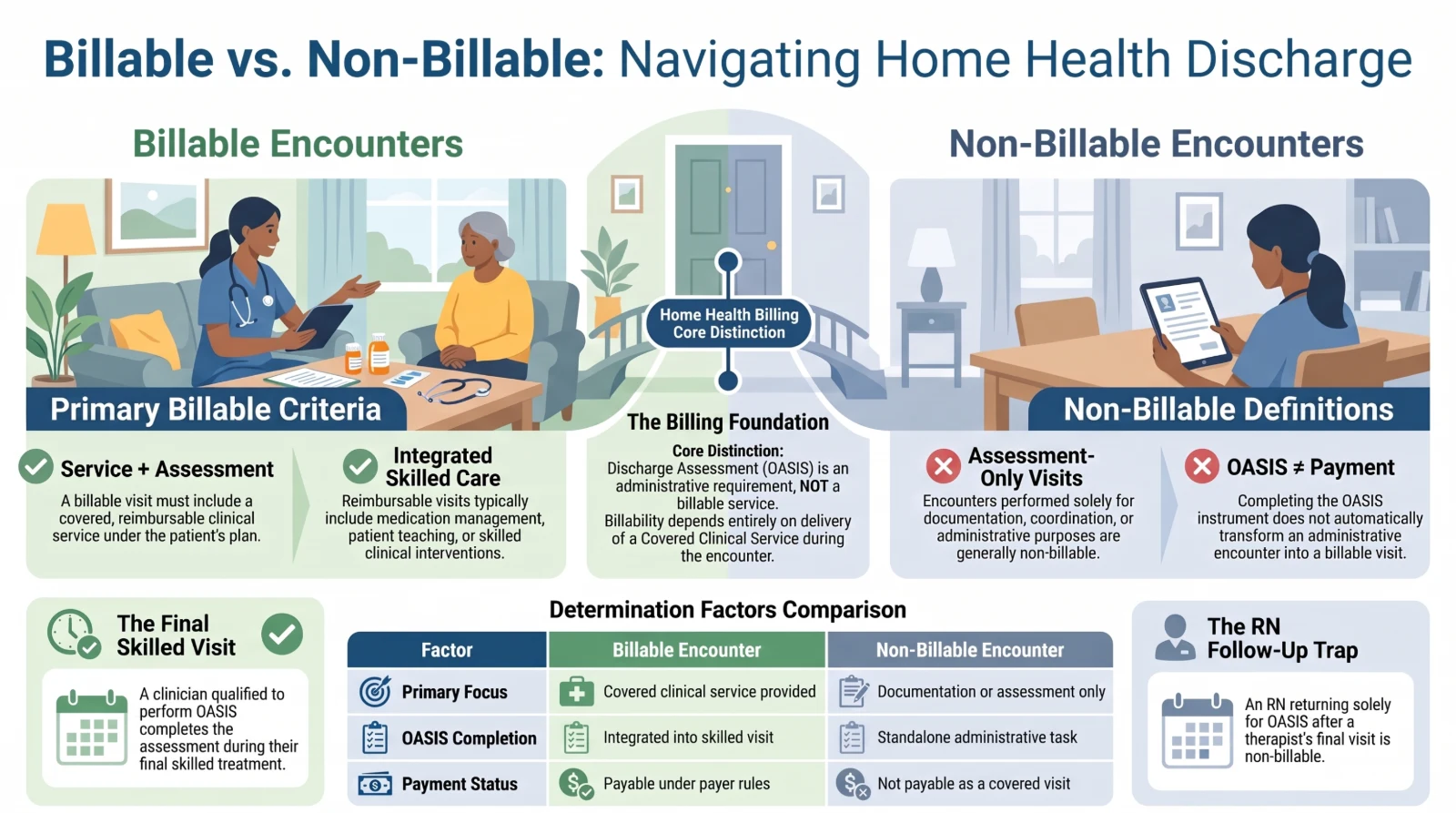
The central distinction is whether a covered clinical service is delivered during the encounter. Completing OASIS alone does not determine payment.
How Does Medicare Treat Home Health Discharge Visits?
Medicare home health does not operate as a simple fee-for-service model in which every clinical task automatically generates a separate payment. CMS states that the Home Health PPS uses 30-day periods of care, with payment adjusted for patient characteristics and other factors.
Periods that do not meet the applicable visit threshold can receive per-visit LUPA payment.
Agencies should therefore avoid assuming that one discharge visit equals one separate Medicare payment. The encounter must be evaluated within the applicable Medicare billing and payment rules, and the clinical record must support the services reported.
What Happens if the Patient Is Discharged After Only One Visit?
This situation also requires agencies to separate clinical documentation from billing. CMS OASIS guidance states that a discharge OASIS is not required for a single-visit quality episode.
Whether the visit can be billed still depends on eligibility, coverage, payer requirements, and whether a payable service was provided.
1 Remember: No discharge OASIS does not mean no bill, and completing an OASIS does not automatically mean a billable visit occurred.
What Documentation Should Be Included for a Billable Discharge?
The documentation should accurately reflect what happened during the encounter. Depending on the discipline and payer requirements, the record may include:
- Date of service, clinician, and discipline.
- Reason for the visit and the patient's current clinical status.
- Skilled service provided and the patient's response.
- Progress toward goals and teaching provided.
- Medication-related information when applicable.
- Discharge assessment, disposition, and follow-up recommendations.
- Patient or caregiver instructions.
- Communication with other providers when applicable.
- OASIS information when required.
CMS emphasizes that clinical records must support Medicare home health eligibility, skilled need, and medical necessity. The record should tell the story of what service was provided and why it was appropriate, not merely state that the patient was discharged.
See common home health documentation errors for related risks.
What Should Agencies Document for a Non-Billable Discharge?
A non-billable encounter still needs appropriate documentation. The record should clearly explain:
- Why the clinician was present and why the discharge assessment was needed.
- What assessment was performed.
- Information obtained from the patient or caregiver.
- Relevant information from recent visits.
- Discharge status and disposition.
- Education or instructions provided.
- Any provider communication.
- Why the encounter was not billed under agency policy and payer requirements.
A non-billable visit should not mean an undocumented visit. It means the agency distinguishes the clinical or documentation activity from a payable service.
Can a Discharge OASIS Use Information From Previous Visits?
Yes, within the applicable OASIS guidance. CMS permits the assessing clinician to use information documented by other agency staff during the relevant recent period when completing the discharge assessment.
In the scenario addressed by CMS, information from visits during the last five days in which the patient received agency visits can be incorporated into the assessment.
This can help when the final clinician must synthesize information gathered by several disciplines. Agencies should follow the current OASIS-E2 guidance and assessment requirements rather than relying on an informal look-back process.
What Happens When Different Disciplines Discharge at Different Times?
A patient may be discharged from one discipline before the overall agency discharge. CMS's 2026 OASIS-E2 guidance notes that multidisciplinary cases can have several discipline-specific discharges while there is one HHA discharge that includes the comprehensive discharge assessment when required.
SN discharge → PT continues → PT completes final skilled visit → agency discharge
The agency needs a workflow that distinguishes discipline discharge, the final skilled visit, agency discharge, transfer, death, the discharge assessment, and billing. Treating all of these as the same event can create documentation and payment problems.
For a related comparison, see home health recertification versus discharge.
How Can Agencies Avoid Billable vs. Non-Billable Discharge Errors?
Step 1: Identify the reason for discharge
Determine whether the patient completed the plan of care, no longer meets benefit requirements, is transferring, was admitted to an inpatient facility, is moving to hospice, refuses further services, no longer requires skilled care, or has another discharge circumstance.
Step 2: Identify the final discipline
Determine which clinician is actually providing the final skilled service.
Step 3: Determine whether a discharge assessment is required
Review the current OASIS and payer requirements for the case.
Step 4: Determine whether the final encounter includes a covered service
Do not assume that completing OASIS makes the visit billable.
Step 5: Determine whether an additional assessment visit is necessary
If another clinician is scheduled only to complete the discharge assessment, determine whether that encounter is non-billable under the applicable rules.
Step 6: Complete the documentation
Make sure the record accurately reflects the patient's status, service provided, discharge reason, and disposition.
Step 7: Complete billing review
Before finalizing the claim, verify that the billed services correspond to the care actually provided and satisfy the payer's requirements. A structured review also helps agencies prepare for Medicare additional documentation requests.
How Can AI Help Home Health Agencies Manage Discharge Documentation?
Discharge is one of the points where information from several visits and disciplines must come together. AI can reduce administrative work by helping teams:
- Pull together recent clinical documentation.
- Organize notes by date and discipline.
- Surface relevant patient information.
- Identify missing documentation and highlight inconsistencies for human review.
- Prepare discharge documentation and support OASIS workflows.
- Organize information needed for QA.
- Create a clearer audit trail of the patient's care.
Last SN visit → recent PT notes → medication information → goals → discharge status → required assessment → QA review
AI should support the clinical and administrative workflow rather than independently determine whether a visit is billable. The agency's clinicians, billing team, and compliance staff remain responsible for reviewing the record and applying payer rules.
Can Copper AI Help With Home Health Discharge Documentation?
Yes. Copper AI can serve as an AI workflow layer that helps home health teams organize and review documentation around discharge, rather than independently determining billing eligibility.
A practical workflow can look like:
Final visit → AI captures documentation → patient information is organized → missing information is surfaced → discharge documentation is prepared → clinician reviews → QA reviews → billing workflow continues
For a multidisciplinary patient, this can bring information together without requiring staff to search through multiple notes manually. The goal is not for AI to decide, This discharge is billable. The goal is to help the team answer, What happened during the patient's final stage of care, what documentation supports it, and what still needs human review?
What Are the Most Common Billable vs. Non-Billable Discharge Mistakes?
- Assuming every discharge visit is billable. A discharge assessment alone does not automatically create a payable service.
- Treating OASIS as a billable service. The underlying encounter still needs to be evaluated for billing purposes.
- Adding an RN visit only because the therapist discharged the patient. CMS recognizes circumstances in which an RN returns solely to complete the discharge assessment and identifies that encounter as non-billable.
- Failing to document the actual skilled service. If a visit is billed, the record should clearly reflect the service provided.
- Confusing discipline discharge with agency discharge. A PT discharge does not necessarily mean the agency episode has ended.
- Ignoring payer-specific requirements. Medicare, Medicare Advantage, Medicaid, and commercial payers may have different requirements.
- Treating billing and OASIS workflows as the same process. They are related, but they are not identical.
- Relying on outdated OASIS guidance. OASIS-E2 became effective April 1, 2026, so agencies should use the current requirements.
What Is the Simplest Way to Remember Billable vs. Non-Billable Discharge?
Think about the service, not just the assessment.
✓ Billable: A covered clinical service is provided and the encounter meets the payer's billing requirements.
Non-billable: The encounter is performed for assessment, documentation, coordination, or another purpose without a payable covered service.
Core rule: Completing a discharge OASIS does not automatically make the visit billable.
What Should Home Health Agencies Remember About Billable vs. Non-Billable Discharge?
The distinction is simple, but the workflow can be complicated: a discharge assessment is not automatically a billable visit. The agency should ask: What service was provided? → Who provided it? → Was it covered? → Does the documentation support it? → What does the payer require?
For Medicare home health, this distinction matters because OASIS requirements, clinical documentation, discharge workflows, and payment rules are connected but separate parts of the process. Agencies should use current CMS OASIS-E2 and Medicare home health payment guidance when updating their 2026 workflows.
What Should I Document? 100 OASIS Situations Home Health Nurses Face Every Day
100 real OASIS scenarios, worked end to end — clinical situation, common mistake, better approach, and key takeaway. Built around OASIS-E2 (effective April 1, 2026) to turn what you assess into accurate, defensible documentation.
Bottom Line
For home health discharge billing, focus on the service provided, not merely the assessment completed: the encounter may be billable when it includes a covered service that satisfies payer requirements, while assessment-only or documentation-only encounters are generally non-billable.

Arvind Sarin is the founder of Copper Digital. He works inside home health agencies to build AI documentation workflows that help clinicians finish OASIS and visit notes sooner, with a nurse reviewing and approving every note. He writes about home health documentation, Medicare compliance, and applying AI responsibly in clinical workflows.
Frequently asked
Frequently asked questions
It can be when the encounter includes a covered service that meets the applicable payer's requirements. A discharge assessment by itself does not automatically make the encounter billable.
Join the conversation
Leave a comment
No comments yet. Be the first to share your thoughts.
Related reading
What Is an ABN in Home Health & Hospice? Complete Guide With Billing Instructions
A patient wants to continue care, but Medicare may not pay for it. Who owes the bill? That's where the Advance Beneficiary Notice of Noncoverage (ABN), Form CMS-R-131, comes in. Here's when it's required in home health and hospice, what makes it valid, the beneficiary's three choices, and how to bill it correctly.
PDGM vs. PPS: What's Changed for Home Health?
PDGM did not replace Medicare's Home Health Prospective Payment System. It changed the case-mix methodology inside HH PPS, and reshaped payment periods, coding, OASIS, LUPA monitoring, billing, and cash flow.
What Is OASIS-E2? A Complete Guide for Home Health Agencies
A practical guide to OASIS-E2: assessment changes, time points, quality and payment uses, EHR and iQIES readiness, and AI support that keeps clinicians in control.