
What Happens If My Home Health or Hospice Agency Fails a Survey?
A survey deficiency does not automatically mean closure. Learn what happens next, how corrective action works, and when survey problems can threaten Medicare participation.
Key Takeaways
- A survey deficiency does not automatically mean an agency will lose Medicare certification.
- Standard-level and condition-level noncompliance have different implications.
- Immediate Jeopardy represents an urgent patient-safety situation.
- The CMS-2567 documents survey deficiencies and, where required, the agency's Plan of Correction.
- A Plan of Correction should address the underlying cause, not just the cited chart.
- Follow-up or dependent survey processes can vary depending on the survey and accreditation pathway.
- Repeated failure to correct deficiencies can lead to increasingly serious enforcement.
- CMS provides multiple enforcement remedies for serious HHA and hospice noncompliance.
- Agencies can recover from survey failures when they successfully correct the underlying problems and demonstrate sustained compliance.
- Continuous survey readiness is more effective than preparing only when a survey is scheduled.
- Documentation quality is an important part of demonstrating that required care was actually delivered.
- The goal isn't simply to pass the next survey. The goal is to build an agency that stays ready.
ℹ️ Important: This article provides general educational information, not legal or regulatory advice. Requirements and enforcement depend on the survey pathway and facts. Follow the notice your agency receives and consult qualified legal or compliance professionals when needed.
Your home health (HH) or hospice (HSP) agency has been operating for years.
Your clinicians are experienced. Patients compliment your staff.
Your team provides excellent care. You have policies, procedures, training, and quality programs in place.
So when your next survey arrives, you expect it to be routine.
Then the surveyor starts finding deficiencies.
One issue becomes several. A documentation problem leads to another question.
Then you hear something more serious: condition-level noncompliance.
Now the questions start:
Did we fail the survey? What happens next?
Do we have to stop admitting patients? Could we lose Medicare certification?
How do we fix this?
A survey finding can have serious operational, financial, compliance, and reputational consequences. But a survey deficiency does not automatically mean your agency is shutting down.
What happens next depends on the nature and severity of the noncompliance, whether patients were placed at risk, whether the agency can correct the deficiencies, and whether CMS or the applicable oversight organization determines that enforcement action is necessary.
For HHAs, CMS explains that survey deficiencies are based on violations of applicable statutes or regulations and observations of the agency's performance or practices.
The good news?
Agencies can recover from survey deficiencies.
The key is understanding what the findings mean, responding quickly, and fixing the system and not just the individual chart.
What Happens If a Home Health or Hospice Agency Fails a Survey?
If a home health or hospice survey identifies significant noncompliance, the agency may have to develop and implement a Plan of Correction (PoC) and demonstrate that the deficiencies have been corrected.
The consequences depend on the seriousness of the findings.
A typical process can involve:
Survey → Deficiencies → CMS-2567 → Plan of Correction → Corrective Action → Follow-Up/Revisit → Compliance or Enforcement
More serious deficiencies can result in additional oversight or enforcement remedies. In some circumstances, unresolved noncompliance can ultimately threaten the agency's Medicare participation. CMS's current HHA and hospice enforcement guidance identifies multiple remedies that can be used for serious noncompliance.
So, “failing a survey” is not one single outcome.
The important question is:
How serious are the deficiencies, and can your agency demonstrate sustained compliance after they are identified?
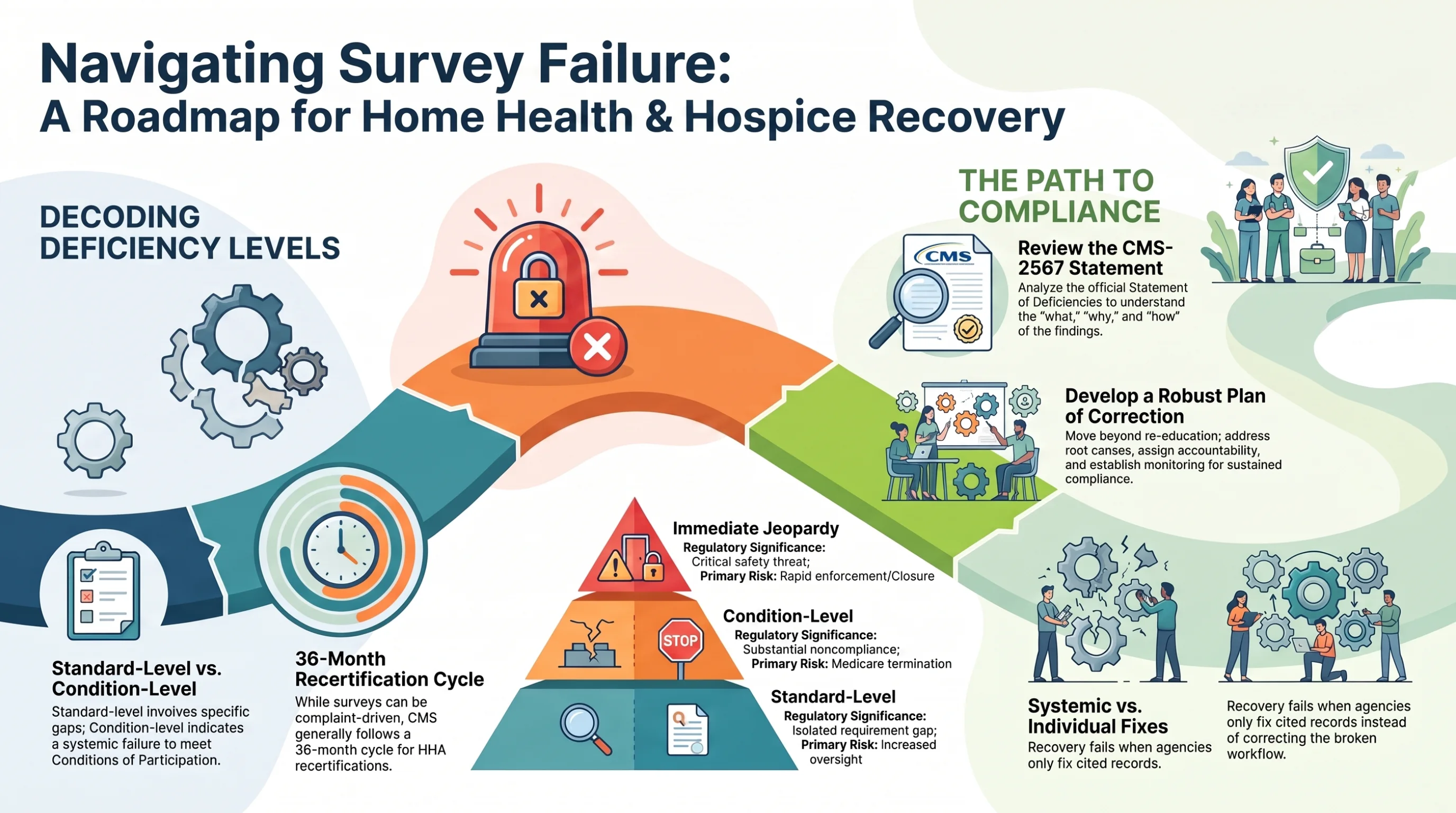
Survey recovery requires more than correcting one record: classify the finding, identify root causes, implement systemic changes, and prove sustained compliance.
What Is a Home Health or Hospice Survey?
A survey is an evaluation of whether a home health agency or hospice program is meeting applicable federal, state, and, where relevant, accreditation requirements.
Surveyors may review:
- Patient records.
- Clinical documentation.
- Assessments.
- Plans of care.
- Medication processes.
- Patient rights.
- Personnel records.
- Policies and procedures.
- Quality assessment and performance improvement activities.
- Interviews with staff and patients.
- Observations of care.
- Administrative records.
CMS maintains specific survey guidance for home health agencies and hospices. It also publishes survey deficiency information through its Quality, Certification and Oversight Reports (QCOR).
For agencies using Medicare-approved accreditation organizations, CMS currently recognizes organizations including the Accreditation Commission for Health Care (ACHC), Community Health Accreditation Partner (CHAP), and The Joint Commission (TJC) for hospice accreditation/deemed-status purposes.
Survey activity can occur as part of the regular certification cycle or in response to other circumstances, such as complaints or changes affecting certification.
CMS's QCOR system, for example, identifies a 36-month cycle for HHA recertification surveys.
Why Do Good Agencies Fail Surveys?
One of the biggest misconceptions about surveys is:
“Our clinicians are excellent, so we should be fine.”
Clinical excellence and regulatory compliance are related, but they are not the same thing.
An agency can have compassionate, highly skilled nurses and still have compliance gaps because:
- A policy does not match the actual workflow.
- Documentation does not clearly demonstrate the care provided.
- Supervisory audits are inconsistent.
- Staff interpret requirements differently.
- A process depends too heavily on one person remembering every requirement.
- A recurring documentation gap has never been identified through internal audits.
- Leadership focuses on individual mistakes instead of systemic causes.
- The agency prepares for surveys instead of maintaining continuous survey readiness.
This is why a survey should be viewed as a test of the agency's operating system, not simply its individual clinicians.
What Are Conditions of Participation?
Conditions of Participation (CoPs) are federal requirements that Medicare-certified providers must meet to participate in the Medicare program.
For home health agencies, CMS publishes regulations and interpretive guidance explaining applicable requirements. Surveyors use those requirements and associated survey protocols to determine whether an agency is compliant.
For hospice programs, CMS likewise establishes Conditions of Participation covering areas such as patient rights, assessment and care planning, quality assessment and performance improvement, clinical services, and organizational requirements.
The important distinction is that not every deficiency has the same regulatory significance.
A finding may involve a particular standard within a broader Condition of Participation, while more serious noncompliance can rise to the condition level.
What Types of Deficiencies Can an Agency Receive?
It's helpful to separate where the requirement comes from from how serious the noncompliance is.
State-Level Requirements
Home health and hospice agencies must also comply with applicable state laws and licensing requirements.
A state-level problem can create consequences separate from Medicare certification.
For example, if an agency loses a required state license, its ability to continue participating in Medicare may also be affected.
Because state requirements vary, agencies should evaluate both federal Medicare requirements and their state's specific licensing rules.
Accreditor Findings
Agencies using an accreditation pathway may also receive findings from their accrediting organization.
Accreditation findings should not simply be treated as equivalent to CMS deficiency levels. Their significance depends on the agency's accreditation and deemed-status arrangement and the applicable requirements.
Standard-Level Noncompliance
A standard-level deficiency generally means the agency failed to meet a specific regulatory requirement.
A standard-level finding does not automatically mean that the agency is being terminated from Medicare.
However, standard-level findings should not be dismissed.
Repeated or systemic problems can indicate that the agency's compliance system is not working reliably.
Condition-Level Noncompliance
Condition-level noncompliance is substantially more serious.
It means the agency is not substantially meeting an applicable Condition of Participation.
CMS guidance distinguishes condition-level findings from lower-level deficiencies and provides enforcement mechanisms for serious noncompliance.
For agency leaders, this should trigger a different response:
Don't just correct the cited record. Investigate the system behind it.
Immediate Jeopardy
Immediate Jeopardy (IJ) represents an even more serious situation.
CMS defines immediate jeopardy as a situation in which noncompliance has caused, or is likely to cause, serious injury, harm, impairment, or death to a patient or other covered individual.
When IJ is identified, surveyors are required to follow specific immediate-jeopardy procedures and notify the appropriate agency leadership.
Which Deficiencies Can Cause a Survey Failure?
There is an important distinction between receiving a deficiency and being found in condition-level noncompliance.
An agency can have individual deficiencies without every deficiency resulting in termination or the same enforcement response.
Condition-level noncompliance is much more consequential because it indicates that the agency has failed to substantially meet an applicable Condition of Participation.
The seriousness of a survey outcome should therefore be evaluated based on:
- The regulation involved.
- Scope of the problem.
- Severity of the problem.
- Actual or potential patient harm.
- Whether the issue is isolated or systemic.
- Whether immediate jeopardy exists.
- Whether the agency corrects the deficiency.
- Whether compliance can be sustained.
CMS's HHA survey guidance specifically explains that when substandard care is identified, an extended survey may examine the policies, procedures, and practices that produced the problem.
That is an important lesson:
Surveyors may look beyond the individual error to understand the system that produced it.
What Happens After a Survey Finds Deficiencies?
If the survey identifies noncompliance, the agency should immediately move into corrective-action mode.
Step 1: Review the Survey Findings
Start with the actual evidence.
For every deficiency, ask:
- What exactly did the surveyor identify?
- Which regulation or requirement is involved?
- Which patient or records were affected?
- Is this isolated?
- Could this problem exist elsewhere?
- What process allowed the issue to happen?
Do not begin by defending the agency.
Begin by understanding the finding.
Step 2: Review the CMS-2567
The CMS-2567, Statement of Deficiencies and Plan of Correction, is a central document in the survey process.
CMS updated its national policy in 2025 regarding release of CMS-2567s and states that the form can be publicly released upon receipt, with the policy generally allowing release within 14 days after receipt. The policy also specifically addresses its application to HHA and hospice accrediting-organization surveys.
CMS also makes HHA and hospice deficiency records available through QCOR.
Read the CMS-2567 carefully.
Look beyond the deficiency tag and understand:
What happened → why it happened → how broadly it may exist → what risk it created.
Step 3: Develop a Plan of Correction
The Plan of Correction should explain how the agency will correct the cited deficiencies and prevent recurrence.
A strong PoC should address:
- Immediate correction.
- Root cause.
- System-level correction.
- Responsible person.
- Implementation date.
- Monitoring.
- How sustained compliance will be demonstrated.
For example, saying:
“Staff were re-educated.”
may not be enough.
A stronger corrective-action approach explains:
- What staff were trained on.
- Who received the training.
- When training occurred.
- How competency was verified.
- What workflow changed.
- How compliance will be audited.
- What happens if another deficiency is identified.
CMS's hospice survey guidance specifically describes the elements expected in an acceptable Plan of Correction.
Step 4: Correct the Underlying Problem
This is where agencies often make a mistake.
If one chart contains a documentation problem, don't automatically assume the problem exists only in that chart.
Audit additional records.
Ask:
“If the surveyor had selected 20 different charts, would we still be confident?”
If the answer is no, the problem is systemic.
Step 5: Complete Follow-Up or Revisit Activities
Depending on the survey pathway, findings, and provider status, additional survey activity may be used to determine whether compliance has been achieved.
The terminology and process can differ between CMS/state surveys and accrediting-organization processes, so agencies should follow the specific instructions associated with their survey.
The key principle remains the same:
A Plan of Correction is not the same as correction.
The agency must actually achieve compliance.
What Is a Dependent Survey?
A dependent survey is a follow-up survey used in certain accreditation/survey pathways to evaluate whether the deficiencies that led to the failed survey have been corrected.
The exact timing, scope, format, and cost can vary depending on the accreditor and the circumstances of the survey.
For that reason, agencies should not assume that every HHA or hospice will receive the same type of dependent survey or that a universal timeframe applies.
The purpose is straightforward:
Demonstrate that the agency corrected the problems identified during the original survey.
If the agency passes the required follow-up process, it can continue toward maintaining its certification/accreditation status, subject to the applicable requirements.
What Happens If You Fail a Follow-Up Survey?
Failing a follow-up survey means the agency has not demonstrated that the identified problems were adequately corrected.
That can lead to:
- Additional corrective action.
- Additional follow-up activity.
- Increased regulatory scrutiny.
- Enforcement remedies.
- Potential loss of Medicare participation if the agency does not achieve compliance.
CMS's current enforcement guidance for HHAs and hospices includes remedies such as directed plans of correction, directed in-service training, civil monetary penalties, suspension of payment for new admissions in applicable circumstances, and temporary management.
The important lesson is:
A second survey failure is not simply another paperwork problem. It can demonstrate that the agency's corrective-action system is not working.
Can a Home Health or Hospice Agency Recover From a Failed Survey?
Yes.
A failed survey does not automatically mean that an agency will permanently close.
Recovery depends on the nature of the deficiencies and whether the agency can achieve and demonstrate compliance.
Agencies can improve their position by:
- Correcting immediate patient-safety risks.
- Conducting a thorough root-cause analysis.
- Auditing beyond the original sample.
- Implementing a credible Plan of Correction.
- Training and validating staff competency.
- Assigning clear accountability.
- Monitoring corrective actions.
- Documenting the results of those audits.
- Demonstrating sustained compliance.
CMS's hospice guidance explicitly notes that failure to submit an acceptable PoC or failure to correct deficiencies can result in termination of the hospice provider agreement under applicable regulations.
So recovery is possible, but it requires more than promising to do better.
You need evidence that the process has changed.
What Happens During an Immediate Jeopardy Situation?
Immediate Jeopardy is different from an ordinary documentation deficiency.
It means the agency's noncompliance has caused, or is likely to cause, serious harm, impairment, injury, or death.
When IJ is identified, the agency must act immediately.
The response should focus first on:
- Protecting patients.
- Removing the immediate threat.
- Identifying affected patients.
- Correcting the underlying condition.
- Implementing sustainable safeguards.
- Providing evidence that the jeopardy has been removed.
CMS's HHA survey guidance instructs surveyors to immediately follow the applicable IJ procedures when immediate jeopardy is identified.
Serious enforcement remedies may also be imposed for condition-level noncompliance, depending on the circumstances.
Can an Agency Recover From Immediate Jeopardy?
Yes, recovery can be possible, but the margin for error is much smaller.
The first objective is to eliminate the immediate threat to patient safety.
The second is to demonstrate that the correction is not temporary.
For example, if a medication-management problem creates immediate jeopardy, simply correcting the affected patient's medication list may not be enough.
Leadership needs to determine:
- How did the error happen?
- Were other patients affected?
- Why wasn't it detected earlier?
- Does the workflow need to change?
- Does staff competency need to be reassessed?
- What monitoring will prevent recurrence?
The response needs to address both the immediate danger and the system that allowed the danger to exist.
How Can a Failed Survey Affect Revenue and Operations?
Survey problems can extend beyond compliance.
Depending on the findings and enforcement action, an agency may face:
- Cost of corrective work.
- Additional survey-related expenses.
- Leadership and staff time.
- Consultant expenses.
- Potential civil monetary penalties.
- Restrictions affecting new admissions in applicable enforcement situations.
- Increased regulatory oversight.
- Disruption to operations.
- Reputational concerns.
- Potential risk to payer relationships.
CMS specifically provides enforcement remedies for serious HHA and hospice noncompliance, including directed plans of correction and, in applicable circumstances, suspension of payment for new admissions and other remedies.
This is why survey readiness should be treated as an operational discipline, not an annual compliance project.
How Can You Prevent Survey Failure?
The best time to prepare for a survey is before you know a survey is coming.
Continuous survey readiness means regularly asking:
“If a surveyor walked in tomorrow, could we prove that our processes are working?”
Survey-Readiness Checklist
Use this checklist regularly:
- Review applicable Conditions of Participation.
- Audit clinical records.
- Review plans of care.
- Check assessment completeness.
- Review medication-management processes.
- Audit patient-rights documentation.
- Review supervisory processes.
- Verify staff competency.
- Review QAPI activities.
- Compare policies against actual workflows.
- Look for recurring deficiencies.
- Conduct mock surveys.
- Track corrective actions.
- Audit whether corrective actions actually worked.
- Document the results of quality monitoring.
The goal is not to create perfect-looking charts for a survey.
The goal is to create reliable clinical and operational processes that consistently produce compliant records and safe patient care.
How Documentation Problems Can Increase Survey Risk
Documentation is often where a surveyor can see whether the agency's processes actually worked.
Consider a simple example.
A nurse provides a skilled visit to a patient with diabetes. The care plan requires monitoring a specific clinical parameter.
The nurse performs the assessment.
But the documentation does not clearly show that the required assessment occurred.
The care may have happened.
The problem is that the record does not clearly demonstrate it.
That creates a critical principle:
The care provided and the care documented should tell the same story.
Documentation should be:
- Accurate.
- Complete.
- Clinically relevant.
- Consistent with the plan of care.
- Timely.
- Supported by the patient's clinical record.
CMS's survey guidance makes clear that deficiencies are based on evidence of the agency's performance and practices.
That means documentation isn't merely paperwork.
It is evidence.
Can Technology Help With Survey Readiness?
Technology can help agencies identify documentation gaps before they become larger compliance problems.
For example, an AI-assisted documentation platform can potentially help:
- Identify missing documentation elements.
- Flag inconsistencies.
- Prompt clinicians about potentially incomplete information.
- Support documentation review.
- Standardize certain quality checks.
- Help leadership identify recurring documentation patterns.
But technology should support, not replace, clinical judgment, compliance oversight, or human review.
The strongest model is not:
AI writes everything.
It is:
Clinician provides the care → documentation is created → technology identifies potential gaps → human reviews → final documentation is completed.
That approach can make continuous documentation quality monitoring more practical for agencies managing large volumes of clinical records.
What Should You Do in the First 72 Hours After a Bad Survey?
If your agency receives serious survey findings, focus first on the following:
- Understand: Read every deficiency carefully.
- Prioritize: Separate immediate patient-safety concerns from lower-level process issues.
- Investigate: Determine whether the cited issue exists beyond the survey sample.
- Correct: Address affected patients and records where appropriate.
- Find the Root Cause: Ask why the process failed, not simply who made the mistake.
- Build the Plan: Develop a specific, measurable Plan of Correction.
- Assign Ownership: Every corrective action needs an accountable owner and deadline.
- Monitor: Audit the process to make sure the correction is working.
- Prepare for Follow-Up: Don't wait until the next survey to discover that your corrective action didn't work.
The Biggest Lesson From a Failed Survey
A survey failure can feel personal.
But the most productive question isn't:
“Who messed up?”
It's:
“What allowed this problem to happen, and why didn't our system catch it?”
That shift matters.
If one nurse makes a documentation mistake, you may have an employee issue.
If five nurses make the same mistake, you probably have a process issue.
If leadership repeatedly discovers the same problem during surveys, you have a system issue.
And system issues require system-level solutions.
Official CMS Sources and Further Reading
- Home Health Agencies: laws, regulations, and survey guidance.
- State Operations Manual, Appendix B: Home Health Agencies.
- State Operations Manual, Appendix M: Hospice.
- HHA and hospice enforcement procedures (QSO-24-11).
- CMS-2567 public-release policy.
- CMS Quality, Certification and Oversight Reports.
What Should I Document? 100 OASIS Situations Home Health Nurses Face Every Day
100 real OASIS scenarios, worked end to end — clinical situation, common mistake, better approach, and key takeaway. Built around OASIS-E2 (effective April 1, 2026) to turn what you assess into accurate, defensible documentation.
Bottom Line
A failed survey does not automatically end Medicare participation, but the agency must understand the severity of each finding, correct immediate risks, address systemic causes, and demonstrate sustained compliance.
Inside Home Health Podcast
5-Star Agency or Compliance Disaster? Understanding Home Health Ratings

Arvind Sarin is the founder of Copper Digital. For the past year he has spent three days a week inside a 500+ census Texas home health agency, building AI documentation that finishes OASIS and visit notes the same day, with a nurse reviewing and approving every note. He writes about home health documentation, OASIS, Medicare compliance, and applying AI responsibly in clinical workflows.
Frequently asked
Frequently asked questions
The agency may receive deficiencies documented through the applicable survey process and may need to submit a Plan of Correction. Depending on the nature and severity of the findings, additional survey activity or enforcement may follow. Serious unresolved noncompliance can threaten Medicare participation.
Join the conversation
Leave a comment
No comments yet. Be the first to share your thoughts.
Related reading
What Is an ABN in Home Health & Hospice? Complete Guide With Billing Instructions
A patient wants to continue care, but Medicare may not pay for it. Who owes the bill? That's where the Advance Beneficiary Notice of Noncoverage (ABN), Form CMS-R-131, comes in. Here's when it's required in home health and hospice, what makes it valid, the beneficiary's three choices, and how to bill it correctly.
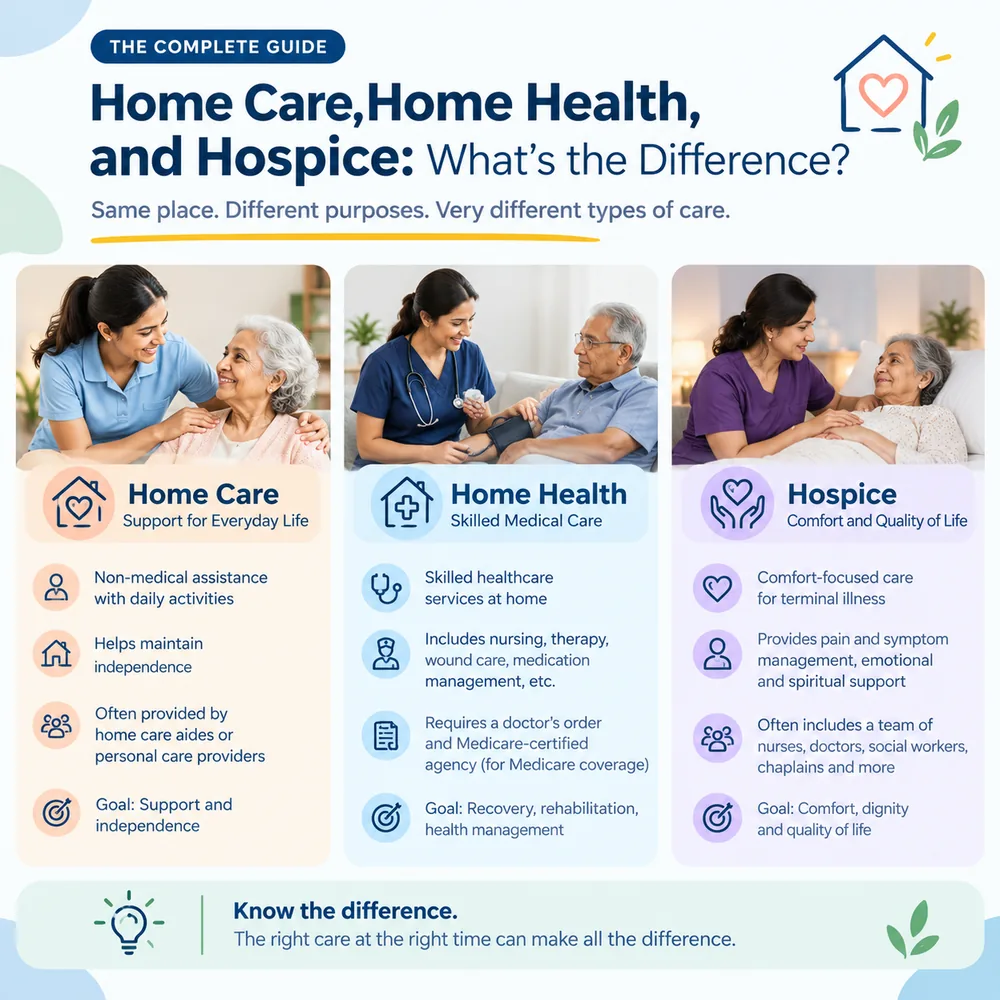
Home Care, Home Health, and Hospice: What's the Difference?
Home care supports daily life, home health provides skilled healthcare, and hospice focuses on comfort for terminal illness. Compare the services, eligibility, coverage, and goals of each model.
What Is a CMS Provider Validation Survey for Home Health Agencies?
A CMS provider validation survey checks whether a deemed-status home health agency actually meets Medicare health and safety requirements. Here is what CMS reviews and how an HHA can stay ready.