✓ Quick answer: AI governance in healthcare is the structure an organization uses to decide how AI systems are selected, evaluated, implemented, monitored, and changed. It establishes accountability around safety, privacy, bias, consent, security, clinical oversight, workforce adoption, and performance, and it should begin before implementation, not after go-live.
Artificial intelligence is already being used across healthcare. It supports clinical decision-making, documentation, patient communication, operational workflows, data analysis, scheduling, and many other processes. Some applications are highly visible. Others have been embedded into healthcare technology for years without being labeled as AI.
The question for healthcare organizations is no longer simply whether they will use artificial intelligence. The more important question is: Who is responsible for how AI is being used? That is where AI governance in healthcare becomes critical.
The World Health Organization has emphasized that AI for health needs governance that puts ethics, human rights, accountability, and the interests of healthcare workers and patients at the center of design and deployment.
For healthcare leaders, governance should not be something added after an AI system goes live. It should begin before implementation.
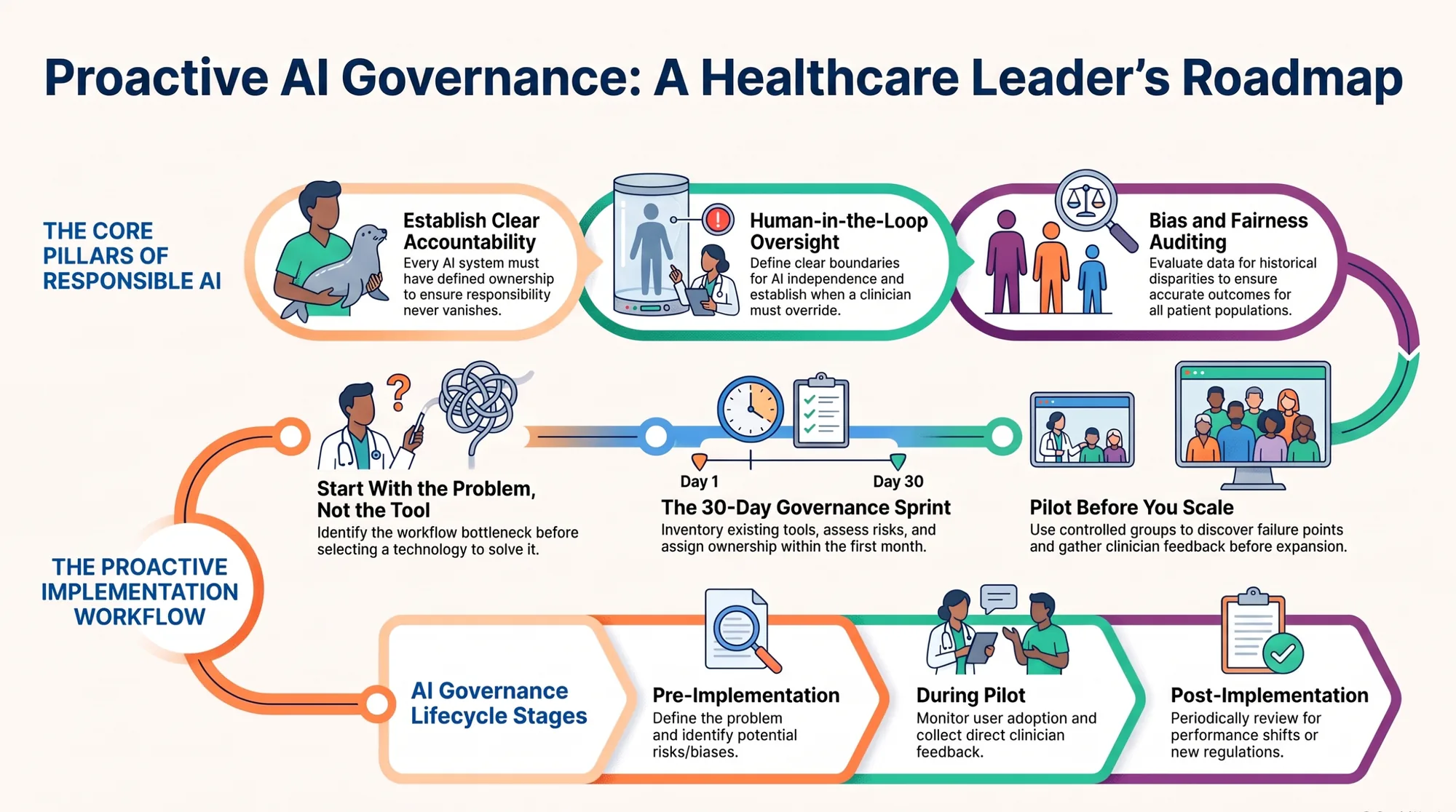
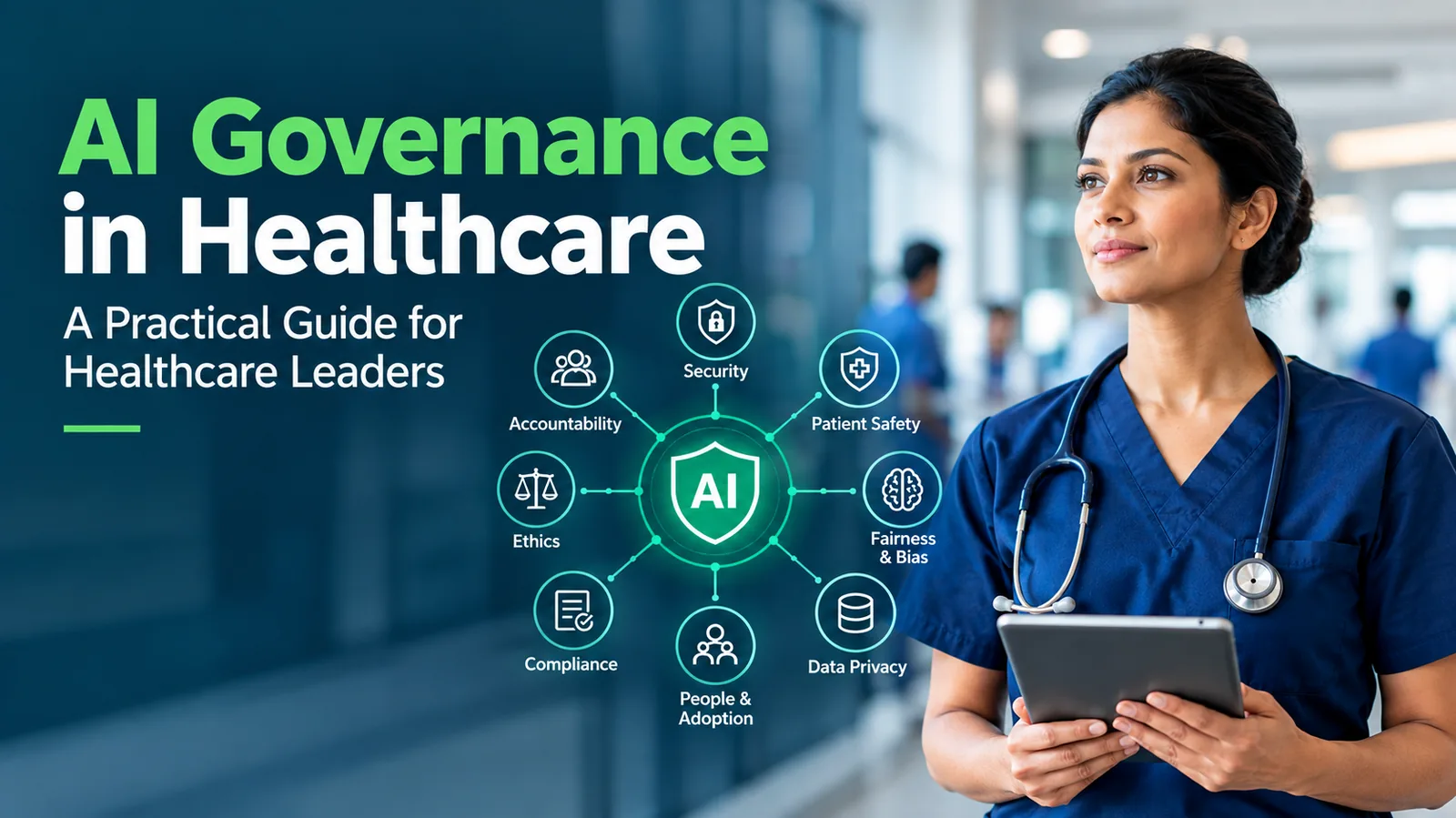
Proactive AI governance connects the core pillars of responsible AI (accountability, human-in-the-loop oversight, bias and fairness auditing) to a lifecycle that runs pre-implementation, during pilot, and post-implementation.
What Is AI Governance in Healthcare?
AI governance in healthcare is the set of policies, processes, people, controls, and responsibilities an organization uses to manage artificial intelligence throughout its lifecycle. That includes questions such as:
- What AI systems are we using?
- What problem is each system supposed to solve?
- What data does the system use?
- Who is accountable if the system produces an unsafe or inappropriate result?
- How was the system evaluated before implementation?
- Could the system produce biased outcomes?
- What privacy and security risks exist?
- Is patient or employee consent required?
- Who monitors the system after deployment?
- How are clinicians trained?
- What happens when the AI produces an incorrect output?
- When should a human override the system?
- How do we measure whether the AI is actually improving the intended workflow?
A useful governance framework turns these questions into a repeatable process. That repeatability matters because healthcare organizations are not implementing AI once; they are likely to evaluate and deploy multiple AI tools across different departments and workflows. Without governance, every new tool can become a separate risk decision. With governance, the organization has a consistent way to evaluate each one.
Why AI Governance Matters in Healthcare
Healthcare is different from many other industries because AI outputs can influence decisions involving patients, clinicians, operations, and access to care. A system that generates an incorrect marketing caption is one thing. An AI system that influences clinical documentation, patient prioritization, staffing, treatment recommendations, or other healthcare workflows carries very different consequences.
WHO identifies issues including privacy, equity, appropriate use, liability, bias, and inclusiveness as important ethical considerations for AI in health. That means healthcare leaders need to evaluate more than whether an AI tool works. They need to ask whether it works appropriately, safely, fairly, and within the intended workflow.
AI can amplify existing problems
One of the most important ideas raised in our discussion with Dr. Lendra James was that AI does not automatically eliminate human bias. If biased assumptions exist in the data, processes, or decisions used to develop an AI system, those assumptions can potentially be reproduced at scale.
Healthcare already has examples of disparities and bias that organizations continue to work to address. The concern is what happens when those same patterns become embedded in automated systems. The result could be a process that is faster but still flawed.
Automation does not automatically make a process objective. It can make an existing process faster, more consistent, and easier to scale, and if the underlying process is problematic, that can make the problem harder to detect.
The Core Components of Healthcare AI Governance
There is no single governance model that every healthcare organization must use. However, an effective framework should address several recurring areas.
1. Accountability
Every AI system should have clearly defined ownership. Someone should be able to answer: Who is accountable for this system? That does not necessarily mean one person is responsible for every technical decision. AI governance typically involves multiple stakeholders, including clinical leaders, IT, compliance, legal, security, operations, data teams, and the people who actually use the system. The important part is that responsibility cannot disappear into the phrase “the AI did it.” If something goes wrong, the organization needs a clear escalation path.
2. Safety and Risk
Before implementing an AI tool, healthcare organizations should understand what could go wrong. Risk assessment should consider:
- Incorrect outputs.
- Hallucinations or fabricated information.
- Inappropriate recommendations.
- Data exposure.
- Unauthorized access.
- Bias.
- Workflow failures.
- Overreliance on automated outputs.
- Poor user training.
- Lack of human oversight.
- Unexpected changes in system performance.
NIST's AI Risk Management Framework provides organizations with a voluntary framework for managing AI risks and incorporating trustworthiness considerations throughout the AI lifecycle. Healthcare organizations can use frameworks like this as a starting point while adapting governance to their specific clinical and operational environment.
3. Privacy and Security
Healthcare AI frequently interacts with sensitive information. That means governance needs to address questions around what data enters the system, where that data is processed, who can access it, whether the data is stored, how long it is retained, who can use the outputs, and what happens if the system or vendor experiences a security incident. Privacy and security should be evaluated before implementation rather than after an incident. For more, see HIPAA-compliant AI documentation.
4. Bias and Fairness
AI governance should explicitly examine whether an AI system could produce different outcomes for different populations. This requires looking beyond the algorithm itself. Organizations should consider:
- The data used to develop or configure the system.
- The population represented in that data.
- Whether certain groups are underrepresented.
- How outputs are evaluated.
- Whether performance differs across populations.
- Whether human users are likely to interpret outputs differently.
This is particularly important in healthcare because historical data can reflect historical practices. The question should not simply be “Is the AI accurate?” It should also be: Accurate for whom, in which circumstances, and compared with what?
5. Consent
Consent is easy to overlook when an AI tool appears operational rather than clinical. That can be a mistake. During our podcast discussion, Dr. Lendra described an example of an organization implementing an AI scribe without incorporating consent into the process. The broader lesson was that even seemingly straightforward implementation decisions can create governance gaps.
The exact consent requirements will depend on the use case, jurisdiction, applicable laws, organizational policies, and the type of information being processed. But the governance question should be asked before implementation: Does this workflow require consent, notification, authorization, or another form of patient or workforce communication?
6. Human Oversight
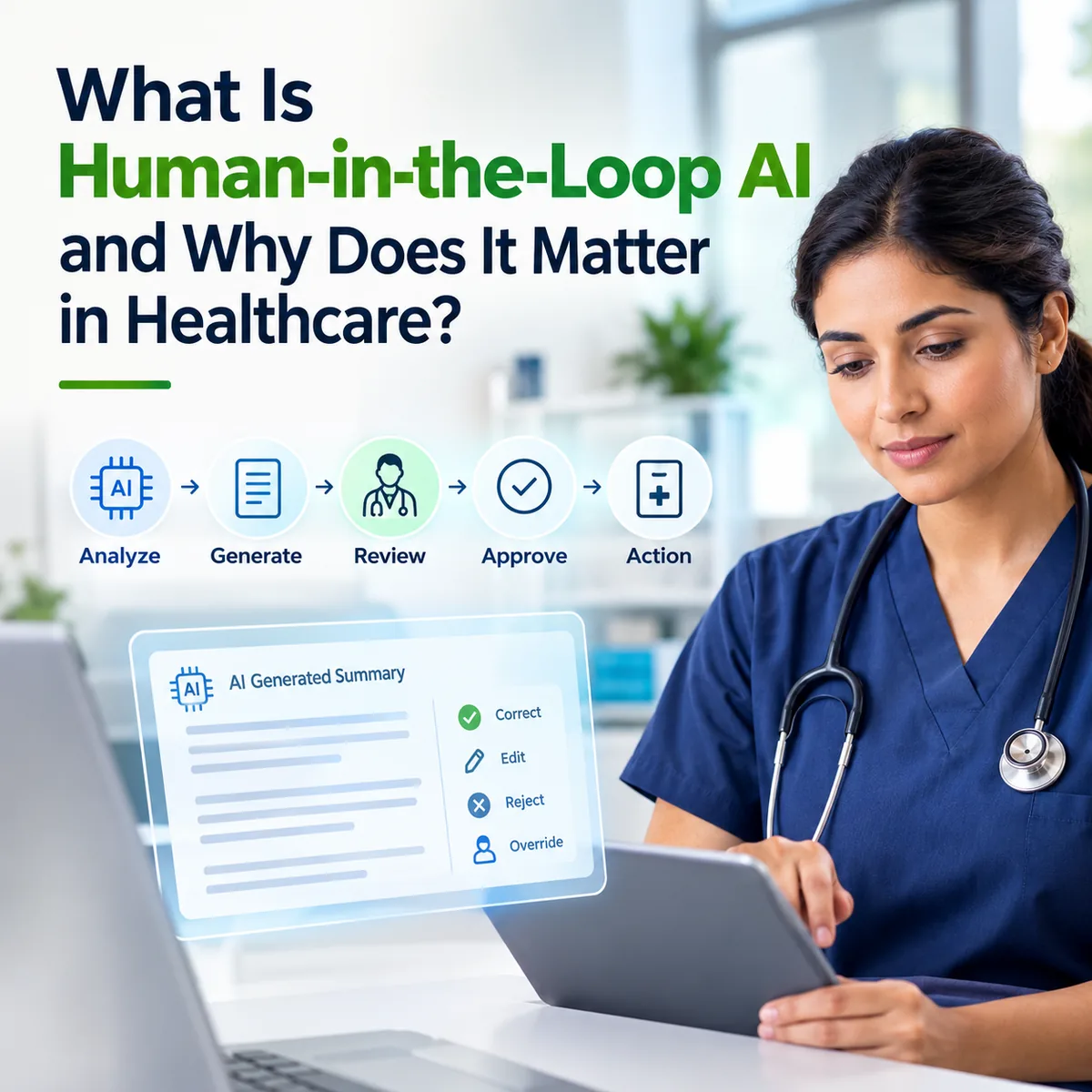
AI should have clearly defined boundaries. Healthcare organizations need to determine what the AI can do independently, what requires human review, who reviews the output, what happens when the AI is uncertain, when a clinician should override the system, how errors are reported, and how repeated errors are investigated. The goal is not necessarily to keep humans involved in every individual AI action; it is to make sure the level of human oversight matches the risk of the use case. This is the core idea behind human-in-the-loop AI in healthcare.
AI Governance Should Start Before Implementation
One of the strongest points from the podcast conversation was that governance is often treated as an afterthought. That approach creates problems. By the time an organization discovers that an AI system has privacy, consent, workflow, bias, or adoption issues, significant money and time may already have been invested. A better approach is to evaluate the system before implementation, starting with the intended outcome.
Ask: What problem are we actually solving?
This is a surprisingly important question. Healthcare organizations can become attracted to AI because a tool is impressive. But an impressive technology is not automatically a useful solution. Start with the workflow. For example:
- Current problem: Nurses spend significant time completing repetitive documentation after patient visits.
- Desired outcome: Reduce documentation burden without reducing documentation quality.
- Potential AI application: AI-assisted documentation.
- Governance questions: What information enters the system? What does the AI generate? Who reviews the output? What happens when the output is incorrect? How is patient information protected? How are clinicians trained?
The technology comes after the problem definition.
Why Healthcare AI Implementation Often Fails
An AI system can be technically impressive and still fail inside a healthcare organization. One reason is that organizations sometimes design the implementation around the technology rather than the people using it. Dr. Lendra described this as a major adoption risk during our discussion. If organizations expect AI to improve performance or reduce burnout without involving the end users in the workflow design, resistance can appear quickly.
This is especially relevant for nursing. A tool can look excellent in a demonstration, but the nurse using it may have an entirely different perspective. The nurse knows:
- What happens during a real patient visit.
- Where documentation slows down.
- Which information is difficult to capture.
- What happens when connectivity fails.
- What has to be entered into another system.
- Which alerts are useful.
- Which alerts create additional work.
- Where the workflow does not match reality.
That knowledge is part of AI governance. It also explains a lot about what stops nurses from using AI in practice.
Clinicians Should Be Part of AI Governance
AI governance should not be an IT-only responsibility. The people who use the technology need a voice in how it is designed and implemented. This is particularly important in home health. A home health clinician may travel between patient homes, perform assessments independently, document clinical information, communicate with other members of the care team, and manage multiple administrative requirements. A workflow that makes sense in a hospital conference room may not make sense inside a patient's home.
That is why clinician participation should happen before, during, and after implementation. During our discussion, Copper Digital's experience reinforced this point: having an experienced nurse help establish the foundation was valuable, but direct feedback from practicing nurses using the workflow provided additional insights that could not be fully captured from a general clinical perspective.
The end user is not simply someone who needs training. The end user is a source of intelligence about whether the system actually works.
Pilot AI Before Scaling It
Healthcare organizations do not necessarily need to deploy an AI system across the entire organization on day one. A controlled pilot can provide an opportunity to evaluate user adoption, workflow impact, accuracy, safety, documentation quality, staff feedback, training requirements, unexpected failure points, and operational performance. The goal of a pilot is not simply to prove that the technology works; it is to discover what needs to change before the technology reaches a larger population.
A practical AI pilot approach
- Define the problem: Clearly document what the organization wants to improve.
- Define measurable outcomes: Decide what success means before implementation.
- Select a limited user group: Start with a manageable group of clinicians or staff.
- Establish governance controls: Define responsibilities, escalation procedures, human oversight, privacy requirements, and acceptable use.
- Train users: Users should understand what the system does, what it does not do, and how they are expected to interact with it.
- Collect feedback: Ask users what is working, what is creating additional work, and what the technology is missing.
- Measure results: Compare the pilot against the original goals.
- Adjust before scaling: Fix workflow and governance issues before expanding deployment.
AI Training Is Part of Governance
Training is sometimes treated as an implementation activity. It should also be treated as a governance activity. Healthcare professionals need to understand:
- What the AI system does.
- What data it uses.
- What its limitations are.
- How to review outputs.
- When to question an output.
- When to escalate a problem.
- What information should never be entered.
- How to report errors.
- How their responsibilities change when AI is introduced.
The podcast discussion also raised a broader point about preparing nurses before they enter the workforce. If healthcare is moving toward greater AI adoption, foundational education can help clinicians understand how these systems work and how they should be used responsibly. That is different from simply telling staff, “Here is the new AI tool. Start using it.”
Responsible AI Means More Than Compliance
AI governance is sometimes reduced to compliance. Compliance matters, but governance is broader. Responsible AI asks whether a system is being used in a way that is safe, accountable, fair, ethical, appropriate for the intended purpose, transparent enough for the people responsible for it, and supported by adequate human oversight.
These principles closely align with the broader direction of international AI governance guidance. WHO recommends putting ethics and human rights at the center of AI design, development, and deployment in healthcare. NIST's AI Risk Management Framework similarly focuses on managing risks and incorporating trustworthiness into AI systems throughout their lifecycle.
A Practical AI Governance Framework for Healthcare Organizations
Healthcare organizations can begin with a simple governance structure.
Before implementation
- What problem are we solving?
- Why is AI the appropriate solution?
- What data will the system use?
- What risks could the system introduce?
- Could bias affect the outcome?
- Are privacy and security requirements addressed?
- Are consent or disclosure requirements applicable?
- Who owns the system?
- Who is responsible for reviewing outputs?
- What does success look like?
During implementation
Monitor user adoption, workflow changes, output quality, errors, safety events, privacy concerns, staff feedback, patient feedback where applicable, training gaps, and unexpected use cases.
After implementation
Governance should continue. Each AI system should be periodically reviewed to determine whether the system is still meeting its intended purpose, performance has changed, the workflow has changed, users have developed workarounds, new risks have appeared, new regulations or organizational requirements apply, additional training is needed, or the system should be modified, restricted, or discontinued.
AI governance is a lifecycle, not a launch checklist.
What Healthcare Leaders Should Do in the First 30 Days
Organizations do not need to create a massive governance department before taking their first step. Start by understanding what already exists.
Week 1: Inventory
Create a list of AI systems currently being used across the organization. Include tools employees may have adopted independently. This is important because AI use does not always begin with an official enterprise implementation.
Week 2: Assess
For every tool, document its purpose, users, data involved, vendor, workflow, risk level, human oversight, privacy and security considerations, and current training.
Week 3: Establish ownership
Assign clear responsibility. Every AI system should have someone who can answer: Why are we using this, and how do we know it is working safely?
Week 4: Create the governance process
Build a repeatable process for approving, implementing, monitoring, and reviewing AI tools. The process does not have to be complicated. It needs to be consistent.
The Biggest Mistake Is Waiting for Something to Go Wrong
AI governance is often discussed after an incident: a patient complains, a clinician refuses to use the system, a privacy concern appears, an AI-generated output creates a workflow problem, a biased result gets discovered, or a vendor changes its system. By then, the organization is reacting.
Good governance moves those conversations earlier. Instead of asking “What went wrong?” the organization starts asking “What could go wrong, and how will we know?” That shift is the foundation of responsible AI adoption.
AI Governance in Home Health
Home health organizations have their own governance considerations. AI may interact with workflows involving clinical documentation, patient intake, scheduling, nurse assignment, referral management, claims, quality assurance, patient communication, and administrative workflows. The technology needs to fit the reality of care delivered outside a traditional facility.
A home health nurse is not sitting at a desk all day waiting for an AI workflow. The clinician may be moving from one patient's home to another and completing assessments independently. That means governance needs to evaluate the actual environment in which the technology will be used. For home health leaders, the question should be more specific than “Is this AI tool safe?” It should be: Is this AI tool safe and appropriate for this workflow, this user, this patient population, and this level of clinical responsibility?
The Future of Healthcare AI Depends on Governance
AI adoption in healthcare will continue. The organizations that benefit most will not necessarily be the ones that adopt the largest number of AI tools. They may be the organizations that build the strongest systems for deciding where AI belongs, where it does not belong, and how it should be used.
Governance provides that structure. It creates accountability. It forces organizations to examine bias. It brings clinicians into the conversation. It makes privacy and consent part of implementation rather than afterthoughts. It gives staff a framework for using AI responsibly. And perhaps most importantly, it creates a repeatable way to evaluate technology before scaling it.
AI itself is not the governance strategy. The governance strategy is what determines whether AI becomes a useful healthcare capability or another source of operational and clinical risk. For healthcare leaders, the starting point is simple: Do not wait until you have an AI problem to start governing AI. Start before implementation.
Final Takeaway
Healthcare organizations do not need to choose between innovation and responsible AI adoption. They need a structure that allows them to pursue both. The most effective approach is to make governance part of the AI implementation process from the beginning: define the problem, evaluate the risks, assign accountability, involve clinicians, address privacy, security, bias, and consent, train users, pilot the workflow, measure the results, then scale.
The goal of AI governance is not to slow healthcare innovation. It is to make innovation safer, more accountable, and more repeatable.