
What Is Human-in-the-Loop AI and Why Does It Matter in Healthcare?
The future of healthcare AI isn't about removing humans from the workflow; it's about putting them in the right place. Human-in-the-loop AI combines AI's speed with human judgment, context, and accountability so people can review, correct, approve, or override AI outputs where it matters.
Key Takeaways
- Human-in-the-loop (HITL) AI is a design approach where a person reviews, corrects, approves, or overrides an AI output before an important action is taken.
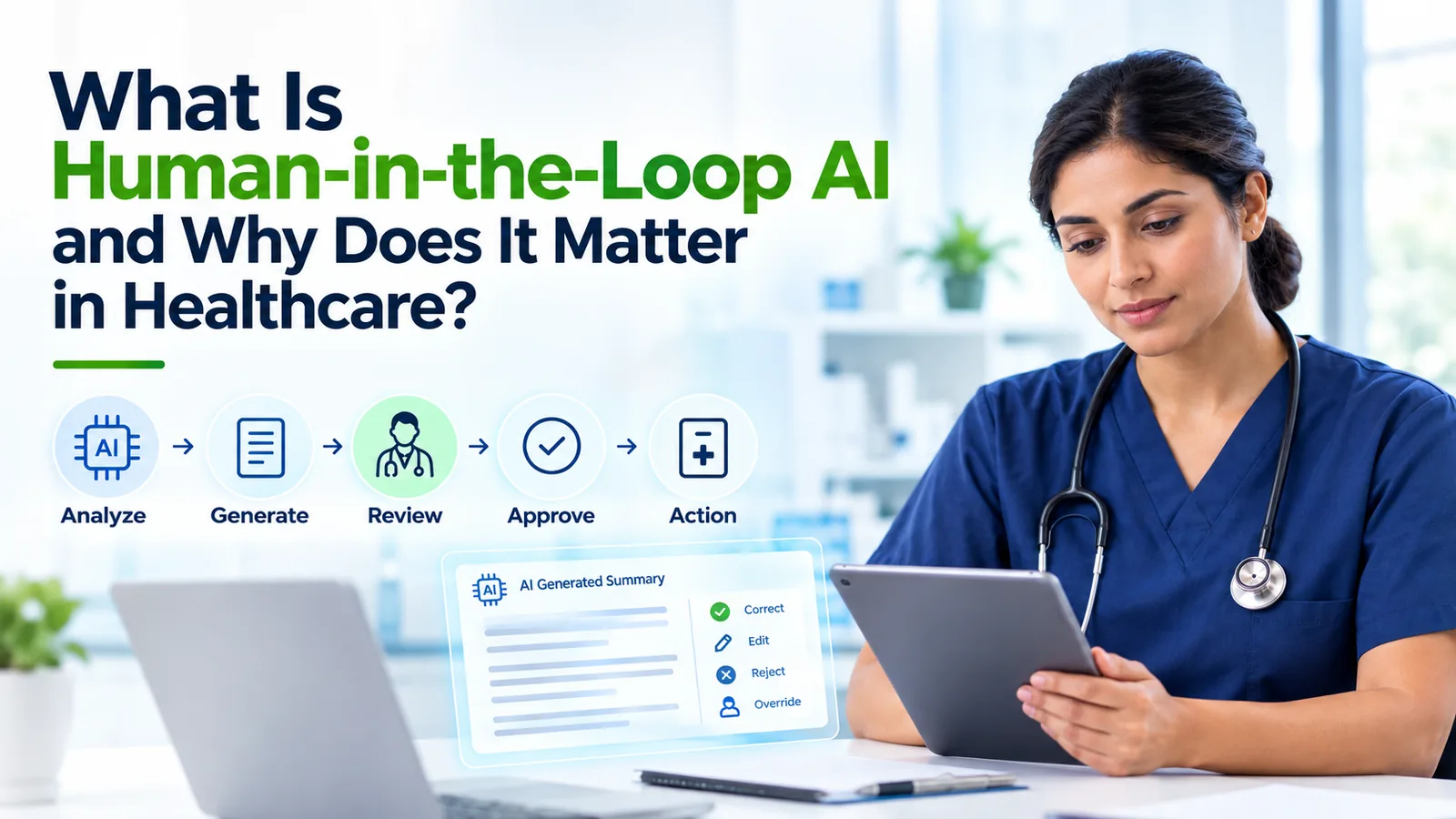
- A typical HITL cycle: AI analyzes → AI generates → human reviews → human corrects or approves → action proceeds; feedback then improves the workflow.
- It matters in healthcare because clinical work involves ambiguity and context that AI doesn't automatically understand; human review becomes a patient-safety mechanism.
- HITL doesn't mean a human reviews everything: risk-based review routes low-risk tasks to automation and higher-risk or uncertain outputs to qualified professionals.
- Done well, HITL adds traceability and accountability; done poorly, it can become a bottleneck, a rubber stamp, or another review step that adds work.
- For home health, HITL lets AI handle repetitive documentation while the nurse keeps clinical judgment and final responsibility for the record.
✓ Quick answer: Human-in-the-loop (HITL) AI is a design approach where AI performs a defined task (an extraction, a summary, a draft) and a human reviews, corrects, approves, or overrides the output before an important action is taken. In healthcare, it combines AI's speed and pattern recognition with human context, judgment, and accountability.
Artificial intelligence is becoming increasingly capable of analyzing clinical data, summarizing records, generating documentation, identifying patterns, and supporting healthcare workflows. But healthcare is different from many other industries.
A wrong recommendation can affect a patient's treatment. A missed detail can affect documentation.
An incorrect interpretation can create a patient-safety or compliance issue. That is why the future of healthcare AI is not necessarily about removing humans from the workflow.
It is about putting humans in the right place in the workflow.
This is where Human-in-the-Loop AI (HITL) comes in. Human-in-the-loop AI combines AI's speed and ability to process large amounts of information with human judgment, clinical context, and accountability.
Instead of allowing AI to make every decision independently, the system gives people an opportunity to review, correct, approve, or override AI-generated outputs where human judgment matters.
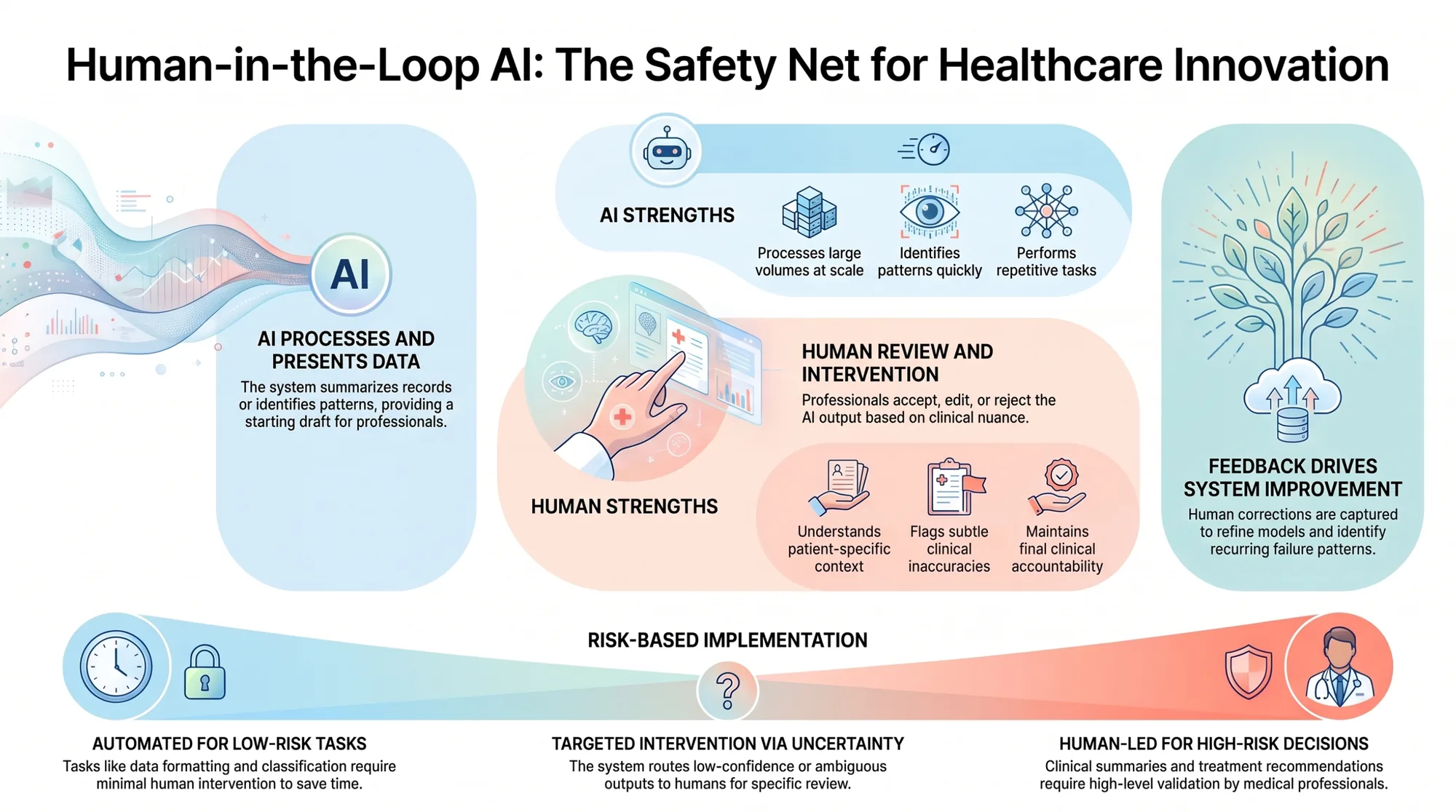
Human-in-the-loop AI as a safety net: AI processes and drafts, humans review and intervene, feedback drives improvement, and the level of human involvement scales with clinical risk.
What Is Human-in-the-Loop AI?
Human-in-the-loop AI is an AI design approach in which a human participates in reviewing, validating, correcting, or approving an AI-generated output before an important action is taken. In healthcare, that could mean:
AI analyzes → AI generates an output → healthcare professional reviews → human corrects or approves → action proceeds.
The human does not necessarily perform every step manually. Instead, the AI handles computational and repetitive work while the human focuses on interpretation, judgment, exceptions, and decisions that require clinical context.
The FDA describes human-in-the-loop machine learning as an approach in which humans interact with machine-learning models to enhance accuracy and end-user trust, particularly where human verification is needed.
What Does the Human-in-the-Loop AI Cycle Look Like?
A typical HITL workflow can follow five stages:
- AI receives information: The system processes clinical notes, images, forms, voice input, patient information, or other relevant data.
- AI performs a defined task: It might extract information, generate a summary, identify a potential issue, classify a document, or draft documentation.
- AI presents its output: The healthcare professional sees the AI-generated result rather than having to start from scratch.
- Human reviews and intervenes: The professional accepts, edits, rejects, or escalates the output depending on the situation.
- Feedback improves the workflow: Human corrections can be used to evaluate system performance, refine rules, improve prompts, calibrate models, retrain systems, or identify recurring failure patterns.
The important distinction is that human feedback does not necessarily mean the AI learns instantly from every correction. In a well-governed system, feedback is captured and used through an appropriate improvement process.
Why Does Human-in-the-Loop AI Matter in Healthcare?
Healthcare involves ambiguity, incomplete information, changing patient conditions, and decisions that often depend on context. AI can identify patterns extremely quickly, but it does not automatically understand every clinical nuance.
Human-in-the-loop AI matters because it brings together two different strengths:
| AI | Human |
|---|---|
| Processes large amounts of data quickly | Understands clinical context |
| Identifies patterns | Applies judgment |
| Generates drafts | Validates accuracy |
| Performs repetitive tasks | Handles exceptions |
| Works consistently at scale | Understands patient-specific circumstances |
| Flags potential issues | Determines what matters |
| Reduces manual workload | Maintains accountability |
The goal isn't necessarily AI versus humans. It is AI + humans doing what each does best.
How Does Human-in-the-Loop AI Improve Patient Safety?
Patient safety is one of the strongest reasons to use human-in-the-loop AI in healthcare. AI can make mistakes.
It may misinterpret ambiguous information, overlook an important detail, produce an incorrect summary, or generate an output that appears convincing but is clinically inappropriate. A human review layer creates an opportunity to identify these problems before they influence a downstream action.
For example, an AI system might identify a medication mentioned in a discharge summary. But that mention could represent:
- A current medication.
- A discontinued medication.
- A historical medication.
- A medication the patient declined.
- A future recommendation.
The text itself may not be enough to determine the correct interpretation. The clinical context matters: human reviewers remain necessary because healthcare workflows contain ambiguous situations where someone must determine whether an AI output is clinically acceptable and consistent with established guidelines.
This is where human judgment becomes a safety mechanism.
How Does Human-in-the-Loop AI Preserve Clinical Judgment?
Healthcare AI should support clinical professionals without unnecessarily replacing their professional judgment. A model may suggest, “This documentation indicates…,” but the clinician may know, “That interpretation doesn't fit this patient's current condition.” That distinction matters.
Patients are not identical datasets. Their medical history, circumstances, preferences, symptoms, medications, and care environments can change the meaning of information.
A HITL workflow allows AI to provide an efficient starting point while keeping the healthcare professional responsible for the decision when clinical judgment is required. This aligns with the broader principle that AI should augment healthcare professionals rather than automatically replace human decision-making.
Is Human-in-the-Loop AI the Same as Human Oversight?
Not exactly. The terms are related, but they describe different levels of involvement.
Human-in-the-loop generally means a person participates directly in a workflow involving an AI output. Human oversight is broader; it can include governance, monitoring, validation, escalation procedures, auditing, performance review, and intervention after deployment.
For example:
- A nurse reviewing an AI-generated note = human-in-the-loop.
- A clinical team monitoring AI error rates = human oversight.
- A compliance team reviewing audit logs = human oversight.
- A clinician overriding an unsafe recommendation = human-in-the-loop.
- An organization establishing policies for when AI must be reviewed = human oversight.
A mature healthcare AI program needs both. This distinction is closely related to the difference between human-in-the-loop vs human-on-the-loop AI.
Does Human-in-the-Loop AI Mean a Human Has to Review Everything?
No. That would defeat much of the purpose of automation.
The better approach is risk-based human review. Low-risk, repetitive tasks may require minimal intervention.
Higher-risk or uncertain outputs may require stronger review.
| AI Output | Potential Review Approach |
|---|---|
| Formatting information | Automated |
| Document classification | Automated with exception handling |
| Data extraction | Human review for low-confidence results |
| Clinical summary | Professional review |
| Medication interpretation | Higher level of clinical validation |
| Treatment recommendation | Appropriate clinical oversight |
| High-risk patient-safety decision | Human decision-maker |
The exact workflow should depend on the clinical use case, risk level, regulatory environment, and organization's governance framework.
What Happens When AI Is Uncertain?
This is one of the most important parts of a good HITL system. AI should not treat every output as equally reliable.
A better workflow can identify:
- Low-confidence predictions.
- Conflicting information.
- Missing information.
- Unusual cases.
- Ambiguous terminology.
- Contradictory documentation.
- Outputs outside expected patterns.
Those cases can then be routed to a human. Instead of “AI → automatic action,” the workflow becomes “AI → confidence/risk assessment → human review when needed → approved action.” This makes human involvement more targeted.
Why Is Human Review Important When AI Generates Clinical Documentation?
Clinical documentation is an especially strong use case for HITL AI. AI can help extract information, organize clinical details, generate summaries, draft notes, identify missing information, surface contradictions, reduce repetitive typing, and convert voice or other inputs into structured documentation.
But the healthcare professional should still be able to review the result.
This matters because documentation is not simply about producing grammatically correct text; it needs to accurately represent what happened clinically. An AI-generated note can sound excellent while still containing a subtle factual error or missing an important detail.
That is why the workflow should be:
AI drafts → clinician reviews → clinician edits if needed → clinician approves/submits.
The AI accelerates documentation. The professional remains responsible for determining whether the documentation accurately reflects the encounter.
This is also what separates an AI scribe from an AI documentation agent.
Can Human-in-the-Loop AI Reduce Healthcare Workload?
Yes, potentially, but the goal should be more specific than simply “saving time.” AI can take on repetitive cognitive and administrative tasks so healthcare professionals spend less time performing mechanical work. For example:
- Without HITL AI: Patient information → manual review → manual entry → manual documentation → final review.
- With HITL AI: Patient information → AI extraction/draft → professional review → correction if needed → final documentation.
The human remains involved, but the amount of work required from the human can be reduced. Human-in-the-loop does not mean humans continue doing all the work.
It means humans focus their effort where it provides the most value.
What Happens When Human Reviewers Disagree With AI?
Human-in-the-loop systems can create another problem if they are not designed properly: inconsistent human review. Different reviewers may interpret the same AI output differently, and this becomes particularly important at scale.
Reviewer disagreement tends to increase as cases become more complex, creating rework and uncertainty around which output should be approved.
A mature HITL system therefore needs more than a simple “approve/reject” button. It may need:
- Clear review criteria.
- Standardized guidelines.
- Escalation rules.
- Reviewer training.
- Calibration exercises.
- Disagreement tracking.
- Audit logs.
- Version history.
- Performance monitoring.
The objective is not to eliminate disagreement. The objective is to make disagreement visible and manageable.
Can Human-in-the-Loop AI Prevent AI Quality From Declining Over Time?
It can help organizations detect and respond to quality drift, but it does not automatically prevent it. AI systems operate on real-world data, and that data changes.
New documentation styles appear. Patient populations change.
Clinical terminology evolves. New edge cases emerge.
Reviewer agreement can gradually decline as datasets become more complex, even when nothing obvious appears to be wrong on a particular day.
This means organizations should monitor AI systems after deployment, not simply validate them once and assume the problem is solved. Useful signals can include:
- Error rates.
- Reviewer disagreement.
- Low-confidence outputs.
- Override frequency.
- Escalation volume.
- Label-specific performance.
- Workflow bottlenecks.
- Changes in output quality.
Human-in-the-loop can therefore become part of an ongoing quality-control system, not just a final approval step.
How Does Human-in-the-Loop AI Create Accountability?
One of the biggest advantages of a structured HITL workflow is traceability. Healthcare organizations may need to understand what the AI generated, what information it used, who reviewed the output, what the reviewer changed, why it was changed, who approved the final version, when the review occurred, and which model or system version generated the output.
Without those records, reconstructing what happened later can become difficult. Auditability and version history are critical because informal collaboration through messages, emails, and spreadsheets can make it difficult to determine which version was approved and why.
This makes auditability an important part of HITL, not an optional add-on.
Does Human-in-the-Loop AI Help Build Trust in Healthcare AI?
It can. Healthcare professionals may be more comfortable using AI when they know they are not expected to blindly accept its output.
A system that says “Here's what I found. Review it.” can feel fundamentally different from “Here's the decision.
Take it.” That difference matters for adoption.
Trust should not mean believing AI is always correct. Instead, trustworthy AI should make it clear what the system is doing, where uncertainty exists, when human review is required, how errors can be corrected, and who is responsible for the final decision.
The goal is informed trust, not blind trust.
What Are the Limitations of Human-in-the-Loop AI?
HITL is not a magic solution. It introduces its own challenges.
Human review can become a bottleneck
If AI produces thousands of outputs but the organization has insufficient review capacity, queues can grow rapidly, a scaling problem where review capacity falls behind task production.
Humans can make mistakes too
A human reviewer can overlook errors, misunderstand context, or approve an AI output too quickly.
Reviewers can become biased
Fluent AI-generated responses may appear more convincing even when they contain errors, and reviewer preferences can vary depending on how outputs are presented.
Human oversight can become performative
Simply placing a human somewhere in the workflow does not guarantee meaningful oversight. If the reviewer does not have enough time, context, authority, or information to challenge the AI, the “human in the loop” may become little more than a rubber stamp.
AI can still create workload
Poorly designed HITL systems can add another review step instead of removing work. That's why workflow design matters as much as model performance.
How Should Healthcare Organizations Design Human-in-the-Loop AI?
A strong HITL workflow should answer several questions before deployment.
1. What exactly is the AI allowed to do?
Define the AI's role clearly. Is it extracting information?
Drafting documentation? Flagging potential issues?
Recommending an action?
2. What requires human approval?
Not every AI action needs the same level of review. Risk should determine the level of human involvement.
3. When should the AI escalate?
Define conditions such as low confidence, contradictory information, missing data, high-risk decisions, unusual cases, and potential safety issues.
4. Can the human override the AI?
A meaningful HITL system should give the reviewer the ability to reject or modify the AI output.
5. Is the review traceable?
The organization should be able to determine what happened and who made the relevant decision.
6. How is feedback used?
Human corrections can inform model evaluation, prompt improvements, workflow changes, training data, error analysis, and quality monitoring.
7. How is performance monitored after deployment?
Validation should not necessarily end when the AI goes live. Organizations need to watch for drift, new failure modes, and changing workflow conditions.
Where Can Human-in-the-Loop AI Be Used in Healthcare?
HITL can be applied across many healthcare workflows:
- Clinical documentation: AI drafts or structures documentation while clinicians review and approve the final result.
- Clinical decision support: AI identifies potential patterns or risks while qualified professionals make the clinical decision.
- Medical imaging: AI can flag or prioritize potentially significant findings for professional review.
- Patient monitoring: AI can identify unusual patterns that require healthcare professional attention.
- Referral and intake workflows: AI can extract information from referrals and identify missing or relevant details, with humans handling exceptions.
- Quality assurance: AI can identify potential inconsistencies or documentation issues for human validation.
- Healthcare data and de-identification: AI can identify potential protected health information, while reviewers validate ambiguous cases before data is released.
- Administrative workflows: AI can classify, summarize, route, and process large volumes of information while humans handle exceptions and higher-risk decisions.
What Does Human-in-the-Loop AI Mean for Home Health?
Home health is particularly interesting because clinicians work with large amounts of documentation while making decisions in environments that are less controlled than hospitals. A home health nurse may need to assess the patient, document the visit, capture clinical observations, review medications, complete OASIS-related documentation, identify changes in condition, communicate with the care team, and complete required administrative tasks.
AI can help reduce the amount of repetitive documentation work. For example: nurse provides information → AI organizes and drafts documentation → nurse reviews → nurse corrects anything necessary → nurse submits.
The technology handles the heavy lifting. The nurse keeps the clinical judgment.
That distinction is particularly important in home health because AI should support the clinician's workflow, not turn the clinician into a reviewer of unchecked machine-generated content.
Is Human-in-the-Loop AI Better Than Fully Autonomous AI?
There is no universal answer. The right architecture depends on the use case.
For a low-risk administrative task, automation may be appropriate. For a high-risk clinical decision, stronger human involvement may be necessary.
The better question is: how much human involvement does this particular AI workflow require? A useful framework is:
| Risk Level | Possible AI Role | Human Role |
|---|---|---|
| Low | Automate | Exception handling |
| Moderate | Assist and recommend | Review and approve |
| High | Analyze and flag | Clinical decision-maker |
| Very high | Provide supporting information | Human-led decision |
The objective is not maximum automation. It is appropriate automation.
What Is the Difference Between Human-in-the-Loop AI and Fully Autonomous AI?
| Human-in-the-Loop AI | Fully Autonomous AI |
|---|---|
| AI assists with a task | AI performs the task independently |
| Human can review the output | Human may not review every output |
| Human can correct or override | Intervention may happen only in predefined circumstances |
| Supports clinical judgment | Attempts to operate with greater independence |
| Can provide structured feedback | Less direct human interaction |
| Easier to design around human accountability | Requires stronger safeguards for independent operation |
Again, autonomous AI isn't inherently inappropriate. The appropriate level of autonomy depends on the risk, task, context, and consequences of failure.
What Is the Role of Human Feedback in Human-in-the-Loop AI?
Human feedback can become a valuable source of improvement. Suppose an AI repeatedly makes the same type of mistake.
A structured system can capture: AI output → human correction → error category → analysis → workflow/model improvement.
Over time, organizations can identify recurring patterns. For example, the model consistently misunderstands an abbreviation, a particular document type produces more errors, certain patient populations create more ambiguity, a particular field has unusually high override rates, or reviewers frequently disagree on the same type of output.
The solution may not always be retraining the model. Sometimes the right solution is better instructions, better UI, better source data, better validation rules, better escalation logic, or better reviewer training.
This is why HITL should be viewed as a continuous improvement mechanism, not merely a safety checkpoint.
Why Is Auditability Important in Healthcare AI?
Accuracy alone is not enough. A healthcare organization may eventually need to answer “Why did the system produce this result?” and “What happened after the system produced it?” A structured HITL workflow can preserve information such as the AI-generated output, human edits, approval status, reviewer identity, timestamp, model/system version, escalation history, and final decision.
This creates an audit trail that supports accountability, quality management, and operational learning. Without structured records, organizations can struggle to reconstruct how datasets or outputs were reviewed and modified.
This is also foundational to HIPAA-compliant AI documentation.
What Is the Future of Human-in-the-Loop AI in Healthcare?
As AI becomes more capable, the role of humans may become more specialized, not necessarily disappear. AI may increasingly handle data extraction, classification, summarization, documentation drafts, pattern recognition, workflow routing, and routine quality checks.
Humans may increasingly focus on exceptions, clinical interpretation, complex decisions, escalations, patient-specific context, governance, quality assurance, and accountability.
The result could be a shift from humans doing everything manually to AI doing the repetitive work and humans focusing on the work that requires judgment. But this will only work if healthcare organizations build the right infrastructure around the AI: governance, monitoring, interoperability, security, training, clear responsibilities, and meaningful human oversight.
What Is the Simplest Way to Understand Human-in-the-Loop AI?
AI is the assistant. The human is the decision-maker when human judgment is required.
AI can process information, find patterns, generate a draft, and flag something unusual. But when the situation requires context, judgment, accountability, or clinical interpretation, the human remains part of the decision process.
That's the fundamental idea behind Human-in-the-Loop AI. The goal isn't to keep humans involved in everything; it is to make sure humans are involved where they matter most.
What Should I Document? 100 OASIS Situations Home Health Nurses Face Every Day
100 real OASIS scenarios, worked end to end — clinical situation, common mistake, better approach, and key takeaway. Built around OASIS-E2 (effective April 1, 2026) to turn what you assess into accurate, defensible documentation.
Bottom Line
Human-in-the-loop AI treats AI as the assistant and the human as the decision-maker where judgment is required. The goal is not to keep humans involved in everything, but to make sure they are involved where they matter most, supported by risk-based review, escalation on uncertainty, auditability, and ongoing monitoring.

Arvind Sarin is the founder of Copper Digital. For the past year he has spent three days a week inside a 500+ census Texas home health agency, building AI documentation that finishes OASIS and visit notes the same day, with a nurse reviewing and approving every note. He writes about home health documentation, OASIS, Medicare compliance, and applying AI responsibly in clinical workflows.
Frequently asked
Frequently asked questions
Human-in-the-loop (HITL) AI is an approach where AI performs a defined task, such as generating a prediction, extracting information, or drafting documentation, while a human reviews the output and makes or approves the final decision when human judgment is required. The goal is to combine AI's speed and pattern recognition with human context, judgment, and accountability.
Join the conversation
Leave a comment
No comments yet. Be the first to share your thoughts.
Related reading
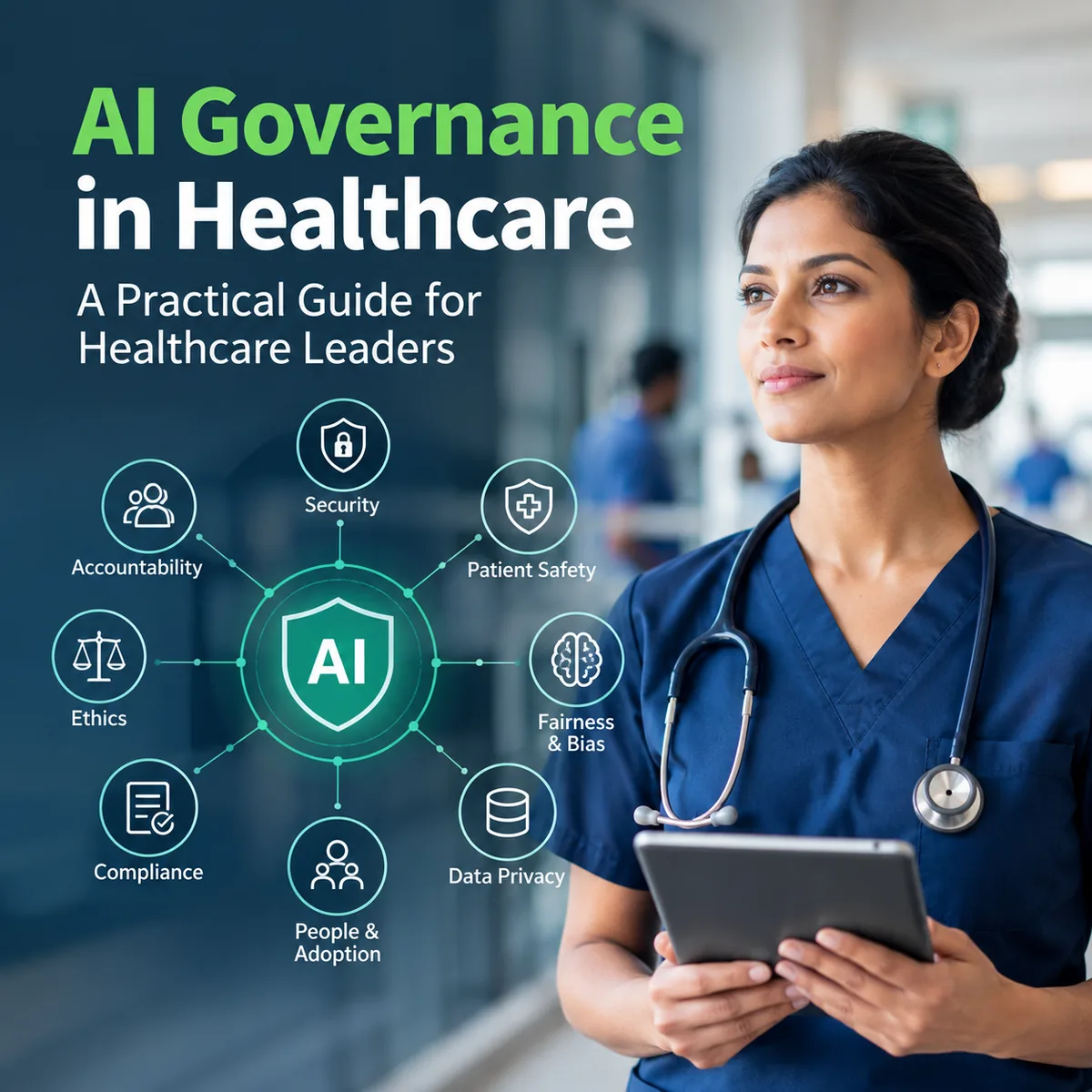
AI Governance in Healthcare: A Practical Guide for Healthcare Leaders
The question for healthcare organizations is no longer whether they will use AI; it is who is responsible for how AI is used. AI governance is the structure for selecting, evaluating, implementing, monitoring, and changing AI systems, and it should start before implementation, not after go-live.
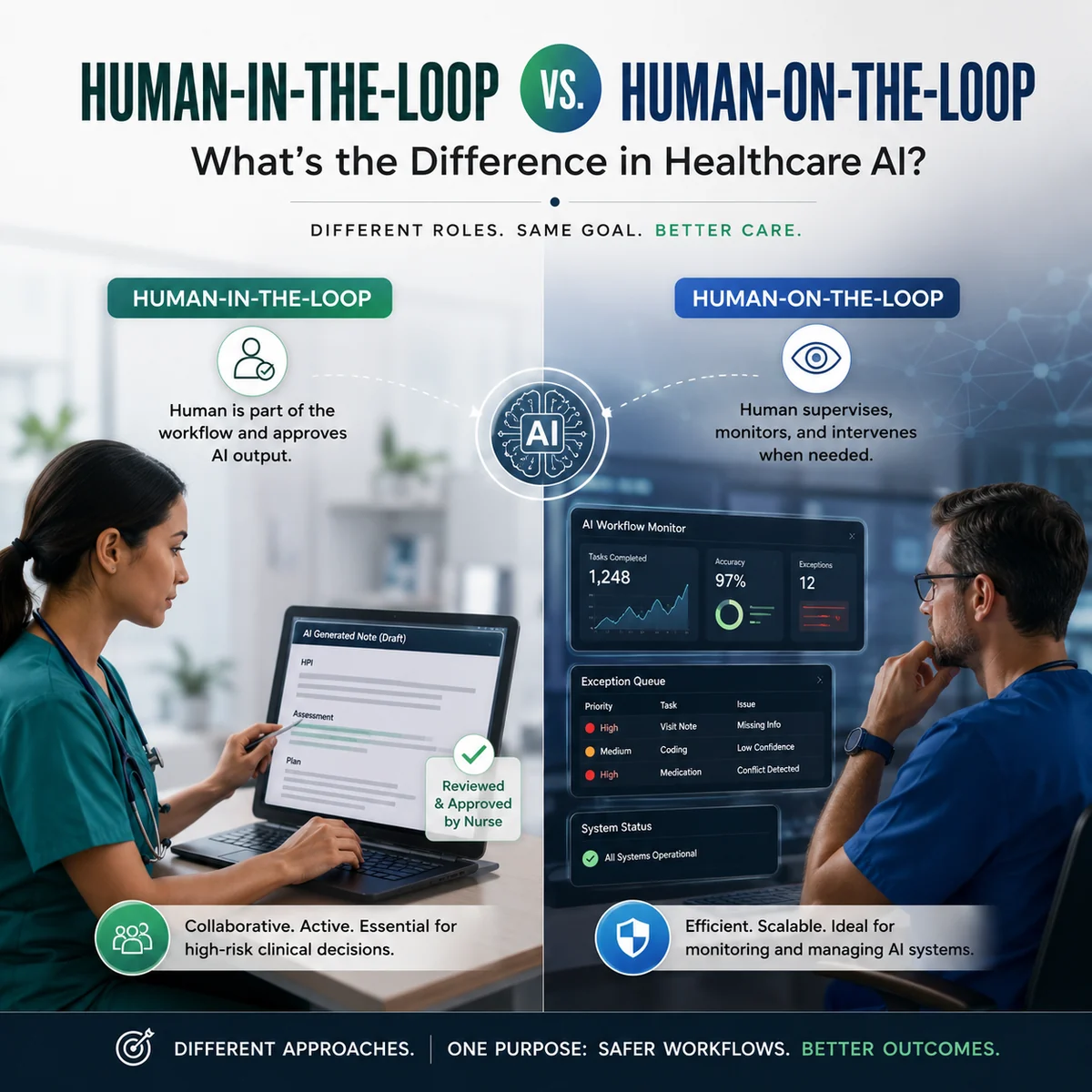
Human-in-the-Loop vs. Human-on-the-Loop: What's the Difference in Healthcare AI?
As healthcare adopts more AI, the key question isn't humans vs. AI; it's where the human belongs in the workflow. This guide explains human-in-the-loop vs. human-on-the-loop AI: how each works, the trade-offs, the risks (including automation bias), and how to match human oversight to clinical risk.
If AI Cannot Handle a Nurse Having a Bad Day, It Does Not Belong in Healthcare
AI is advisory. The nurse's judgment is sacred. Susie Branagan, RN, who calls herself AI's clinical conscience, on applying Just Culture to AI, the real danger of hallucinations in home health, trauma-informed design, and why deploying technology into a broken culture only gives it more efficient ways to do harm.