
WellSky Documentation Tips Every Home Health Nurse Should Know
Home health documentation isn't about filling in fields; it's about telling the clinical story. These WellSky documentation tips help nurses show skilled need, document wounds and homebound status clearly, and use AI to reduce charting work without losing clinical judgment.
Key Takeaways
- Strong WellSky documentation answers a few core questions: what you assessed, why skilled care was needed, what you did, how the patient responded, what changed, and what happens next.
- Make the skilled component clear with action verbs such as assessed, evaluated, instructed, and reassessed, but only when they reflect the care actually provided.
- Replace vague phrases ("wound healing well," "patient educated," "patient stable") with specific, measurable, patient-specific findings.
- Connect homebound status, abnormal vital signs, and interventions to the patient's actual condition and response, not generic copied sentences.
- WellSky emphasizes that high-quality documentation is about focus, not volume; copy-forward should be a reference, not a substitute for today's assessment.
- AI, including WellSky's SkySense AI and Scribe, and tools like Copper AI, should reduce documentation work while keeping the nurse in the review-and-approve loop.
✓ Quick answer: Strong home health documentation in WellSky isn't about filling out more fields; it's about telling the clinical story. A good note should make it clear what you assessed, why skilled care was needed, what you did, how the patient responded, what changed, and what needs to happen next.
Home health documentation isn't just about filling out fields in an EHR. A strong clinical note should help answer a few basic questions: What did you assess?
Why was skilled care needed? What did you do?
How did the patient respond? What changed?
And what needs to happen next?
For nurses documenting in WellSky, the challenge is often balancing complete clinical documentation with the reality of a busy day of visits. WellSky's own educational material emphasizes that high-quality documentation should be focused and patient-specific rather than simply lengthy.
Its clinical documentation guidance also highlights areas such as current patient condition, changes since the last visit, skilled need/focus of care, response to the visit, and the plan for the next visit.
Here are practical WellSky documentation tips every home health nurse should keep in mind.
What Should a Home Health Nurse Document in WellSky After Every Visit?
A good visit note should tell the story of the visit without forcing the next clinician, reviewer, or care team member to guess what happened. Depending on the visit and discipline, documentation may include:
- Current patient condition.
- Assessment findings.
- Changes since the previous visit.
- Vital signs.
- Symptoms and relevant observations.
- Skilled interventions performed.
- Medication-related findings or interventions.
- Wound or skin assessment.
- Patient and caregiver education.
- Patient response to care.
- Communication with physicians or other providers.
- Follow-up needs.
- Plan for the next visit.
The important part is not simply documenting everything that happened. It is documenting the information that explains the patient's current clinical picture and the skilled care provided.
What Are the Most Important WellSky Documentation Tips for Home Health Nurses?
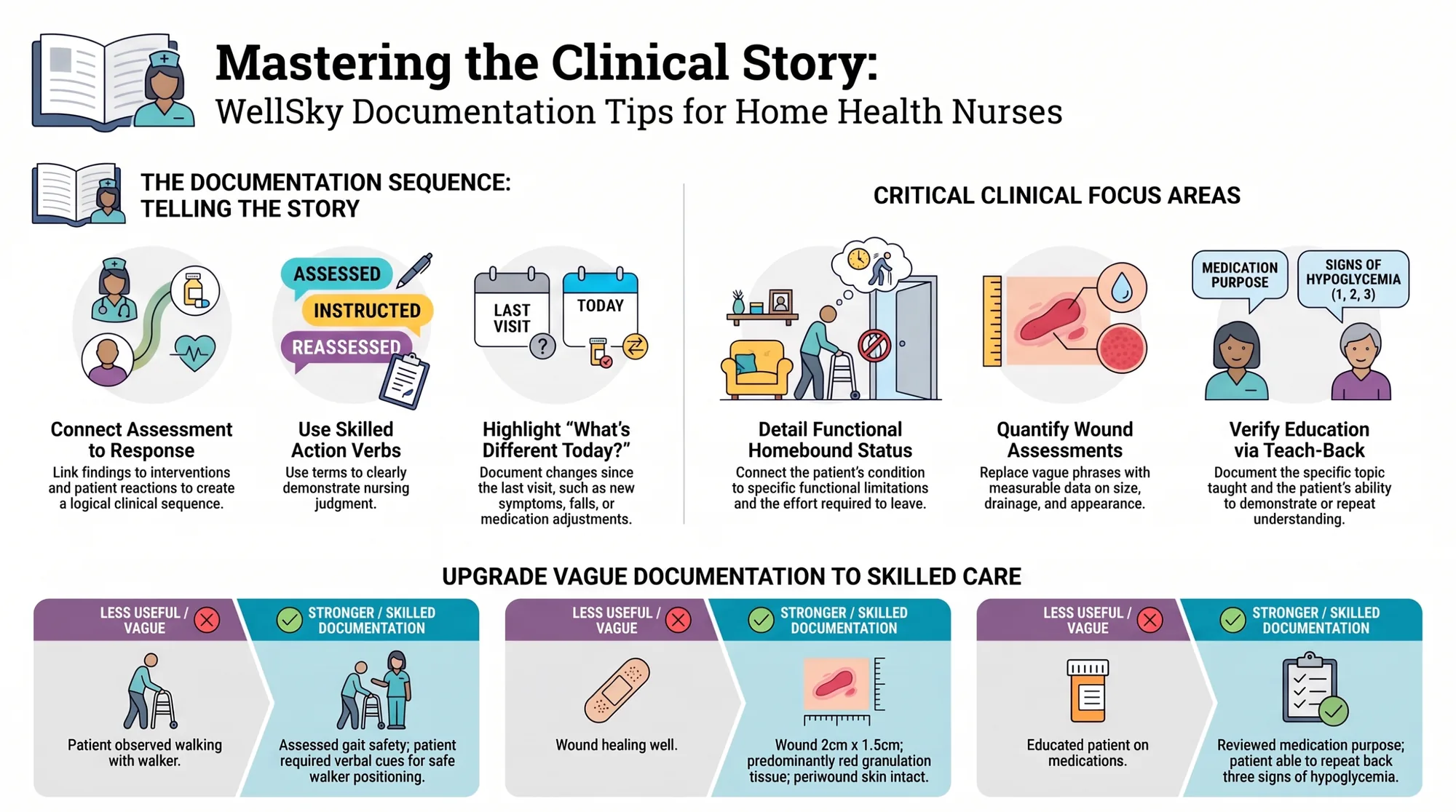
Mastering the clinical story: connect assessment to response, use skilled action verbs, highlight what's different today, and upgrade vague notes into specific, skilled documentation.
1. How Can Nurses Show the Skilled Need Clearly?
One of the most important documentation habits is to make the skilled component of the visit clear. Instead of simply documenting that something happened, explain the clinical action and reasoning behind it.
Less useful: Patient observed walking with walker.
Stronger: Assessed gait and transfer safety due to increased unsteadiness reported since previous visit; patient required verbal cues for safe walker positioning.
Words such as assessed, evaluated, monitored, instructed, reinforced, administered, performed, and reassessed can help describe what the nurse actually did. But don't use "skilled" language simply as a writing trick.
The documentation should accurately reflect the care that was actually provided.
CMS guidance specifically recognizes skilled observation and assessment when a patient's condition presents a reasonable potential for complications or changes requiring skilled nursing judgment.
2. How Should Nurses Document Wounds in WellSky?
Avoid vague descriptions such as "wound healing well." That statement doesn't tell the reader much. When clinically applicable, document measurable and observable characteristics such as:
- Location.
- Length and width.
- Depth when applicable.
- Wound bed appearance.
- Drainage amount.
- Drainage color or characteristics.
- Odor when relevant.
- Periwound condition.
- Edema.
- Redness or other concerning changes.
- Treatment provided.
- Patient response.
Right lower-leg wound measured 2.0 cm × 1.5 cm. Small amount of serous drainage noted. Wound bed with predominantly red granulation tissue. Periwound skin intact with mild edema.
The goal is to make the documentation specific enough that someone reviewing the record can understand what the nurse actually saw.
3. How Can Nurses Document Homebound Status More Effectively?
Homebound status shouldn't be treated as a checkbox disconnected from the patient's actual condition. For Medicare home health, CMS requires documentation supporting homebound status and skilled need.
CMS describes the homebound criteria in terms of the patient's inability to normally leave home and the considerable and taxing effort required to leave home, subject to the applicable criteria.
Instead of simply writing "patient is homebound," connect the patient's condition to the functional limitation:
Patient requires assistance to leave the home due to generalized weakness and impaired balance and requires considerable effort and use of an assistive device to ambulate outside the residence.
The documentation should reflect the patient's actual clinical circumstances, not a generic sentence copied from another visit.
4. What Should Nurses Document When Providing Patient or Caregiver Education?
"Patient educated" isn't enough. Document what was taught.
For example, instead of "educated patient on medications," consider documenting:
Reviewed prescribed medication schedule, purpose of medication, and signs of hypoglycemia. Patient was able to repeat back three signs that should prompt a call to the provider.
Depending on the situation, document:
- Topic taught.
- Specific instructions.
- Signs and symptoms discussed.
- Medication instructions.
- Safety precautions.
- Teach-back or patient/caregiver understanding.
- Questions or concerns.
- Follow-up needed.
This turns education from a checkbox into a meaningful clinical record.
5. How Should Nurses Document Abnormal Vital Signs?
Don't let an abnormal vital sign sit in the chart without documenting what happened next. If a vital sign falls outside the patient's expected or ordered parameters, follow the applicable agency and provider notification process.
Document the relevant finding and the action taken, including communication when applicable.
BP 178/96 prior to medication administration. Patient denied headache, dizziness, chest pain, or shortness of breath. Provider notified at 10:42 a.m.; spoke with [appropriate contact]. New instructions received to…
The exact response will depend on the patient's condition, orders, agency policy, and clinical judgment. CMS specifically identifies abnormal or fluctuating vital signs among clinical findings that can support the need for skilled observation and assessment in appropriate circumstances.
6. How Can Nurses Connect Assessment, Intervention, and Patient Response?
This is one of the simplest ways to make documentation more clinically meaningful. Think: What did I find? → What did I do? → How did the patient respond?
Patient reported increased shortness of breath with ambulation. Assessed respiratory status and oxygen saturation. Reviewed prescribed breathing techniques and reinforced energy conservation strategies. Patient demonstrated technique correctly and reported reduced shortness of breath after rest.
This gives the note a clinical sequence instead of a list of disconnected tasks.
7. How Can Nurses Make WellSky Documentation More Patient-Specific?
Two patients can receive the same type of visit but still require very different documentation. Avoid relying on generic statements such as "patient stable," "patient tolerated treatment well," "continue plan of care," "caregiver educated," or "no concerns." These statements may not adequately explain the patient's clinical situation on their own.
Instead, connect the documentation to the patient's diagnosis, current symptoms, functional limitations, recent changes, skilled needs, treatment, response, and plan. WellSky's own documentation education emphasizes patient-specific documentation and avoiding generic care plans.
8. How Can Nurses Avoid Copying Forward Incorrect Information?
Copying previous documentation can save time, but only when the information remains accurate. Before carrying information forward, ask: Is this still true today?
Check:
- Medication changes.
- Vital signs.
- Symptoms.
- Wound measurements.
- Functional status.
- Caregiver availability.
- Patient response.
- Physician orders.
- Changes in condition.
A previous note should be a reference, not a substitute for today's assessment.
9. What Should Nurses Document About Changes Since the Previous Visit?
A useful question to ask is: "What's different today?" That could include new or improved symptoms, falls, medication changes, new physician visits, hospital or ED visits, changes in appetite or mobility, new wounds, changes in wound status, changes in caregiver support, or new safety concerns.
WellSky's own documentation training specifically calls out changes since the last in-home visit, including medication changes, falls, physician visits, and other events.
10. How Should Nurses Document the Patient's Response to Care?
Don't stop at documenting the intervention. Document the response when clinically relevant.
Instead of "wound care performed," document what was performed and how the patient responded, consistent with the actual visit. Similarly, instead of "patient tolerated therapy," explain the meaningful clinical response when applicable.
CMS guidance emphasizes that clinical notes should reflect the patient's response to skilled care and provide a clear picture of treatment and next steps.
11. How Can Nurses Document Physician Communication Clearly?
When communicating with a physician or other provider about a clinical concern, don't just write "MD notified." Capture the relevant communication details required by your agency's documentation process, such as:
- Reason for notification.
- Relevant clinical finding.
- Date/time.
- Who was contacted.
- Instructions or orders received.
- Follow-up action taken.
This creates a much clearer clinical trail.
12. How Should Nurses Document the Plan for the Next Visit?
A good note should not feel like the patient's story simply stops at the end. Document what needs to be followed up, based on the patient's condition and plan of care.
For example: reassess wound, follow up on medication change, monitor blood glucose, reinforce education, assess response to treatment, follow up on provider appointment, or continue monitoring identified symptoms.
WellSky training materials specifically identify the plan for the next visit as part of focused clinical documentation.
What Are the Most Common WellSky Documentation Mistakes Nurses Should Avoid?
Some documentation problems are less about missing information and more about how information is documented. Common mistakes include:
- Vague language: "Patient doing well.".
- Task-only documentation: "Medication administered.".
- Generic education: "Patient educated.".
- Missing patient response: The intervention is documented, but the outcome isn't.
- Copy-forward errors: Old information remains even though the patient's condition has changed.
- Missing changes from baseline: The note doesn't explain what's different today.
- Weak skilled-need connection: The note lists activities without explaining the clinical reason for the skilled service.
- Incomplete communication documentation: A provider was notified, but the record doesn't explain why or what happened next.
- Over-documenting without adding clinical value: More words don't automatically mean better documentation.
WellSky itself notes that high-quality documentation is about focus, not volume. For a deeper look at the patterns that trip nurses up, see the biggest documentation challenges home health nurses face and the top home health documentation errors.
How Can Home Health Nurses Make WellSky Documentation Faster Without Sacrificing Quality?
Efficiency doesn't mean writing less just for the sake of writing less. It means reducing unnecessary work while preserving the information needed to understand the patient's condition and care.
A few practical habits can help:
Document as close to the visit as practical.
Details are easier to recall while they are fresh. Delayed charting also carries risk.
See the hidden cost of late nursing documentation.
Use a consistent clinical sequence.
Assessment → Skilled intervention → Response → Education → Communication → Next step
Avoid unnecessary repetition.
If information has already been captured accurately in the appropriate part of the record, don't create additional repetitive text unless it serves a clinical or documentation purpose.
Use structured fields appropriately.
Structured documentation can make important information easier to find and review.
Personalize templates.
Templates can improve consistency, but they should not replace individualized clinical documentation. See how to build home health documentation templates that stay patient-specific.
Review before finalizing.
Take a quick look for contradictions, missing findings, unanswered questions, and information that no longer reflects the patient's current condition.
Can AI Help Home Health Nurses With WellSky Documentation?
Yes, AI can potentially reduce some of the administrative burden associated with clinical documentation. But the goal shouldn't be "let AI write the note." The better goal is: let AI help capture and organize the information so the nurse spends less time typing and more time reviewing clinically meaningful documentation.
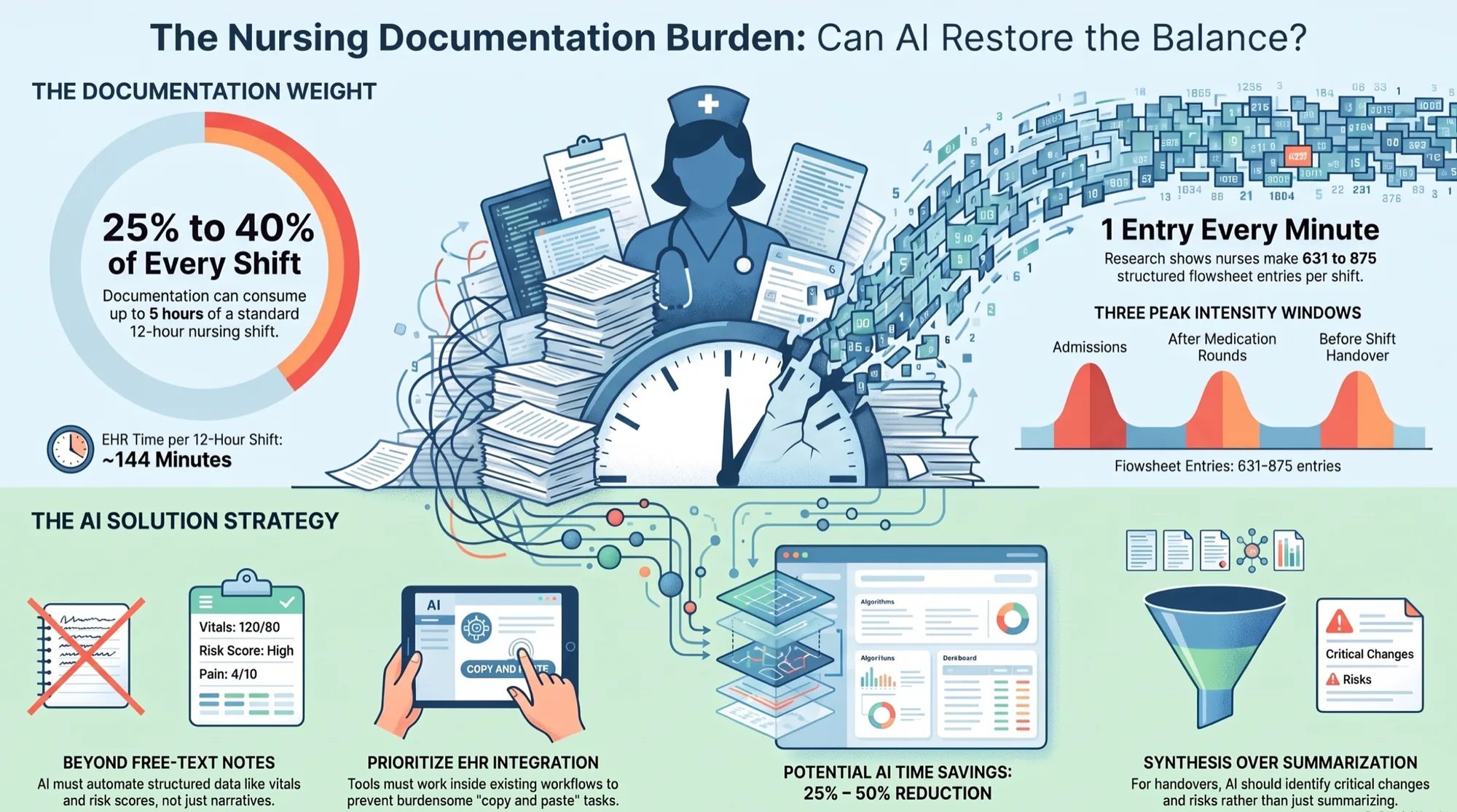
Documentation can consume a large share of a shift. Useful AI should go beyond free-text notes: integrating with the EHR, capturing structured data, and synthesizing what matters rather than just summarizing.
WellSky itself now offers AI-powered documentation capabilities through SkySense AI and WellSky Scribe, including ambient documentation integrated with the WellSky Home Health EHR.
That also means agencies evaluating AI documentation should look beyond whether an AI tool can generate a paragraph. Ask: Does it fit into the nurse's existing workflow?
Can the nurse review the output? Does it preserve clinical context?
Can it reduce repetitive data entry? Does it work with the existing EHR?
How are errors handled? What happens when the AI is uncertain?
It also helps to understand the distinction between an AI scribe and an AI documentation agent before comparing tools.
How Can Copper AI Help With Home Health Documentation?
Copper AI is designed around the same problem: reducing the documentation burden without asking agencies to replace their existing EMR. Instead of making the nurse manually build every part of a clinical note, AI can help turn information captured during the visit into structured clinical documentation that the nurse can review, correct, and approve.
The important distinction is that AI should support the nurse, not replace the nurse's clinical judgment. For home health agencies, that can mean moving toward a workflow where the nurse spends less time staring at the screen and more time reviewing what actually matters.
The goal isn't simply faster charting. It's less charting work.
What Should Home Health Agencies Look for in an AI Documentation Tool?
Before choosing an AI documentation solution, agencies should consider more than the quality of generated text.
Does it work with the existing EHR?
An AI tool should fit the agency's workflow rather than creating another disconnected documentation system.
Can nurses review and edit the documentation?
Clinical oversight should remain central.
Does it capture structured information as well as narrative?
A polished paragraph doesn't solve every documentation problem.
Does it reduce duplicate entry?
The value should be measured in actual workflow reduction.
Can it handle real-world home health conditions?
Home visits involve interruptions, background noise, changing patient conditions, and unpredictable conversations.
Does it protect patient information?
Healthcare organizations should evaluate privacy, security, access controls, contractual requirements, and applicable HIPAA obligations. See is AI documentation HIPAA compliant? for a closer look.
Can the agency measure the impact?
Look at documentation time, late notes, correction rates, clinician experience, and workflow efficiency, not simply how impressive an AI-generated note looks.
What Is the Biggest WellSky Documentation Tip to Remember?
Don't document for the sake of documenting. Document to tell the clinical story.
A strong home health note should make it possible to understand: Why was the patient seen? What did the nurse find?
What skilled care was provided? How did the patient respond?
What changed? What happens next?
When those questions are answered clearly, documentation becomes more than a record of tasks. It becomes part of the patient's care story.
✓ The opportunity for AI isn't to make nurses spend less time thinking about patients. It's to make them spend less time doing repetitive documentation work.
What Should I Document? 100 OASIS Situations Home Health Nurses Face Every Day
100 real OASIS scenarios, worked end to end — clinical situation, common mistake, better approach, and key takeaway. Built around OASIS-E2 (effective April 1, 2026) to turn what you assess into accurate, defensible documentation.
Bottom Line
Don't document for the sake of documenting. Document to tell the clinical story. The strongest WellSky notes make it easy to understand why the patient was seen, what the nurse found and did, how the patient responded, what changed, and what happens next, and AI's role is to remove repetitive work while nurses keep control of the record.

Arvind Sarin is the founder of Copper Digital. For the past year he has spent three days a week inside a 500+ census Texas home health agency, building AI documentation that finishes OASIS and visit notes the same day, with a nurse reviewing and approving every note. He writes about home health documentation, OASIS, Medicare compliance, and applying AI responsibly in clinical workflows.
Frequently asked
Frequently asked questions
A home health nurse should document relevant assessment findings, changes in condition, skilled services provided, patient response, education, communication, and follow-up needs, according to the visit and applicable agency requirements.
Join the conversation
Leave a comment
No comments yet. Be the first to share your thoughts.
Related reading
Must-Ask Questions for AI Vendors Before Giving Away Your Patient Data
Twelve questions to ask healthcare AI vendors about patient data, security, model training, clinical accuracy, accountability, and what happens when the contract ends.
Medicare Advantage Star Ratings 2027: What Home Health Agencies Need to Know
Understand the 2027 Medicare Advantage Star Ratings changes, how plan-level measures differ from home health agency ratings, and practical steps to strengthen care coordination.
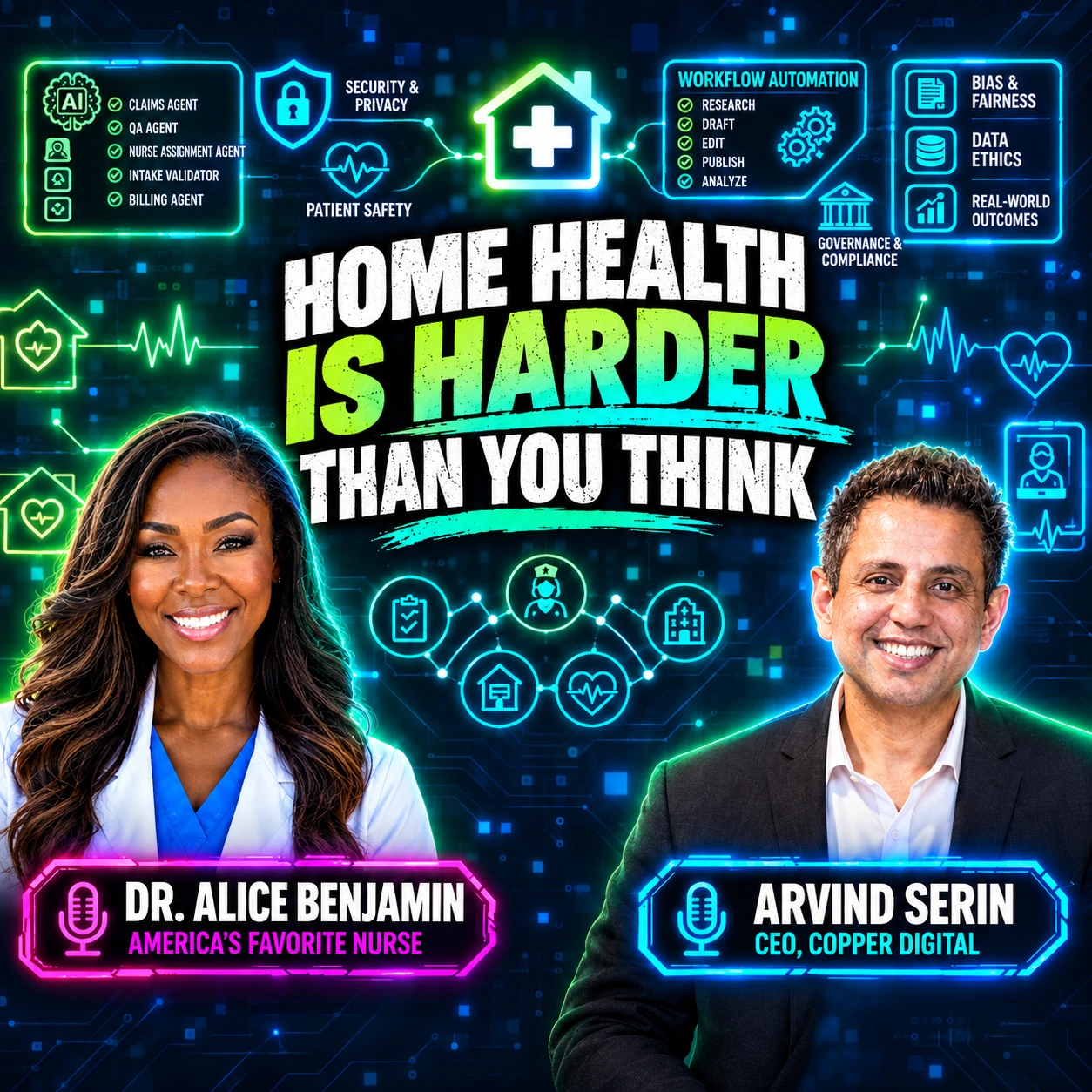
Why Is Home Health More Complex Than It Looks?
Nurse Alice Benjamin joins Arvind Sarin to explore the hidden clinical, operational, and caregiver demands of care at home, and how technology can support nurses without replacing clinical judgment.