
Why Is Home Health More Complex Than It Looks?
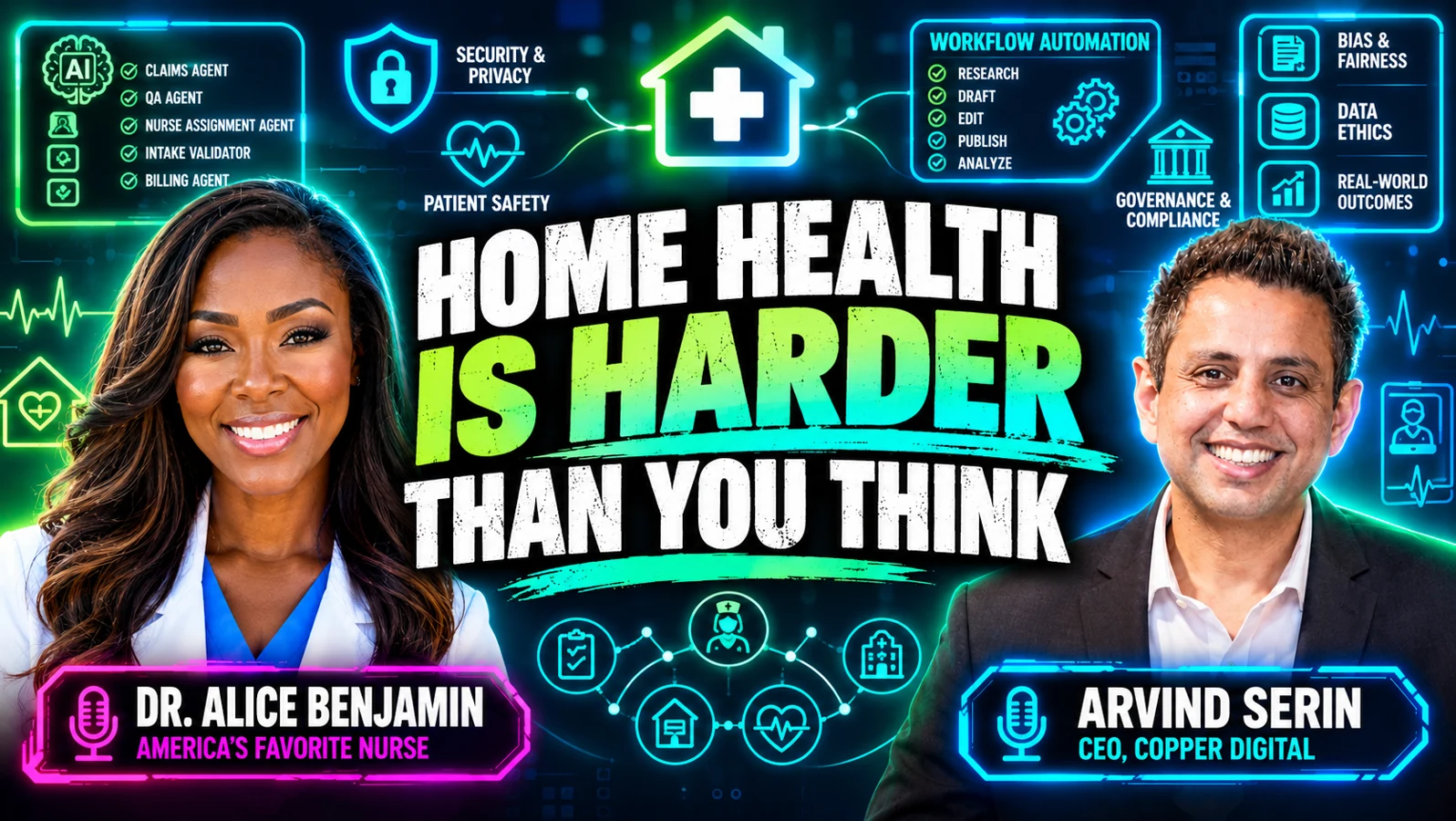
Nurse Alice Benjamin joins Arvind Sarin to explore the hidden clinical, operational, and caregiver demands of care at home, and how technology can support nurses without replacing clinical judgment.
Key Takeaways
- A patient’s location does not determine the complexity of their care.
- Home health nurses need clinical autonomy and support for high-acuity care outside a hospital.
- Discharge handoffs, fragmented records, caregiver capacity, and payer requirements add operational complexity.
- AI can support administrative work and documentation while clinicians retain review and approval.
For years, home health was sometimes viewed as the easier side of healthcare.
The patient is at home. There is no hospital floor.
There is no ICU. There is no code team around the corner.
So how hard could it be?
A lot harder than it looks.
That was one of the central themes in a recent Inside Home Health conversation with Nurse Alice Benjamin, a nurse practitioner with nearly three decades of experience across nursing, critical care, emergency medicine, family medicine, and home health.
Her perspective was shaped by working across different parts of the healthcare system, including home health earlier in her career.
And one point came through clearly:
The complexity of healthcare has moved into the home.
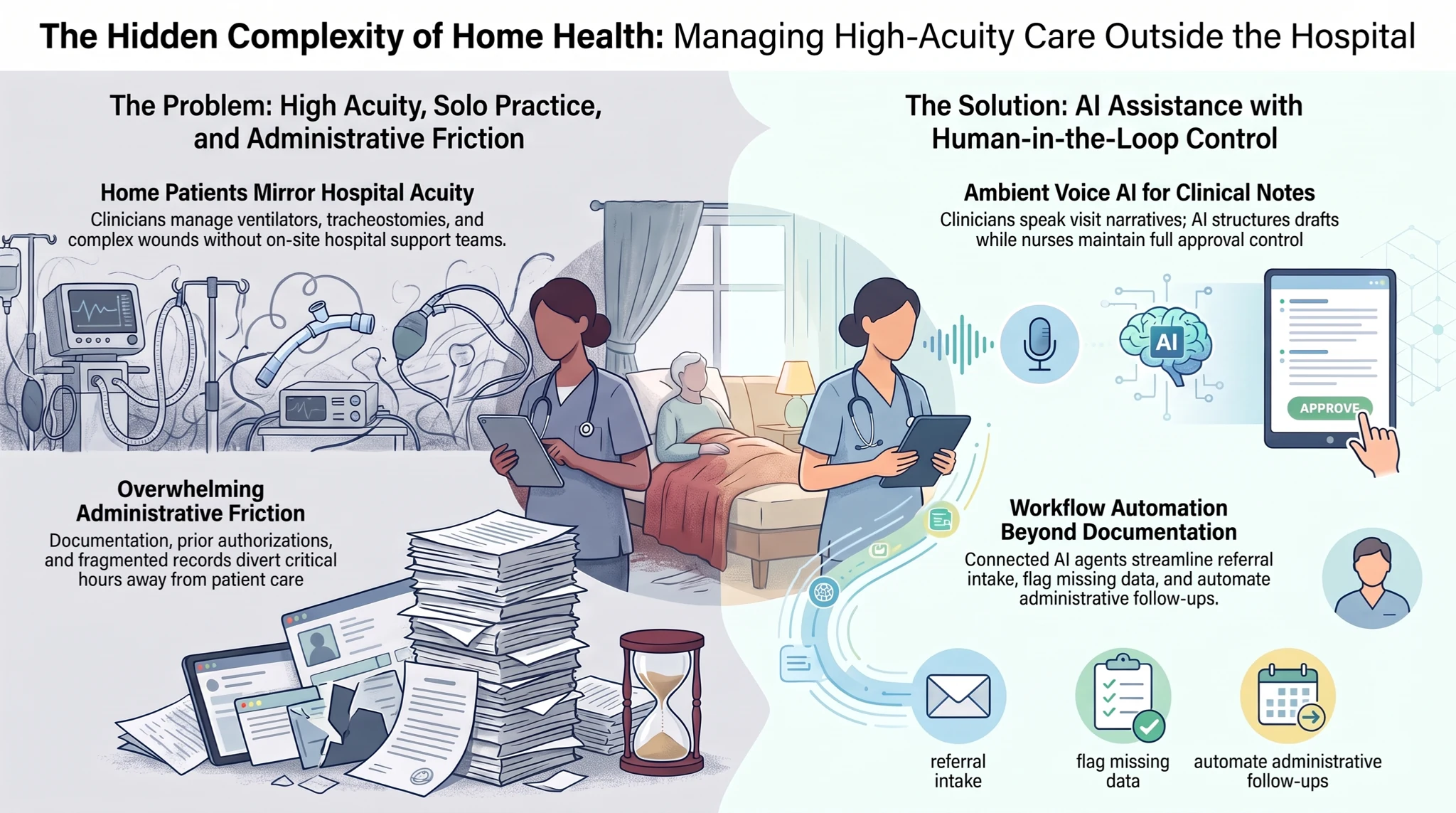
Patients who once would have remained in hospitals or other institutional settings can now receive increasingly sophisticated care at home. Ventilators, complex wound care, remote monitoring, advanced medical devices, and technology-supported clinical workflows are changing what home health nurses encounter during a visit.
At the same time, the nurse may be working largely on their own.
There may be no respiratory therapist immediately available. No ICU team down the hall.
No colleague to step in when something unexpected happens.
There is the patient, the family, the home environment, the care plan, the technology, and the clinician.
And all of it has to work together.
Why Is Home Health Becoming More Complex?
Several changes are converging to make care at home more clinically demanding.
People are living longer.
Many are also living longer with multiple chronic conditions.
At the same time, medical technology has advanced enough that patients who once required prolonged hospital-based care can sometimes be supported in their homes.
This means home health clinicians may encounter patients with:
- Multiple chronic conditions.
- Complex medication regimens.
- Advanced wound care needs.
- Respiratory equipment.
- Tracheostomies and ventilators.
- Mobility limitations.
- High risk of hospitalization.
- Frequent transitions between care settings.
- Complex family and caregiver dynamics.
- Increasing technology needs.
CMS describes Medicare home health as including skilled nursing, physical therapy, occupational therapy, speech-language pathology, medical social services, and certain home health aide services. The Medicare benefit is specifically built around patients who need qualifying skilled care in the home.
Source: Medicare home health services.
The important point is that home does not mean simple.
In some cases, it means the healthcare professional has to manage significant clinical complexity without the infrastructure of a hospital around them.
Why Can a Home Health Patient Be Just as Clinically Complex as a Hospital Patient?
A patient's physical location does not determine the complexity of their condition.
A patient may be at home and still require sophisticated clinical care.
Nurse Alice described seeing patients who were chronically ventilated at home. A ventilator might immediately make people think of an ICU, but advances in technology and care delivery have made home-based management possible for some patients.
That changes the skill set required in home health.
A nurse may need to understand:
- Respiratory equipment.
- Tracheostomy care.
- Complex wound care.
- Medication management.
- Chronic disease management.
- Early signs of deterioration.
- Emergency escalation.
- Caregiver education.
- Coordination with physicians and specialists.
CMS's Medicare Benefit Policy Manual makes an important point about skilled nursing: coverage is based on the patient's individualized need for skilled care, including when the complexity of the service requires professional nursing skill.
Source: Medicare Benefit Policy Manual, Chapter 7, Section 40.1.
So the question isn't simply:
"Is this patient at home?"
The better question is:
"What level of clinical judgment and skill does this patient's condition require?"
Why Does Home Health Require More Clinical Autonomy From Nurses?
A hospital has layers of support.
A nurse can reach a physician. A respiratory therapist may be nearby.
Another nurse can help. A rapid response team exists.
Specialists may already be in the building.
Home health is different.
The clinician may arrive at the patient's home alone and discover something that wasn't obvious from the referral.
They have to assess the situation, understand the patient's baseline, recognize changes, communicate with the appropriate providers, educate the patient or caregiver, document the visit, and determine what needs to happen next.
That requires clinical judgment and autonomy.
As Nurse Alice explained in the podcast, the home health nurse doesn't necessarily have a "code blue team" to call when something goes wrong.
That doesn't make the care less serious.
It makes the clinician's ability to recognize and respond to problems even more important.
Why Is the Home Environment a Different Clinical Environment?
One of the most important insights from Nurse Alice's experience across care settings is that healthcare changes when the environment changes.
A hospital is designed for healthcare delivery.
A patient's home isn't.
A home may have:
- Limited space.
- Different levels of cleanliness.
- Narrow hallways.
- Stairs.
- Pets.
- Family members.
- Limited equipment.
- Different electrical or connectivity considerations.
- Medication storage challenges.
- Mobility barriers.
- Cultural and personal routines that affect care.
The clinician has to work within that environment.
Something that is straightforward in an ICU may require a different approach at home.
Even infection-control practices and resource availability can look different.
The home health clinician has to ask:
What is clinically appropriate, what is safe, and what can realistically be done in this patient's environment?
That is a different kind of complexity.
Why Are Care Transitions One of the Biggest Challenges in Home Health?
Patients rarely enter home health in isolation.
They often arrive there after moving through another part of the healthcare system.
For example:
Hospital → Home Health
Or:
Emergency Department → Hospital → Home → Home Health
Or:
Specialist → Procedure → Hospital → Home Health
Every transition creates an opportunity for information to be lost.
A medication may have changed.
A diagnosis may have changed.
The reason for hospitalization may not be obvious from the referral.
A new piece of equipment may have been ordered.
A wound may have progressed.
The patient's functional status may be different from what it was before hospitalization.
And the home health team has to put all of those pieces together.
CMS requires home health agencies to conduct an initial assessment visit within 48 hours of referral, within 48 hours of the patient's return home, or on the physician- or allowed practitioner-ordered start-of-care date, depending on the circumstances.
Source: 42 CFR 484.55(a)(1).
That means the transition isn't simply:
"The patient was discharged. Go see them."
It is a time-sensitive clinical handoff.
Why Is the Handoff From Hospital to Home Health So Important?
A hospital discharge summary can contain a large amount of information.
But home health needs to understand what that information means in the patient's actual home environment.
The home health clinician may need to determine:
- Why was the patient hospitalized?
- What changed?
- What medications were started or stopped?
- What is the patient's current baseline?
- What equipment was ordered?
- What follow-up is required?
- What symptoms should trigger escalation?
- What does the physician need to know?
- What does the caregiver understand?
- What information is still missing?
A poor handoff can create downstream problems.
A strong handoff gives the home health team a starting point.
This is why transitions of care are not simply administrative events.
They are clinical events.
Why Are Home Health Nurses Sometimes Working With Incomplete Information?
The information needed to safely care for a patient may live in multiple systems.
Some information may be in the hospital's EHR.
Some may be in a physician's office.
Some may be in a specialist's record.
Some may arrive through a referral.
Some may arrive by fax.
Some may not arrive at all.
The home health agency then has to connect the dots.
This creates a frustrating reality:
The clinician may be physically at the patient's home while still trying to reconstruct the patient's recent healthcare history.
That is an information problem, not a clinical capability problem.
And it is one area where technology can potentially make a meaningful difference.
Why Is Wound Care Becoming More Technology-Enabled in Home Health?
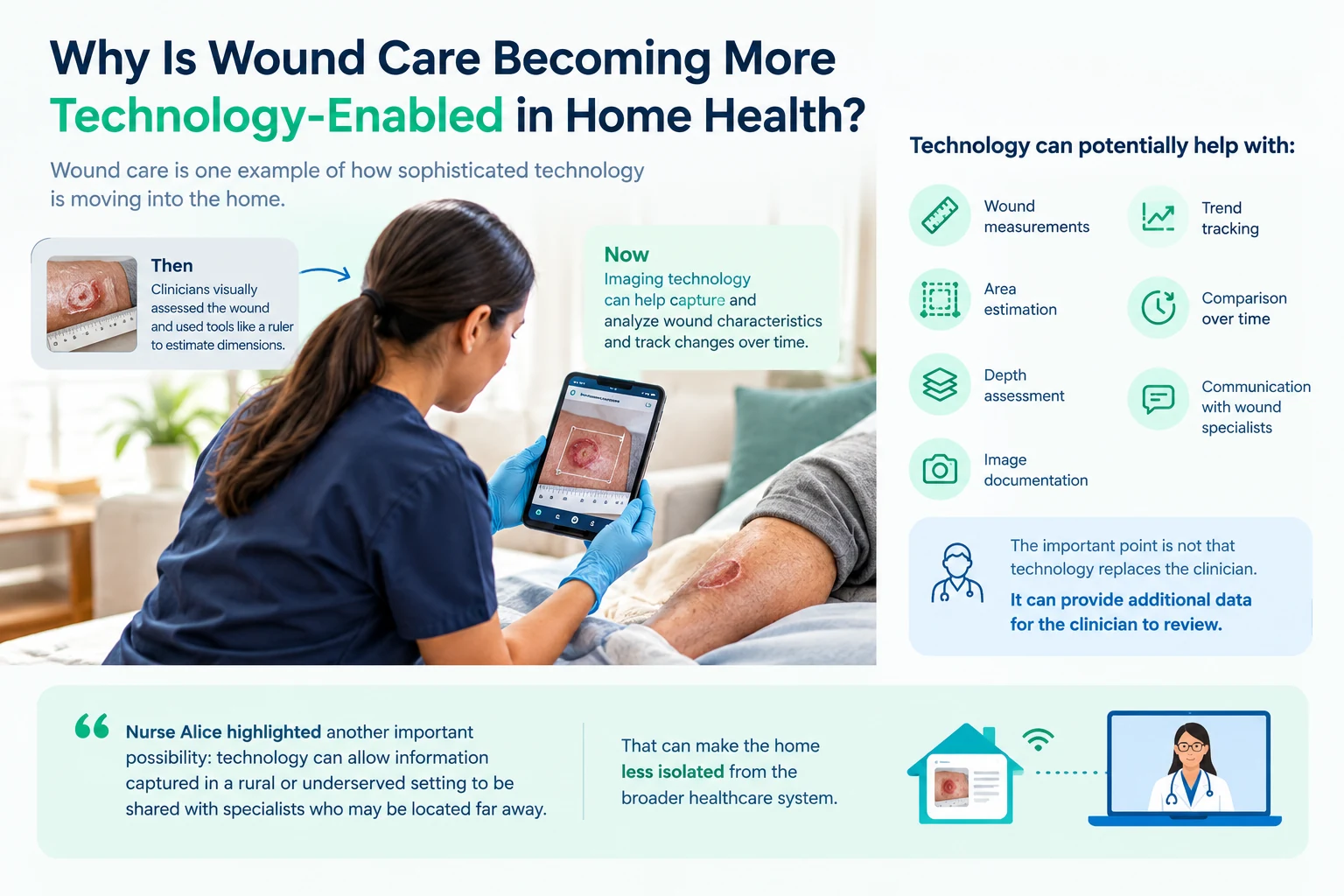
Wound care is one example of how sophisticated technology is moving into the home.
Historically, wound measurements could involve a clinician visually assessing a wound and using tools such as a ruler to estimate dimensions.
Today, imaging technology can help capture and analyze wound characteristics and track changes over time.
Technology can potentially help with:
- Wound measurements.
- Area estimation.
- Depth assessment.
- Image documentation.
- Trend tracking.
- Comparison over time.
- Communication with wound specialists.
The important point is not that technology replaces the clinician.
It can provide additional data for the clinician to review.
Nurse Alice highlighted another important possibility: technology can allow information captured in a rural or underserved setting to be shared with specialists who may be located far away.
That can make the home less isolated from the broader healthcare system.
Why Is Technology Changing What Can Be Done in the Home?
Technology has changed the physical footprint of healthcare.
Devices that once required substantial hospital infrastructure can increasingly be made smaller, more portable, and easier to use outside institutional settings.
That can include:
- Portable respiratory equipment.
- Remote monitoring devices.
- Digital wound imaging.
- Connected medical devices.
- Telehealth.
- Virtual clinical support.
- AI-assisted documentation.
This doesn't mean every patient should receive hospital-level care at home.
It means the boundary between "hospital care" and "home care" is becoming more technologically flexible.
Hospital-at-home models are one example of this broader shift.
Why Do More Patients Want to Receive Care at Home?
Clinical capability is only part of the story.
Patients often prefer to be at home.
Nurse Alice shared a personal example involving her mother, who expressed a strong preference to remain at home rather than spend time in the hospital.
For many patients, home means:
- Familiar surroundings.
- Family nearby.
- Greater sense of independence.
- Fewer disruptions to daily life.
- Less institutional dependence.
- More control over the environment.
There can also be potential benefits associated with avoiding unnecessary institutional exposure, although the appropriateness of home-based care depends on the patient's condition and available support.
The key is that patient preference is becoming an increasingly important part of the care-at-home conversation.
Why Does Caregiver Capacity Matter So Much in Home Health?
There is another side to the shift toward home-based care.
The patient may leave the hospital, but some of the responsibility moves into the home.
That often means caregivers become part of the care infrastructure.
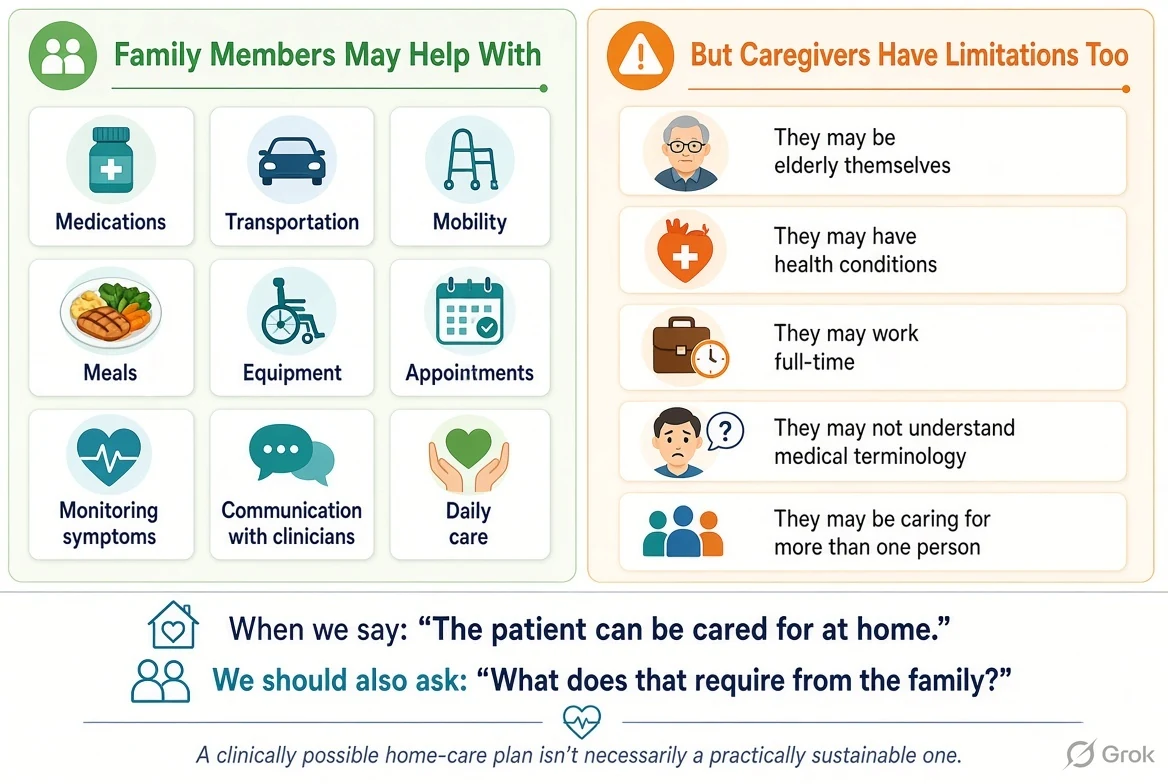
Family members may help with:
- Medications.
- Transportation.
- Mobility.
- Meals.
- Equipment.
- Appointments.
- Monitoring symptoms.
- Communication with clinicians.
- Daily care.
But caregivers have limitations too.
They may be elderly themselves.
They may have health conditions.
They may work full-time.
They may not understand medical terminology.
They may be caring for more than one person.
So when we say:
"The patient can be cared for at home."
We should also ask:
"What does that require from the family?"
A clinically possible home-care plan isn't necessarily a practically sustainable one.
Why Is the Home Health Workforce Under So Much Pressure?
The complexity of patients is increasing at the same time that healthcare organizations are dealing with workforce constraints.
Home health agencies need clinicians who can manage increasingly complex patients while also handling:
- Travel.
- Scheduling.
- Documentation.
- Care coordination.
- Physician communication.
- Orders.
- Medication reconciliation.
- Quality requirements.
- Payer requirements.
- Technology.
- Administrative follow-up.
The clinician's time is finite.
And every hour spent on administrative work is an hour that cannot be spent on something else.
This creates a fundamental question for the industry:
How do we make home health jobs easier without making care less personal?
Why Is Documentation Such a Major Burden in Home Health?
Documentation is necessary.
But the amount of documentation surrounding a visit can become overwhelming.
A home health clinician may finish the clinical work and still have significant documentation left to complete.
That can mean:
Visit → Drive → Documentation → Corrections → QA → Orders → Follow-up
Instead of:
Visit → Care → Done
And the documentation burden doesn't exist in isolation.
It connects to the rest of the workflow.
The clinical note may need to support the plan of care.
Orders may need physician or practitioner signatures.
Information may need to be available for billing and compliance.
OASIS data may be part of the assessment and quality infrastructure.
CMS requires documentation supporting the need for Medicare home health, including the need for skilled services and homebound status.
Source: CMS home health documentation requirements.
So the answer isn't to eliminate documentation.
The better question is:
How can we make necessary documentation less burdensome for clinicians?
Why Isn't Documentation the Only Problem Home Health Agencies Need to Solve?
This was one of the broader lessons from the podcast.
Solving documentation exposes other connected problems.
You can create a faster clinical note.
But what happens if:
- The order isn't signed?
- A referral is incomplete?
- The patient isn't eligible?
- The authorization is delayed?
- The physician's office doesn't respond?
- Important records are missing?
- The patient deteriorates between visits?
- A caregiver can't manage the plan?
- The agency can't staff the case?
Home health is a connected system.
Improving one step doesn't automatically fix everything around it.
Why Do Prior Authorizations and Payer Requirements Add Complexity to Home Health?
Payer requirements can create another layer of work for clinicians and agency staff.
Depending on the payer and plan, agencies may have to deal with:
- Authorization requirements.
- Visit limitations.
- Documentation requests.
- Medical-necessity reviews.
- Additional clinical information.
- Appeals.
- Different payer portals.
- Different communication processes.
The exact requirements vary by payer and plan, so it is important not to generalize one insurer's process to every home health patient.
But the operational challenge is consistent:
Someone has to navigate the process.
And when that process is slow, the patient can end up waiting while the agency works through administrative requirements.
Why Can Healthcare Denials Put Clinicians in the Middle?
Nurse Alice raised a broader concern about prior authorization and denials.
Clinicians may believe a patient needs a service.
The payer may disagree.
The clinician may then have to provide additional documentation, communicate with the payer, or submit an appeal.
The patient, meanwhile, is waiting.
This creates a difficult position for clinicians:
They are responsible for caring for the patient while also navigating a system that may determine whether the patient can receive the care.
That tension is not unique to home health, but the consequences can be especially visible when resources are limited, and the patient is already medically vulnerable.
How Can Home Health Balance Access to Care With Fraud and Waste Prevention?
This is one of the hardest questions in healthcare.
There needs to be protection against fraud, waste, and unnecessary services.
But safeguards can become burdensome if they are designed without sufficient clinical context.
Nurse Alice's perspective in the conversation was that healthcare needs checks and balances without turning the system into purely punitive oversight.
That means better:
- Education.
- Clinical support.
- Monitoring.
- Infrastructure.
- Communication.
- Data.
- Surveillance.
- Feedback loops.
The goal should be to catch inappropriate care while also helping legitimate providers navigate complicated requirements.
Because the two problems can exist at the same time:
Fraud needs to be addressed.
And:
Patients still need care.
Why Does Home Health Need Better Infrastructure?
If the care model is becoming more sophisticated, the infrastructure supporting it needs to evolve too.
That infrastructure isn't just technology.
It includes:
- Clinicians.
- Education.
- Care coordination.
- Payer communication.
- Data exchange.
- Clinical support.
- Administrative resources.
- Technology.
- Policy.
- Oversight.
Technology can support many of these areas, but it cannot solve every structural problem.
The objective should be to remove unnecessary friction from the system so clinicians can focus on the work that actually requires clinical judgment.
Can AI Reduce the Administrative Burden on Home Health Nurses?
Potentially, yes, but the strongest use cases are not about replacing the clinician.
They are about removing repetitive work around the clinician.
For example, AI can potentially help with:
- Referral intake.
- Document extraction.
- Information retrieval.
- Clinical documentation.
- Missing-information identification.
- Order follow-up.
- Patient communication.
- Workflow coordination.
- QA support.
- Record organization.
The ideal workflow is not:
AI replaces nurse.
It is:
Nurse provides clinical judgment → AI handles appropriate administrative work → nurse reviews and remains accountable.
That distinction matters.
Nurse Alice made a similar point when discussing her own approach to AI: use technology to facilitate healthcare work, not replace the healthcare provider.
How Can Voice AI Help With Home Health Documentation?
One of the clearest opportunities is voice-based documentation.
Instead of spending additional time navigating an EHR after a visit, a clinician could describe what happened during the visit in a natural narrative.
For example:
"I arrived at the patient's home. The patient answered the door using a walker.
I performed hand hygiene, completed the assessment, reviewed medications, assessed mobility, provided CHF education, and discussed daily weight monitoring."
An AI system can potentially transform that narrative into structured documentation.
The clinician can then review the generated note, correct anything that is inaccurate or missing, and complete the required workflow.
The technology is doing the organization and drafting.
The clinician is still doing the clinical review and approval.
How Can AI Support More Than Just Clinical Documentation?
The podcast discussion highlighted an important lesson for healthcare technology:
Documentation is only one part of the workflow.
An agency may also need help with:
Referral → Eligibility → Documentation → Orders → Scheduling → Visit → QA → Billing → Follow-up
AI agents can potentially support individual steps across that workflow.
For example:
- One agent can organize incoming referrals.
- Another can extract information from documents.
- Another can identify missing information.
- Another can help follow up on administrative tasks.
- Another can support documentation.
- Another can help identify exceptions requiring human attention.
The value comes from connecting those pieces.
Not simply adding another documentation tool.
Can AI Help Monitor Patients Between Home Health Visits?
Potentially.
A home health nurse may visit a patient only at certain intervals.
What happens between visits?
Depending on the care model, technology can support:
- Patient check-ins.
- Medication reminders.
- Symptom questions.
- Weight monitoring.
- Other remote monitoring workflows.
- Escalation when predefined concerns arise.
AI voice agents can potentially conduct longer conversations with patients and identify information that should be escalated to a human team.
But this requires careful clinical governance.
An AI system should not independently diagnose a patient or replace emergency services.
The appropriate role is to collect information, identify predefined signals or exceptions, and route them to the appropriate human team.
How Can Home Health Technology Preserve the Human in the Loop?
This is where healthcare AI needs to be different from consumer automation.
A nurse shouldn't have to blindly trust an AI-generated note.
The workflow should make review easy.
For example:
AI captures → AI structures → Clinician reviews → Clinician edits → Clinician approves
The same principle can apply to wound measurements, documentation, patient communication, and workflow alerts.
The AI can do more of the repetitive work.
The clinician keeps control over the final clinical decision.
Why Is AI Education Becoming Important for Home Health Clinicians?
Technology adoption isn't only a technology problem.
It is an education problem.
Clinicians need to understand:
- What AI can do.
- What it cannot do.
- Where it can make mistakes.
- What information should not be entered into an AI system.
- How to verify AI-generated content.
- When human escalation is required.
- How patient privacy is protected.
- How AI changes their workflow.
Nurse Alice emphasized the importance of helping healthcare professionals understand AI rather than simply being afraid of it.
That is especially relevant as patients themselves increasingly use AI before seeing their clinicians.
A patient may arrive with:
"I put my symptoms into AI and it told me I might have this condition."
Clinicians now have to navigate that conversation too.
Why Should Home Health Clinicians Have a Voice in Healthcare Policy?
Home health professionals see the consequences of healthcare policies at ground level.
They see:
- Where referrals break down.
- Where documentation requirements create unnecessary work.
- Where patients wait.
- Where authorization processes fail.
- Where caregivers struggle.
- Where regulations don't match clinical reality.
- Where technology helps.
- Where technology creates new problems.
That perspective is valuable.
Nurse Alice argued that clinicians need to become more vocal about the policies and systems affecting the patients they actually care for.
The people delivering care often have a different perspective from the people designing the process.
Both perspectives matter.
What Does the Future of Home Health Look Like?
The future is unlikely to be simply "more home health."
It will probably be more sophisticated care at home.
That could mean:
- More complex patients.
- More advanced medical devices.
- More remote monitoring.
- More hospital-at-home programs.
- More virtual specialist support.
- More AI-assisted workflows.
- More connected data.
- More caregiver involvement.
- More clinical responsibility outside hospitals.
But there is a fundamental constraint:
There still need to be enough skilled people to deliver the care.
Technology can make clinicians more efficient.
It cannot eliminate the need for clinical judgment, empathy, communication, and accountability.
What Does It Mean to Make Home Health Easier for Nurses?
Making home health easier doesn't mean making the patients less complex.
It means removing unnecessary friction.
If a nurse spends less time:
- Hunting for records.
- Re-entering information.
- Chasing signatures.
- Repeating documentation.
- Waiting on administrative responses.
- Navigating disconnected systems.
then more time becomes available for:
- Assessing the patient.
- Educating the caregiver.
- Coordinating care.
- Recognizing deterioration.
- Building trust.
- Providing clinical care.
The goal isn't less care.
The goal is less unnecessary work around the care.
Why Is Home Health Not "Easy" Anymore?
Maybe the better conclusion is that home health was never actually easy.
We just had a different perception of what complexity looked like.
The hospital made complexity visible.
There were monitors, machines, specialists, teams, alarms, and equipment everywhere.
At home, the complexity can be much less visible.
It may look like:
A nurse standing alone in a patient's living room.
A ventilator running beside the bed.
A family member trying to understand a medication change.
A wound that needs to be tracked.
A physician who needs to be reached.
A missing discharge document.
An authorization that hasn't come through.
A patient whose condition has changed since yesterday.
And a clinician who has to decide what happens next.
That's home health.
And as more complex care moves into the home, the industry needs to recognize what Nurse Alice's experience makes clear:
Care at home is not simpler healthcare. It is healthcare delivered in a more complex environment.
The opportunity now is to build the clinical, operational, policy, and technology infrastructure that allows clinicians to do that work well.
What Is the Biggest Lesson From Nurse Alice About the Future of Home Health?
The biggest lesson is simple:
Don't confuse location with complexity.
A patient can be at home and still require highly skilled care.
A nurse can be outside a hospital and still be managing significant clinical risk.
And a healthcare organization can have excellent clinicians while still struggling with the administrative infrastructure surrounding them.
The future of home health will require all three pieces to evolve:
Better clinical support. Better infrastructure.
Better technology.
And if AI is part of that future, its job should not be to replace the people delivering care.
Its job should be to give those people more time, better information, and fewer unnecessary tasks.
About Nurse Alice Benjamin
Nurse Alice Benjamin is a nurse practitioner and healthcare educator with nearly 30 years of experience across multiple clinical settings, including critical care, emergency medicine, family medicine, and home health. Her work also extends into healthcare media, education, and advocacy.
She joined Inside Home Health to discuss why home health is becoming more complex, what that means for clinicians and patients, and how technology and AI could help healthcare professionals navigate the changing care-at-home environment.
Watch the full conversation: Home Health Is NOT “Easy” Anymore: The Hidden Complexity of Care at Home | Nurse Alice Benjamin.
Connect with Nurse Alice Benjamin on LinkedIn or explore more Inside Home Health conversations.
Home Health Documentation Playbook
The complete guide to OASIS-E, Medicare compliance, PDGM, and AI-assisted documentation. Learn how top agencies reduce documentation time without sacrificing compliance.
Inside Home Health Podcast
Watch the full conversation with Nurse Alice Benjamin

Arvind Sarin is the founder of Copper Digital. He works inside home health agencies to build AI documentation workflows that help clinicians finish OASIS and visit notes sooner, with a nurse reviewing and approving every note. He writes about home health documentation, Medicare compliance, and applying AI responsibly in clinical workflows.
Frequently asked
Frequently asked questions
Home health teams increasingly care for people with multiple chronic conditions, advanced equipment, complex wounds, and frequent care transitions. Clinicians must manage these needs in homes that lack the immediate support and infrastructure of a hospital.
Join the conversation
Leave a comment
No comments yet. Be the first to share your thoughts.
Related reading
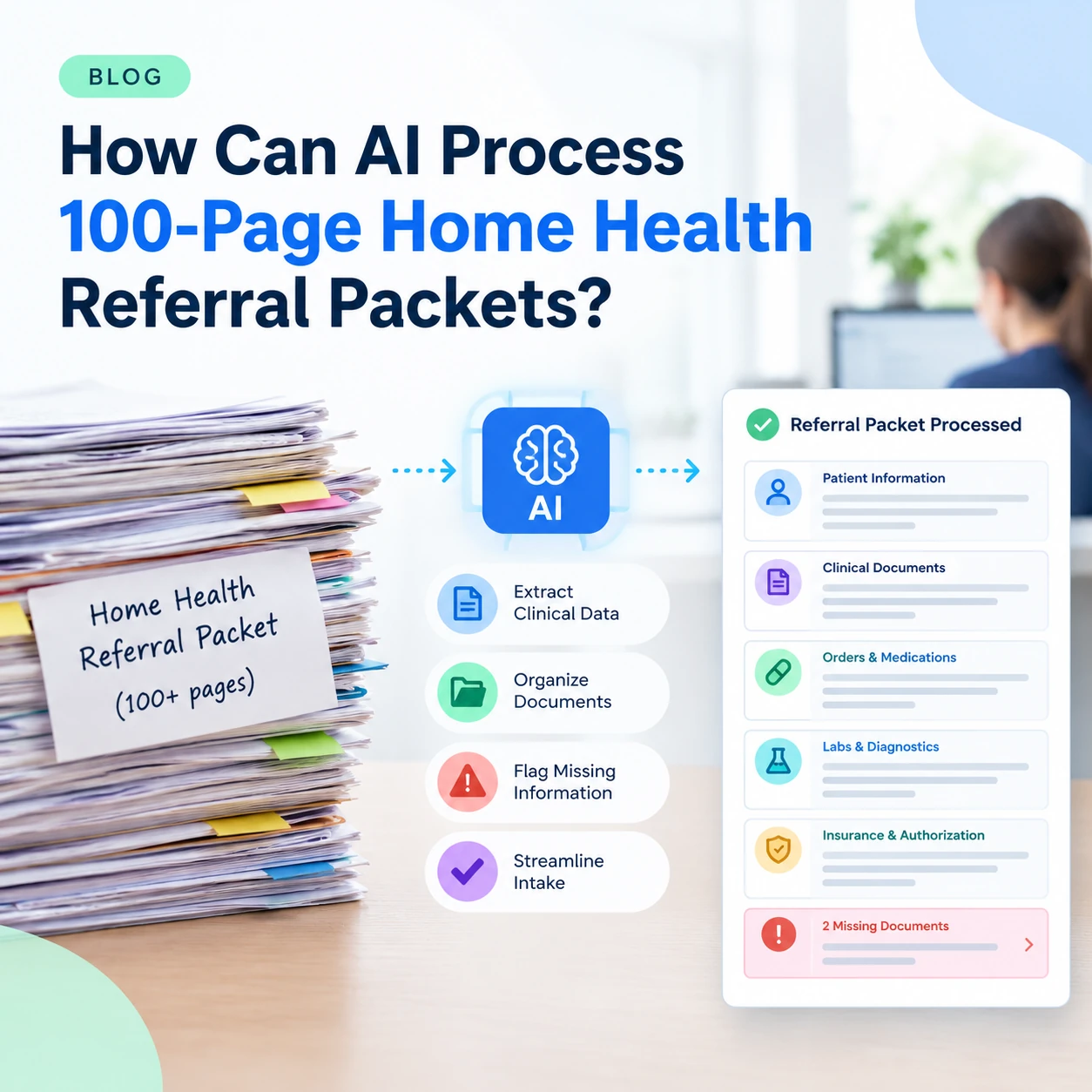
How Can AI Process 100-Page Home Health Referral Packets?
How AI can organize 100-page referral packets, extract clinical information, flag missing records, and support source-linked review across a six-stage intake workflow.
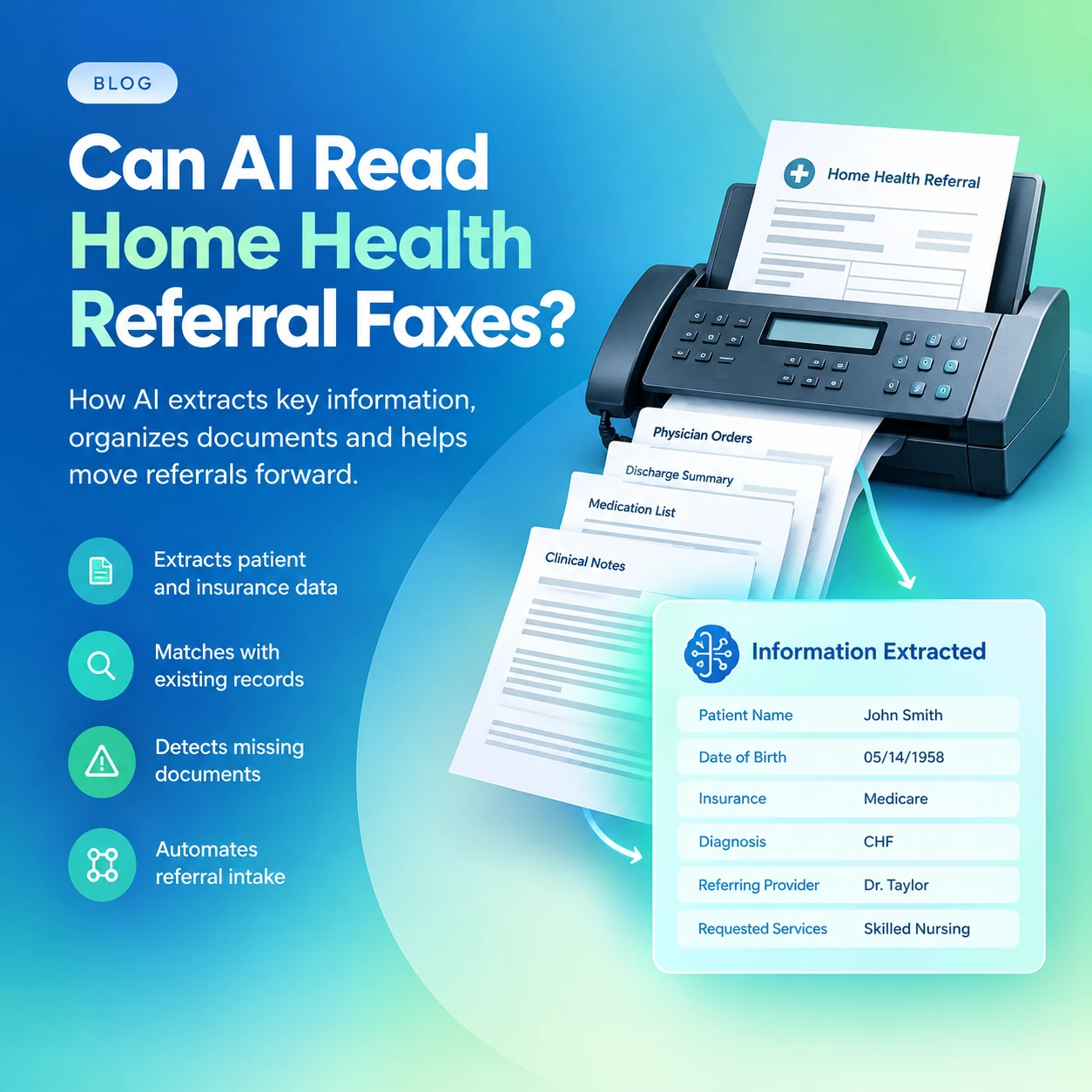
Can AI Read Home Health Referral Faxes?
How AI reads referral faxes, extracts patient information, flags missing records, supports patient matching, and routes home health intake tasks for human review.
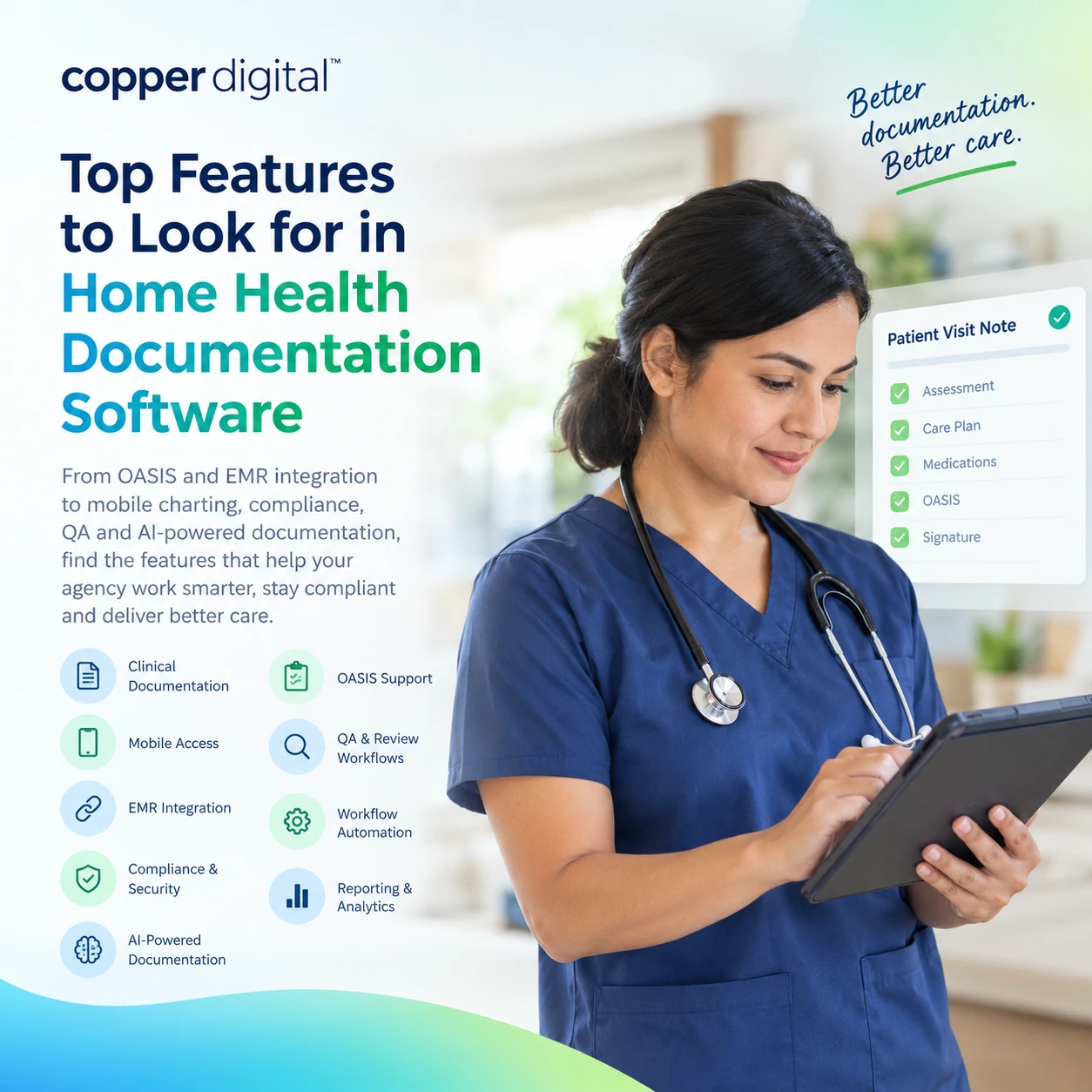
Top Features to Look for in Home Health Documentation Software
A practical guide to evaluating home health documentation software, including OASIS support, mobile charting, EMR integration, QA, security, workflow automation, and clinician-reviewed AI.