
How Can AI Process 100-Page Home Health Referral Packets?
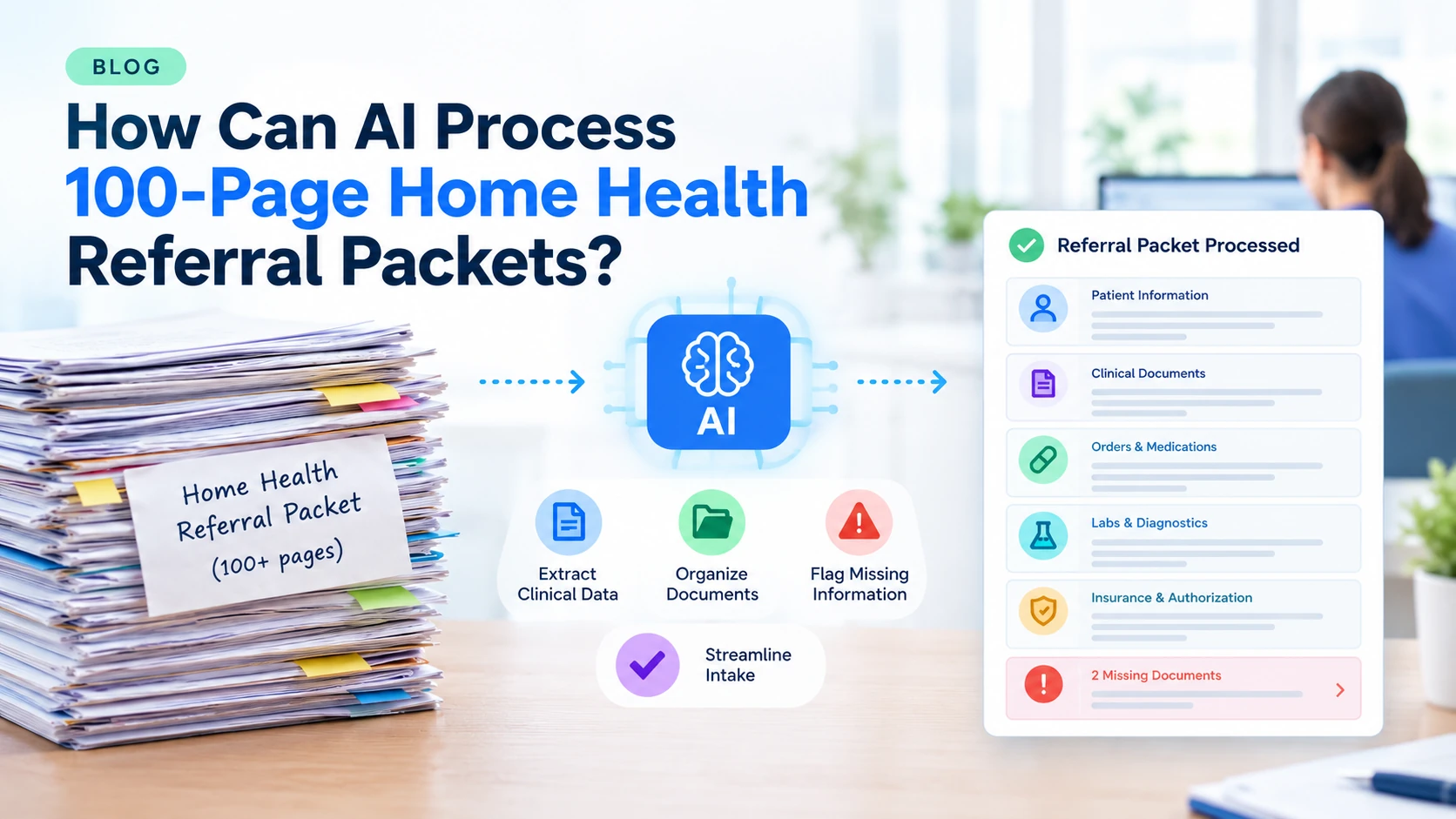
How AI can organize 100-page referral packets, extract clinical information, flag missing records, and support source-linked review across a six-stage intake workflow.
Key Takeaways
- AI can help capture, classify, extract, verify, summarize, and route large referral packets.
- Processing results depend on document quality, supported integrations, and the capabilities of the chosen system.
- Insurance data extraction is not the same as confirming eligibility, coverage, or authorization.
- Source-linked verification and human review help staff resolve uncertain or conflicting information.
- Measure end-to-end performance, including corrections and review, instead of assuming vendor time-saving claims apply to every agency.
How Can AI Process a 100-Page Home Health Referral Packet?
A home health referral can arrive as a thick PDF containing hospital records, physician orders, medication lists, lab results, insurance information, and clinical notes. Before an agency can move forward, someone must review the documents, identify relevant information, check for missing records, and determine what needs further attention.
For intake coordinators, this often means switching between documents, searching for specific details, and manually entering information into operational systems.
AI can help by turning a large, unstructured referral packet into an organized, searchable, and reviewable record. Using technologies such as Intelligent Document Processing (IDP), Optical Character Recognition (OCR), Natural Language Processing (NLP), and, where appropriate, Retrieval-Augmented Generation (RAG), AI systems can extract information, categorize documents, prepare summaries, and flag potential gaps.
The goal is not simply to read 100 pages faster. It is to help intake teams find the information they need, identify what is missing, and move referrals through the next steps with less repetitive work.
The exact processing time depends on packet quality, document complexity, integrations, and the workflow being automated. AI-generated information should also remain subject to appropriate human review.
Why Are 100-Page Home Health Referral Packets So Difficult to Process?
A referral packet is rarely one neatly organized document. It may contain records created by different hospitals, physicians, laboratories, and administrative teams.
Common challenges include:
- Scanned and faxed pages: Some documents contain low-resolution text, skewed scans, or handwritten notes.
- Mixed document types: Physician orders, discharge summaries, lab results, and insurance documents may be combined in one file.
- Repeated information: The same diagnosis, medication, or patient detail may appear in multiple records.
- Conflicting details: Different documents may contain different medication lists, dates, or demographic information.
- Missing records: A packet may lack a required order, supporting clinical documentation, or other information needed for the next step.
- Manual data entry: Staff may need to locate the same information repeatedly and transfer it between systems.
A conventional keyword search can help locate text, but it may not establish which document contains the relevant information, whether two records conflict, or whether a required document is missing.
AI-assisted processing can help organize these tasks into a structured workflow.
How Does AI Process a 100-Page Referral Packet in Six Stages?
A practical AI referral-processing workflow can be divided into six stages. The exact sequence and capabilities depend on the platform and its integrations.
1. How Does AI Capture Referral Packets From Different Sources?
The process begins when referral documents enter the agency's workflow.
Depending on the available integrations, an AI platform may receive documents through electronic fax, email, scanned uploads, or connected referral and EHR systems. The documents can then be brought into a centralized intake queue.
A unified queue helps staff work from one organized view rather than searching multiple inboxes and folders.
The system should also preserve the relationship between each packet, its source, and the intended patient record. Duplicate detection and secure access controls can further support the intake process when those capabilities are available.
2. How Does AI Classify and Organize Documents?
Once a packet is received, AI can help identify and categorize its contents.
For example, a 100-page PDF may include:
- Patient face sheets and demographic records.
- Hospital admission and discharge summaries.
- Physician orders.
- Medication lists.
- Laboratory and diagnostic reports.
- Clinical assessments and progress notes.
- Insurance and authorization documents.
- Face-to-face encounter documentation.
Document classification makes it easier to navigate the packet without manually opening every page to determine what it contains.
Classification is not infallible. Unclear, incomplete, or incorrectly categorized documents should be flagged for review rather than silently treated as confirmed.
3. How Does AI Extract Information From Scanned and Clinical Documents?
After identifying the document types, AI can extract relevant information into structured fields.
Several technologies may contribute to this process:
- Optical Character Recognition (OCR) converts text in scanned documents and fax images into machine-readable text.
- Natural Language Processing (NLP) helps interpret clinical language, identify entities, and understand relationships between terms.
- Layout analysis helps interpret the position of text, tables, labels, and other document elements.
- Handwriting recognition may help with handwritten information, although accuracy depends on legibility and the technology used.
The extracted information may include patient demographics, diagnoses, medication names, dates, physician details, and other referral information relevant to the agency's workflow.
For example, rather than manually searching a lengthy discharge summary for a diagnosis and then entering it into a separate field, an intake coordinator may be able to review the extracted value alongside its source.
Extracted data should not automatically be treated as correct. Low-confidence fields, ambiguous abbreviations, illegible handwriting, and inconsistent values need appropriate validation.
4. How Can AI Verify Insurance and Coverage Information?
Insurance information is an important part of referral intake, but finding an insurance card or payer name is not the same as confirming eligibility.
AI can help extract payer details, organize insurance documents, identify missing information, and prepare the data needed for verification.
Where the platform has the necessary integrations and authorization, it may also support checks against payer systems, eligibility services, or clearinghouses.
The result depends on the information available and the response returned by the connected service. A failed or incomplete response should not be represented as confirmed coverage.
Agencies should distinguish between:
- Extracting insurance information from documents.
- Checking eligibility through an available service.
- Confirming authorization requirements.
- Reviewing other payer-specific conditions.
These are related but separate steps. AI can help coordinate them, but the agency must follow the applicable payer requirements and its own review procedures.
5. How Does AI Turn a Large Referral Packet Into a Clinical Summary?
After extracting and organizing information, AI can help prepare a concise summary of the referral packet.
Depending on the source documents and configured workflow, the summary may highlight:
- The patient's relevant clinical history.
- Recent hospitalizations or discharge details.
- Documented diagnoses and comorbidities.
- Current or recently documented medications.
- Physician orders and supporting records.
- Important dates and encounter information.
- Potential gaps, discrepancies, or items requiring follow-up.
Some systems use Retrieval-Augmented Generation (RAG) to retrieve relevant information from source documents before generating a response or summary.
In simple terms, RAG can help ground a generated summary in retrieved source material rather than relying solely on a language model's internal knowledge. However, RAG does not guarantee accuracy or eliminate hallucinations.
A useful summary should make it possible to verify important details against the original records. It should also distinguish documented facts from missing information, uncertain interpretations, and items that require clinical judgment.
Technical background: Retrieval-Augmented Generation for Knowledge-Intensive NLP Tasks. This research describes the retrieval-and-generation approach; it does not validate a particular home health product.
6. How Can AI Route Referrals to the Right Team?
Once information has been organized, AI-assisted workflows may help route referrals to the appropriate intake team or queue.
Routing rules could consider factors such as agency branch, service area, payer, specialty, or workflow status, depending on the system's capabilities.
For example, a referral may be placed in a queue for staff to review missing documents, verify coverage, or assess whether the packet is ready for the next step.
Routing should follow agency-approved rules. AI should not independently make clinical admission decisions or bypass required reviews simply because a packet appears complete.
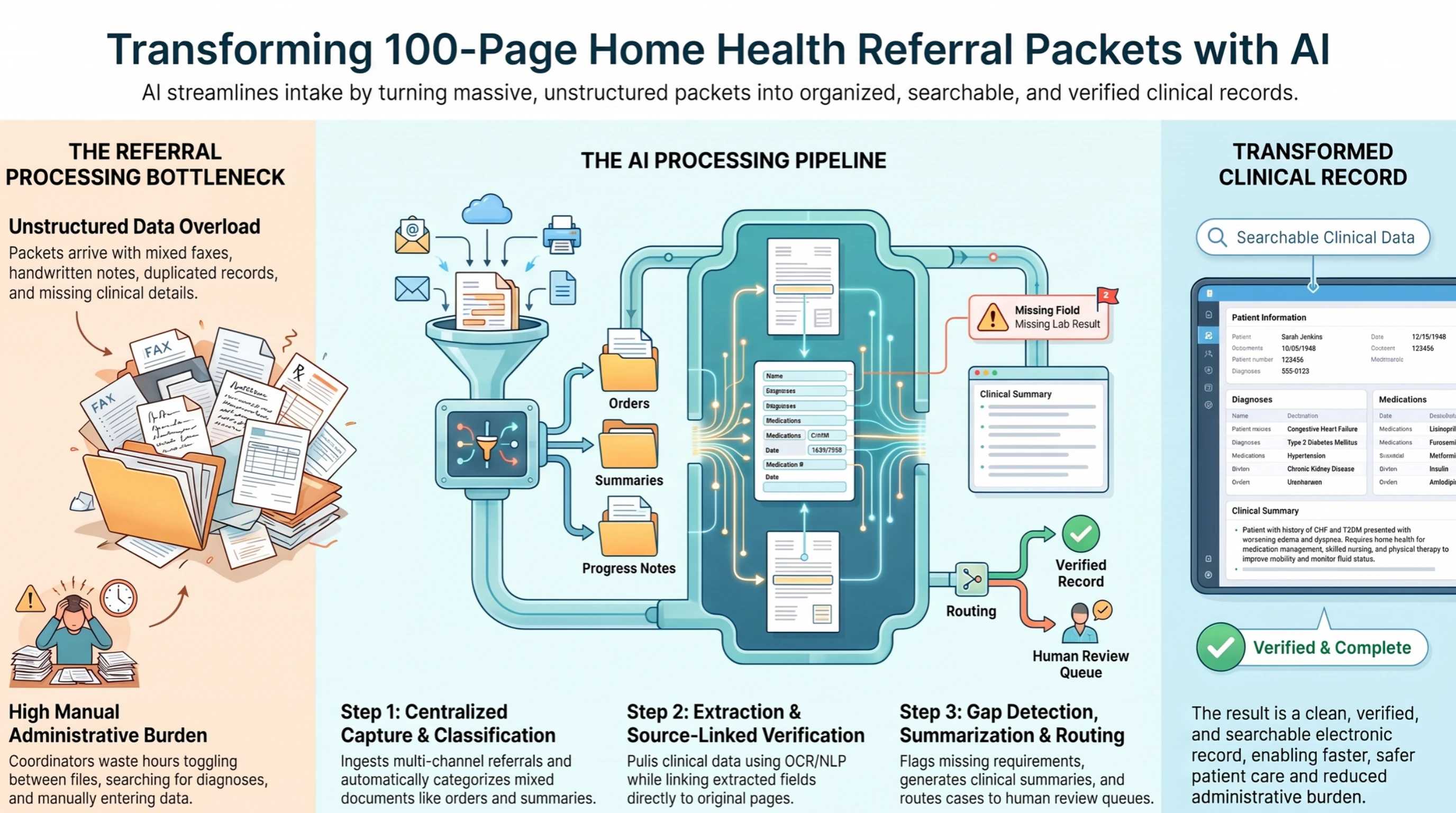
Illustrative workflow. Extracted fields and summaries require appropriate verification; processing a packet does not establish coverage, admission readiness, or clinical accuracy.
How Can AI Find Missing Documents and Conflicting Information?
Identifying missing information is one of the most useful applications of AI-assisted referral processing.
An agency can configure checks for specific documents and data fields needed at different stages of its intake process. AI can compare the packet against those requirements and flag items that appear absent, incomplete, or inconsistent.
Examples include:
- A physician order that cannot be located in the packet.
- Face-to-face encounter documentation that appears to be missing.
- An absent or incomplete insurance record.
- A medication list that differs from another document.
- Dates or patient details that do not match across records.
- A document that is present but too unclear to verify reliably.
The system can then present the issue to the intake coordinator for review.
Where supported, it may also help draft a request for clarification or additional documentation from the referring provider. A staff member can review the request before it is sent.
A critical distinction is that a missing document is not always proof that a requirement has been violated or that a referral must be rejected. The next step depends on the applicable requirements, the patient's circumstances, and the agency's policies.
How Can AI Reduce Errors Through Source-Linked Verification?
AI-generated summaries are only useful when staff can check whether the information accurately reflects the original records.
One valuable capability is source-linked verification. When supported, an extracted field or summary statement can link back to the source document and relevant page or text passage.
This allows an intake coordinator to:
- Review the extracted diagnosis, medication, date, or other field.
- Open the source page that supports the value.
- Compare the extracted information with the original document.
- Correct or flag the value if it is inaccurate or unclear.
This is especially important when working with handwritten notes, poor-quality faxes, abbreviations, conflicting medication lists, or documents containing similar patient names.
Source links make verification easier, but they do not guarantee that the extraction is correct. Agencies should also consider confidence indicators, audit trails, exception handling, and a clear process for correcting errors.
How Can AI Handle Long Contexts and Different Document Formats?
A 100-page packet may contain digitally generated text, scanned pages, embedded tables, stamps, checkboxes, and handwritten annotations.
Different technologies address different parts of this problem. OCR helps extract text from images, while layout analysis and document understanding models can help interpret where information appears on a page.
Language models may then help organize or summarize the extracted content.
Large context windows can allow a model to consider more information at once, but a larger context window alone does not guarantee that every detail in a long packet will be identified correctly.
Similarly, multimodal processing capabilities vary between platforms. Agencies should ask vendors to demonstrate how their systems handle the actual mix of scanned documents, tables, handwriting, and low-quality fax pages encountered in their workflows.
The most useful test is not whether a vendor can process a clean sample PDF. It is whether the system can handle representative referral packets, flag uncertain information, and make source verification practical.
How Much Time Can AI Save in Home Health Referral Intake?
AI can reduce repetitive document handling, searching, and data entry. The actual time saved depends on the starting workflow, the quality of the incoming records, the number of manual steps automated, and how much human review remains necessary.
Potential improvements include:
- Less time spent opening and sorting individual documents.
- Faster access to key clinical and administrative information.
- Reduced repetitive data entry.
- Earlier identification of missing records.
- More organized follow-up with referring providers.
- Better visibility into referral status and outstanding tasks.
Claims such as processing a 100-page packet in under 10 minutes, reducing data entry by 80%, or shortening referral turnaround from 48–72 hours to under 24 hours should be treated as targets or vendor-reported results unless independently substantiated.
To evaluate performance, agencies should compare the same workflow before and after implementation. Useful measures include average handling time, referral turnaround time, extraction accuracy, missing-document detection, correction rates, and staff time spent on follow-up.
Can AI Process Referral Packets Without Replacing the Intake Team?
Yes. AI-assisted referral processing can reduce repetitive work while leaving important decisions and exception handling with the appropriate staff.
AI may help read documents, organize records, extract information, draft summaries, and flag potential issues. Intake coordinators and clinical staff remain responsible for reviewing the information, resolving discrepancies, following agency procedures, and making decisions within their roles.
A sensible workflow keeps a human in the loop, especially when the information affects clinical care, coverage, authorization, or admission.
Human oversight is not a substitute for appropriate security and compliance controls. Agencies should also assess how patient data is handled, who can access it, which third parties process it, how activity is logged, and whether the vendor's contractual and operational safeguards meet the agency's requirements.
Reference: HHS guidance on HIPAA and cloud computing.
What Should Home Health Agencies Look for in an AI Referral Processing Solution?
Before adopting an AI referral-processing platform, agencies should ask vendors to demonstrate the workflow using realistic, appropriately protected referral packets.
Consider these questions:
- Can it process large, mixed-format packets? Test scanned faxes, tables, low-resolution pages, and different document types.
- Can it identify and classify individual documents? Check how it handles duplicates, mislabeled pages, and uncertain classifications.
- Can it extract key information accurately? Validate diagnoses, medication details, dates, and demographic fields against the original records.
- Can staff verify extracted information at its source? Look for useful source links or page-level references where supported.
- Can it flag missing or conflicting information? Ask for examples of how it identifies exceptions without automatically assuming the referral is invalid.
- Can it support insurance checks? Confirm which payer or eligibility integrations are available and what the results actually establish.
- Can it support follow-up and routing? Verify which actions are automated, which require approval, and how exceptions are handled.
- Does it fit the existing workflow? Understand the integration requirements, data transfer process, and any changes staff must make.
- How is patient data protected? Review the business associate agreement where applicable, security controls, subprocessors, retention policies, and incident-response procedures.
- How is performance measured? Request evidence for accuracy and time-saving claims, including the test conditions and limitations.
A live demonstration with representative packets is more informative than a generic product presentation. Agencies should evaluate both the system's speed and the reliability of its output.
How Can Copper Digital Help Streamline Home Health Referral Processing?
Home health agencies often need to coordinate referral documents, clinical information, insurance details, and follow-up tasks before a patient can move through the intake process.
Copper Digital develops AI-powered workflows for home health operations, with a focus on reducing repetitive administrative work and helping teams access the information they need.
AI-assisted referral workflows can support document intake, information extraction, organization, and identification of potential gaps, depending on the implemented capabilities and integrations. The objective is to help intake teams spend less time searching through paperwork and more time resolving the issues that require their attention.
Agencies evaluating these workflows should confirm the specific document sources supported, the fields extracted, the checks performed, the integrations available, and the points at which staff review or approve the output.
Learn more about Copper Digital's solutions for home health agencies.
What Is the Key Takeaway About AI and 100-Page Home Health Referral Packets?
Processing a large home health referral packet involves more than converting pages into text. Teams need to find relevant documents, extract accurate information, check for gaps, resolve discrepancies, and prepare the referral for the next step.
AI can help coordinate this work through a pipeline of document capture, classification, extraction, verification, summarization, and routing.
The most effective approach is not simply to automate every step. It is to make information easier to find and verify, surface potential problems early, and preserve appropriate human oversight.
For home health agencies, that can mean a more organized intake process, fewer repetitive tasks, and better visibility into what each referral needs next.
Related reading
What Should I Document? 100 OASIS Situations Home Health Nurses Face Every Day
100 real OASIS scenarios, worked end to end — clinical situation, common mistake, better approach, and key takeaway. Built around OASIS-E2 (effective April 1, 2026) to turn what you assess into accurate, defensible documentation.
Bottom Line
AI can make large home health referral packets easier to navigate and review. Its value depends on accurate extraction, traceable source information, useful exception handling, and appropriate human oversight throughout the intake workflow.
Inside Home Health Podcast
What Makes OASIS Documentation So DIFFICULT? | Arvind Sarin & Kathy Duckett

Arvind Sarin is the founder of Copper Digital. He works inside home health agencies to build AI documentation workflows that help clinicians finish OASIS and visit notes sooner, with a nurse reviewing and approving every note. He writes about home health documentation, Medicare compliance, and applying AI responsibly in clinical workflows.
Frequently asked
Frequently asked questions
AI can use document processing, OCR, language understanding, and summarization to classify documents, extract key information, identify potential gaps, and prepare a structured summary for human review. The exact workflow depends on the platform.
Join the conversation
Leave a comment
No comments yet. Be the first to share your thoughts.
Related reading
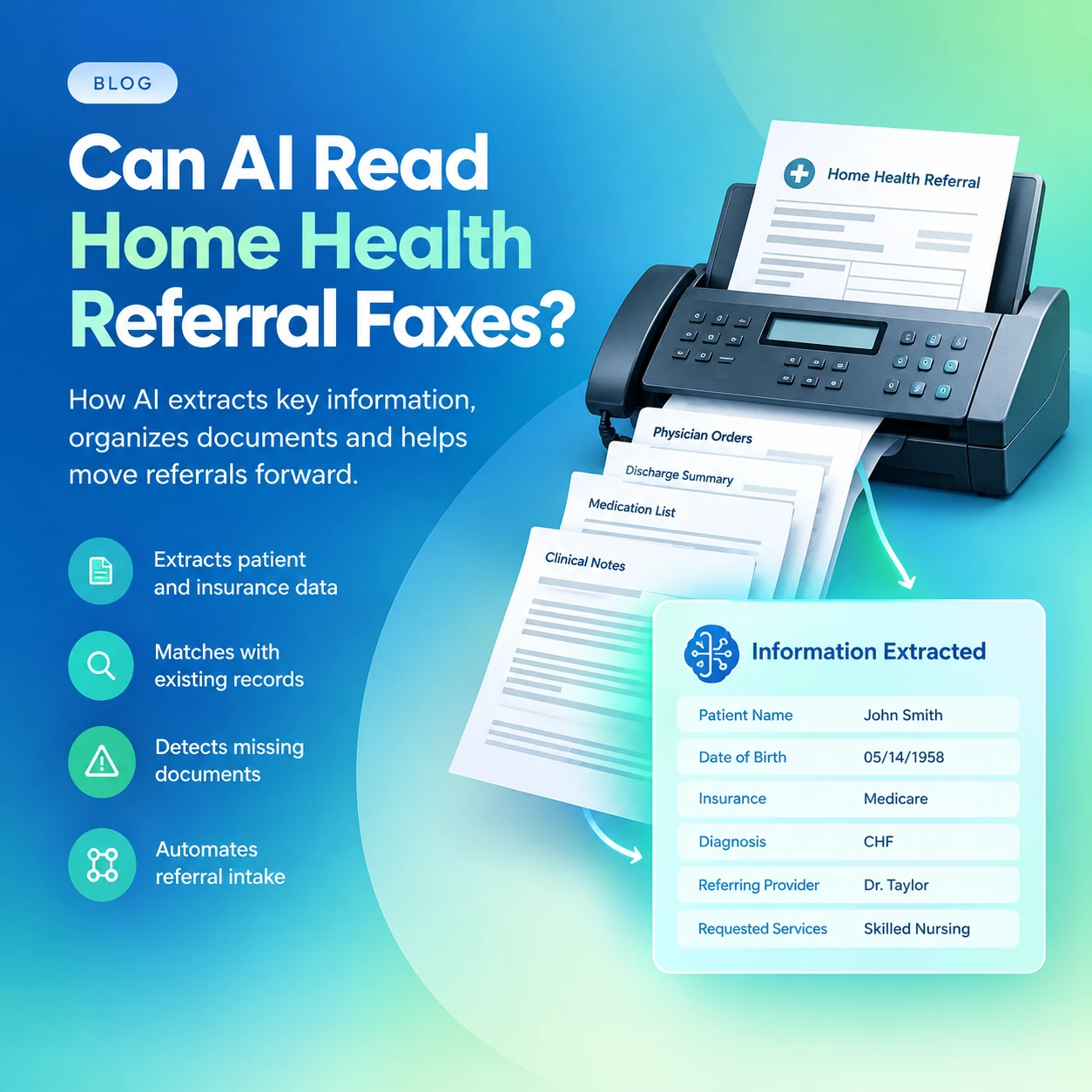
Can AI Read Home Health Referral Faxes?
How AI reads referral faxes, extracts patient information, flags missing records, supports patient matching, and routes home health intake tasks for human review.
Must-Ask Questions for AI Vendors Before Giving Away Your Patient Data
Twelve questions to ask healthcare AI vendors about patient data, security, model training, clinical accuracy, accountability, and what happens when the contract ends.
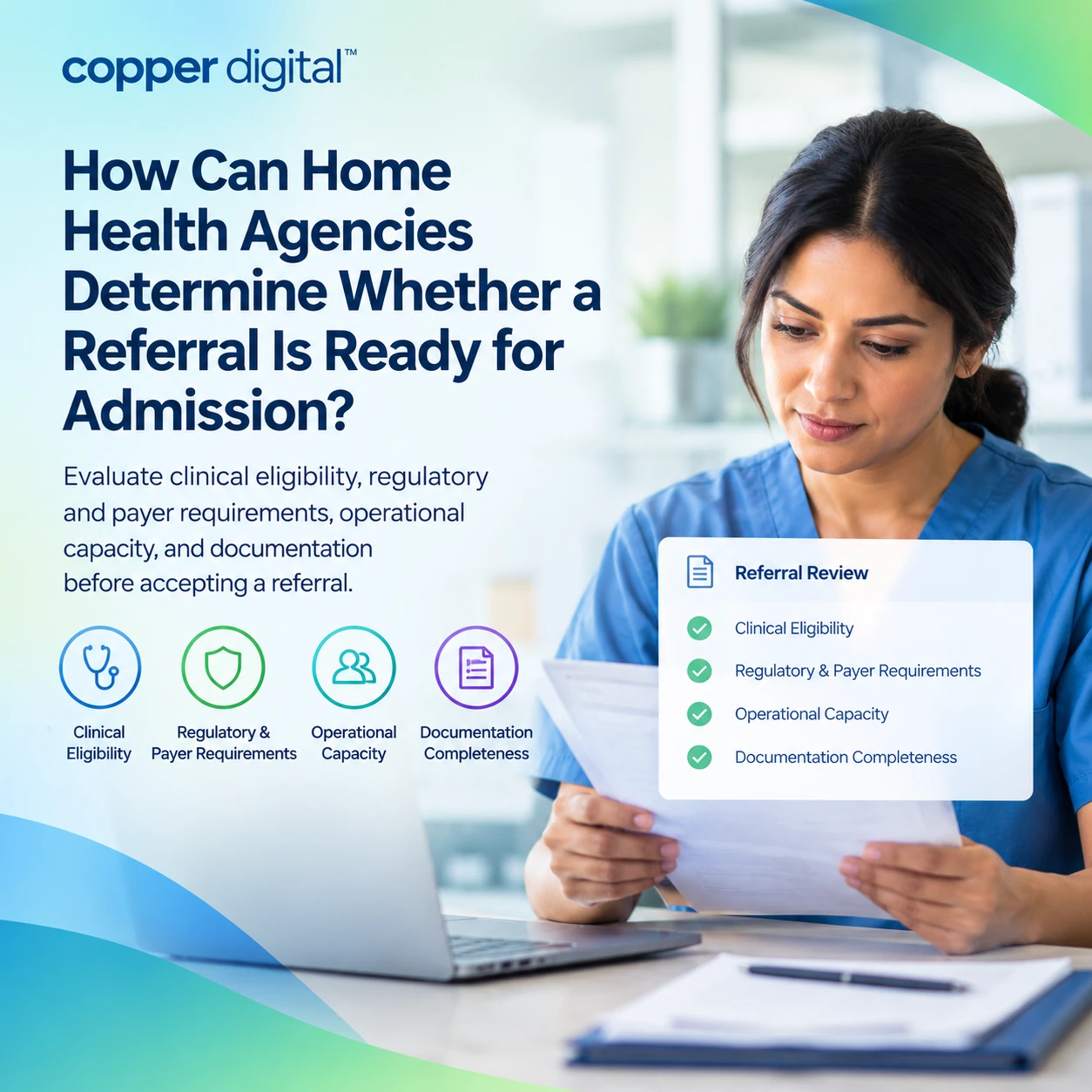
How Can Home Health Agencies Determine Whether a Referral Is Ready for Admission?
A practical framework for checking clinical eligibility, payer requirements, staffing capacity, and documentation before accepting a home health referral.