
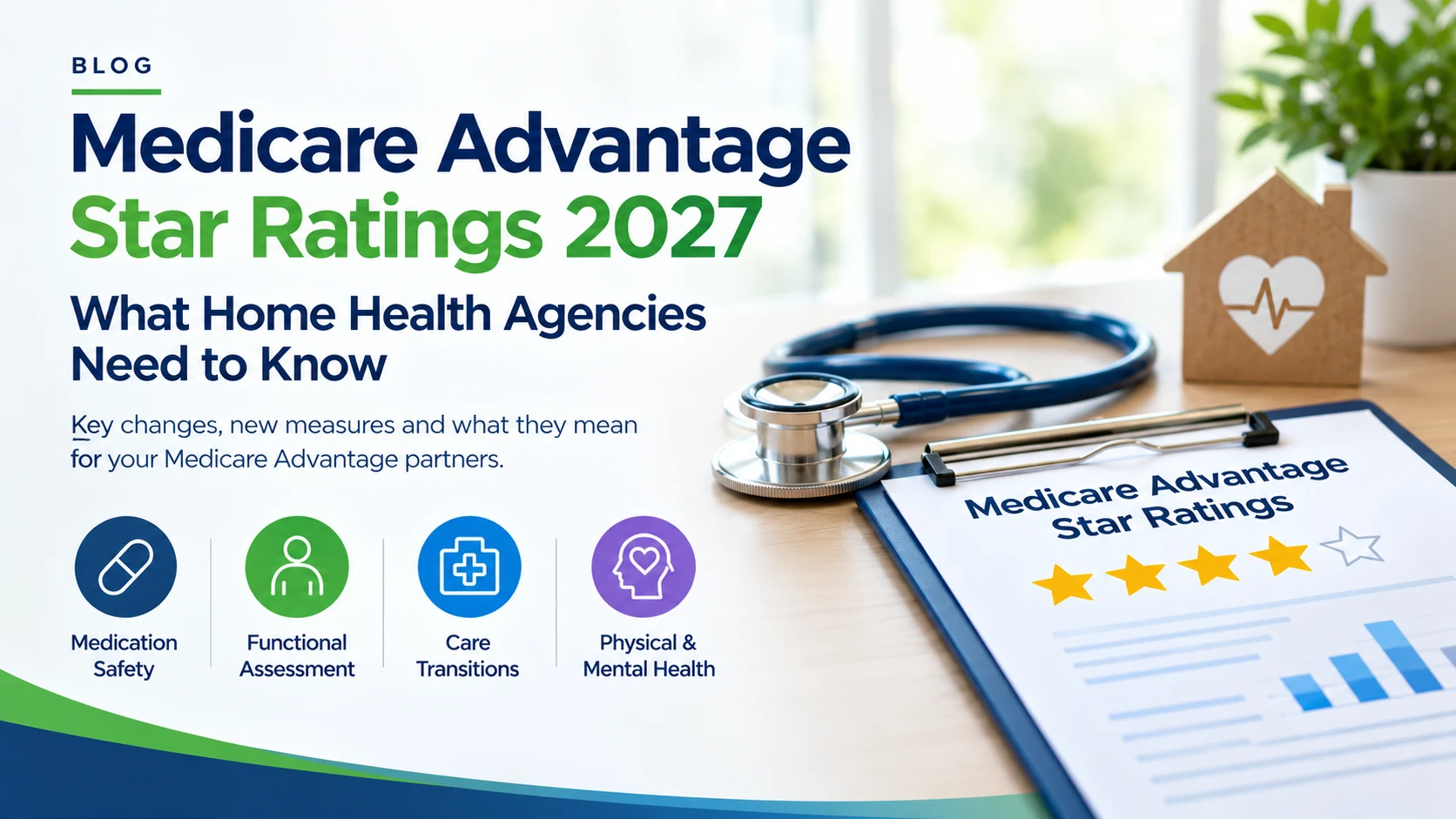
Medicare Advantage Star Ratings 2027: What Home Health Agencies Need to Know
Understand the 2027 Medicare Advantage Star Ratings changes, how plan-level measures differ from home health agency ratings, and practical steps to strengthen care coordination.
Key Takeaways
- The enrollment-weighted overall MA-PD rating declined from 4.01 in 2026 to 3.99 in 2027.
- The 2027 ratings introduce medication safety measures and bring back a revised functional status assessment measure.
- Care transitions and readmissions ratings improved, while emergency department follow-up and diabetes medication adherence ratings declined.
- Medicare Advantage Star Ratings evaluate health plans, not individual home health agencies.
- Agencies can focus on timely information, accurate assessments, patient education, and clear follow-up responsibilities with care partners.
The 2027 Medicare Advantage Star Ratings reveal important changes in health-plan quality performance, including new medication safety measures, changes to functional assessment, and shifting results across care transitions, readmissions, and medication adherence.
For home health agencies, these findings matter because they highlight areas where communication between hospitals, health plans, clinicians, and patients can influence the continuity of care. Although Medicare Advantage Star Ratings measure health-plan performance rather than individual home health agency performance, they provide useful context for agencies working with Medicare Advantage partners.
The Centers for Medicare & Medicaid Services (CMS) published the 2027 Star Ratings on October 8, 2026. These ratings appear during the 2027 Medicare plan enrollment season and will affect Medicare Advantage quality bonus payments for 2028.
Here are the three questions home health agency leaders should be asking: What changed in the 2027 Star Ratings? Why should home health agencies care?
And what can agencies do now?
What Changed in the 2027 Medicare Advantage Star Ratings?
The 2027 ratings show a small decline in the overall enrollment-weighted rating for Medicare Advantage prescription drug (MA-PD) contracts, alongside notable changes in individual quality measures.
1. The overall average rating declined slightly
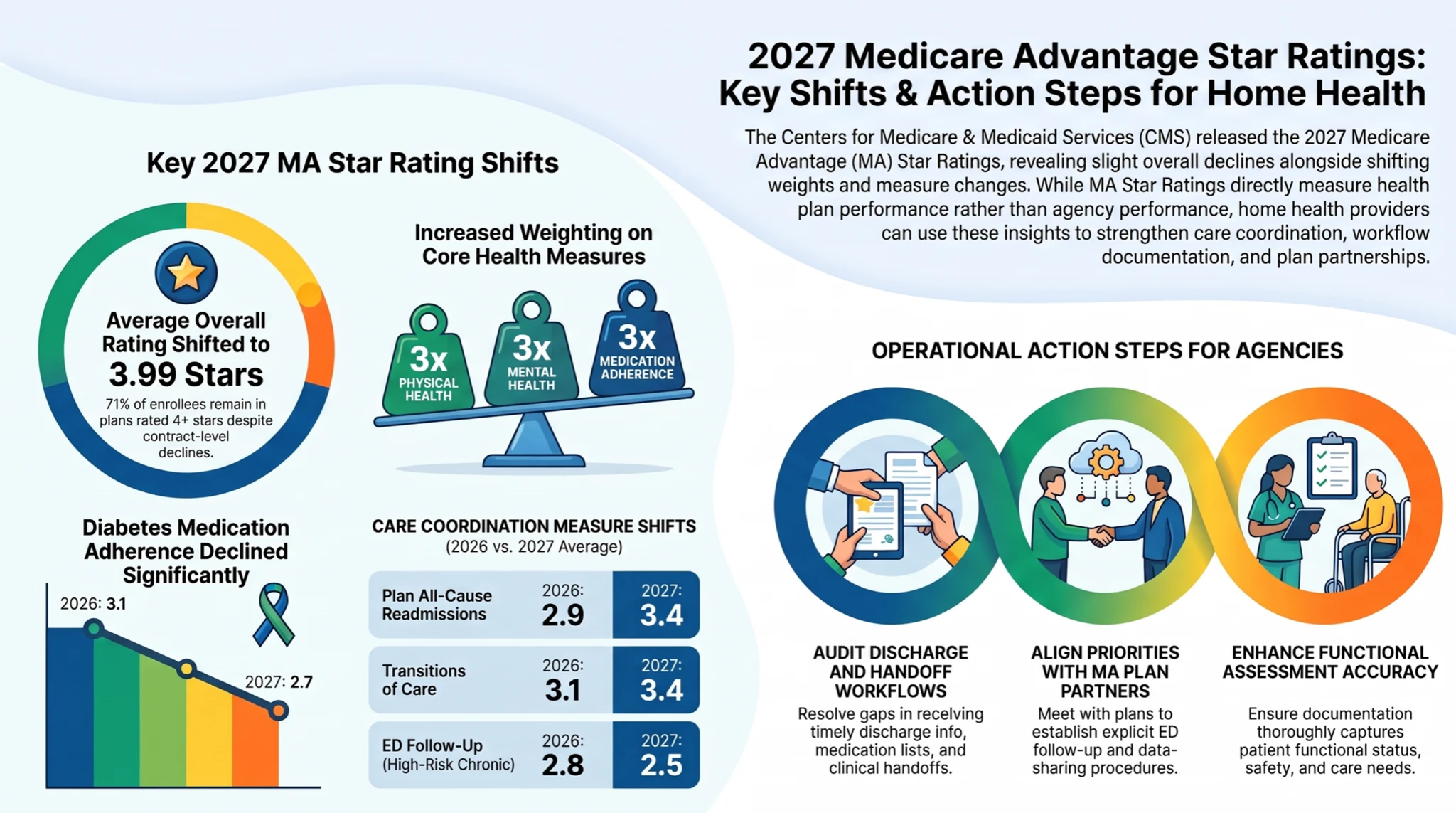
According to CMS, the enrollment-weighted average overall Star Rating for MA-PD contracts declined from 4.01 in 2026 to 3.99 in 2027.
The distribution of contracts also changed:
- 188 of 508 MA-PD contracts (approximately 37%) earned four or more stars.
- Approximately 71% of MA-PD enrollees are in contracts rated four stars or higher.
- In 2026, 229 of 516 contracts earned four or more stars.
These figures reveal an important distinction: the percentage of contracts earning four or more stars is not the same as the percentage of beneficiaries enrolled in those contracts. Enrollment weighting means a relatively small number of large plans can account for a substantial share of members.
For home health agencies, the figures offer context for conversations with Medicare Advantage partners. They do not establish how any individual plan performs in a particular local market, nor do they indicate that home health providers caused the changes.
2. Two new medication safety measures were added
The 2027 Star Ratings introduced two Part D measures:
- Concurrent Use of Opioids and Benzodiazepines: Evaluates potentially risky overlapping use of these medications.
- Polypharmacy: Use of Multiple Anticholinergic Medications in Older Adults: Evaluates the use of multiple medications with anticholinergic properties among older adults.
Both measures have a standard weight of one in the Star Ratings methodology.
These additions reinforce the importance of medication safety, particularly for older adults managing multiple chronic conditions and receiving care from several providers.
Home health clinicians can support safer care by reviewing medication information within their scope and agency protocols, documenting discrepancies and patient-reported concerns, and communicating clinically significant findings to the appropriate prescriber or care team.
However, these are defined health-plan measures. Home health documentation alone does not determine a plan's score, and agencies should not assume their individual activities automatically count toward these measures.
3. Functional status assessment returned to the ratings
The Care for Older Adults – Functional Status Assessment measure returned to the 2027 Star Ratings following substantive specification changes. It is treated as a new measure and has a weight of one.
The distinction is important: the measure focuses on whether an eligible older adult received the required assessment. It does not measure whether the patient's functional abilities improved.
For home health agencies, accurate functional assessment remains important for understanding mobility, daily activities, safety concerns and support needs. Clear documentation helps the broader care team understand a patient's status and plan appropriate care.
Agencies should confirm the measure's eligibility and reporting requirements before assuming a home health assessment contributes directly to a health plan's score.
4. Physical and mental health measures received greater weight
CMS increased the weight of the Improving or Maintaining Physical Health and Improving or Maintaining Mental Health measures from one in the 2026 Star Ratings to three in 2027.
The average rating for Improving or Maintaining Physical Health declined from 3.2 in 2026 to 3.0 in 2027. Improving or Maintaining Mental Health remained at 3.2.
The increased weighting makes these measures more influential in the overall rating methodology. The results also underline why leaders should look beyond an overall Star Rating and examine individual measures.
Home health agencies can support patient-centered care by documenting relevant assessments, changes in condition, functional status and care needs accurately. But they should not interpret the health-plan measures as direct measures of their own agency's performance.
5. Care transitions and readmissions improved, but emergency department follow-up declined
The 2027 ratings show mixed results across several measures relevant to coordinated care.
| CMS measure | 2026 average | 2027 average |
|---|---|---|
| Plan All-Cause Readmissions | 2.9 | 3.4 |
| Transitions of Care | 3.1 | 3.4 |
| Follow-up After Emergency Department Visit for People with Multiple High-Risk Chronic Conditions | 2.8 | 2.5 |
The first two measures improved, while the emergency department follow-up measure declined.
These are health-plan measure ratings, not home health agency scores. Still, they provide a useful starting point for discussing how care teams communicate after hospital discharges and emergency department visits.
Agencies can review whether clinicians receive the information they need, whether changes in patient condition are escalated promptly, and whether follow-up responsibilities are clear.
6. Medication adherence remains an area to watch
Medication adherence results were mixed in the 2027 MA-PD ratings.
The average rating for Medication Adherence for Diabetes Medications declined from 3.1 in 2026 to 2.7 in 2027. By comparison, Medication Adherence for Hypertension remained relatively stable, increasing from 3.3 to 3.4, while Medication Adherence for Cholesterol increased from 3.2 to 3.3.
CMS assigns higher influence to these three medication adherence measures: each has a weight of three.
For home health agencies, medication education, patient and caregiver communication, and timely escalation of medication-related concerns can support continuity of care. Agencies may also want to discuss recurring adherence barriers with their care partners when appropriate.
These plan-level ratings do not establish why adherence changed or prove that a particular provider caused the result. They should be treated as signals for further discussion, not as evidence of agency-level performance.
7. Some familiar measures were retired or moved out of the ratings
CMS retired the Care for Older Adults – Pain Assessment and Medication Reconciliation Post-Discharge measures from the Star Ratings.
The Medication Therapy Management Program Completion Rate for Comprehensive Medication Review moved to the display page for measurement years 2025 and 2026. CMS has scheduled its return as a new Star Ratings measure in 2029, using measurement year 2027.
A measure being retired or moved to the display page does not mean the underlying clinical activity is unimportant. Medication reconciliation, pain assessment and comprehensive medication reviews may still be important to patient care and other applicable requirements.
Home health leaders should follow current clinical standards, contract requirements and reporting specifications rather than assuming that a change in the rating methodology eliminates a care responsibility.
Why Should Home Health Agencies Care About Medicare Advantage Star Ratings?
Medicare Advantage Star Ratings do not directly score individual home health agencies. However, several of the measures reflect broader care coordination challenges that home health providers encounter every day.
Understanding these priorities can help agency leaders have more informed conversations with health plans, identify gaps in their own workflows and strengthen continuity of care.
1. Care transitions depend on timely information
A hospital discharge may involve new medications, revised treatment instructions, follow-up appointments, equipment needs and referrals to other providers.
When information is missing or arrives late, clinicians may have difficulty understanding the patient's current status or knowing which concerns need escalation.
Home health agencies can review whether their workflows support:
- Receipt and review of relevant discharge information.
- Clear documentation of medication discrepancies and patient concerns.
- Communication with the appropriate provider when follow-up is needed.
- Documentation of patient and caregiver education.
- Clear handoffs when multiple clinicians or organizations are involved.
The goal is to make care transitions more reliable. These practices support continuity but do not guarantee a higher Medicare Advantage Star Rating.
2. Readmissions require attention to the patient's changing condition
The improvement in the average Plan All-Cause Readmissions rating is encouraging at the plan level. It does not mean readmissions are no longer a concern, or that every plan or provider has improved.
Home health teams can help identify changes in a patient's condition, reinforce the care plan, educate patients and caregivers about warning signs, and communicate concerns through appropriate channels.
Agency leaders should review their own hospitalization and emergency department utilization patterns, investigate recurring causes and use the findings to guide quality improvement.
3. Emergency department follow-up deserves closer attention
The decline in the average rating for follow-up after emergency department visits among people with multiple high-risk chronic conditions makes this a useful topic for discussion with health-plan partners.
The measure applies to a defined population and specific follow-up requirements. It should not be interpreted as a direct assessment of every home health patient's follow-up experience.
Agencies can still examine how they learn about emergency department visits, assess patients after a change in condition, communicate with the appropriate provider and document the next steps.
4. Medication safety and adherence need coordinated support
Patients may return home with changed prescriptions, complex medication schedules or questions about their treatment. Older adults managing multiple conditions may need help understanding instructions and knowing whom to contact with concerns.
Home health agencies can support coordinated medication management by documenting medication information accurately, providing education within their role, identifying concerns and communicating with the appropriate clinician.
Medication adherence and medication safety are not the same measure. Adherence concerns whether patients take medications as prescribed; medication safety measures examine specified medication-use patterns.
Both can matter to patient care, but the relevant CMS measures have distinct definitions.
5. Local market conditions matter
National Star Rating trends provide useful context, but they do not tell an agency how every Medicare Advantage plan performs in its service area.
Local plan availability, enrollment, contract ratings and provider relationships can vary by geography. Agency leaders should therefore review the plans that actually serve their patients rather than relying on national averages alone.
Before entering or expanding a health-plan partnership, agencies can review the relevant contract's current rating, service area, network requirements and quality priorities. They should also clarify how performance information is shared and what responsibilities each organization has.
Local market-share figures should be verified against the relevant market tables and current plan data before being used to make business decisions.
What Can Home Health Agencies Do Now?
The 2027 Star Ratings give home health leaders an opportunity to review workflows, strengthen communication and align their quality improvement work with the needs of their patients and partners.
1. Audit documentation and communication workflows
Start with the patient journey from hospital discharge or referral through the first home health visits and subsequent follow-up.
Ask:
- Does the clinician receive the relevant discharge information and current medication list?
- Are medication discrepancies and changes in condition documented clearly?
- Are concerns communicated to the appropriate provider or care team?
- Are patient and caregiver instructions recorded?
- Is responsibility for unresolved issues clear?
- Can the agency identify whether appropriate follow-up occurred?
Use the findings to improve the workflow. Adding documentation requirements without addressing the underlying communication problem may increase administrative burden without resolving the gap.
2. Track relevant quality indicators
Select measures that are relevant to your patient population and agency's responsibilities. Depending on available data, these may include hospitalization patterns, emergency department utilization, timely visits, completion of required assessments and follow-up on clinical concerns.
Review trends over time, identify recurring problems and use the findings in quality assurance and performance improvement activities.
Keep agency-level measures separate from health-plan Star Rating measures. Similar labels do not necessarily mean that two measures use the same population, data source or calculation.
3. Meet with Medicare Advantage partners
Ask health plans which care coordination challenges they are prioritizing and how contracted providers can support patients across settings.
Useful discussion topics include:
- Availability of discharge and referral information.
- Communication pathways for medication discrepancies.
- Follow-up expectations after emergency department visits.
- Escalation procedures for worsening symptoms.
- Functional assessment and documentation expectations.
- Data-sharing processes and the reporting of quality concerns.
Agree on responsibilities, timelines and practical communication channels. A partnership is more effective when each organization understands its role and knows how to escalate unresolved issues.
4. Strengthen functional assessment and patient education
Review whether clinicians consistently document functional abilities, safety concerns, patient goals and education needs according to applicable requirements.
Ensure that notes reflect the assessment actually performed and the patient's circumstances. Completing an assessment is not the same as demonstrating improvement, and documentation should never imply an outcome that was not observed.
5. Evaluate technology for documentation support
Technology can help agencies organize information, reduce repetitive administrative tasks and make documentation workflows more consistent.
When evaluating an AI documentation solution, look beyond the speed of note generation. Consider whether the system supports accurate capture of patient-specific information, clinician review, clear documentation of medication-related concerns and integration with existing workflows.
Agencies should also assess privacy, security, access controls and contractual requirements before adopting new technology. AI should support documentation and clinical workflows, not replace clinician judgment or independently make clinical decisions.
No documentation tool can guarantee better health-plan Star Ratings. Its value should be evaluated against practical workflow, accuracy and patient-care objectives.
6. Review the latest CMS specifications
The Star Ratings methodology changes over time. Measures can be revised, retired, assigned different weights or moved to the display page.
Agency leaders should consult the latest CMS technical notes and confirm requirements with their health-plan partners before changing workflows or interpreting performance results.
The 2027 ratings are a useful planning input, but they are not a substitute for understanding the current rules and responsibilities that apply to a specific organization.
The Takeaway: Focus on the Care Processes Your Agency Can Influence
The 2027 Medicare Advantage Star Ratings present a mixed picture. The average overall MA-PD rating declined slightly, the share of contracts earning four or more stars fell, and the results varied across readmissions, care transitions, emergency department follow-up and medication adherence.
The methodology also introduced new medication safety measures, brought back a functional assessment measure and increased the weight of physical and mental health measures.
For home health agencies, the practical response is to focus on the parts of care they can influence: accurate assessments, clear documentation, patient and caregiver education, appropriate escalation and reliable communication with the broader care team.
Agency leaders should also look beyond national averages. The Medicare Advantage plans operating in their local markets may have different ratings, networks and priorities.
Start by reviewing the workflows that connect your clinicians with hospitals, prescribers and health plans. Identify where information gets lost, where follow-up responsibilities are unclear and where administrative work distracts clinicians from patient care.
Then work with partners to make those processes more reliable.
The goal is not to chase a health-plan score. It is to support better coordinated care for the patients who depend on home health services.
Sources: Centers for Medicare & Medicaid Services, 2027 Medicare Advantage and Part D Star Ratings (October 8, 2026), including its rating distribution and year-over-year measure tables. Check the latest technical notes and measure specifications before operational use.
Official CMS resources
What Should I Document? 100 OASIS Situations Home Health Nurses Face Every Day
100 real OASIS scenarios, worked end to end — clinical situation, common mistake, better approach, and key takeaway. Built around OASIS-E2 (effective April 1, 2026) to turn what you assess into accurate, defensible documentation.
Inside Home Health Podcast
Related conversation for home health leaders

Arvind Sarin is the founder of Copper Digital. He works inside home health agencies to build AI documentation workflows that help clinicians finish OASIS and visit notes sooner, with a nurse reviewing and approving every note. He writes about home health documentation, Medicare compliance, and applying AI responsibly in clinical workflows.
Frequently asked
Frequently asked questions
The 2027 Medicare Advantage Star Ratings are CMS's annual ratings of Medicare Advantage and Part D plan performance. They help beneficiaries compare plans and affect Medicare Advantage quality bonus payments for 2028. CMS published the 2027 ratings on October 8, 2026.
Join the conversation
Leave a comment
No comments yet. Be the first to share your thoughts.
Related reading
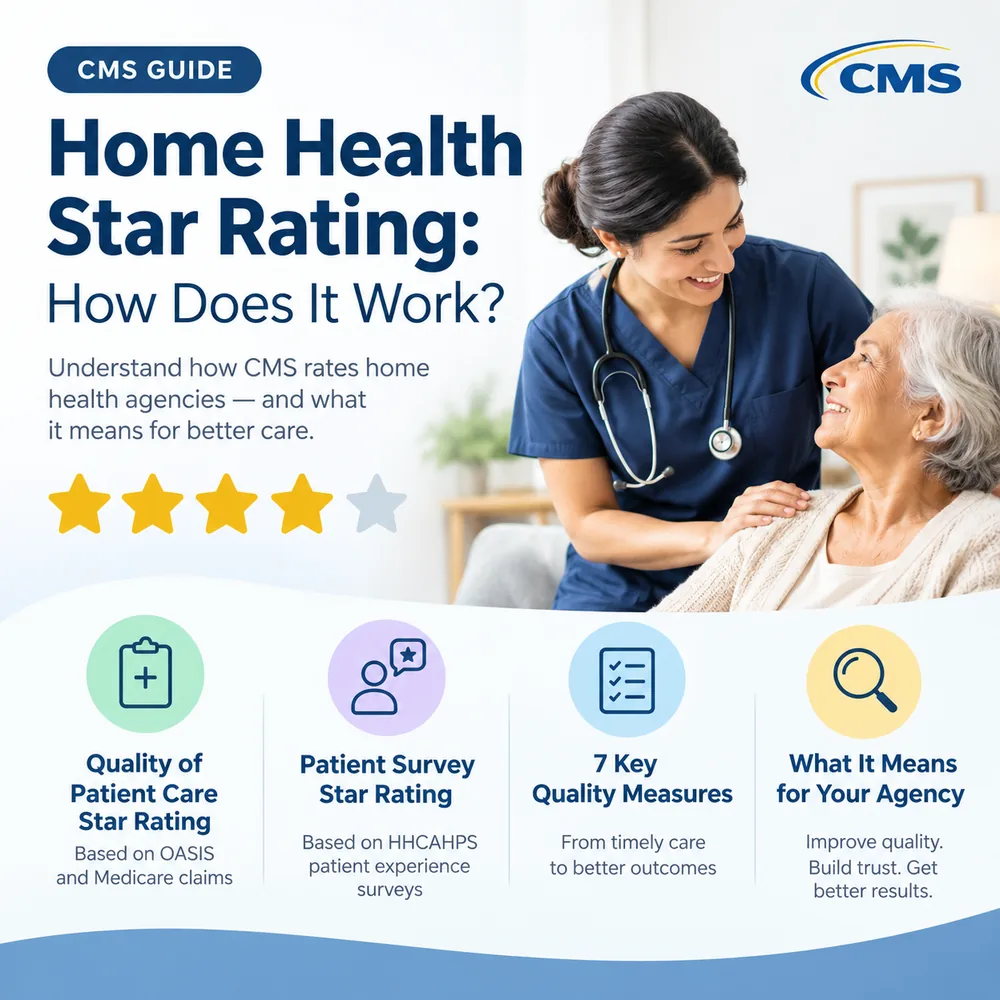
Home Health Star Rating: How Does It Work?
CMS publishes two separate Home Health Star Ratings on Care Compare. Learn what each rating measures, how OASIS and HHCAHPS affect the scores, and what agencies can improve.

Must-Ask Questions for AI Vendors Before Giving Away Your Patient Data
Twelve questions to ask healthcare AI vendors about patient data, security, model training, clinical accuracy, accountability, and what happens when the contract ends.
What Is a CMS Provider Validation Survey for Home Health Agencies?
A CMS provider validation survey checks whether a deemed-status home health agency actually meets Medicare health and safety requirements. Here is what CMS reviews and how an HHA can stay ready.