Medicare Additional Documentation Requests (ADRs) can create significant administrative work for home health agencies. When a claim is selected for review, the agency must provide medical records that demonstrate why the services were covered, medically necessary, and properly documented.
The challenge is that documentation gaps are not always obvious when care is being delivered. A nurse may complete a visit, a therapist may document progress, and the agency may submit a claim, only to discover later that the record does not clearly support the services billed.
For home health agencies, reducing ADR-related risk starts well before a request arrives. It requires consistent clinical documentation, accurate eligibility records, clear plans of care, timely orders and signatures, proactive audits, and a reliable process for monitoring billing patterns.
CMS's 2024 Medicare Fee-for-Service improper payment data identified insufficient documentation as 51.4% of improper payments for home health services and medical necessity as another 33.7%. These figures highlight why documentation quality and clinical support deserve ongoing attention. They are categories of improper payments, not percentages of all home health claims denied.
So, how can agencies strengthen their processes and become better prepared for Medicare reviews?
What Is a Medicare ADR in Home Health?
A Medicare Additional Documentation Request, commonly called an ADR, is a request from a Medicare review contractor for medical records or other documentation needed to evaluate a claim.
The review may be conducted by a Medicare Administrative Contractor (MAC), Recovery Audit Contractor (RAC), Supplemental Medical Review Contractor (SMRC), Unified Program Integrity Contractor (UPIC), or another authorized review entity.
The requested records help the reviewer determine whether the services billed meet applicable Medicare coverage, coding, billing, and medical-necessity requirements.
For a home health agency, an ADR may request records such as:
- Physician or allowed practitioner's orders and certification documentation.
- The plan of care.
- Start of care and comprehensive assessment records.
- OASIS documentation, when applicable.
- Skilled nursing and therapy visit notes.
- Therapy evaluations and reassessments.
- Medication-related documentation.
- Clinical records supporting homebound status.
- Discharge or transfer documentation, when relevant.
- Supporting records from a referring or treating provider, when relevant to the claim.
The exact documents depend on the request and the claim being reviewed. Some supporting records may also fall outside the specific billing period under review.
An ADR does not automatically mean that an agency has committed a compliance violation or that the claim will be denied. It means the reviewer needs additional documentation to make a payment determination.
Why Do Medicare ADRs Create Challenges for Home Health Agencies?
Responding to an ADR can be difficult because the records needed to support a claim may be spread across multiple systems, departments, clinicians, and providers.
A clinical team may have completed its documentation, but the billing department may not have easy access to the physician's supporting records. A signed order may still be pending. A visit note may describe the care provided without clearly explaining why skilled services were necessary.
Common operational challenges include:
- Missing or incomplete clinical documentation.
- Difficulty retrieving records from previous care settings.
- Delayed physician or practitioner signatures.
- Inconsistent documentation across clinicians.
- Weak support for homebound status or skilled need.
- Differences between the plan of care and visit notes.
- Coding or billing information that does not align with the medical record.
- No centralized process for tracking ADR deadlines.
- Unclear responsibility for collecting and submitting records.
These issues can make it harder to demonstrate that the services billed were supported by the patient's clinical record.
What Documentation Problems Can Increase Medicare ADR Risk?
Agencies should pay particular attention to the following areas because they can affect whether a reviewer can establish eligibility, coverage, and medical necessity.
Does the Documentation Clearly Support Medical Necessity?
The clinical record should explain why the patient needed the services provided and why those services met the applicable Medicare coverage requirements.
When an applicable Local Coverage Determination (LCD) exists, agencies should review its relevant coverage criteria. However, an LCD should not be assumed to apply to every service or every jurisdiction. Agencies must also consider applicable Medicare statutes, regulations, National Coverage Determinations, the Medicare Benefit Policy Manual, and other relevant guidance.
Documentation should connect the patient's condition and functional limitations to the need for covered services rather than rely on vague statements such as "patient remains appropriate."
For example, a note stating "skilled nursing required" does not explain the clinical need.
A stronger record describes the patient's relevant condition, the skilled assessment or intervention performed, the clinical findings, the patient's response, and why skilled care remains necessary.
Is Homebound Status Clearly Supported?
Medicare home health eligibility includes specific homebound requirements. Documentation should explain the patient's individual circumstances rather than rely on a generic statement.
The record should describe relevant details, such as:
- The patient's illness, injury, or condition.
- Functional limitations affecting the ability to leave home.
- The assistance or supportive devices needed to leave home.
- The considerable and taxing effort involved in leaving home, when applicable.
- The frequency and circumstances of leaving home.
The homebound rationale should be consistent across the relevant clinical records, including the certification documentation, comprehensive assessment, and visit notes.
A statement such as "patient is homebound" does not explain how the patient meets the applicable criteria.
Are Physician Orders and Certifications Complete?
Home health eligibility and coverage depend on required certifications, orders, and supporting documentation.
Agencies should have a process to verify that required documentation is present, properly authenticated, and consistent with the services being provided.
This includes checking:
- Initial certification and recertification requirements.
- Face-to-face encounter documentation.
- Physician or allowed practitioner orders.
- Plan of care signatures and dates.
- Documentation supporting the basis for eligibility.
- Consistency between orders, assessments, and delivered services.
The face-to-face encounter generally must occur within the applicable period: no more than 90 days before the start of care or within 30 days after the start of care. It must be related to the primary reason the patient requires home health services, and the applicable documentation requirements must be met.
Agencies should verify the specific timing and authentication requirements that apply to the certification and claim rather than assume that every signature must be obtained before claim submission.
A signed certification alone should not be treated as a substitute for supporting clinical evidence.
Does the Plan of Care Match the Services Delivered?
The plan of care should provide a clear connection between the patient's assessed needs, goals, ordered services, and interventions.
Agencies should check whether:
- The patient's problems and needs are identified.
- Goals are individualized and measurable.
- Ordered disciplines and services are appropriate.
- Visit frequency and duration are supported.
- Interventions relate to the identified problems.
- Changes in the patient's condition are reflected in updated documentation and orders, when required.
If the plan of care describes one treatment approach but visit notes document something different, the agency should be able to explain the clinical circumstances and ensure the record is appropriately updated.
Are Visit Notes Complete and Consistent Across Disciplines?
Visit notes should provide a clear account of the care delivered during each encounter.
Common weaknesses include:
- Copy-forward documentation that does not reflect the current visit.
- Generic statements without patient-specific details.
- Missing assessment findings.
- No explanation of the patient's response to treatment.
- Incomplete documentation of teaching and patient or caregiver understanding.
- Missing or unclear signatures and authentication.
- Contradictions between different clinical records.
Agencies should also review documentation across nursing, physical therapy, occupational therapy, speech-language pathology, and medical social work, as applicable.
For example, if one record describes a patient as independently mobile while another documents substantial assistance with transfers, the agency should determine whether the difference reflects a change in condition, different assessment circumstances, or a documentation inconsistency.
The goal is not to make every discipline's notes identical. It is to ensure that the record presents an accurate and understandable clinical picture.
How Can Home Health Agencies Strengthen Documentation Before Submitting Claims?
The best time to identify documentation gaps is before a claim is submitted, not after an ADR arrives.
Agencies can strengthen their processes by introducing consistent checks throughout the episode of care.
Can a Pre-Claim Documentation Audit Catch Problems Early?
A structured pre-billing review can help identify missing or inconsistent records before claims move forward.
A practical review can include:
- Confirm that the patient meets the applicable Medicare eligibility requirements.
- Verify that required certification and supporting records are available.
- Review the plan of care for completeness and consistency.
- Check that visit notes support the services billed.
- Confirm required signatures, dates, and authentication.
- Compare clinical documentation with the claim information.
- Identify unresolved documentation gaps and assign responsibility for follow-up.
The review should focus on the actual requirements applicable to the claim rather than treating every patient record as identical.
How Can Agencies Align Documentation Across Clinical Disciplines?
Different clinicians may document the same patient's needs from different perspectives. That is expected, but the records should not contain unexplained contradictions.
Agencies can improve interdisciplinary alignment by:
- Reviewing nursing and therapy assessments together when relevant.
- Comparing functional findings across assessments and visits.
- Confirming that goals and interventions support the plan of care.
- Reviewing changes in the patient's condition.
- Ensuring that updates are communicated to the appropriate team members.
- Correcting documentation process gaps through training and feedback.
This helps establish a coherent clinical record without encouraging copy-forward notes or identical wording.
Should Agencies Conduct Episode-End Chart Reviews?
Yes. An episode-end review can help identify missing documentation and inconsistencies before the record is closed and becomes more difficult to retrieve or clarify.
A targeted review can check:
- Whether the required assessments are complete.
- Whether the plan of care and orders are appropriately documented.
- Whether visit notes support the services provided.
- Whether changes in condition are explained.
- Whether goals and outcomes are documented accurately.
- Whether required discharge or transfer documentation is present.
- Whether unresolved orders or documentation issues have been followed up.
An episode-end review should supplement, not replace, ongoing documentation checks. Waiting until discharge to identify a problem may be too late to address it properly.
How Often Should Agencies Conduct Internal Documentation Audits?
Agencies should establish a regular audit schedule based on their claim volume, identified risks, service lines, and previous review findings.
Rather than reviewing records only when an ADR arrives, agencies can conduct periodic sample audits across clinicians, service types, branches, and billing periods.
An audit can evaluate:
- Homebound status support.
- Skilled service documentation.
- Certification and plan of care requirements.
- Visit note completeness.
- OASIS consistency, when applicable.
- Coding accuracy.
- Required signatures and dates.
- Alignment between documentation and billed services.
The findings should lead to practical corrective actions, such as targeted training, workflow changes, or additional review steps.
Agencies should also track recurring issues over time to determine whether corrective actions are working.
How Can PEPPER Reports Help Home Health Agencies Identify Billing Risks?
The Program for Evaluating Payment Patterns Electronic Report (PEPPER) is a useful resource for identifying Medicare billing patterns that may deserve closer review.
The report provides agency-specific statistics for target areas associated with potential improper payments. Home health agencies can compare their results with national, jurisdictional, and state benchmarks.
The 2025 Home Health Agency PEPPER was released in August 2026 and is available through the PEPPER Portal.
What Should Agencies Look for in Their PEPPER Reports?
Agencies can use the report to identify patterns such as:
- Billing or utilization patterns that differ from comparison groups.
- Potential undercoding or overcoding trends.
- Changes in length of stay.
- Target areas with unusually high or low results.
- Trends that may warrant focused internal audits.
The Compare Targets Report helps agencies understand where their results fall relative to national, jurisdictional, and state comparisons.
Does Being a PEPPER Outlier Mean an Agency Will Be Audited?
No. An outlier result does not establish that the agency has submitted an improper claim or that an audit will follow.
PEPPER is a monitoring and self-assessment tool. It helps agencies prioritize areas for further review, not determine whether a specific claim was paid incorrectly.
If an agency identifies an unusual pattern, it should examine the underlying claims, understand the reason for the result, and determine whether a documentation, coding, or billing process needs attention.
For example, a pattern involving longer patient stays may warrant a review of episode documentation, continued eligibility, and support for the services provided. The finding itself does not prove that the stays were inappropriate.
Agencies can access PEPPER reports and guidance at PEPPER.CBRPEPPER.org.
Which CMS Reports Should Home Health Agencies Monitor?
In addition to PEPPER, agencies should review relevant quality and assessment reports available through CMS reporting systems.
Should Agencies Review OASIS Quality Improvement Reports in iQIES?
Yes. Agencies can use relevant iQIES reports to identify quality and documentation patterns that deserve further review.
Useful reports include:
- Potentially Avoidable Event Report.
- Potentially Avoidable Event Patient Listing Report.
- Outcome Report.
- HHA Process Measures Report.
- Agency Patient-Related Characteristics (Case Mix) Report.
- OASIS Error Summary and Error Detail reports, where relevant.
These reports can help agencies identify trends in patient outcomes, assessment quality, and data accuracy.
They should not be treated as direct evidence of an ADR risk or a Medicare claim denial. Instead, agencies can use them alongside claims data and internal chart audits to identify areas that may need attention.
The HHA OASIS quality-improvement reports are available through iQIES rather than the legacy CASPER reporting workflow. Agencies should use the current iQIES reporting guidance and available reports.
How Can Home Health Agencies Build a Culture of Compliance?
Documentation quality should not be treated as the responsibility of the billing department alone.
Clinical leaders, administrators, compliance personnel, intake teams, and billing staff all influence whether the agency maintains complete and consistent records.
What Should Staff Training Cover?
Training should address the documentation requirements relevant to each employee's responsibilities.
For clinicians, this may include:
- Supporting homebound status.
- Documenting skilled need and medical necessity.
- Recording patient-specific assessment findings.
- Explaining interventions and patient responses.
- Documenting patient and caregiver education.
- Completing OASIS assessments accurately.
- Following authentication and late-entry policies.
For administrative and billing teams, training may include:
- Certification and order tracking.
- Claim documentation requirements.
- Record retrieval procedures.
- ADR routing and deadline management.
- Submission procedures.
- Denial and appeal workflows.
Training should use real examples of documentation gaps identified during internal audits, while protecting patient information.
How Can Agencies Make ADR Responsibilities Clear?
Every agency should have a defined process for receiving, routing, preparing, reviewing, and submitting ADR responses.
Responsibilities should be assigned for:
- Receiving ADR correspondence.
- Reviewing the request and identifying the records needed.
- Coordinating with clinical and administrative teams.
- Retrieving records from the appropriate systems.
- Checking the response for completeness.
- Submitting records through the required channel.
- Retaining proof of submission.
- Reviewing the contractor's determination and following up when necessary.
The agency should also ensure that its Medicare correspondence address is current in PECOS so that requests are routed correctly.
A centralized tracking log can help teams monitor the request date, patient, claim, contractor, deadline, assigned owner, outstanding records, submission date, and confirmation of receipt.
How Should a Home Health Agency Respond When It Receives a Medicare ADR?
Even with strong documentation processes, an agency may still receive an ADR. The important thing is to have a clear response process.
What Should the Agency Do First After Receiving an ADR?
Start by reviewing the request carefully.
Identify:
- The patient and claim involved.
- The billing period or dates of service.
- The review type and contractor.
- The specific records requested.
- The submission method.
- The deadline for receipt of documentation.
Assign one person or team to coordinate the response and track its progress.
Do not assume that the deadline or requested documents are the same for every ADR.
How Much Time Does an Agency Have to Respond to an ADR?
The timeframe depends on the contractor and whether the review is prepayment or post-payment.
CMS guidance generally provides:
- 45 calendar days for MAC, RAC, and SMRC requests.
- 30 calendar days for UPIC requests.
The agency should always follow the deadline stated in the actual ADR notice and the applicable contractor instructions.
CMS explains that contractors may accept late documentation for good cause in qualifying circumstances. Agencies should not rely on this as a routine extension.
If the agency anticipates difficulty meeting the deadline, it should contact the relevant contractor promptly and follow its instructions.
Failure to provide requested documentation within the applicable timeframe can result in a claim denial. The outcome and any available review rights depend on the circumstances and applicable Medicare rules.
How Should Agencies Organize Records for an ADR Response?
A well-organized response makes it easier to identify the records associated with the claim.
A practical approach is to:
- Place a copy of the ADR letter at the beginning of the submission, as CMS recommends.
- Organize records by patient and relevant dates of service.
- Include the requested documentation and other relevant supporting records.
- Include relevant supporting documentation from outside the billing period when needed to establish coverage.
- Check that all pages are legible and complete.
- Verify signatures, dates, and authentication.
- Confirm that the records correspond to the claim under review.
- Retain a copy of the complete submission and proof of delivery.
Agencies should follow the submission instructions provided by the reviewing contractor. CMS identifies possible submission methods such as mail, electronic Submission of Medical Documentation (esMD), a MAC-designated provider portal, fax, or other specified media.
What Should Agencies Avoid When Preparing an ADR Response?
The goal is to submit an accurate and complete medical record, not to make the documentation look better after the fact.
Agencies should avoid:
- Creating clinical details that were never documented.
- Changing original records without following proper amendment procedures.
- Backdating signatures or entries.
- Submitting unrelated records that do not support the claim.
- Ignoring discrepancies between documents.
- Waiting until the final days to gather records.
- Assuming that a large submission is automatically a strong submission.
If a correction or late entry is appropriate, it should follow applicable documentation policies and requirements, preserve the original record, and accurately identify the nature and timing of the entry.
What Should an Agency Do If a Medicare ADR Results in a Denial?
An ADR and a claim denial are different stages of the review process.
If the claim is denied, the agency should review the determination and identify the specific reason for the denial. It should compare the contractor's findings with the documentation submitted and determine whether the issue involves missing records, insufficient clinical support, a coverage requirement, coding, or another matter.
If the agency believes the determination is incorrect, it should evaluate the applicable Medicare appeal rights and deadlines. The appeal process and filing timeframe depend on the type of determination.
The agency should also record the reason for the denial and look for patterns across other claims. A repeated issue may indicate a need for changes in documentation guidance, staff training, intake procedures, or pre-billing review.
How Can Technology Help Home Health Agencies Reduce ADR-Related Documentation Gaps?
Technology can help agencies make documentation processes more organized and reduce avoidable administrative work.
However, technology should support accurate clinical documentation rather than simply generate more text.
Can AI Help Identify Missing Documentation Before an ADR Arrives?
AI-assisted documentation tools can help organize information, extract details from records, and flag potential gaps for human review.
For example, an agency may use AI-supported workflows to:
- Extract patient information from referral packets.
- Identify missing documents during intake.
- Organize clinical information for review.
- Compare documentation against defined completeness checks.
- Flag missing signatures or inconsistent information.
- Help clinicians prepare structured visit documentation.
- Support teams in retrieving records when an ADR arrives.
These tools can help reduce manual searching and make documentation workflows more manageable.
But there is an important distinction: identifying a missing field does not establish medical necessity, and generating a clinical summary does not prove that a patient meets Medicare coverage requirements.
AI-generated information must be checked against the original record. Clinicians and authorized staff remain responsible for reviewing and approving documentation within their roles.
Can AI Replace Clinical Review or Guarantee Fewer ADRs?
No. AI cannot guarantee that claims will avoid review or be approved.
It cannot replace clinical judgment, required practitioner certifications, or the agency's responsibility to comply with Medicare coverage and documentation rules.
Its value is in helping teams organize information, identify potential gaps, and reduce repetitive administrative work.
The strongest approach combines technology with clear documentation standards, trained staff, internal audits, and human oversight.
What Should Home Health Agencies Include in an ADR-Readiness Checklist?
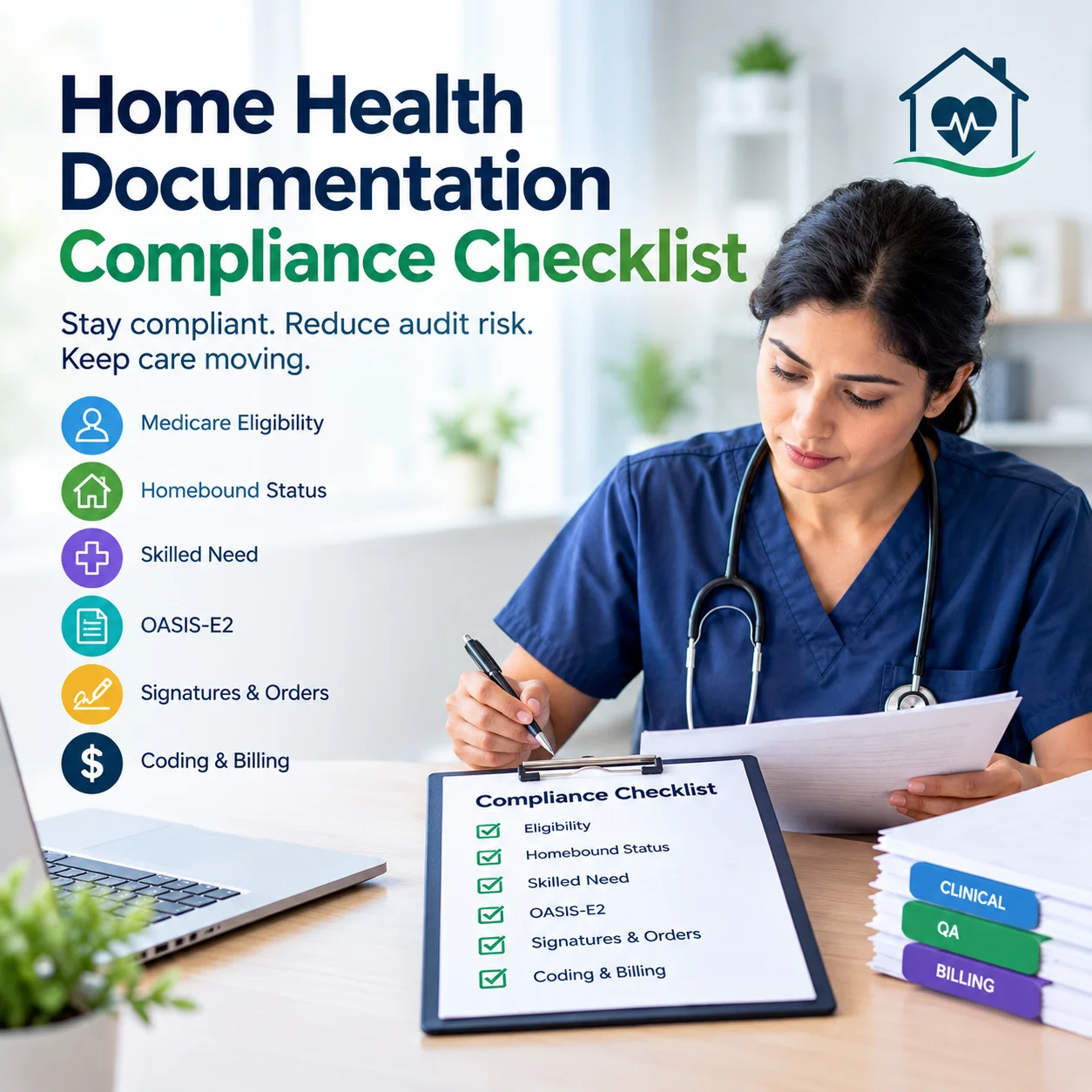
Agencies can use the following checklist as part of their ongoing compliance and documentation review process.
- Patient eligibility and homebound status are supported.
- Skilled need and medical necessity are clearly documented.
- Applicable coverage criteria, including relevant LCDs, have been reviewed.
- Required certification and face-to-face documentation are available.
- The plan of care is complete and consistent with the patient's needs.
- Visit notes reflect the care actually delivered.
- Clinical findings, interventions, and patient responses are documented.
- Interdisciplinary records are consistent and discrepancies are addressed.
- Required signatures, dates, and authentication are present.
- Clinical records align with the services and dates billed.
- Pre-claim and episode-end documentation reviews are conducted.
- PEPPER and relevant iQIES reports are reviewed periodically.
- Recurring documentation and billing issues are tracked and addressed.
- Medicare correspondence details are current in PECOS.
- ADR correspondence is monitored and assigned to responsible staff.
- Submission deadlines and proof of delivery are tracked.
- Denials are reviewed for patterns and appropriate follow-up.
- Complete records are retained according to applicable requirements.
This checklist is a starting point, not a substitute for reviewing the specific Medicare rules, contractor guidance, and documentation requirements that apply to each claim.
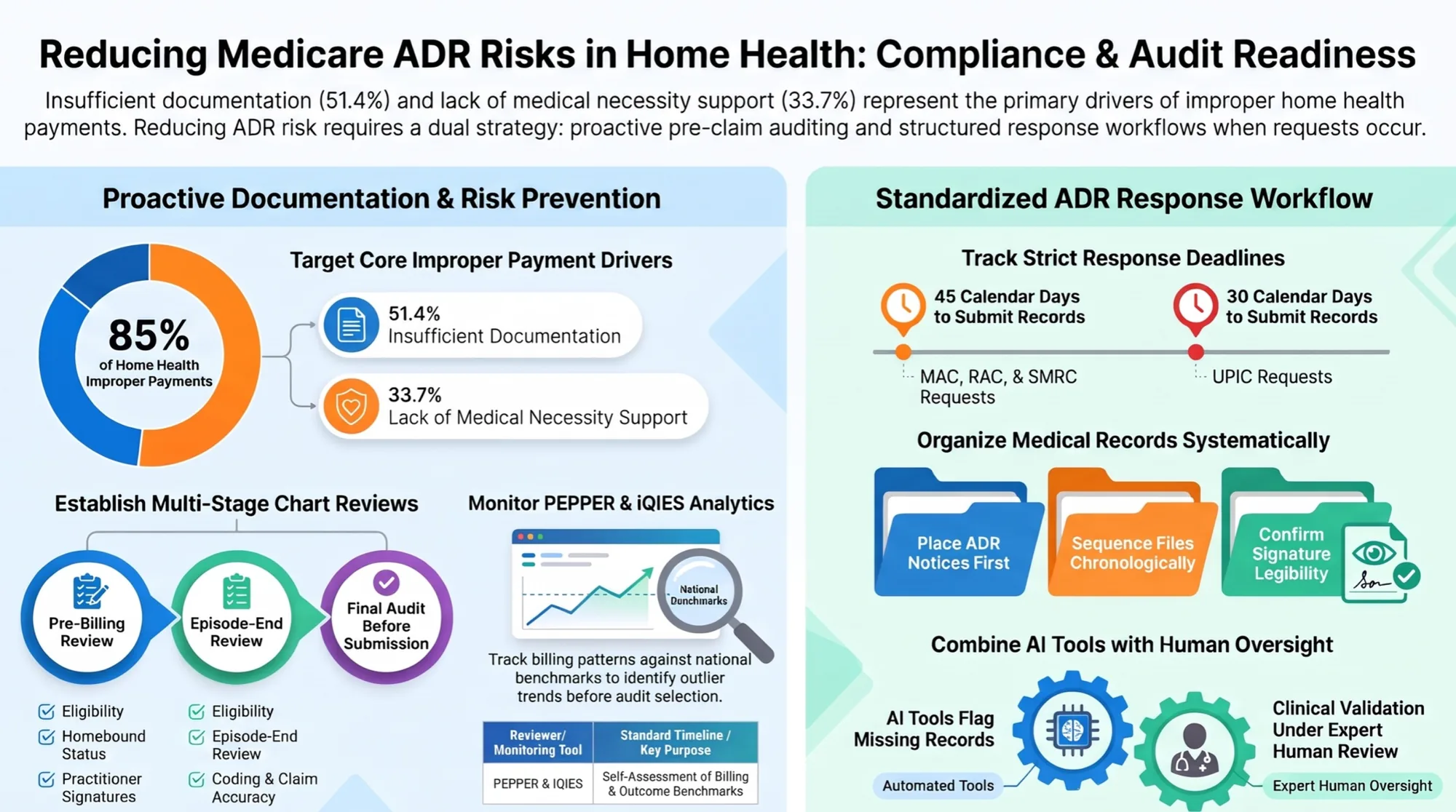
Reducing ADR risk combines proactive documentation review with a standardized response workflow when requests arrive.
Frequently Asked Questions About Medicare ADRs in Home Health
What Does ADR Stand for in Medicare?
ADR stands for Additional Documentation Request. It is a request from a Medicare review contractor for records needed to evaluate whether a claim meets applicable coverage, coding, billing, and medical-necessity requirements.
Why Does Medicare Send ADRs to Home Health Agencies?
Medicare review contractors may select claims for review when additional information is needed to determine whether the services billed meet Medicare requirements. The request may involve eligibility, medical necessity, documentation, coding, or billing.
Does Receiving a Medicare ADR Mean the Claim Will Be Denied?
No. Receiving an ADR does not automatically mean a claim will be denied. It means the reviewer needs additional documentation to make a determination. The claim may be paid or denied depending on the records submitted and the applicable coverage requirements.
How Many Days Does a Home Health Agency Have to Respond to an ADR?
CMS generally provides 45 calendar days for MAC, RAC, and SMRC requests and 30 calendar days for UPIC requests. The actual deadline and instructions in the ADR notice should always be checked.
What Documents Should a Home Health Agency Submit for an ADR?
The requested records may include physician or allowed practitioner orders, certification documents, the plan of care, clinical assessments, OASIS records when applicable, nursing and therapy visit notes, and other records supporting eligibility and medical necessity. Agencies should submit the records specified in the request and relevant supporting documentation.
What Happens If a Home Health Agency Does Not Respond to an ADR?
If the agency fails to submit the requested documentation within the applicable timeframe, the contractor may deny the claim. Agencies should track ADR notices, assign responsibility, and allow enough time to gather and submit complete records.
Can an Agency Reduce Its Risk of Medicare ADRs?
An agency cannot guarantee that its claims will never be selected for review. However, it can reduce avoidable documentation weaknesses by strengthening eligibility checks, supporting medical necessity, maintaining complete clinical records, monitoring billing patterns, conducting internal audits, and reviewing claims before submission.
What Is PEPPER and How Does It Help Home Health Agencies?
PEPPER stands for Program for Evaluating Payment Patterns Electronic Report. It provides agency-specific Medicare billing statistics that can be compared with national, jurisdictional, and state benchmarks. Agencies can use the results to identify patterns that may deserve further auditing and monitoring. An outlier result does not, by itself, prove an improper payment or mean that an audit will occur.
Should Home Health Agencies Use CASPER or iQIES Reports?
Home health agencies should use the current iQIES reporting system for applicable OASIS quality-improvement and provider reports. The HHA OASIS quality-improvement reports transitioned from the legacy CASPER reporting workflow to iQIES. Agencies should consult current CMS and QIES Technical Support Office guidance for available reports.
Can AI Help Home Health Agencies Prepare for Medicare ADRs?
AI can support documentation organization, information extraction, missing-document checks, and record retrieval. However, AI cannot guarantee claim approval or replace clinical judgment and required human review. All generated or extracted information should be checked against the original medical record.
What Is the Difference Between an ADR and a Medicare Claim Denial?
An ADR is a request for additional records so a reviewer can evaluate a claim. A denial is a payment decision made when the claim does not meet applicable requirements or the requested documentation is not provided or does not adequately support payment.
Is Your Agency Prepared Before the Next Medicare ADR Arrives?
Reducing ADR-related risk is not just about responding quickly when a request arrives. It is about building documentation practices that support the care delivered from the beginning of the episode.
When eligibility is clearly supported, skilled services are explained, plans of care are consistent, billing patterns are monitored, and records are easy to retrieve, agencies are better prepared to respond to reviews.
The goal is not to create documentation just for auditors. It is to make sure the medical record accurately reflects the patient's needs, the care provided, and the clinical reasoning behind it.
Strong documentation supports better compliance, clearer communication, and a more reliable revenue cycle.
And for home health agencies, that work starts long before an ADR reaches the inbox.
Sources and Further Reading
- CMS: Additional Documentation Request.
- CMS: Home Health Services – Medicare Provider Compliance Tips.
- CMS: Local Coverage Determinations.
- 42 CFR § 424.22: Requirements for Home Health Services.
- PEPPER: Home Health Agency Resources.
- PEPPER: Frequently Asked Questions.
- CMS: Home Health Quality Reporting Requirements.
- QIES Technical Support Office: iQIES Report Updates.