A Medicare audit can put a home health agency under pressure, especially when the requested documentation is spread across clinical notes, OASIS assessments, physician or allowed practitioner orders, and supporting medical records.
The challenge is not simply finding the documents. The agency must be able to demonstrate that the patient met Medicare's eligibility requirements, that the services were medically necessary, and that the care provided was consistent with the plan of care.
A chart may contain plenty of documentation and still have gaps. A signed plan of care does not automatically establish medical necessity. A diagnosis alone does not demonstrate the need for skilled services. A statement that a patient is homebound needs to be supported by the patient's actual condition and limitations.
Preparing for a Medicare audit should therefore begin well before a documentation request arrives.
This guide explains how home health agencies can organize and review patient charts, identify common documentation gaps, and prepare records for Medicare medical review.
What does a Medicare auditor look for in a home health chart?
A Medicare reviewer evaluates whether the services billed meet the requirements of the Medicare home health benefit and are supported by the medical record.
The review may examine whether the patient:
- Meets the applicable homebound criteria.
- Requires qualifying skilled nursing care, physical therapy, or speech-language pathology services, or continues to require occupational therapy under the applicable benefit requirements.
- Is under the care of an eligible physician or allowed practitioner.
- Has an established and appropriately reviewed plan of care.
- Had a qualifying face-to-face encounter.
- Received services that were reasonable and necessary.
- Has documentation that supports the services and dates billed.
The reviewer also looks at whether the clinical record tells a consistent story. The referral, face-to-face documentation, comprehensive assessment, plan of care, visit notes, and claim should support one another.
The central question is: Does the record demonstrate why this patient needed home health services and why the services billed were appropriate?
Which documents should an agency collect before a Medicare audit?
Start by identifying the exact dates of service and claims included in the review request. Then gather the complete record for the relevant period.
A typical chart-preparation checklist includes:
- Referral and initial orders for home health services.
- Physician or allowed practitioner certification and recertification documentation.
- Face-to-face encounter documentation.
- Supporting medical records from the certifying practitioner or applicable acute or post-acute care facility.
- Comprehensive assessment and applicable OASIS records.
- Signed and dated plan of care, including revisions.
- All relevant physician or allowed practitioner orders.
- Skilled nursing and therapy visit notes.
- Medication reconciliation and relevant medication records.
- Treatment records and evidence of patient response.
- Documentation of progress toward goals.
- Care coordination and communication records.
- Discharge or transfer documentation, when applicable.
- Records supporting the dates and services billed.
The exact documents required depend on the request, claim, and services under review. Agencies should follow the documentation request instructions and applicable CMS requirements rather than sending an incomplete or unrelated chart.
How can an agency verify that the patient met Medicare home health eligibility requirements?
Before reviewing individual visit notes, verify that the record supports the patient's eligibility for the Medicare home health benefit.
The core requirements include:
- The patient is confined to the home under Medicare's homebound criteria.
- The patient needs qualifying skilled services.
- The patient is under the care of a physician or allowed practitioner.
- Services are provided under an established and appropriately reviewed plan of care.
- The required face-to-face encounter has occurred and is properly documented.
These requirements should be supported by the clinical record and relevant practitioner documentation.
A useful internal review is to check whether the chart explains the patient's condition at the time services were provided, rather than relying only on a diagnosis or a general statement of eligibility.
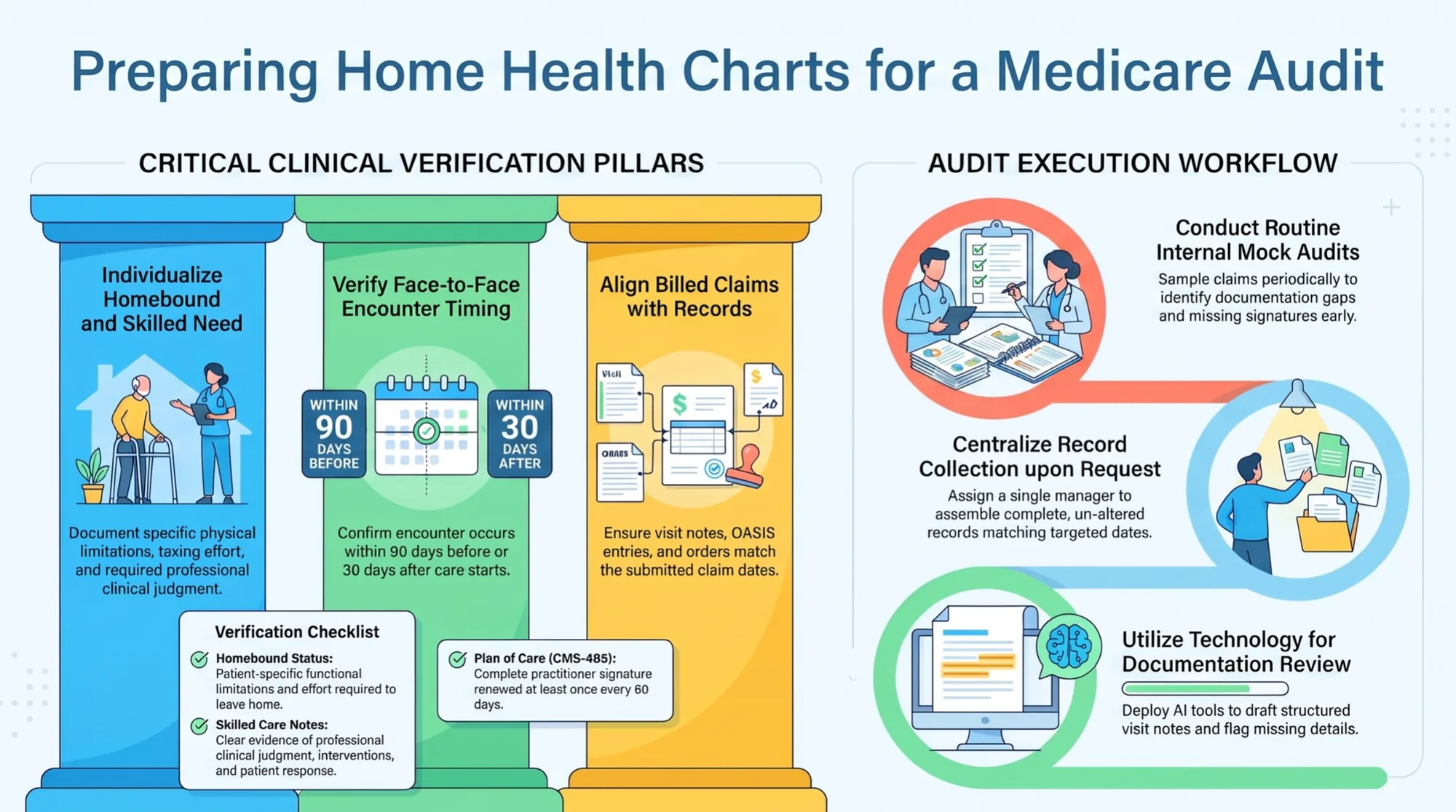
An audit-ready chart connects eligibility, homebound status, skilled need, orders, and billed services into one consistent record.
Does the chart clearly support the patient's homebound status?
Homebound status is one of the areas agencies should review carefully.
Medicare's homebound criteria involve two requirements. The record should support both:
First requirement: The patient must either need the assistance of another person or supportive devices such as crutches, canes, wheelchairs, or walkers to leave home; require special transportation; or have a condition for which leaving home is medically contraindicated.
Second requirement: The patient must have a normal inability to leave home, and leaving home must require a considerable and taxing effort.
A statement such as "patient is homebound" is not enough by itself. The documentation should explain the patient's actual limitations and why the applicable criteria are met.
Review whether the record describes:
- The patient's mobility and functional limitations.
- The need for assistance from another person or use of an assistive device.
- The patient's medical condition and its effect on leaving home.
- The effort required to leave the residence.
- The frequency and circumstances of absences from home, where relevant.
- Changes in the patient's condition during the episode.
The documentation should be individualized. Avoid relying on identical homebound statements across multiple patients or visits.
The clinical record should make it possible for a reviewer to understand why leaving home is difficult for this particular patient.
Does the medical record demonstrate the need for skilled services?
A diagnosis does not automatically establish the need for skilled home health care.
The chart should explain what skilled service was required, why the patient's condition called for that service, and what the clinician did.
For skilled nursing, review whether the notes describe:
- The patient's relevant clinical condition.
- The assessment or observation performed.
- The skilled intervention or teaching provided.
- The clinical judgment involved.
- The patient's response to the intervention.
- The plan for continued care or follow-up.
For therapy services, review whether the documentation supports the need for the applicable therapy, the treatment provided, the patient's functional limitations, and progress toward measurable goals.
The record should also explain why the service required the knowledge and skills of a qualified professional rather than routine assistance that could be provided safely by an untrained caregiver.
Avoid vague statements such as "patient tolerated treatment well" without supporting clinical details. The record should describe the actual intervention and the patient's response.
What should a strong skilled visit note include?
A strong visit note should tell the clinical story of the encounter. It should demonstrate not only what the clinician did, but why the service was necessary.
Review each relevant visit for six elements:
- Patient condition: What did the clinician observe or assess?
- Skilled need: Why was professional nursing or therapy expertise necessary?
- Intervention: What specific skilled service was performed?
- Clinical judgment: What decisions, assessments, or adjustments did the clinician make?
- Patient response: How did the patient respond to the intervention?
- Next steps: What follow-up, continued care, or change in the plan was needed?
For example, "wound care completed" may not provide enough context on its own. The record should include relevant wound assessment findings, the treatment performed, and the patient's response, consistent with the clinical situation.
The same principle applies to medication teaching, disease management, therapy interventions, and other skilled services. The note should reflect the actual clinical work performed.
Are the face-to-face encounter and certification documents complete?
The face-to-face encounter is an important part of Medicare home health eligibility documentation.
Under the general Medicare timing framework, the encounter must occur within the 90 days before or 30 days after the start of home health care.
Check whether the chart contains documentation supporting the encounter, including:
- The date of the encounter.
- Documentation of the relevant clinical findings.
- The relationship between the encounter and the primary reason for home health services.
- The required certification statement and supporting documentation.
- The applicable timing requirements.
- Appropriate authentication by the practitioner who performed the encounter.
The practitioner who performs the face-to-face encounter must document and authenticate it as required. The certifying physician or allowed practitioner has separate certification responsibilities.
Also verify that the certification and recertification requirements are met for the claim under review. The supporting record should establish that the patient met the applicable home health benefit criteria and required services.
CMS guidance recognizes physicians and allowed practitioners, including nurse practitioners, clinical nurse specialists, and physician assistants, within the applicable statutory and regulatory framework. Agencies should verify that the practitioner is eligible to perform the relevant function and that the documentation meets the requirements.
Do not assume that a signed certification alone resolves every eligibility question. Supporting medical record documentation may also be needed to establish that the patient met the home health benefit criteria.
Does the plan of care support the services actually provided?
The plan of care, sometimes documented using CMS-485 or an equivalent format, should reflect the patient's individual needs and provide a clear basis for the services delivered.
Review whether it includes the applicable elements, such as:
- Pertinent diagnoses.
- Mental, psychosocial, and cognitive status.
- Types of services, supplies, and equipment required.
- Disciplines, frequency, and duration of visits.
- Prognosis and rehabilitation potential.
- Functional limitations and activities permitted.
- Nutritional requirements.
- Medications and treatments.
- Safety measures.
- Risk factors for emergency department visits and hospital readmissions, with necessary interventions.
- Patient-specific interventions, education, measurable outcomes, and goals.
- Patient and caregiver education and training.
- Relevant advance directive information.
Compare the plan of care with the actual visit notes and billed services.
For example, if the plan identifies a particular treatment or visit frequency, the record should make it possible to determine whether the care delivered followed the plan or whether an appropriate revision or order was made.
The plan of care must be established, periodically reviewed, and signed by the appropriate physician or allowed practitioner. CMS regulations require review and revision as often as the patient's condition or needs require, and at least once every 60 days beginning with the start of care date.
Are physician or allowed practitioner orders properly documented and authenticated?
Orders should be reviewed for completeness, clarity, and consistency with the care delivered.
Check whether:
- Orders identify the services or treatments to be furnished.
- Verbal orders are documented in the clinical record.
- The person accepting a verbal order is authorized under applicable state law and agency policy.
- Verbal orders are signed, dated, and timed by the authorized person accepting them.
- Practitioner authentication follows applicable requirements.
- PRN orders include clear parameters and indications for use.
- Treatment changes and plan-of-care revisions are documented.
- Orders are consistent with the services provided.
Pay particular attention to orders that are missing, incomplete, or inconsistent with the visit documentation.
A reviewer should be able to follow the relationship between the order, the planned service, the care delivered, and the documentation supporting that care.
Are OASIS assessments accurate and consistent with the clinical notes?
OASIS documentation should be reviewed as part of the complete clinical record, not as a standalone form.
Check whether:
- The correct assessment time point and reason for assessment were selected.
- The assessment was completed within the applicable time requirements.
- Responses are supported by the patient's clinical condition.
- Functional status is consistent with the visit documentation.
- Medication and diagnosis information is consistent across relevant records.
- Changes in the patient's condition are reflected appropriately.
- Required items and applicable skip patterns have been followed.
- The assessment completion and submission records are available where relevant.
Review all applicable OASIS time points, including Start of Care, Resumption of Care, Follow-Up, Transfer, Discharge, and Death at Home, as applicable. Not every patient will have every assessment time point.
Look for discrepancies between OASIS responses and the clinical notes. For example, if the assessment describes substantial functional limitations but the visit notes repeatedly describe independent performance, the record should explain the difference when clinically appropriate.
For OASIS-E2 assessments, use the applicable CMS manual and item instructions for the assessment time point. Do not rely on older templates or assumptions about item requirements.
Are medication records reconciled and consistent across the chart?
Medication documentation can contain discrepancies because patients' medications may change during an episode of care.
The goal is not to make every medication list identical. It is to demonstrate that changes and discrepancies were identified, reviewed, and addressed appropriately.
Check whether:
- The medication profile reflects the patient's current medication regimen.
- Medication changes are documented.
- Discrepancies between medication sources are identified and addressed.
- Relevant practitioner communication and follow-up are recorded.
- Medication teaching and management interventions are documented when provided.
- The patient's response or concerns are recorded where relevant.
A medication list that differs from an earlier record is not automatically an error. However, unexplained differences can create questions during medical review.
Do the dates, signatures, and authentication details meet documentation requirements?
Incomplete or unauthenticated entries can create avoidable problems during medical review.
Check that entries are:
- Legible and clear.
- Complete.
- Dated and timed.
- Authenticated by the appropriate author.
- Signed with the author's title or occupation, or authenticated through an appropriate secured electronic entry using a unique identifier.
- Corrected through the agency's approved process, with the original record and audit trail preserved where applicable.
Avoid backdating, undocumented alterations, shared user credentials, or changes that obscure who created or approved an entry.
Under 42 CFR §484.110, clinical record entries must be legible, clear, complete, appropriately authenticated, dated, and timed. The regulation also requires clinical records to be retained for five years after discharge, unless state law requires a longer period.
Does the chart support the services and dates billed?
The agency should compare the claim with the actual clinical record.
Ask:
- Was the service included in the plan of care or appropriately ordered?
- Was the service actually furnished on the billed date?
- Does the note describe the service provided?
- Does the documentation support the need for skilled care?
- Is the service consistent with the patient's condition and goals?
- Are visit frequency and duration supported?
- Are changes in the patient's condition reflected in the record?
- Are missed visits, cancellations, and changes in service documented appropriately?
A claim should not be supported by a generic statement that the patient needed home health care. The documentation should explain the need for the specific services billed during the period under review.
The dates, disciplines, and services on the claim should be traceable to the orders, plan of care, and clinical documentation.
Are discharge and transfer records complete when applicable?
Discharge and transfer documentation can provide important context about the patient's progress, condition, and continuity of care.
When applicable, check whether the record includes:
- The reason for discharge or transfer.
- The patient's condition at the time.
- Progress toward established goals.
- Services provided during the episode.
- Medication and treatment information relevant to the transition.
- Communication with the receiving provider or other care team members.
- Patient and caregiver instructions.
- Follow-up recommendations and outstanding care needs.
- The required discharge or transfer summary.
The record should explain what happened at the end of the episode and support the applicable OASIS assessment and discharge or transfer documentation requirements.
What common documentation gaps can put a home health claim at risk?
Some documentation issues appear repeatedly during internal chart reviews.
Common examples include:
- Generic homebound statements without patient-specific support.
- Diagnoses listed without a clear explanation of skilled need.
- Visit notes that describe tasks but not clinical assessment or judgment.
- Missing or incomplete face-to-face documentation.
- Certification or recertification gaps.
- Plan-of-care details that do not match services provided.
- Missing or unauthenticated orders.
- Unclear PRN order parameters.
- Inconsistent information between OASIS and visit notes.
- Incomplete documentation of patient response or progress.
- Medication discrepancies that are not explained or addressed.
- Missing dates, times, signatures, or author identification.
- Claims containing services that are not adequately supported by the record.
- Missing discharge or transfer documentation when applicable.
The best way to address these gaps is through routine, consistent chart review rather than trying to correct everything after an audit request arrives.
How should an agency organize and submit records when it receives a Medicare audit request?
Once an agency receives a request, it should assign responsibility for coordinating the response.
A practical process includes:
- Review the request carefully. Identify the patient, claim, dates of service, requested records, submission method, and deadline.
- Assign an owner. Designate one person to coordinate record collection and submission.
- Collect the complete record. Include the relevant home health documentation and supporting practitioner or facility records requested.
- Check for missing information. Use a checklist to confirm that all requested documents are present.
- Review consistency. Compare the claim, plan of care, OASIS, orders, and visit notes.
- Preserve record integrity. Do not alter original documentation or create retrospective entries that misrepresent when care was documented.
- Submit securely and on time. Follow the review contractor's instructions and retain evidence of submission.
If documentation is missing or a question arises about the request, escalate it to the agency's compliance or reimbursement leadership. The response should be accurate and complete, not an attempt to manufacture supporting documentation after the fact.
How can an agency conduct a mock Medicare audit before submitting records?
An internal mock audit can help identify missing documents and weak clinical rationales before an external reviewer examines the chart.
A practical review process should include:
- Selecting a sample of claims and patient charts.
- Reviewing the complete record against Medicare eligibility requirements.
- Checking homebound status and skilled need.
- Comparing the face-to-face documentation, certification, plan of care, and visit notes.
- Checking OASIS consistency.
- Reviewing orders, signatures, and authentication.
- Matching billed services and dates to the clinical record.
- Recording findings and assigning corrective actions.
Agencies can use their own audit tools and relevant Medicare Administrative Contractor resources to support this process. For example, Palmetto GBA publishes provider education and medical review resources. Any third-party audit checklist should be checked for current applicability before use.
The purpose of a mock audit is not simply to find missing signatures. It is to determine whether the complete record supports the care provided and the claim submitted.
How can technology help agencies prepare audit-ready home health charts?
Preparing a chart for review can involve gathering information from multiple records, checking for missing details, and comparing documentation across the episode.
Technology can help agencies organize this work, but it should support rather than replace clinical and compliance review.
AI-assisted tools may help with:
- Organizing relevant clinical information.
- Preparing structured clinical summaries.
- Reducing repetitive data entry.
- Bringing together information from supported EMR records.
- Highlighting potential gaps for human review.
- Supporting more consistent documentation workflows.
Copper AI is designed to support home health documentation by helping organize clinical information and prepare structured documentation for clinician review. Its voice agent, Joy, can turn a nurse's visit narration into a structured draft.
For audit preparation, the value is in making the underlying documentation easier to organize and review. The clinician remains responsible for checking the accuracy of the clinical record and approving the documentation. AI does not replace required signatures, practitioner certification, or agency compliance review.
Agencies should also evaluate any technology for appropriate privacy safeguards, access controls, auditability, and compatibility with their existing workflows.
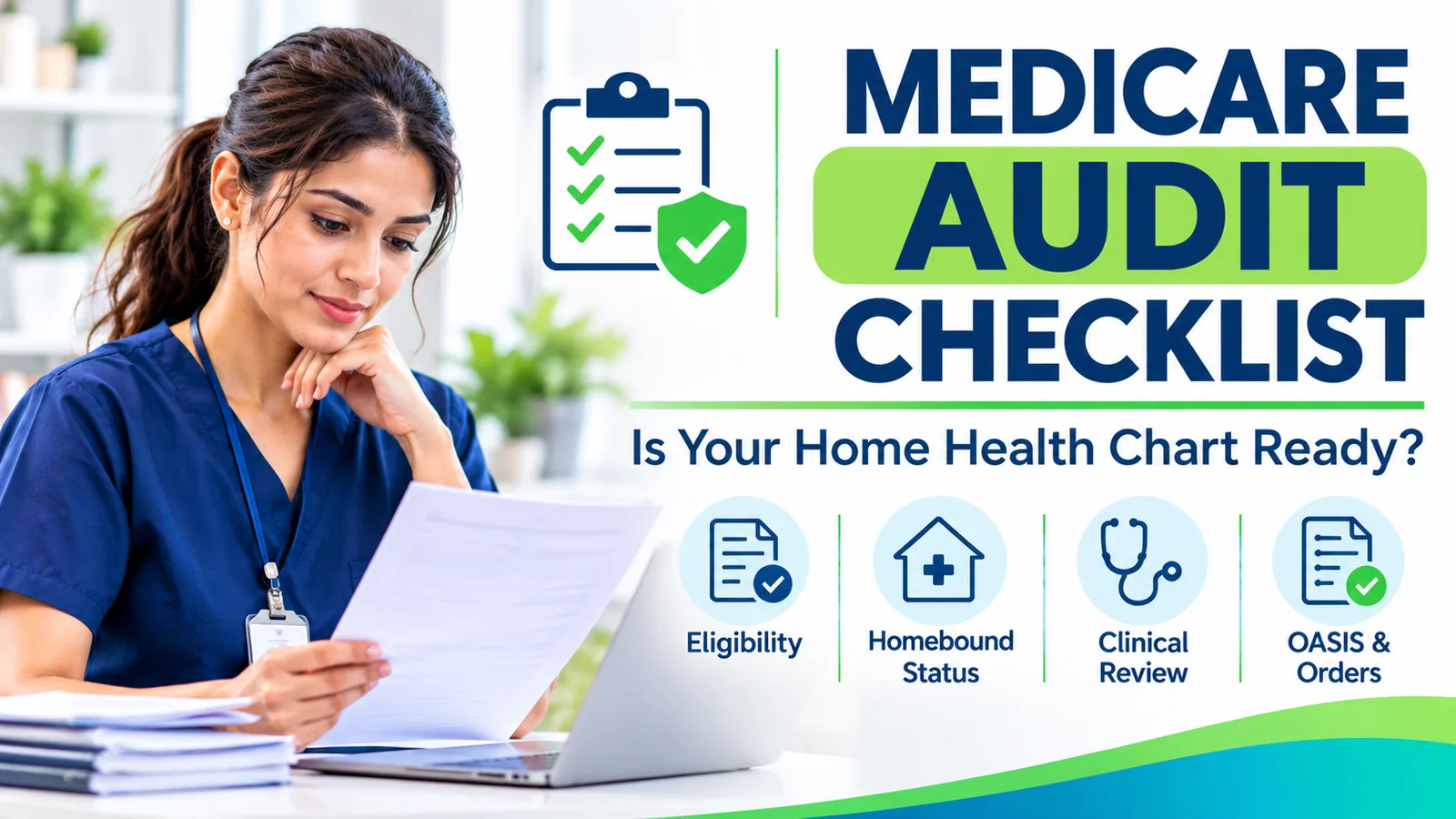
What should be included in a final home health Medicare audit checklist?
Before submitting a chart, use this checklist to confirm that the record is organized and that the key documentation is present.
- The requested patient and dates of service have been confirmed.
- Patient identifiers match across the relevant records.
- Referral and initial orders are included.
- Certification and recertification documentation is available.
- Face-to-face encounter documentation is included and meets applicable timing and authentication requirements.
- Supporting practitioner or facility records are available when required or requested.
- Homebound status is supported by patient-specific clinical information.
- The need for skilled services is clearly documented.
- The plan of care is complete, signed, and consistent with services provided.
- Orders, PRN parameters, and revisions are documented and authenticated.
- Comprehensive assessment and applicable OASIS records are included.
- Visit notes support the services and dates billed.
- Patient response and progress toward goals are documented.
- Medication changes and discrepancies are appropriately addressed.
- Dates, times, signatures, and author identification have been checked.
- Discharge or transfer records are included when applicable.
- Any discrepancies or missing records have been escalated.
- The submission follows the review contractor's instructions and deadline.
This checklist is an internal preparation aid, not a substitute for the specific documentation request, CMS requirements, or applicable Medicare coverage policies.
How can home health agencies stay prepared for Medicare audits throughout the year?
Audit readiness should be part of the agency's routine operations, not a project that begins when a request arrives.
A practical approach is to conduct periodic chart reviews across different clinicians, patient types, and service periods. Track recurring gaps, share findings with clinical teams, and provide targeted education where needed.
Agencies should also review whether their documentation processes make it easy to connect the patient's condition, the plan of care, the skilled service provided, and the outcome.
At Copper Digital, we believe technology should work around the way home health professionals already work. Copper AI helps organize clinical information and supports documentation workflows while keeping clinicians involved in reviewing and approving their records.
A well-prepared chart is more than a collection of signed forms. It is a clear, consistent record of why the patient needed care, what services were provided, and how those services supported the patient's needs.
Related Reading
- How Can Home Health Agencies Reduce Their Risk of Medicare ADRs? A Practical Guide.
- How to Respond to a Medicare ADR in 30 Days: A Step-by-Step Guide for Home Health & Hospice.
- Beginner's Guide to Medicare ADRs for Home Health and Hospice Agencies.
- Home Health Documentation Compliance Checklist.
- How to Close a Home Health Episode Without Missing Documentation.