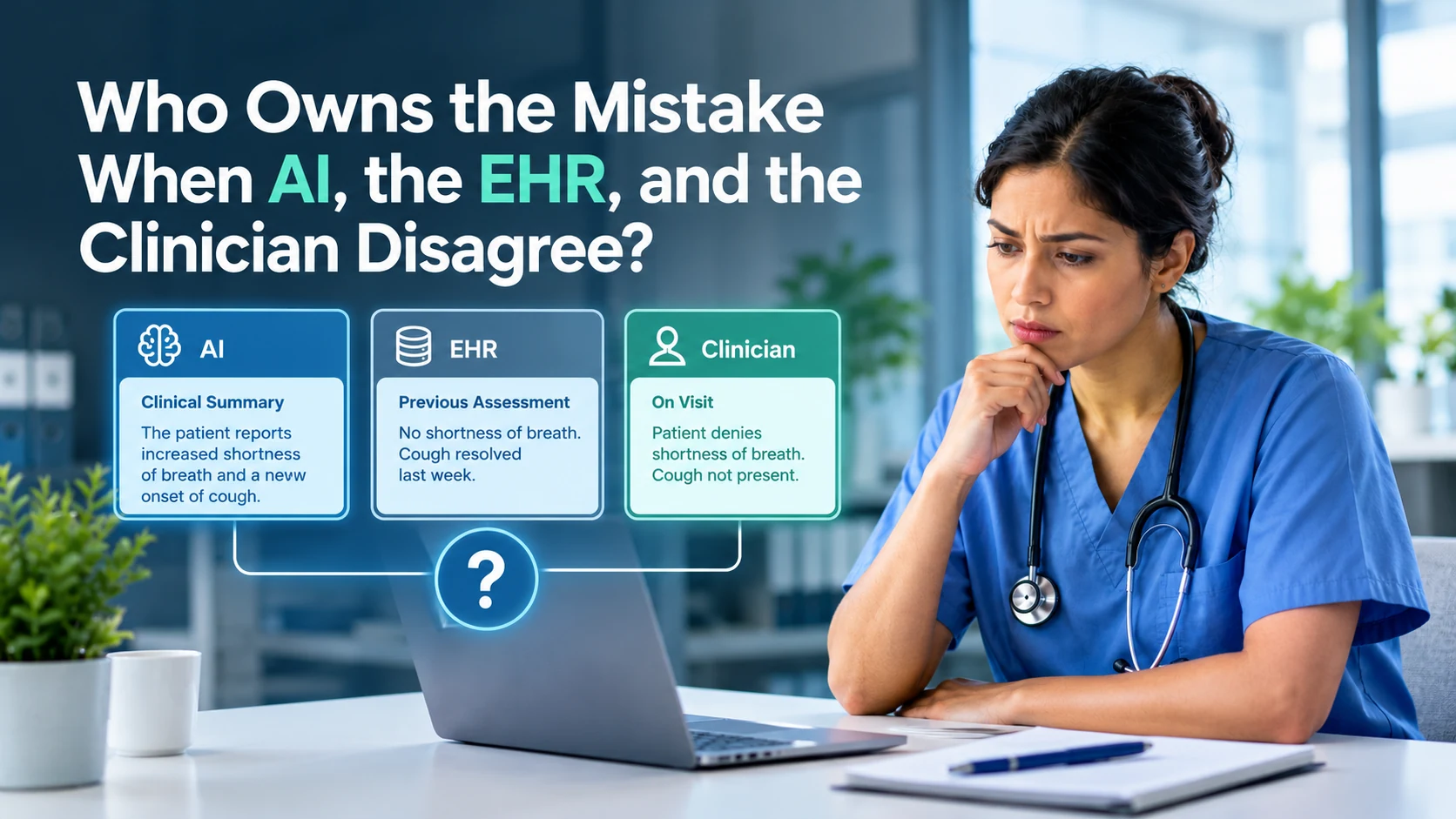
What happens when an AI tool generates a clinical summary, the EHR contains different information, and the clinician knows the output does not reflect the patient’s condition?
Who owns the mistake?
Is it the AI developer that generated the incorrect statement? The EHR vendor whose system supplied the data? The clinician expected to review the output? Or the healthcare organization that introduced the technology into its workflow?
The answer depends on what went wrong, who was responsible for the relevant step, and how the system was designed, deployed, and used.
Healthcare AI accountability cannot be reduced to a simple rule that the clinician is always responsible or that the technology vendor is always at fault. Understanding an error requires examining the entire chain, from the original patient information to the final clinical record.
What happens when AI, the EHR, and the clinician disagree?
Consider a home health nurse completing documentation after a patient visit.
The EHR contains an earlier assessment. The nurse records new observations during the visit. An AI tool uses available information to generate a clinical summary.
But the summary includes a statement that the nurse did not document and that the current assessment does not support.
The nurse notices the discrepancy.
At this point, several questions matter:
- Did the AI generate information that was never provided?
- Did it rely on an outdated assessment?
- Did the EHR supply the wrong patient information or an incomplete record?
- Did the integration retrieve the wrong data or fail to preserve an update?
- Did the interface make the AI-generated statement look like verified clinical information?
- Was the clinician given a meaningful opportunity to review and correct it?
These are different failure scenarios. Each requires a different investigation.
The fact that an error appeared in an AI-generated summary does not, by itself, establish its cause. The fact that it appeared in the EHR does not establish that the EHR created it.
The first step is to identify where the information changed, where the process failed, and whether the discrepancy reached the final clinical record.
Who is responsible when AI generates an incorrect clinical statement?
Responsibility depends on the nature of the error, the intended use of the AI, the decisions made by the people involved, and the applicable legal and contractual obligations.
An AI developer may need to address a model that generates unsupported statements or fails to perform as represented. An EHR or integration provider may need to investigate data retrieval, mapping, synchronization, or display problems. A clinician may have professional responsibilities when reviewing and approving clinical documentation. A healthcare organization may need to examine its implementation, training, policies, and monitoring.
These responsibilities can overlap.
For example, an AI tool may generate a statement based on incomplete information. The EHR may display that statement without clearly identifying it as AI-generated. The workflow may then allow the statement to enter the record without an adequate review step.
There may be more than one contributing factor.
That is why organizations should avoid treating accountability as a search for one person to blame. They need to establish the facts and determine which responsibilities applied to each stage.
The appropriate legal outcome will depend on the circumstances and the jurisdiction. No single rule determines responsibility for every healthcare AI error.
Is the clinician always responsible for an AI-generated mistake?
No. It would be too simplistic to say that a clinician automatically owns every error produced by an AI system.
Clinicians have professional obligations that depend on their role, the clinical context, applicable standards, and the decisions they make. But those obligations do not make every technical failure their fault.
Consider the difference between these situations:
- A visible discrepancy: The AI summary contradicts the clinician’s documented findings, and the discrepancy is clear during review.
- A hidden data problem: An integration retrieves an outdated record, and the interface does not reveal that the information is stale.
- An unsupported AI statement: The system generates a plausible-sounding clinical detail that was never present in the source information.
- A workflow failure: The organization introduces AI-generated documentation without a clearly defined review and correction process.
These scenarios raise different questions about foreseeability, control, professional judgment, and system design.
Clinicians should not be expected to compensate for every hidden technical failure through vigilance alone. At the same time, AI-generated content should not automatically be treated as clinically verified simply because it appears inside a trusted application.
A safer approach combines clear professional responsibilities with systems that make errors easier to identify and correct.
Can an EHR be responsible for an AI documentation error?
An EHR can be part of the failure, but its role must be established rather than assumed.
An EHR may store patient information, display documentation, manage permissions, or exchange data with another application. Depending on the implementation, it may also host AI functionality or integrate with an external AI tool.
Potential problems include:
- Retrieving information from the wrong encounter.
- Displaying outdated patient information.
- Mapping one data field to another incorrectly.
- Failing to synchronize a correction.
- Losing context when transferring information between systems.
- Displaying generated content without making its status clear.
However, an EHR may simply have displayed an incorrect statement that originated elsewhere. The source of the statement and the point at which the error entered the workflow need to be established.
This is why interoperability matters beyond whether two systems can exchange data. Organizations also need to know whether the correct information was exchanged, whether its meaning was preserved, and whether changes were recorded accurately.
How can healthcare organizations identify where an AI error occurred?
The most useful question is not simply, “Who entered this information?”
It is, “Can we reconstruct what happened?”
A structured investigation should examine the path from source information to final documentation.
1. Check the original clinical information.
Review the nurse’s observations, encounter notes, assessment, and relevant source records. Establish what information was actually available when the AI generated its output.
2. Review the AI-generated output.
Identify the specific statement that was incorrect. Determine whether it was copied from a source, altered during summarization, inferred without sufficient support, or generated without a clear source.
3. Examine the data exchange.
Check whether the AI received the intended patient, encounter, and record version. Review integration mappings, synchronization events, and relevant system errors.
4. Reconstruct the timeline.
Determine when the output was generated, displayed, edited, reviewed, and approved. Where available, examine the corresponding system and user events.
5. Establish how the output entered the record.
Was it saved as a draft? Was it copied into a note? Did an integration write it into a field? Did a clinician approve it? The answers can help distinguish a generation error from a workflow or data-handling error.
6. Document the findings and corrective action.
Record the confirmed cause, any remaining uncertainty, the correction made, and the changes needed to prevent a similar event.
Not every system records every event. If critical information is unavailable, the investigation should state that limitation rather than present an assumption as a confirmed cause.
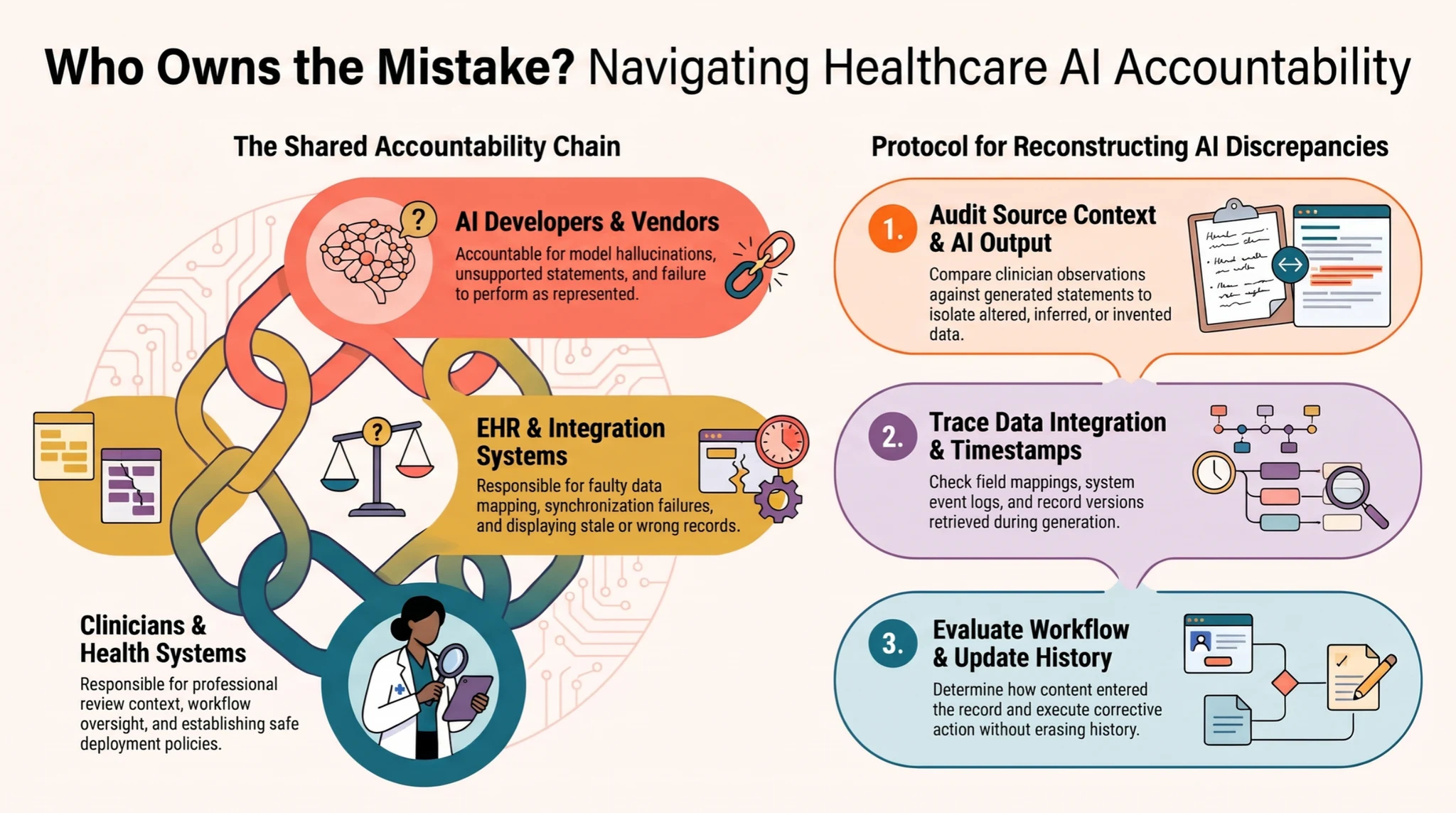
Potential areas of responsibility and investigation. Legal liability depends on the facts, applicable law, and contractual and professional obligations; the diagram does not assign liability in an individual case.
What role do explainability, traceability, and audit trails play in healthcare AI accountability?
These capabilities help answer different questions during an investigation.
Explainability helps users understand the basis for an AI recommendation. Depending on the system, this may include the information used, relevant factors, or the reasoning method behind the output.
Traceability helps establish which inputs, records, and data sources were associated with a particular output.
Audit trails record events such as creation, access, modification, review, or approval, depending on the system’s logging capabilities.
Together, they can help organizations reconstruct a discrepancy.
For example, an explanation may help identify which clinical information influenced a generated summary. Traceability may establish which version of the patient record was available. An audit trail may show when the summary was created and whether it was subsequently edited or approved.
But none of these capabilities guarantees that an AI recommendation is clinically correct. A log can show what happened without explaining why a model generated a particular statement. A source record can be accurate while the AI summary of it is not.
Healthcare leaders should understand exactly what their tools expose, what they record, and what remains difficult to investigate.
What should healthcare leaders establish before deploying AI in clinical workflows?
Accountability should be designed into the workflow before an error occurs.
Healthcare leaders can start with a practical set of questions.
- Defined responsibilities: Who owns the AI system, the EHR integration, clinical review, and incident investigation?
- Clear output status: Can users distinguish AI-generated content from verified information?
- Meaningful review: Does the workflow provide an appropriate opportunity to inspect and correct outputs before they are finalized?
- Source visibility: Can users identify the records or information associated with a generated statement where the system supports it?
- Reliable logging: Are relevant generation, transfer, editing, review, and approval events recorded?
- Correction procedures: Can incorrect information be corrected without losing the history needed to understand what happened?
- Incident escalation: Do staff know how to report discrepancies and who will investigate them?
- Ongoing monitoring: Are recurring errors, integration problems, and workflow weaknesses reviewed after deployment?
- Vendor coordination: Do contracts and operating procedures clarify access to relevant logs, investigation support, and responsibility for remediation?
These questions should be adapted to the AI tool’s intended use and the potential consequences of an error. A tool that formats administrative information may require different controls from one that produces clinical recommendations.
For organizations operating in the United States, relevant frameworks can include the FDA’s clinical decision support guidance and applicable health IT transparency requirements. The requirements depend on the system’s functionality, intended use, and regulatory status.
How can AI support clinicians without shifting hidden risks onto them?
AI can reduce repetitive work, organize information, and help clinicians prepare documentation. But saving time is not enough if users cannot identify unsupported statements or understand what they are being asked to approve.
A practical workflow should make it clear:
- Which information came from the clinician.
- Which information came from the existing record.
- Which content was generated or transformed by AI.
- What needs review or clarification.
- Who has authority to approve and finalize the documentation.
This does not mean every AI output needs a lengthy technical explanation. The information presented to the clinician should be appropriate to the task and the risk.
For a generated clinical summary, that may mean easy access to the relevant source information, clear identification of generated content, and a straightforward way to correct discrepancies.
The aim is not to make clinicians responsible for policing every technical detail. It is to give them the visibility and control they need for their part of the workflow, while ensuring that technical and organizational responsibilities remain clearly assigned.
What should happen when an AI-generated error is discovered after documentation is approved?
The response should address both the clinical record and the underlying cause.
First, the organization should assess whether the error affects patient care, care coordination, billing, compliance, or another downstream process. Any necessary correction should follow the organization’s established clinical documentation and record-amendment procedures.
Second, the organization should preserve the relevant evidence. Depending on what is available, this may include the original source information, generated output, record versions, timestamps, integration logs, and review history.
Third, the organization should determine whether the issue was isolated or could affect other records. A recurring mapping error, for example, may require a broader review than a single unsupported statement.
Finally, the organization should correct the contributing process. That might involve changing a data mapping, improving source visibility, modifying the AI workflow, updating staff training, or revising review requirements.
The purpose of an incident review should be to establish what happened, protect patients and record integrity, and reduce the likelihood of recurrence. It should not stop at correcting the visible error.
What does healthcare AI accountability mean for the future of clinical documentation?
Healthcare AI accountability is not about choosing between trusting clinicians and trusting technology.
It is about recognizing that each part of the workflow has different capabilities and limitations.
AI can generate content. An EHR can store and exchange information. A clinician can interpret the patient’s situation and exercise professional judgment. An organization can establish the policies, controls, and oversight that connect these activities.
None of those roles should be treated as interchangeable.
As AI becomes more integrated into clinical workflows, healthcare organizations will need more than accuracy claims. They will need clear responsibilities, appropriate human oversight, reliable records of system activity, and a practical way to investigate errors when they occur.
The goal is not to decide who to blame before understanding what happened. It is to make sure the organization can establish what happened, determine who was responsible for each part, and take action to prevent the same failure from happening again.