
Wound Documentation and Coding Errors: How to Prevent Claim Denials
Keep wound assessments, diagnosis codes, procedure notes, and claim requirements aligned. Learn practical ways to identify documentation gaps before billing.
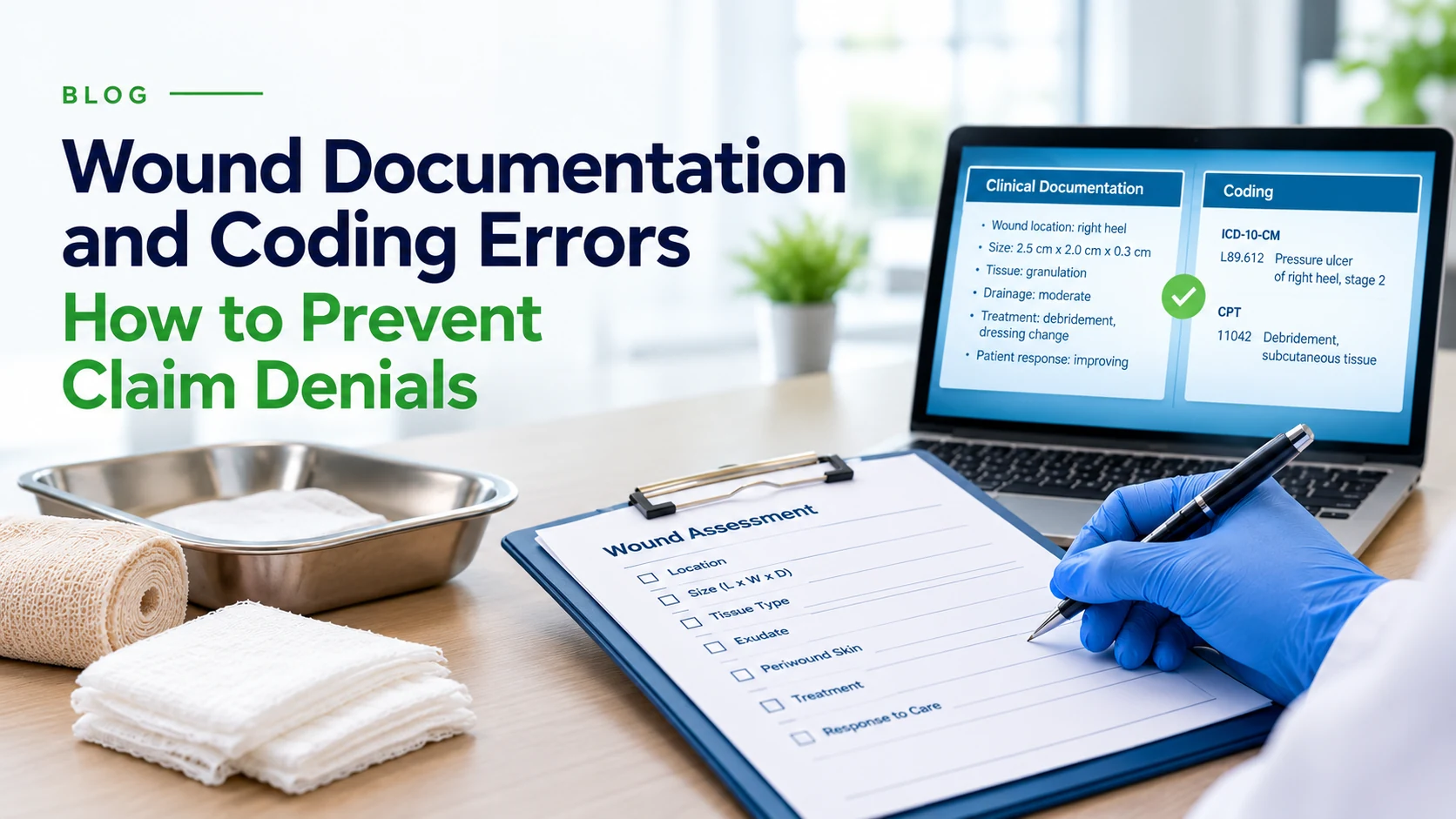
Key Takeaways
- Wound documentation and reported codes must describe the same clinical facts.
- Clinical changes should prompt review when they affect coding; improvement does not automatically mean a lower pressure injury stage.
- Debridement and negative pressure wound therapy require documentation that supports the specific service and code.
- Resolve missing or conflicting information through qualified review and appropriate provider clarification.
- Pre-submission checks should cover diagnosis, procedure, medical necessity, modifiers, and payer requirements.
Wound care documentation and medical coding must tell the same clinical story. The provider's notes describe the wound, its characteristics, the treatment performed, and the patient's response.
The codes submitted on the claim must accurately represent those documented facts and meet applicable billing requirements.
Problems arise when the wound assessment changes but the diagnosis code does not, when procedure documentation lacks details needed to support a CPT code, or when the selected code does not match the service performed.
These discrepancies can lead to coding corrections, requests for medical records, payment delays, or claim denials. For wound care clinics, home health providers, and medical billing teams, the challenge is not simply assigning a code.
It is ensuring that the code remains supported by the clinical record throughout the billing process.
What Is the Difference Between Wound Documentation and Wound Coding?
Wound documentation is the clinical record of a patient's wound, including its location, characteristics, severity, treatment, and response to care. Wound coding translates the documented diagnosis and services into the appropriate ICD-10-CM diagnosis codes and CPT or other applicable procedure codes.
The two must align, but they serve different purposes.
For example, a clinical note may describe a chronic ulcer at a particular anatomical site, document its measurements, and explain the treatment performed. The diagnosis code should reflect the documented wound category and required details.
Any procedure code should accurately describe the service performed and satisfy the applicable code requirements.
A mismatch can occur when a code is selected using an earlier assessment, when documentation is incomplete, or when the billed service is not adequately supported by the procedure note.
Accurate billing requires a review of the clinical documentation and the codes together, rather than checking whether a code is present on the claim alone.
Why Do Wound Documentation and Coding Stop Matching?
Wound documentation and coding can drift apart because wounds change over time, clinical notes may vary in detail, and diagnosis codes can be carried forward without sufficient review.
Common causes include:
- The wound's characteristics change, but the existing diagnosis code is not reviewed.
- The clinical note and coded diagnosis describe different wound sites or categories.
- Required details, such as laterality, stage, severity, or depth, are missing.
- The procedure note does not provide enough information to support the billed CPT code.
- A code is selected based on an assumption rather than documented clinical facts.
- Clinical documentation is updated, but the information used for billing is not reconciled with the latest assessment.
- Payer-specific documentation or coverage requirements are overlooked.
These issues can occur even when the original code was appropriate. The important question is whether the code being reported is supported by the documentation relevant to that claim and service.
How Can Changes in Wound Status Affect ICD-10-CM Coding?
Wounds can improve, deteriorate, develop complications, or change in their documented characteristics during treatment. When new information affects the diagnosis or coding requirements, the existing code may need to be reviewed.
For example, a note may document a change in wound dimensions, tissue characteristics, or the presence of a complication. If the existing coded diagnosis no longer accurately represents the documented condition, the discrepancy should be investigated before billing.
However, not every clinical change automatically requires a different diagnosis code. Coding decisions must follow the applicable ICD-10-CM guidelines and reflect the provider's documentation.
Pressure injuries require particular care because their staging rules differ from the severity classification used for non-pressure chronic ulcers. A healing pressure injury should not automatically be assigned a lower stage simply because it appears to be improving.
The appropriate code must follow the documented stage and applicable coding guidance.
When the record is incomplete or conflicting, coders should seek clarification when appropriate rather than independently infer a diagnosis, stage, or severity level.
What Wound Details Must Be Documented to Support Accurate Coding?
The documentation required depends on the wound type, service performed, and applicable coding and payer rules. Relevant details may include:
- Wound type: Pressure injury, non-pressure chronic ulcer, traumatic wound, postoperative wound, or another documented category.
- Location and laterality: The anatomical site and side of the body, when required.
- Stage or severity: The documented stage for pressure injuries or the applicable severity classification for non-pressure chronic ulcers.
- Measurements: Length, width, and depth when clinically relevant or required to support the service billed.
- Wound characteristics: Tissue appearance, drainage, undermining, tunneling, and other relevant findings.
- Clinical complications: Infection or other complications when diagnosed and supported by the record.
- Treatment provided: The specific intervention, procedure, or wound management service performed.
- Medical necessity: The clinical rationale for the service and continued treatment, when required.
- Patient response: Changes in wound condition and response to treatment where relevant.
A general description such as "wound improving" may communicate the clinician's impression, but it may not provide enough detail to support every diagnosis or procedure code.
The objective is not to make every note longer. It is to ensure that the required clinical facts are documented clearly and consistently.
How Can Missing Wound Measurements Lead to CPT Coding Errors?
Wound measurements can affect coding when the applicable procedure code depends on the surface area treated or debrided.
For example, certain selective debridement codes use surface-area thresholds. If the record contains only a vague description such as "small wound" or does not support the area reported, the billing team may not be able to validate the selected code.
Where required, the record should contain measurements and support the calculation used for coding. The coder should also confirm whether the code is based on the area of an individual wound, the applicable aggregate area, or another requirement in the current code descriptor and payer policy.
Measurements should never be estimated simply to justify a preferred code. If required information is missing, the appropriate response is to follow the practice's documentation clarification process.
How Can Incorrect Debridement Documentation Cause Billing Problems?
Debridement coding depends on the procedure actually performed and the requirements of the applicable CPT code. A note stating only that "tissue was removed" may not contain enough detail to determine which code is supported.
Depending on the procedure, the documentation may need to establish:
- The technique or type of debridement performed.
- The tissue removed and the relevant depth or level of the procedure.
- The wound or area treated.
- The extent of the service when required by the code.
- The clinical reason for performing the procedure.
- Other details required by the applicable code descriptor or payer policy.
Selective debridement, non-selective debridement, and surgical debridement are not interchangeable coding categories. The code must represent the service documented, not simply the diagnosis or the fact that a wound was treated.
Billing teams should review the procedure note against the selected code and applicable coding rules before claim submission.
What Documentation Is Needed for Negative Pressure Wound Therapy Billing?
Negative pressure wound therapy (NPWT) claims must be supported by documentation that meets the requirements of the service and code reported.
Depending on the code and payer, relevant details may include the wound's surface area, the treatment provided, the system used, and the clinical rationale for the therapy.
A note that simply says "wound vac applied" may not establish every detail needed to validate the claim.
Billing teams must also distinguish between NPWT codes based on wound surface area and codes applicable to disposable systems. For example, CPT 97605 and 97606 relate to non-disposable NPWT systems and use wound-area thresholds, while CPT 97607 and 97608 address disposable NPWT systems and have their own applicable requirements.
The current CPT descriptors, documentation, and payer policies should be checked before assigning the code. Device details should not be assumed from a generic reference to a wound vacuum.
How Should Coders Handle Missing or Conflicting Wound Documentation?
Coders should not fill documentation gaps by guessing. When relevant details are missing, contradictory, or insufficient to support a diagnosis or procedure code, the next step depends on the information available and the applicable coding rules.
A structured review can include:
- Checking the relevant clinical record for additional supporting information.
- Comparing the most recent assessment with the diagnosis being reported.
- Identifying the specific detail needed to validate the code.
- Requesting provider clarification when appropriate.
- Documenting the resolution through the practice's established process.
- Assigning a code that is supported by the record and applicable guidelines.
AI-assisted coding tools can help identify missing information or potential discrepancies, but their output should not be treated as proof that the documentation is complete. A system cannot reliably establish an undocumented clinical fact merely by generating a confident code.
Human review and appropriate provider clarification remain important when clinical details are unclear.
Can Correct Wound Documentation Still Result in a Denied Claim?
Yes. Complete clinical documentation does not guarantee payment if the wrong code is selected or other claim requirements are not met.
A claim may still face problems involving:
- Incorrect ICD-10-CM or CPT code selection.
- Inappropriate diagnosis-to-procedure linkage.
- Missing or incorrect modifiers.
- Applicable bundling or National Correct Coding Initiative edits.
- Insufficient evidence of medical necessity under the relevant coverage policy.
- Provider, setting, authorization, or payer-specific requirements.
- Inconsistent information across the claim and supporting records.
A correct code is only one part of a valid claim. Billing teams should evaluate the diagnosis, procedure, supporting documentation, and applicable payer requirements together.
How Can Medical Billing Teams Prevent Wound Documentation and Coding Errors?
Medical billing teams can reduce avoidable discrepancies by introducing a consistent review process that checks both clinical documentation and code accuracy.
A practical process includes:
- Review the current wound assessment: Confirm that the diagnosis reflects the documented wound category and relevant details.
- Validate diagnosis codes: Check site, laterality, stage, severity, and other applicable requirements.
- Match procedure notes to CPT codes: Verify that the documentation supports the service actually performed.
- Check measurements when required: Confirm that documented dimensions support applicable area-based coding.
- Review medical necessity: Ensure the record supports the service under the relevant coverage requirements.
- Resolve documentation gaps: Follow appropriate clarification procedures rather than inferring missing details.
- Check claim edits and payer policies: Review modifiers, bundling, coverage rules, and other applicable requirements.
- Monitor recurring issues: Analyze denials, coding corrections, and documentation requests to identify patterns.
The timing of the review matters. Practices should reconcile the relevant documentation and codes at appropriate reassessment and billing points, rather than relying solely on the diagnosis assigned at the beginning of an episode.
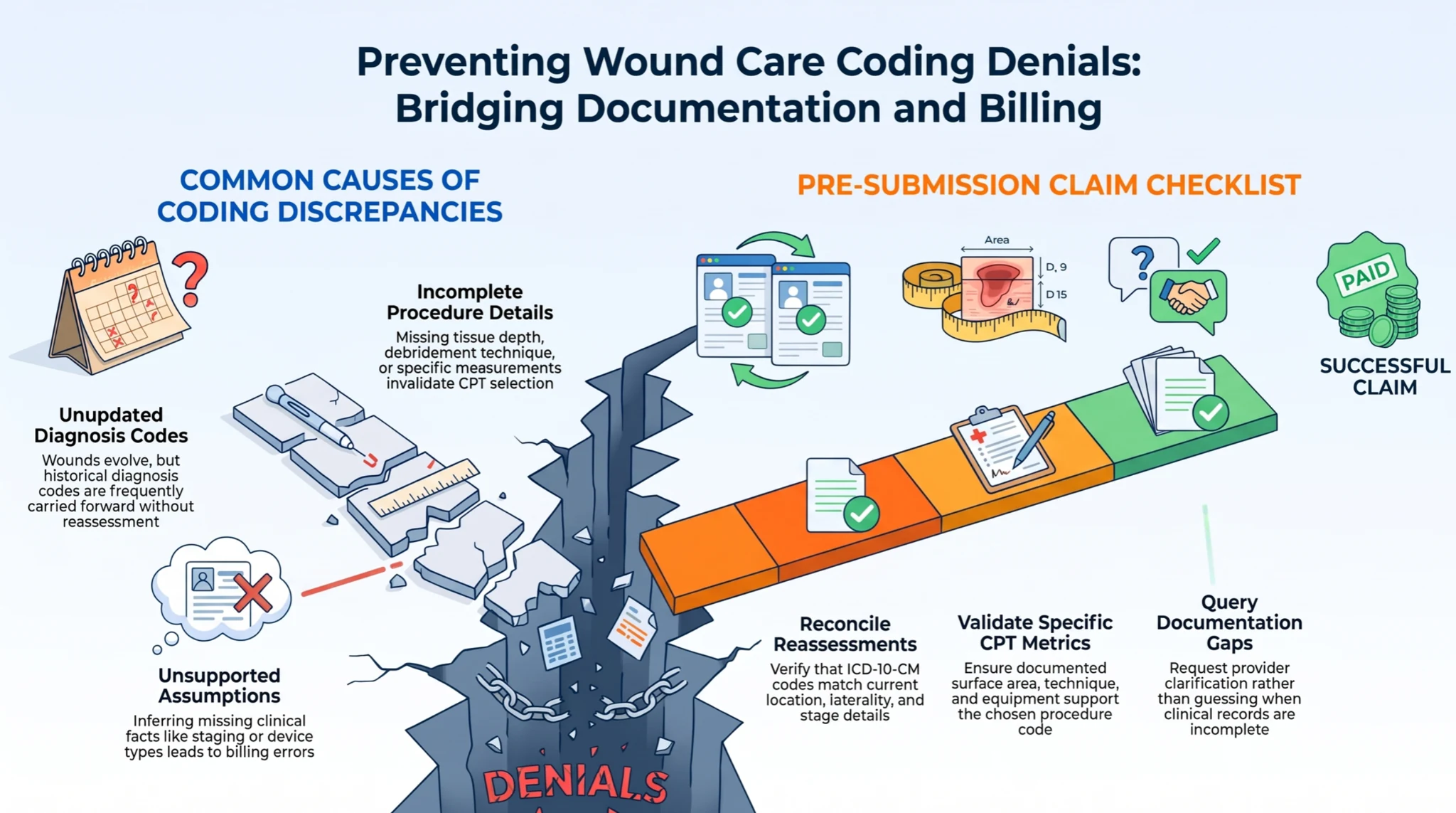
What Should Be Included in a Wound Care Claim Review Checklist?
A wound care claim checklist should confirm that the diagnosis, procedure, and supporting documentation agree before the claim is submitted.
Diagnosis review
- Does the ICD-10-CM code match the documented wound type?
- Are the required anatomical site and laterality details supported?
- Are stage or severity details documented where applicable?
- Is the code supported by the relevant clinical record?
Procedure review
- Does the CPT code represent the service actually performed?
- Are required wound measurements and procedure details present?
- Does the documentation support the reported debridement or NPWT service, where applicable?
- Have relevant coding edits and modifier requirements been checked?
Claim and coverage review
- Is the diagnosis appropriately linked to the procedure?
- Is medical necessity supported under the applicable payer policy?
- Have required provider clarification and documentation issues been resolved?
- Does the claim meet applicable payer and timely filing requirements?
The checklist should be adapted to the practice's services and payer mix. It is a quality-control tool, not a substitute for official coding guidelines or payer-specific requirements.
How Can Medical Billing Support Improve Wound Care Billing Accuracy?
Wound care billing involves several connected steps: reviewing clinical documentation, selecting appropriate diagnosis and procedure codes, validating medical necessity, submitting claims, and following up on denials and outstanding balances.
Medical billing support can help healthcare practices manage coding workflows, claims, denial follow-up, and revenue cycle processes.
A structured billing review can help identify discrepancies between the documentation and the codes reported, surface recurring issues, and direct incomplete records for appropriate clarification. Reviewing denial patterns can also help practices determine whether problems are linked to documentation, code selection, claim edits, or payer requirements.
The goal is to support accurate, well-documented claims and a more consistent billing process, not to guarantee reimbursement or claim approval.
Healthcare practices can evaluate their current workflow by reviewing common denial reasons, documentation requests, coding corrections, and unresolved receivables.
Final Thoughts
Wound documentation and coding accuracy depend on more than assigning the right code once. The clinical record and the billed diagnosis or procedure must remain consistent with the information that supports each claim.
By reviewing wound assessments, validating diagnosis and procedure codes, addressing incomplete documentation, and checking applicable payer requirements, practices can identify discrepancies earlier and manage billing issues more systematically.
Healthcare practices can strengthen accurate claim submission by reviewing their billing workflows, addressing recurring claim issues, and improving coordination between clinical and billing teams.
Coding resources and further reading
- CMS: ICD-10-CM codes and official coding guidelines.
- CMS Medicare Coverage Database: Billing and Coding, Debridement Services.
- CMS Medicare Coverage Database: Billing and Coding, Outpatient Physical and Occupational Therapy Services.
Coverage articles apply to the contractors, services, and settings they specify. Confirm the current requirements for your payer and care setting.
What Should I Document? 100 OASIS Situations Home Health Nurses Face Every Day
100 real OASIS scenarios, worked end to end — clinical situation, common mistake, better approach, and key takeaway. Built around OASIS-E2 (effective April 1, 2026) to turn what you assess into accurate, defensible documentation.
Inside Home Health Podcast
Home Health Is NOT “Easy” Anymore: The Hidden Complexity of Care at Home | Nurse Alice Benjamin

Arvind Sarin is the founder of Copper Digital. He works inside home health agencies to build AI documentation workflows that help clinicians finish OASIS and visit notes sooner, with a nurse reviewing and approving every note. He writes about home health documentation, Medicare compliance, and applying AI responsibly in clinical workflows.
Frequently asked
Frequently asked questions
One common mismatch occurs when the clinical record changes but the coded diagnosis is not reviewed accordingly. Other examples include a wound site that differs between the note and the claim, missing details needed for code specificity, or a procedure code that is not supported by the documented service.
Join the conversation
Leave a comment
No comments yet. Be the first to share your thoughts.
Related reading
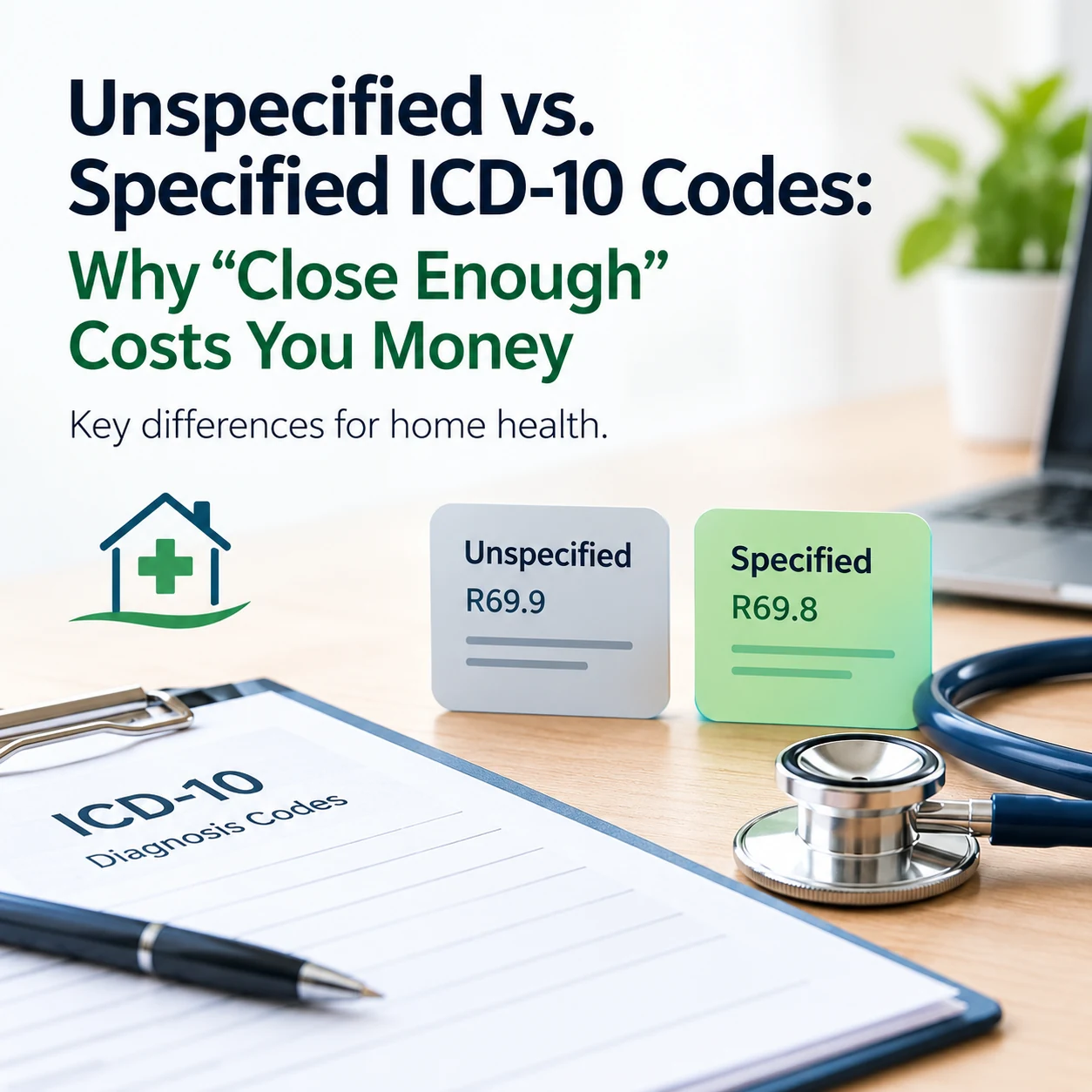
Unspecified vs. Specified ICD-10 Codes: Key Differences for Home Health
Learn when unspecified ICD-10-CM codes are appropriate, how documented specificity can affect PDGM classification, and how home health agencies can close avoidable coding gaps.

Why Is Home Health More Complex Than It Looks?
Nurse Alice Benjamin joins Arvind Sarin to explore the hidden clinical, operational, and caregiver demands of care at home, and how technology can support nurses without replacing clinical judgment.
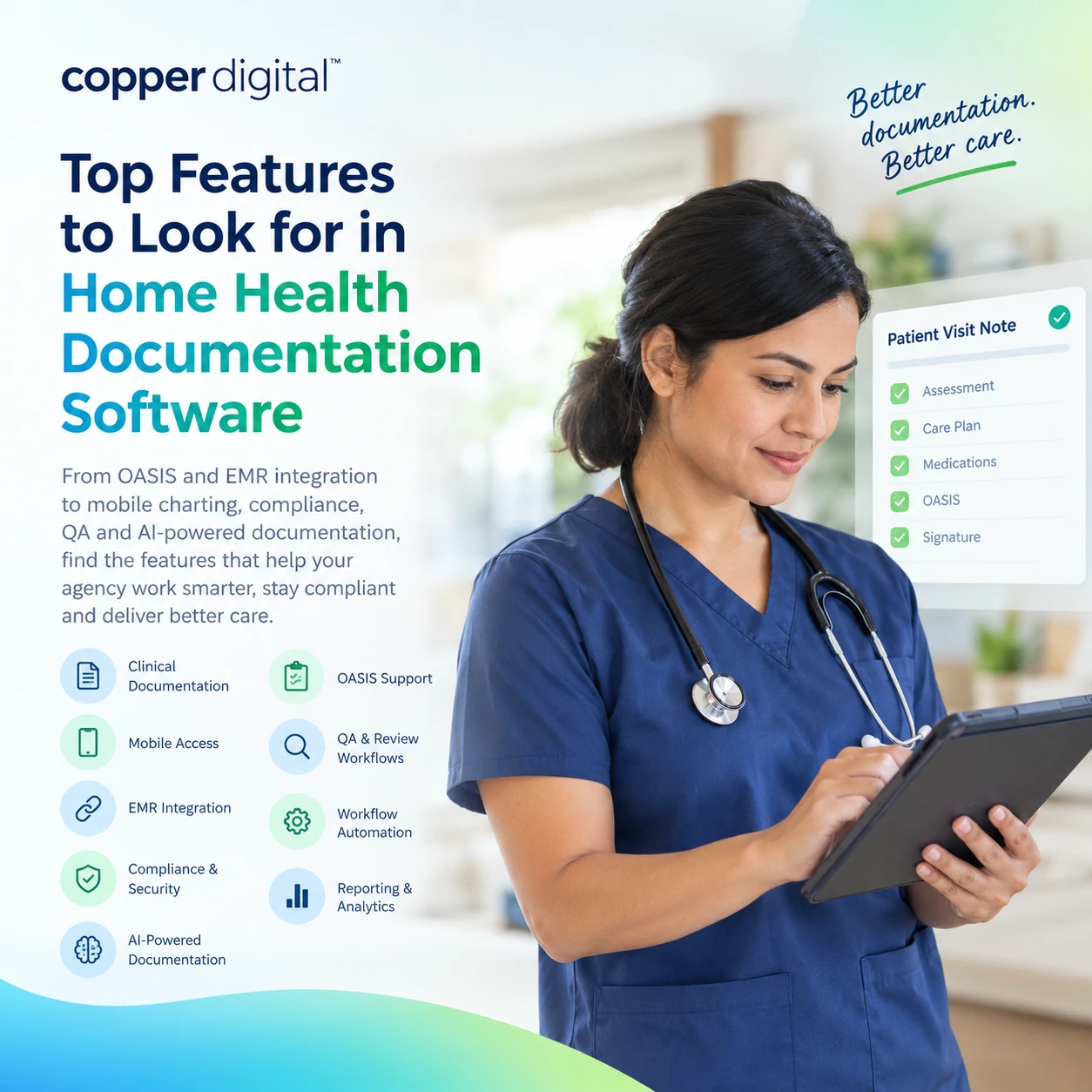
Top Features to Look for in Home Health Documentation Software
A practical guide to evaluating home health documentation software, including OASIS support, mobile charting, EMR integration, QA, security, workflow automation, and clinician-reviewed AI.