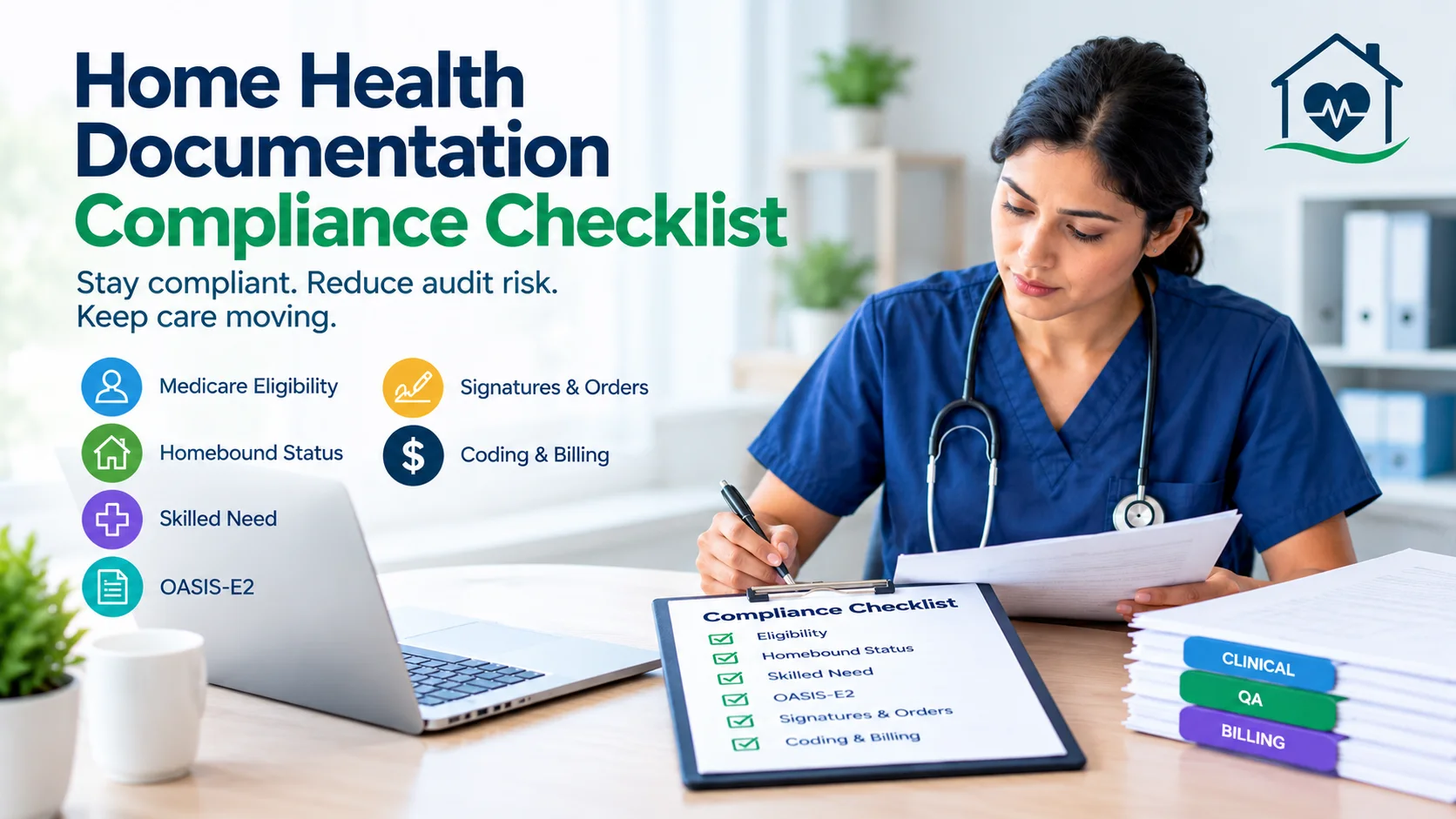
Home health documentation compliance is about more than completing every field in the electronic health record (EHR). The patient record must support why the patient qualifies for services, what care was ordered, what clinicians assessed and delivered, and whether the claim accurately reflects that care.
For home health agencies, gaps in documentation can create problems during internal quality reviews, Medicare medical reviews, audits, and billing. A missing signature, an unsupported homebound statement, an incomplete skilled-need narrative, or a mismatch between OASIS responses and visit notes can require additional work and may affect payment.
The Centers for Medicare & Medicaid Services (CMS) reported that insufficient documentation accounted for 51.4% of improper payments for home health services in the 2024 Medicare fee-for-service reporting period. Medical necessity accounted for another 33.7%. These figures reinforce the importance of maintaining records that support the services billed.
This home health documentation compliance checklist gives agency leaders, clinicians, quality assurance (QA) teams, and billing staff a practical way to review records throughout the episode of care and before claims are submitted.
Scope note: This checklist focuses primarily on Medicare-certified home health agencies. Requirements may differ by payer, state, service, and program. Use current CMS guidance, applicable regulations, payer policies, and agency procedures to determine what applies to each record.
What Should a Home Health Documentation Compliance Checklist Include?
A comprehensive home health documentation checklist should cover patient eligibility, the required face-to-face encounter, homebound status, skilled need, orders and plan of care, clinical assessments, OASIS documentation, visit notes, signatures, coding, and claim reconciliation.
Use the following checklist as a starting point for your agency’s internal review.
1. Patient Eligibility and Referral Documentation Checklist
Before reviewing individual visit notes, confirm that the record supports the patient’s eligibility for the services being provided.
- The documentation belongs to the correct patient.
- The referral identifies the reason for home health services.
- The relevant diagnoses and clinical history are available.
- The record supports the need for qualifying skilled services under the applicable coverage requirements.
- Documentation from the referring practitioner or facility supports the patient’s eligibility.
- Required certification and recertification documentation is present and properly authenticated.
- The information used to support eligibility is consistent across the relevant records.
- Missing or conflicting referral information has been resolved or appropriately escalated.
What to watch for: A referral diagnosis alone may not explain why skilled home health services are necessary. The record should contain sufficient clinical information to support the services requested and the patient’s eligibility.
CMS explains that documentation from the certifying practitioner or relevant facility must support eligibility. Home health agency documentation may also contribute when the applicable incorporation and authentication requirements are met.
2. Homebound Status Documentation Checklist
For Medicare home health coverage, the record must support the applicable homebound criteria. Simply writing “patient is homebound” does not explain the clinical circumstances supporting that conclusion.
Review the following:
- Documentation describes the patient’s relevant functional limitations or medical condition.
- The record identifies applicable assistance, mobility-device, transportation, or medical restrictions related to leaving home.
- The documentation supports the applicable criteria concerning the patient’s normal inability to leave home and the considerable and taxing effort required to leave.
- Clinical details are specific to the patient rather than generic statements copied from a template.
- Relevant changes in mobility, endurance, cognition, or functional status are documented when assessed.
- The supporting clinical record is consistent with the eligibility determination.
- The documentation reflects the patient’s actual condition rather than assuming homebound status based solely on age, diagnosis, or residence.
Example of a stronger narrative:
Instead of writing, “Patient is homebound due to weakness,” document the actual assessed limitations, assistance required, relevant mobility findings, and the clinical circumstances that support the applicable homebound criteria.
The example is illustrative, not a substitute for documenting the individual patient’s actual findings.
3. Face-to-Face Encounter Documentation Checklist
When a face-to-face encounter is required, verify that the documentation meets the applicable timing, provider, authentication, and clinical-support requirements.
- The required face-to-face encounter documentation is present.
- The encounter was performed by an eligible provider under the applicable rules.
- The encounter date is documented.
- The timing meets the applicable Medicare requirement.
- The documentation relates to the primary reason for home health services.
- The record supports the patient’s need for qualifying skilled services and homebound status, as applicable.
- Required signatures, dates, and authentication are present.
- The encounter documentation is consistent with the referral and other supporting medical records.
Common risk: A form may be present without sufficient clinical detail to support eligibility. Check the content of the record, not just whether a document has been uploaded.
For the governing requirements, refer to 42 CFR § 424.22 and current CMS guidance.
4. Plan of Care and Physician or Practitioner Orders Checklist
The plan of care should reflect the patient’s assessed needs and specify the services required to address them.
- The plan of care identifies the applicable diagnoses and patient-specific needs.
- Required services and responsible disciplines are identified.
- Visit frequency and duration are documented as required.
- The plan includes applicable treatment goals and other required clinical information.
- Required orders and authorizations are present.
- Required signatures and dates are complete.
- The plan of care is reviewed and updated when required.
- Changes in condition and treatment needs are reflected in the relevant orders and documentation.
- The services delivered are consistent with the authorized plan of care or appropriately supported by applicable orders.
- Discrepancies between the plan, orders, visit notes, and billed services are resolved.
What to watch for: A well-written visit note does not, by itself, establish that the service was properly ordered or authorized. Review the plan, applicable orders, and clinical record together.
CMS’s home health services guidance outlines relevant plan-of-care and supporting-documentation requirements.
5. Skilled Need and Medical Necessity Documentation Checklist
Clinical documentation should explain why the service was needed, what the clinician did, and how the patient responded.
For each applicable visit, review whether the note:
- Identifies the relevant assessment findings.
- Explains the skilled service or intervention provided.
- Connects the intervention to the patient’s condition and care goals.
- Documents the patient’s response to the intervention.
- Records relevant progress, lack of progress, or changes in condition.
- Identifies the need for continued skilled intervention when applicable.
- Includes patient-specific details rather than generic statements.
- Supports the service billed and aligns with the applicable plan of care.
- Documents relevant education, instructions, or care coordination.
- Identifies follow-up needs or changes that require communication with the care team.
A practical test: Can a reviewer understand what the clinician assessed, why skilled care was needed, what was done, and what happened as a result?
If the note only says “treatment completed” or “patient tolerated well,” it may not adequately describe the skilled work performed. The note should contain the relevant clinical details required for that service.
6. Visit Note and Clinical Narrative Checklist
A compliant visit note should accurately represent the encounter and support continuity of care.
- The note identifies the correct patient, date, and visit.
- The documented service matches the care actually delivered.
- Relevant assessment findings are included.
- Interventions are described clearly.
- The patient’s response is documented.
- Changes in condition are recorded and communicated as appropriate.
- Relevant patient or caregiver education is documented.
- The next steps or follow-up plan are clear when applicable.
- The narrative is consistent with structured EHR fields.
- The note is patient-specific and does not contain unexplained copied text.
- The note is completed and authenticated according to applicable requirements and agency policy.
- Late entries and corrections follow the organization’s documentation procedures and applicable requirements.
What to watch for: Repeated wording is not automatically evidence of noncompliance, but copied-forward content that conflicts with the patient’s current condition can undermine the credibility of the record.
7. OASIS-E2 Documentation Compliance Checklist
OASIS documentation should accurately represent the patient’s status at the applicable assessment time point and be consistent with the supporting clinical record.
OASIS-E2 became effective April 1, 2026. Agencies should use the current CMS assessment instruments, manual, and related guidance applicable to the assessment being completed.
During review, check that:
- The correct assessment type and applicable OASIS version are used.
- Assessment responses reflect the patient’s actual status at the relevant time point.
- Responses are supported by the clinician’s findings and available clinical information.
- Functional and other assessment items are completed according to applicable instructions.
- Relevant narratives are consistent with the structured assessment responses.
- Conflicting or unclear information is reviewed and resolved appropriately.
- Required assessment time points and submission processes are followed.
- Corrections and updates follow applicable procedures.
- The assessment is completed and authenticated as required.
- Coding and payment-related information derived from the record is supported by the clinical documentation.
Important: An automated edit check or completed field does not prove that an answer is clinically accurate. Assessment responses must reflect the patient’s condition and the applicable OASIS instructions.
Refer to the CMS OASIS User Manuals for the current manual and assessment guidance.
8. Signatures, Dates, and Authentication Checklist
Missing or incomplete authentication can create avoidable documentation problems.
- Required clinician signatures are present.
- Required practitioner or physician signatures are present where applicable.
- Dates of signatures and relevant documentation are recorded.
- Required orders and plan-of-care approvals are authenticated.
- Entries can be attributed to the appropriate individual.
- Corrections, amendments, and late entries are identifiable and follow applicable procedures.
- Documentation does not contain unexplained alterations.
- Required records are accessible for internal review and external requests.
Do not assume that every document has the same signature or timing requirements. Confirm the requirements that apply to the particular record, service, payer, and situation.
9. Diagnosis Coding and Billing Documentation Checklist
Before a claim is released, confirm that the billed services and coding are supported by the clinical record.
- Diagnoses are supported by available documentation.
- Applicable diagnosis codes are accurate and current.
- Diagnosis sequencing follows the applicable coding and billing requirements.
- OASIS responses and relevant clinical findings are consistent with the record.
- The principal diagnosis and other payment-related data are supported as applicable.
- Services and visit dates match the documentation.
- Billed disciplines and services align with the applicable orders and plan of care.
- Required certifications and supporting records are available.
- Any required visit-verification records are reconciled with the applicable documentation and billing data.
- Unresolved discrepancies are addressed before claim submission.
Coding should reflect the supported clinical facts and applicable coding rules. Do not select or change a diagnosis solely to achieve a desired reimbursement outcome.
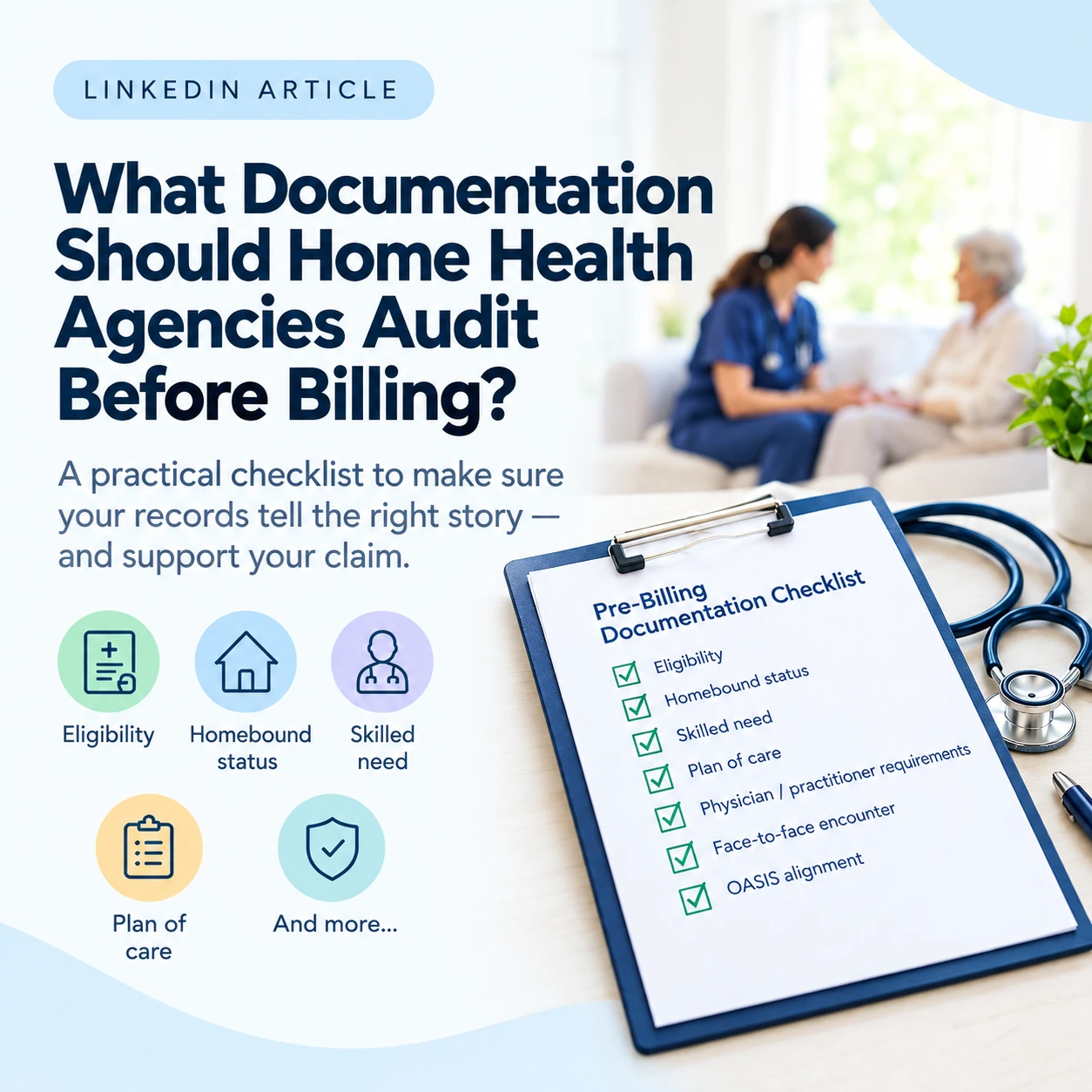
10. Pre-Billing Home Health Documentation Audit Checklist
A pre-billing audit brings the relevant parts of the record together. Instead of reviewing every document in isolation, confirm that the full episode tells a consistent story.
Before releasing the claim, ask:
- Does the record support patient eligibility for the billed services?
- Is the required face-to-face documentation present and sufficient?
- Does the record support homebound status where applicable?
- Are skilled need and medical necessity adequately documented?
- Are the plan of care and relevant orders complete and consistent?
- Do visit notes support the services delivered?
- Is the OASIS assessment accurate and consistent with the supporting record?
- Are diagnoses and codes supported?
- Are required signatures and dates complete?
- Do service dates, disciplines, and billed services match the record?
- Are unresolved discrepancies, missing records, or documentation queries addressed?
- Is the complete supporting documentation available if requested by a reviewer?
A pre-billing audit should not be treated as a guarantee of payment. It is a quality-control step intended to identify and resolve issues before submission.
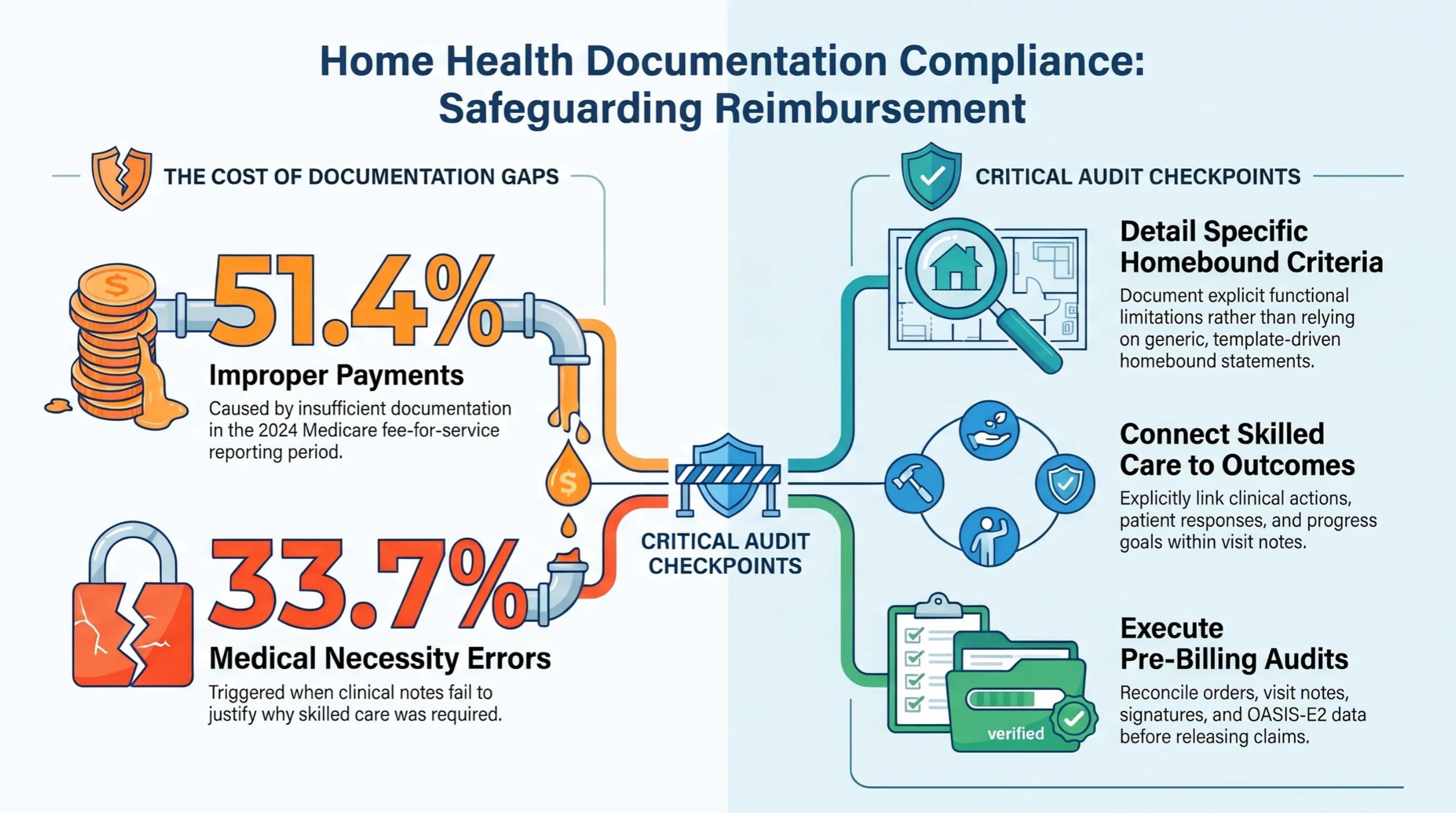
The 51.4% and 33.7% figures refer to categories of home health improper payments in the 2024 Medicare fee-for-service reporting period, not percentages of all home health claims. A checklist or pre-billing review does not guarantee payment.
How Can Home Health Agencies Make Documentation Compliance More Consistent?
A checklist is useful, but consistency depends on how the agency uses it. If the checklist is reviewed only when a claim is about to be submitted, missing information may already have triggered multiple rounds of correction.
A stronger process combines point-of-care documentation, routine QA, clear escalation paths, and periodic audits.
Standardize the documentation workflow
Use clear templates and expectations for visit notes, assessments, and required records. Templates should guide documentation without encouraging clinicians to enter findings they did not assess.
Review records throughout the episode
Do not wait until billing to identify missing signatures, conflicting information, or incomplete clinical narratives. Build review checkpoints into the agency’s workflow.
Track recurring documentation issues
Monitor patterns such as frequently missing orders, incomplete skilled-need narratives, repeated OASIS inconsistencies, and late documentation. Repeated errors may indicate a training, template, or workflow problem that needs to be addressed.
Use AI as a support layer
AI-enabled documentation and QA tools may help draft notes, identify potential gaps, and flag inconsistencies for human review. Their value depends on the capabilities of the particular tool and how well it fits the agency’s workflow.
AI-generated content should be checked against the source information. It should not independently invent clinical findings, decide eligibility, or replace required professional review and authentication.
Measure the process
Useful measures include documentation correction rates, time from visit completion to finalization, missing-document frequency, QA turnaround time, and the proportion of records requiring additional review. These measures help agencies identify where their compliance process needs improvement.
Final Takeaway
A strong home health documentation compliance process does not stop at completing forms. It ensures that eligibility, clinical findings, skilled services, orders, assessments, and billed services are supported by a consistent and reviewable record.
Use this checklist as a starting point for your agency’s internal QA process. Adapt it to the applicable payer and program requirements, keep it aligned with current CMS guidance, and use recurring audit findings to improve documentation workflows.
The objective is simple: identify gaps earlier, reduce avoidable corrections, and make sure the record accurately reflects the care delivered.
Sources and Related Reading
- CMS: Home Health Services, Medicare Compliance Tips.
- CMS: OASIS User Manuals.
- 42 CFR § 424.22: Requirements for Home Health Services.
- CGS Medicare: Home Health Documentation Checklist Tool (revised August 2019). Check current requirements before relying on this older review aid.
- Medbridge: Home Health Audits, What Agencies Need to Know.
- What Documentation Should Home Health Agencies Audit Before Billing?.
- OASIS Documentation Compliance Tips for Home Health Agencies.