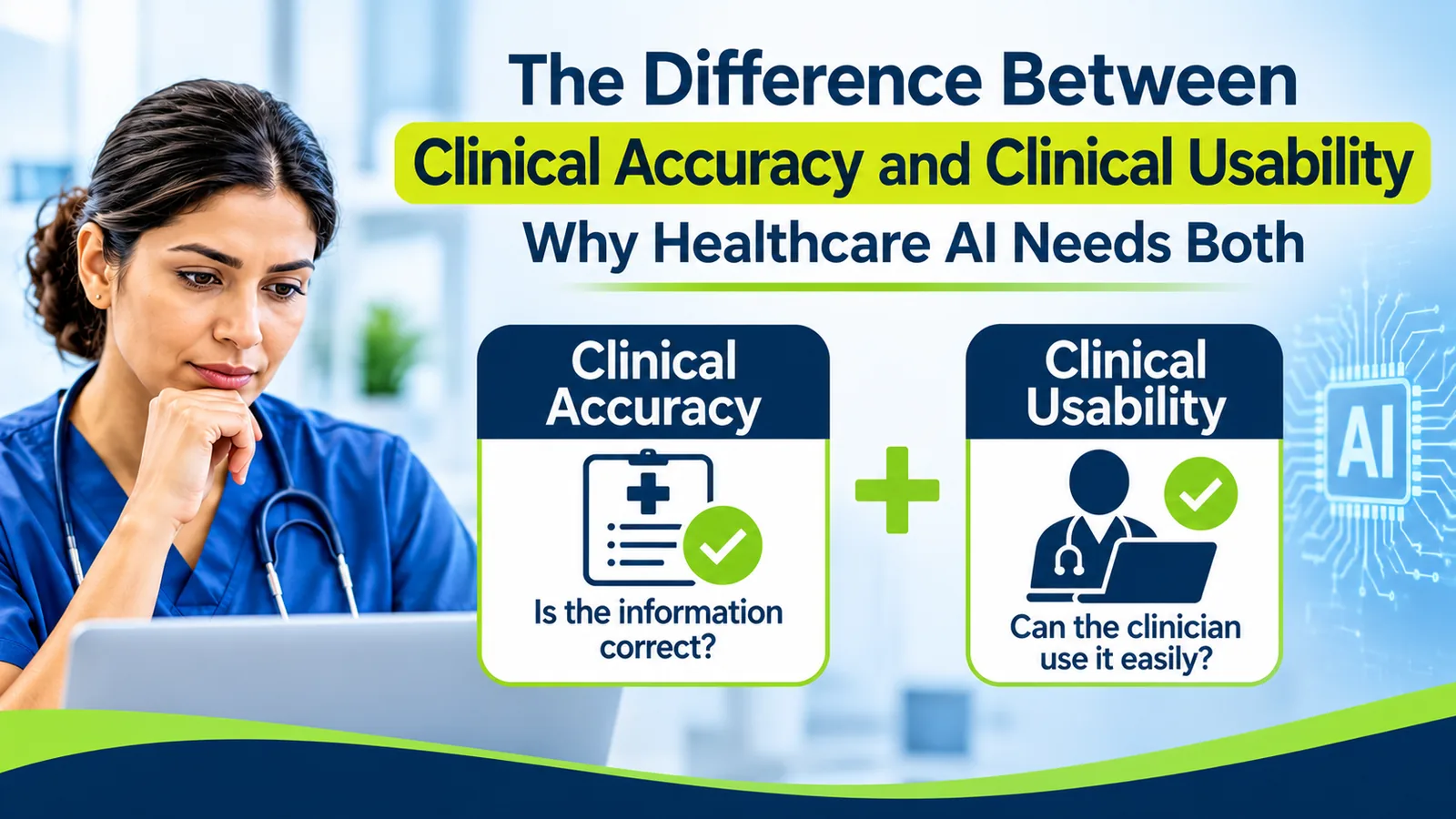
An AI tool can give a clinically accurate answer and still be difficult for a nurse to use.
It might identify the right information, summarize a patient's condition correctly, or generate a technically sound clinical note. But if the nurse has to spend another 15 minutes correcting the format, searching for missing details, or moving information between systems, has the technology really made the job easier?
This is an important distinction healthcare organizations need to understand as they adopt AI.
Clinical accuracy and clinical usability are not the same thing.
Accuracy tells us whether the information is correct. Usability tells us whether that information can be understood, applied, and used effectively in a real clinical workflow.
Healthcare AI needs both. One without the other can create problems for clinicians, patients, and the organizations relying on it.
What Is Clinical Accuracy in Healthcare AI?
Clinical accuracy refers to how correctly a system represents, interprets, or processes clinical information.
For an AI tool, this can mean whether it:
- Correctly interprets clinical terminology.
- Captures the information provided by a clinician.
- Produces documentation consistent with the source information.
- Avoids introducing unsupported clinical details.
- Identifies relevant information without omitting important context.
- Provides outputs that align with applicable clinical and documentation requirements.
Consider a home health nurse describing a patient's visit.
The nurse explains that the patient has difficulty walking, uses a walker, and requires assistance when moving around the home.
An AI documentation tool converts that narrative into a structured clinical summary.
If the summary accurately reflects what the nurse observed and reported, the system has performed well from an accuracy standpoint.
But accuracy is only the first question.
Can the nurse easily review that summary? Is the information organized in a way that supports the documentation workflow? Can the nurse identify and correct anything that needs attention?
That is where clinical usability comes in.
What Is Clinical Usability in Healthcare?
Clinical usability describes how effectively healthcare professionals can use a tool, its information, and its outputs to complete their work.
A clinically usable system should fit the realities of the clinical environment rather than forcing clinicians to adapt their work around the technology.
It should help users understand what they are seeing, find what they need, and take the appropriate next step without unnecessary effort.
In practice, clinical usability involves:
- Clear and understandable information.
- Logical organization of clinical content.
- Easy navigation and interaction.
- Compatibility with existing workflows.
- Minimal unnecessary data entry.
- Relevant information presented at the right time.
- Clear opportunities for review and correction.
- Accessibility for the people expected to use the system.
For home health clinicians, usability matters because their work does not happen entirely behind a desk.
They document visits in patients' homes, coordinate with other care professionals, review clinical records, and manage multiple responsibilities throughout the day.
A tool that works well in a controlled demonstration may not work as well in those real-world conditions.
What Is the Difference Between Clinical Accuracy and Clinical Usability?
The simplest way to understand the distinction is to look at the questions each one answers.
| Clinical accuracy | Clinical usability |
|---|---|
| Is the information correct? | Can the clinician use the information effectively? |
| Does the output reflect the source documentation? | Is the output organized and understandable? |
| Are relevant clinical details captured? | Can the clinician find those details easily? |
| Does the system avoid unsupported information? | Can the clinician review and correct the output efficiently? |
| Does the output meet the required level of correctness? | Does the tool fit into the actual workflow? |
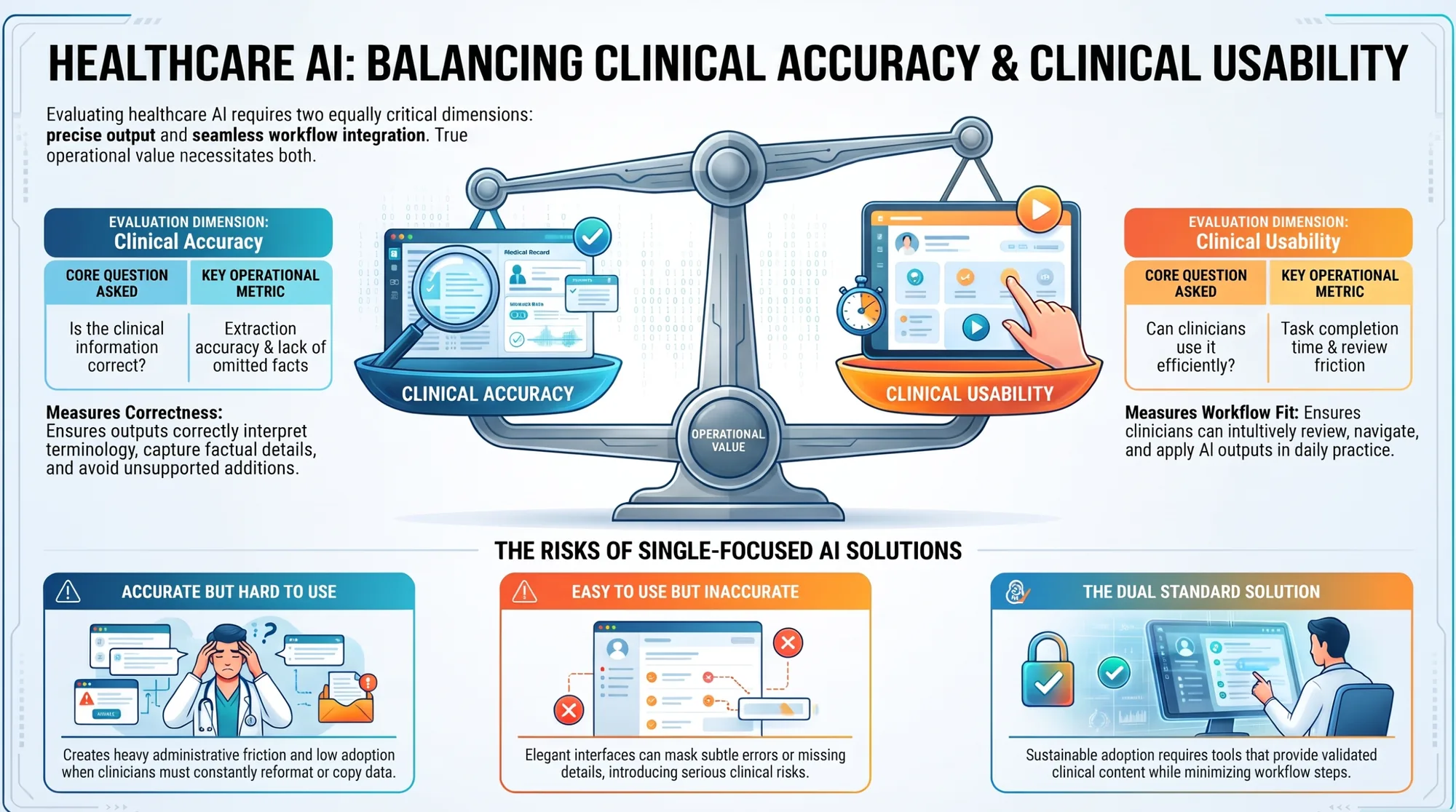
Accuracy determines whether AI output can be trusted. Usability determines whether clinicians can work with it. Sustainable adoption requires both.
Think of it this way:
A system may generate a clinically accurate 10-page summary. But if the nurse needs only a few relevant details to complete the next step and has to search through all 10 pages, the output may be accurate without being particularly usable.
Similarly, a system may have a clean interface and simple navigation, but if it frequently misinterprets clinical information, it is not safe or useful.
Accuracy determines whether the information can be trusted. Usability determines whether people can work with it effectively.
Can an AI Tool Be Clinically Accurate but Difficult to Use?
Yes. This is one of the most overlooked problems in healthcare technology adoption.
Imagine an AI tool that produces accurate clinical documentation but requires nurses to:
- Re-enter information already available in the patient's record.
- Navigate multiple screens to complete one task.
- Manually reorganize generated content.
- Correct formatting before submitting documentation.
- Switch between the AI tool and the agency's existing EMR.
- Spend additional time checking information that should have been presented clearly.
The clinical information may be correct, but the workflow remains inefficient.
In this situation, the organization has improved one part of the process without necessarily improving the clinician's experience.
This matters because technology is supposed to support clinical work, not create another layer of work around it.
Can an AI Tool Be Easy to Use but Clinically Inaccurate?
Absolutely.
A tool may have an attractive interface, simple prompts, and fast responses. It may feel intuitive from the first interaction.
But ease of use does not guarantee clinical reliability.
For example, an AI documentation tool might turn a nurse's brief description into a polished clinical paragraph. The paragraph reads well, but it includes an assessment finding the nurse never reported.
Or it might summarize a patient's condition but leave out an important detail that changes the meaning of the documentation.
The output may look professional enough that a busy clinician overlooks the error.
This is why healthcare organizations should never evaluate AI based on appearance or convenience alone.
Clinical content must be checked against the source information, and clinicians must retain appropriate responsibility for reviewing and approving documentation.
Why Do Healthcare Organizations Need Both Clinical Accuracy and Clinical Usability?
Healthcare technology is often evaluated through separate lenses.
Technical teams may focus on performance, integration, and reliability. Clinical teams may focus on whether the information is correct. Operations teams may focus on time savings and productivity.
All of these perspectives matter, but they need to come together.
A tool that is accurate but difficult to use may see low adoption. A tool that is easy to use but unreliable may introduce clinical and documentation risks.
When both dimensions are considered, organizations are better positioned to evaluate whether a solution actually supports the work it was introduced to improve.
This is especially important for AI because its output can look polished and complete even when it contains errors or requires significant human correction.
How Does the Difference Affect Home Health Documentation?
Home health is a useful example because clinicians work across multiple environments and manage extensive documentation responsibilities.
A nurse may need to document:
- Patient observations and assessment findings.
- Functional abilities and limitations.
- Medication-related information.
- Patient and caregiver education.
- Changes in the patient's condition.
- Interventions and responses to care.
- Coordination and follow-up activities.
An AI tool may accurately convert a spoken narrative into written documentation. But its value depends on what happens next.
Can the nurse review the summary without navigating unnecessary screens? Are the details organized in a familiar structure? Can the nurse correct an error easily? Does the system preserve the clinician's intended meaning?
If the nurse spends more time reviewing and restructuring the output than completing the original documentation, the technology may not be delivering the expected benefit.
The goal should be to reduce administrative effort while preserving the quality and integrity of clinical documentation.
How Can Healthcare Leaders Evaluate Clinical Usability Before Adopting AI?
A vendor demonstration is a starting point, not proof that a solution will work in everyday clinical practice.
Healthcare leaders should evaluate AI tools using real workflows and feedback from the people who will use them.
Here are some practical questions to ask.
Does the AI Tool Fit Into Existing Clinical Workflows?
Does it support the way clinicians already complete their work, or does it require them to learn an entirely separate process?
For home health agencies, this includes considering how the tool interacts with existing documentation systems, assessment processes, and administrative workflows.
Can Clinicians Understand and Review AI-Generated Information?
The output should be clear enough for a clinician to review without having to interpret what the AI intended to say.
Users should be able to identify the source information, recognize generated content, and make corrections when necessary.
Does the Tool Reduce Work or Simply Move It Somewhere Else?
A system may reduce typing but create more time-consuming review and correction.
Leaders should measure the entire workflow, including the time spent entering information, reviewing output, correcting errors, and completing the final task.
Can Frontline Clinicians Test the Tool Before Deployment?
Nurses and other end users should be involved in testing.
They can identify workflow issues that may not be obvious to executives, IT teams, or vendors during a presentation.
Testing should include realistic cases, different user experience levels, and situations where the AI output needs correction.
Does the Tool Make Human Oversight Practical?
Human review should be a meaningful part of the workflow, not an additional administrative burden.
Clinicians should have clear opportunities to verify information, correct errors, and approve the final documentation.
How Should Healthcare Organizations Measure Clinical Accuracy and Usability?
Organizations should avoid relying on a single performance metric.
A tool may achieve a high accuracy score in testing while still creating friction in everyday use. Similarly, positive user feedback does not prove that clinical outputs are reliable.
Both dimensions need to be measured.
Clinical accuracy can be evaluated through:
- Correctness of extracted clinical information.
- Completeness of relevant documentation.
- Frequency of unsupported or fabricated details.
- Consistency with source records.
- Error rates identified during clinical review.
- Compliance with applicable documentation requirements.
Clinical usability can be evaluated through:
- Time required to complete a workflow.
- Number of manual corrections.
- Ease of navigation and review.
- Number of additional steps or system switches.
- User satisfaction and adoption.
- Frequency of workarounds.
- Amount of time spent fixing AI-generated output.
The most useful evaluation combines these measures.
For example, an agency could compare the time required to complete a documentation task before and after introducing AI, while also measuring the number and type of corrections clinicians make.
That provides a more complete picture than simply reporting how quickly the AI generates a note.
How Can Healthcare AI Be Designed Around Clinicians Rather Than Just Technology?
The most successful healthcare AI solutions start with the people and processes they are meant to support.
Instead of asking only what the technology can do, organizations should ask what clinicians actually need.
That means:
- Involving clinicians during product design and evaluation.
- Understanding the challenges of real clinical workflows.
- Presenting information in a familiar and useful format.
- Reducing repetitive tasks rather than adding new ones.
- Making errors easy to identify and correct.
- Preserving clinician control over clinical decisions and final documentation.
- Continuously collecting feedback after deployment.
It also means accepting that usability is not a one-time design decision.
As workflows change and AI capabilities evolve, organizations need to keep evaluating whether the tool remains useful to the people relying on it.
What Should Healthcare Leaders Remember About Clinical Accuracy and Clinical Usability?
Clinical accuracy and clinical usability should never be treated as competing priorities.
An accurate tool that clinicians struggle to use may fail to deliver its intended operational value. An easy-to-use tool that produces unreliable information may create risks that outweigh its convenience.
Healthcare organizations need solutions that do both.
For home health agencies, that means evaluating AI not just by how quickly it generates documentation, but by whether the output is reliable, understandable, easy to review, and aligned with the way clinicians actually work.
At Copper Digital, we believe AI should support the people delivering care, not give them another system to manage.
That is why the conversation should go beyond what AI can generate. It should focus on what clinicians can confidently use.
Because the best healthcare technology isn't simply technology that gets the answer right. It's technology that helps the right people use that answer in the right way.