
HIPAA in Home Health & Hospice: Understanding the Basics & Privacy Rules
Understand how HIPAA applies when home health and hospice teams work in patients' homes, travel with devices, communicate with families, and rely on outside vendors.
Key Takeaways
- HIPAA applies to organizations that meet the definitions of a covered entity or business associate, not automatically to everyone working in healthcare.
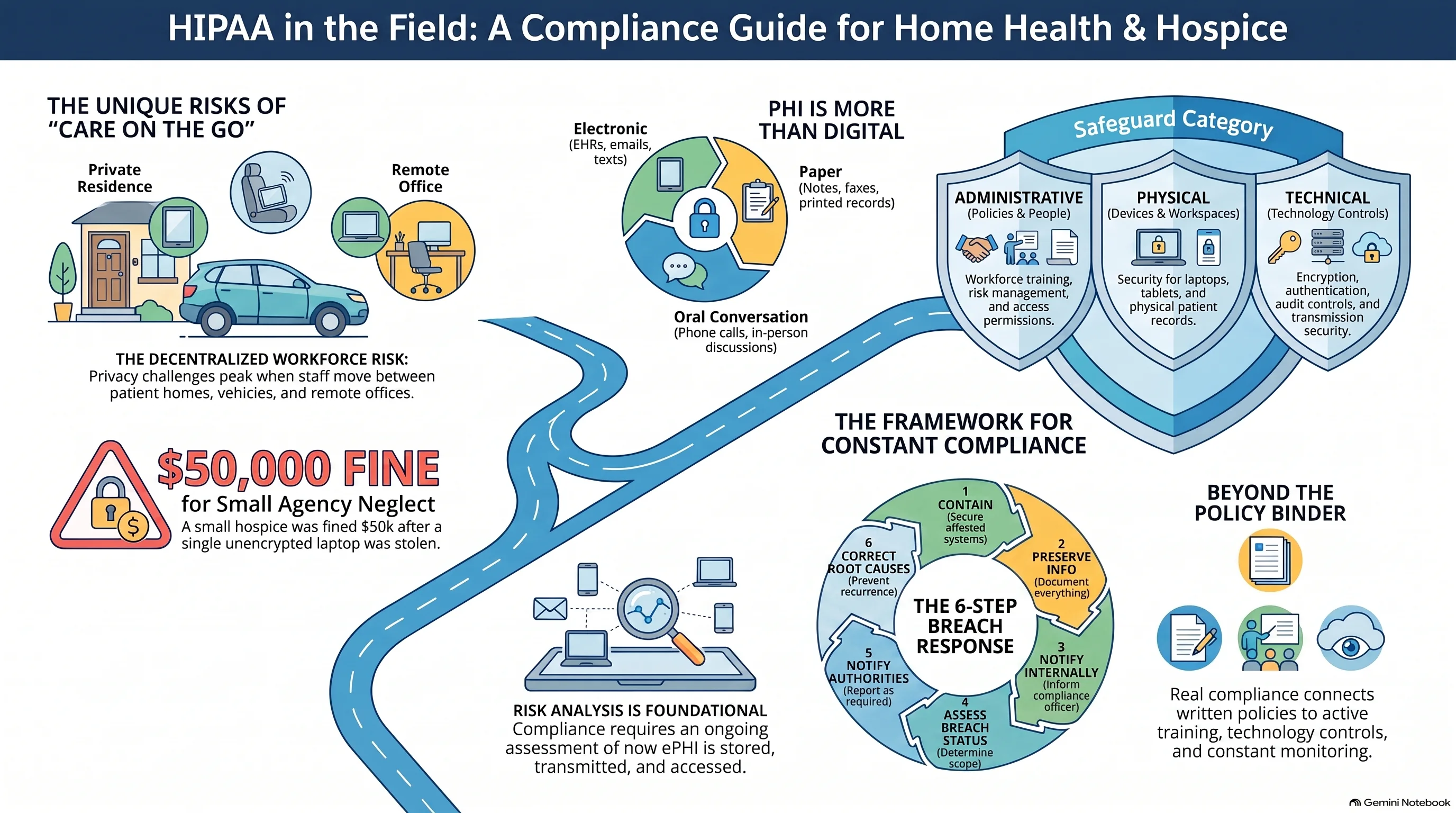
- Protected health information can be electronic, paper, or oral; it is not limited to the electronic health record.
- The minimum necessary standard is context-specific and does not apply to disclosures to or requests by healthcare providers for treatment.
- Family relationships alone do not create unrestricted access to a patient's information; the patient's preferences and the person's involvement in care matter.
- Mobile devices and cloud services may be used with ePHI when appropriate safeguards, risk management, and applicable business associate agreements are in place.
- Risk analysis is foundational and ongoing, while potential breaches require prompt containment, assessment, documentation, and any required notifications.
ℹ️ Important: This guide is educational and does not replace legal advice or a fact-specific compliance review. HIPAA obligations can depend on the entity, relationship, information, purpose, and applicable federal and state law.
How can a home health or hospice agency comply with HIPAA without drowning in legal jargon or treating every conversation as prohibited? More importantly, what practical steps protect patient privacy when care happens in homes, vehicles, mobile devices, and remote systems?
HIPAA compliance can feel especially complex for a mobile workforce. A misplaced tablet, misdirected email, unlocked workstation, overheard conversation, or unauthorized login can expose protected health information (PHI).
Compliance is not only about avoiding penalties. It protects the privacy, dignity, and trust of patients and families who depend on the agency.
What Is HIPAA, and Why Is Home-Based Care Different?
The Health Insurance Portability and Accountability Act (HIPAA) and its implementing rules establish privacy, security, and breach-notification requirements for certain health information.
HIPAA does not automatically apply to every person or organization working in healthcare. HHS explains that the rules apply to covered entities and business associates that meet the applicable definitions. A healthcare provider is a covered entity when it transmits health information electronically in connection with a HIPAA-covered transaction.
For home health and hospice agencies that are covered entities, HIPAA affects how PHI is accessed, used, disclosed, stored, transmitted, and protected. Their staff may:
- Visit patients in private residences.
- Carry laptops, tablets, and smartphones between visits.
- Access electronic records remotely.
- Coordinate care from vehicles or other locations.
- Communicate with physicians, families, and caregivers.
- Use outside technology and service vendors.
Every workflow can create privacy or security considerations. The compliance program must therefore follow the workforce into the field rather than remain in an office binder.
HIPAA Enforcement Can Affect Small Agencies Too
HIPAA enforcement is not limited to large hospital systems. In a well-known case, Hospice of North Idaho agreed to pay HHS $50,000 to settle potential Security Rule violations after reporting the theft of an unencrypted laptop containing ePHI for 441 people.
The HHS resolution agreement identified broader security-management issues, including an inadequate risk analysis and insufficient safeguards for portable devices. The lesson is not merely that a laptop was stolen; it is that organizations must identify and manage risks created by mobile technology.
What Is the HIPAA Privacy Rule?
The HIPAA Privacy Rule sets standards for covered entities' uses and disclosures of PHI and gives individuals rights concerning their information.
The rule permits certain uses and disclosures without a separate written authorization, including many uses and disclosures for treatment, payment, and healthcare operations. It also permits or requires other disclosures in specified circumstances, including some disclosures required by law.
✓ Not every disclosure requires a signed authorization. Staff should understand why information is being shared, who will receive it, what HIPAA provision applies, and whether another federal or state requirement changes the answer.
What Counts as PHI in Home Health and Hospice?
PHI generally includes individually identifiable health information created, received, maintained, or transmitted by a covered entity or business associate. In home-based care, it may include:
- Names, addresses, contact details, and other patient identifiers.
- Diagnoses, medications, vital signs, and treatment information.
- Assessments, visit notes, care plans, and physician orders.
- Functional, insurance, billing, admission, and discharge information.
- Electronic health records and patient-identifiable communications.
PHI can exist in electronic, paper, and oral form. A hallway or in-home conversation may raise privacy concerns just as an electronic record can.
What Is the Minimum Necessary Standard?
The minimum necessary standard generally requires covered entities to take reasonable steps to limit certain uses, disclosures, and requests for PHI to what is reasonably necessary for the intended purpose.
Employees should not automatically receive unrestricted access to every patient record simply because they work for the agency. Role-based access and procedures should reflect job responsibilities.
Minimum necessary does not mean “share as little as possible” in every situation. HHS lists exceptions, including disclosures to or requests by healthcare providers for treatment, disclosures to the individual, authorized disclosures, certain HHS enforcement disclosures, and uses or disclosures required by law.
What Are the HIPAA Rules for Family and Caregiver Disclosures?
Family members and caregivers may be closely involved in home health and hospice care, but a family relationship alone does not create unrestricted access to PHI.
When the patient is present and able to decide
When appropriate, ask whether the patient agrees or objects to sharing relevant information, or use the circumstances to reasonably infer that the patient does not object. Share only information directly relevant to that person's involvement in care or payment.
When the patient is incapacitated or unavailable
Under applicable HIPAA provisions, a covered entity may use professional judgment to determine whether a disclosure to a person involved in care is in the patient's best interests. Do not assume every relative should receive every detail.
When the patient has objected
A known patient preference matters. Staff should not disregard an expressed instruction that information not be shared with a particular person unless another applicable legal basis controls.
HHS provides detailed guidance for disclosures to family, friends, and others involved in care.
What happens after a patient dies?
HIPAA protection does not end immediately at death. The Privacy Rule generally protects a decedent's individually identifiable health information for 50 years after death, subject to the rule's provisions and exceptions.
What About Conversations in the Patient's Home?
HIPAA does not require clinicians to provide care in complete isolation whenever PHI is discussed. Agencies should use reasonable safeguards to reduce unnecessary disclosures.
- Be mindful of who is within hearing distance.
- Avoid discussing sensitive details in front of unrelated visitors.
- Confirm who is involved in care when appropriate.
- Use discretion in hallways, vehicles, public spaces, and phone calls.
- Train staff to adapt conversations to the home environment.
HIPAA and Mobile Devices in Home-Based Care
Laptops, tablets, smartphones, mobile apps, cloud platforms, remote access, and electronic health records can improve care coordination. They also expand the places where electronic protected health information (ePHI) can be exposed.
The HIPAA Security Rule requires regulated entities to use administrative, physical, and technical safeguards to protect the confidentiality, integrity, and availability of ePHI.
What Does HIPAA Require for Mobile Devices?
HIPAA does not prescribe one phone, tablet, application, or software product for every agency. Organizations must analyze their risks and implement reasonable and appropriate safeguards.
HHS confirms that providers may use mobile devices to access ePHI in the cloud when appropriate administrative, physical, and technical safeguards, and applicable business associate agreements, are in place.
- Authentication and role-appropriate access controls.
- Device and remote-access management.
- Audit controls and security-event review.
- Transmission protection and secure configurations.
- Physical protections for devices and work areas.
- Workforce policies, training, and termination procedures.
- Contingency planning, backup, and recovery.
Why Is a HIPAA Security Risk Analysis So Important?
HHS describes risk analysis as foundational to Security Rule compliance. The organization must accurately and thoroughly assess potential risks and vulnerabilities to all ePHI it creates, receives, maintains, or transmits.
- Where is ePHI stored, processed, backed up, and transmitted?
- Which workforce members, devices, vendors, and systems can access it?
- What happens when a device is lost or an employee leaves?
- Are authentication, permissions, and audit controls appropriate?
- How are incidents detected, reported, investigated, and contained?
- What new risks appear when technology or workflows change?
Risk analysis should be documented and revisited as the environment changes. Having a HIPAA policy is not the same as operating an effective security program.
Administrative, Physical, and Technical Safeguards
| Safeguard category | Home health and hospice examples |
|---|---|
| Administrative | Risk management, policies, workforce responsibilities, training, access management, incident response |
| Physical | Device, workstation, office, paper-record, and equipment protections |
| Technical | Access control, authentication, audit controls, integrity safeguards, transmission security |
Is Encryption Required by HIPAA?
The current Security Rule identifies certain encryption specifications as addressable. Addressable does not mean optional or ignorable.
HHS explains that if an organization determines an addressable specification is not reasonable and appropriate, it must document why and implement an equivalent alternative measure when reasonable and appropriate.
Encryption decisions should follow the documented risk analysis. Encryption also does not replace access control, monitoring, backups, workforce practices, or the other safeguards needed to protect confidentiality, integrity, and availability.
What Is a HIPAA Breach?
A breach is not simply any mistake involving patient information. Under the Breach Notification Rule, an impermissible use or disclosure of PHI is generally presumed to be a breach unless an exception applies or the regulated entity demonstrates through the required risk assessment that there is a low probability the PHI was compromised.
- A lost tablet or stolen laptop.
- PHI sent to the wrong email address.
- Unauthorized access to a patient record.
- Improper disposal of PHI.
- An inappropriate disclosure to a third party.
- A security incident affecting ePHI.
What Should an Agency Do After a Potential HIPAA Breach?
- Contain the incident. Take reasonable steps to stop or limit further exposure.
- Preserve relevant information. Document what happened and retain evidence needed for the investigation.
- Notify appropriate internal personnel. Follow privacy, security, and incident-response procedures.
- Perform the required assessment. Determine whether the incident is a breach under applicable HIPAA rules.
- Determine notification duties. If reportable, notify affected individuals, HHS, and the media when applicable within the required timeframes.
- Correct the underlying problem. Address training, technology, access, vendor, policy, or workflow causes and monitor the fix.
Under HHS breach-notification guidance, individual notice for a reportable breach generally must be made without unreasonable delay and no later than 60 days after discovery. Breaches affecting 500 or more individuals generally must be reported to HHS on the same outside timeline; breaches affecting fewer than 500 may be reported annually, no later than 60 days after the end of the calendar year in which they were discovered.
⚠️ Do not wait until day 60. Other deadlines, including state-law or contractual duties, may be shorter. Engage qualified privacy and legal professionals promptly for a fact-specific incident.
Use Incidents to Strengthen the Compliance Program
Incident response should not end after notification. Review the root cause, determine whether the vulnerability exists elsewhere, update the risk analysis, implement corrective action, and verify that the change works.
- Update policies and provide role-specific education.
- Revise access permissions or device controls.
- Strengthen vendor and business-associate processes.
- Audit the affected workflow.
- Document implementation and ongoing monitoring.
What Role Do Business Associates and BAAs Play?
Home health and hospice agencies may use vendors for EHRs, billing, cloud storage, scheduling, documentation, communications, IT, and data processing. A vendor is not a business associate merely because it sells to healthcare; the definition turns on its functions and access to PHI.
When a vendor is a business associate, HIPAA generally requires a written business associate agreement (BAA) or other permitted arrangement. HHS's business-associate guidance explains that the agreement must define permitted uses and disclosures and require appropriate safeguards, among other terms.
A signed BAA does not complete the agency's compliance work. The agency still needs to understand the data flow, services, safeguards, incident obligations, subcontractors, and risks identified through its own analysis.
HIPAA Compliance Is More Than Having a Policy
Policies → training → technology → workforce practices → risk analysis → monitoring → corrective action
A strong program can demonstrate that staff are trained, access is controlled, risks are assessed, safeguards are implemented, incidents are investigated, business-associate relationships are managed, and corrective actions are documented and monitored.
Common HIPAA Mistakes in Home Health and Hospice
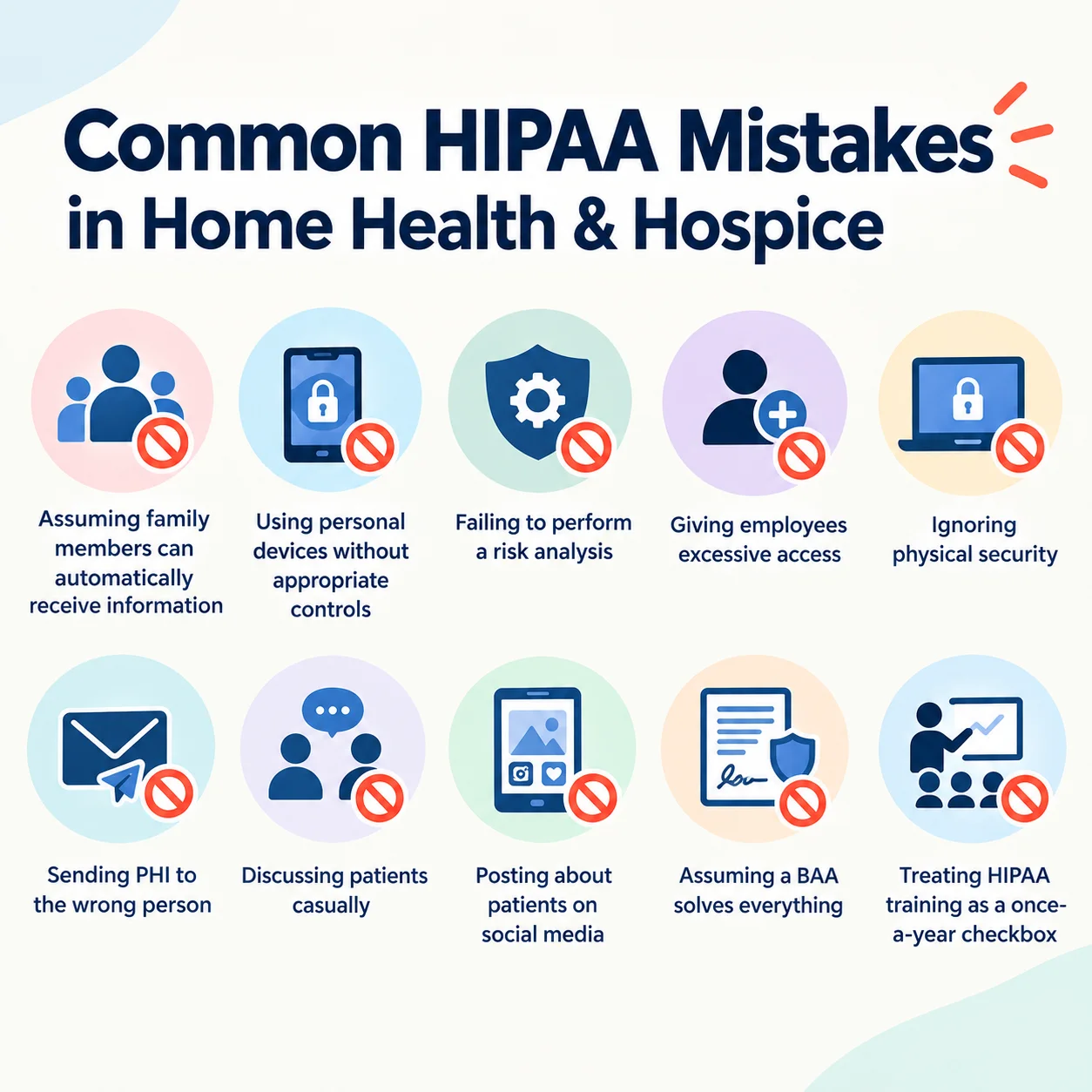
Ordinary daily workflows often create the most important privacy and security risks.
- Assuming family members automatically receive unrestricted information.
- Using personal devices without appropriate controls.
- Failing to perform and update the risk analysis.
- Giving employees broader access than their duties require.
- Ignoring physical security for devices, records, and workspaces.
- Sending PHI to the wrong recipient.
- Discussing patients casually with unauthorized people.
- Posting patient-identifiable information on social media.
- Assuming a BAA solves every vendor risk.
- Treating training as a once-a-year checkbox.
HIPAA Compliance Checklist for Home Health and Hospice
| Area | Question to ask |
|---|---|
| PHI | Do we know what PHI and ePHI we create, receive, maintain, or transmit? |
| Privacy | Do staff understand permitted uses, disclosures, individual rights, and family requests? |
| Minimum necessary | Are access, uses, disclosures, and requests limited where the standard applies? |
| Security | Do administrative, physical, and technical safeguards address actual workflows? |
| Risk analysis | Have we documented risks to all ePHI and updated the analysis as conditions change? |
| Mobile devices | Are laptops, tablets, phones, remote access, and cloud systems appropriately governed? |
| Access | Are authentication and permissions appropriate to job duties and promptly removed when needed? |
| Vendors | Have we identified business associates, mapped data flows, and executed required BAAs? |
| Training | Is education role-specific and refreshed when workflows, systems, or risks change? |
| Incidents | Can staff promptly report concerns, and can the agency contain, assess, document, and correct them? |
| Monitoring | Do we periodically evaluate safeguards and verify corrective actions? |
Why HIPAA Basics Matter for Every Home-Based Care Agency
Home health and hospice staff work in private homes, travel with technology, communicate remotely, coordinate with families, and use multiple vendors. Privacy and security must be built into those real workflows.
Understanding PHI, permitted disclosures, family communication, minimum necessary, mobile security, risk analysis, business associates, and breach response creates the foundation for a stronger program. Agencies evaluating new documentation technology can continue with our guide: Is AI Documentation HIPAA Compliant?
Final Takeaway
HIPAA compliance in home health and hospice is about protecting information that patients and families entrust to the organization.
Privacy + security + risk analysis + workforce training + technology controls + documentation + ongoing improvement
The key question is not merely, “Do we have a HIPAA policy?” It is, “Can we demonstrate that our agency consistently protects patient information in the real-world environments where staff work?”
Editorial Review and Sources
This article was written in consultation with Mariam Treystman and reviewed against current U.S. Department of Health and Human Services guidance available on the publication date.
- HHS: Covered Entities and Business Associates.
- HHS: Summary of the HIPAA Privacy Rule.
- HHS: Summary of the HIPAA Security Rule.
- HHS: Guidance on Risk Analysis.
- HHS: Breach Notification Rule.
- HHS: Business Associates.
- HHS: Hospice of North Idaho Resolution Agreement.
ℹ️ Legal disclaimer: This article is for educational and informational purposes only and does not constitute legal, privacy, security, clinical, compliance, or professional advice. Agencies should evaluate their obligations under current federal and state law, contracts, organizational structure, and specific facts with qualified professionals.
Home Health Documentation Playbook
The complete guide to OASIS-E, Medicare compliance, PDGM, and AI-assisted documentation. Learn how top agencies reduce documentation time without sacrificing compliance.
Bottom Line
Effective HIPAA compliance in home health and hospice connects privacy rules, risk analysis, workforce training, mobile-device safeguards, vendor management, incident response, and ongoing monitoring to the real places where staff work.
Inside Home Health Podcast
Data Privacy in the Digital Health Era: Is Your Medical Information Really Safe?

Arvind Sarin is the founder of Copper Digital. For the past year he has spent three days a week inside a 500+ census Texas home health agency, building AI documentation that finishes OASIS and visit notes the same day, with a nurse reviewing and approving every note. He writes about home health documentation, OASIS, Medicare compliance, and applying AI responsibly in clinical workflows.
Frequently asked
Frequently asked questions
Home health and hospice agencies that meet HIPAA's definition of a covered entity must comply with the applicable HIPAA Rules. HIPAA also applies directly to business associates for specified requirements.
Join the conversation
Leave a comment
No comments yet. Be the first to share your thoughts.
Related reading
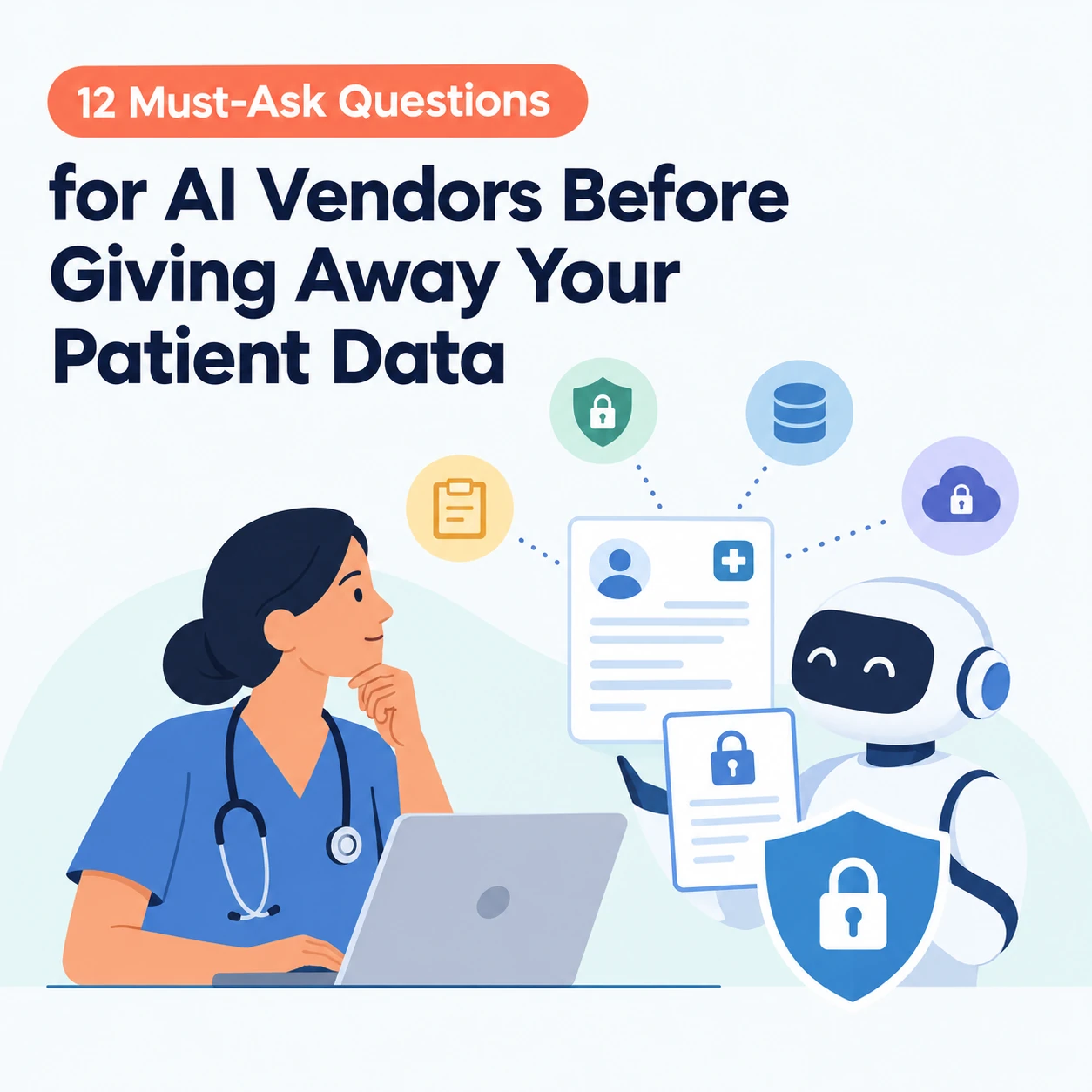
Must-Ask Questions for AI Vendors Before Giving Away Your Patient Data
Twelve questions to ask healthcare AI vendors about patient data, security, model training, clinical accuracy, accountability, and what happens when the contract ends.
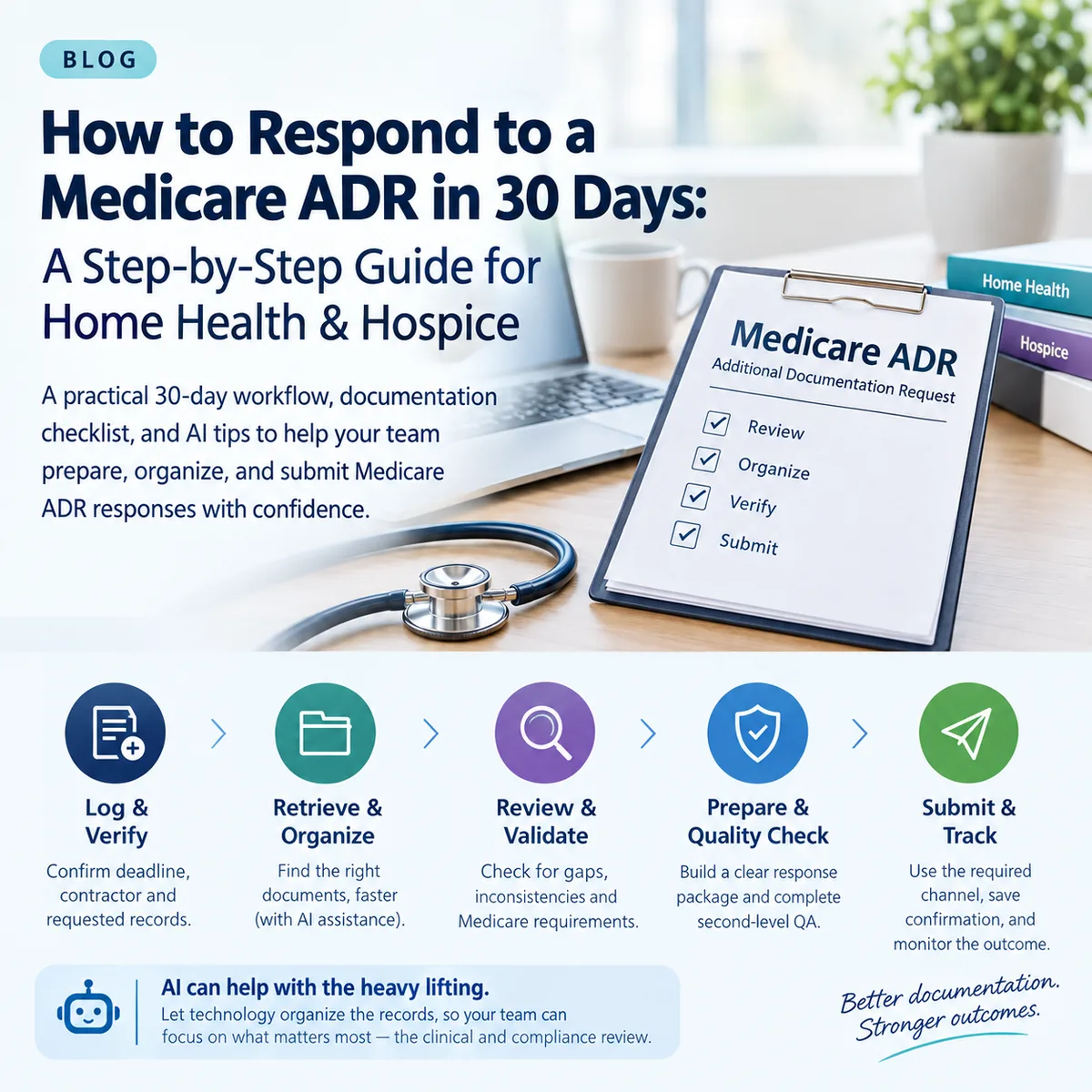
How to Respond to a Medicare ADR in 30 Days: A Step-by-Step Guide for Home Health & Hospice
A Medicare ADR turns an ordinary claim into a time-sensitive compliance project. Not every ADR is due in 30 days, so the goal isn't to "respond in 30 days" but to have a process that moves quickly, consistently, and defensibly. Here's a practical day-by-day workflow for home health and hospice, plus where AI can help.
What Is an ABN in Home Health & Hospice? Complete Guide With Billing Instructions
A patient wants to continue care, but Medicare may not pay for it. Who owes the bill? That's where the Advance Beneficiary Notice of Noncoverage (ABN), Form CMS-R-131, comes in. Here's when it's required in home health and hospice, what makes it valid, the beneficiary's three choices, and how to bill it correctly.