
How to Respond to a Medicare ADR in 30 Days: A Step-by-Step Guide for Home Health & Hospice
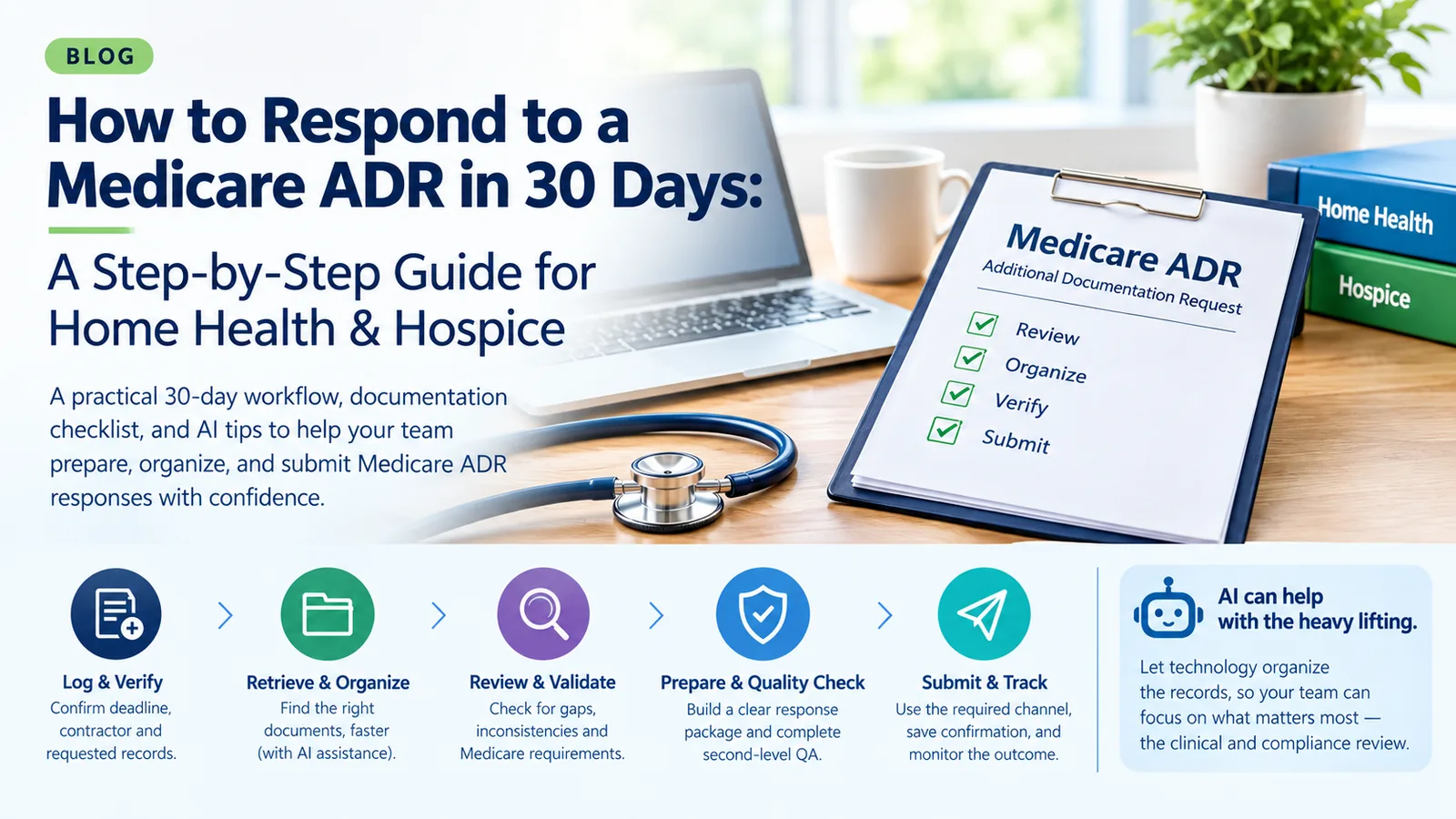
A Medicare ADR turns an ordinary claim into a time-sensitive compliance project. Not every ADR is due in 30 days, so the goal isn't to "respond in 30 days" but to have a process that moves quickly, consistently, and defensibly. Here's a practical day-by-day workflow for home health and hospice, plus where AI can help.
Key Takeaways
- Not every Medicare ADR has a 30-day deadline: many MAC, RAC, SMRC, and CERT requests allow 45 calendar days, while UPIC requests generally allow 30; the ADR letter controls.
- An ADR creates a chain of tasks, so start immediately and set internal milestones earlier than the contractor's deadline (Day 21 is a useful internal submission target for a 30-day request).
- Send only the documentation the contractor requested plus necessary supporting records, not the entire chart, and include the ADR letter as the first page.
- Review for consistency and gaps (skilled need, homebound status, orders, face-to-face, signatures), and run a second-level QA before submitting.
- Hospice update: since October 1, 2025, a signed and dated clinical note can satisfy the face-to-face attestation when the record shows the encounter occurred with the visit date and signature.
- AI can find, organize, compare, and flag documentation, but the model is AI-assisted, human-reviewed, agency-submitted; humans decide compliance and submit.
✓ Quick answer: Not every Medicare ADR is due in 30 days. Many MAC, RAC, SMRC, and CERT requests allow 45 calendar days; UPIC requests generally allow 30. The goal isn't simply to "respond in 30 days" but to run an ADR process that can move quickly, consistently, and defensibly: log early, retrieve systematically, review, QA, submit, track.
A Medicare Additional Documentation Request (ADR) can turn an ordinary claim into a time-sensitive compliance project. The request may require your team to locate clinical documentation, verify that the record supports the services billed, identify gaps or inconsistencies, organize the response, complete an internal quality review, and submit everything through the required channel before the contractor's deadline.
And there is one important point to clarify upfront: not every Medicare ADR has a 30-day response deadline. CMS currently provides 45 calendar days for many MAC, RAC, SMRC, and CERT requests, while UPIC requests generally allow 30 calendar days.
The specific ADR letter and contractor instructions should control your response timeline.
That means the goal should not simply be "respond in 30 days." The goal is to have an ADR response process that can move quickly, consistently, and defensibly whenever a request arrives. This guide walks through that process for home health and hospice agencies, including where AI can help reduce the administrative work involved in preparing an ADR response.
For the fundamentals, see our beginner's guide to Medicare ADRs.
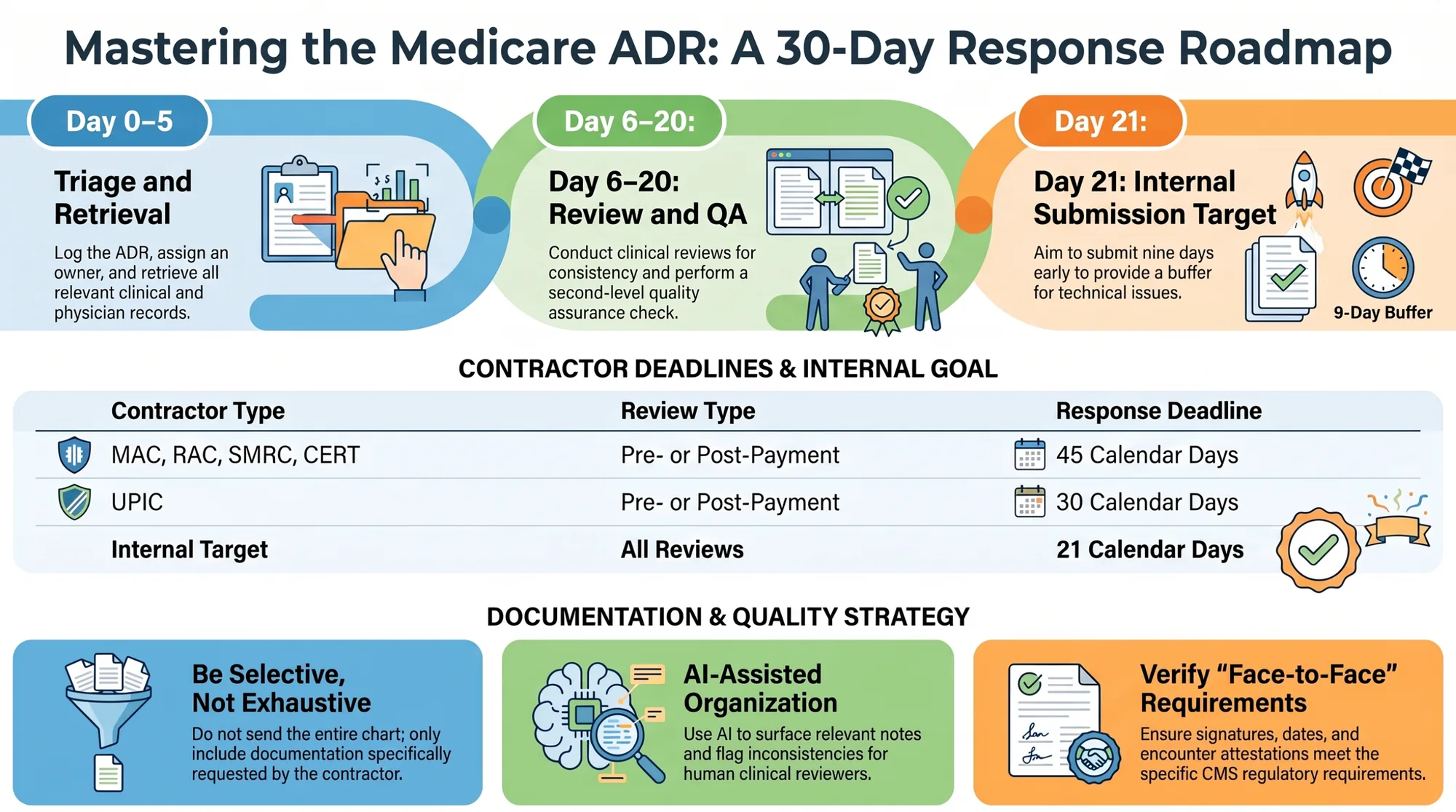
A 30-day ADR response roadmap: triage and retrieve (Day 0-5), review and QA (Day 6-20), and aim for an internal submission target around Day 21 to leave a buffer. Contractor deadlines are 45 calendar days (MAC/RAC/SMRC/CERT) or 30 (UPIC).
What Is a Medicare ADR?
A Medicare Additional Documentation Request (ADR) is a request from a Medicare review contractor for additional records needed to make a determination on a claim. CMS explains that contractors may issue an ADR when they cannot make a payment determination based on the claim, its attachments, billing history, or other available information.
The contractors involved can include Medicare Administrative Contractors (MACs), Recovery Audit Contractors (RACs), Supplemental Medical Review Contractors (SMRCs), Comprehensive Error Rate Testing (CERT), and Unified Program Integrity Contractors (UPICs), depending on the review.
The purpose is not simply to collect a patient's entire chart. CMS's Program Integrity Manual states that contractors should specify the individual pieces of documentation needed to make the determination.
For a home health or hospice agency, an ADR therefore raises a practical question: can we quickly find the documentation that supports what was billed and organize it so the reviewer can make a determination?
How Many Days Do You Have to Respond to a Medicare ADR?
The deadline depends on the contractor and whether the review is prepayment or post-payment.
| Review | Typical CMS timeframe |
|---|---|
| MAC prepayment review | 45 calendar days |
| UPIC prepayment review | 30 calendar days |
| MAC, SMRC, or RAC post-payment review | 45 calendar days |
| CERT post-payment review | 45 calendar days |
| UPIC post-payment review | 30 calendar days |
CMS also states that contractors may accept documentation after the applicable timeframe when there is good cause, such as a natural disaster, interruption in business practices, or another qualifying extenuating circumstance.
What should your agency do?
Treat the deadline in the ADR letter as the controlling deadline. As soon as the request arrives, record the date received, identify the contractor, identify whether it is prepayment or post-payment, confirm the response deadline, record the required submission method, assign an owner, and create internal milestones that occur before the contractor's deadline.
Don't build your internal workflow around the final day; build it around having the response ready several days early.
Why Should You Start an ADR Response Immediately?
An ADR rarely creates just one task. It creates a chain of tasks:
Request → chart retrieval → documentation review → gap identification → clinical/compliance review → response preparation → quality assurance → submission → confirmation → tracking.
If the team waits until the final week, a problem discovered during documentation review can become a deadline problem. For example, a required order may be difficult to locate, a signature may need verification, documentation may contain inconsistent dates, the requested record may span multiple episodes, a supporting note may need to be located, a second reviewer may need time, or the submission portal may have specific requirements.
The safest workflow is to start immediately and create internal deadlines earlier than the external deadline.
What Should You Do on Day 0 of a Medicare ADR?
The first day should be about triage and control. Create an ADR record containing:
- Patient name and identifiers.
- Claim number.
- Dates of service or billing period.
- Contractor name.
- Prepayment or post-payment review.
- Date the ADR was received.
- Official response deadline.
- Submission method.
- Specific documents requested.
- Assigned owner, clinical reviewer, and compliance/QA reviewer.
- Internal submission target.
- Submission confirmation.
- Final outcome.
CMS also advises providers to include a copy of the ADR letter as the first page of the response when submitting documentation. The most important thing on Day 0 is not reviewing the entire chart.
It's making sure nothing about the request is ambiguous or unowned.
What Should You Do on Day 1? Set Internal Milestones
By Day 1, someone should officially own the response. Set internal milestones rather than relying on one final deadline.
For example:
| Day | Internal milestone |
|---|---|
| Day 0 | ADR logged and deadline verified |
| Day 1 | Owner and reviewers assigned |
| Days 2-5 | Documentation retrieved |
| Days 6-10 | Clinical / documentation review |
| Days 11-15 | Gaps addressed and response drafted |
| Days 16-20 | Second-level QA |
| Day 21 | Internal submission target |
| Days 22-27 | Finalization and submission preparation |
| Days 28-30 | Final submission and confirmation (for a 30-day ADR) |
Day 21 is an internal target, not a CMS requirement. For a 45-day ADR, agencies can use the same workflow with additional time between internal QA and the actual submission deadline.
What Documents Should Be Collected for a Home Health ADR?
The exact request should determine what your team gathers. Do not assume that every ADR requires the same documentation; CMS specifically instructs contractors to identify the individual documentation needed for the determination.
Depending on the ADR, a home health response may involve:
- OASIS documentation.
- Start of Care or subsequent assessment documentation.
- Skilled nursing visit notes.
- Therapy notes.
- Home health aide documentation when relevant.
- Physician orders.
- Plan of Care.
- Certification and recertification documentation.
- Face-to-face documentation.
- Medication information.
- Communication and care coordination notes.
- Discharge documentation.
- Documentation supporting homebound status and skilled need.
- Other records specifically requested by the contractor.
The key question is: does the documentation requested by the contractor demonstrate that the billed services met the applicable Medicare requirements? For a fuller picture of these records, see what home health documentation actually includes.
What Documents Should Be Collected for a Hospice ADR?
Hospice ADR preparation can involve a different set of records. Depending on the request, the response may include:
- Hospice election statement.
- Certification of terminal illness.
- Recertification documentation.
- Face-to-face encounter documentation.
- Clinical notes and physician or practitioner documentation.
- Interdisciplinary Group (IDG) documentation.
- Plan of care.
- Nursing, social work, and spiritual care documentation.
- Medication and symptom-management documentation.
- Level-of-care documentation when applicable.
- Relevant communication and discharge documentation.
- Other records specifically requested in the ADR.
ℹ️ Important hospice update: Starting October 1, 2025, CMS allows a signed and dated clinical note to fulfill the face-to-face attestation requirement when the medical record clearly indicates that the encounter occurred and includes the visit date, practitioner's signature, and signature date. This is exactly the type of requirement to consider when reviewing a hospice ADR.
Should You Send the Entire Patient Chart for an ADR?
Not automatically. The response should be based on the ADR and the documentation needed to support the claim.
CMS's Program Integrity Manual says contractors should specify the individual pieces of documentation needed to make a determination. That means the agency should avoid treating the ADR response as "download everything in the EMR and send it." Instead:
Read the request → identify what was requested → retrieve the relevant documentation → add necessary supporting documentation → organize the response clearly.
Sending irrelevant material can make the response harder to review and harder for your own team to quality-check.
What Should Happen During Days 2-5? Documentation Retrieval
This is the documentation retrieval phase. The goal is to build the evidence package while the request is still fresh.
For home health, that might mean locating documentation across OASIS, EMR visit notes, orders, the Plan of Care, physician documentation, therapy records, medication records, and care coordination notes. For hospice, it may involve certification and recertification records, face-to-face documentation, IDG documentation, clinical narratives, nursing notes, and supporting clinical records.
The challenge is that these records may not always be located in one convenient place. That's where a structured ADR workflow can make a significant difference.
What Should You Review During Days 6-10?
Once the documents are collected, move from retrieval to review. For home health, the team may review whether the documentation is internally consistent and supports the services billed.
Areas to examine can include:
- OASIS and clinical narrative consistency: Does the broader clinical record support the information documented in the assessment?
- Skilled need: Does the record clearly support the skilled services provided?
- Homebound status: Does the documentation support the applicable homebound requirement?
- Orders and Plan of Care: Are the relevant orders present and consistent with the services documented?
- Face-to-face documentation: Is the required documentation present and properly completed?
- Signatures and dates: Are required signatures, dates, and related documentation present?
- Diagnosis and clinical documentation: Does the clinical record support the diagnoses and services associated with the claim?
The purpose is not to "make the chart look better." The purpose is to determine whether the existing documentation supports the claim and the applicable Medicare requirements.
What Are Common Home Health ADR Documentation Problems?
An ADR review can reveal issues such as missing documentation, inconsistent dates, incomplete orders, documentation that does not clearly establish skilled need, insufficient support for homebound status, missing or incomplete signatures, inconsistencies between assessments and narrative documentation, clinical information scattered across multiple records, and difficulty connecting documentation to the specific claim under review.
These issues should be documented and escalated to the appropriate clinical or compliance reviewer. An ADR response should not be an exercise in rewriting history.
If the record does not contain required information, the team needs to identify that fact and handle it appropriately.
What Are Common Hospice ADR Documentation Problems?
Hospice agencies may need to pay particular attention to certification and recertification documentation, face-to-face encounter documentation, required signatures and dates, terminal illness documentation, clinical narratives, IDG documentation, evidence supporting continued hospice eligibility, consistency between clinical findings and certification documentation, documentation supporting the level of care billed, and missing or incomplete records.
For example, CMS states that when a required hospice face-to-face encounter is missing, the recertification is not complete. That makes documentation completeness particularly important when preparing a hospice ADR response.
What Should the ADR Response Cover Letter Include?
The response should make it easy for the reviewer to understand what is being submitted. A practical structure can include:
- ADR identification: patient, claim, billing period, contractor, and ADR reference number.
- Table of contents: clearly identify each document included.
- Brief response summary: explain what is being submitted and how it addresses the request.
- Documentation references: point the reviewer to the relevant records (for example, "Skilled nursing need: See SN visit note dated [date], Plan of Care, and physician order").
- Supporting documentation: organize the requested records in a logical sequence.
- Contact information: identify the appropriate agency contact for questions.
The objective is simple: make the response easy to navigate.
Is the ADR Cover Letter the Most Important Document?
The cover letter matters, but it should not be treated as a substitute for supporting documentation. A well-organized cover letter can help the reviewer understand the package and locate relevant evidence, but the underlying medical record remains critical.
A concise response that clearly points to strong supporting documentation is generally more useful than a long narrative that does not connect its statements to the record.
What Should Happen During Days 16-20? Second-Level QA
This is where a second-level QA review can help. The person preparing the ADR response should ideally not be the only person checking it.
The second reviewer can verify the correct patient, claim, billing period, and ADR; that all requested documents are included and legible; that relevant signatures and dates are present; that documentation is organized correctly; that no unrelated patient information was inadvertently included; that the response addresses the request; that submission requirements are satisfied; and that the internal deadline is still achievable. This is also a useful point to resolve any remaining documentation questions.
What Should Happen on Day 21?
For agencies using the 30-day workflow, Day 21 can be an internal submission target. That gives the team a buffer before the external deadline.
Again, this is an internal operational target, not a CMS requirement. If the ADR provides 45 days, the agency can use the additional time for further review, but it should still avoid waiting until the final days.
What Should Happen After the ADR Is Submitted?
Submission is not the end of the process. Your team should confirm the submission was successfully received, save the confirmation or receipt, record the submission date and method, update the ADR tracker, track subsequent contractor correspondence, record the final determination, and escalate any denial or appeal issue according to the applicable process and deadlines.
CMS identifies multiple possible submission methods, including mail, esMD, contractor portals, fax, and certain electronic media, depending on the contractor and request. Follow the submission instructions in the ADR letter.
What Happens If You Miss the ADR Deadline?
CMS states that when a contractor has given the provider notice and time to respond and the requested documentation is not provided timely, the contractor has authority to deny the claim. CMS also allows contractors to accept late documentation for good cause in applicable circumstances.
That is why agencies should not build their process around the assumption that "we can always ask for an extension later." If you believe additional time is necessary, contact the applicable contractor as early as possible and follow its instructions.
What Happens If the ADR Results in a Denial?
A denial should become a separate workflow. The agency should review the reason for denial, identify what documentation or requirement was considered insufficient, determine whether additional information is available, review the applicable appeal rights and deadlines, assign responsibility for the next step, document the outcome internally, and identify whether the underlying issue represents a recurring process problem.
An ADR shouldn't disappear from your compliance system once the response is submitted. The outcome can provide useful information about where your documentation workflow needs improvement.
What Are the Most Common Medicare ADR Response Mistakes?
- Waiting until the deadline is close: the longer you wait, the fewer options you have when something is missing.
- Treating every ADR as a 30-day request: different contractors and review types have different timeframes.
- Sending the entire chart without reviewing the request: more documentation is not automatically better.
- Failing to verify the actual ADR request: the request should determine what documentation is gathered.
- Having one person manage everything: retrieval, review, QA, submission, and tracking can become a bottleneck.
- Failing to preserve submission confirmation: maintain evidence that the response was submitted.
- Not tracking the outcome: the response should remain in the tracker through final resolution.
- Treating ADRs as isolated events: repeated findings may indicate a larger documentation or workflow issue.
Can AI Help With Medicare ADR Preparation?
Yes, but AI should be positioned as a documentation support and workflow tool, not as the decision-maker. AI can potentially help teams find relevant clinical records, organize documentation chronologically, identify records associated with a particular patient or episode, surface potentially missing documentation, compare information across records, flag potential inconsistencies for human review, summarize large volumes of documentation, and reduce manual chart-searching.
The human team still needs to determine whether the documentation actually supports the claim and whether the final response is appropriate. A useful workflow is: ADR received → AI-assisted document retrieval → AI-assisted organization and review → human clinical/compliance review → final response → agency submission.
Not: ADR received → AI decides → automatic submission. This is the human-in-the-loop principle applied to compliance work, handled under HIPAA-compliant AI documentation practices.
How Can Copper AI Help With ADR Preparation?
Copper AI can fit into the documentation retrieval, organization, and review portion of an ADR workflow. The goal is not to replace the compliance or clinical reviewer.
The goal is to reduce the time teams spend searching through records so they can spend more time reviewing the evidence. A Copper AI-assisted ADR workflow can look like this:
- ADR received: the agency identifies the patient, claim, contractor, requested records, and deadline.
- Documentation is located: Copper AI can help surface relevant documentation across the patient's clinical record.
- Records are organized: relevant notes and documentation can be organized around the episode, dates, and clinical context.
- Potential issues are surfaced: AI can help identify potential gaps or inconsistencies that deserve human attention.
- Human review: clinical and compliance staff review the underlying documentation and determine what should be included.
- Response preparation: the team organizes the supporting records and prepares the response according to the ADR instructions.
- Agency submission: the agency submits the final response through the required channel and retains confirmation.
This distinction matters: Copper AI can help prepare the documentation for human review. It does not independently determine Medicare compliance or submit an ADR response on the agency's behalf.
Should AI Review Replace Human ADR Review?
No. AI can help with retrieval, organization, comparison, and issue identification, but the final response should remain under appropriate human oversight.
A human reviewer should verify what the contractor requested, whether the correct records were retrieved, whether the documentation actually supports the claim, whether any gaps or inconsistencies need escalation, whether the response is accurate, and whether the submission follows the contractor's instructions.
The right model is: AI-assisted. Human-reviewed. Agency-submitted.
Can ADRs Become a Compliance Improvement Tool?
Yes. An ADR response should not end with "submitted." After the determination, ask what triggered the review, what documentation was difficult to locate, whether records were missing, whether there were recurring inconsistencies, whether the team struggled to find orders, whether the process depended too heavily on one employee, whether the deadline was difficult to meet, whether the same issue appeared in previous ADRs, whether the agency needs additional staff training, and whether the documentation workflow should change.
Over time, the ADR tracker can become a source of operational intelligence. The objective isn't simply to respond to the next ADR faster.
It is to understand why the agency keeps encountering the same documentation problems.
What Should Your ADR-Ready Workflow Look Like?
A practical workflow is:
Medicare ADR received → verify contractor, deadline, and requested records → log the ADR and assign an owner → retrieve relevant documentation → AI-assisted organization and review where appropriate → clinical/compliance review → resolve documentation questions → prepare response package → second-level QA → submit through required channel → save confirmation → track determination → identify process improvements.
The biggest improvement may not be a new software platform. It may simply be having a workflow that everyone follows.
Medicare ADR Response Checklist
When the ADR arrives
- ADR logged; patient and claim verified.
- Contractor and review type identified.
- Deadline and submission method confirmed.
- Requested documentation identified.
- Owner assigned and internal milestones created.
During chart preparation
- Requested and supporting records retrieved.
- Records organized.
- Missing documentation identified.
- Potential inconsistencies flagged.
- Clinical/compliance review completed.
Before submission
- Correct patient, claim, and dates verified.
- ADR letter included as required.
- Requested documentation included and response organized.
- Second-level QA completed.
- Submission requirements verified.
After submission
- Submission completed and receipt/confirmation saved.
- Tracker updated and follow-up date recorded.
- Determination tracked.
- Denial/appeal workflow initiated if necessary.
- Root cause reviewed.
What Should You Do This Week?
If you have an active ADR right now
Verify it's logged in your tracking system; don't assume someone else has it. Confirm the deadline date and add milestone reminders, working backward from the actual deadline in the ADR letter.
Use this playbook to structure the next 21 days, with Day 21 as an internal target for a 30-day response workflow that gives your team a buffer for final QA and submission. If you don't have capacity to respond well, consider outsourcing; the financial and operational consequences of a missed or denied claim can make outside support worth evaluating when internal capacity is insufficient.
If you don't have an active ADR, use the quiet period to prepare
Audit your ADR tracking system: does it exist, is it actually being used, and can someone immediately tell you how many ADRs are open, who owns each one, when each response is due, what documentation has been collected, which responses have been submitted, and which determinations are still pending? Document your current ADR response workflow from ADR received to determination recorded; if the process exists only in one employee's head, that is a risk.
Identify your single biggest weakness (documentation retrieval, clinical review, QA, response organization, cover-letter preparation, submission, tracking, or follow-up), then fix the workflow or evaluate outsourcing before the next ADR arrives, because the cost of being unprepared can be far higher than the cost of preparation.
Final Takeaway
A Medicare ADR is easier to manage when it is treated as a repeatable workflow rather than an emergency. The process should be: log early, verify the actual deadline, retrieve systematically, review carefully, QA before submission, track the outcome, and learn from the result.
And where technology can reduce the administrative work involved in finding and organizing documentation, use it to give your clinical and compliance teams more time to focus on reviewing the evidence and making the right decisions. For agencies exploring AI, the opportunity is not to have AI "answer the ADR." It's to make the work surrounding the ADR faster, more organized, and easier for humans to review.
Home Health Documentation Playbook
The complete guide to OASIS-E, Medicare compliance, PDGM, and AI-assisted documentation. Learn how top agencies reduce documentation time without sacrificing compliance.
Bottom Line
A Medicare ADR is easier to manage when it's treated as a repeatable workflow rather than an emergency: log early, verify the actual deadline, retrieve systematically, review carefully, QA before submission, track the outcome, and learn from the result. Where technology can reduce the administrative work of finding and organizing documentation, use it to give clinical and compliance teams more time to review the evidence and make the right decisions.
Inside Home Health Podcast
What Makes OASIS Documentation So DIFFICULT?

Arvind Sarin is the founder of Copper Digital. For the past year he has spent three days a week inside a 500+ census Texas home health agency, building AI documentation that finishes OASIS and visit notes the same day, with a nurse reviewing and approving every note. He writes about home health documentation, OASIS, Medicare compliance, and applying AI responsibly in clinical workflows.
Frequently asked
Frequently asked questions
It depends on the contractor and review type. CMS currently specifies 45 calendar days for many MAC, RAC, SMRC, and CERT requests and 30 calendar days for UPIC requests. Always follow the deadline stated in the ADR and applicable contractor instructions.
Join the conversation
Leave a comment
No comments yet. Be the first to share your thoughts.
Related reading
Beginner's Guide to Medicare ADRs for Home Health and Hospice Agencies
A letter from Medicare asking for additional records raises fast questions: what do they need, why this claim, how long do we have? That letter is often an Additional Documentation Request (ADR). Here's what an ADR is, why home health and hospice agencies get them, what's requested, the deadlines, and how to respond.
What Is an ABN in Home Health & Hospice? Complete Guide With Billing Instructions
A patient wants to continue care, but Medicare may not pay for it. Who owes the bill? That's where the Advance Beneficiary Notice of Noncoverage (ABN), Form CMS-R-131, comes in. Here's when it's required in home health and hospice, what makes it valid, the beneficiary's three choices, and how to bill it correctly.

HIPAA in Home Health & Hospice: Understanding the Basics & Privacy Rules
Understand how HIPAA applies when home health and hospice teams work in patients' homes, travel with devices, communicate with families, and rely on outside vendors.