
Beginner's Guide to Medicare ADRs for Home Health and Hospice Agencies
A letter from Medicare asking for additional records raises fast questions: what do they need, why this claim, how long do we have? That letter is often an Additional Documentation Request (ADR). Here's what an ADR is, why home health and hospice agencies get them, what's requested, the deadlines, and how to respond.
Key Takeaways
- An ADR (Additional Documentation Request) is a request from a Medicare medical review contractor for records needed to evaluate a claim; it is a request for documentation, not a denial.
- Receiving an ADR does not mean the agency did something wrong; the reviewer simply needs more documentation to make a determination.
- ADRs can come from MACs, RACs, the SMRC, UPICs, or CERT; the contractor type affects the deadline and submission method.
- Response deadlines are typically 45 calendar days (MAC/SMRC/RAC/CERT) or 30 calendar days (UPIC), based on calendar days and receipt (not postmark).
- Send only the specific documentation requested, attach the ADR letter as the first page, submit through the required channel, and keep proof of submission.
- Missing the deadline gives the contractor authority to deny the claim, resulting in a prepayment denial or a post-payment overpayment and recoupment.
✓ Quick answer: An Additional Documentation Request (ADR) is a request from a Medicare medical review contractor for the records needed to evaluate a claim. It is a request for documentation, not a denial. Responding well means identifying the correct claim, sending exactly what was requested, meeting the deadline, submitting through the required channel, and keeping proof.
A letter from Medicare asking for additional records can immediately raise questions: What do they need? Why was this claim selected?
How long do we have? What happens if we miss the deadline?
The letter may be an Additional Documentation Request, or ADR.
An ADR is part of Medicare's medical review process. It asks a provider or supplier to submit medical record documentation needed to support a claim and allow the reviewer to determine whether the services meet applicable Medicare coverage, coding, payment, billing, and medical-necessity requirements.
For home health and hospice agencies, responding to an ADR is therefore more than gathering paperwork. The agency needs to identify the correct claim, understand exactly what documentation was requested, meet the applicable deadline, submit through the required channel, and retain evidence of the response.
This beginner's guide explains how the process works.
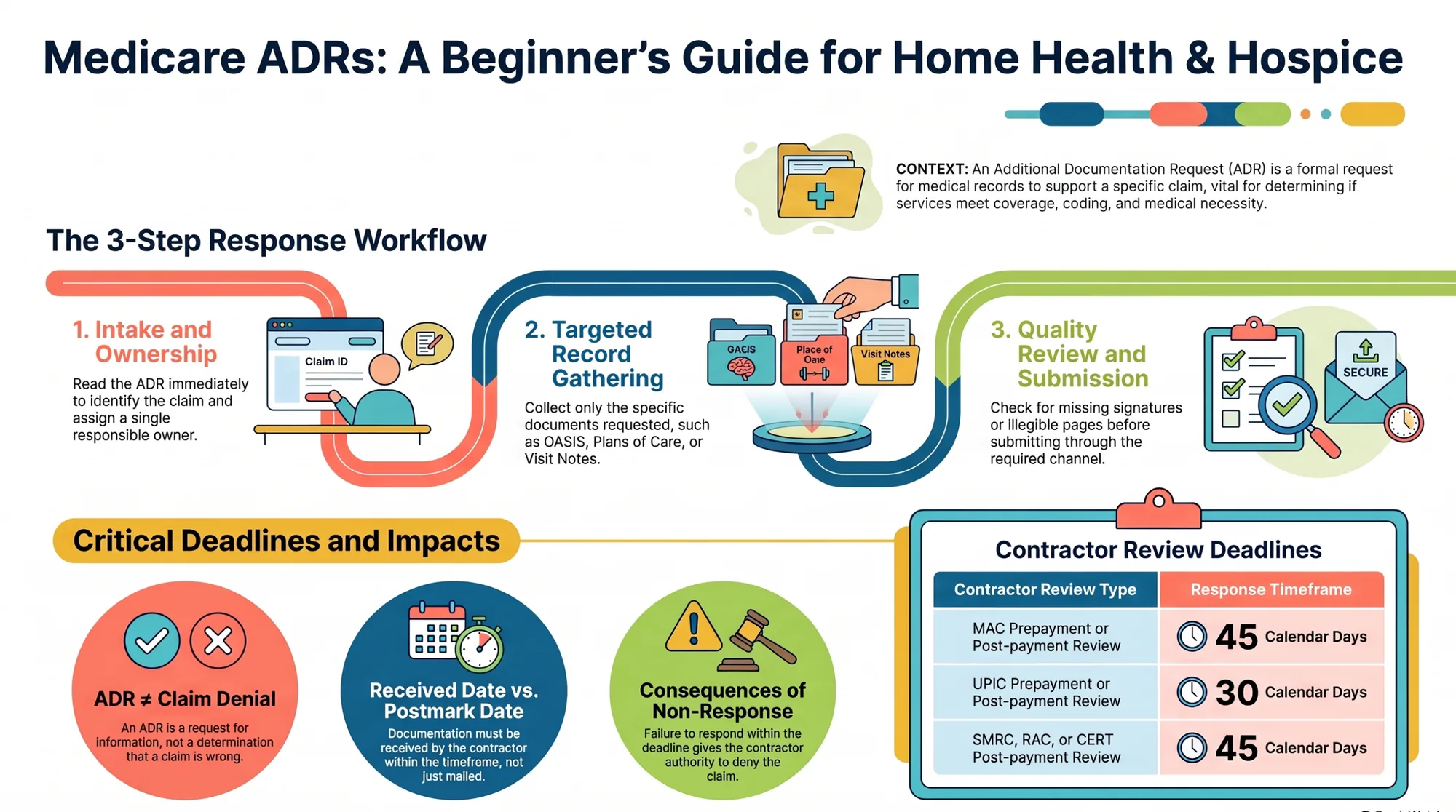
The three-step ADR response workflow (intake and ownership, targeted record gathering, quality review and submission) plus the critical deadlines: an ADR is not a denial, receipt beats postmark, and non-response lets the contractor deny the claim.
What Is a Medicare Additional Documentation Request?
An Additional Documentation Request (ADR) is a request from a Medicare medical review contractor for documentation needed to evaluate a Medicare claim. CMS explains that medical reviewers issue an ADR when they cannot make a determination based on the information already available from the claim, attachments, billing history, or other applicable claims information.
In simple terms: Medicare has selected a claim for review and needs additional documentation to make a determination. The ADR should identify the documentation the reviewer needs.
CMS's current guidance instructs contractors to request the individual pieces of documentation needed to make the determination.
Does Receiving an ADR Mean the Agency Did Something Wrong?
No. Receiving an ADR does not by itself establish that a claim is incorrect or that an agency violated Medicare requirements.
An ADR means the reviewer needs additional documentation to evaluate the claim. The purpose of the medical review process is to determine whether Medicare payment requirements are supported by the available documentation.
That distinction is important: an ADR is a request for documentation, while a denial is a payment determination. They are not the same thing.
Why Does Medicare Issue ADRs?
An ADR is issued when additional documentation is necessary to make a claim determination. The specific reason a particular claim is selected can depend on the review program, contractor, claim characteristics, or other review criteria.
The exact selection methodology is not necessarily something an agency can determine from the ADR itself.
Rather than assuming why a claim was selected, agencies should focus on what the ADR actually requests and the Medicare requirements relevant to the claim. For home health, medical review can examine whether the beneficiary meets Medicare coverage requirements and whether the services provided were reasonable, necessary, and appropriately documented.
CMS materials also identify review of OASIS information and whether it is supported by the medical record.
Who Can Send a Medicare ADR?
Medicare Fee-for-Service medical reviews may involve several types of contractors, including:
- Medicare Administrative Contractors (MACs).
- Recovery Audit Contractors (RACs).
- Supplemental Medical Review Contractor (SMRC).
- Unified Program Integrity Contractors (UPICs).
- Comprehensive Error Rate Testing (CERT) in applicable reviews.
- Other authorized Medicare review entities.
CMS's current Program Integrity Manual identifies the applicable contractors and ADR procedures. The contractor named in the ADR matters because the response deadline and submission process can depend on the type of review.
How Will a Home Health or Hospice Agency Receive an ADR?
CMS states that an ADR is sent to the practice address on file with Medicare. Agencies should therefore keep their Medicare correspondence information current.
Depending on the contractor and review process, electronic notification may also be involved. For example, CMS supports electronic medical documentation requests through esMD, and contractors may use designated provider portals or other secure electronic methods.
Agencies should therefore have a process for monitoring:
- Medicare correspondence.
- Applicable contractor portals.
- Electronic documentation systems.
- Internal compliance or billing notifications.
An ADR that is not noticed is still an ADR with a response deadline.
What Information Does an ADR Letter Usually Provide?
The ADR should give the agency the information needed to understand and respond to the request. Look for:
- The claim or claims being reviewed.
- The patient or beneficiary information.
- The documentation requested.
- The review or contractor information.
- The submission instructions.
- The response deadline.
The source material also emphasizes checking the claim, requested documents, and deadline immediately after receiving the letter.
What Documentation Can Be Requested in a Home Health ADR?
The exact records depend on the claim and review. Home health documentation may include:
- Plan of care.
- Certification and recertification documentation.
- Clinical assessments.
- OASIS information, when applicable.
- Nursing visit notes.
- Therapy documentation.
- Progress notes.
- Physician or practitioner orders.
- Medication-related documentation.
- Documentation supporting skilled services.
- Documentation supporting homebound status.
- Documentation supporting medical necessity.
- Other records relevant to the claim.
CMS home health review guidance specifically identifies areas such as the plan of care, OASIS, progress notes, signatures, medical necessity, and documentation supporting home health certification as relevant to medical review. For a fuller picture of these records, see what home health documentation actually includes.
What Documentation Can Be Requested in a Hospice ADR?
Hospice ADRs can request records needed to evaluate the claim and the applicable Medicare requirements. Depending on the review, documentation may include:
- Certification of terminal illness.
- Clinical documentation supporting the terminal prognosis.
- Assessments.
- Plan of care.
- Hospice visit documentation.
- Interdisciplinary documentation.
- Medication and treatment documentation.
- Physician or practitioner documentation.
- Records supporting services provided.
- Other documentation relevant to the claim.
CMS medical review materials specifically address hospice services and documentation supporting medical necessity. The ADR itself should determine what documentation the agency needs to submit.
Should an Agency Send the Entire Patient Record?
Not automatically. The current CMS Program Integrity Manual says contractors should specify the individual pieces of documentation needed to make a determination.
The agency should therefore read the ADR, identify the requested documentation, gather the relevant records, and submit according to the instructions. If the ADR requests a broader record, the agency should follow that request.
How Should an Agency Respond to a Medicare ADR?
A practical workflow is:
1. Read the ADR carefully
Identify the claim, patient, review type, contractor, requested records, submission method, and deadline.
2. Assign an owner
Someone should be responsible for coordinating the response rather than allowing the request to sit between billing, clinical, and compliance teams.
3. Gather the requested documentation
Pull the records identified in the ADR.
4. Check the documentation
Look for missing records, incorrect patient or claim information, illegible pages, missing applicable signatures, inconsistencies, and records that do not correspond to the review period.
5. Organize the submission
CMS recommends attaching a copy of the ADR letter as the first page so the documentation can be matched to the appropriate patient and claim.
6. Submit through the required channel
Follow the submission instructions in the ADR.
7. Confirm and track the submission
Keep a copy of what was submitted and retain confirmation or other evidence that the documentation was received.
How Long Does an Agency Have to Respond to an ADR?
The current CMS guidance specifies different timeframes depending on the contractor and whether the review is prepayment or post-payment.
| Review | Response timeframe |
|---|---|
| MAC prepayment review | 45 calendar days |
| UPIC prepayment review | 30 calendar days |
| MAC, SMRC, RAC, or CERT post-payment review | 45 calendar days |
| UPIC post-payment review | 30 calendar days |
These are calendar days, and the contractor's ADR should tell the provider when the documentation is expected. The current June 2026 CMS manual confirms these timeframes.
Always follow the actual ADR letter and applicable contractor instructions.
Is the ADR Deadline Based on When the Agency Mails the Records?
The important operational point is that the documentation needs to be received within the applicable timeframe, not simply placed in the mail by the deadline. CMS's current guidance states that contractors notify providers when they expect documentation to be received.
So agencies should avoid waiting until the final day, particularly when using a submission method that requires physical delivery.
Can an Agency Request More Time to Respond?
Potentially, depending on the contractor and circumstances. CMS states that MACs, SMRCs, RACs, and UPICs may accept documentation submitted after the applicable timeframe for good cause.
Examples can include natural disasters, interruptions in business practices, or other extenuating circumstances determined by the contractor.
The current CMS guidance also encourages providers and suppliers to work with their designated MAC if additional time is needed. An extension should therefore not be treated as automatic.
If an agency anticipates a problem meeting the deadline, it should follow the contractor's instructions and address the issue as early as possible.
How Can Agencies Submit ADR Documentation?
CMS identifies several submission methods, depending on the contractor and review. These can include:
- US mail.
- esMD.
- MAC-designated provider portal.
- Fax.
- Other contractor-approved electronic or physical methods.
CMS currently supports esMD for responses to ADRs. The ADR letter should identify the applicable submission method.
What Happens If an Agency Does Not Respond to an ADR?
Failure to respond can have significant consequences. Under CMS guidance, when a provider or supplier does not submit requested documentation within the applicable timeframe, the contractor has authority to deny the claim.
For a prepayment review, this can mean the claim is denied before payment. For a post-payment review, the review can result in an overpayment determination and applicable recoupment procedures.
The distinction matters because the financial impact can occur at different points in the payment process.
What Happens During a Post-Payment ADR?
In a post-payment review, Medicare has already paid the claim. The reviewer requests documentation to determine whether the payment was appropriate.
If the documentation does not support the claim under the applicable Medicare requirements, the claim may be denied or an overpayment may be identified, followed by applicable recovery procedures. CMS's home health review materials describe post-payment review and recoupment procedures for claims that are denied.
What Happens During a Prepayment ADR?
A prepayment ADR occurs before the claim is paid. The reviewer requests additional documentation to determine whether Medicare should make payment.
If the requested documentation is not received within the applicable timeframe, CMS guidance states that the reviewer shall deny the claim when the requested documentation needed to support payment is not received within the expected timeframe.
What Are Common ADR Response Mistakes?
Some common operational problems include:
- Missing the response deadline.
- Not reading the ADR carefully.
- Sending incomplete documentation.
- Sending documentation for the wrong claim.
- Using the wrong submission method.
- Failing to retain proof of submission.
- Poorly organized records.
- Missing applicable signatures or documentation elements.
- Not having a clear person responsible for the response.
- Waiting until the deadline to begin gathering records.
The source material also recommends attaching the ADR letter to the submission and keeping copies of everything sent. Many of these problems trace back to why home health documentation takes so long in the first place: fragmented, hard-to-retrieve records.
How Can Agencies Prepare for ADRs Before They Receive One?
ADR preparation starts before the letter arrives. Agencies can establish:
- Documentation checklists.
- Clear ownership of ADR responses.
- Organized medical records.
- Consistent documentation workflows.
- Submission tracking.
- Deadline monitoring.
- Record-retention procedures.
- Internal documentation reviews.
It is also important to keep the agency's Medicare correspondence information current and monitor applicable contractor communication channels. A pre-claim documentation checklist can also help identify missing records before claims are submitted.
The goal isn't to guarantee that an agency will never receive an ADR. It is to make sure the agency can respond efficiently when one arrives.
Can Better Documentation Reduce ADR Problems?
Better documentation can make it easier to demonstrate that the care provided is supported by the medical record. For home health, CMS medical review considers whether documentation supports applicable coverage requirements, medical necessity, and the services provided.
For hospice, documentation needs to support applicable hospice eligibility and medical-necessity requirements.
That means agencies should focus not just on having documentation, but on having documentation that is complete, timely, consistent, clinically relevant, traceable, easy to retrieve, and connected to the services being reviewed.
Can Technology Help With Medicare ADR Preparation?
Yes. Technology can reduce the administrative work involved in finding and organizing documentation.
For example, an agency may use technology to search records by patient and date, locate relevant documentation, organize records, track ADR deadlines, track submission status, store copies of responses, identify potentially missing documentation, and create internal ADR checklists. CMS also supports electronic submission of medical documentation through esMD for ADR responses.
Can AI Help With a Medicare ADR Response?
AI can potentially assist with the administrative and information-management side of an ADR response. For example, AI could help find relevant documentation, summarize records for human review, identify potentially missing information, organize documents chronologically, surface inconsistencies for review, and create an internal response checklist.
But AI should not independently determine that a claim is compliant simply because it finds documentation that appears to support it. A human reviewer should remain responsible for evaluating the records and finalizing the response, the same human-in-the-loop principle that applies across clinical AI.
Any tool handling these records should also follow HIPAA-compliant AI documentation practices.
How Can Agencies Reduce the Administrative Burden of ADRs?
A useful workflow can be:
ADR received → claim identified → documentation requested → records gathered → records reviewed → response organized → submission sent → receipt confirmed → response archived.
The more of this process that can be standardized, the less likely the agency is to reinvent the process every time an ADR arrives. The goal is not simply to respond faster.
It is to create a repeatable response process.
What Is the Simplest Way to Understand a Medicare ADR?
Think of an ADR as Medicare saying, "We need additional documentation to evaluate this claim." The agency's response is: read the request, find the requested records, review them, submit them correctly, meet the deadline, and keep proof of submission. An ADR is a request for documentation, not automatically a finding that the claim is wrong.
Home Health Documentation Playbook
The complete guide to OASIS-E, Medicare compliance, PDGM, and AI-assisted documentation. Learn how top agencies reduce documentation time without sacrificing compliance.
Bottom Line
Think of an ADR as Medicare saying "we need additional documentation to evaluate this claim." The agency's job is to read the request, find the requested records, review them, submit them correctly, meet the deadline, and keep proof. An ADR is a request for documentation, not automatically a finding that the claim is wrong, and a repeatable response process is what keeps it manageable.
Inside Home Health Podcast
Star Agency or Compliance Disaster? Understanding Home Health Ratings

Arvind Sarin is the founder of Copper Digital. For the past year he has spent three days a week inside a 500+ census Texas home health agency, building AI documentation that finishes OASIS and visit notes the same day, with a nurse reviewing and approving every note. He writes about home health documentation, OASIS, Medicare compliance, and applying AI responsibly in clinical workflows.
Frequently asked
Frequently asked questions
ADR stands for Additional Documentation Request. It is a request from a Medicare medical review contractor for documentation needed to support a Medicare claim and allow the reviewer to make a determination.
Join the conversation
Leave a comment
No comments yet. Be the first to share your thoughts.
Related reading
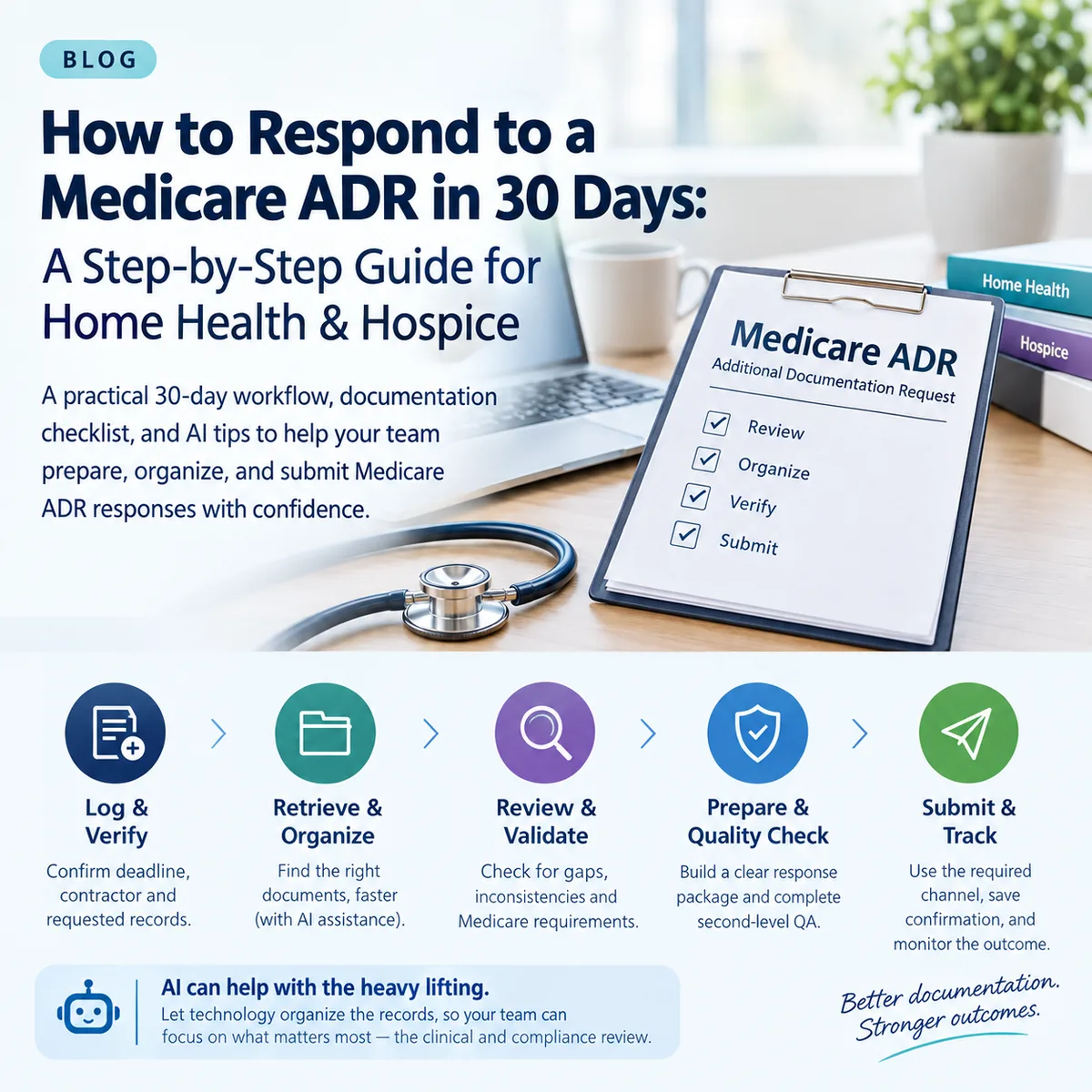
How to Respond to a Medicare ADR in 30 Days: A Step-by-Step Guide for Home Health & Hospice
A Medicare ADR turns an ordinary claim into a time-sensitive compliance project. Not every ADR is due in 30 days, so the goal isn't to "respond in 30 days" but to have a process that moves quickly, consistently, and defensibly. Here's a practical day-by-day workflow for home health and hospice, plus where AI can help.
What Is an ABN in Home Health & Hospice? Complete Guide With Billing Instructions
A patient wants to continue care, but Medicare may not pay for it. Who owes the bill? That's where the Advance Beneficiary Notice of Noncoverage (ABN), Form CMS-R-131, comes in. Here's when it's required in home health and hospice, what makes it valid, the beneficiary's three choices, and how to bill it correctly.

HIPAA in Home Health & Hospice: Understanding the Basics & Privacy Rules
Understand how HIPAA applies when home health and hospice teams work in patients' homes, travel with devices, communicate with families, and rely on outside vendors.