Discharging a patient from home health care involves more than documenting that services have ended. It requires bringing together the patient's clinical history, progress during the episode, current condition, and plans for continued care.
A strong home health discharge narrative tells the story of the entire episode. It explains why the patient needed home health services, what care was provided, how the patient responded, which goals were achieved, and what needs attention after discharge.
Yet completing this documentation can be challenging. Clinicians must review information from multiple visits, assessments, interventions, and care plan updates while ensuring the final record is accurate, complete, and meaningful.
A note that simply states "patient stable" or "goals met" may not communicate enough information to the next healthcare professional.
So, how do you write a discharge narrative that is both clinically meaningful and easy to understand?
The key is to connect the patient's initial condition, the care provided, measurable progress, and discharge status into one clear clinical account.
This guide explains the essential elements, documentation best practices, practical examples, and CMS requirements clinicians should understand when preparing a home health discharge narrative.
What Is a Home Health Discharge Narrative?
A home health discharge narrative is a clinical summary of the patient's condition, services, progress, and care needs at the end of a home health episode.
It documents the patient's journey from admission to discharge and explains the outcomes of the services provided.
A well-written narrative should help another healthcare professional understand:
- Why the patient was admitted to home health.
- Which diagnoses and clinical problems were addressed.
- What skilled services and interventions were provided.
- How the patient responded to those interventions.
- Which care plan goals were met, partially met, or not met.
- What the patient's clinical and functional status is at discharge.
- What medications, education, and support the patient needs.
- What follow-up or ongoing care is required.
A discharge narrative should not simply repeat the admission assessment or list every visit completed. It should bring together the most relevant information to explain what changed during the episode and what happens next.
Why Is a Strong Home Health Discharge Narrative Important?
A strong discharge narrative supports continuity of care, clinical communication, and an accurate record of the services provided.
Its importance extends beyond completing a documentation requirement.
How does it support continuity of care?
When a patient transitions from home health to another provider, facility, or routine self-management, the receiving healthcare professional needs a clear understanding of the patient's condition and ongoing needs.
A complete discharge narrative helps communicate relevant clinical findings, treatment outcomes, medication information, and follow-up requirements.
How does it demonstrate progress toward care plan goals?
The narrative should explain whether the patient achieved the goals established during the episode.
Rather than simply stating that the patient improved, clinicians should describe the specific clinical or functional changes that support the outcome.
How does it establish the patient's condition at discharge?
The final documentation should reflect the patient's actual condition when services end.
This includes relevant symptoms, functional limitations, safety concerns, remaining clinical problems, and the patient's ability to manage care needs.
How does it support an accurate clinical record?
A complete, consistent, and authenticated discharge record helps demonstrate the care provided and supports communication among healthcare professionals.
How does it help identify remaining care needs?
Not every patient is fully recovered when home health services end. Some may still need medication support, wound management, caregiver assistance, outpatient therapy, or follow-up with their healthcare provider.
The discharge narrative should make those needs clear rather than suggesting that discharge automatically means every problem has been resolved.
What Information Should a Home Health Discharge Narrative Include?
A strong narrative should include the information needed to understand the patient's episode of care, progress, and current status.
The exact format may vary by agency, discipline, patient needs, and applicable requirements. The following elements provide a practical framework.
What patient identification and episode details should be documented?
Begin with the appropriate patient identifiers and episode information.
This may include:
- Patient's full name and date of birth.
- Medical record number or other agency-approved identifier.
- Admission or start-of-care date.
- Discharge date.
- Primary care practitioner or responsible healthcare professional.
- Relevant episode information required by the agency's documentation system.
Medical record and insurance details should follow the agency's documentation format and privacy policies. They do not necessarily need to be repeated in the narrative itself.
Which diagnoses and reasons for home health admission should be included?
Clearly document why the patient required home health services.
Include the relevant primary and secondary diagnoses, comorbidities, and clinical problems addressed during the episode.
For example, a patient may have been admitted following hospitalization for heart failure, requiring skilled nursing for medication education, symptom monitoring, and disease management.
Ensure the diagnoses and clinical information are consistent with the patient's record and applicable OASIS assessment and discharge requirements.
Avoid adding diagnoses or clinical conclusions that are not supported by the record.
How should the services provided during the episode be summarized?
Describe the disciplines involved and the services delivered during the home health episode.
Depending on the patient's needs, this may include:
- Skilled nursing assessments and interventions.
- Physical therapy for mobility, balance, and strength.
- Occupational therapy for activities of daily living.
- Speech-language pathology services.
- Wound care and treatment.
- Medication management and education.
- Disease management and patient education.
- Home health aide services, when applicable.
Include relevant visit frequency and duration when required by the documentation format or useful for understanding the episode.
More importantly, explain the purpose of the interventions and the patient's response. A list of completed visits does not explain the clinical value of the services provided.
How should progress toward individualized care plan goals be documented?
Address each relevant individualized care plan goal and identify whether it was:
- Met.
- Partially met.
- Not met.
- No longer applicable.
Support each outcome with specific clinical or functional evidence.
For example, instead of writing "patient met mobility goals," describe the patient's actual transfer ability, walking distance, assistance level, or other relevant functional findings.
If a goal was not achieved, document the reason when it is known and supported by the clinical record. This may include persistent functional limitations, changes in condition, patient preferences, or other documented barriers.
Do not assume that all goals must be achieved before discharge. The record should accurately reflect the patient's progress and discharge circumstances.
How should clinical and functional status at discharge be described?
Document the patient's condition at the time of discharge and compare relevant findings with the admission baseline.
Depending on the patient's condition and services provided, consider:
- Vital signs and relevant assessment findings.
- Pain level and symptom management.
- Wound condition, if applicable.
- Mobility and transfer ability.
- Functional independence and assistance needs.
- Activities of daily living.
- Cognitive and communication status.
- Medication management ability.
- Safety concerns and fall risk.
- Nutritional or hydration concerns, when relevant.
- Caregiver involvement and support.
For example, instead of writing "patient's mobility improved," explain the documented change in walking ability or the level of assistance required.
The purpose of this comparison is to show what changed during the episode, what remains unresolved, and how the patient is functioning at discharge.
How should medication reconciliation be documented?
Medication reconciliation is an important part of discharge planning.
Document the patient's current medication regimen and relevant changes during the home health episode, according to agency policy and applicable requirements.
Include:
- Medications currently prescribed at discharge.
- Relevant medications started, stopped, or changed during the episode.
- Medication discrepancies identified and addressed.
- Who is responsible for medication administration.
- Patient or caregiver understanding of medication instructions.
- Any unresolved medication concerns requiring follow-up.
Do not assume that the medication list is accurate simply because it appears in the electronic record. Relevant discrepancies should be addressed through the appropriate clinical process.
How should patient and caregiver education be documented?
Document the education provided during the episode and the patient's or caregiver's understanding and ability to manage relevant care needs.
Depending on the patient, this may include:
- Medication administration.
- Insulin injection.
- Wound or ostomy care.
- Disease management.
- Symptom monitoring.
- Fall prevention.
- Nutrition and hydration.
- Recognition of warning signs.
- When to contact a healthcare professional.
- When to seek urgent or emergency care.
Avoid relying only on phrases such as "education completed" or "patient verbalized understanding."
Where appropriate, document whether the patient or caregiver could explain or demonstrate the skill.
For example, if insulin administration was taught, describe whether the patient or caregiver demonstrated the technique correctly, if assessed.
What discharge disposition and reason should be recorded?
Clearly identify why home health services are ending and where the patient is going after discharge.
Common circumstances may include:
- Goals achieved or maximum potential reached.
- Patient no longer requires the skilled services provided.
- Transfer to a hospital or another healthcare setting.
- Patient or caregiver request.
- Patient relocation outside the agency's service area.
- Other documented clinical or operational circumstances.
The reason for discharge should reflect the actual situation. Different discharge and transfer circumstances may have different documentation and communication requirements.
What should the aftercare plan and follow-up section include?
A discharge narrative should make the next steps clear.
Document relevant information such as:
- Follow-up with the primary care practitioner or specialist.
- Confirmed appointments, when known.
- Recommended follow-up that has not yet been scheduled.
- Pending laboratory or diagnostic results.
- The provider or person responsible for following up on outstanding results.
- Continued medication or symptom monitoring.
- Outpatient therapy or other services.
- Caregiver assistance and community resources.
- Instructions for contacting healthcare professionals when concerns arise.
Distinguish between an appointment that has been confirmed and one that has only been recommended. Do not document a follow-up arrangement as confirmed unless it has actually been established.
How Should Clinicians Connect the Patient's Initial Assessment to the Discharge Narrative?
A strong discharge narrative follows what is often called the Golden Thread.
The Golden Thread connects the patient's initial assessment, identified problems, care plan goals, interventions, and final outcomes.
Every significant problem identified at admission and addressed during the episode should have a corresponding status or outcome at discharge.
For example:
| Initial problem or deficit | Care provided | What should be documented at discharge? |
|---|---|---|
| Limited mobility | Physical therapy, gait training, and transfer education | Current mobility, assistance required, and progress toward goals |
| Medication management difficulty | Medication education and reconciliation | Current regimen, understanding, and ability to manage medications |
| Wound requiring skilled care | Wound assessment and treatment | Current wound findings and ongoing care needs |
| Risk of falls | Safety education and mobility interventions | Current safety concerns, assistive devices, and remaining limitations |
| Knowledge deficit related to chronic disease | Disease management education | Patient or caregiver understanding and ability to recognize warning signs |
The purpose is to prevent gaps between what was identified, what was addressed, and what was documented at discharge.
If a problem remains unresolved, its status should be clear. A discharge narrative should never imply that an issue was resolved simply because the episode ended.
How Do You Structure a Home Health Discharge Narrative?
A consistent structure makes documentation easier to read and helps clinicians avoid leaving out important information.
A practical sequence can follow these steps:
- Reason for discharge: Explain why services are ending and identify the discharge circumstances.
- Admission context: Summarize the reason for home health admission and relevant diagnoses.
- Services provided: Describe the disciplines, skilled interventions, and relevant treatment delivered.
- Patient response and progress: Explain how the patient responded to care and progressed toward individualized goals.
- Clinical and functional status: Describe the patient's condition at discharge, including relevant changes from admission.
- Medication and education review: Document medication reconciliation, education, and patient or caregiver competency where assessed.
- Discharge disposition: Identify the patient's destination or discharge circumstances.
- Follow-up and ongoing needs: Document relevant appointments, pending results, instructions, and responsible providers.
This sequence creates a logical clinical story: why the patient received care, what happened during the episode, where the patient stands now, and what comes next.
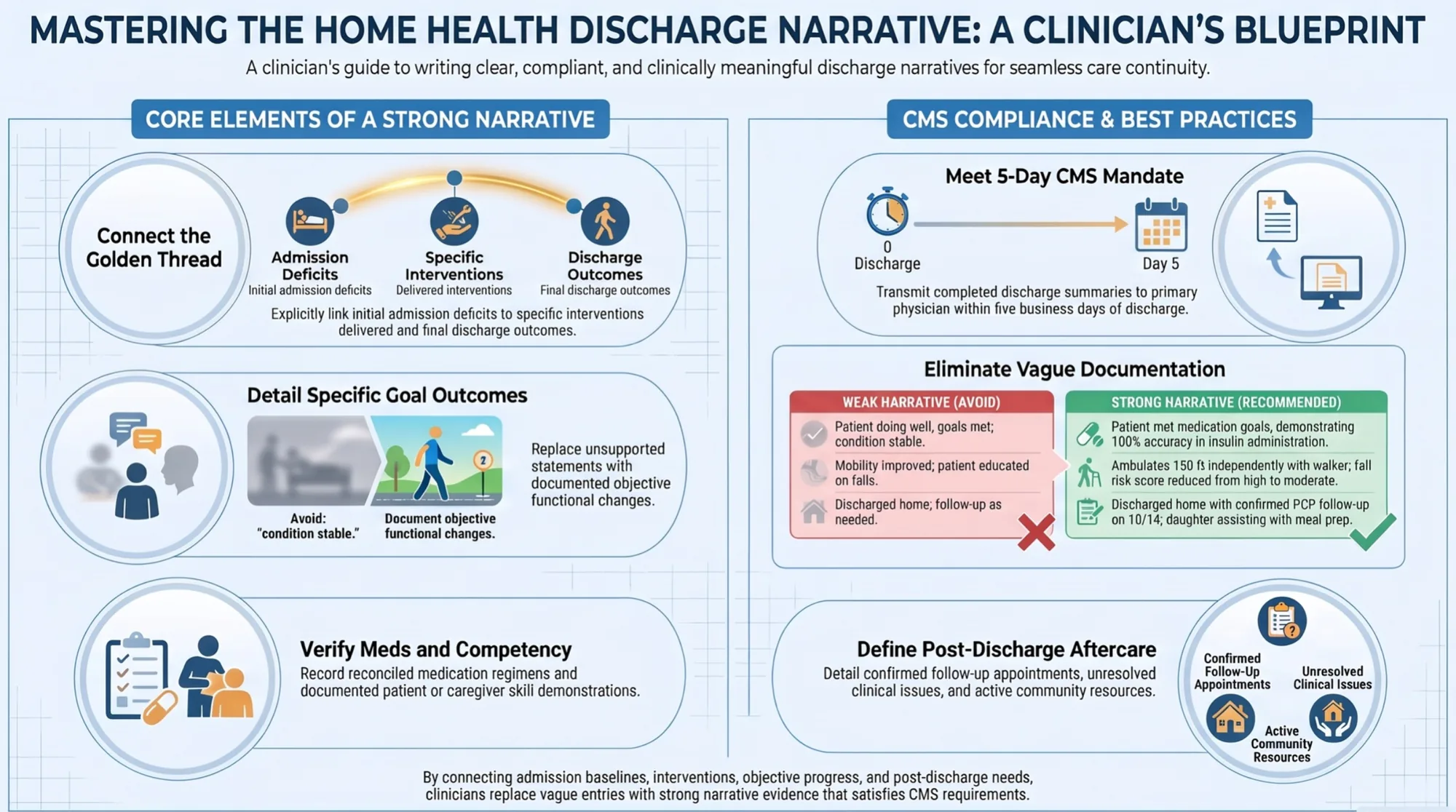
A strong discharge narrative connects admission baselines, interventions, objective progress, and post-discharge needs into one clear clinical account.
What Is an Example of a Weak Versus Strong Home Health Discharge Narrative?
The difference between a weak and strong narrative is often the quality of the clinical information.
What does a weak discharge narrative look like?
Patient doing well. Condition stable. Goals met. Patient educated. Discharged from home health services.
This note is brief, but it leaves several questions unanswered:
- What services were provided?
- What changed during the episode?
- Which goals were met?
- What clinical findings support the statement that the patient is stable?
- What education was provided?
- Can the patient or caregiver manage ongoing care?
- What happens after discharge?
How can the same narrative be made stronger?
The following is an illustrative example for a hypothetical patient. It should be adapted to the actual clinical findings, care plan, and discharge circumstances.
Patient admitted to home health following hospitalization for management of a chronic medical condition. Skilled nursing services focused on clinical assessment, medication reconciliation, disease management education, and monitoring for changes in condition.
During the episode, the patient received education regarding the prescribed medication regimen, symptom monitoring, and when to contact the healthcare provider. The patient's response to interventions and progress toward individualized care plan goals were documented during the episode.
At discharge, the patient demonstrated improved understanding of the medication regimen and was able to explain the key instructions reviewed during the episode. Relevant assessment findings were documented in the clinical record. The medication list was reviewed, and any identified discrepancies were addressed through the appropriate process.
The patient met the established education goals related to medication management and symptom recognition. Other care plan goals were reviewed, with their outcomes and any remaining limitations documented. The patient and caregiver received instructions regarding continued self-management and follow-up with the responsible healthcare professional.
Home health services were discontinued in accordance with the documented discharge plan. Relevant discharge information was communicated to the healthcare professional responsible for ongoing care.
The stronger example provides a clearer account of the episode and its outcomes. In actual documentation, general statements should be replaced with the patient's specific assessment findings, goal outcomes, medication details, and follow-up arrangements.
What Common Mistakes Should Clinicians Avoid When Writing Discharge Narratives?
Even when all the expected sections are present, a discharge narrative can be difficult to interpret if the information is vague, repetitive, or unsupported.
Are vague or subjective statements weakening the note?
Phrases such as "patient doing well," "condition stable," or "goals met" do not explain what the clinician observed.
Use specific, relevant findings to support statements about the patient's condition and progress.
Does the note simply repeat previous documentation?
A discharge narrative should summarize the episode and explain what changed. Copying information from admission assessments or previous visit notes without updating it can create inconsistencies.
Are unmet goals left unexplained?
If a goal was partially met or not met, document its status and the reason when known.
Is the patient's response to treatment missing?
Documenting that an intervention occurred is not the same as documenting its outcome. Explain how the patient responded and what progress was observed.
Is the patient's or caregiver's competency assumed?
Do not automatically describe someone as independent or competent because education was provided. Document demonstrated skills or understanding when assessed.
Are discharge instructions incomplete?
A note that explains why services ended but does not identify relevant next steps may leave important gaps in communication.
Does the narrative contain unsupported statements?
Do not document improvements, goal completion, medication understanding, or independence unless the available clinical information supports those statements.
Is the language judgmental?
Avoid labels such as "non-compliant" without explaining the circumstances.
Instead, describe objective barriers, such as difficulty obtaining medication, financial limitations, cognitive challenges, or the patient's stated decision not to follow a recommendation, when relevant and documented.
What CMS Requirements Apply to Home Health Discharge Documentation?
For Medicare-certified home health agencies, federal Conditions of Participation establish requirements for clinical records and discharge planning.
Under 42 CFR § 484.110, the clinical record must include a completed discharge summary sent to the primary care practitioner or other healthcare professional responsible for the patient's care after discharge, if any, within five business days of the patient's discharge.
The regulation also establishes separate timeframes for transfer summaries:
- Planned transfers: The transfer summary must be sent within two business days of the planned transfer.
- Unplanned transfers: The transfer summary must be sent within two business days of the agency becoming aware of the transfer, when the patient is still receiving care in the facility.
CMS requirements identify relevant discharge summary content, including:
- Admission and discharge dates.
- The physician responsible for the home health plan of care.
- Reason for admission.
- Types and frequency of services provided.
- Relevant laboratory data.
- Medications at discharge.
- Patient's condition at discharge.
- Outcomes in meeting care plan goals.
- Post-discharge instructions for the patient and family.
Under 42 CFR § 484.58, the agency's discharge planning process must support a safe and effective transition of care. Necessary medical information about the patient's current course of illness and treatment, post-discharge goals of care, and treatment preferences must be sent to the receiving facility or healthcare practitioner.
Clinical record entries must also be clear, complete, legible, dated, timed, and appropriately authenticated under § 484.110.
These are federal requirements for applicable Medicare-certified agencies. Agencies should also follow relevant state requirements, payer rules, and internal policies. A clinical discharge narrative should not be treated as a substitute for the complete discharge summary or other required documentation.
How Can Home Health Agencies Improve Discharge Documentation Consistency?
Agencies can improve discharge documentation by making the process more structured without turning it into a checklist exercise.
Can standardized templates reduce missing information?
A consistent framework can help clinicians remember important elements such as patient status, services, goal outcomes, medication reconciliation, education, and follow-up needs.
Templates should still allow patient-specific clinical details rather than encouraging generic statements.
How can agencies improve the connection between assessments and discharge documentation?
Encourage clinicians and reviewers to connect the admission assessment, plan of care, interventions, and discharge outcomes.
This helps identify unresolved problems and inconsistencies before the record is finalized.
How can documentation reviews improve clinical quality?
A review process can identify missing goal outcomes, unclear discharge instructions, inconsistent information, unsupported statements, or incomplete medication details.
Feedback should help clinicians improve documentation rather than focus only on correcting formatting.
How can agencies reduce repetitive documentation work?
Where appropriate, existing clinical information can be used to help prepare a structured discharge draft.
Clinicians should still verify that the information is current, relevant, and accurate before approving the final record.
Why should clinicians remain involved in the final review?
The discharge narrative reflects the patient's actual condition and care outcomes. Technology and templates can help organize information, but they should not replace clinical judgment or the required review and authentication process.
Can AI Help Clinicians Write Home Health Discharge Narratives?
AI can help reduce the administrative effort involved in preparing clinical documentation, including discharge narratives.
For example, an AI-supported workflow may help organize relevant information from assessments, visit notes, medication records, and care plan details into a structured draft.
This can reduce the time clinicians spend assembling information from different sections of the record.
However, AI-generated documentation must be handled carefully.
A responsible workflow should ensure that:
- The draft uses information from appropriate clinical sources.
- The patient's current discharge status is accurately represented.
- Admission and discharge findings are not confused.
- Care plan goals are not assumed to be achieved.
- Missing information is identified rather than filled with guesses.
- Contradictions are flagged for clinician review.
- Medication changes and follow-up details are verified.
- The clinician can edit and correct the draft.
- The final documentation is reviewed and approved by the responsible clinician.
AI should support documentation, not make unsupported clinical conclusions or replace professional judgment.
The objective is straightforward: reduce repetitive paperwork while keeping clinical accuracy and clinician control at the center of the process.
What Should Clinicians Check Before Finalizing a Home Health Discharge Narrative?
Before completing the discharge documentation, clinicians can use this checklist to review the most important elements.
- Are the patient identifiers and episode dates accurate?
- Is the reason for home health admission documented?
- Are the relevant diagnoses and clinical problems included?
- Are the services and interventions provided summarized?
- Is the patient's response to care documented?
- Is the patient's clinical condition at discharge described?
- Are relevant functional findings compared with admission?
- Are all individualized care plan goals addressed?
- Are goal outcomes supported by clinical findings?
- Are unresolved problems and remaining limitations documented?
- Is medication reconciliation completed according to agency policy?
- Is patient and caregiver education documented?
- Is demonstrated competency included when assessed?
- Is the discharge disposition and reason clear?
- Are follow-up arrangements, pending results, and ongoing needs addressed?
- Is the receiving provider or care setting identified when applicable?
- Has relevant discharge information been communicated?
- Is the documentation consistent with the clinical record?
- Has the record been dated, timed, and authenticated appropriately?
- Has the required discharge or transfer summary been sent within the applicable timeframe?
A final review helps ensure that the documentation reflects the patient's actual episode of care and supports a safe transition.
How Can a Strong Discharge Narrative Improve Continuity of Care?
A home health discharge narrative is the final clinical account of an episode of care, but its value extends beyond the last visit.
It helps the next healthcare professional understand why the patient received care, what interventions were provided, how the patient responded, which goals were achieved, and what needs attention moving forward.
The strongest narratives are not necessarily the longest. They are the ones that connect the patient's initial assessment to the care provided and the outcomes at discharge.
For home health agencies, improving discharge documentation means giving clinicians a consistent structure, reducing repetitive work, and making sure every final note reflects the patient's actual clinical journey.
Because when home health services end, the need for clear clinical communication does not.