
Long-Standing vs. New Medications in Home Health Documentation: What Nurses Need to Know
A patient's medication list often mixes drugs they've taken for years with brand-new prescriptions from a recent hospital stay — and the two need very different documentation. This guide breaks down what to document for long-standing vs. new medications, how to reconcile the regimen, and how to use teach-back to confirm understanding.
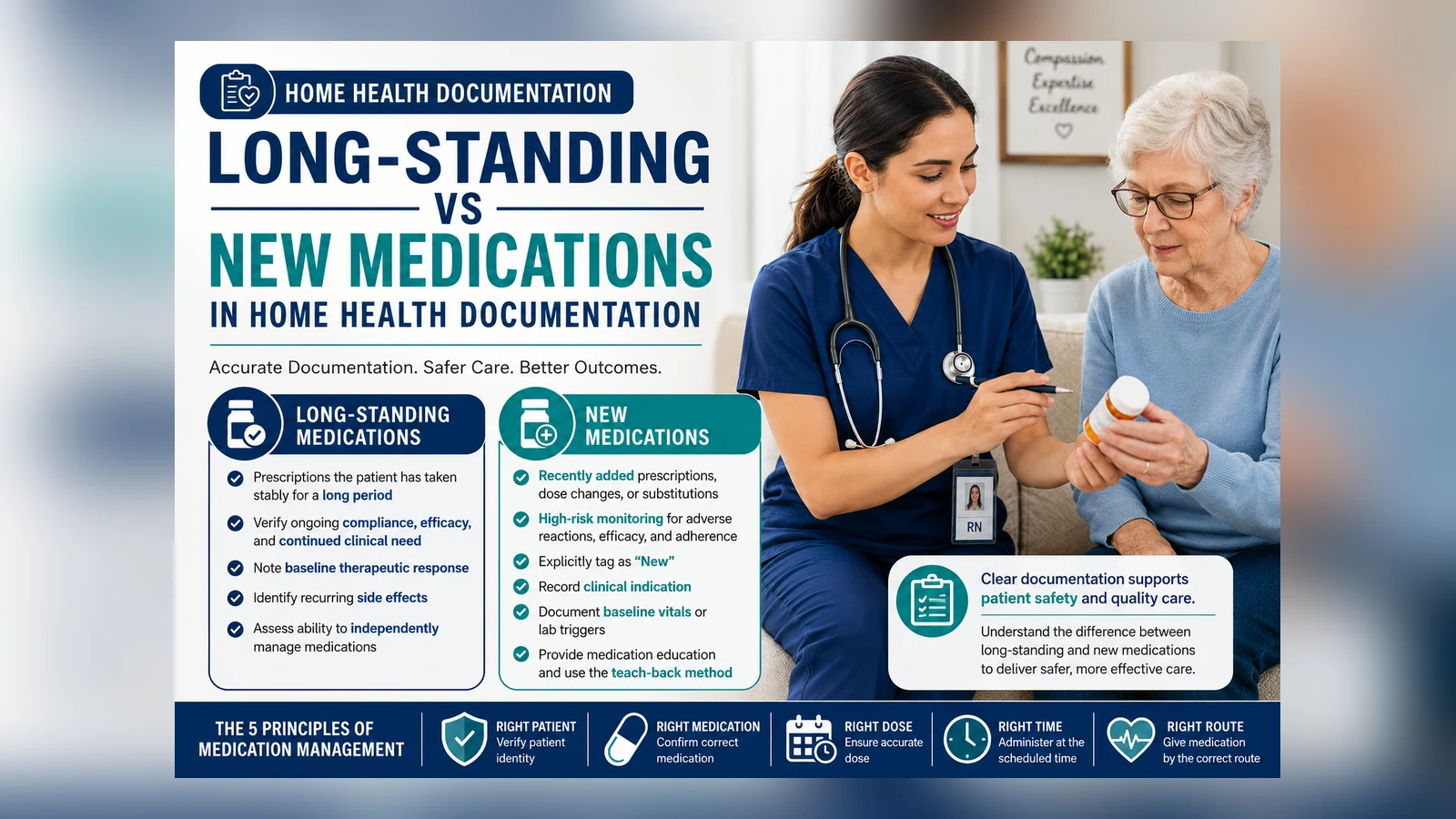
Key Takeaways
- Long-standing and new medications need different documentation priorities — baseline vs. change.
- For long-standing meds: verify current use, document therapeutic response, note recurring side effects, and assess self-management.
- For new meds: clearly identify the change, document the indication and baseline, monitor for adverse reactions, and track response.
- Education matters most for new medications — use the teach-back method and document demonstrated understanding.
- Reconcile every regimen; don't copy an old list forward — sources (hospital, pharmacy, patient report, bottles) often disagree.
- SOC, ROC, and discharge are key medication checkpoints, especially after a hospital transition.
- Strong documentation shows what changed, what stayed stable, what the patient is experiencing, and what the team did.
💡 Quick Answer: Long-standing medications and new medications call for different documentation priorities. For long-standing meds, document the baseline — is the patient still taking it, is it working, are there recurring side effects, can they self-manage? For new meds (after a hospitalization, dose change, or substitution), document the change — clearly identify it as new, note the clinical indication, establish baseline data, monitor for adverse reactions and response, and confirm understanding with teach-back.
Medication documentation in home health is more than creating a list of what a patient takes. A patient may have medications they've taken consistently for years while also returning home from a hospital stay with new prescriptions, dosage changes, or substitutions — and these two categories require different documentation priorities.
Long-standing medications require nurses to understand the patient's baseline: is the medication still clinically appropriate, is the patient taking it as prescribed, is it working, are there recurring side effects, and can the patient manage it independently? New medications, on the other hand, require closer attention to changes in condition, potential adverse reactions, therapeutic response, adherence, and patient or caregiver understanding. Distinguishing between the two makes documentation more clinically meaningful and helps the care team recognize medication-related concerns earlier.
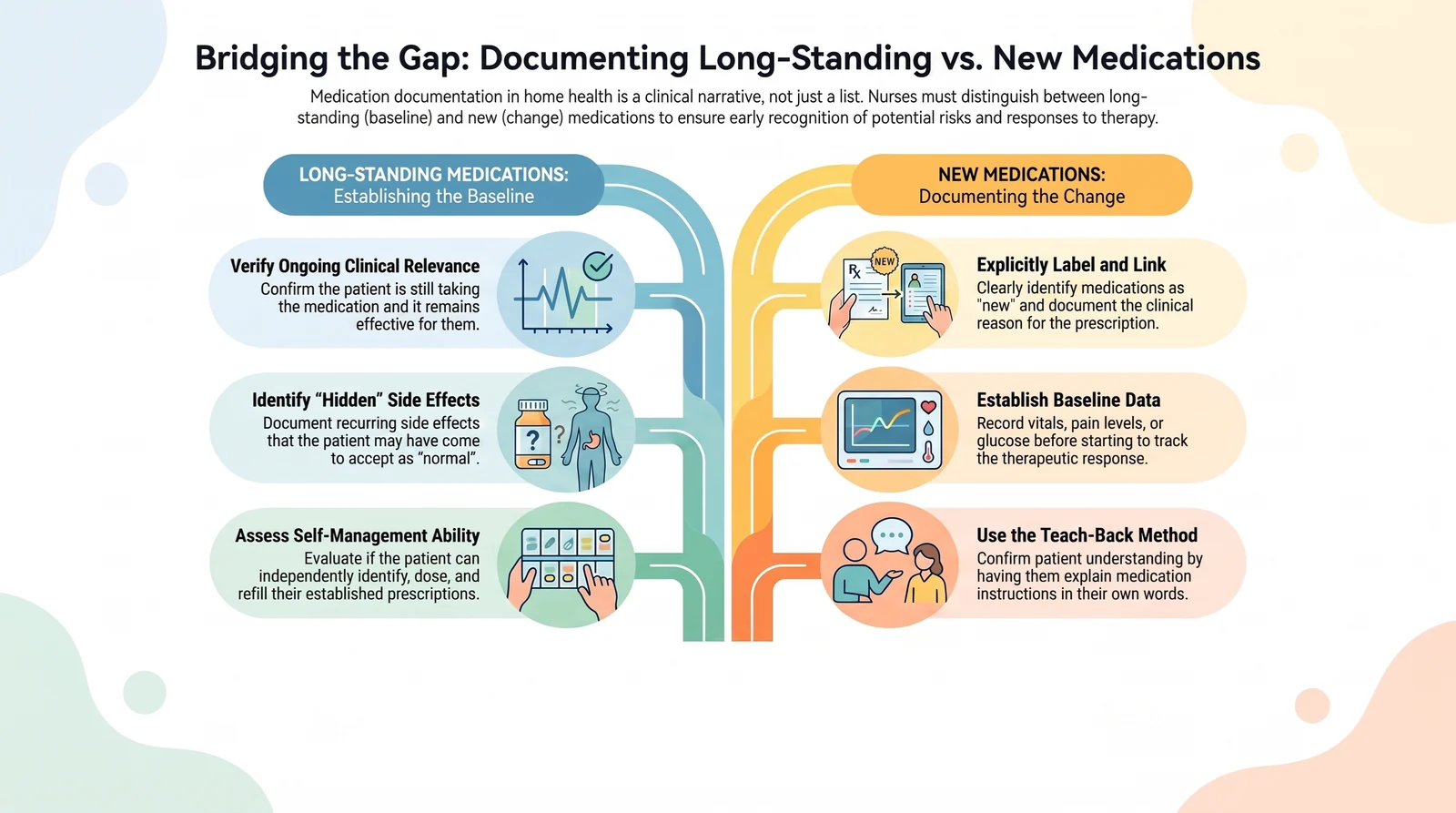
Medication documentation is a clinical narrative, not just a list: establish the baseline for long-standing meds and document the change for new ones.
What Is the Difference Between Long-Standing and New Medications?
The simplest distinction is when and why the medication became part of the patient's regimen.
Long-standing medications
Long-standing medications are prescriptions the patient has taken stably for an extended period before the current home health admission. Documentation should establish the patient's baseline experience: whether they consistently take it, whether it remains clinically effective, whether it continues to be needed, whether they experience recurring side effects, and whether they can manage it independently.
New medications
New medications are recently introduced prescriptions, dosage changes, or substitutions — often following a hospital discharge, a rehabilitation stay, a physician visit, a new diagnosis, a change in condition, or a transition between care settings. Because the medication is new to the regimen, documentation should place greater emphasis on monitoring, indication, response, adherence, and education.
Long-Standing Medications: What Should Home Health Nurses Document?
Long-standing medications can receive less attention because the patient has been taking them for a long time — but "long-standing" does not automatically mean "problem-free." The nurse should establish whether the medication continues to work as expected and whether the patient can safely manage it.
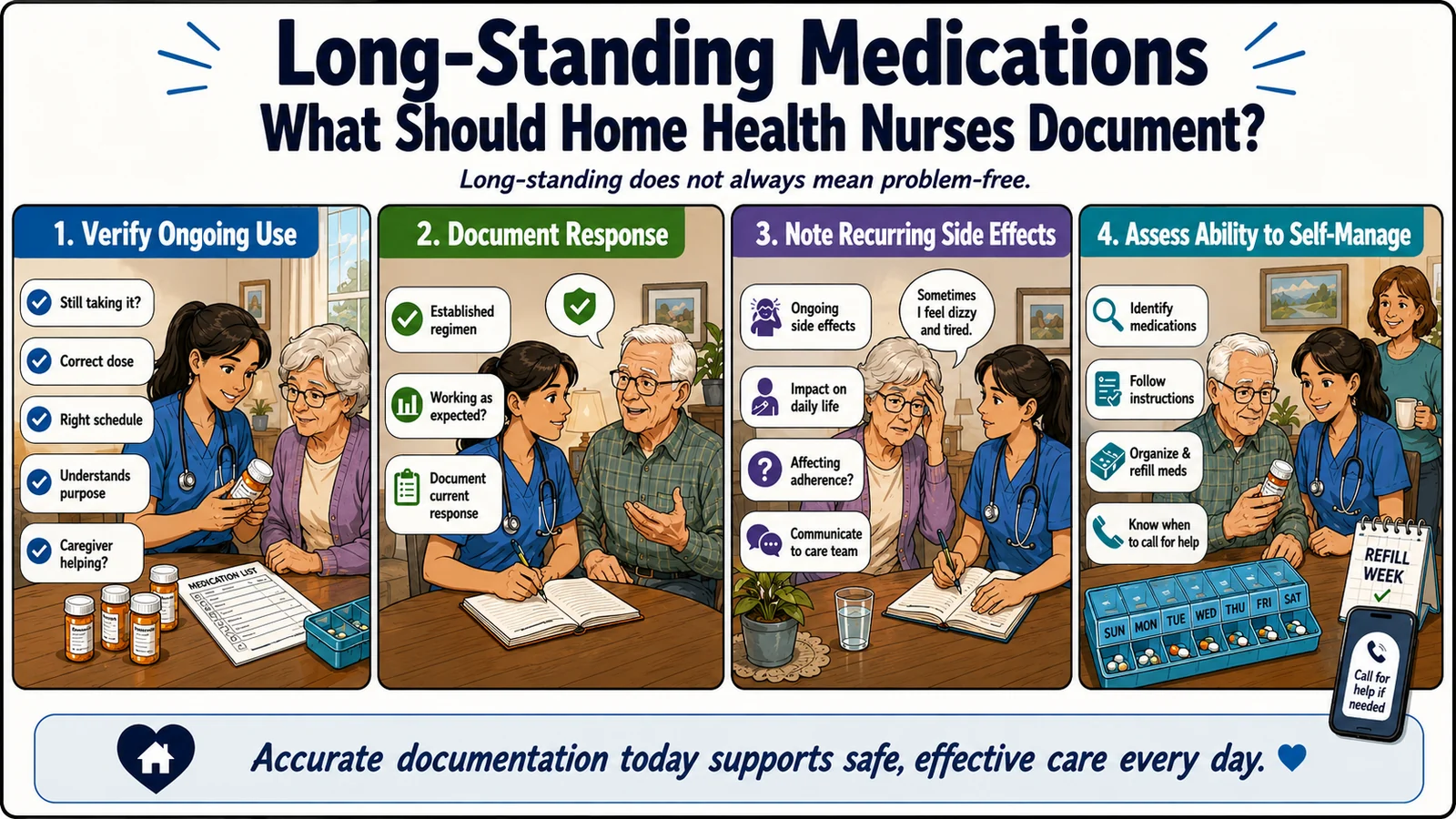
For long-standing medications: verify current use, document response, note recurring side effects, and assess the patient's ability to self-manage.
1. Verify ongoing medication use
First, determine whether the patient is actually taking the medication as prescribed: is it still being taken, at the prescribed dose and schedule, and does the patient understand its purpose — or is a caregiver assisting? A medication that appears on a previous list does not necessarily represent what the patient is currently taking.
2. Document baseline therapeutic response
For a long-standing medication, the patient's established response provides important clinical context. Rather than simply documenting "patient continues medication," a more useful note explains that the medication remains part of the established regimen and whether the patient's condition is responding as expected — reflecting the patient's actual condition and the nurse's assessment.
3. Note recurring side effects
A patient may have experienced a side effect for months or years and consider it "normal" — which doesn't mean it should be ignored. When relevant, document the reported or observed side effect, whether it's recurring, how it affects the patient, whether it affects adherence or daily activities, and whether the issue was communicated for further evaluation. The purpose isn't to diagnose or change the medication; it's to make clinically relevant observations visible to the care team.
4. Assess the patient's ability to manage the medication
Medication management also means determining whether the patient can independently manage their regimen — can they identify their medications, understand dosing, follow the schedule, organize medications, recognize when refills are needed, explain what a medication is for, and know when to contact a healthcare professional? This matters most when a patient has a complex regimen or limited caregiver support.
New Medications: What Should Home Health Nurses Document?
New medications require a different level of attention. A medication recently introduced after a hospitalization or other transition can represent a significant change in the treatment plan — and the documentation should make that change clear.
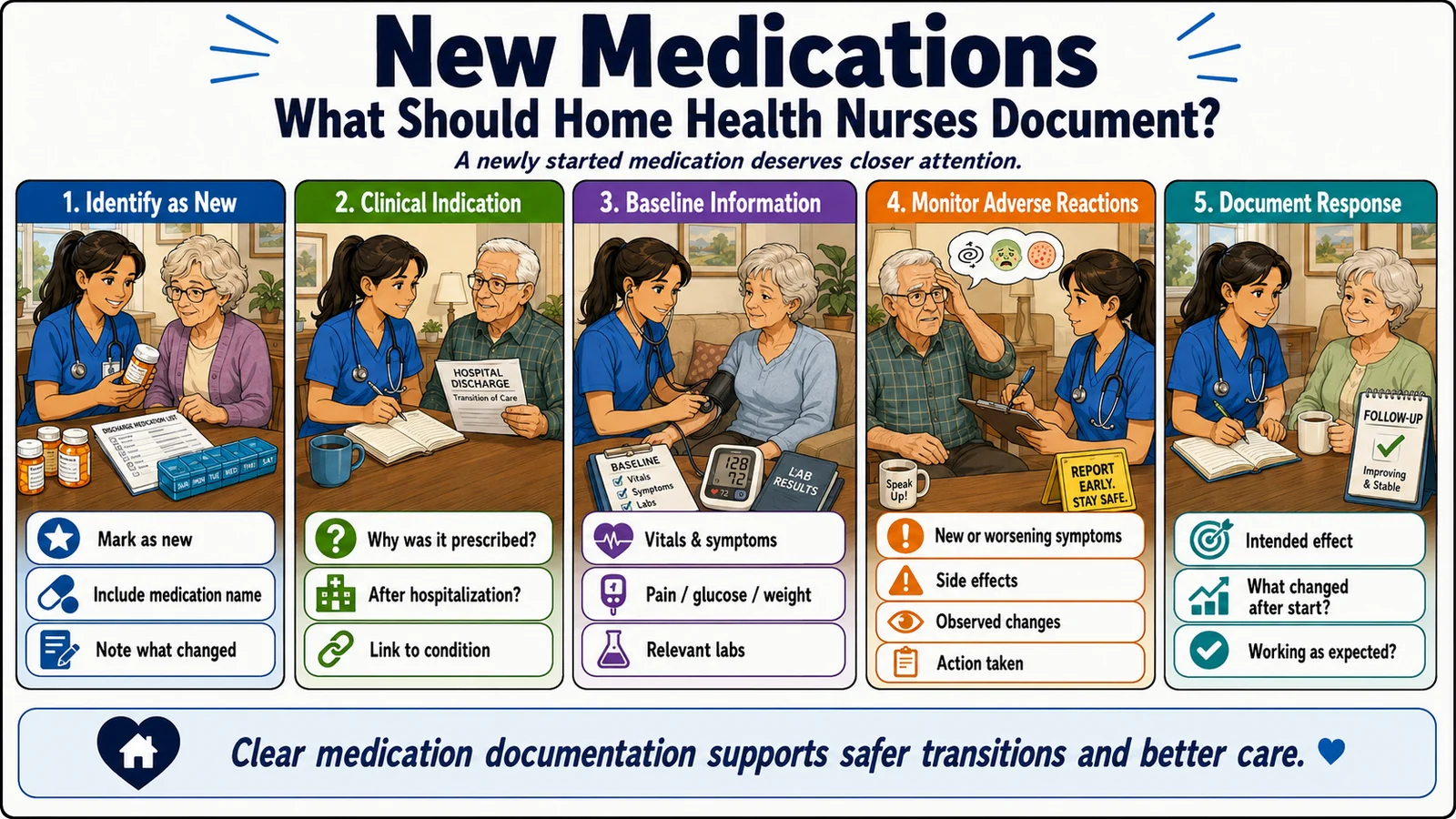
For new medications: identify the change, document the indication and baseline, monitor for adverse reactions, and track therapeutic response.
1. Explicitly identify the medication as new
When appropriate, clearly distinguish the medication from the patient's established regimen — for example, New medication: [medication name] — then document the relevant details based on the orders and assessment. Clearly identifying what changed makes it easier for another clinician reviewing the chart to understand the medication history.
2. Document the clinical indication
A new medication should be connected to the clinical reason it was prescribed when that information is available — for example, "new medication prescribed following recent hospitalization for [documented condition]." The goal is context rather than simply adding another name to a list, which is especially valuable during transitions of care when multiple medication changes may occur at once.
3. Establish relevant baseline information
New medications may require closer monitoring of response. Depending on the medication and situation, relevant baseline information may include vital signs, symptoms, pain level, blood glucose, weight, relevant laboratory information, or other clinically relevant findings — appropriate to the medication and condition, rather than automatically documenting every possible measurement.
4. Monitor for adverse reactions
A new medication can introduce new risks. Nurses should observe and document relevant changes — new or worsening symptoms, reported side effects, changes in vital signs or functional status, patient tolerance, and concerns affecting adherence — and communicate concerns through the appropriate clinical and agency processes. The documentation should distinguish between what the patient reported, what the nurse observed, and what action was taken.
5. Document therapeutic response
New medications also require attention to whether the intended effect is occurring: what was the medication intended to address, and what changed after it was started? Documenting response over time gives the care team a clearer picture of whether the treatment plan is working as intended.
Patient and Caregiver Education for New Medications
Education is especially important when a medication is newly introduced. Patients may return home with several new prescriptions and little understanding of how the new regimen differs from before. Education may address the medication name, purpose, dose, frequency, route, timing, administration instructions, relevant precautions, potential concerns, what to do if problems occur, and when to contact the appropriate healthcare professional.
Use the teach-back method
Simply telling a patient how to take a medication does not establish that they understood. The teach-back method gives the patient an opportunity to explain the information in their own words — for example, "can you tell me how you'll take this medication when you get home?" The nurse can then document the education provided and the patient's demonstrated understanding, based on what actually occurred during the visit. This is particularly useful for new medications, where misunderstandings can affect adherence and safe use.
Medication Reconciliation: Don't Just Copy the List
Medication reconciliation is particularly important during transitions of care. A patient may have information from hospital discharge paperwork, physician orders, pharmacy information, previous home health records, patient or caregiver report, and the medication bottles in the home — and these sources may not always match. The documentation should reflect the current medication situation, rather than simply copying an older list into the new record. Copy-forward errors like this are among the top documentation errors in home health.
Common medication discrepancies
- Different dose — the hospital paperwork lists one dose, but the patient reports taking another.
- Different frequency — the medication is prescribed once daily, but the patient reports taking it twice.
- Medication listed but no longer taken — a previous medication remains on the list even though it was discontinued.
- New medication missing from the list — the patient received a new prescription that hasn't been incorporated.
- Patient doesn't have the medication — the prescription exists, but the patient hasn't obtained it yet.
- Patient doesn't understand the medication — the patient has it but can't explain what it's for or how to take it.
Each discrepancy should be addressed according to the appropriate clinical and agency process, with documentation showing what was identified and what action was taken.
Long-Standing vs. New Medications: Documentation Comparison
| Documentation area | Long-standing medication | New medication |
|---|---|---|
| Medication history | Established regimen | Recently added or changed |
| Clinical focus | Baseline response and continued need | Response and potential adverse effects |
| Side effects | Recurring or established effects | New or unexpected reactions |
| Clinical indication | Establish ongoing relevance | Document reason for new prescription when available |
| Baseline assessment | Relevant established condition/status | Relevant baseline before monitoring response |
| Patient education | Reinforce as needed | Usually requires focused education |
| Teach-back | When appropriate | Particularly useful for new instructions |
| Follow-up | Ongoing management | Closer monitoring may be appropriate |
| Documentation priority | Stability and continued management | Change, monitoring, response, and education |
Why the Distinction Matters in Home Health
The distinction helps tell the patient's clinical story. Consider a patient returning home after hospitalization with a previously stable regimen. After discharge, one medication was discontinued, one dose increased, two new medications added, and another substituted. If the documentation simply contains a long list, the change itself becomes hard to see. A stronger process highlights what's established, what's new, what changed, and how the patient is responding — improving communication between the nurse, physician, caregiver, pharmacist, and other team members. It's the same principle behind writing a stronger home health visit note.
Medication Documentation Across the Episode
Start of Care (SOC)
At Start of Care, nurses often encounter patients who recently transitioned from another setting, making reconciliation especially important. A practical workflow: review available medication information, ask the patient or caregiver what's actually being taken, review medication containers when appropriate, identify new and discontinued medications and dose/frequency changes, flag discrepancies, assess medication-related risks, provide education, and document findings and actions. The goal is a reliable medication baseline for the episode.
Resumption of Care (ROC)
If a patient was hospitalized during an existing episode, Resumption of Care is another key checkpoint. Look for new prescriptions, discontinued medications, dose or frequency changes, new diagnoses affecting medication management, patient understanding of the revised regimen, and post-discharge discrepancies. The ROC documentation should reflect the patient's post-hospitalization medication situation.
Discharge
Reconciliation remains important when services end. The regimen may have changed throughout the episode, and the information provided to the patient or caregiver should reflect the current situation. A clear medication record supports continuity to the next stage of care; where applicable, document medication-related education and communication provided at discharge per current requirements and agency policy.
Common Medication Documentation Errors
- Treating every medication the same — long-standing and new meds have different priorities; identify what's established versus what recently changed.
- Copying forward an old medication list — a prior list may no longer represent the current regimen; reconcile the current situation.
- Failing to identify new medications — if a new med is buried in a long list, the change isn't obvious; clearly identify recent additions or changes.
- Documenting a new medication without its clinical context — recording only the name doesn't explain why it was added or what happened; document indication, baseline, monitoring, response, and education.
- Ignoring recurring side effects — a patient may consider a long-standing side effect "normal"; document relevant effects and communicate concerns.
- Documenting education without assessing understanding — "medication teaching provided" doesn't demonstrate understanding; use teach-back and document what the patient showed.
A Practical Medication Documentation Workflow
- Identify — what medications are part of the current regimen?
- Classify — which are long-standing, new, changed, or discontinued?
- Reconcile — compare the patient's reported medications with available orders and records.
- Assess — for long-standing meds: adherence, therapeutic response, recurring side effects, self-management. For new meds: indication, baseline, adverse reactions, response, adherence.
- Educate — provide appropriate education and use teach-back when appropriate.
- Communicate — escalate discrepancies or clinically relevant concerns through the appropriate channels.
- Document — record what was actually assessed, observed, reported, taught, communicated, and followed up.
Home Health Medication Documentation Checklist
Long-standing medications
- Is the medication still being taken?
- Are dose and frequency consistent with the current regimen?
- Is the patient adherent?
- Is it producing the expected therapeutic response?
- Are there recurring side effects?
- Can the patient manage it independently?
- Does the patient need additional education?
New medications
- Is the medication clearly identified as new or recently changed?
- Is the clinical indication documented when available?
- Has relevant baseline information been established?
- Has the patient's response been assessed?
- Have relevant adverse reactions been monitored?
- Has adherence been assessed?
- Was patient/caregiver education provided, with teach-back when appropriate?
- Were clinically relevant concerns communicated and follow-up documented?
Final Takeaway
Long-standing and new medications should not be treated as identical documentation tasks. For long-standing medications, the focus is the baseline — is the patient taking it, is it working, are there recurring side effects, can they manage it? For new medications, the focus shifts to the change — why was it added, what was the baseline, is the patient tolerating it, is it producing the intended response, and do they understand how to take it? The strongest home health medication documentation doesn't just tell the next clinician what's on the list; it tells them what changed, what stayed stable, what the patient is experiencing, and what the care team did about it.
📝 Important: Medication documentation should always follow the patient's actual clinical situation, current physician/practitioner orders, applicable CMS/OASIS guidance, payer requirements, and agency policies. This article is educational and is not a substitute for current regulatory or clinical guidance.
What Should I Document? 100 OASIS Situations Home Health Nurses Face Every Day
100 real OASIS scenarios, worked end to end — clinical situation, common mistake, better approach, and key takeaway. Built around OASIS-E2 (effective April 1, 2026) to turn what you assess into accurate, defensible documentation.
Bottom Line
Long-standing and new medications aren't identical documentation tasks. Long-standing meds are about the baseline — is the patient taking it, is it working, are there recurring side effects, can they manage it. New meds are about the change — why it was added, the baseline, tolerance, response, and understanding. The strongest medication documentation doesn't just list the drugs; it tells the next clinician what changed, what stayed stable, what the patient is experiencing, and what the care team did about it.

Arvind Sarin is the founder of Copper Digital. For the past year he has spent three days a week inside a 500+ census Texas home health agency, building AI documentation that finishes OASIS and visit notes the same day, with a nurse reviewing and approving every note. He writes about home health documentation, OASIS, Medicare compliance, and applying AI responsibly in clinical workflows.
Frequently asked
Frequently asked questions
A long-standing medication is a prescription the patient has been taking stably for an extended period before the current home health admission. Documentation focuses on continued use, effectiveness, side effects, adherence, and the patient's ability to manage the medication.
Join the conversation
Leave a comment
Related reading
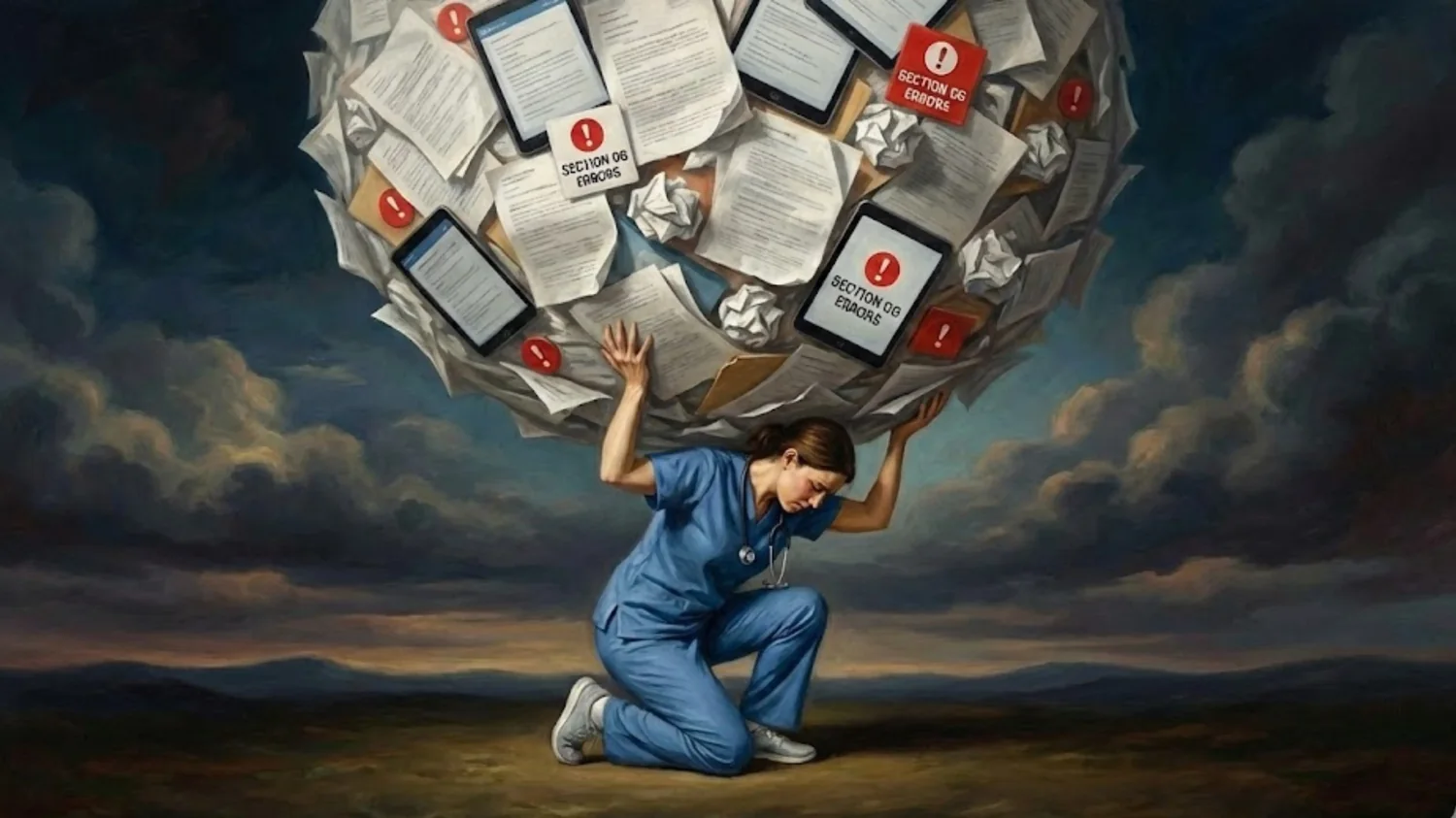
Why OASIS Documentation Is Burning Out Your Nurses
OASIS documentation is the CMS-required Outcome and Assessment Information Set that home health nurses complete for Medicare patients. With more than 100 data elements and a Start of Care assessment that takes 60 to 90 minutes, it often follows nurses home as after-hours 'pajama time,' making it a leading cause of home health nurse burnout. AI-powered documentation with human-in-the-loop review can cut charting time and give nurses their evenings back.

The Biggest Documentation Challenges Home Health Nurses Face
Home health nurses face heavy documentation challenges: delayed point-of-care charting, excessive administrative time, clunky EHRs, OASIS complexity, strict reimbursement rules, working in isolation, endless QA corrections, and after-hours charting that drives burnout. Reducing documentation burden is now essential for clinician retention, patient outcomes, and agency financial performance.

Home Health Is Not What Most People Think It Is
Most people, even those who work near the industry, misunderstand what home health is. Kathy Duckett, RN, explains the bridge it was designed to be, how it differs from home care and hospice, why OASIS accuracy is everything, and where AI can genuinely help nurses.