
Top Documentation Errors in Home Health (and How to Avoid Them)
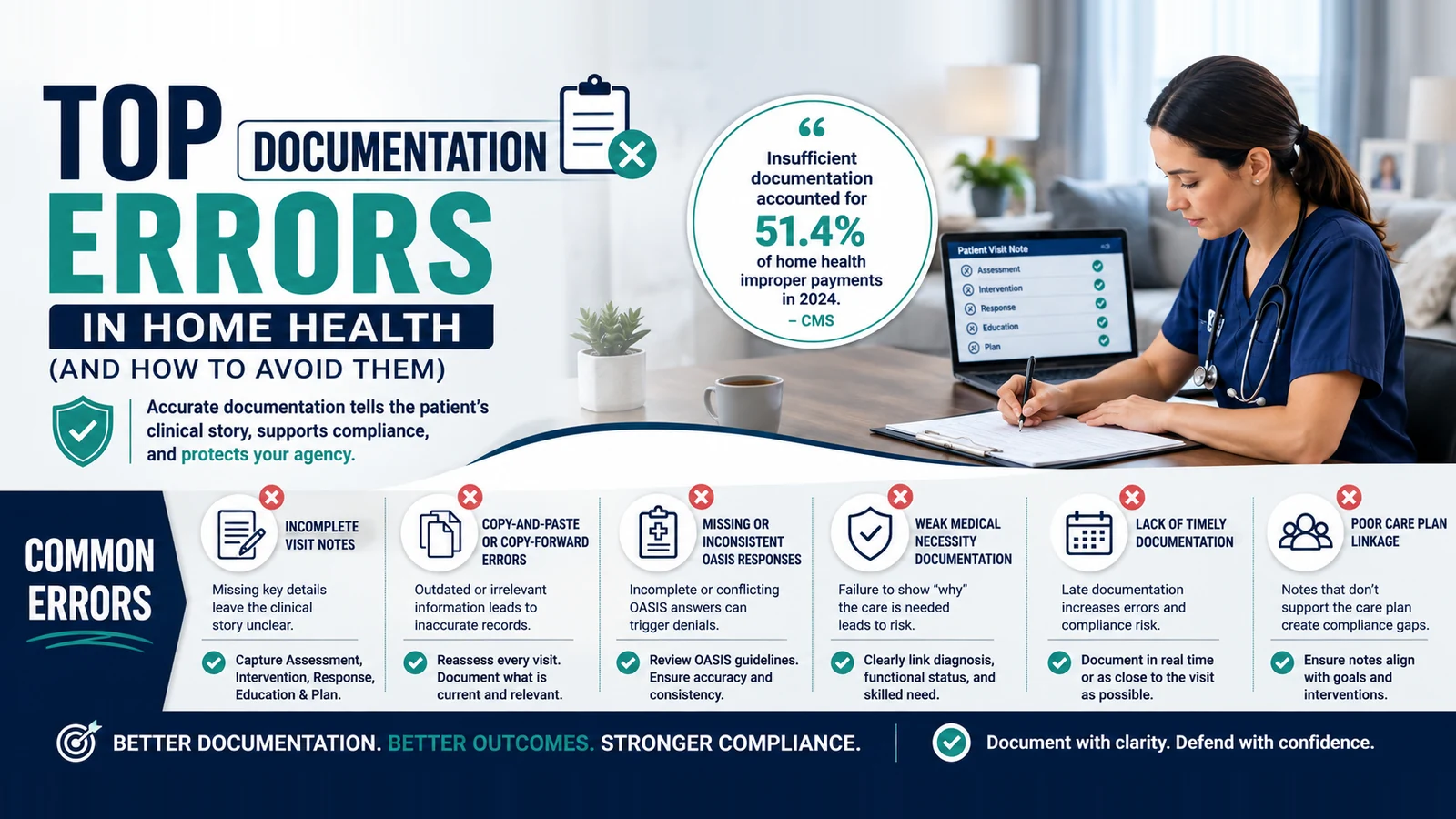
A home health note can be technically complete and still be clinically weak, and CMS ties 51.4% of home health improper payments to insufficient documentation. This guide walks through the 15 most common documentation errors with weak-vs-strong examples, then shows how to prevent them with standards, audits, in-workflow checks, and clinician-reviewed AI.
Key Takeaways
- CMS reports insufficient documentation accounted for 51.4% of home health improper payments in the 2024 reporting period, documentation is a top risk area.
- A note can be technically complete and still clinically weak; the test is whether it tells the patient's clinical story.
- The most common errors: incomplete notes, copy-forward, unsupported statements, contradictions, weak medical-necessity and homebound support, medication and wound gaps, vague education, missing patient response, and OASIS that doesn't match the record.
- Use a repeatable structure, Assessment → Intervention → Response → Education → Plan, and connect every conclusion to objective evidence.
- Reduce errors with standards, real-example training, regular audits, in-workflow quality checks, and clinician-reviewed AI, not by telling nurses to 'document better.'
- AI can flag missing information, contradictions, and OASIS gaps, but the clinician reviews and approves the final record.
- OASIS-E2 is effective April 1, 2026; keep documentation aligned with current CMS guidance.
💡 Quick Answer: A home health note can be technically "complete" and still be clinically weak. CMS reports that insufficient documentation accounted for 51.4% of home health improper payments in the 2024 reporting period, so the real question isn't "did the nurse complete the documentation?" but "does the documentation accurately tell the patient's clinical story?" The most common errors, incomplete notes, copy-forward, unsupported statements, contradictions, weak medical-necessity and homebound support, medication and wound gaps, vague education, missing patient response, and OASIS that doesn't match the record, are all preventable with clear standards, real examples, auditing, and clinician-reviewed technology.
Home health documentation has never been just about completing a note before the end of the day. Every assessment, skilled visit note, medication update, wound assessment, care plan, and OASIS response contributes to the patient's clinical record. Together, these pieces need to tell a consistent and defensible story about the patient's condition, the care provided, why that care was necessary, and what happens next.
That becomes especially important when documentation is reviewed by a payer, auditor, surveyor, or another clinician. A note can be technically "complete" and still be clinically weak. For example, a nurse may document "Patient tolerated visit well." But that doesn't tell the next clinician what was assessed, what intervention was performed, why it was needed, whether anything changed, or how the patient responded.
CMS's Medicare provider compliance guidance reports that insufficient documentation accounted for 51.4% of home health improper payments in the 2024 reporting period, making documentation one of the most significant areas of risk for home health providers. At the same time, agencies are working with evolving OASIS requirements, including OASIS-E2, effective April 1, 2026.
Below are the most common documentation problems home health agencies encounter and practical ways to prevent them.
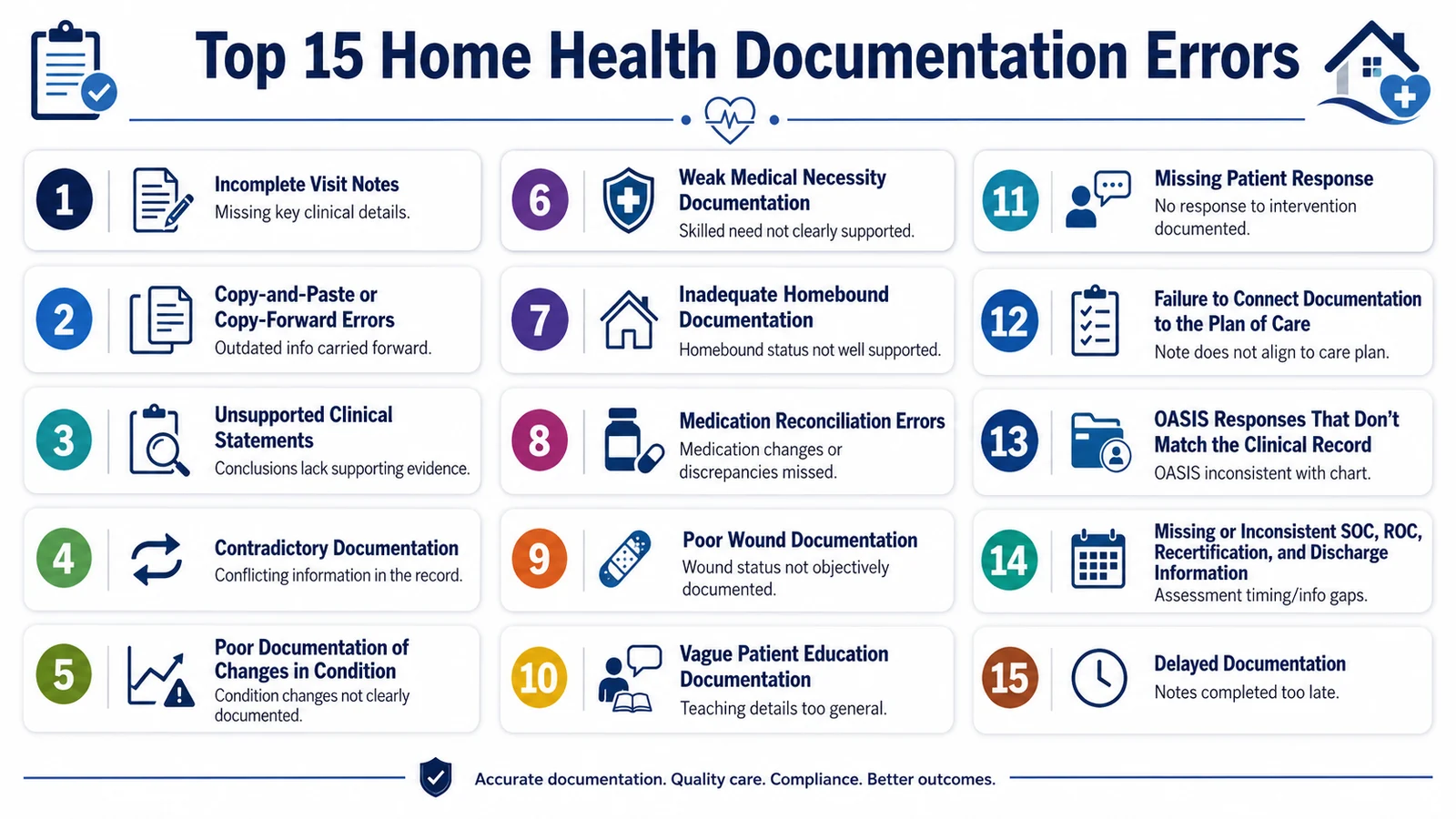
The 15 most common home health documentation errors at a glance.
1. Incomplete Visit Notes
One of the most common problems is a visit note that technically exists but doesn't contain enough clinical information to explain what happened during the visit. This often happens under time pressure: the nurse completes the required fields, selects the checkboxes, and moves on. The result may look complete in the EHR while leaving important questions unanswered. A reviewer should be able to understand:
- What was the patient's condition?
- What did the clinician assess?
- What skilled service was provided?
- Why was the intervention necessary?
- How did the patient respond?
- Was education provided?
- Were there changes from baseline?
- What is the plan for follow-up?
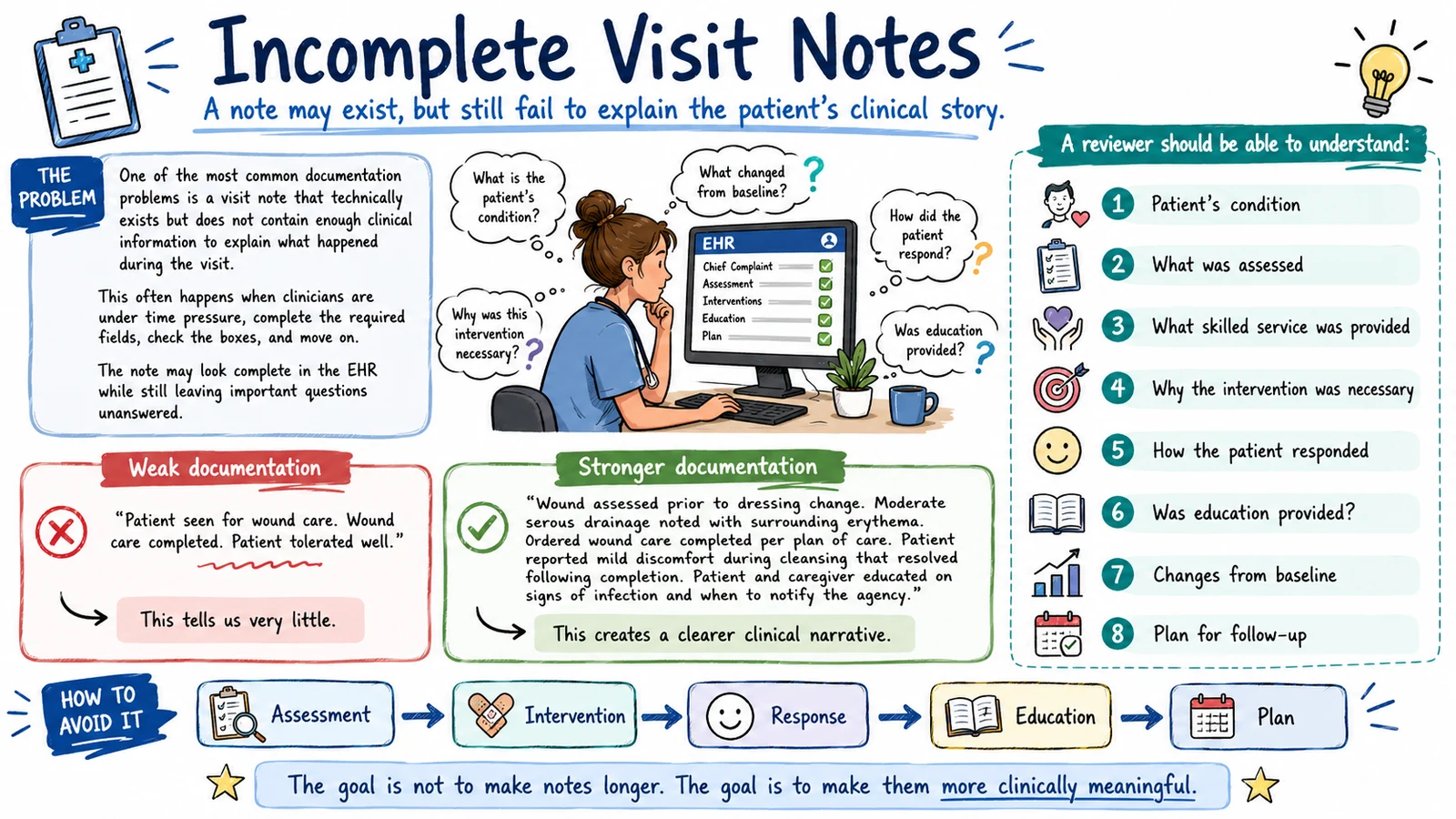
A note can exist and still fail to tell the clinical story, the fix is a repeatable Assessment → Intervention → Response → Education → Plan structure.
Weak documentation:
Patient seen for wound care. Wound care completed. Patient tolerated well.
Stronger documentation:
Wound assessed prior to dressing change. Moderate serous drainage noted with surrounding erythema. Ordered wound care completed per plan of care. Patient reported mild discomfort during cleansing that resolved following completion. Patient and caregiver educated on signs of infection and when to notify the agency.
➡️ A simple framework helps clinicians consistently capture the essentials: Assessment → Intervention → Response → Education → Plan. The objective isn't longer notes, it's more clinically meaningful ones.
2. Copy-and-Paste or Copy-Forward Errors
Templates and previous notes help clinicians avoid re-entering information that genuinely hasn't changed. The problem begins when information is copied forward without being reassessed. An old wound measurement might remain in a new note. A discontinued medication might still appear active. A previous pain score might be carried forward even though the patient's condition has changed. These errors are concerning because the documentation may appear polished and complete while containing information that is no longer accurate. Copy-forward errors commonly involve:
- Wound measurements
- Medication lists
- Pain scores
- Functional status
- Vital signs
- Patient education
- Caregiver availability
- Mobility status
- Previous clinical findings
Before signing a note, clinicians should ask: "Is every clinical fact documented here true for today's visit?" Templates should reduce administrative burden while still requiring the clinician to validate current clinical information.
➡️ A useful quality-control flow: Previous documentation → Current assessment → Current intervention → Current response → Current plan. If something has changed, the current record should reflect that change.
3. Unsupported Clinical Statements
Another common problem is documenting a clinical conclusion without documenting the evidence behind it. "Patient is at high risk for falls", but why? "Wound is improving", based on what? "Patient educated on diabetes", what exactly was taught, and did the patient understand? These statements communicate the clinician's conclusion but don't provide enough information to understand how it was reached.
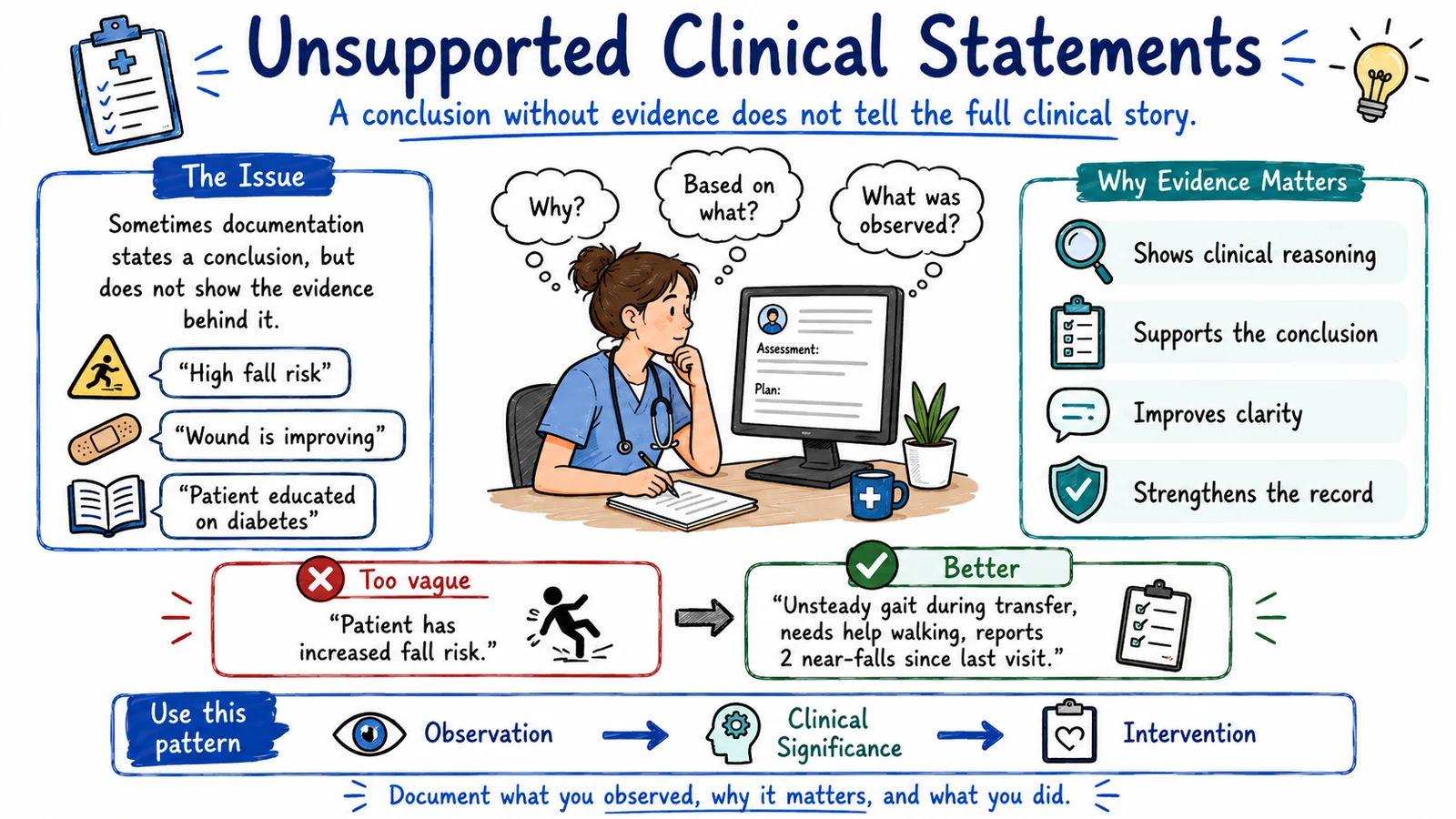
A conclusion without evidence doesn't tell the full clinical story, connect it to observable findings.
Instead of "Patient has increased fall risk," consider: "Patient demonstrates unsteady gait during sit-to-stand transfer and requires assistance with ambulation. Patient reports two near-falls since the previous visit." Now the reader can understand the clinical reasoning.
➡️ A useful pattern: Observation → Clinical significance → Intervention. This turns vague statements into clinically useful documentation.
4. Contradictory Documentation
A patient's chart should tell one coherent clinical story, but contradictions can occur between different parts of the record. For example: OASIS indicates the patient is independent while the narrative describes assistance with ADLs; the medication list marks a drug discontinued while the visit note says the patient is taking it; a wound note says the wound is improving while measurements show deterioration; the plan of care specifies one frequency while visit documentation suggests another; one section documents no pain while another documents significant pain. These inconsistencies make it difficult to determine what is actually happening. CMS guidance emphasizes OASIS accuracy and consistency with the patient's actual status.
➡️ Periodically review consistency across: OASIS ↔ Comprehensive Assessment ↔ Visit Notes ↔ Plan of Care ↔ Medication Profile. The goal isn't identical sections, it's every section reflecting the same underlying clinical reality.
5. Poor Documentation of Changes in Condition
One of the most valuable things a home health clinician brings is familiarity. A nurse may know a patient is "not themselves" before a change becomes obvious in the vital signs, more fatigued, less responsive, a change in mentation, eating less, walking differently, new pain, looking pale, a change in mobility, new symptoms, or a subtle change in behavior. The challenge is translating that observation into objective documentation.
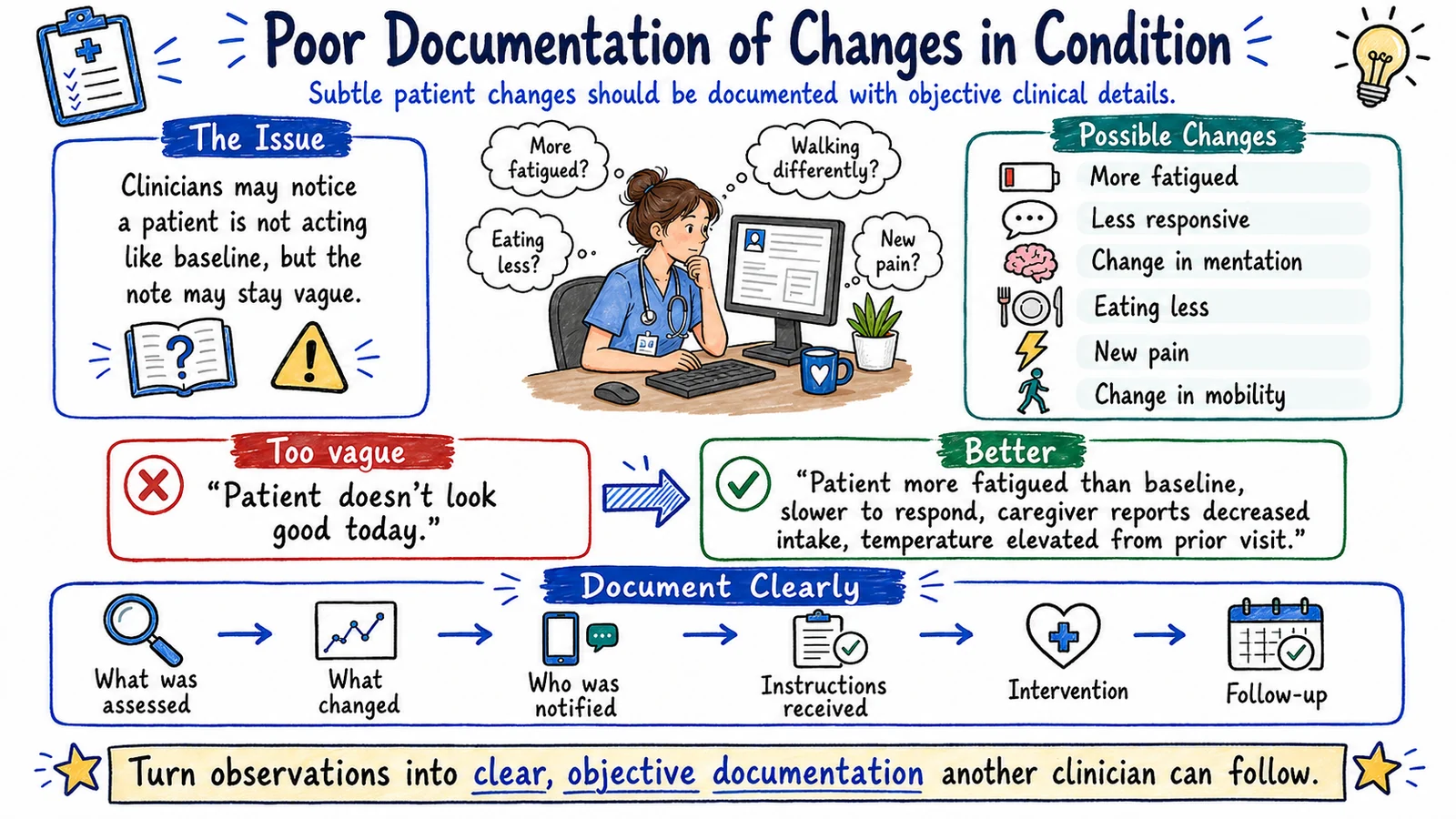
Subtle changes should become objective documentation another clinician can follow.
Instead of "Patient doesn't look good today," document what you observed: "Patient appears more fatigued than baseline and requires additional time to respond to questions. Caregiver reports decreased oral intake since yesterday. Patient's temperature is elevated compared with previous visit." The note can then explain what was assessed, what changed, who was notified, what instructions were received, what intervention occurred, and what follow-up is required, creating a clinical timeline another professional can follow.
6. Weak Medical Necessity Documentation
One of the most important questions a home health record needs to answer is: why was skilled care necessary? Simply documenting that a nurse visited doesn't explain why skilled nursing was required. The documentation should connect the patient's condition to the skilled service provided.
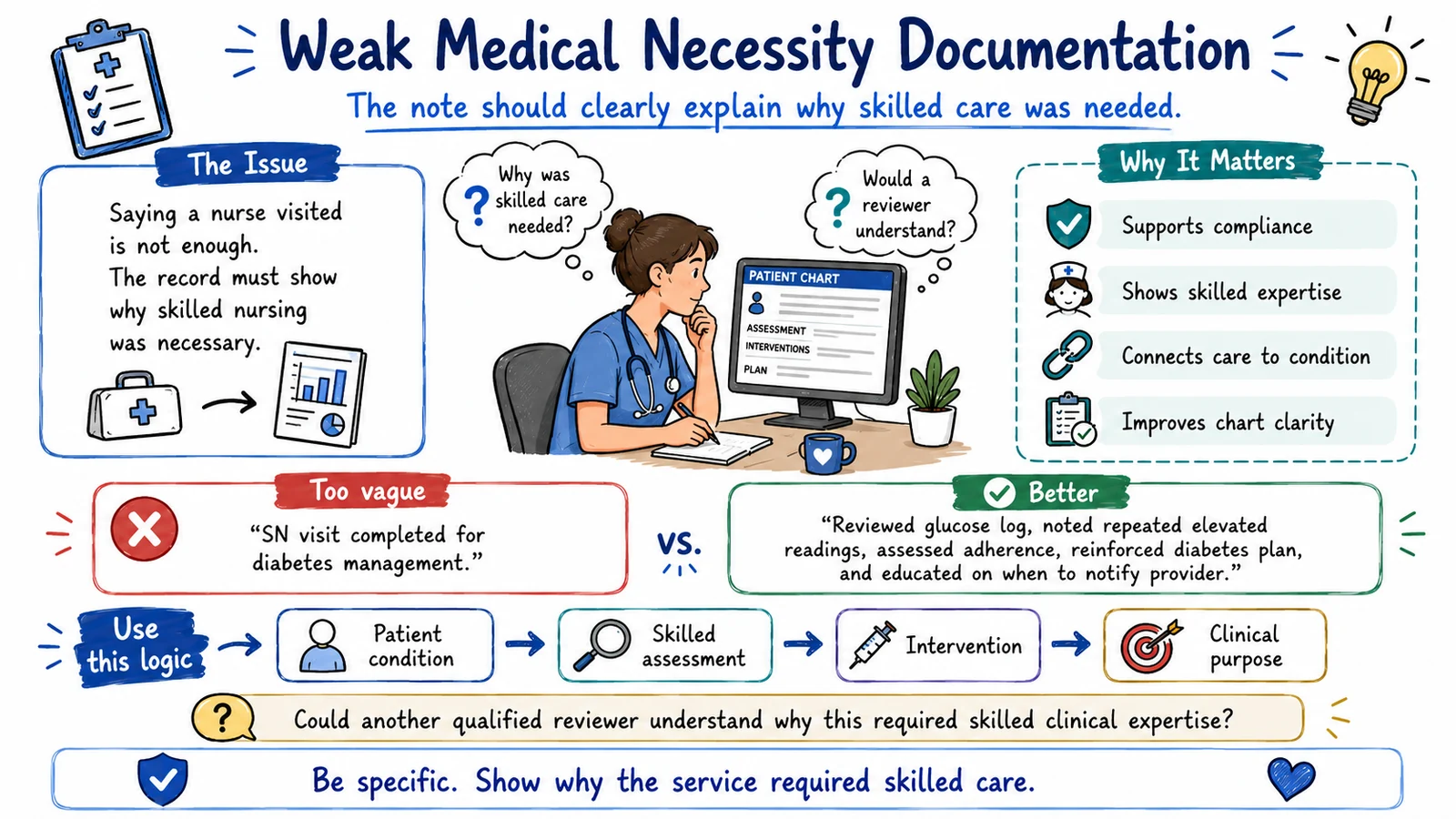
The note should make it obvious why the service required skilled clinical expertise.
Weak: "SN visit completed for diabetes management."
Stronger: "Skilled nursing provided assessment of blood glucose management, reviewed the patient's glucose log, identified repeated elevated readings, assessed medication adherence, reinforced the prescribed diabetes management plan, and educated the patient on signs and symptoms requiring provider notification."
➡️ The stronger example establishes a relationship between Patient condition → Skilled assessment → Intervention → Clinical purpose. Ask: "Could another qualified reviewer understand why this service required skilled clinical expertise?" If not, add specificity.
7. Inadequate Homebound Documentation
Homebound status should not simply become a checkbox carried from one visit to the next. The record should describe the patient's actual circumstances and limitations consistent with Medicare requirements. "Patient is homebound" doesn't provide much clinical context. Stronger: "Patient requires assistance and an assistive device to ambulate due to generalized weakness and impaired balance following recent hospitalization. Leaving the home requires assistance from another person and considerable effort." Document relevant factors such as:
- Functional limitations
- Need for assistance
- Use of assistive devices
- Symptoms or conditions affecting mobility
- Difficulty leaving the home
- Frequency or circumstances of absences from the home
Homebound status should be supported by the patient's actual clinical condition, not simply repeated because it appeared in the previous note.
8. Medication Reconciliation Errors
Medication management is another area where documentation can quickly become outdated. A patient may return home with several medication changes, a physician may discontinue one drug and start another, a dosage may change, or the patient may be taking medications that don't appear on the agency's list. When the profile is copied forward, these changes can be missed.
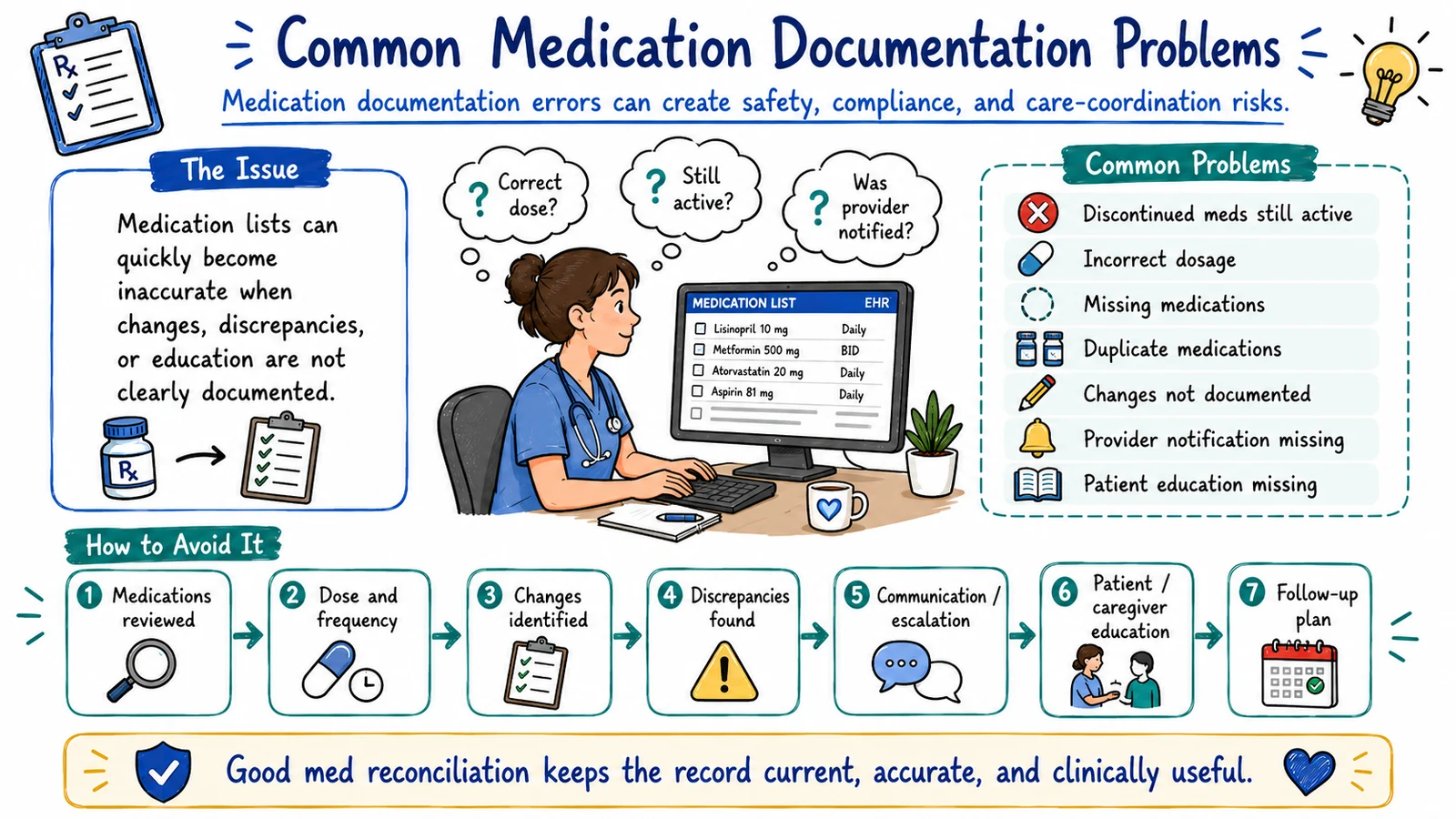
Good medication reconciliation keeps the record current, accurate, and clinically useful.
Common problems include discontinued medications still listed as active, incorrect dosage, missing medications, duplicate medications, medication changes not documented, provider notification not documented when appropriate, and patient education not documented. Medication reconciliation should document: medications reviewed, current dose and frequency, changes identified, discrepancies found, appropriate communication or escalation, patient/caregiver education, and the follow-up plan, treated as an ongoing clinical activity, not a one-time administrative task.
9. Poor Wound Documentation
Wound documentation is an area where vague language quickly creates problems. Words such as "better," "worse," "healing," or "looks good" don't provide enough objective information on their own. Depending on the wound and applicable protocol, documentation may include location, length, width, depth, wound bed characteristics, drainage amount and type, odor when clinically relevant, periwound condition, pain, signs of infection, treatment performed, patient response, education, and communication or escalation.
Compare "Wound is smaller" with: "Wound measures 2.0 cm × 1.5 cm × 0.2 cm, compared with 2.5 cm × 1.8 cm × 0.3 cm at previous assessment." The second makes the patient's progress measurable.
10. Vague Patient Education Documentation
Patient education is an important component of home health care, but documentation often reduces it to a single sentence: "Patient educated." That doesn't tell the reader what happened. Stronger education documentation answers four questions: what was taught, how it was taught, how the patient responded, and what happens next. For example: "Patient educated on daily weight monitoring and symptoms of fluid retention. Patient verbalized understanding and correctly demonstrated how to record weight on monitoring log." Document education's clinical purpose and outcome, not merely its existence.
11. Missing Patient Response
Documentation frequently explains what the nurse did without explaining what happened afterward. "Wound care completed", but did the patient tolerate the procedure? Did pain improve? Did the patient demonstrate understanding? Did symptoms change? A complete clinical narrative often follows Assessment → Intervention → Response. For example: "Patient reported 6/10 pain before dressing change and 3/10 following completion. No adverse response noted." That is substantially more useful than simply stating wound care was performed.
12. Failure to Connect Documentation to the Plan of Care
The plan of care provides the framework for the services being delivered, yet visit notes can become disconnected from it. The plan may identify wound management, diabetes education, and medication management as key areas while individual visit notes don't clearly demonstrate how those needs are addressed. CMS guidance emphasizes the relationship between the comprehensive assessment and the physician-ordered plan of care.
➡️ The visit note should make the connection clear: Patient problem → Goal → Skilled intervention → Response → Next step, so another clinician can understand why today's care occurred.
13. OASIS Responses That Don't Match the Clinical Record
OASIS documentation is not an isolated form-filling exercise. Responses should accurately reflect the patient's status at the relevant assessment time. Problems occur when clinicians select an answer without sufficient assessment, misinterpret an item, use outdated information, copy previous responses, fail to reconcile OASIS with the narrative, or document an OASIS response that is unsupported elsewhere. CMS guidance states OASIS data should accurately reflect the patient's status at the time the information is collected.
When OASIS contradicts the rest of the chart, it's a data mismatch that invites review, and rework.
➡️ Treat these as connected components of one clinical story: Clinical assessment → Documentation → OASIS → Plan of care. If one component contradicts the others, it deserves review. (More in our OASIS documentation compliance tips.)
14. Missing or Inconsistent SOC, ROC, Recertification, and Discharge Information
Not every OASIS assessment represents the same point in a patient's episode. Start of Care, Resumption of Care, recertification, transfer, and discharge each have different clinical and documentation contexts. CMS maintains specific guidance for OASIS assessment time points. Common problems include missing required information, incorrect timing, reusing outdated information, failing to reflect changes since the previous assessment, inconsistencies between assessment periods, and incomplete discharge information.
➡️ Agencies should have clearly defined workflows for each assessment type. Clinicians should know: What information is required → When it is collected → What has changed since the previous assessment → How it affects the current plan of care.
15. Delayed Documentation
The longer a clinician waits to document a visit, the greater the risk that important details will be lost. Delayed documentation can contribute to forgotten observations, approximation rather than accurate recall, copy-forward behavior, missing patient education, missing changes in condition, and inconsistent timelines. This is especially challenging in home health, where nurses may have several visits a day and still face significant documentation requirements after leaving the patient's home.
The solution isn't simply "chart faster." Agencies should examine whether their workflow makes timely documentation realistic, through mobile documentation, voice input, structured templates, point-of-care workflows, automated reminders, AI-assisted documentation, and real-time completeness checks. The technology should reduce friction without removing the clinician's responsibility for reviewing the record.
How to Reduce Home Health Documentation Errors
Documentation quality is not solved by a single training session. It requires a combination of clear standards, clinician education, auditing, workflow design, and appropriate technology.
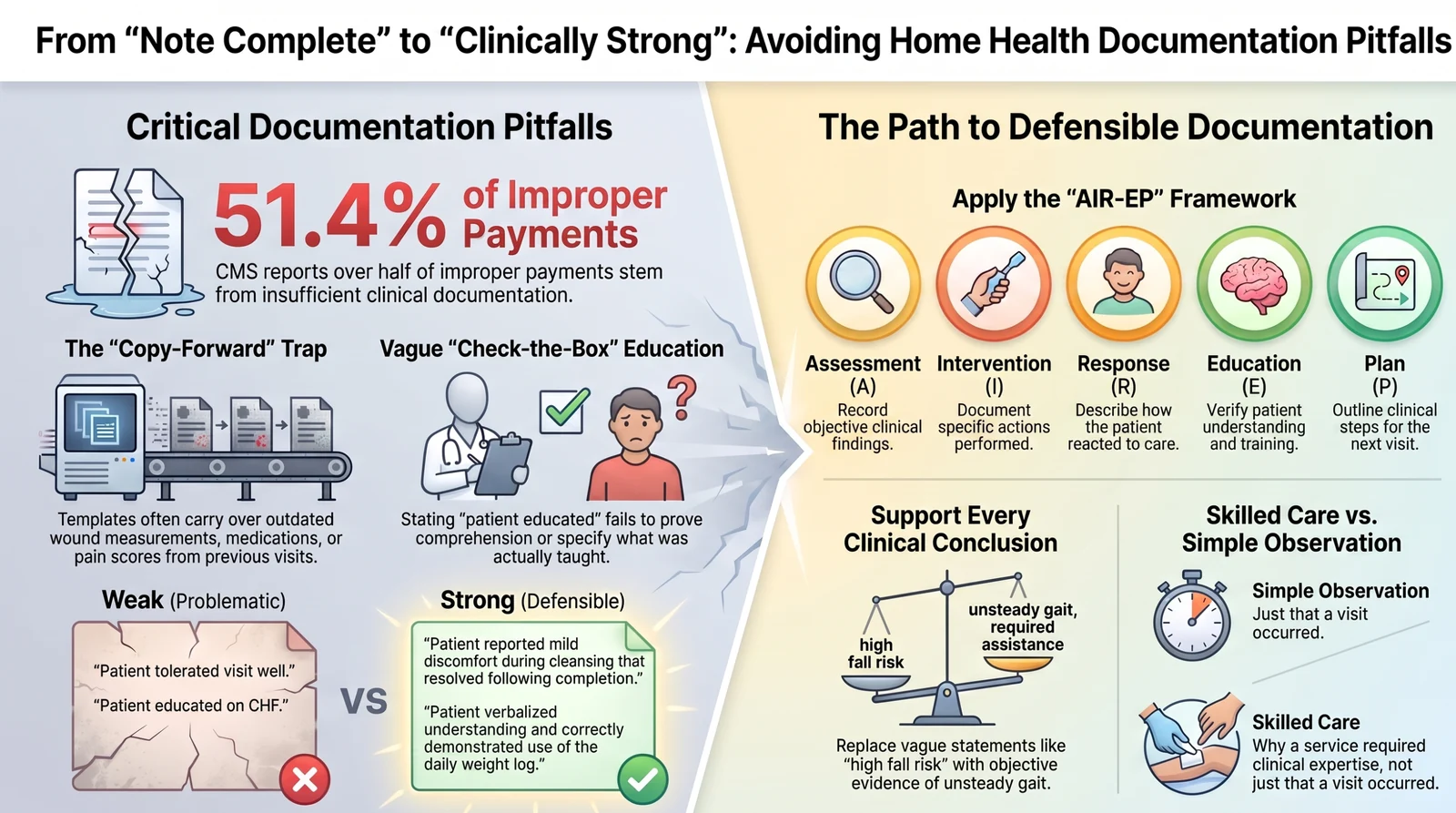
Move from "note complete" to "clinically strong" with the AIR-EP framework, and by supporting every clinical conclusion with objective evidence.
1. Standardize documentation expectations
Clinicians should know what a strong note looks like. A simple agency-wide framework helps: Assessment (what did you observe?), Intervention (what skilled service did you provide?), Response (how did the patient respond?), Education (what did the patient/caregiver learn?), and Plan (what happens next?). Standardization doesn't mean every note looks identical, it means clinicians understand the minimum clinical story that needs to be captured.
2. Conduct regular documentation audits
Audits help agencies identify patterns before they become larger compliance problems. CMS's OASIS guidance discusses agency-level monitoring and auditing for identifying data accuracy issues. Audits can look for missing information, contradictory documentation, unsupported OASIS responses, copy-forward errors, weak medical necessity documentation, missing education, missing patient response, and medication discrepancies. The most effective audits don't simply identify who made a mistake, they identify why the workflow allowed it to happen.
3. Train clinicians with real examples
Training becomes far more effective when clinicians can see the difference between weak and strong documentation. Weak: "Patient educated on CHF." Stronger: "Patient educated on daily weight monitoring, low-sodium diet, and signs of fluid overload. Patient correctly verbalized when to notify the agency regarding weight gain and demonstrated use of the daily weight log." The objective isn't longer notes, it's clinically meaningful ones.
4. Build documentation quality checks into the workflow
Instead of discovering problems days later during an audit, agencies can identify potential issues before the chart is finalized. A system could flag: "OASIS indicates independence, but narrative documentation indicates assistance is required, review before signing," or "Medication list identifies medication as discontinued, but current note documents administration." The system should not automatically change the nurse's documentation, it should surface a potential issue and let the clinician review it.
Can AI Help Reduce Home Health Documentation Errors?
AI can play an important role in improving documentation quality, but implementation matters. AI should not replace the nurse's clinical judgment. Instead, it can function as an additional layer of documentation assistance, completeness checking, and consistency review, helping identify missing clinical information, potential contradictions, incomplete narratives, medication discrepancies, missing patient response, missing education details, potential OASIS gaps, and documentation that may require clinician review. The nurse remains responsible for reviewing and approving the final record.
💡 AI should ask: "Is something missing?", "Does something contradict another part of the record?", "Does this documentation adequately explain the clinical story?" It should not independently decide: "This is what the patient's clinical condition is."
A Practical Home Health Documentation Checklist
Before signing a note, clinicians can use this quick review.
| Area | Before signing, confirm |
|---|---|
| Patient status | Current condition documented; meaningful changes from baseline identified; objective findings included where appropriate. |
| Skilled care | Skilled service clearly documented; reason for the intervention is clear; documentation supports the clinical need. |
| Intervention | Exactly what you did is documented and consistent with the plan of care. |
| Response | How the patient responded is documented; any change in condition is captured. |
| Education | What you taught is documented; patient/caregiver demonstrated understanding. |
| Medications | Medication information is current; discrepancies addressed appropriately. |
| OASIS | OASIS responses are supported by the assessment and align with the clinical record. |
| Consistency | Today's documentation reflects today's patient; no outdated copy-forward; the note aligns with the plan of care. |
| Follow-up | Significant changes communicated appropriately; the next step is clear. |
The Goal Isn't More Documentation. It's Better Documentation.
Home health nurses already carry a significant administrative burden. The solution isn't to ask them to write longer notes, it's to help them create documentation that is accurate, relevant, consistent, clinically meaningful, and timely. The strongest home health documentation answers a simple set of questions: What was the patient's condition? What did the clinician identify? What skilled care was provided? Why was it necessary? How did the patient respond? What happens next? When those answers are clear, documentation becomes more than a compliance exercise, it becomes a useful clinical communication tool.
Final Takeaway
The most dangerous documentation errors aren't always obvious. Sometimes they are small gaps: a missing assessment detail, an outdated medication, a copied-forward wound measurement, an unsupported OASIS response, a vague education statement, or a change in condition that was noticed but never clearly documented. Individually they may seem minor. Collectively, they can weaken the patient's record and create compliance, clinical, operational, and financial risk.
The strongest agencies don't simply tell nurses to "document better." They create systems that make good documentation easier, combining clinical judgment, clear documentation standards, education, auditing, workflow improvements, and appropriate technology. As OASIS requirements continue to evolve, documentation quality will only become more important. Good documentation isn't paperwork for paperwork's sake, it is part of the care.
Home Health Documentation Playbook
The complete guide to OASIS-E, Medicare compliance, PDGM, and AI-assisted documentation. Learn how top agencies reduce documentation time without sacrificing compliance.
Bottom Line
Most costly home health documentation errors aren't blatant, they're small gaps (a missing assessment detail, an outdated medication, a copied-forward measurement, an unsupported OASIS response) that collectively weaken the record and create compliance, clinical, and financial risk. Prevent them by standardizing what a strong note looks like (Assessment → Intervention → Response → Education → Plan), connecting every conclusion to objective evidence, auditing for contradictions and copy-forward, and using clinician-reviewed AI to flag gaps before signing, so documentation tells one consistent, defensible clinical story.

Arvind Sarin is the founder of Copper Digital. For the past year he has spent three days a week inside a 500+ census Texas home health agency, building AI documentation that finishes OASIS and visit notes the same day, with a nurse reviewing and approving every note. He writes about home health documentation, OASIS, Medicare compliance, and applying AI responsibly in clinical workflows.
Frequently asked
Frequently asked questions
The most common errors include incomplete visit notes, unsupported clinical statements, contradictory documentation, copy-forward errors, inadequate medical necessity documentation, weak homebound documentation, medication discrepancies, incomplete wound documentation, vague patient education, and OASIS responses that don't align with the clinical record.
Join the conversation
Leave a comment
Related reading
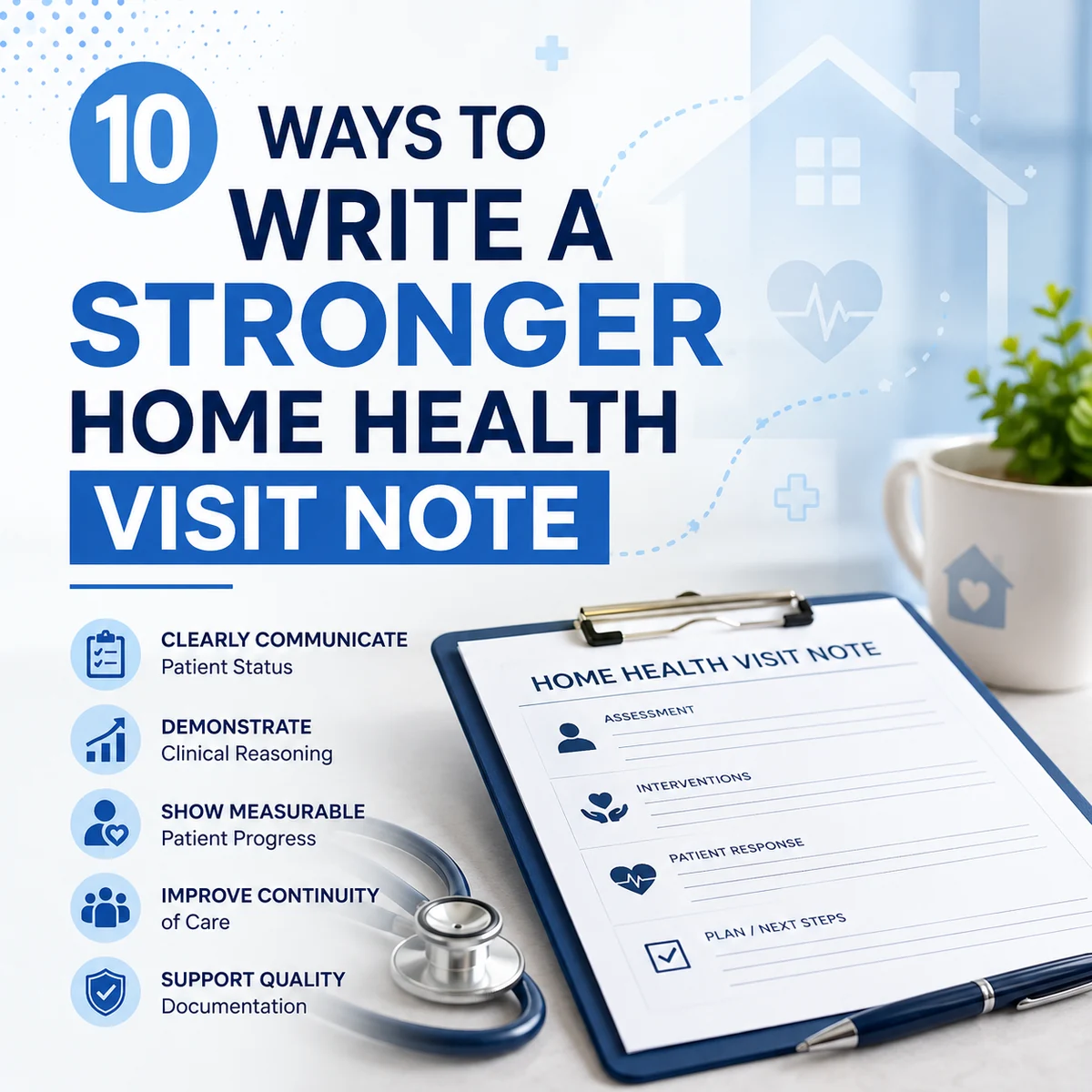
Ways to Write a Stronger Home Health Visit Note
A strong home health visit note creates a clear clinical narrative, what was assessed, what changed, what skilled care was provided and why, how the patient responded, and what happens next, not just a record that a task was completed. This guide gives 10 practical ways to write stronger notes, weak-vs-strong examples across nursing, therapy, and education, common mistakes to avoid, and a simple Assess → Interpret → Intervene → Evaluate → Plan framework.
OASIS Documentation Compliance Tips for Home Health Agencies
OASIS compliance isn't just filling in every field, it's making the assessment tell a consistent, clinically supported story that agrees with the rest of the record. This guide covers 12 practical compliance tips, 9 common errors, a pre-submission checklist, what's new in OASIS-E2, and where AI helps (and where it must not).
Why Home Health Agencies Lose Money on Incomplete Visit Notes
An incomplete visit note rarely creates just one problem, it moves downstream into QA rework, billing holds, denials, and audit risk. This guide breaks down the 7 most common documentation gaps, how they drain revenue, and the workflow (frameworks, real-time QA, prompts, and clinician-reviewed AI) that helps nurses finish accurate notes the first time.