
10 Ways to Write a Stronger Home Health Visit Note
A strong home health visit note creates a clear clinical narrative, what was assessed, what changed, what skilled care was provided and why, how the patient responded, and what happens next, not just a record that a task was completed. This guide gives 10 practical ways to write stronger notes, weak-vs-strong examples across nursing, therapy, and education, common mistakes to avoid, and a simple Assess → Interpret → Intervene → Evaluate → Plan framework.
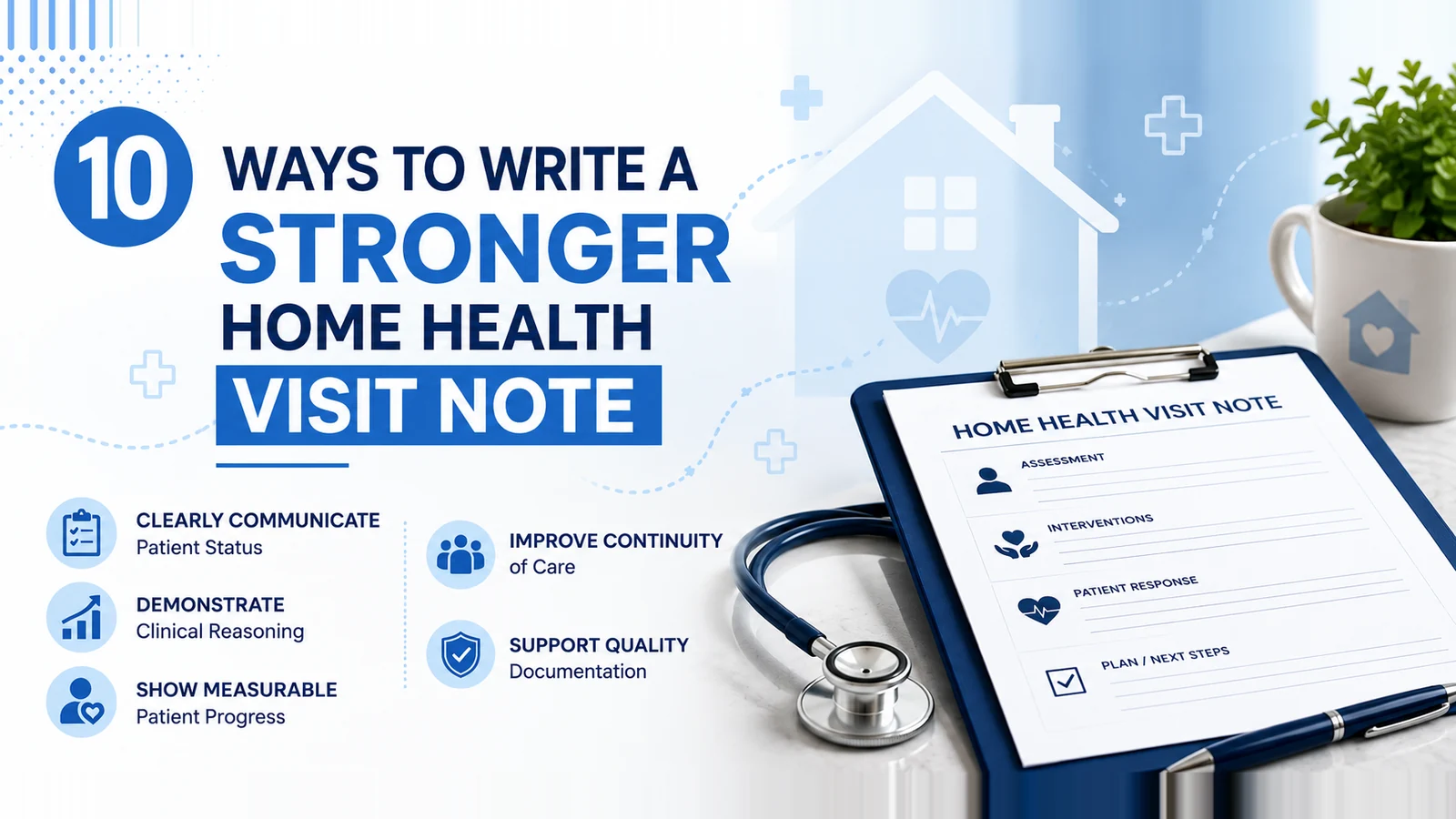
Key Takeaways
- A strong visit note is a clinical narrative another clinician can follow without asking for clarification, not a record that a task was done.
- Include patient status, changes since last visit, skilled interventions, clinical reasoning, education, patient response, progress toward goals, safety, coordination, and the follow-up plan.
- Be specific, not generic: 'completed transfer training with verbal cueing, less assistance than last visit' beats 'tolerated treatment well.'
- Demonstrate skilled need by showing the professional assessment, judgment, and action, not just that a task occurred.
- Use the pattern Finding → Interpretation → Intervention → Response → Next action to show clinical reasoning.
- Avoid copy-forward language, vague statements, missing patient response, and contradictions; document what changed.
- A simple five-part framework, Assess → Interpret → Intervene → Evaluate → Plan, keeps notes focused, readable, and complete; AI can flag gaps but the clinician owns the record.
💡 Quick Answer: A strong home health visit note does more than record that a clinician saw a patient and completed tasks, it creates a clear clinical narrative another qualified clinician can follow without asking for clarification: the patient's current status, what changed, what skilled care was provided and why, how the patient responded, progress toward goals, and the next step. The goal isn't longer notes; it's more clinically meaningful ones. A simple framework, Assess → Interpret → Intervene → Evaluate → Plan, keeps documentation focused and readable.
A strong home health visit note does more than record that a clinician saw a patient and completed assigned tasks. It creates a clear clinical narrative that helps the next person reviewing the record understand why the visit was necessary, what the clinician observed, what skilled care was provided, how the patient responded, what changed, and what should happen next.
For nurses, therapists, clinical managers, agency leaders, and documentation teams, improving the quality of the home health visit note can make patient records easier to understand, strengthen continuity of care, and reduce time spent interpreting vague or incomplete documentation. The goal is not to make notes longer. The goal is to make them more clinically meaningful.
What Is a Home Health Visit Note?
A home health visit note is the clinical record of an individual patient encounter in the home. It documents the patient's current condition, relevant assessment findings, skilled interventions, clinical reasoning, response to care, progress toward goals, education, coordination activities, and the plan for follow-up.
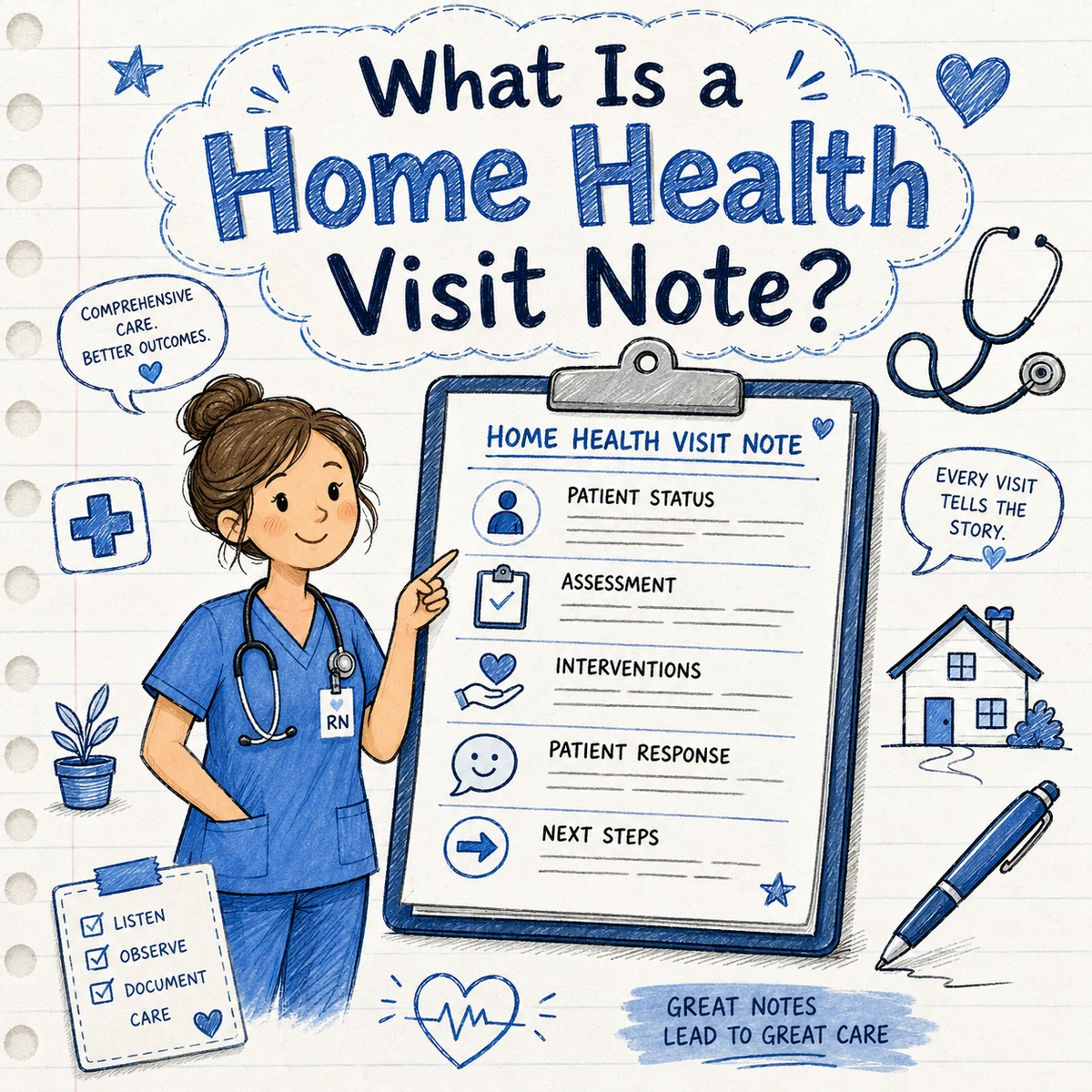
The visit note connects a single encounter to the patient's plan of care, every visit tells the story.
The visit note sits within the broader home healthcare documentation record and should connect the individual encounter to the patient's established plan of care. A useful home health visit note should allow another qualified clinician to understand the clinical story of the visit without needing additional explanation from the person who wrote it.
What Should a Strong Home Health Visit Note Include?
A complete note should capture the clinical information that explains what happened during the visit and why it mattered.
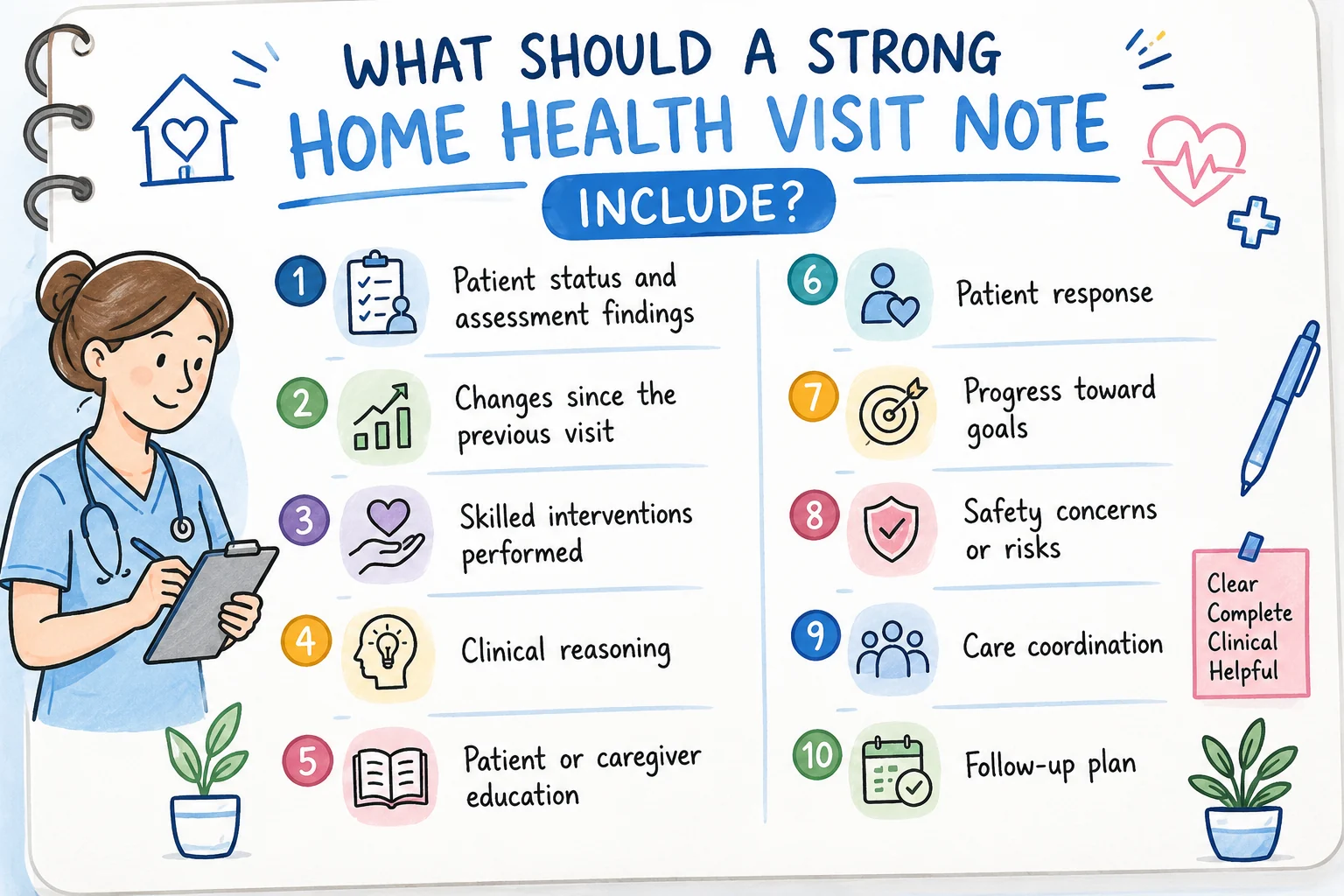
Ten elements that make a visit note clear, complete, and clinically helpful.
1. Patient status and assessment findings
Document the findings that are relevant to the patient's condition, current risks, treatment goals, and reason for the visit. The note should distinguish meaningful clinical information from observations that do not affect care.
2. Changes since the previous visit
Identify whether the patient's symptoms, function, mobility, wound status, pain, cognition, medication management, caregiver support, or other relevant areas have improved, declined, or remained stable. Documenting change helps the care team understand the direction of the patient's condition.
3. Skilled interventions performed
Describe the skilled care provided rather than simply listing tasks. The documentation should make clear what the clinician actually assessed, treated, taught, modified, monitored, or evaluated.
4. Clinical reasoning
Explain relevant findings that influenced clinical decisions. Documentation becomes more useful when the reader can understand why an intervention was selected, modified, continued, or escalated.
5. Patient or caregiver education
Document what was taught, how education was delivered, and whether the patient or caregiver demonstrated understanding. Simply writing "education provided" leaves important information unanswered.
6. Patient response
Describe what happened after an intervention. The response may involve symptoms, functional performance, understanding, tolerance, safety, pain, mobility, confidence, or another clinically relevant outcome.
7. Progress toward goals
Connect the visit to established goals and outcomes whenever appropriate. The record should help the clinical team determine whether the patient is progressing, stable, experiencing barriers, or requiring adjustment to the care approach.
8. Safety concerns or risks
Document relevant risks identified during the visit, including changes that may affect patient safety or the ability to carry out the plan of care.
9. Care coordination
Capture meaningful communication with physicians, therapists, nurses, caregivers, pharmacies, or other members of the care team when it affects ongoing care.
10. Follow-up plan
Make the next clinical step clear. This may include additional monitoring, reinforcement of education, reassessment, communication with another provider, or a treatment priority for the next visit.
10 Ways to Write a Stronger Home Health Visit Note
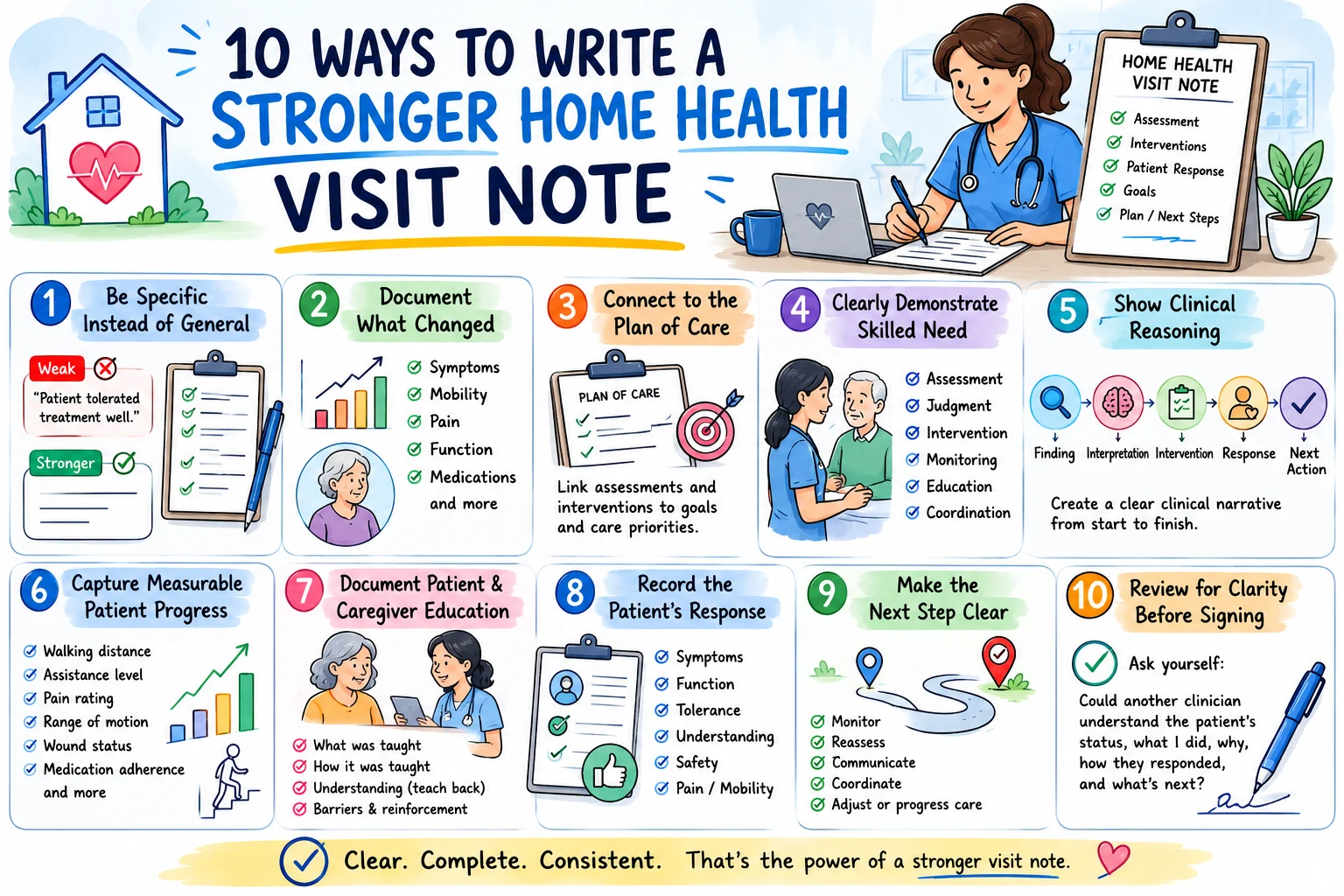
Ten practical ways to turn a task list into a clear clinical narrative.
1. Be Specific Instead of General
Generic statements make it difficult to understand what occurred during the visit.
Weak: "Patient tolerated treatment well."
Stronger: "Patient completed transfer training from chair to walker with verbal cueing for hand placement. Patient required less assistance than at the previous visit and reported no increase in pain following the activity."
The stronger version explains the intervention, the patient's performance, the clinician's involvement, and the patient's response. Specificity doesn't require excessive detail, it requires clinically useful detail.
2. Document What Changed
One of the most valuable questions a home health progress note can answer is: what is different from the previous visit? Capture meaningful changes in symptoms, wounds, mobility, pain, cognition, medication response, functional ability, caregiver capacity, exercise tolerance, or safety. Repeatedly carrying forward identical language makes it harder for the clinical team to identify real changes. A stronger note distinguishes between improvement, stability, decline, and unresolved barriers.
3. Connect the Visit to the Plan of Care
Each visit should make sense within the patient's overall treatment plan. Documentation should connect assessments and interventions to established problems, goals, and care priorities. If a patient has a mobility goal, the note should show how the clinician assessed or treated mobility and what the patient's performance indicates about progress toward that goal.
4. Clearly Demonstrate Skilled Need
Skilled need means the patient's care required the professional knowledge, assessment, judgment, intervention, monitoring, or teaching of a qualified clinician. Instead of documenting only that a task occurred, explain the skilled contribution. A nurse may identify a change in symptoms, evaluate its significance, provide targeted education, communicate with the care team, and establish a monitoring plan. A therapist may assess movement quality, identify a safety concern, modify an activity, provide corrective instruction, and evaluate the response. The documentation should allow the reader to understand why professional clinical involvement mattered.
5. Show Clinical Reasoning
A strong visit note explains not only what the clinician did, but what influenced the decision. A useful structure is:
➡️ Finding → Clinical interpretation → Intervention → Patient response → Next action
For example, Finding: patient demonstrated increased difficulty rising from a low chair. Interpretation: reduced lower-extremity control increased transfer difficulty and safety concerns. Intervention: therapist modified transfer training and provided instruction on positioning and sequencing. Response: patient completed subsequent transfers with improved control and fewer cues. Next action: continue transfer training and reassess consistency during the next visit. This format transforms a list of activities into a readable clinical narrative.
6. Capture Measurable Patient Progress
Objective information makes progress easier to interpret, walking distance, assistance level, pain rating, range of motion, wound characteristics, medication adherence, functional tolerance, vital-sign trends, ability to perform a task, or caregiver competence after education. Not every observation needs to be numeric; specific descriptive findings also demonstrate progress. "Patient now completes the medication setup with one reminder" is more informative than "medication management improving."
7. Document Patient and Caregiver Education Properly
Education is often a major component of home health nursing notes and therapy documentation, but the phrase "education provided" says very little. Stronger documentation identifies the topic taught, the teaching method, the patient or caregiver's understanding, teach-back or return demonstration when appropriate, barriers to learning, and areas requiring reinforcement.
For example: "Reviewed safe walker positioning during transfers using demonstration and guided practice. Patient correctly demonstrated the sequence twice but required one reminder to position the walker before standing. Reinforcement planned at the next visit."
8. Record the Patient's Response
Documenting an intervention without documenting its outcome leaves the clinical story incomplete. If pain management strategies were reviewed, describe whether pain changed. If gait training was performed, document performance. If wound care was completed, describe tolerance and assessment findings. If medication education was provided, record whether the patient or caregiver could explain the instructions. The patient's response helps determine whether the current approach is effective and what should happen next.
9. Make the Next Step Clear
Every visit contributes to an ongoing care process. A well-written note should indicate what the clinical team needs to do next, monitor a symptom, reinforce education, reassess mobility, communicate a change to the physician, coordinate with another discipline, evaluate a safety concern, or progress treatment. Clear next steps improve care coordination and reduce ambiguity between visits.
10. Review the Note for Clarity Before Signing
Before completing the note, use one simple test: could another clinician understand the patient's current status, what I did, why I did it, how the patient responded, and what should happen next? If the answer is no, the documentation may need additional context. The purpose of the final review isn't to make the note longer, it's to make the clinical narrative complete.
Weak vs. Strong Home Health Visit Note Examples
The following examples are illustrative. Appropriate documentation depends on the patient's condition, discipline, plan of care, agency workflow, and clinical circumstances.
Example 1: Skilled Nursing
Weak: "Patient stable. Medications reviewed. Education provided."
Patient reports difficulty remembering the evening medication schedule. Nurse reviewed the medication list and identified confusion regarding administration timing. Medication schedule was reviewed using the patient's written medication organizer. Patient correctly explained the morning schedule but required additional prompting for evening medications. Reinforcement planned for the next visit.
Why it works: it identifies the problem, describes the skilled nursing intervention, documents the patient's response, and establishes a follow-up need.
Example 2: Physical Therapy
Weak: "Patient walked and did exercises. Tolerated treatment well."
Patient completed gait training in the home using the prescribed assistive device. Frequent verbal cues were initially required for safe positioning during turns. By the end of the session, patient completed two turns with improved positioning and fewer cues. Continue gait and turning practice to improve consistency and safety.
Why it works: the documentation shows the intervention, safety issue, clinician input, patient response, and next treatment priority.
Example 3: Patient or Caregiver Education
Weak: "Caregiver educated on fall prevention."
Reviewed fall prevention strategies with caregiver, including keeping the primary walking path clear and positioning frequently used items within easy reach. Caregiver identified two environmental hazards and described how they would be corrected. Reinforcement will continue as needed.
Why it works: it identifies the education provided and demonstrates whether the caregiver understood and could apply the information.
Common Home Health Documentation Mistakes
Even experienced clinicians can fall into documentation habits that reduce the usefulness of the patient record.
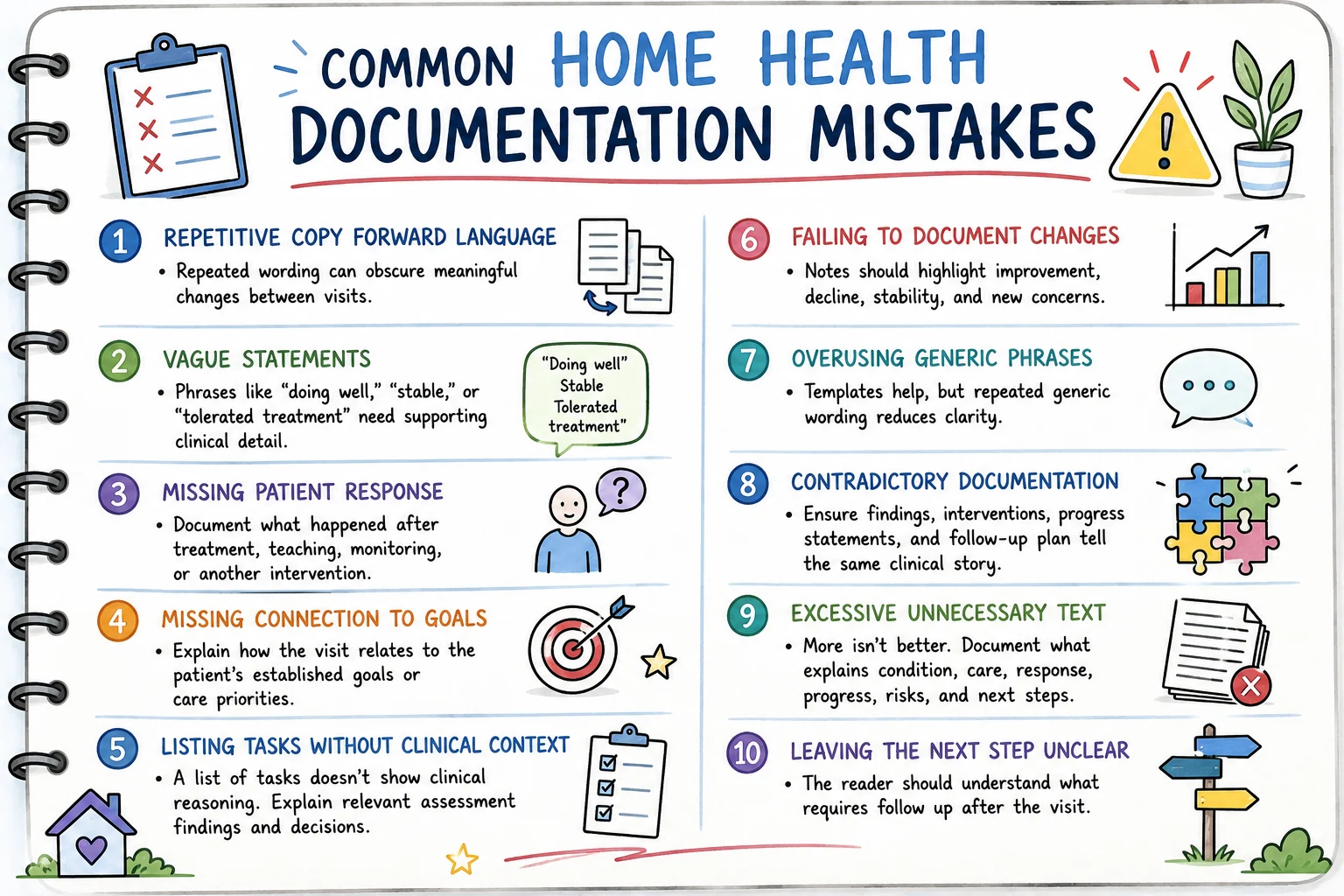
Ten habits that quietly weaken a patient record.
- Repetitive copy-forward language — repeated wording can obscure meaningful changes between visits. Each note should reflect the patient's condition on that specific day.
- Vague statements — phrases such as "doing well," "stable," or "tolerated treatment" should be supported by relevant clinical detail.
- Missing patient response — document what happened after treatment, teaching, monitoring, or another intervention.
- Missing connection to goals — when appropriate, explain how the visit relates to the patient's established goals or care priorities.
- Listing tasks without clinical context — a list of completed activities doesn't communicate skilled clinical reasoning; explain the assessment findings and decisions.
- Failing to document changes — documentation should help readers recognize improvement, decline, stability, and new concerns.
- Overusing generic phrases — templates can support efficiency, but repeated generic wording reduces clarity.
- Contradictory documentation — assessment findings, interventions, progress statements, and the follow-up plan should tell the same clinical story.
- Excessive unnecessary text — more documentation is not automatically better; prioritize what explains the patient's condition, care, response, progress, risks, and next steps.
- Leaving the next step unclear — the reader should understand what requires follow-up after the visit.
A Simple Framework for Better Home Health Visit Notes
Clinicians can organize patient visit documentation using a five-part framework:
➡️ Assess → Interpret → Intervene → Evaluate → Plan
- Assess — document the relevant patient findings. What did you observe, measure, or learn during the visit?
- Interpret — explain what those findings mean clinically. Did they indicate progress, decline, a new risk, a barrier, or a need to modify care?
- Intervene — describe the skilled intervention performed. What did the clinician assess, teach, treat, modify, coordinate, or monitor?
- Evaluate — record the patient's response. Did function improve? Did symptoms change? Did the patient demonstrate understanding? Was additional assistance required?
- Plan — state what should happen next: continued treatment, reassessment, reinforcement, monitoring, escalation, or care coordination.
The framework creates a logical sequence that makes home health documentation easier to follow.
How AI Can Help Improve Home Health Documentation
AI can support documentation workflows by helping clinicians and clinical teams identify areas where a note may need clarification or additional context. Potential capabilities include identifying incomplete documentation, detecting vague or repetitive language, highlighting a missing patient response, identifying sections that may require clarification, summarizing longitudinal changes, supporting documentation review, and helping transform structured clinical information into clearer narratives. AI may also help documentation teams review larger volumes of clinical information more efficiently and identify patterns that warrant human attention.
The appropriate role of AI is supportive. Clinical judgment, interpretation, validation, and responsibility for the patient's record should remain with qualified healthcare professionals. For organizations exploring intelligent documentation workflows, solutions can be designed around the actual needs of home health clinicians instead of adding another disconnected administrative tool. (For a deeper look, see AI vs. ambient scribe for home health nurses.) Copper Digital can support home health organizations exploring AI-assisted workflows for documentation quality, clinical information visibility, and operational efficiency.
Home Health Visit Note Checklist
Before completing a note, ask:
- Did I clearly describe the patient's current status?
- Did I document meaningful changes since the previous visit?
- Is the skilled intervention clear?
- Did I explain the relevant clinical reasoning?
- Did I document the patient's response?
- Did I connect the visit to established goals or the plan of care?
- Did I capture patient or caregiver education and understanding?
- Did I document relevant concerns, risks, or coordination needs?
- Is the next step clear?
- Could another clinician understand this visit without asking me for clarification?
If the note answers these questions clearly, it is more likely to communicate a complete clinical story. (Many of these overlap with the top documentation errors to avoid and the most common gaps in visit notes.)
Stronger Documentation Starts With a Clearer Clinical Story
A stronger home health visit note does not require clinicians to document everything that occurred during an encounter. It requires them to document what matters. The most useful notes connect assessment findings to clinical interpretation, skilled intervention, patient response, progress, and the plan for what happens next.
Using the Assess → Interpret → Intervene → Evaluate → Plan framework can help clinicians create a consistent clinical narrative while keeping documentation focused and readable. For agencies, improving home health documentation is also an opportunity to simplify workflows: intelligent documentation tools can help identify gaps, reduce repetitive administrative work, and make patient information easier for care teams to review.
Home Health Documentation Playbook
The complete guide to OASIS-E, Medicare compliance, PDGM, and AI-assisted documentation. Learn how top agencies reduce documentation time without sacrificing compliance.
Bottom Line
A stronger home health visit note isn't a longer one, it's a clearer clinical story: it connects assessment findings to interpretation, skilled intervention, patient response, progress toward goals, and the next step, so another clinician can pick up the record without asking for clarification. Be specific instead of generic, document what changed, demonstrate skilled need, and record the patient's response, and use the Assess → Interpret → Intervene → Evaluate → Plan framework to keep every note focused and complete. AI can help surface gaps and vague or repetitive language, but clinical judgment and final responsibility stay with the clinician.

Arvind Sarin is the founder of Copper Digital. For the past year he has spent three days a week inside a 500+ census Texas home health agency, building AI documentation that finishes OASIS and visit notes the same day, with a nurse reviewing and approving every note. He writes about home health documentation, OASIS, Medicare compliance, and applying AI responsibly in clinical workflows.
Frequently asked
Frequently asked questions
A home health visit note should document the patient's current status, relevant assessment findings, changes since the previous visit, skilled interventions, clinical reasoning, patient or caregiver education, response to care, progress toward goals, safety concerns, care coordination, and the follow-up plan. The information included should be relevant to the patient's condition and plan of care.
Join the conversation
Leave a comment
Related reading
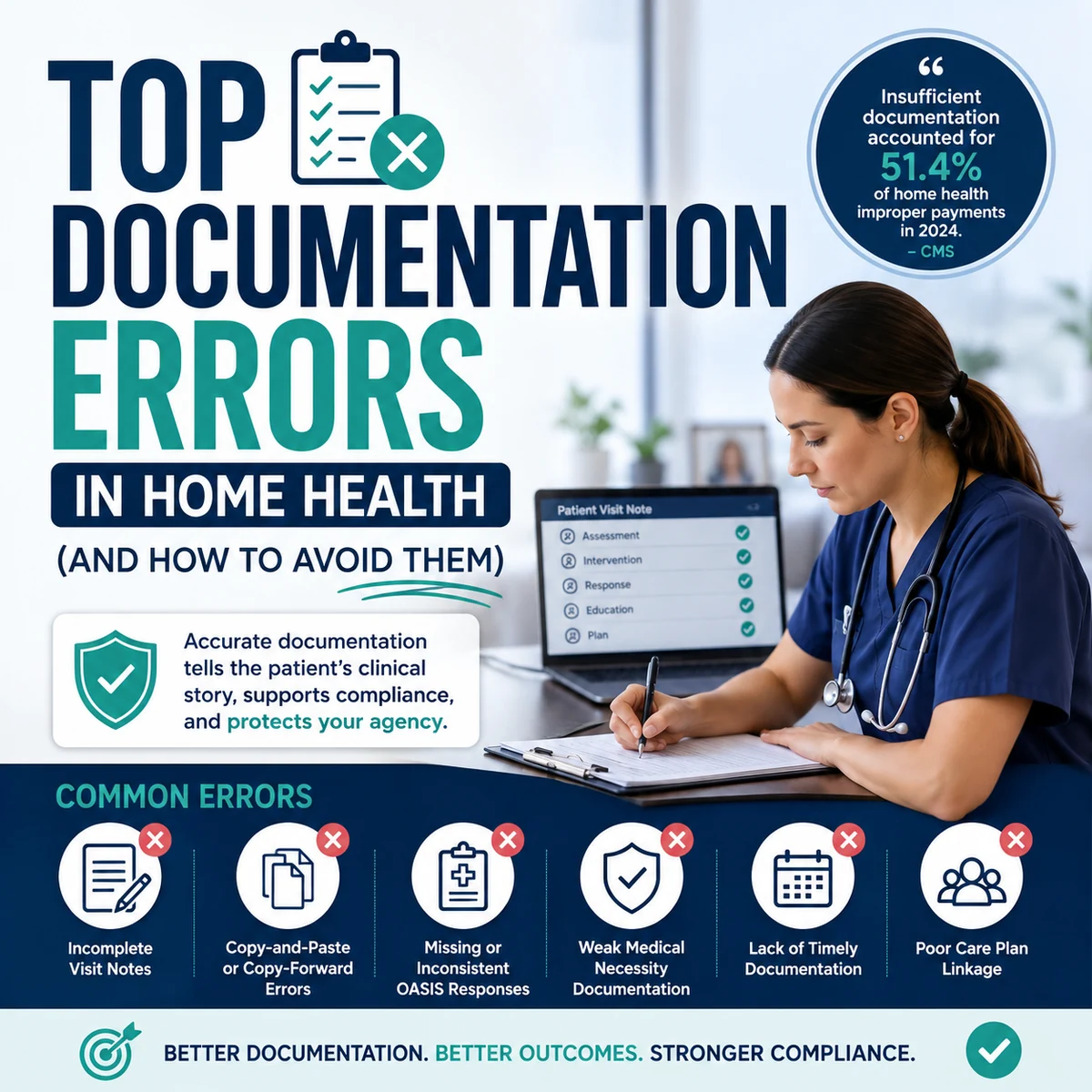
Top Documentation Errors in Home Health (and How to Avoid Them)
A home health note can be technically complete and still be clinically weak, and CMS ties 51.4% of home health improper payments to insufficient documentation. This guide walks through the 15 most common documentation errors with weak-vs-strong examples, then shows how to prevent them with standards, audits, in-workflow checks, and clinician-reviewed AI.
OASIS Documentation Compliance Tips for Home Health Agencies
OASIS compliance isn't just filling in every field, it's making the assessment tell a consistent, clinically supported story that agrees with the rest of the record. This guide covers 12 practical compliance tips, 9 common errors, a pre-submission checklist, what's new in OASIS-E2, and where AI helps (and where it must not).
Why Home Health Agencies Lose Money on Incomplete Visit Notes
An incomplete visit note rarely creates just one problem, it moves downstream into QA rework, billing holds, denials, and audit risk. This guide breaks down the 7 most common documentation gaps, how they drain revenue, and the workflow (frameworks, real-time QA, prompts, and clinician-reviewed AI) that helps nurses finish accurate notes the first time.