
The Budget Error That Sets Every Nurse Manager Up to Fail
Most nursing budgets underestimate staffing by 2 to 6 percent before a schedule is ever built, because replacement staff are calculated from patient care FTEs instead of the total budget. Robert Wingo, RN-BC walks through the 40-year-old math error, why 'non-productive time' language makes it worse, and Care-Centric Modeling, the framework that fixes the calculation and gives nurse managers a data-backed argument with finance.
Key Takeaways
- Most nursing budgets underestimate resources by 2 to 6 percent before a schedule is built, because replacement staff are calculated from patient care FTEs instead of the total budget.
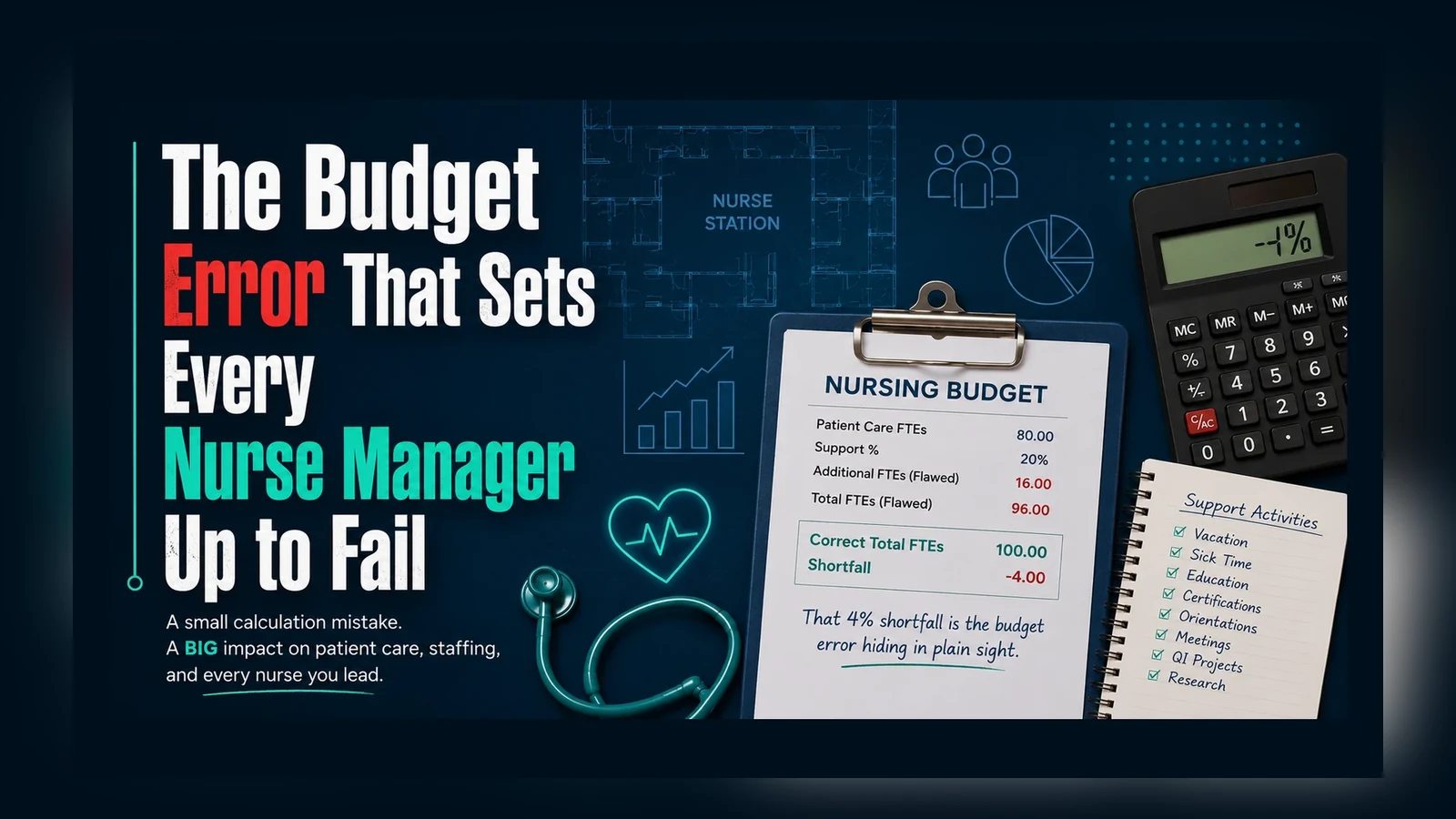
- At a 20 percent support rate the correct total is 100 FTEs, not 96, a built-in 4 percent shortfall.
- The 'productive vs. non-productive time' language invites finance to cut the exact time nurses need to rest, train, and orient, reframe it as patient care FTEs and patient care support FTEs.
- Care-Centric Modeling calculates patient care needs first, then the support hours available before bedside coverage gaps appear, giving managers a hard threshold.
- The error is documented globally (US, UK, Europe, Saudi Arabia, Australia, the Philippines) and applies to home health, where an understaffed agency simply means a missed visit.
- Burnout and resilience programs are downstream; the upstream fix is correcting the budget math so schedules are staffable from day one.
- AI that reduces documentation burden extends the capacity of the existing workforce, but it can't compensate for a budget that was wrong from the start.
💡 TL;DR: Most hospitals and post-acute facilities use a budget formula that systematically underestimates nursing resources by 2 to 6 percent before a single shift is scheduled. The error is mathematical, not political, and it has been hiding in plain sight for over 40 years: the formula calculates replacement staff based on the patient care FTEs only, instead of the total budget. This post walks through the math, explains why the terminology we use makes the problem worse, introduces a framework I developed called Care-Centric Modeling that fixes the calculation, and connects all of it to the burnout, turnover, and patient safety crises leaders say they want to solve.
I started my nursing career as an adult inpatient medical oncology nurse at Duke University Medical Center. My patients would come back every four to six weeks for their next round of chemotherapy, and I got to know them and their families in a way that made the work deeply personal.
Then managed care pushed most chemotherapy administration to the outpatient clinics, and the only time I saw my patients on the floor was when they were critically ill or actively dying. That shift changed my career path.
I was a nerd long before I was a nurse, and after a handful of years at the bedside, I moved into nursing informatics. I installed my first staffing and scheduling system in 1999, and I have spent the 25 years since studying how healthcare organizations decide how many nurses they need and how that decision translates into care at the bedside.
What I found, after two decades of looking at the data, is that most facilities are using a budget process with a mathematical error that has been in our literature and practice for over 40 years. It is not a rounding issue.
It is not a difference of opinion about staffing ratios. It is a calculation error that systematically underestimates the nursing resources a unit needs, and it creates a 2 to 6 percent shortfall before the nurse manager ever sits down to build a schedule.
The Math Behind the Error
To understand where the error lives, you need to understand how a nursing budget is built. The first step is straightforward: figure out how much staff you need to take care of the patients.
If you run a telemetry unit with a one-to-four nurse-to-patient ratio and you average 24 patients per day, you need six nurses per shift. You multiply that out across the week and convert it to FTEs by dividing total hours by 40, which is the standard full-time equivalent.
That math is clean.
The second step is where it breaks. You need to budget for additional resources that can step in and provide coverage at the bedside when someone is away for a reason that is not patient care.
This includes vacation, sick time, education, certifications, orientation, conferences, research, quality improvement projects, shared governance meetings, and all the administrative work required to maintain a care environment. A good ballpark for this category is anywhere from 13 to 25 percent of the total budget, depending on the unit.
ICUs tend to be on the higher end because they have longer-tenure nurses who accrue more benefit time and more stringent educational requirements.
Now here is the error. The flawed formula takes the patient care FTEs and multiplies them by the support percentage to get the additional FTEs needed.
Using round numbers to make this easy to follow: if you need 80 patient care FTEs and your support rate is 20 percent, the flawed formula says 80 times 0.20 equals 16 additional FTEs, giving you a total of 96. But the correct total should be 100, because 20 percent of 100 is 20, not 16.
The formula calculated the support FTEs based on the patient care FTEs only, instead of calculating them based on the total budget. It failed to account for the fact that the replacement staff you just hired also need vacation, sick time, and education.
You are 4 percent short before a single shift is posted.
| Line item | Flawed formula | Correct calculation |
|---|---|---|
| Patient care FTEs | 80.00 | 80.00 |
| Support rate | 20% | 20% |
| Additional (support) FTEs | 16.00 (20% of 80) | 20.00 (20% of the total) |
| Total FTEs | 96.00 | 100.00 |
| Shortfall | −4.00 (4%) | 0 |
That 4 percent is not theoretical. At a 15 percent support rate, the shortfall is about 2.25 percent.
At 20 percent, it is 4 percent. At 25 percent, it exceeds 6 percent.
The higher your legitimate support needs, the larger the error becomes. And when you layer a 5 percent budget shortfall on top of a 10 percent vacancy rate and then subtract the FTEs you have on orientation who cannot independently provide patient care coverage, many units start the scheduling period in what I call a negative patient care support scenario.
They do not have enough resources to provide the budgeted level of care at the budgeted census before they approve their first time-off request.
The Language Makes the Problem Worse
For decades, nursing budgets have categorized time into two buckets: productive time and non-productive time. Productive time is when a nurse is at the bedside.
Non-productive time is everything else: vacation, education, orientation, administrative tasks, and all the other activities that enable safe and effective care delivery. The terminology is the problem.
When finance sees a line item called non-productive time, the instinct is to reduce it. The word non-productive literally communicates that this time has no value.
Every budget conversation becomes a fight to cut the thing that sounds like waste.
But this non-productive time is what allows nurses to rest so they are not fatigued, to maintain certifications so they are clinically competent, to orient new hires so they can eventually provide independent coverage, and to participate in quality improvement so patient outcomes actually improve. Cutting it does not save money.
It transfers the cost from the budget line to overtime, turnover, burnout, and adverse patient events, all of which are more expensive than the time off and education that were cut.
🔑 I have proposed replacing this terminology with patient care FTEs and patient care support FTEs. This keeps the patient central to every budget discussion with finance. Instead of talking about cutting non-productive time, you are talking about cutting resources that support patient care. That is a very different conversation, and it forces finance to engage with the clinical implications of every budget decision rather than treating the nursing budget as a cost center to optimize.
Care-Centric Modeling: How to Fix the Budget
The traditional scheduling approach works backwards. The nurse manager sits down, approves all the time-off requests and education requests first, and then puts whatever is left over at the bedside.
That is how you end up with schedules posted full of unfilled overtime shifts. The manager overspent on patient care support because they had no concept of how much they could spend before pulling staff away from patients.
Care-Centric Modeling flips this. You calculate how many resources you need for patient care first.
Then you calculate the available patient care support resources by taking your filled FTEs, subtracting the FTEs on orientation (because an orientee cannot independently cover for a nurse on vacation), subtracting leave FTEs and any other FTEs temporarily reassigned, and then subtracting your patient care FTEs. What remains is the number of hours you have available each week to assign to patient care support shifts without creating an unfilled shift at the bedside.
That number becomes a bright line. Once you cross it, every additional support shift you approve directly creates a gap in patient care coverage.
That gap either gets filled with overtime, agency staff, or floating a nurse from another unit, or it does not get filled and the remaining nurses absorb a higher patient load. With this data, understaffing becomes a conscious, documented decision rather than something that just happens.
And that data gives the nurse manager something they have never had before: a quantifiable argument to bring to finance that translates FTE cuts into lost shifts, lost coverage, and increased risk.
➡️ When finance says we are cutting 2.1 FTEs from your budget, the nurse manager who understands these concepts can respond: that is 84 hours per week, which is seven 12-hour shifts. Those shifts were covering patient care support. If you cut them, I lose the capacity to send staff to the upcoming EHR implementation training, or I lose the capacity to approve enough time off to prevent fatigue-related errors.
That is a fundamentally different conversation than the one where the nurse manager just absorbs the cut and tries to make it work.
This Is Not Just a Hospital Problem
I have documented this budget calculation error in sources from the United States, the United Kingdom, Europe, Saudi Arabia, Australia, and the Philippines. Its longevity and global prevalence strongly suggest that healthcare has been systematically underestimating nursing resources for decades.
The error is not limited to hospitals. I recently assessed a post-acute system affiliated with a well-known academic medical center that advertises generous time-off benefits and professional development programs on their website.
When we did the budget assessment, they had not calculated any patient care support at all. They only budgeted for patient care FTEs.
They received donations and grants for professional development, which funded the programs, but they never accounted for the human resources needed to put someone at the bedside when a nurse is in class.
In home health, the dynamics are different but the principle is the same. You have a volume of patients you want to provide a certain level of care to, and you have to map that care to the resources available to provide it.
When a hospital is understaffed, there is still someone on the unit. When a home health agency is understaffed, the patient simply does not get the visit.
The stakes are arguably higher because there is no backup. The math still applies: if you are not budgeting enough capacity for your clinicians to rest, train, and handle administrative responsibilities without pulling them away from patient visits, you are setting them up to burn out and leave.
The Upstream Cause of Burnout Nobody Is Talking About
Everyone in healthcare is talking about burnout, turnover, and resilience. Organizations are spending money on resilience programs, wellness apps, and mental health support for nurses.
Those interventions are not wrong, but they are downstream. They are treating the symptoms of a structural problem that starts in the budget spreadsheet.
If your budget systematically underestimates the resources your unit needs, your nurses will always be stretched too thin. No amount of resilience training fixes a schedule that was impossible to staff from the day it was posted. (This is the same upstream dynamic behind so much of what drives clinicians out, explored in can AI help reduce nurse burnout?)
Florence Nightingale was the first informatics nurse. In the Crimean War, she did not go in and teach soldiers how to cope with horrible conditions.
She used data to figure out what was going on and then used that data to advocate for change. We are in the same position today.
The data exists to show that nursing budgets are structurally flawed. Lives are at stake, both patients and nurses.
It is time to get the math right.
Technology is part of the solution but not a replacement for correct staffing. AI tools like Copper Digital that reduce documentation burden free up time within the existing nursing workforce, which means each nurse can see more patients or spend more time on direct care.
Virtual nursing and telehealth extend the reach of available nurses. But technology alone cannot compensate for a budget that was wrong from the start.
You need both: fix the budget so there are enough nurses, and build technology that reduces the administrative burden so each nurse can do more of what she was trained to do.
What Should I Document? 100 OASIS Situations Home Health Nurses Face Every Day
100 real OASIS scenarios, worked end to end — clinical situation, common mistake, better approach, and key takeaway. Built around OASIS-E2 (effective April 1, 2026) to turn what you assess into accurate, defensible documentation.
Bottom Line
Most hospitals and post-acute facilities use a nursing budget formula that underestimates staffing by 2 to 6 percent because replacement (support) FTEs are calculated from patient care FTEs instead of the total budget, an error hiding in plain sight for 40+ years and documented worldwide. Care-Centric Modeling fixes the calculation by budgeting patient care first and quantifying the support hours available before bedside gaps appear, turning understaffing into a documented decision and giving nurse managers a data-backed argument with finance. It's the upstream fix for burnout that resilience programs can't deliver, and in home health, where there's no backup on the unit, the math matters even more.

Watch the Full Conversation
The Hidden Spreadsheet Error That's Causing the Nursing Shortage
Arvind Sarin and Robert Wingo on the 40-year-old nursing budget calculation error that undermines safe staffing, and Care-Centric Modeling, the framework that fixes it.

Robert Wingo, RN-BC is a board-certified informatics nurse with 25 years in healthcare, including 20 years at MD Anderson Cancer Center. He holds a nursing degree from the University of North Carolina at Chapel Hill and began his career at Duke University Medical Center. He is the developer of Care-Centric Modeling, a framework for correcting systemic errors in nursing budget calculations. He is a fellow of the inaugural Commission for Nurse Reimbursement Nursing Economics Program and the founder of Perceptive Staffing Innovations. Find him at InformaticsNurse.com.
Frequently asked
Frequently asked questions
The error occurs when hospitals calculate replacement staff (for vacation, education, and administrative time) based on patient care FTEs only instead of the total budget. For a unit that needs 80 patient care FTEs and has a 20 percent support rate, the flawed formula produces 96 total FTEs instead of the correct 100. This creates a 2 to 6 percent resource shortfall before the nurse manager sits down to build a schedule. The error has been documented in nursing literature and practice for over 40 years and has been found in the US, UK, Europe, Saudi Arabia, Australia, and the Philippines.
Join the conversation
Leave a comment
No comments yet. Be the first to share your thoughts.
Related reading

Why Does Home Health Documentation Take So Long?
Home health nurses don't just document a visit. They assess, manage medications, educate, coordinate, update care plans, and complete OASIS, then document it all. Documentation takes so long because it's spread across an entire workflow, where information is captured, checked, entered, updated, and sometimes entered again.

How Much of a Nursing Shift Is Actually Spent on Documentation?
Research commonly places nursing documentation at roughly 25% to 40% of a shift. The real burden spans structured fields, medications, observations, admissions, handover, and end-of-shift synthesis, not only narrative notes.

Can AI Help Reduce Nurse Burnout?
Nurses now spend nearly as much time documenting care as delivering it, and the result is unprecedented burnout. AI can help, but only when it is designed to support nurses rather than replace them. This guide breaks down how AI reduces cognitive load, ambient documentation, predictive deterioration detection, human-in-the-loop safety, and what it means for retention and home health.