Home health agencies that used OASIS-D had to make significant adjustments when CMS introduced OASIS-E on January 1, 2023. The update changed more than the assessment form. It reorganized sections, introduced standardized data elements, expanded social determinants of health (SDOH) collection, and revised existing assessment questions and instructions.
The changes were part of CMS's effort to standardize patient assessment information across post-acute care settings under the Improving Medicare Post-Acute Care Transformation (IMPACT) Act.
Since then, CMS has introduced two additional versions: OASIS-E1, effective January 1, 2025, and OASIS-E2, effective April 1, 2026.
For clinicians, QA reviewers, and agency administrators, understanding these changes is essential. Using an outdated assessment reference, applying an incorrect response option, or overlooking a revised time point can result in incomplete or inaccurate OASIS data.
This guide compares OASIS-D and OASIS-E, explains the major assessment changes, and covers the subsequent updates agencies need to understand under the current OASIS-E2 framework.
What Is the Difference Between OASIS-D and OASIS-E?
OASIS-D and OASIS-E are different versions of the Outcome and Assessment Information Set used by home health agencies to collect standardized patient assessment information.
OASIS-D became effective in 2019, followed by OASIS-D1 in 2020. OASIS-E replaced OASIS-D1 on January 1, 2023.
The most significant difference is that OASIS-E introduced additional standardized assessment elements and revised the instrument to improve alignment with other post-acute care assessment systems.
| Area | OASIS-D/D1 | OASIS-E |
|---|---|---|
| Effective date | OASIS-D: 2019; OASIS-D1: 2020 | January 1, 2023 |
| Section structure | Earlier instrument organization | Reorganized into lettered sections |
| SDOH | Did not include the expanded standardized SDOH elements introduced in OASIS-E | Added standardized SDOH assessment elements |
| Cognitive assessment | Earlier assessment structure | Added standardized cognitive assessment elements, including BIMS |
| Mood assessment | Earlier mood assessment structure | Revised and standardized mood assessment using the PHQ framework |
| Functional assessment | Included functional assessment elements and Section GG | Revised and standardized selected functional assessment guidance and items |
| Medication-related assessment | Earlier medication assessment structure | Revised and standardized medication-related elements |
| Item instructions | Earlier definitions and skip patterns | Updated definitions, response options, time points, and skip patterns |
OASIS-E was a substantial revision, not simply a new name for the existing assessment form.
Why Did CMS Replace OASIS-D With OASIS-E?
CMS introduced OASIS-E to improve the consistency and comparability of patient assessment information across post-acute care settings.
Before the transition, different care settings used their own assessment instruments. Although these instruments collected some similar information, differences in item wording, response options, and assessment methods made direct comparisons more difficult.
The IMPACT Act of 2014 established requirements for standardized patient assessment data elements across specified post-acute care settings.
OASIS-E supported this effort by expanding standardized data collection in areas such as:
- Cognitive function.
- Mood and depression.
- Functional abilities.
- Social determinants of health.
- Medication-related information.
- Patient preferences and care-related information.
The objective was to improve the consistency of patient assessment data, support quality measurement, and make information more useful across care transitions.
How Did OASIS-E Change the OASIS Section Structure?
One visible change from OASIS-D to OASIS-E was the organization of the assessment instrument.
OASIS-E moved toward a lettered section structure that more closely aligns with other standardized post-acute care assessment instruments.
The current OASIS-E2 instrument includes sections such as:
| Section | Assessment area |
|---|---|
| A | Administrative Information |
| B | Hearing, Speech, and Vision |
| C | Cognitive Patterns |
| D | Mood |
| E | Behavior |
| F | Preferences for Customary Routine Activities |
| G | Functional Status |
| GG | Functional Abilities |
| H | Bladder and Bowel |
| I | Active Diagnoses |
| J | Health Conditions |
| K | Swallowing/Nutritional Status |
| M | Skin Conditions |
| N | Medications |
| O | Special Treatments, Procedures, and Programs |
| Q | Participation in Assessment and Goal Setting |
The reorganization changed how clinicians and reviewers locate assessment questions. It also required agencies and EMR vendors to update their assessment templates, item references, and documentation workflows.
However, agencies do not have to arrange every OASIS item in precisely the same visual order as the CMS instrument. CMS permits agencies to organize their own assessment forms, provided they preserve the required item language, numbers, response options, and skip logic.
What Were the Biggest Changes From OASIS-D to OASIS-E?
The most important changes included:
- Reorganized sections: The assessment instrument moved toward a standardized lettered structure.
- New SDOH elements: Added questions about social and environmental factors that may affect health and access to care.
- Standardized cognitive assessment: Introduced BIMS-related assessment elements.
- Revised mood assessment: Added standardized PHQ-based assessment elements.
- Functional assessment updates: Continued and refined standardized functional assessment elements, including Section GG.
- Medication-related changes: Expanded and standardized selected medication-related information.
- Revised item instructions: Updated definitions, response options, collection time points, and skip patterns.
- Cross-setting alignment: Improved consistency with assessment instruments used in other post-acute care settings.
These changes affected clinical assessment, EMR configuration, staff training, and QA review.
What New Social Determinants of Health Items Were Added to OASIS-E?
One of the most significant changes in OASIS-E was the addition of standardized SDOH data elements.
Social determinants of health are nonmedical factors that can influence a person's health, access to services, and ability to follow a care plan.
The original OASIS-E instrument included standardized questions related to:
- Ethnicity (A1005): Information about the patient's ethnicity.
- Race (A1010): Information about the patient's race.
- Language (A1110): The patient's preferred language and need for an interpreter.
- Health Literacy (B1300): The patient's ability to obtain, process, and understand health information.
- Transportation (A1250): Whether a lack of reliable transportation has prevented the patient from attending appointments or obtaining necessities.
These questions help the care team understand circumstances that may affect the patient's ability to access healthcare and manage their condition.
For example, a patient may understand their medication instructions but have difficulty obtaining refills because transportation is unavailable. Another patient may need education delivered in a language they understand.
OASIS-E2 later modified the transportation question, replacing A1250 with A1255. This is an example of why agencies should use the applicable version rather than relying on the original OASIS-E item list.
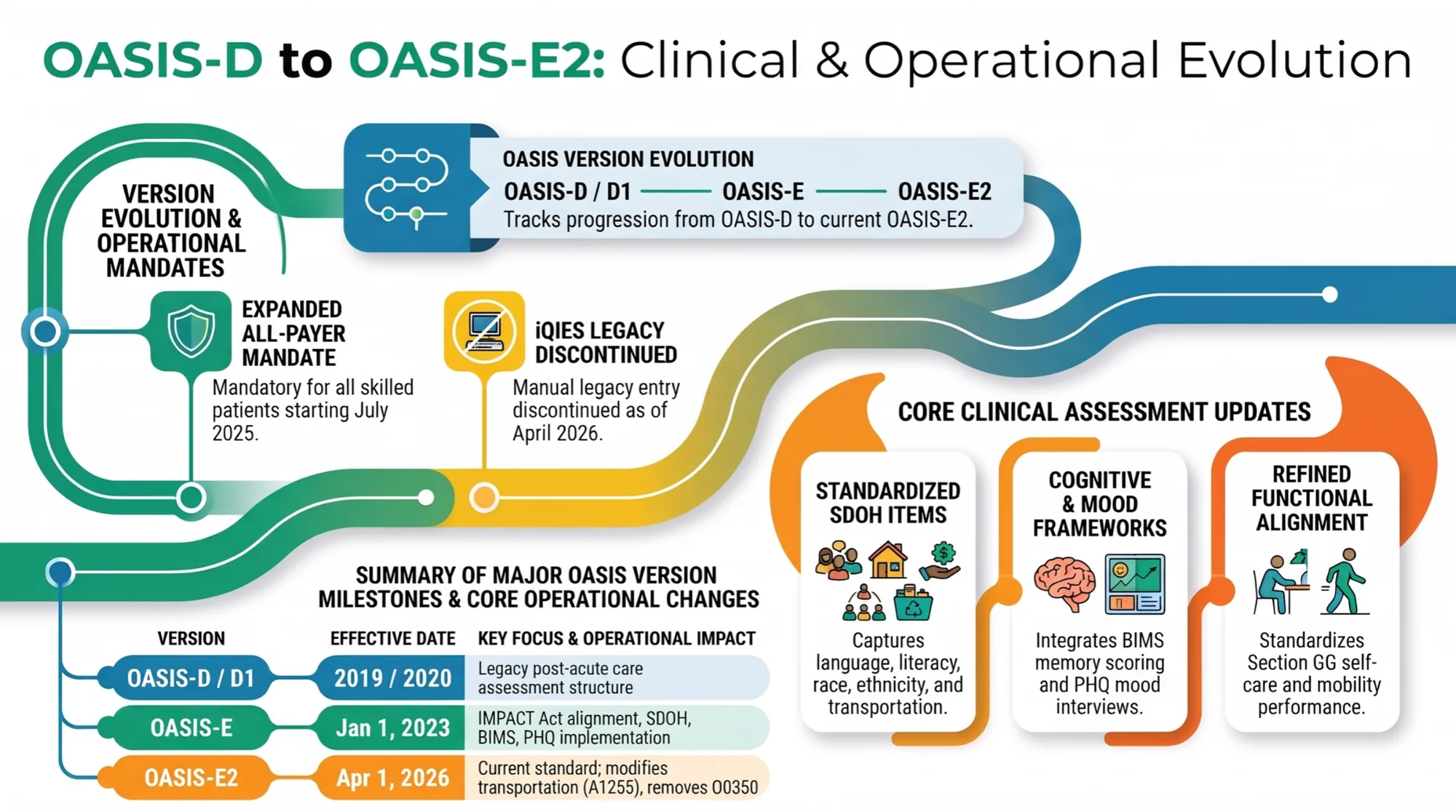
OASIS-E was the major redesign. OASIS-E1, OASIS-E2, all-payer collection, and iQIES submission changes followed.
How Did Cognitive Assessment Change in OASIS-E?
OASIS-E introduced standardized cognitive assessment elements to improve the consistency of cognitive information collected across post-acute care settings.
One important addition was the Brief Interview for Mental Status (BIMS).
BIMS is a structured assessment used to evaluate aspects of cognitive function, including memory and orientation. It helps clinicians collect information about the patient's ability to understand and respond to questions.
OASIS-E also includes standardized assessment elements related to delirium through the Confusion Assessment Method (CAM) framework.
These elements help distinguish different cognitive concerns and support more consistent assessment documentation.
For home health clinicians, this means following the assessment instructions carefully and documenting the patient's actual responses and performance.
What should agencies review?
- BIMS interview and scoring instructions.
- Appropriate use of the assessment when the patient can participate.
- Applicable coding for patients who cannot complete the interview.
- CAM assessment guidance.
- Consistency between cognitive assessment responses and the clinical record.
A cognitive diagnosis alone should not be used as a substitute for completing the required assessment.
What Changed in Mood and Depression Assessment?
OASIS-E revised the mood assessment section and introduced standardized elements using the Patient Health Questionnaire (PHQ) framework.
The assessment includes questions about depressive symptoms, such as:
- Reduced interest or pleasure in activities.
- Feeling down, depressed, or hopeless.
Two important items are:
- D0150 – Patient Mood Interview: Includes the initial screening questions and, when indicated, additional questions about depressive symptoms.
- D0160 – Total Severity Score: Records the calculated severity score when the assessment is completed according to the applicable instructions.
These questions support standardized collection of mood-related information.
A positive screening response does not automatically establish a clinical diagnosis of depression. Clinicians should follow the assessment instructions and communicate relevant concerns through the appropriate clinical process.
What should agencies review?
- Correct administration of the mood interview.
- Appropriate use of the additional questions.
- Accurate scoring and documentation.
- Applicable skip instructions.
- Follow-up or communication when concerning responses are identified.
How Did OASIS-E Revise Functional Assessment and Section GG?
Functional assessment is an important part of understanding a patient's ability to perform daily activities and mobility tasks.
One important distinction is that Section GG was not introduced for the first time in OASIS-E. It was already present in the earlier OASIS-D framework.
OASIS-E continued the standardized functional assessment approach and revised selected instructions and assessment requirements as part of the broader cross-setting alignment effort.
Section GG captures information about activities such as:
Self-care
- Eating.
- Oral hygiene.
- Toileting hygiene.
- Showering or bathing.
- Upper-body dressing.
- Lower-body dressing.
- Putting on and taking off footwear.
Mobility
- Bed mobility.
- Transfers.
- Walking.
- Wheelchair mobility, where applicable.
The purpose is to document what the patient can do and the level of assistance required.
Accurate functional assessment helps establish the patient's abilities, document progress, and support care planning.
What should agencies review?
- The applicable assessment time point.
- Item-specific coding instructions.
- The patient's actual performance.
- Appropriate use of assistance and activity-not-performed codes.
- Consistency between functional responses and visit documentation.
Clinicians should not simply carry forward an earlier functional score without assessing the patient's current abilities.
What Changed in Medication and Health Assessment?
OASIS-E included standardized medication-related and health assessment elements to improve the collection of information relevant to patient safety and care transitions.
Medication-related documentation includes information about medication management, potential medication issues, and communication of medication information.
The assessment and clinical record may need to address:
- Current medications.
- Medication reconciliation.
- Medication-related concerns.
- Potential adverse effects.
- Medication education.
- Communication of medication information to the patient or next provider, where applicable.
OASIS-E also revised selected health-related assessment elements to improve consistency with other post-acute care instruments.
Agencies should distinguish between what is collected in a specific OASIS item and what must be documented in the broader comprehensive assessment or clinical record. Not every medication-related documentation requirement is a new OASIS-E item.
Which OASIS-D Items Were Removed, Revised, or Renumbered?
OASIS-E did not simply add questions to OASIS-D. CMS also revised, removed, reorganized, and changed the collection time points of selected items.
This means agencies should not assume that an item in OASIS-D has an identical equivalent in OASIS-E.
For example:
- Some existing items were revised to align with standardized assessment requirements.
- Some items were removed from the instrument.
- Selected items were assigned different collection time points.
- Some sections and item references were reorganized.
- Skip patterns and response options were updated.
One example is M2016, Patient/Caregiver Drug Education Intervention, which was removed from the OASIS instrument.
Agencies should use the official CMS OASIS-D1-to-OASIS-E change documentation when performing an item-by-item comparison. A general comparison table should not be treated as a complete crosswalk.
Did OASIS-E Change Assessment Time Points and Skip Logic?
Yes. OASIS-E revised selected item collection requirements and introduced updated instructions and skip patterns.
The main OASIS assessment time points include:
| Time point | Purpose |
|---|---|
| Start of Care (SOC) | Initial assessment when home health services begin |
| Resumption of Care (ROC) | Assessment after a qualifying inpatient stay |
| Follow-Up (FU) | Recertification or other follow-up assessment |
| Transfer (TRN) | Transfer to an inpatient facility |
| Discharge (DC) | Discharge from the agency |
| Death at Home (DAH) | Assessment following death at home |
Not every item is collected at every assessment time point.
For example, an item may be required at SOC and ROC but not at a routine follow-up assessment. Other items may be collected only when a particular assessment reason applies.
Agencies should use the relevant CMS time-point instrument and item-specific instructions.
Why does skip logic matter?
Incorrect skip patterns can result in missing responses, unnecessary data entry, and invalid assessment submissions. Clinicians and QA reviewers should understand when an item applies and when a response should be skipped.
CMS also requires that each assessment reflect a unique patient assessment rather than simply carrying forward responses from a previous assessment.
How Did OASIS-E Affect Documentation and QA Workflows?
The new assessment elements and revised instructions required agencies to review their clinical documentation and QA processes.
Clinicians needed to understand the new questions, while QA reviewers needed to confirm that responses were supported by the patient's assessment and clinical record.
Common areas requiring attention included:
- Correct use of new assessment items.
- Accurate SDOH responses.
- Appropriate cognitive and mood assessment.
- Functional scoring based on the patient's actual performance.
- Medication-related documentation.
- Correct assessment time points.
- Updated skip patterns.
- Consistency between OASIS responses and visit notes.
A common risk during a version transition is continuing to use an older workflow with a newer assessment instrument.
This can result in missing responses, incorrect coding, or documentation that does not support the selected answer.
Agencies should update their internal assessment templates, QA checklists, staff training materials, and EMR workflows whenever CMS introduces a new OASIS version.
Does OASIS-E Affect PDGM and Home Health Quality Reporting?
OASIS data supports multiple CMS home health reporting and payment-related functions.
Selected OASIS items are used in payment-related processes, while other items support quality reporting and standardized patient assessment.
The transition to OASIS-E changed the collection of certain data elements and the way selected items were used at different assessment time points.
However, agencies should not assume that every new OASIS-E item directly changes PDGM reimbursement.
PDGM uses specific patient and episode information for payment classification. OASIS also supports quality reporting and other CMS requirements. The role of an individual item depends on the applicable program and reporting rules.
Agencies should verify current CMS instructions rather than treating every OASIS change as a payment change.
What Should Home Health Agencies Review When Transitioning From OASIS-D to OASIS-E?
Preparing for an OASIS update requires more than distributing a revised assessment form.
Agencies should review the changes across clinical, operational, QA, and technology workflows.
A practical transition checklist includes:
1. Review the CMS change table
Identify new, removed, revised, and time-point-specific items.
2. Update clinical assessment workflows
Make sure clinicians understand the questions, coding instructions, and skip patterns.
3. Train clinical staff
Provide practical training on SDOH, cognitive assessment, mood assessment, functional scoring, and medication-related items.
4. Update QA checklists
Revise validation procedures to account for changed items and documentation expectations.
5. Check EMR readiness
Confirm that assessment templates, response options, and time-point logic reflect the applicable OASIS version.
6. Review documentation consistency
Compare OASIS responses with visit notes, comprehensive assessments, medication records, and plans of care.
7. Monitor recurring errors
Track returned assessments and corrections to identify where additional training or workflow changes are needed.
A structured transition process helps reduce confusion and prevents staff from relying on outdated assessment practices.
What Changed in OASIS-E1 and OASIS-E2?
OASIS-E was the major update that replaced OASIS-D in 2023. CMS subsequently introduced OASIS-E1 and OASIS-E2 with additional changes.
| Version | Effective date | Key information |
|---|---|---|
| OASIS-D | 2019 | Earlier assessment version |
| OASIS-D1 | 2020 | Updated version of OASIS-D |
| OASIS-E | January 1, 2023 | Major redesign with standardized post-acute care and SDOH elements |
| OASIS-E1 | January 1, 2025 | Subsequent update to the OASIS-E instrument |
| OASIS-E2 | April 1, 2026 | Current version, with additional instrument and guidance changes |
Some important OASIS-E2 changes include:
| Item | OASIS-E2 update | What agencies should know |
|---|---|---|
| A1250 | Replaced | The earlier transportation item was removed |
| A1255 | Added/modified | Revised transportation question collected at SOC and ROC |
| O0350 | Removed | Patient's COVID-19 vaccination status item was removed |
| M0069 | Replaced | The earlier gender item was replaced by A0810, Sex |
| B0200 | Added to ROC | Hearing item added to the Resumption of Care time point |
| B1000 | Added to ROC | Vision item added to the Resumption of Care time point |
| A1110 | Added to ROC | Language item added to the Resumption of Care time point |
| J1900 | Revised | Response descriptions for the number of falls since SOC/ROC were modified |
These updates show why agencies must use the correct instrument for the applicable assessment date.
The current CMS OASIS-E2 manual also includes additional guidance on completing OASIS for patients with all payers.
Does OASIS Apply to All Payers or Only Medicare and Medicaid Patients?
This is an important operational change that agencies should understand.
CMS expanded OASIS collection and submission to include qualifying patients with any payer, effective July 1, 2025.
The requirement generally applies when the patient:
- Has any payment source.
- Receives skilled home health services.
- Is not exempt from OASIS data collection.
- Begins receiving home health services with an OASIS SOC M0090 date on or after July 1, 2025.
Examples of payment sources include Medicare, Medicaid, commercial insurance, self-pay, charity-based care, and no-payer situations.
There are exceptions. For example, patients under 18, patients receiving maternity services, and patients receiving only personal care, housekeeping, or chore services are generally exempt. Certain outpatient therapy services billed under Medicare Part B without a home health plan of care are also excluded.
Agencies should review the CMS guidance for payer transitions and phase-in situations rather than assuming that every non-Medicare patient automatically requires OASIS.
This change is particularly important for agencies that previously completed OASIS only for Medicare and Medicaid patients.
What Changed in iQIES and OASIS Data Submission in 2026?
OASIS-E2 introduced changes to the assessment instrument and its submission specifications.
Another important operational change took effect on April 1, 2026: CMS discontinued the legacy iQIES front-end interface that agencies previously used to manually create and enter OASIS assessments.
Agencies can no longer use that legacy interface for direct manual data entry. They must submit OASIS data through the applicable data submission process using the required format.
This means agencies should review:
- EMR and OASIS software readiness.
- Current CMS data specifications.
- Assessment export and submission processes.
- Validation and edit checks.
- Procedures for correcting rejected or inaccurate submissions.
The transition to OASIS-E2 is therefore not just an assessment-form update. It also affects how agencies prepare and submit assessment data.
How Can AI Help Home Health Agencies With OASIS Documentation?
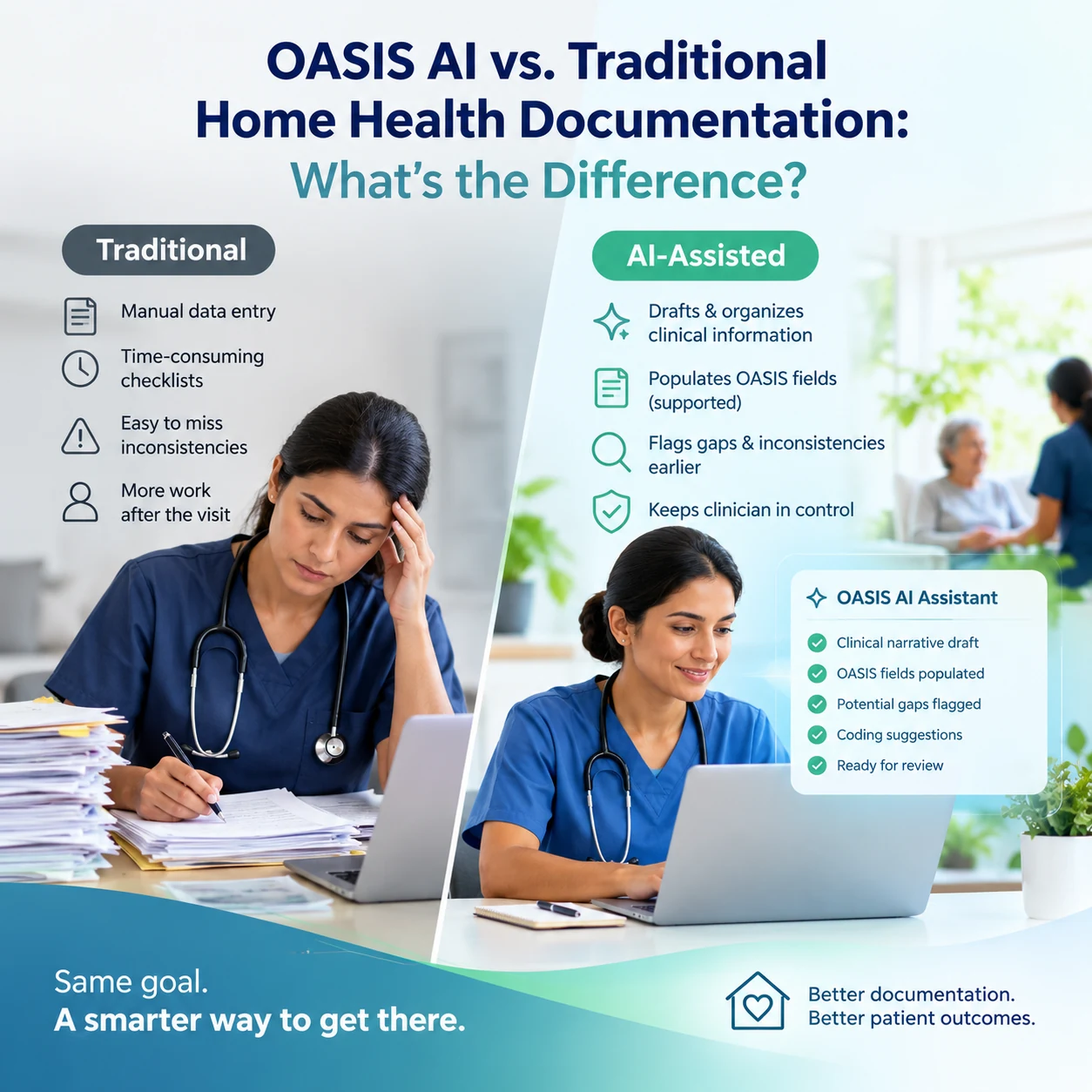
OASIS assessments contain multiple questions, response options, coding instructions, and time-point requirements. Reviewing all this information manually can create additional work for clinicians and QA teams.
AI can support OASIS workflows by helping agencies organize clinical information and identify documentation that needs further review.
For example, AI-supported tools can help:
- Review clinical notes for information relevant to OASIS responses.
- Identify missing or incomplete documentation.
- Flag inconsistencies between assessment responses and supporting notes.
- Support review of functional and clinical documentation.
- Identify items that may need clarification.
- Help QA teams prioritize charts requiring attention.
However, AI-generated suggestions must be checked against the patient's actual assessment and clinical record. AI should not independently determine clinical status, assign unsupported assessment responses, or replace the clinician's responsibility for reviewing and approving the assessment.
Copper AI helps home health agencies support clinical documentation and review workflows. Its AI capabilities can assist with preparing structured documentation and identifying information that needs attention, while clinicians remain responsible for reviewing, correcting, and approving the final record.
The goal is to reduce repetitive documentation work without removing clinical oversight.
The transition from OASIS-D to OASIS-E changed how home health agencies collect, document, and review patient assessment information. The addition of standardized SDOH, cognitive, and mood assessment elements, along with revised instructions and time-point requirements, made accurate assessment and staff training even more important.
But understanding the original OASIS-E transition is only the starting point. Agencies must also keep up with OASIS-E1, OASIS-E2, and the expanded all-payer collection requirements.
The practical priority is to ensure that clinicians, QA reviewers, and agency systems are all working from the correct assessment version. Accurate OASIS documentation starts with understanding the questions, following the applicable guidance, and making sure every response is supported by the patient's actual assessment.