Closing a home health episode involves more than entering a discharge date in the EMR. Before an agency closes a patient’s record, it must make sure the reason for discharge is supported, the final clinical information is documented, the appropriate OASIS requirements are met, and the necessary summaries and orders are completed.
The process can become complicated when a patient is transferred to a hospital, refuses further services, reaches their goals, or is discharged unexpectedly. Each situation can involve different documentation, communication, and assessment requirements.
A missed discharge assessment, incomplete summary, unsigned order, or inconsistent medication list can send a chart back for correction. It can also delay QA review and create problems during billing or an audit.
This guide explains how to close a home health episode step by step, what to review before finalizing the record, and how agencies can reduce documentation gaps without adding more work for clinicians.
What Does It Mean to Close a Home Health Episode?
Closing a home health episode means completing the clinical and administrative steps required when an agency's services end for a patient.
It includes documenting why services ended, recording the patient's condition and progress, completing applicable assessments, preparing the discharge or transfer summary, reconciling medications, and ensuring that the clinical record is complete.
Episode closure generally involves three areas:
- Clinical closure: Documenting the patient's final condition, progress toward goals, remaining needs, and discharge instructions.
- Administrative closure: Updating the patient's status, confirming the discharge reason and date, and completing required communication.
- Documentation and billing review: Checking assessments, orders, visit notes, signatures, and payer-specific requirements before the record moves forward.
A patient should not be considered fully closed simply because the discharge status has been updated in the EMR. The supporting documentation and required follow-up must also be addressed.
When Should a Home Health Agency Close a Patient Episode?
An agency may need to close an episode for several reasons, including:
- The patient's measurable goals have been achieved, and skilled home health services are no longer needed.
- The patient refuses further services or elects to be discharged or transferred.
- The patient is transferred to another care setting.
- The patient is admitted to a hospital.
- The patient dies.
- The agency can no longer meet the patient's needs, requiring an appropriate transfer.
- The patient or payer will no longer pay for the services.
- The agency ceases operation.
Under 42 CFR §484.50(d), an HHA may transfer or discharge a patient only under specified circumstances. For example, discharge because goals have been achieved requires agreement between the agency and the physician or allowed practitioner responsible for the home health plan of care that the goals have been met and the patient no longer needs the agency's services.
Discharge for cause also has specific requirements, including notifying relevant parties, making efforts to resolve the problem, providing information about other providers, and documenting those efforts.
The reason for closure should be clear in the clinical record and consistent with the discharge assessment, summary, orders, and other supporting documentation.
What Should an Agency Check Before Starting Episode Closure?
Before beginning the final documentation process, the agency should confirm that the discharge is appropriate and that the record supports the decision.
Review the following:
- Reason for discharge: Is the reason clearly identified and supported by the patient's situation?
- Discharge date: Is the date consistent across the EMR, clinical notes, assessment, and administrative record?
- Patient status: Is the patient being discharged home, transferred to another provider, admitted to a facility, or ending services for another reason?
- Plan of care: Have the patient's goals and progress been reviewed?
- Responsible practitioner: Has the physician or allowed practitioner responsible for the plan of care been involved where required?
- Patient communication: Has the patient or representative received the applicable information and notices?
- Receiving provider: If care is continuing elsewhere, has the receiving provider's contact information been recorded?
- Outstanding documentation: Are there incomplete visit notes, orders, assessments, or communications that need attention?
This initial review helps prevent the agency from completing the wrong assessment or closing a record before essential information is available.
Which OASIS Assessment Is Required Before Closing an Episode?
For patients and episodes subject to OASIS requirements, the agency must determine the appropriate assessment based on the circumstances of discharge or transfer.
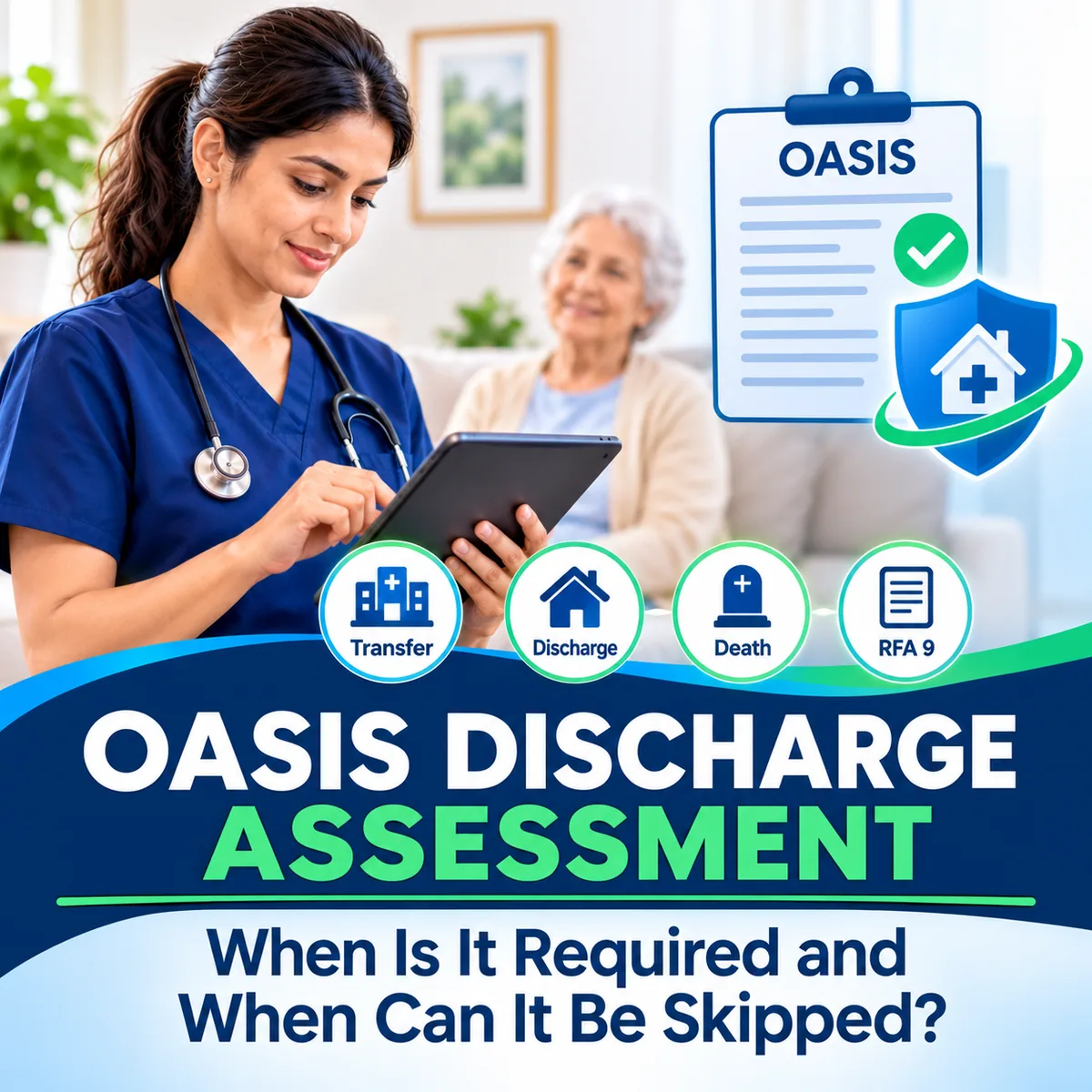
Under the OASIS-E2 guidance effective April 1, 2026, the relevant discharge and transfer reason-for-assessment codes include:
| RFA | Situation |
|---|---|
| RFA 6 | Transferred to an inpatient facility, but not discharged from the HHA because the patient is expected to return |
| RFA 7 | Transferred to an inpatient facility and discharged from the HHA because the patient is not expected to return |
| RFA 8 | Death at home |
| RFA 9 | Discharged from the HHA for a reason other than an inpatient transfer or death at home |
The agency should select the assessment that accurately reflects the patient's situation. A hospital visit or emergency department visit does not automatically qualify as an inpatient transfer. The actual setting and circumstances matter.
The discharge assessment should reflect the patient's condition and the applicable assessment timeframes. The agency should also check that the assessment information is consistent with the clinical record.
When Can an Agency Close an Episode Without a Separate OASIS Discharge Assessment?
Not every episode closure requires a separate OASIS Discharge assessment. The agency must review the applicable CMS guidance and the patient's circumstances before deciding that one is not required.
Examples of specific situations include:
- RFA 7: When the patient is transferred to an inpatient facility and discharged from the HHA, no additional OASIS discharge data are required beyond the applicable transfer assessment.
- RFA 6 followed by no return: If an RFA 6 assessment has been submitted and the patient does not return to the HHA during the current 60-day certification period, the manual specifies that an additional OASIS discharge assessment is not required.
- Single-visit quality episodes: A separate Discharge OASIS assessment is not required in the specified single-visit quality episode situation.
These exceptions should not be applied simply because a patient has stopped receiving visits or the agency wants to close the chart quickly.
The agency should confirm the applicable OASIS rules, payer requirements, and episode circumstances. OASIS collection and submission requirements can also differ from the documentation needed to support billing.
What Notices Must Be Provided Before Home Health Services End?
Patient notices are an important part of discharge planning, but the same notice is not required in every discharge situation.
Under 42 CFR §484.50, patients have the right to receive proper written notice in advance when an HHA believes a specific service may not be covered or before the agency reduces or terminates ongoing care. Applicable Medicare notice and expedited appeal requirements must also be followed when relevant.
Depending on the circumstances, the agency may need to review:
- Notice of Medicare Non-Coverage (NOMNC), when applicable.
- Other payer-specific notices.
- Notice related to a reduction or termination of ongoing services.
- Appeal rights and instructions, where applicable.
- Documentation of when the notice was provided and to whom.
The agency should record the notice date, recipient, delivery method, and any relevant patient or representative response.
Do not assume that every discharge requires the same notice or that a NOMNC applies to every patient. Notice requirements depend on the payer, the type of service ending, and the circumstances of the discharge.
How Should the Final Home Health Visit Be Documented?
The final visit should give a clear picture of the patient's condition when home health services end.
The clinician's documentation should explain what was assessed, what care was provided, how the patient responded, and whether the patient's goals were achieved.
A complete final visit note may include:
- Patient's current clinical condition.
- Relevant assessment findings and changes since the previous visit.
- Interventions, treatments, and education provided.
- Patient and caregiver response to care.
- Progress toward the goals in the plan of care.
- Remaining clinical concerns or unmet needs.
- Safety risks and recommendations for continued care.
- Instructions provided to the patient or caregiver.
- Communication with the physician or other responsible practitioner, when applicable.
Documentation should be objective and consistent with the patient's clinical status. If a goal has not been met, the record should explain the patient's status and the reason for discharge rather than simply marking the goal as completed.
The final visit note and discharge summary serve related but different purposes. The visit note documents the encounter, while the discharge summary communicates the patient's overall home health course and status at discharge.
What Should Be Included in a Home Health Discharge Summary?
A discharge summary should give the next responsible provider a useful overview of the patient's home health care.
Under 42 CFR §484.110, the clinical record must include a completed discharge summary sent to the primary care practitioner or other health care professional responsible for the patient's care after discharge, if any.
CMS interpretive guidance identifies common discharge summary elements, including:
- Admission and discharge dates.
- Physician responsible for the home health plan of care.
- Reason for admission to home health.
- Types and frequency of services provided.
- Relevant laboratory information.
- Medications the patient is taking at discharge.
- Patient's condition at discharge.
- Outcomes and progress toward plan-of-care goals.
- Post-discharge instructions for the patient and family.
Agencies should also ensure that the summary communicates relevant ongoing needs, unresolved concerns, and follow-up recommendations when applicable.
A useful discharge summary should answer three questions:
- What was the patient's condition when home health services began?
- What services were provided, and how did the patient progress?
- What does the patient or next provider need to know after discharge?
A summary that only states that the patient was discharged does not provide enough clinical context for an effective handoff.
What Should an Agency Document When a Patient Refuses or Self-Discharges?
A patient may refuse further visits, request to end services, or become unavailable for continued care. These situations still require clear documentation.
The agency should record:
- The patient's stated reason for refusing or ending services, if known.
- The date and time the agency learned of the decision.
- The patient's current clinical status, based on available information.
- Education provided about the potential risks of stopping services.
- Communication with the patient, representative, caregiver, and responsible practitioner, as applicable.
- Efforts to address concerns or arrange appropriate follow-up.
- Applicable discharge documentation and OASIS requirements.
If the patient refuses a scheduled visit, the missed visit should be documented according to agency policy and applicable requirements. A missed visit alone should not automatically be treated as a completed discharge.
Patient refusal does not remove the need to document the circumstances, communication, and actions taken by the agency.
When Must a Home Health Discharge or Transfer Summary Be Sent?
The timeline depends on whether the patient is being discharged from the HHA or transferred to a facility where care will continue.
Under 42 CFR §484.110(a)(6):
| Situation | Required timeframe |
|---|---|
| Discharge from the HHA | Send the completed discharge summary to the responsible primary care practitioner or other health care professional, if any, within 5 business days of discharge |
| Planned transfer to a health care facility where care will immediately continue | Send the completed transfer summary within 2 business days of the planned transfer |
| Unplanned transfer to a health care facility | Send the completed transfer summary within 2 business days of becoming aware of the transfer, if the patient is still receiving care in the facility when the HHA becomes aware |
These are specific clinical record requirements. Agencies should not treat the timelines as interchangeable.
For every summary, maintain evidence of completion and transmission. The record should identify the intended recipient and provide enough information to demonstrate that the required communication took place.
How Should Physician Orders, Certifications, and Signatures Be Reviewed?
Before closing the episode, the agency should review the orders and clinical entries associated with the patient's care.
Check for:
- Applicable physician or allowed practitioner orders.
- Plan-of-care updates and relevant changes in treatment.
- Discharge or transfer orders, where required.
- Required certifications and recertifications.
- Missing or incomplete signatures.
- Entries that have not been authenticated.
- Documentation that does not match the services provided.
Under 42 CFR §484.110(b), clinical record entries must be legible, clear, complete, appropriately authenticated, dated, and timed. Authentication must include the primary author's signature and title or an appropriate secured computer entry using a unique identifier.
The agency should also verify that Medicare certification and face-to-face documentation requirements applicable to the episode are present and consistent with the record. Face-to-face documentation is primarily an eligibility and certification requirement where applicable; it should not be presented as a universal new discharge requirement.
If a required order or entry is pending, the agency should track it through the appropriate follow-up process rather than treating the record as complete.
Why Is Medication Reconciliation Important at Discharge?
Medication reconciliation helps ensure that the medication information available at the end of home health services is accurate and useful for the patient and the next provider.
The agency should compare the medication information in the clinical record with the patient's current medication use and any available updated instructions.
Review:
- Current medication names and dosages.
- Medication changes made during the episode.
- Medications started, stopped, or modified.
- Known discrepancies between the medication list and the patient's reported use.
- Relevant medication-related concerns.
- Education provided to the patient or caregiver.
- Communication of medication changes or unresolved discrepancies to the responsible practitioner or next provider, as applicable.
The discharge summary should reflect the medications the patient is taking at discharge. If a discrepancy cannot be resolved before the episode closes, document the issue and the communication or follow-up action taken.
A medication list copied from an earlier visit may not reflect the patient's current regimen. It should be reviewed rather than carried forward without verification.
What Should Be Documented When a Patient Is Transferred to Another Provider?
A transfer requires more than changing the patient's status in the EMR. The agency should support continuity of care by documenting the destination, the reason for transfer, and the information shared with the receiving provider.
The transfer documentation should include, as applicable:
- Reason for transfer.
- Date of transfer and known destination.
- Receiving facility or provider details.
- Patient's clinical condition at the time of transfer, based on available information.
- Relevant diagnoses and recent assessment findings.
- Current medications and known medication changes.
- Treatments, equipment, or services in progress.
- Pending tests, orders, or follow-up needs.
- Relevant risks, precautions, and care instructions.
- Communication with the patient, representative, and receiving provider.
- Transfer summary completion and transmission details.
For a planned transfer, the agency should coordinate the handoff before the patient moves when possible. For an unplanned transfer, it should document when the agency became aware of the transfer and whether the patient was still receiving care in the facility at that time.
This information helps the next provider understand what has happened and what needs attention.
What Should QA Review Before an Episode Is Closed?
A QA review should confirm that the clinical record tells a consistent and complete story of the patient's home health episode.
A practical review should cover:
1. Discharge details
- Is the reason for discharge documented?
- Does the discharge date match across the record?
- Is the discharge or transfer supported by the applicable circumstances and documentation?
2. Clinical documentation
- Is the final visit note complete?
- Does the patient's clinical status support the discharge narrative?
- Are goals and outcomes documented accurately?
- Are unresolved needs or risks addressed?
3. OASIS
- Is the correct assessment required for the situation?
- Is the correct RFA selected?
- Are applicable timeframes followed?
- Are the assessment responses consistent with the clinical record?
- Are any applicable exceptions supported?
4. Discharge or transfer summary
- Is the summary complete?
- Does it include the patient's condition, services, medications, goals, and instructions?
- Has it been sent to the appropriate provider within the required timeframe?
5. Orders and authentication
- Are applicable orders and certifications present?
- Are entries dated, timed, and authenticated?
- Are missing signatures or pending orders being tracked?
6. Medication reconciliation
- Does the discharge medication list reflect the available current information?
- Are discrepancies and medication changes documented?
- Has relevant information been communicated?
7. Patient communication
- Are applicable notices documented?
- Are patient and caregiver instructions recorded?
- Is the communication with the responsible practitioner documented where required?
The goal of QA is not simply to check whether every field has been filled. It is to confirm that the documentation is accurate, consistent, and supported by the patient's actual care.
What Should Agencies Check Before Submitting the Final Claim?
Clinical episode closure and final claim preparation are connected, but they are not the same process. A chart can appear complete from a clinical perspective and still contain discrepancies that need to be addressed before billing.
A pre-billing review can help identify these issues.
Check the following:
- Visits delivered: Do completed visit notes match the services and dates recorded for the episode?
- Missed and cancelled visits: Are missed, refused, cancelled, or incomplete visits documented appropriately?
- EVV: Where electronic visit verification applies, do the available records align with the documented services?
- Plan of care: Are the services billed supported by the applicable plan of care and orders?
- Authorizations: Have payer-specific authorization and service requirements been met?
- Service dates and disciplines: Are the dates, visit types, and disciplines consistent across the record?
- Assessments: Are applicable OASIS requirements and submission steps addressed?
- Signatures: Are required clinical entries and orders authenticated?
- Coding: Are diagnoses and billing information supported by the clinical record?
- Duplicate or unsupported services: Are there any services that appear duplicated, incorrectly coded, or unsupported?
These are recommended operational controls, not a single CMS-mandated pre-billing checklist. Agencies should also apply payer contracts, Medicare billing rules, and their own compliance procedures.
The final claim should reflect the services actually furnished and supported by the record.
How Long Must a Home Health Clinical Record Be Retained?
Under 42 CFR §484.110(c), an HHA must retain clinical records for at least five years after the patient's discharge, unless state law requires a longer retention period.
Agencies should also have policies for protecting records and retaining them if the agency discontinues operations.
Before closing an episode, ensure that the completed record is stored securely and remains accessible to authorized personnel in accordance with applicable requirements.
The agency should not treat episode closure as permission to delete or discard the underlying clinical documentation.
What Are the Most Common Home Health Episode Closure Errors?
Several recurring documentation gaps can delay closure, trigger QA corrections, or create problems during an audit.
| Common error | Why it creates a problem |
|---|---|
| Incorrect discharge reason | The record may not support the selected discharge status or assessment |
| Inconsistent discharge dates | Different dates across notes, OASIS, and the EMR create confusion |
| Incorrect OASIS RFA | The assessment may not reflect the actual transfer or discharge situation |
| Missing final clinical note | The patient's condition and progress at the end of care are unclear |
| Incomplete discharge summary | The next provider may not receive essential clinical information |
| Missing medication reconciliation | The medication list may not reflect the patient's current regimen |
| Pending orders or signatures | The clinical record may remain incomplete or unauthenticated |
| Missing patient notices | Applicable patient rights and notice requirements may not be documented |
| Incomplete transfer handoff | The receiving provider may lack information needed for continuity of care |
| Inconsistent visit and billing records | Services billed may not align with the clinical documentation |
| Untracked late entries | The record may contain unresolved documentation gaps |
Most of these problems are preventable when the agency uses a consistent closure process and identifies missing information before the chart reaches final QA.
What Is a Practical Checklist for Closing a Home Health Episode?
Agencies can use the following checklist as a starting point for their internal episode closure workflow. It should be adapted to the patient's circumstances, applicable OASIS requirements, payer rules, and state requirements.
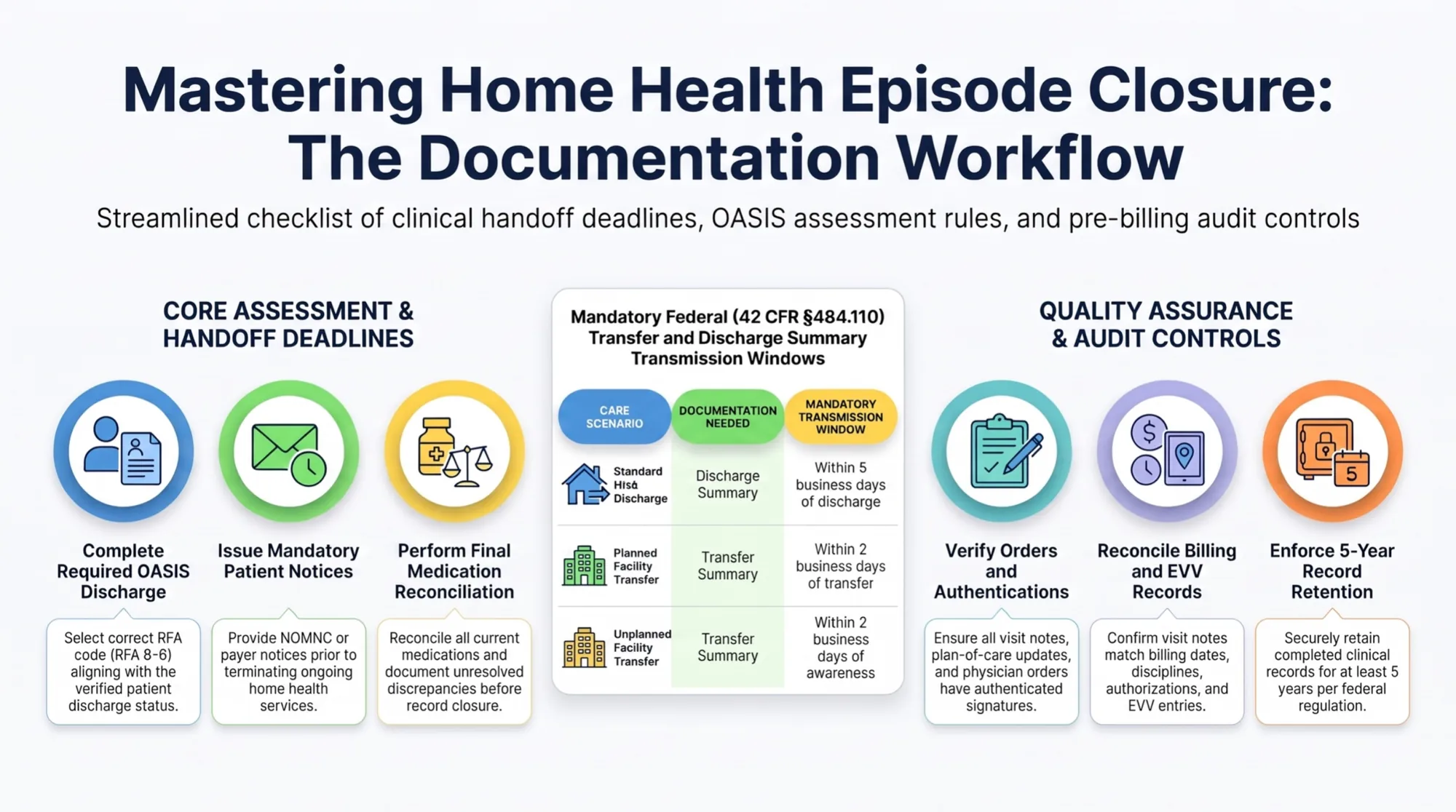
Episode closure brings together clinical handoff deadlines, OASIS assessment rules, and pre-billing QA controls.
Home Health Episode Closure Checklist
Discharge decision and notices
- Confirm the reason for discharge or transfer.
- Verify the discharge date.
- Confirm that the discharge is supported by the applicable requirements.
- Document patient or representative communication.
- Provide applicable notices and document delivery.
- Record the receiving provider or destination when relevant.
Clinical assessment and documentation
- Complete the final visit documentation, where applicable.
- Record the patient's condition at discharge.
- Document progress toward goals and any unmet needs.
- Complete the applicable OASIS assessment.
- Verify the correct RFA and applicable assessment timeframe.
- Document patient and caregiver education.
- Record relevant follow-up recommendations.
Discharge or transfer summary
- Prepare the discharge or transfer summary.
- Include the patient's condition, services, medications, and outcomes.
- Identify the responsible next provider, if any.
- Send the summary within the applicable timeframe.
- Retain evidence of transmission.
Orders and medication review
- Review applicable physician or allowed practitioner orders.
- Verify required certifications and recertifications.
- Check for missing signatures and authentication.
- Reconcile the medication list.
- Document unresolved medication discrepancies and communication.
QA and billing review
- Check for incomplete or missing visit notes.
- Review late entries and pending signatures.
- Confirm consistency across the EMR, OASIS, orders, and discharge summary.
- Reconcile visits delivered with documented services.
- Review EVV records where applicable.
- Confirm payer and authorization requirements.
- Check diagnosis and billing information against the clinical record.
- Store the completed record securely.
A standardized checklist helps clinicians, QA reviewers, and billing teams work from the same closure requirements instead of discovering missing documentation at different stages.
How Can AI Help Agencies Close Home Health Episodes Without Missing Documentation?
Episode closure involves reviewing information that may be spread across visit notes, OASIS assessments, medication lists, physician orders, and discharge summaries. Finding inconsistencies manually can take time, particularly when a chart has multiple visits and several disciplines involved.
AI can support this process by helping agencies organize and review documentation before the record moves to final approval.
For example, AI-supported workflows can help with:
- Identifying missing or incomplete documentation.
- Reviewing visit notes for required information.
- Comparing clinical summaries with the available record.
- Flagging inconsistencies in dates, medications, or patient details.
- Supporting OASIS documentation review.
- Identifying pending items that need clinician or staff attention.
- Organizing information for QA review.
However, AI should support the review process rather than replace clinical judgment. It should not independently decide that a patient is ready for discharge, determine that a clinical goal has been met, or submit a final assessment without the required human review and approval.
Copper AI supports home health documentation workflows by helping agencies prepare and review clinical information. Its AI agents can assist with documentation and identify items that need attention, while clinicians and authorized staff remain responsible for reviewing, correcting, and approving the final record.
The objective is straightforward: reduce repetitive documentation work and help teams spend less time searching for missing information and more time focused on patient care.
Closing a home health episode should not mean chasing paperwork after care has ended. When discharge decisions, OASIS requirements, summaries, orders, medication information, and billing checks follow a consistent process, agencies can reduce avoidable rework and make the transition safer for patients and the next care provider.