
OASIS Documentation Best Practices
OASIS Documentation Best Practices are evidence-based documentation techniques that help clinicians produce accurate, complete, and defensible OASIS assessments.
Definition
OASIS Documentation Best Practices are evidence-based documentation techniques that help clinicians produce accurate, complete, and defensible OASIS assessments.
Why it matters
OASIS Documentation Best Practices is part of the OASIS vocabulary used across home health operations, documentation, and revenue cycle. Understanding it helps clinicians, QA leads, and administrators stay aligned on care quality and compliance.
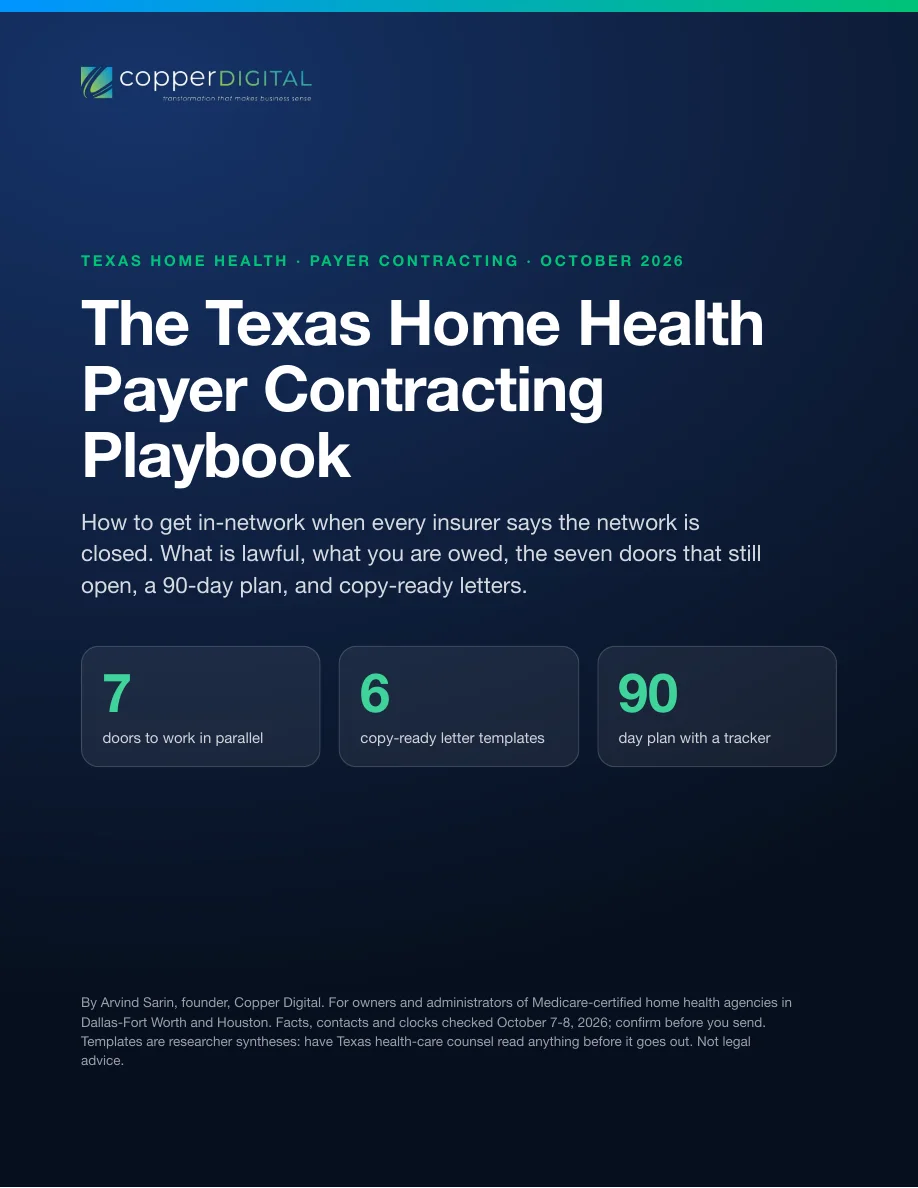
Texas Home Health Payer Contracting Playbook
When a Texas payer says “our network is closed,” it doesn’t mean every door is shut. This playbook explores three paths to pursue payer contracts, access referral networks, and secure out-of-network payments. Learn which three numbers payers check first, and how to build a stronger case for your agency.
Related terms
Listen While You Read
Conversations on oasis
Episodes from Inside Home Health that put OASIS Documentation Best Practices in operational context.
 Ep 25
Ep 25 · Oct 5, 2026
Home Health Is NOT “Easy” Anymore: The Hidden Complexity of Care at Home | Nurse Alice Benjamin
 Nurse Alice BenjaminWatch
 Ep 24
Ep 24 · Sep 16, 2026
83% of Healthcare AI Has NO Governance (Here's Why That's Dangerous) | Dr. Lendra James
 Dr. Lendra James, DNP, MS, RN, NE-BCWatch
 Ep 21
Ep 21 · Jul 20, 2026
Why Nurses Stop Using AI Tools After 90 Days | Jennifer Ngure
 Jennifer NgureWatch
Related Blogs
OASIS Documentation Compliance Tips for Home Health Agencies
OASIS compliance isn't just filling in every field; it's making the assessment tell a consistent, clinically supported story that agrees with the rest of the record. This guide covers 12 practical compliance tips, 9 common errors, a pre-submission checklist, what's new in OASIS-E2, and where AI helps (and where it must not).

Common OASIS Documentation Mistakes That Lead to Payment Delays
Common OASIS documentation mistakes, such as incomplete assessments, incorrect diagnosis coding, inaccurate Section GG scoring, medication and homebound-status errors, weak skilled-need documentation, and missing physician signatures, are among the biggest causes of home health payment delays. Because OASIS data drives PDGM reimbursement, most of these errors are preventable with point-of-care charting, strong QA, and AI-powered documentation validation.