
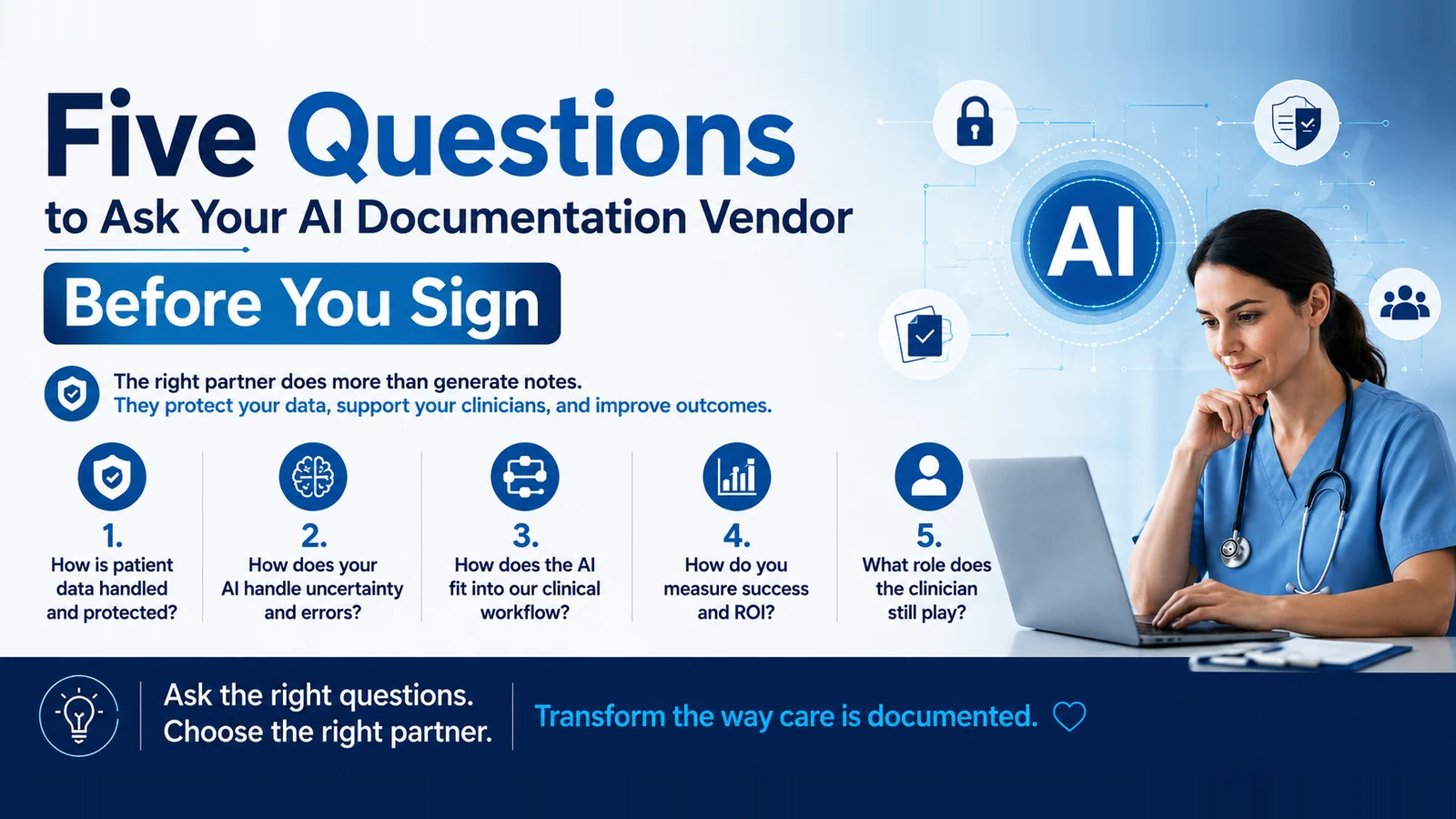
Five Questions to Ask Your AI Documentation Vendor Before You Sign
Almost every AI documentation vendor can show an impressive demo, but a demo doesn't tell you how the technology behaves inside your real clinical workflow. This guide gives five questions to ask before you sign, covering data handling, hallucinations, workflow fit, measurable ROI, and clinician control, plus demo red flags and a six-area vendor evaluation framework.
Key Takeaways
- A polished demo shows the best case; ask what the AI does inside your real clinical workflow, not just how fast it generates a note.
- Map the full patient-data flow: what is processed, stored, retained, who can access it, whether it trains external models, and what third-party AI/infrastructure is involved.
- Test how the AI handles uncertainty and hallucinations, it should flag gaps and separate observed from generated information, not fill gaps with plausible language.
- Check workflow fit: a tool that saves 10 minutes generating a note but adds 15 minutes of copying and correcting hasn't solved the problem, it moved it.
- Tie the AI to a measurable workflow problem and ask: what should improve 90 days after implementation?
- Keep clinicians in control, they should review, validate, edit, and approve the final record; AI removes work around documentation, not clinical judgment.
- Evaluate implementation, integration, governance, and support, an excellent platform with poor implementation can still fail.
💡 Quick Answer: A good AI documentation demo doesn't tell you how the technology will behave inside your real clinical workflow. Before you sign with an AI documentation vendor, ask five questions: (1) exactly what the AI does with patient information end to end, (2) how it handles uncertainty, missing information, and hallucinations, (3) whether it adapts to your clinical workflow or forces you to adapt to it, (4) how it measures whether clinicians are actually helped, and (5) what role the clinician still plays in reviewing and approving the record. The right partner doesn't just sell automation, it helps you build a better workflow while clinicians stay in control of the clinical story.
AI documentation tools are becoming easier to find. Choosing the right one is getting harder. Almost every vendor can show you an impressive demo, notes appear in seconds, summaries look clean, documentation sounds polished, and administrative work suddenly seems lighter. But a good demo does not tell you how the technology will behave inside your actual clinical workflow.
For home health organizations, that distinction matters. An AI documentation platform may touch clinical notes, patient information, clinician workflows, quality review, care coordination, and potentially multiple systems across the organization. So before asking how fast the AI can generate a note, home health leaders should ask a more important question: can this technology fit safely, reliably, and practically into the way our clinicians actually work? Here are five questions worth asking before you sign.
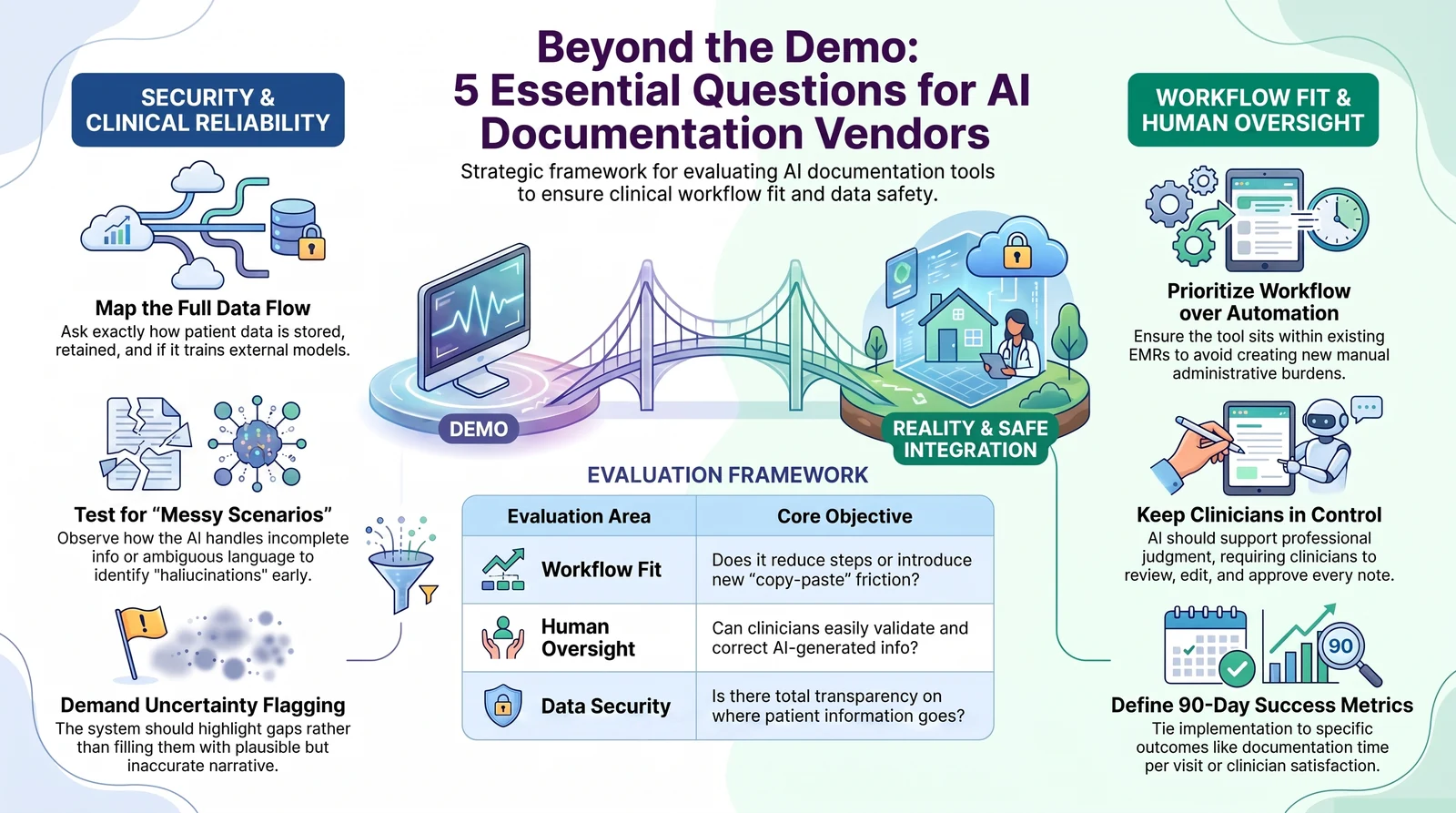
Look past the demo, evaluate data handling, uncertainty, workflow fit, measurable value, and clinician control.
1. What Exactly Does Your AI Do With Patient Information?
This should be one of the first questions in any AI documentation conversation, and not "is your platform secure?" Almost every vendor will answer yes. Ask instead: what happens to our patient information from the moment it enters your system until the moment it leaves? You want to understand the full data flow, including:
- What patient information does the system process?
- Where is that information stored?
- How long is it retained?
- Who can access it?
- Is customer data used to train AI models?
- Can data retention be configured?
- What third-party AI models or infrastructure providers are involved?
- How is information handled when a customer relationship ends?
These questions are especially important when a vendor relies on external AI models behind the scenes. The application your clinician sees may only be one layer of the technology, patient information may move through transcription services, language models, hosting infrastructure, analytics platforms, or other systems before a completed note reaches the clinician. A strong vendor should be able to explain that architecture clearly.
⚠️ If the answer is simply "don't worry, we are HIPAA compliant," keep asking questions. Security and privacy should be understandable at the workflow level, not reduced to a marketing statement. (For a deeper look, see is AI documentation HIPAA compliant?)
2. How Does the AI Handle Uncertainty, Missing Information, and Hallucinations?
Every AI documentation platform can show you what happens when everything goes right. Ask what happens when it does not. Generative AI can sometimes produce information that sounds reasonable but is inaccurate, unsupported, incomplete, or inferred from context, and in clinical documentation, that distinction matters. Ask: what does your system do when it does not have enough information to confidently document something? Ideally, the AI should not simply fill the gap with plausible language. Look for capabilities that help clinicians recognize uncertainty:
- Flagging incomplete information
- Highlighting areas that need confirmation
- Showing the underlying source information
- Separating observed information from generated narrative
- Preventing unsupported clinical conclusions
- Requiring clinician review before information becomes part of the record
The strongest AI documentation workflow is not the one that produces the most polished note automatically. It is the one that makes it easy for the clinician to understand what the AI knows, what it inferred, and what still requires human judgment.
Ask for a difficult demo
Do not only ask the vendor to demonstrate an ideal patient encounter. Give them a messy scenario: include incomplete information, use conversational language, change something halfway through the encounter, mention a symptom without explaining whether it improved, and see what the AI does. That demonstration may tell you much more than the polished sales demo. (Many of these failure modes map directly to the top home health documentation errors.)
3. Can the AI Adapt to Our Clinical Workflow, or Do We Have to Adapt to It?
This is where many promising AI projects run into trouble. The technology works, clinicians simply do not want to use it, because the system was designed around the AI rather than around the clinician. Home health clinicians already work across schedules, EMRs, care plans, assessments, medication information, communication tools, patient homes, and documentation requirements. Adding another application can easily create more work instead of less. Ask: where exactly does your AI sit inside the clinician's existing workflow? Walk through a real visit:
- Before the visit: can the clinician quickly understand relevant patient history?
- During the visit: does the tool require additional steps?
- After the visit: what does the clinician have to review, correct, approve, or copy?
- Before signing: how much manual work remains?
🎯 An AI documentation tool that saves ten minutes generating a note but creates fifteen minutes of copying, reviewing, correcting, and moving information between systems has not solved the documentation problem. It has moved it. (This is the core difference explored in AI vs. ambient scribe for home health nurses.)
4. How Do You Measure Whether the AI is Actually Helping Clinicians?
"AI-powered" is not an outcome. Neither is "automated documentation." Before implementing an AI documentation platform, define what success actually means for your organization, then ask the vendor how they measure it. Potential measures include:
- Documentation time per visit
- After-hours documentation
- Time from visit completion to note completion
- Frequency of clinician corrections
- Documentation completeness
- Quality review effort
- Clinician adoption and satisfaction
- Missing patient response or clinical context
- Administrative workload
Different organizations will prioritize different outcomes, a home health agency struggling with late documentation may care about completion time, another may want to reduce time spent reviewing notes, another may focus on clinician experience, and another may want better visibility into patient changes across visits. The important point is that the AI should be tied to a real operational or clinical workflow problem.
➡️ Ask one simple question: what should improve 90 days after we implement this? The vendor should be able to answer. If the answer focuses mostly on AI features rather than measurable workflow outcomes, that is useful information.
5. What Role Does the Clinician Still Play?
This may be the most important question of all. Good clinical AI should make professional judgment easier to exercise, not make that judgment invisible. Ask: where does the clinician remain responsible for reviewing, validating, editing, and approving the documentation? You want to understand what happens between AI-generated content and the final clinical record:
- Can clinicians easily correct the note?
- Can they see why certain information was included?
- Are important findings surfaced for review?
- Does the system make it clear when information requires clinical confirmation?
- Can agency leaders configure review rules?
- What happens when the clinician disagrees with the AI?
The goal should not be to remove clinicians from documentation. The goal should be to remove unnecessary work around documentation while keeping clinicians in control of the clinical narrative. That is an important distinction.
Bonus Question: What Happens After We Sign?
Many technology evaluations focus heavily on the product and spend much less time evaluating implementation. But AI adoption is not finished when the contract is signed, in many ways, that is when the real work begins. Ask:
- Who owns implementation?
- How are clinicians onboarded?
- How are workflows configured?
- How is adoption measured?
- What support is available after launch, and how are issues escalated?
- How frequently does the AI change, and how are model updates communicated?
- How does the vendor collect clinician feedback and evaluate new use cases?
An excellent AI platform with poor implementation can still fail. Home health agencies should evaluate the vendor's ability to support organizational change, not just its ability to build software.
Do Not Buy an AI Documentation Tool. Buy a Better Workflow.
This is perhaps the most useful way to think about AI documentation. The objective is not to purchase AI, the objective is to improve a workflow. Imagine your clinicians currently spend too much time finishing notes after visits. Your problem is not "we do not have generative AI." Your problem is "documentation is taking too much clinician time." Now the evaluation becomes clearer:
- Can this technology reduce that burden?
- Can it do so without sacrificing documentation quality?
- Can clinicians trust and review the output?
- Can it work inside the existing workflow?
- Can the organization measure whether things actually improved?
Those are much better buying questions. (Documentation burden is also a leading driver of turnover, explored in can AI help reduce nurse burnout?)
Red Flags to Watch for During an AI Documentation Demo
Certain signals should trigger additional questions. Specific answers are more useful than confident answers.
| Red flag claim | What to ask |
|---|---|
| "Our AI is almost 100% accurate." | How is accuracy defined, tested, and measured? A single percentage rarely tells the whole story. |
| "Clinicians don't need to review much." | Exactly what review remains, and what happens when generated information is incorrect? |
| "We can integrate with anything." | Show examples involving systems like ours, and explain what the integration actually includes. |
| "The AI learns your organization automatically." | What does 'learning' mean, and is customer information used for model training? |
| "Implementation is easy." | Show the actual onboarding process, timeline, responsibilities, and clinician workflow changes. |
A Simple AI Documentation Vendor Evaluation Framework
Before choosing a vendor, evaluate the platform across six areas. A vendor doesn't need to be perfect in every category, but your leadership team should understand the tradeoffs before deciding.
| Evaluation area | The question to answer |
|---|---|
| Clinical usefulness | Does the technology help clinicians create or review better documentation? |
| Workflow fit | Does it reduce steps or introduce new ones? |
| Human oversight | Can clinicians easily review, validate, and correct AI-generated information? |
| Data and security | Do you understand where patient information goes and how it is handled? |
| Integration | Can the technology work effectively with your existing systems? |
| Measurable value | Can you demonstrate that the workflow became better after implementation? |
The Best Vendor May Not Have the Flashiest AI Demo
AI documentation technology is moving quickly, which makes it tempting to compare vendors on features, who generates the note fastest, who has the most impressive interface, who uses the newest AI model. Those questions can matter, but they should come after more fundamental ones: does the technology solve a real problem? Can clinicians use it naturally? Can your organization understand and manage the risks? Can the vendor explain what happens when the AI gets something wrong? Can you measure whether the workflow actually became better?
For home health organizations, the right AI documentation partner should not simply sell automation. They should help create a workflow where technology handles more of the administrative friction while clinicians retain control over the clinical story. Before you sign, ask the difficult questions, the quality of those answers may tell you more about the vendor than the AI demo ever will.
Home Health Documentation Playbook
The complete guide to OASIS-E, Medicare compliance, PDGM, and AI-assisted documentation. Learn how top agencies reduce documentation time without sacrificing compliance.
Bottom Line
Before signing with an AI documentation vendor, look past the demo and ask five questions: exactly what the AI does with patient information end to end, how it handles uncertainty and hallucinations, whether it adapts to your clinical workflow, how it measures real clinician benefit (what improves in 90 days?), and where the clinician stays responsible for reviewing and approving the record. Then evaluate implementation, integration, and support. The objective isn't to buy AI, it's to buy a better workflow, where technology absorbs administrative friction while clinicians keep control of the clinical story.

Arvind Sarin is the founder of Copper Digital. For the past year he has spent three days a week inside a 500+ census Texas home health agency, building AI documentation that finishes OASIS and visit notes the same day, with a nurse reviewing and approving every note. He writes about home health documentation, OASIS, Medicare compliance, and applying AI responsibly in clinical workflows.
Frequently asked
Frequently asked questions
Ask how patient information is handled, how the AI manages missing or uncertain information, how the platform integrates into clinical workflows, how outcomes are measured, and how clinicians remain involved in reviewing and approving documentation. Agencies should also evaluate implementation support, integrations, governance, and ongoing model changes.
Join the conversation
Leave a comment
Related reading

AI Scribe vs AI Documentation Agent: Which One Does Home Health Really Need?
An AI scribe transcribes conversations into notes. An AI Documentation Agent goes further: it understands clinical workflows, processes referral PDFs, drafts OASIS-E assessments, assists with medication reconciliation, surfaces missing documentation, and helps nurses complete compliant charts. For home health's OASIS complexity and referral processing, an AI Documentation Agent does more than a transcription-only scribe.

How Ambient AI Is Changing Clinical Documentation
Ambient AI passively listens to patient-clinician conversations and automatically generates structured clinical documentation, using speech recognition, NLP, and large language models to capture symptoms, diagnoses, medications, and plans. It reduces after-hours charting and burnout while the clinician reviews and approves every note. In home health, it works best paired with an AI documentation agent that understands OASIS and referral workflows.

Healthcare AI Trust: Why Great Care Technology Fails Without Earning It
Healthcare AI fails when users don't trust it. Successful healthcare technology must be transparent, reliable, easy to use, protect patient data, fit naturally into caregiving workflows, and strengthen, not replace, the human relationships at the center of care.