
AI vs. Ambient Scribe for Home Health Nurses: What's the Difference?
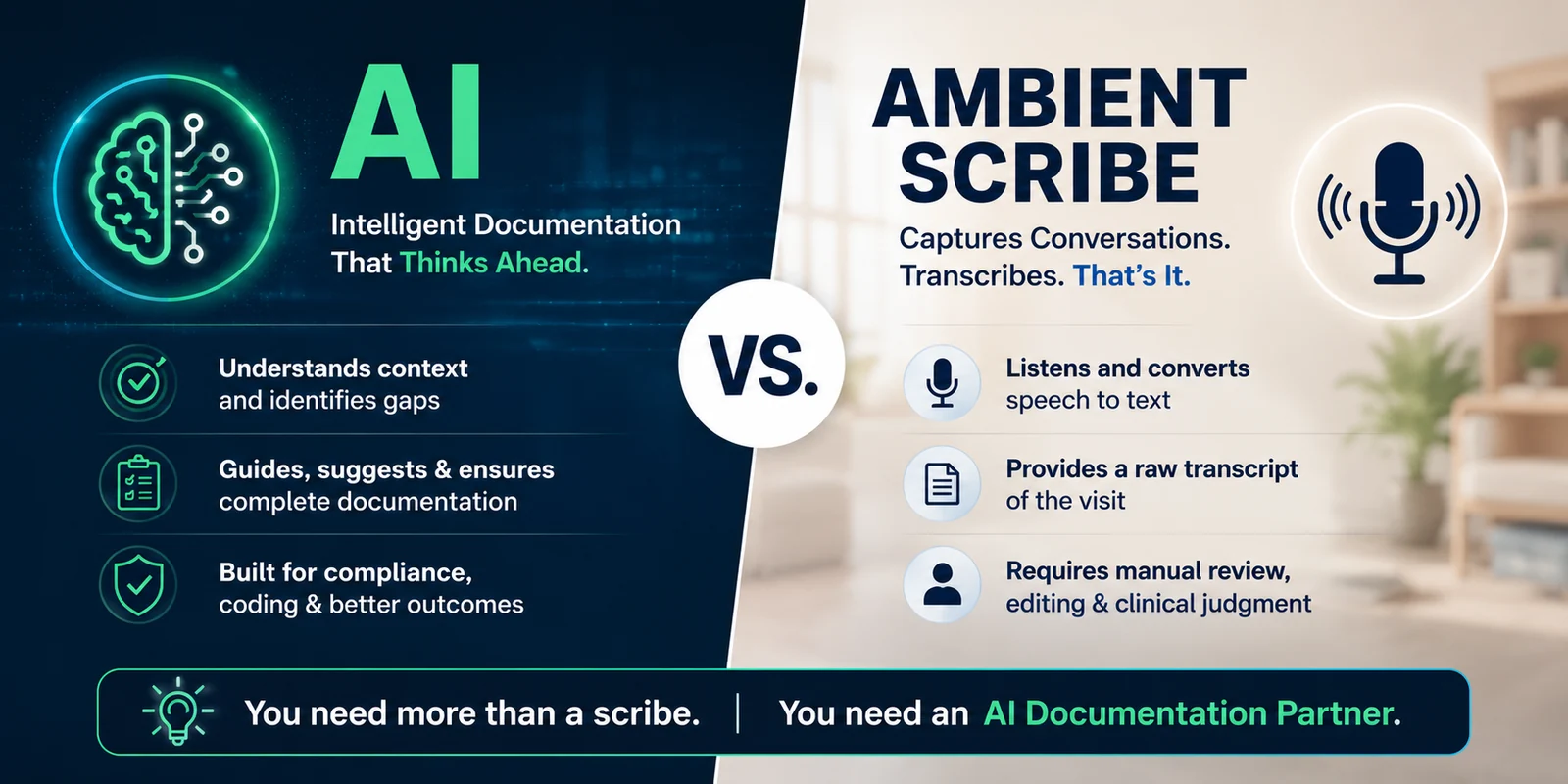
An ambient scribe listens and drafts a note from the conversation; AI documentation supports a broader capture-to-approval workflow. This guide breaks down the difference, why it matters more in home health (where much of the clinical story is observed, not spoken), a side-by-side comparison, OASIS considerations, and the questions to ask AI vendors.
Key Takeaways
- An ambient scribe listens to a conversation and turns it into a note; AI documentation supports a broader capture-to-approval workflow.
- Home health visits are unstructured, and many key observations are never spoken aloud, so capturing speech alone can miss the clinical picture.
- AI documentation can identify missing information, support OASIS workflows, and check completeness, capabilities ambient scribes may lack.
- "AI scribe," "ambient AI," and "AI documentation" aren't standardized categories, so evaluate what a platform actually does, not its label.
- Human-in-the-loop review is essential: AI can misinterpret or infer, and the nurse remains accountable for the clinical record.
- AI should never invent an OASIS answer; it should surface relevant information and leave the clinical determination to the clinician.
- The best tool fits the nurse's existing workflow and gives back cognitive space and time, not just keystrokes.
💡 Quick Answer: An ambient scribe uses AI to listen to clinician-patient conversations and generate a clinical note from what was said. AI documentation is broader: it can capture information through voice, typing, images, or structured input, organize it, identify missing documentation, support OASIS workflows, and prepare a note for clinician review. For home health nurses, that broader workflow often matters more, because the clinical story extends far beyond what is said out loud during a visit.
AI vs. Ambient Scribe: The Short Answer
Ambient scribes and AI documentation tools are related, but they aren't necessarily the same thing.
An ambient scribe primarily listens to a clinician-patient conversation and uses AI to turn that conversation into a clinical note. AI documentation can go further. Depending on the platform, it may help nurses capture information, organize clinical findings, identify missing documentation, structure a narrative, support OASIS documentation, surface inconsistencies, and prepare a note for clinician review.
For home health nurses, that distinction matters. Home health documentation isn't simply a conversation between a nurse and a patient. A nurse may need to document:
- Clinical assessments
- Skilled interventions
- Patient response
- Medication changes
- Patient and caregiver education
- Functional status
- Care coordination
- Physician communication
- Homebound status
- Skilled need
- OASIS-related information
- Progress toward goals
The right technology should therefore fit the entire home health documentation workflow, not just capture a conversation.
What Is an Ambient Scribe?
An ambient scribe is an AI-powered documentation tool designed to listen to conversations between clinicians and patients and generate documentation from those interactions. Instead of manually typing throughout an encounter, the clinician can focus on the patient while the system captures the conversation.
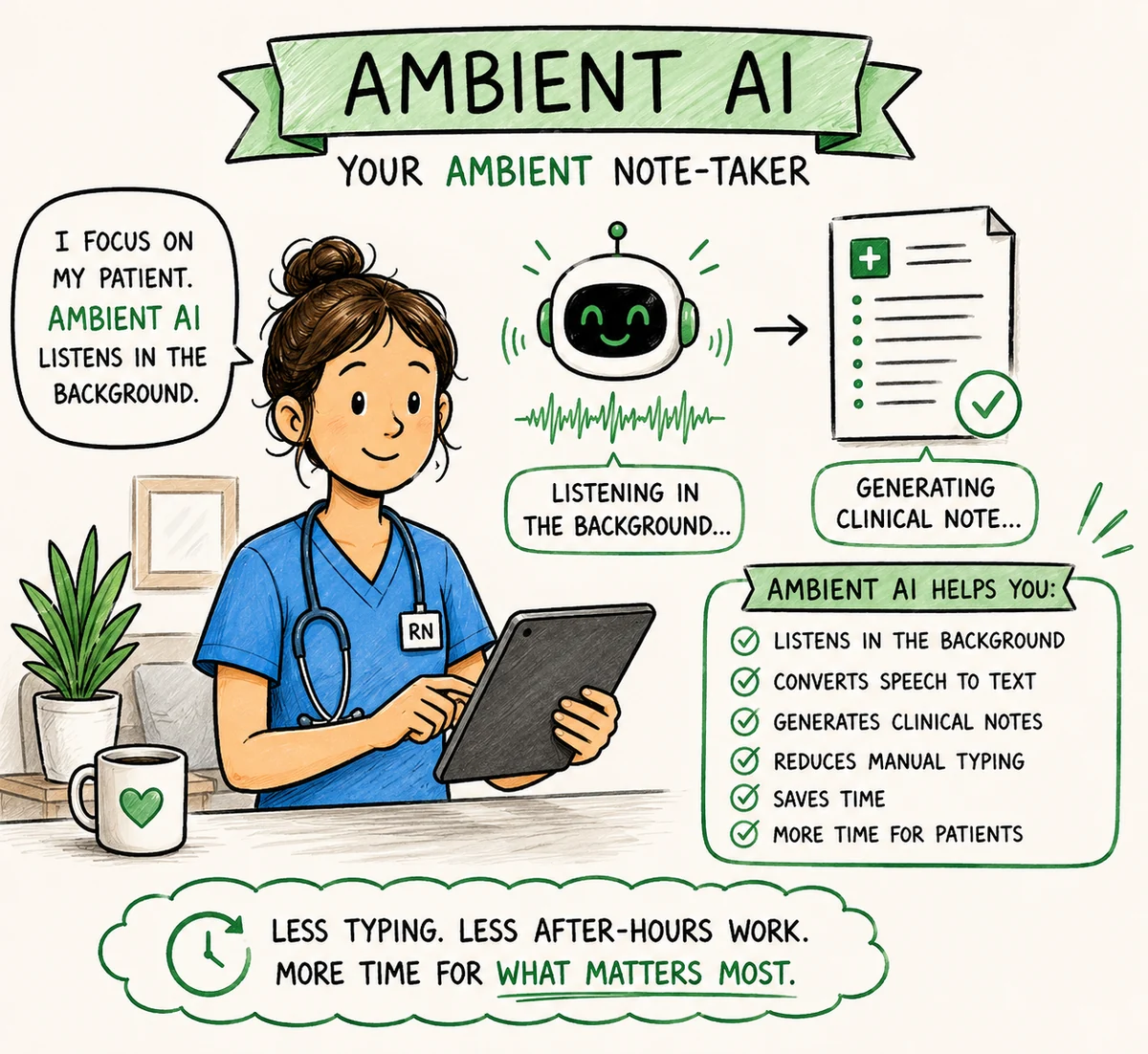
An ambient scribe listens in the background and turns the spoken conversation into a draft note.
A typical ambient-scribe workflow looks like this:
➡️ Patient conversation → Ambient AI listens → Speech is converted to text → AI identifies relevant clinical information → Clinical note is generated → Clinician reviews and edits → Note is finalized
This can reduce the amount of manual typing required from clinicians. Ambient documentation has become particularly attractive in healthcare because documentation is one of the most time-consuming administrative activities clinicians perform. But home health introduces an important complication.
Why Ambient Scribing Is Different in Home Health
A hospital or outpatient encounter often follows a relatively predictable structure. A clinician and patient may sit together in an examination room while discussing symptoms, medical history, medications, diagnosis, and a treatment plan.
A home health visit can be much less structured. The nurse may be walking through the patient's home, assessing the environment, checking medications, measuring vital signs, examining a wound, speaking with a caregiver, teaching the patient, coordinating with another provider, reviewing equipment, assessing functional limitations, and identifying safety concerns.
Some of the most important clinical observations may never be explicitly spoken. A nurse may simply notice that "the patient doesn't look like themselves today." That observation may come from skin color, mobility, behavior, breathing, affect, confusion, the environment, or subtle changes from previous visits.
⚠️ That is why capturing speech alone isn't necessarily the same as capturing the complete clinical picture.
What Is AI Documentation?
AI documentation is a broader category. Instead of focusing exclusively on listening and transcription, an AI documentation platform may support multiple stages of the documentation process.
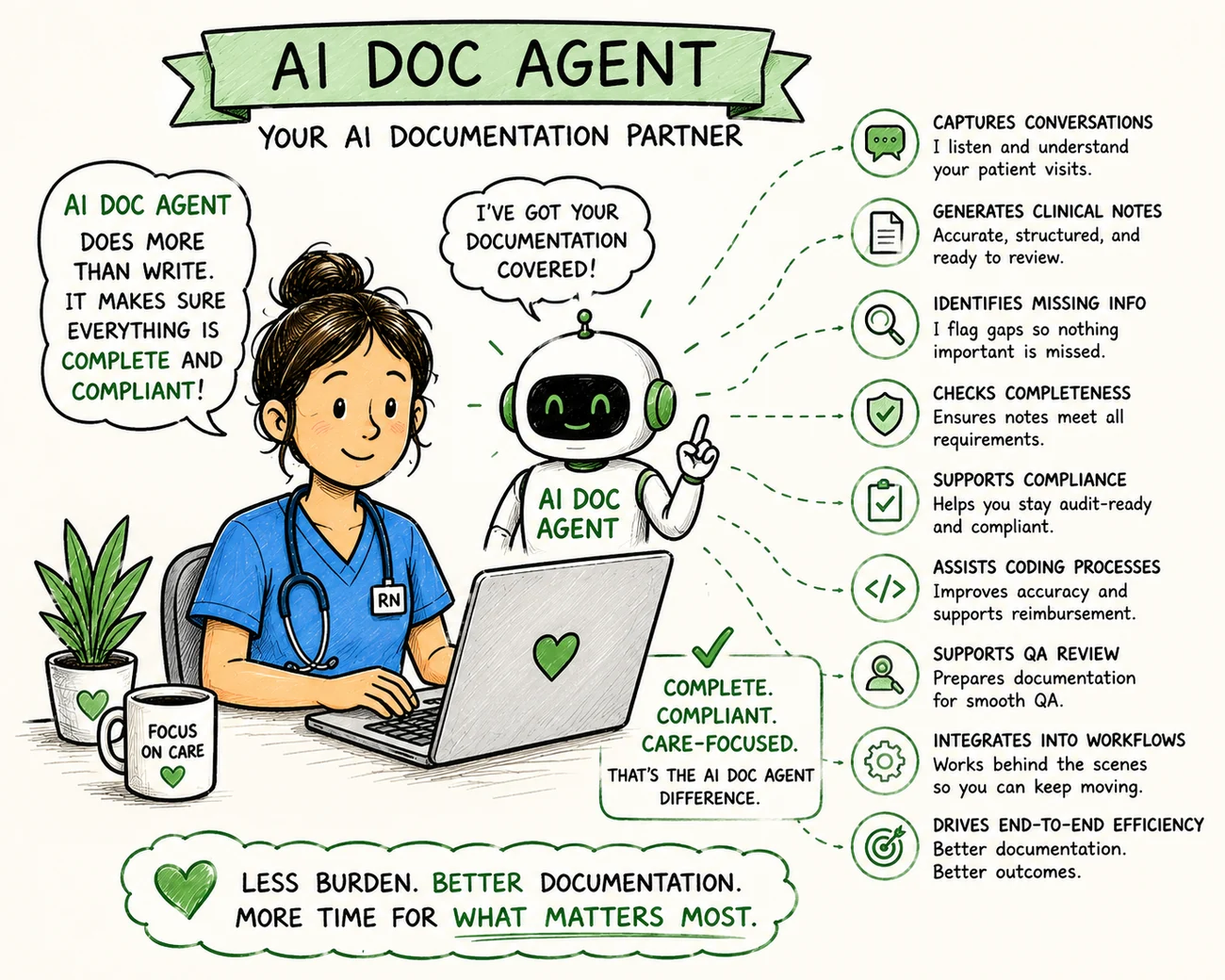
An AI documentation agent supports the whole workflow, not just transcription: capture, structure, check for gaps, and prepare for review.
➡️ Capture (voice, typing, structured information, images) → Understand (AI identifies relevant clinical information) → Structure (organized into the right documentation format) → Check (potential omissions, inconsistencies, or gaps are surfaced) → Review (clinician validates) → Finalize (the approved documentation is completed)
This distinction is particularly important for home health.
Ambient Scribe vs. AI Documentation
At a glance, the two overlap on the basics but diverge on completeness, workflow, and compliance support:
| Feature | Ambient Scribe | AI Documentation |
|---|---|---|
| Captures conversations | Yes | Often |
| Voice input | Yes | Yes |
| Generates clinical notes | Yes | Yes |
| Reduces typing | Yes | Yes |
| Structures documentation | Yes | Yes |
| Identifies missing information | Depends on platform | Often |
| Supports documentation completeness | Limited to platform capabilities | More comprehensive |
| OASIS workflow support | Varies | Can be designed for it |
| Compliance checks | Varies | Can be built into workflow |
| Multiple input methods | Often primarily voice | Voice, typing, images, structured data |
| Workflow automation | Usually focused on note creation | Can extend across documentation workflow |
| Clinician review | Recommended / required | Human review remains important |
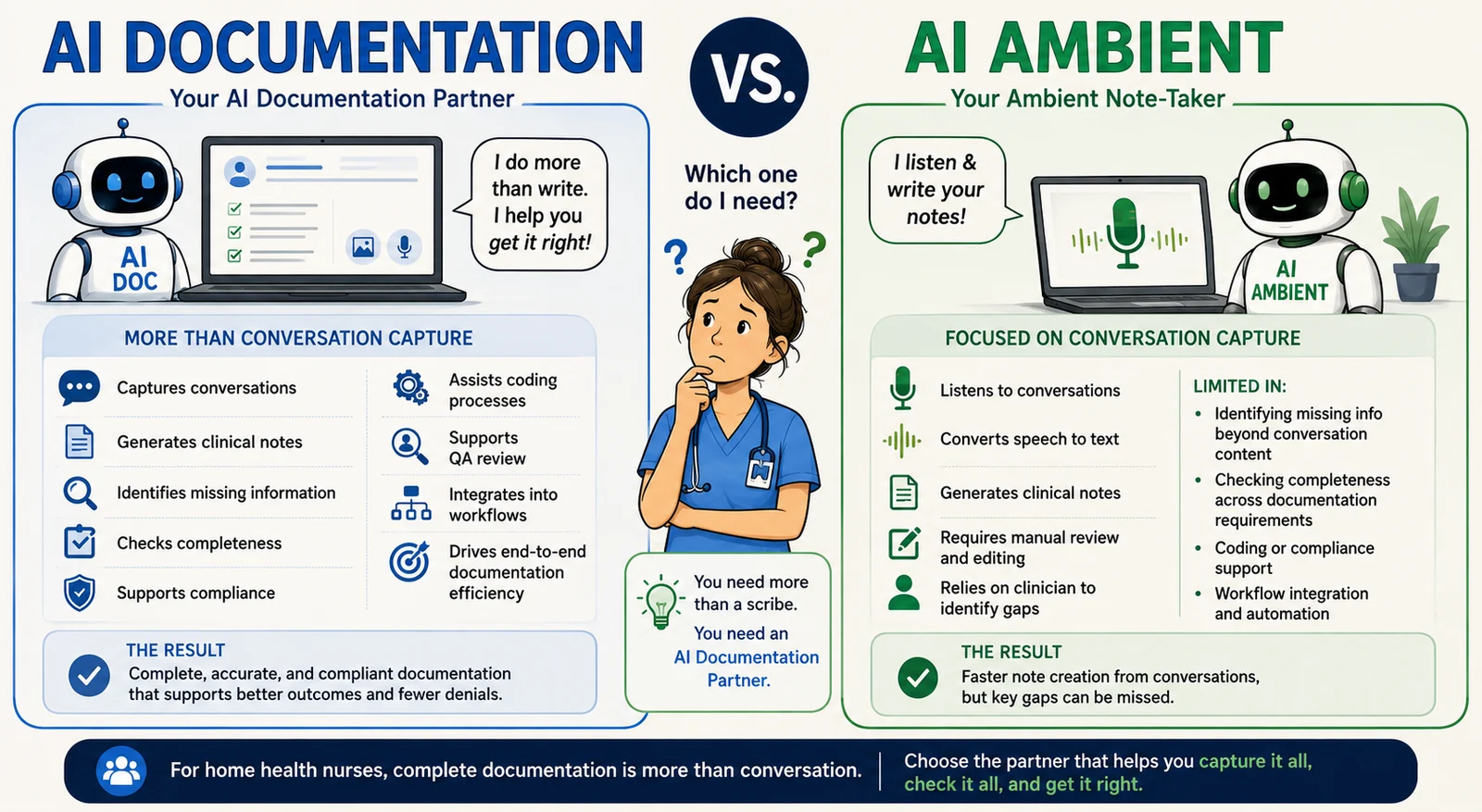
For home health nurses, complete documentation is more than conversation, capture it all, check it all, and get it right.
💡 The important caveat: these capabilities vary significantly by vendor. "AI scribe," "ambient AI," and "AI documentation" are not standardized regulatory product categories, so agencies should evaluate what a specific platform actually does rather than relying on the label.
Why This Matters for Home Health Nurses
Home health nurses don't just need to write faster. They need to document completely and accurately without allowing documentation to take attention away from the patient.
Consider a typical visit. The nurse arrives at the patient's home, checks vital signs, reviews medications, assesses the patient's breathing, looks at the wound, talks with the caregiver, provides education, updates the care plan, calls the physician, documents the visit, and then potentially spends another 30–60 minutes finishing the chart.
The problem isn't simply typing. The problem is the cognitive load of documentation.
Ambient Scribes Can Reduce the Typing Burden
Ambient technology can be valuable here. Instead of typing throughout the encounter, the nurse can interact naturally with the patient. The AI captures relevant conversation and generates a draft.
That means the nurse may spend less time typing, reconstructing conversations, writing repetitive narratives, and switching between screens, and more time looking at the patient. That is a meaningful benefit. (For a deeper look at this technology, see how ambient AI is changing clinical documentation.)
But What Happens When Something Wasn't Said?
This is where home health becomes particularly interesting. Imagine a nurse notices that a patient is unusually short of breath. The nurse measures oxygen saturation. The patient says they're feeling fine. The conversation itself may not contain enough information to explain the clinical significance of the change.
A simple transcription-focused system can only work with the information it captures. A broader documentation workflow can potentially prompt the nurse to consider:
- What changed from the previous visit?
- Were additional assessments performed?
- Was the physician notified?
- What intervention occurred?
- How did the patient respond?
- Does the documentation support the skilled service provided?
The goal isn't for AI to make the clinical decision. The goal is to help the nurse capture and document the clinical reasoning already taking place.
AI Should Support Clinical Judgment, Not Replace It
This distinction is critical. A nurse's clinical judgment cannot simply be automated. A nurse may recognize a subtle change because she has visited the patient every week for three months. The patient may move differently, speak differently, look different, behave differently, seem confused, or have less energy.
The nurse may not initially be able to explain exactly why. That doesn't mean the observation isn't clinically meaningful. AI should help document and organize that information. It shouldn't replace the nurse's judgment. (We explore this further in nursing intuition vs. clinical judgment.)
The Role of Human-in-the-Loop AI
A strong AI documentation workflow keeps the clinician in control. The basic model should be:
➡️ Nurse provides information → AI generates or structures documentation → AI identifies potential gaps → Nurse reviews → Nurse corrects or rejects anything inaccurate → Nurse approves
The AI shouldn't independently submit a clinical note simply because it generated one. Human review matters because AI systems can misinterpret conversations, miss context, generate incorrect information, misunderstand abbreviations, and infer information that wasn't actually documented. The nurse remains accountable for the clinical record.
AI Documentation for OASIS and Home Health
Home health has another layer that makes documentation different: OASIS. OASIS documentation requires clinicians to capture detailed information about a patient's clinical status, functional abilities, cognition, medications, risk factors, care needs, and support system.
An AI tool designed specifically around home health can potentially help nurses organize information relevant to these workflows. But agencies should be careful about one thing: AI should not invent an OASIS answer. The technology should help surface relevant information and reduce administrative work while leaving the final clinical determination to the qualified clinician. (New to it? Start with understanding OASIS-E.)
AI Scribe vs. Ambient Scribe for Home Health: Which Is Better?
There isn't one answer for every agency. The better question is: what problem are you trying to solve?
- If the problem is "our nurses spend too much time typing," an ambient scribe may be a strong solution.
- If the problem is "our nurses spend too much time completing, reviewing, and correcting documentation," a broader AI documentation platform may be more appropriate.
- If the problem is "our nurses struggle with documentation completeness, OASIS workflows, and capturing the clinical story," you may need more than an ambient scribe.
For a related breakdown of the categories, see AI scribe vs. AI documentation agent.
What Home Health Agencies Should Ask AI Vendors
Before purchasing an AI documentation solution, ask:
- Does the platform only transcribe conversations? Or does it actually support the documentation workflow?
- Can nurses use voice and typing? Home health visits aren't always conducive to continuous conversation.
- Can nurses document observations that aren't spoken? This is particularly important in home health.
- Does the platform support OASIS workflows? Ask specifically what OASIS functionality exists.
- Does it identify potential documentation gaps? A good workflow should help clinicians recognize what's missing.
- Is there human review? The nurse should remain in control of the final clinical record.
- Can the nurse edit the AI-generated documentation? AI-generated content should never become a black box.
- How does the system handle hallucinations? Ask how inaccurate AI-generated information is detected and prevented.
- What happens to patient data? Ask about HIPAA, Business Associate Agreements, encryption, data retention, model training, access controls, and audit logs.
- Does it integrate with your EMR? A tool that creates another place for nurses to document may simply move the administrative burden somewhere else.
The Best AI Is the One That Fits the Nurse's Workflow
Technology adoption fails when nurses have to change their entire workflow to accommodate the technology. The ideal experience should feel simple:
➡️ See the patient → Care for the patient → Capture what happened → Review the documentation → Approve it → Move on.
The technology should disappear into the workflow.
What This Means for Nurse Burnout
Documentation isn't the only cause of nurse burnout. But it is one of the administrative burdens technology can realistically address. When nurses finish a visit and still have multiple charts waiting for them, the workday doesn't really end. That creates after-hours charting, lost personal time, cognitive fatigue, documentation stress, and reduced job satisfaction.
Reducing unnecessary documentation work doesn't solve every problem in nursing. But it can give nurses something incredibly valuable: time. Time to care. Time to think. Time to recover. Time to go home. (More on this in can AI help reduce nurse burnout?)
AI Should Give Nurses Back Cognitive Space
The most important benefit of AI documentation may not be the number of keystrokes eliminated. It may be the cognitive space returned to the nurse. A nurse who isn't thinking "I need to remember all of this for the chart" can focus more completely on "what's happening with my patient?" That difference matters.
The Bottom Line
Ambient scribes are a powerful application of AI, but an ambient scribe and a comprehensive AI documentation platform are not necessarily the same thing. Ambient AI primarily focuses on capturing conversations and converting them into documentation. AI documentation can encompass a broader workflow:
🔗 Capture → Structure → Identify gaps → Support documentation → Review → Approve
For home health nurses, that distinction is especially important because the clinical story extends far beyond what is said during a visit. The best technology isn't the one that generates the longest note. It's the one that helps the nurse capture the right information, document it accurately, spend less time on administrative work, and stay focused on the patient. Because nurses didn't choose home health to spend their evenings finishing charts. They chose it to care for people in their homes.
Home Health Documentation Playbook
The complete guide to OASIS-E, Medicare compliance, PDGM, and AI-assisted documentation. Learn how top agencies reduce documentation time without sacrificing compliance.
Bottom Line
An ambient scribe captures the spoken conversation and drafts a note; AI documentation supports the fuller home health workflow, capture, structure, gap-checking, OASIS support, and clinician review. Because so much of a home health visit is observed rather than said, broader AI documentation with human-in-the-loop review usually fits home health better than transcription alone, so long as the nurse stays accountable for the final record and AI never fabricates an OASIS answer.

Arvind Sarin is the founder of Copper Digital. For the past year he has spent three days a week inside a 500+ census Texas home health agency, building AI documentation that finishes OASIS and visit notes the same day, with a nurse reviewing and approving every note. He writes about home health documentation, OASIS, Medicare compliance, and applying AI responsibly in clinical workflows.
Frequently asked
Frequently asked questions
Not exactly. An ambient scribe generally refers to AI that listens to a clinical conversation and generates documentation from it. "AI scribe" is a broader term that can include ambient and non-ambient documentation workflows.
Join the conversation
Leave a comment
Related reading
OASIS Documentation Compliance Tips for Home Health Agencies
OASIS compliance isn't just filling in every field, it's making the assessment tell a consistent, clinically supported story that agrees with the rest of the record. This guide covers 12 practical compliance tips, 9 common errors, a pre-submission checklist, what's new in OASIS-E2, and where AI helps (and where it must not).
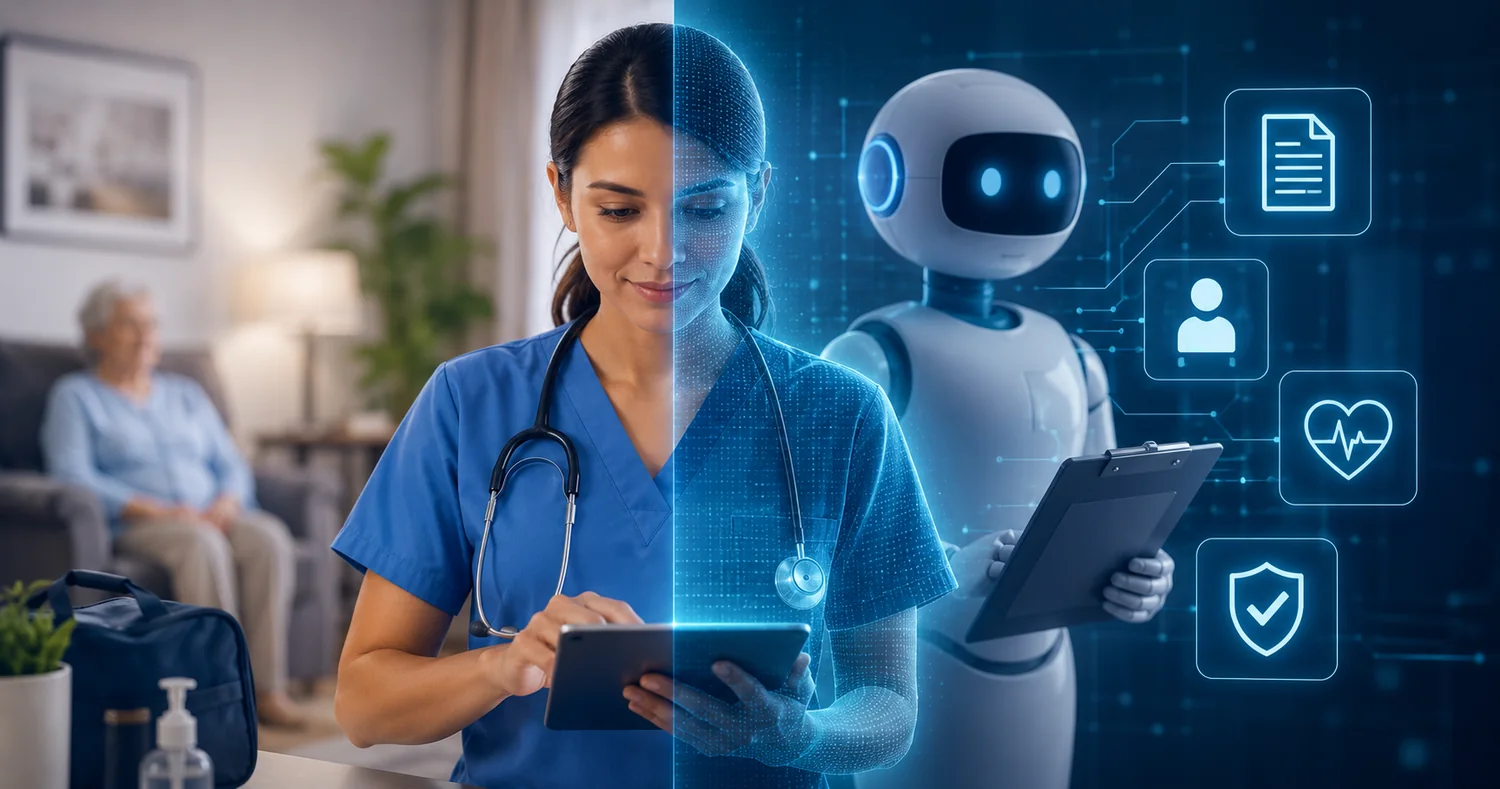
AI Scribe vs AI Documentation Agent: Which One Does Home Health Really Need?
An AI scribe transcribes conversations into notes. An AI Documentation Agent goes further: it understands clinical workflows, processes referral PDFs, drafts OASIS-E assessments, assists with medication reconciliation, surfaces missing documentation, and helps nurses complete compliant charts. For home health's OASIS complexity and referral processing, an AI Documentation Agent does more than a transcription-only scribe.
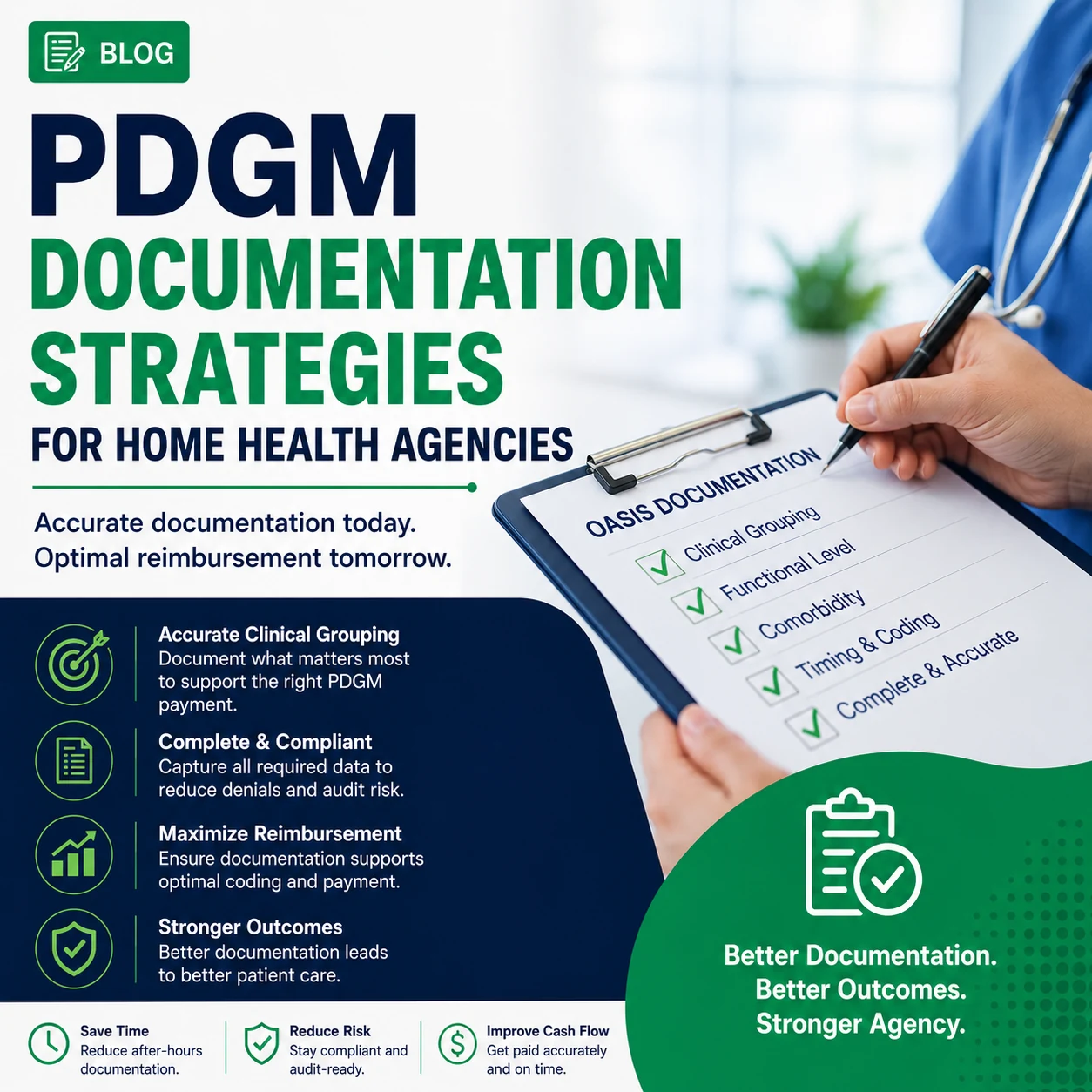
PDGM Documentation Strategies for Home Health Agencies
Under PDGM, documentation establishes the clinical picture that supports classification, medical necessity, coding, and payment. This guide breaks down 15 PDGM documentation strategies, a documentation-to-payment framework, weak-vs-strong examples, and a closed-loop workflow to keep charts consistent and audit-ready.