What Is the Difference Between Home Health Intake and Admissions?
Home health intake and admissions are two distinct but connected phases in bringing a patient into a home health agency's system.
Home health intake is primarily the administrative, financial, and preliminary eligibility-screening phase. Home health admission is the operational and clinical onboarding phase through which the agency formally accepts the patient and initiates services.
In simple terms:
- Intake: Does the referral have the necessary information, and can the agency potentially serve this patient?
- Admissions: Can the agency take responsibility for the patient's care, and what needs to happen to begin services?
During intake, the team gathers patient information, reviews clinical records, verifies payer details, checks applicable documentation requirements, and identifies missing information.
During admissions, the agency evaluates staffing and service availability, confirms acceptance, coordinates the initial assessment, and establishes the processes needed to begin care.
Both stages require coordination between administrative staff, clinical teams, referral sources, patients, and caregivers. When information moves smoothly between them, agencies can reduce delays, avoid repeated work, and make the transition into care more efficient.
What Happens During the Home Health Intake Process?
The home health intake process begins when an agency receives a referral from a hospital, physician, skilled nursing facility, another healthcare provider, or another referral source.
The intake team reviews the referral to determine whether the information is complete, whether the patient may meet applicable home health requirements, and whether the agency can potentially provide the requested services.
Intake is not simply collecting a patient's name and contact information. It also involves administrative, financial, and preliminary clinical review.
Typical intake activities include:
- Receiving referrals through electronic referral platforms, fax, email, or phone.
- Collecting patient demographics and contact information.
- Reviewing available clinical records and referral documentation.
- Verifying insurance, Medicare, or Medicaid information, as applicable.
- Checking authorization or payer-specific requirements.
- Reviewing applicable face-to-face encounter documentation requirements.
- Identifying missing orders, records, or supporting documents.
- Reviewing the patient's location and the requested services.
- Creating or updating the initial patient record in the agency's EHR.
- Setting up preliminary billing and payer information.
- Coordinating with referral sources to obtain missing information.
The objective is to prepare the referral for an informed acceptance decision and identify potential barriers before the admission process moves forward.
What Documents Are Reviewed During Home Health Intake?
The documents required during intake depend on the patient's circumstances, referral source, payer, and agency workflow.
Commonly reviewed records may include:
- Physician or allowed practitioner's orders, when applicable.
- Face-to-face encounter documentation, when required.
- Hospital discharge summaries or recent clinical notes.
- Patient demographics and contact information.
- Insurance cards and payer information.
- Diagnosis and medical history.
- Medication information.
- Requested services and visit information.
- Supporting clinical documentation.
- Authorization or other payer-specific records, when applicable.
The intake team should identify missing or inconsistent information early.
For example, a hospital may send a referral containing patient demographics and a discharge summary but not include all the supporting documentation needed for the agency's review. The intake team can follow up with the referral source rather than allowing the missing information to create avoidable delays later.
What Is the Role of Insurance Verification in Home Health Intake?
Insurance verification is an important part of the intake process because the agency needs to understand the patient's coverage and applicable payer requirements before proceeding.
Depending on the payer, verification may involve:
- Confirming the patient's insurance information.
- Reviewing Medicare or Medicaid coverage, where applicable.
- Checking whether the agency participates with the patient's plan.
- Identifying authorization or referral requirements.
- Reviewing applicable coverage criteria.
- Confirming payer-specific documentation requirements.
- Identifying potential financial or billing issues that need follow-up.
However, verifying insurance does not automatically establish that a patient qualifies for covered home health services.
For Medicare home health, coverage depends on applicable requirements, including eligibility, homebound status, the need for qualifying skilled services, and required certification and documentation.
The intake team can identify potential gaps, but coverage and clinical eligibility must be evaluated in accordance with the applicable rules and the responsibilities of qualified professionals.
When Should Face-to-Face Documentation Be Reviewed During Intake?
Face-to-face encounter requirements should be considered during intake when they apply to the patient's referral and payer.
For Medicare home health, a qualifying face-to-face encounter is generally required for certification, subject to applicable rules and exceptions. The encounter must meet the relevant timing and documentation requirements and be related to the primary reason the patient requires home health services.
The intake team may check:
- Whether the relevant encounter occurred.
- Whether supporting documentation is available.
- Whether the encounter falls within the applicable timeframe.
- Whether the documentation supports the primary reason for home health services.
- Whether additional information or clarification is needed.
The exact requirements depend on the patient's circumstances and applicable Medicare rules. Agencies should not assume that every referral arrives with a completed face-to-face document or that an administrative check alone establishes compliance.
What Happens During the Home Health Admissions Process?
The admissions process begins after the agency has reviewed the referral and determined that it can move forward with the patient, subject to applicable requirements.
Unlike intake, which focuses heavily on referral review and preliminary verification, admissions involves an operational decision and the clinical steps needed to initiate services.
Typical admission activities include:
- Evaluating whether the agency has the staffing capacity to serve the patient.
- Confirming that the patient's location falls within the agency's service area.
- Determining whether the required clinical disciplines are available.
- Reviewing whether the agency can meet the patient's care needs.
- Confirming the agency's acceptance of the referral.
- Coordinating with the patient and caregiver.
- Scheduling the initial in-home assessment.
- Completing applicable admission documentation and notices.
- Conducting the comprehensive assessment.
- Completing applicable OASIS documentation.
- Developing and coordinating the initial Plan of Care.
- Arranging the start of ordered services.
The agency must consider whether it can actually provide the care required, not just whether the referral documents are complete.
How Does an Agency Determine Whether It Has the Capacity to Admit a Patient?
A home health agency must consider its ability to provide the requested services before accepting a patient.
A referral may appear complete and clinically appropriate, but the agency may not have the resources needed to serve the patient.
Operational considerations can include:
1. Geographic coverage
Does the patient's home fall within the agency's service area? Can clinicians reach the location within the required schedule?
2. Staffing availability
Does the agency have enough available clinicians to provide the ordered services and required visit frequency?
3. Clinical skill mix
Does the agency have appropriately qualified staff to address the patient's needs, such as skilled nursing, physical therapy, occupational therapy, or speech-language pathology?
4. Scheduling capacity
Can the agency coordinate the initial visit and ongoing services around the patient's needs and applicable timing requirements?
5. Ability to meet care needs
Can the agency provide the services required within its capabilities, policies, and applicable regulatory and payer requirements?
This operational review helps agencies make an informed acceptance decision rather than accepting referrals they may not be able to serve appropriately.
Who Can Conduct the Initial Home Health Assessment?
The initial comprehensive assessment must be performed by a qualified clinician in accordance with applicable Medicare requirements, the patient's circumstances, and the services ordered.
A registered nurse commonly performs the initial assessment. However, a qualified therapist may conduct the assessment when permitted under the applicable rules and the patient's circumstances.
The assessment helps establish a more complete understanding of the patient's condition and care needs.
It may include:
- Current medical condition and relevant history.
- Functional abilities and limitations.
- Medication review and reconciliation, as applicable.
- Home environment and safety concerns.
- Homebound status, where applicable.
- Skilled care needs.
- Patient goals and preferences.
- Caregiver availability and support.
- Risks that may affect the patient's health or safety.
- Need for additional services or referrals.
The assessment is not simply an administrative admission form. It is an important clinical process that informs the patient's care.
How Does the Admission Assessment Lead to the Plan of Care?
The initial assessment provides the clinical information needed to establish the patient's care requirements.
The Plan of Care (POC) describes the services and interventions needed to address the patient's condition and goals.
Depending on the patient's needs and applicable requirements, the plan may address:
- Diagnoses and relevant medical conditions.
- Skilled nursing or therapy services.
- Frequency and duration of visits.
- Treatment and intervention requirements.
- Medication-related instructions.
- Patient-specific goals.
- Safety concerns and precautions.
- Patient and caregiver education.
- Coordination with other healthcare providers.
The plan must be established and reviewed in accordance with applicable Medicare, payer, and regulatory requirements, including the required practitioner involvement and signatures.
The assessment informs the plan. The agency should ensure that the plan reflects the patient's actual needs rather than relying only on the information received in the original referral.
How Do Home Health Intake and Admissions Compare?
Although the two teams work closely together, their responsibilities and primary objectives differ.
| Feature | Home Health Intake | Home Health Admissions |
|---|---|---|
| Primary focus | Administrative, financial, and preliminary eligibility review | Operational acceptance and clinical onboarding |
| Starting point | Referral received | Referral reviewed and approved to proceed |
| Main objective | Prepare the referral for an acceptance decision | Initiate appropriate patient services |
| Patient information | Collects demographics and referral details | Confirms and expands information during admission |
| Insurance | Verifies payer information and applicable requirements | Confirms relevant coverage details are available for the admission workflow |
| Clinical review | Reviews available records for preliminary appropriateness and missing information | Completes the comprehensive clinical assessment |
| Agency capacity | May check basic service-area and availability information | Evaluates staffing, geographic reach, and clinical skill mix |
| Documentation | Referral records, orders, payer information, and supporting documents | Admission records, assessment documentation, applicable OASIS, and POC coordination |
| Typical staff | Intake coordinators, referral coordinators, intake nurses, verification specialists | Admissions coordinators, qualified clinicians, clinical managers, and scheduling staff |
| Desired outcome | Referral ready for an acceptance decision | Patient onboarded and services initiated |
The two stages should work as one coordinated workflow, with clearly defined responsibilities and a reliable handoff of information.
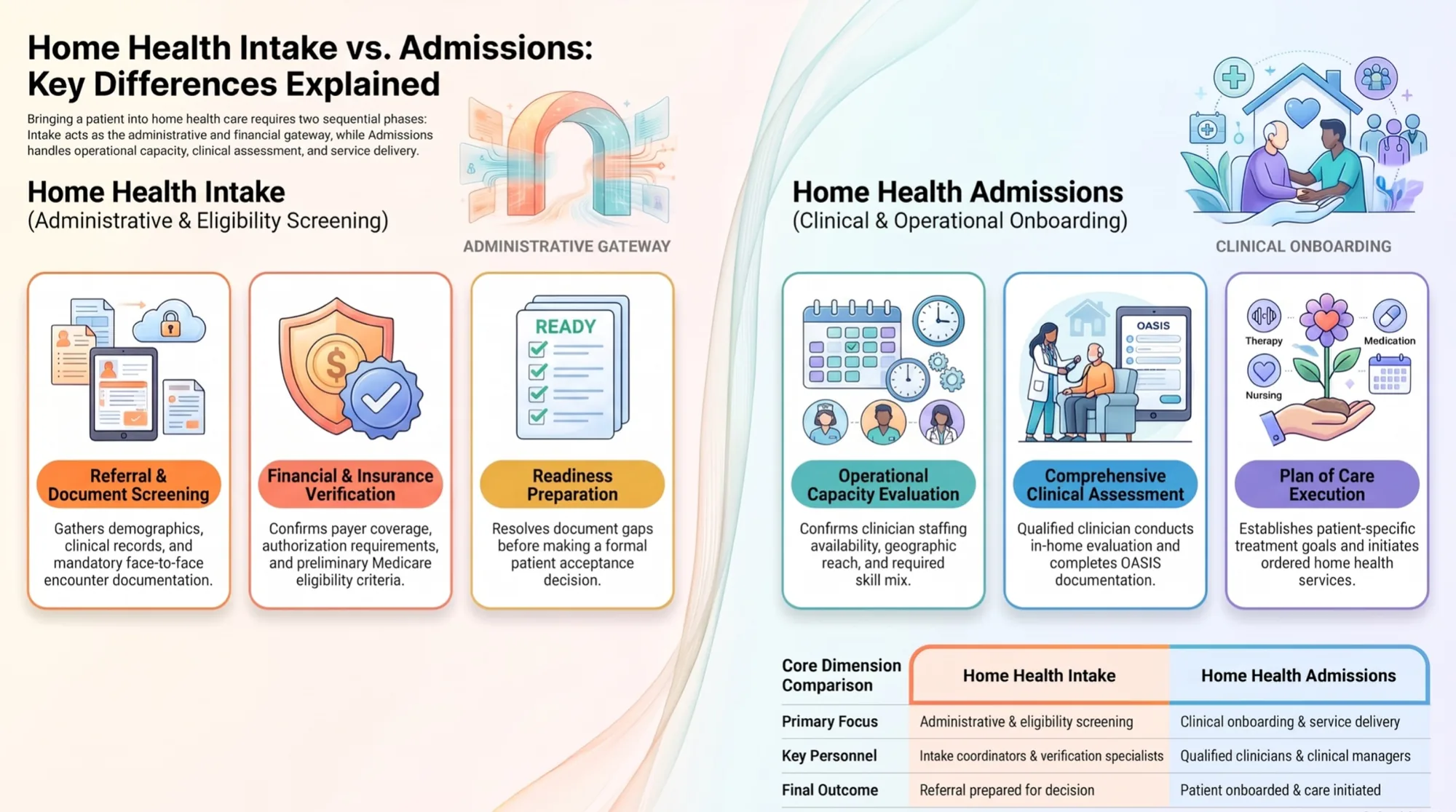
Intake prepares the referral for an acceptance decision. Admissions confirms the agency can serve the patient and starts care.
Who Is Responsible for Home Health Intake and Admissions?
Responsibilities vary depending on the size and structure of the agency. Some agencies maintain separate intake and admissions teams, while smaller organizations may assign both functions to the same employees.
Intake responsibilities may include:
- Intake coordinators.
- Referral coordinators.
- Insurance verification specialists.
- Clinical intake reviewers or nurses.
- Authorization and payer specialists, where applicable.
Admissions responsibilities may include:
- Admissions coordinators.
- Registered nurses.
- Qualified therapists.
- Clinical managers.
- Scheduling teams.
- Other staff responsible for admission documentation and coordination.
Administrative staff can coordinate referrals, gather information, and manage records. Clinical assessments and decisions must remain with appropriately qualified professionals.
Clear role definitions help prevent duplicated work, missed follow-ups, and confusion over who is responsible for moving a referral to the next stage.
What Happens When a Home Health Agency Cannot Accept a Referral?
Not every referral results in an admission.
An agency may be unable to accept a referral for several reasons, including:
- The patient lives outside the agency's service area.
- Required clinical disciplines are not available.
- The agency does not have sufficient staffing capacity.
- The patient's needs fall outside the agency's capabilities.
- Applicable payer or authorization requirements cannot be met.
- Required information remains unavailable after appropriate follow-up.
- The patient chooses another provider or declines services.
When a referral cannot proceed, the agency should document the reason according to its policies and communicate appropriately with the referral source and patient, as applicable.
If the agency cannot provide the required services, timely communication helps the referral source explore other appropriate care arrangements.
How Is Patient Information Transferred from Intake to Admissions?
The handoff between intake and admissions is one of the most important parts of the workflow.
Intake may collect a substantial amount of patient information before the admissions clinician ever visits the home. If that information is not transferred accurately, the admissions team may need to repeat work or contact the referral source again.
A structured handoff should make relevant information available to the admissions team, including:
- Patient demographics and contact details.
- Referral source and referring practitioner information.
- Available clinical records.
- Diagnosis and medical history.
- Insurance and payer information.
- Orders and supporting documentation.
- Face-to-face documentation status, where applicable.
- Requested services and known care needs.
- Missing information and outstanding follow-ups.
- Scheduling details and patient preferences.
A centralized patient record, consistent referral checklist, and clear workflow ownership can reduce repeated data entry and communication gaps.
What Are the Most Common Challenges in Home Health Intake?
Intake teams often handle referrals from multiple sources, with different document formats and varying levels of completeness.
Common challenges include:
- Incomplete referrals: Required information or supporting documents may be missing.
- Scattered information: Records arrive through fax, email, referral portals, and other channels.
- Insurance verification delays: Payer details and authorization requirements may require additional review.
- Repeated follow-ups: Staff may need to contact referral sources several times to obtain missing information.
- Manual data entry: Patient information may need to be entered into multiple systems.
- High referral volume: Large numbers of incoming referrals can create processing backlogs.
- Unclear ownership: Staff may be unsure who is responsible for reviewing, verifying, or following up on specific items.
These challenges can delay the acceptance decision and create additional work for the admissions team.
What Are the Most Common Challenges in Home Health Admissions?
Admissions teams face a different set of challenges because their work involves operational coordination and clinical onboarding.
Common issues include:
- Limited clinician availability.
- Geographic and scheduling constraints.
- Difficulty coordinating timely start-of-care visits.
- Outstanding orders or supporting documents.
- Incomplete handoffs from intake.
- Coordination between nursing and therapy disciplines.
- Time-consuming admission documentation.
- Completing applicable OASIS assessments accurately.
- Communicating care arrangements to patients and caregivers.
- Ensuring the Plan of Care reflects the patient's actual needs.
A delay in any of these steps can affect how quickly an agency can initiate services.
How Can Agencies Improve Their Home Health Intake and Admissions Workflows?
Improving intake and admissions requires a coordinated process that moves information from referral receipt to the start of care without unnecessary delays.
1. Can standardized referral checklists reduce missing information?
Yes. A consistent checklist helps staff identify required documents, payer information, and other referral details early. It also makes follow-up more predictable.
2. Can clear role ownership prevent workflow delays?
Yes. Agencies should define who handles document review, insurance verification, clinical review, acceptance decisions, scheduling, and admission documentation.
3. Can agencies reduce duplicate data entry?
Where possible, integrations and structured data extraction can help transfer information between systems and reduce repetitive manual work.
4. Can referral status tracking improve visibility?
A shared workflow can use clear status categories such as received, under review, pending information, accepted, declined, scheduled, and admitted. This helps teams identify where each referral stands.
5. How can agencies improve communication between intake and admissions?
A structured handoff should make relevant patient information, outstanding documents, and follow-up requirements available to the next team.
6. Which performance metrics should agencies monitor?
Agencies can track referral processing time, incomplete referral rates, acceptance rates, pending referral volume, time to start of care, and admission completion rates.
7. Where can automation help?
Automation can support document extraction, information organization, referral routing, and repetitive administrative tasks. Staff should review extracted information and retain responsibility for decisions within their roles.
How Can AI Help With Home Health Intake and Admissions?
AI can support both intake and admissions by reducing repetitive administrative work and making patient information easier to organize and review.
How can AI support intake?
AI tools can help agencies:
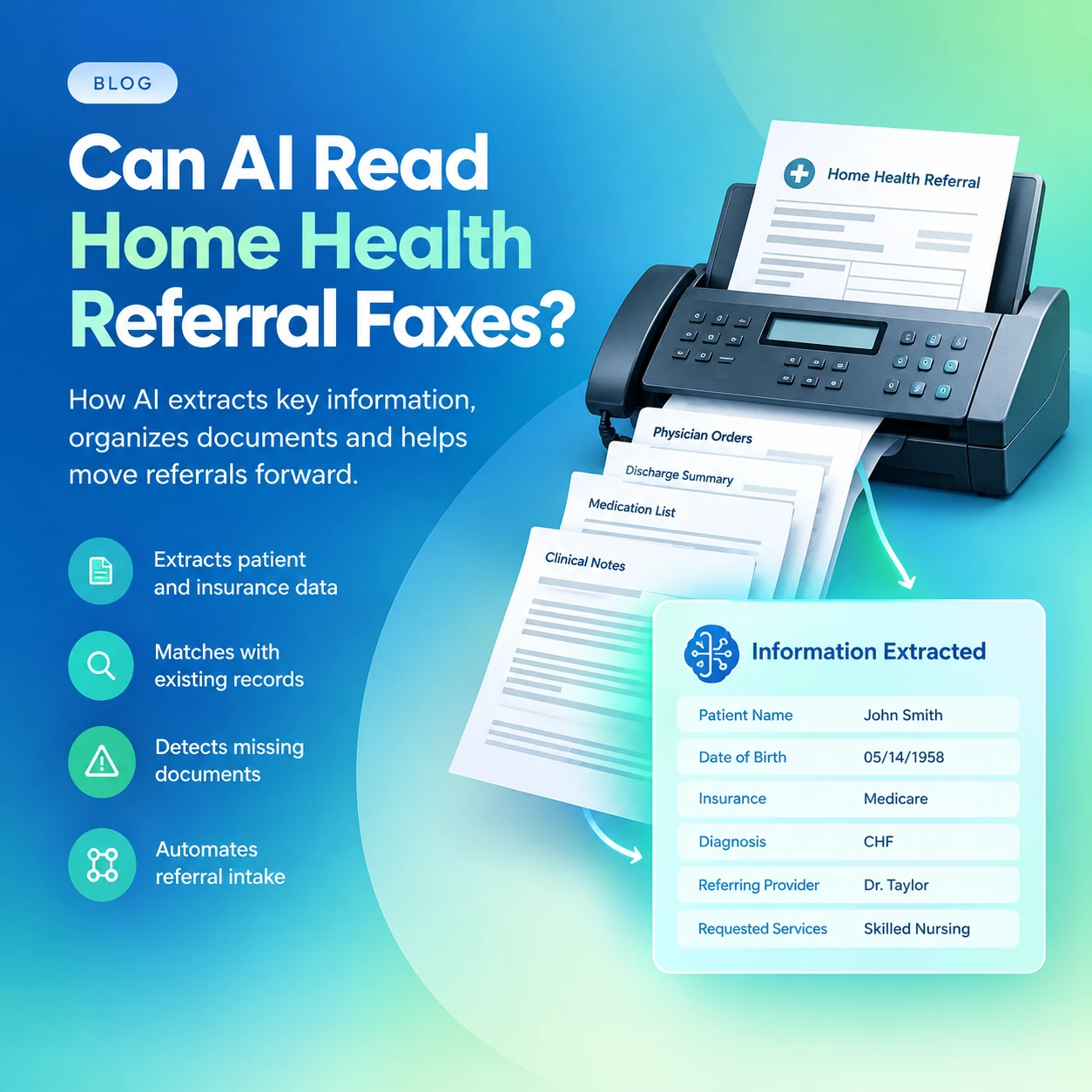
- Extract patient demographics and other information from referral documents.
- Organize records received through different channels.
- Identify potentially missing fields or documents.
- Summarize relevant clinical information for staff review.
- Support referral data entry and routing.
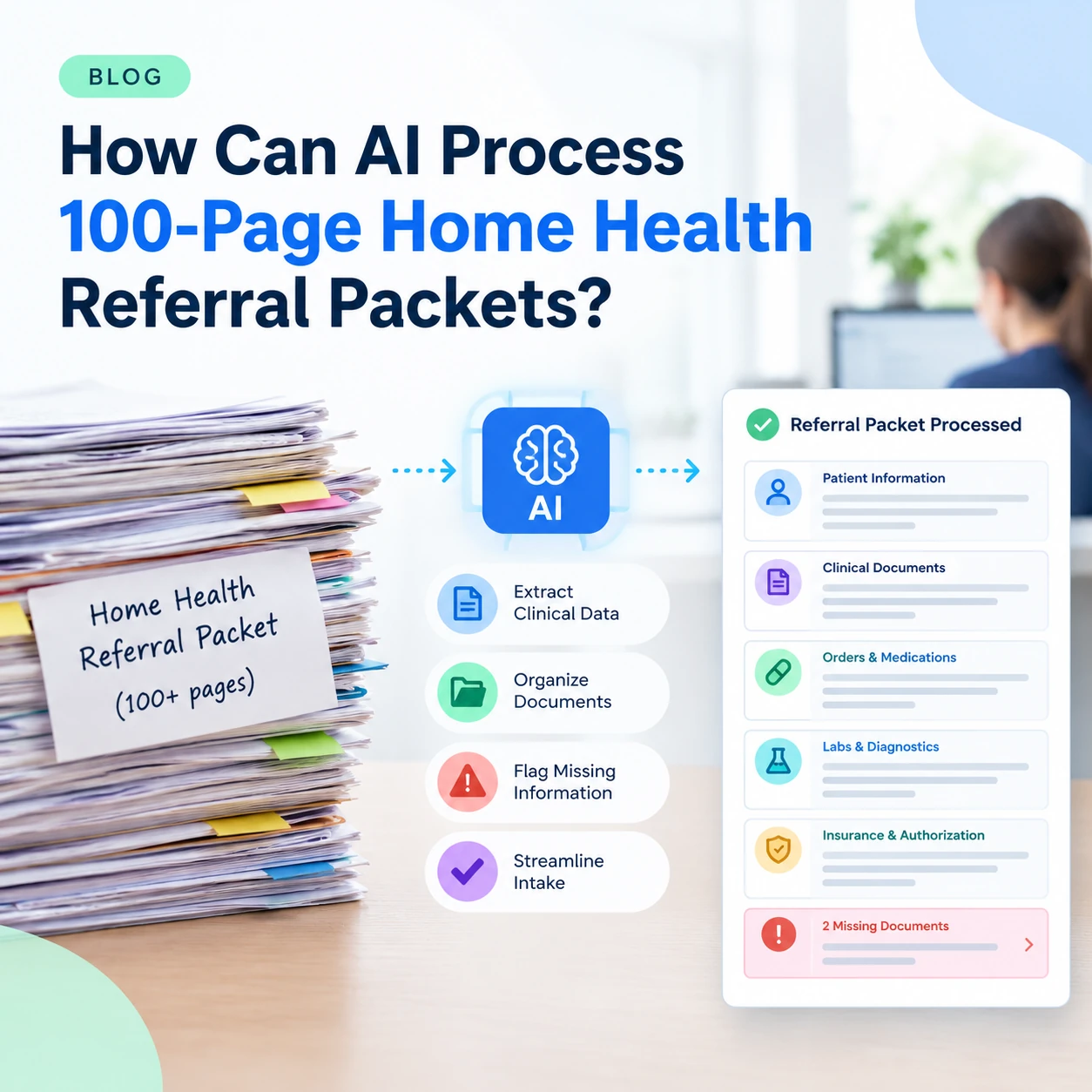
- Help staff locate information in large referral packets.
How can AI support admissions?
AI can also assist with:
- Organizing patient information for the start-of-care process.
- Supporting clinical documentation workflows.
- Structuring clinician-provided visit narratives.
- Identifying incomplete documentation fields for review.
- Reducing repetitive administrative tasks.
AI should support the people responsible for the process, not replace their judgment. Clinical assessments, care decisions, and final documentation approval must remain with the appropriately qualified professionals.
How Does Copper AI Support Home Health Agencies?
Home health agencies manage large volumes of information before and after a patient begins receiving care. Referral packets, clinical records, assessments, and follow-up tasks all require coordination.
Copper AI is designed to help home health agencies reduce repetitive administrative work through AI-powered documentation and workflow support.
Its capabilities support workflows such as:
- Extracting and organizing information from documents.
- Reducing repetitive documentation tasks.
- Helping clinicians turn spoken visit narratives into structured documentation.
- Supporting review of clinical information before documentation is finalized.
For clinical documentation, Copper AI's voice agent, Joy, can turn a clinician's spoken visit narrative into structured documentation for the clinician to review, correct, and approve.
The goal is to help teams spend less time handling repetitive paperwork and more time focusing on patient care.
Copper AI is designed to work around existing home health workflows, with the aim of supporting agencies without requiring a complete change to their EMR processes.
What Should Home Health Agencies Remember About Intake vs. Admissions?
Home health intake and admissions are separate stages, but they must work together.
Intake focuses on referral processing, administrative and financial verification, preliminary clinical review, and preparing the information needed for an acceptance decision. Admissions focuses on operational acceptance, clinical assessment, patient onboarding, and initiating services.
The start-of-care visit is a key part of the admission process, but it should not be confused with the referral or intake stage.
When agencies establish clear responsibilities, maintain accurate records, and coordinate information between teams, they can reduce avoidable delays and improve the patient transition into home health care.
The objective is not simply to process more referrals. It is to ensure that appropriate patients can move into care through a coordinated process with accurate information and the right clinical oversight.
Related Reading
- How Does Home Health Referral Intake Connect to Patient Eligibility?.
- How Can Home Health Agencies Determine Whether a Referral Is Ready for Admission?.
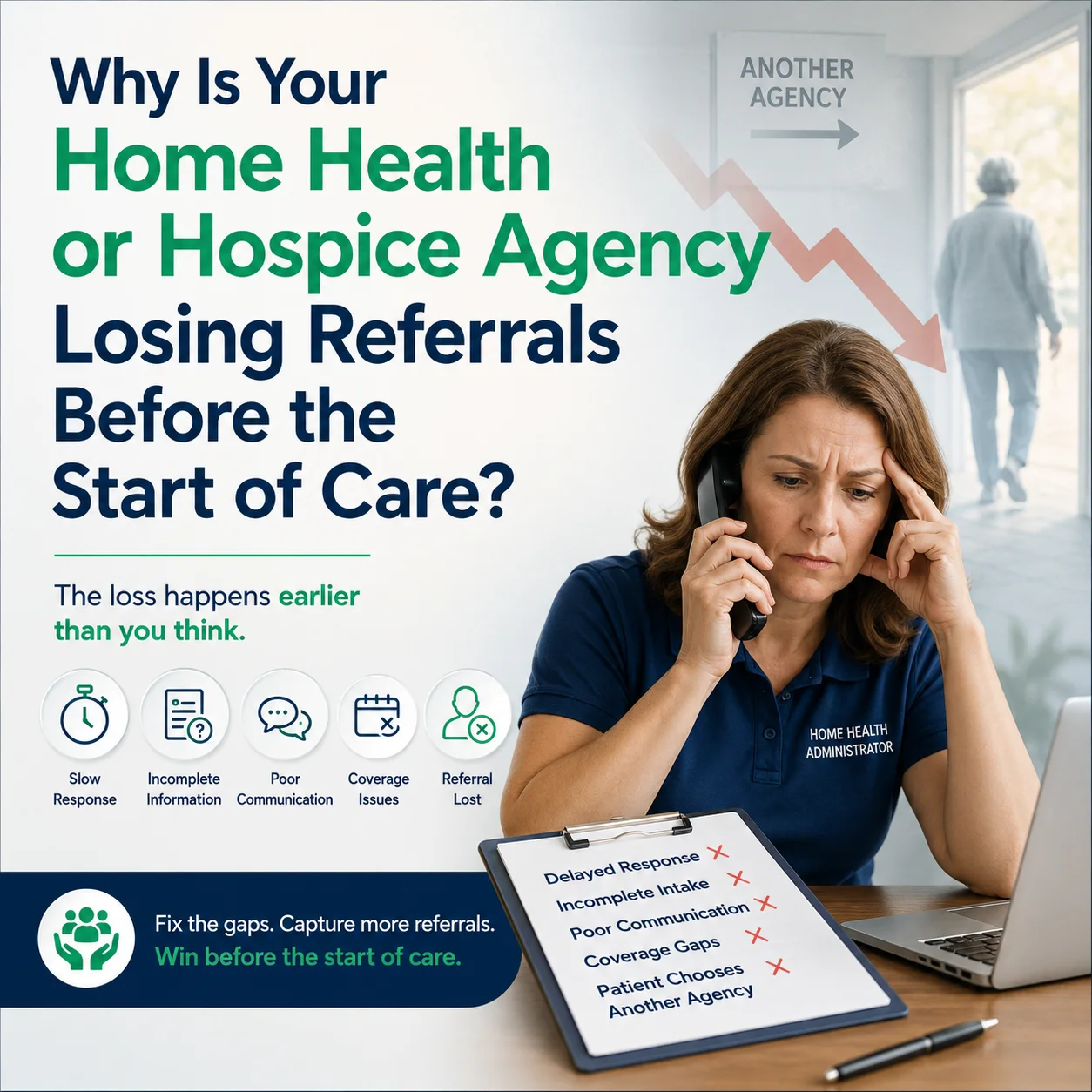
- Why Is Your Home Health or Hospice Agency Losing Referrals Before the Start of Care?.
- What Is a Comprehensive Assessment in Home Health?.
- What happens during a home health admission?.