
How Can Home Health Agencies Determine Whether a Referral Is Ready for Admission?
A practical framework for checking clinical eligibility, payer requirements, staffing capacity, and documentation before accepting a home health referral.
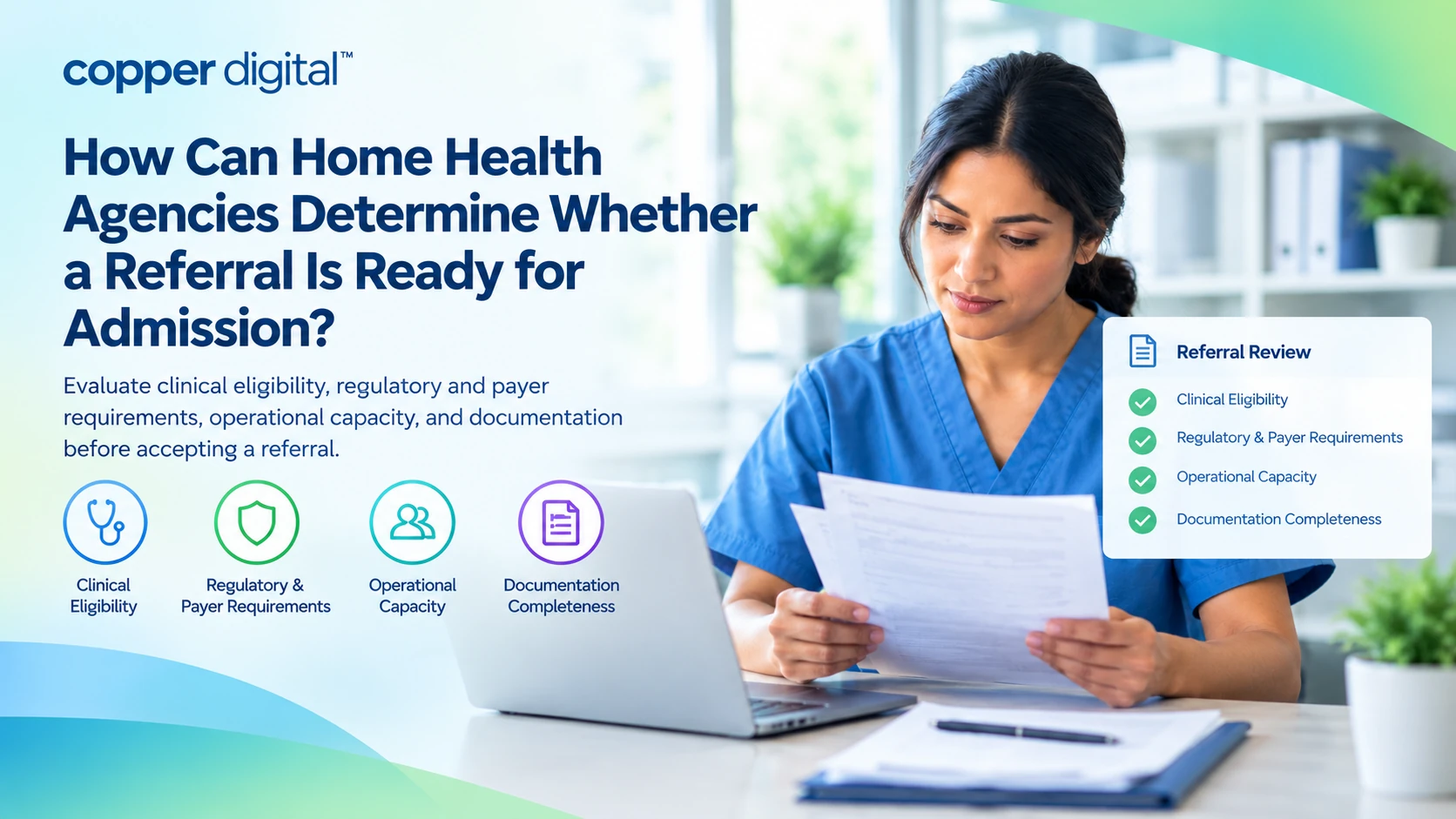
Key Takeaways
- Review clinical eligibility, regulatory and payer requirements, operational capacity, and documentation completeness.
- Distinguish a referral that is ready for initial review from a patient who is approved for admission.
- Assign every missing record, discrepancy, or pending authorization an owner and a next action.
- Apply the agency’s acceptance-to-service policy consistently, considering staffing, competencies, caseload, and patient needs.
- Use AI to organize and flag information while keeping clinical judgment, verification, and acceptance decisions with the appropriate staff.
A home health referral can arrive with a discharge summary, physician notes, medication lists, insurance information, and dozens of additional pages. But a complete-looking packet does not necessarily mean the agency is ready to admit the patient.
The physician's order may need clarification. Documentation may not adequately support the need for skilled care.
Insurance coverage or authorization may remain unresolved. The agency may also lack the staffing, clinical expertise, or geographic coverage required to provide the requested services safely.
For home health agencies, determining whether a referral is ready for admission involves more than checking whether the paperwork has arrived.
A referral must be evaluated across four areas: clinical eligibility, regulatory and payer requirements, operational capacity, and documentation completeness. Each area helps the agency determine whether to proceed, request additional information, escalate the referral for review, or decline it based on its established acceptance criteria.
What Does It Mean for a Home Health Referral to Be Ready for Admission?
A referral is ready to move forward when the agency has enough reliable information to evaluate the patient's needs, verify applicable requirements, assess its ability to provide care, and identify any remaining steps before admission.
It is important to distinguish between a referral that is ready for review and a patient who is fully approved for admission. A referral may contain enough information for an initial clinical assessment while still requiring an authorization, additional documentation, or confirmation of staffing availability.
Agencies should evaluate referral readiness across four areas:
- Clinical eligibility: Does the available documentation support the need for the requested home health services?
- Regulatory and payer requirements: Have the applicable orders, certification requirements, coverage details, and authorizations been reviewed?
- Operational capacity: Can the agency provide the necessary services with its available staff, competencies, and service-area coverage?
- Documentation completeness: Are the required records available, legible, consistent, and sufficient for the next stage?
A standardized review helps intake teams avoid treating every incoming fax as a separate manual investigation without a clear process.
What Clinical Eligibility Requirements Should Agencies Review Before Admission?
The first question is whether the patient's documented condition and care needs support the requested home health services.
For Medicare home health, the agency must evaluate the applicable coverage requirements, including homebound status, the need for qualifying skilled services, care under a physician or allowed practitioner's direction, a plan of care, and a qualifying face-to-face encounter.
The intake and clinical review should establish whether the records provide sufficient support for the appropriate decision-maker to assess these requirements.
Does the Referral Include the Required Physician Order and Plan of Care?
The agency should verify the applicable order and certification requirements, including who is authorized to order and certify care and what documentation must be completed.
For Medicare, the patient must receive services under a plan of care established and periodically reviewed by a physician or allowed practitioner. The required certification and supporting documentation must satisfy applicable Medicare rules.
At the referral stage, the team should determine whether the order is available, whether the ordering or certifying provider information is clear, and whether any missing signatures or documentation require follow-up.
An order alone does not establish that all eligibility requirements have been met.
Does the Documentation Support Homebound Status?
For Medicare home health, homebound status must be supported by the patient's circumstances and clinical documentation.
The review should look for information describing relevant functional limitations, the need for another person's assistance or an assistive device, or other circumstances affecting the patient's ability to leave home. The documentation must support the applicable Medicare criteria rather than rely only on a label such as “homebound.”
If the referral does not adequately explain the patient's functional limitations, the agency may need additional clinical records or clarification before completing its review.
Does the Patient Have a Qualifying Need for Skilled Services?
The agency should determine whether the referral supports the need for the requested services, such as skilled nursing, physical therapy, speech-language pathology, or occupational therapy where Medicare's continuing-need requirement applies.
A diagnosis or a general request for home care does not, by itself, establish medical necessity for covered home health services.
The clinical record should explain the patient's condition, the skilled services being requested, and the rationale for those services. If the documentation is insufficient, the agency should identify the gap for the appropriate clinical reviewer or referring provider.
Is the Required Face-to-Face Encounter Documented?
For Medicare home health, the qualifying face-to-face encounter must be related to the primary reason the patient requires home health services. It must generally occur no more than 90 days before the start-of-care date or within 30 days after care begins, and it must be performed by an allowed practitioner.
The encounter date must be documented as required. CMS Medicare home health guidance.
The intake team should check whether the relevant encounter documentation is available or whether follow-up is needed. A missing record should be flagged rather than assumed to be satisfied because the referral mentions a recent provider visit.
The agency must still follow applicable certification, documentation, and timing requirements.
How Should Agencies Verify Insurance, Coverage, and Authorization Requirements?
A referral may appear clinically appropriate while still requiring administrative or financial verification.
The agency should identify the primary payer, check applicable coverage requirements, and determine what must be completed before services begin.
Depending on the payer and circumstances, this review may include:
- Confirming active insurance coverage.
- Verifying whether the agency participates with the payer or is otherwise permitted to provide the service.
- Checking applicable home health benefits and coverage requirements.
- Determining whether prior authorization or another approval is required.
- Reviewing referral, network, or documentation requirements.
- Identifying relevant inpatient or facility history when required for the applicable coverage or billing rules.
- Explaining applicable financial responsibility to the patient or family.
Medicare, Medicare Advantage, Medicaid, and commercial plans do not necessarily follow identical administrative requirements. Agencies should use current payer-specific rules rather than treat one authorization checklist as universal.
For example, prior authorization may be required by a particular Medicare Advantage or managed care plan even when the referral packet contains extensive clinical documentation.
Financial responsibility should also be explained accurately. Patient cost-sharing depends on the payer, covered service, and circumstances.
Agencies should verify applicable deductibles, copayments, coinsurance, or other charges rather than assume the same financial rules apply to every referral.
A referral is not financially cleared simply because the insurance card is present. Coverage, authorization, and applicable requirements must be verified.
What Documentation Should Be Included in a Home Health Referral Packet?
A complete referral packet gives the agency the information needed to identify the patient, understand the requested care, and conduct the relevant clinical and administrative reviews.
Depending on the referral and payer, the packet may include:
- Patient face sheet and demographic information.
- Referral and applicable home health orders.
- Recent hospital or facility discharge summary, when applicable.
- Relevant history and physical documentation, progress notes, and clinical assessments.
- Medication list and reconciliation information, as available.
- Diagnosis information and supporting clinical records.
- Referring provider and follow-up provider details.
- Face-to-face encounter documentation, where required.
- Insurance and payer information.
- Authorization or other payer-required documentation.
- Patient or family choice documentation, where applicable.
- Relevant therapy assessments, nursing notes, or functional assessments.
The exact requirements depend on the patient's circumstances, payer, and stage of the admission process.
A referral should not be considered complete simply because every document type appears in the packet. The team must also check whether the records are legible, relevant, consistent, and sufficient for the decision being made.
How Can Agencies Identify Missing or Conflicting Information Before Admission?
Large referral packets often contain repeated information from different providers and facilities. Patient identifiers, medications, diagnoses, and dates may differ across documents or may be difficult to locate.
A structured review should compare key details across the available records, including:
- Patient name, date of birth, and other identifying information.
- Referring and treating providers.
- Diagnoses and the stated reason for referral.
- Medication information.
- Discharge and encounter dates.
- Requested services and clinical instructions.
- Insurance information and authorization status.
- Required orders, signatures, and supporting documentation.
For example, the discharge summary may list one medication regimen while another record contains different information. The intake team should flag the discrepancy for appropriate review instead of silently choosing one version.
A missing discharge summary may require follow-up with the hospital. An unclear order may require clarification from the provider.
An unresolved authorization may need to be routed to the person responsible for payer coordination.
Each gap should have a clear status, an assigned owner, and a next action.
How Should Agencies Evaluate Staffing, Skills, and Geographic Coverage?
Even when a referral appears clinically appropriate and the documentation is complete, the agency must determine whether it can provide the required care.
CMS's home health Conditions of Participation include an acceptance-to-service policy requirement under 42 CFR § 484.105(i). The policy must be applied consistently to prospective patients and address the agency's capacity to provide care, including anticipated patient needs, current caseload and case mix, staffing levels, and staff skills and competencies.
The policy must be reviewed annually. CMS acceptance-to-service requirement and updated guidance.
Does the Agency Have the Right Staff Available?
The agency should assess whether it has the nurses, therapists, and other qualified personnel required for the patient's anticipated needs.
This includes considering the clinical complexity of the case, the type and frequency of services requested, staff competencies, and the agency's existing workload.
A nurse may be available in the schedule but may not have the specific expertise required for a particular case. Similarly, accepting several complex referrals at once may affect the agency's ability to provide timely, safe care.
The decision should account for both staffing numbers and the skills required.
Does the Patient Live Within the Agency's Service Area?
The team should confirm that the patient's residence falls within the agency's service territory and that travel requirements are practical for the planned care.
Geographic coverage affects visit scheduling, travel time, staffing allocation, and the agency's ability to meet the patient's needs.
If the address falls outside the agency's service area, the referral may need to be redirected or evaluated under the agency's established policy.
Can the Agency Support the Entire Episode of Care?
The review should consider anticipated care needs, current caseload, supervisory capacity, clinical documentation support, and the resources needed to coordinate services.
A referral should not be accepted solely because the agency can complete the first visit if it cannot reasonably support the anticipated care requirements.
The objective is to match patient needs with the agency's actual capacity, not just its available appointment slots.
Is the Agency Applying Its Acceptance-to-Service Policy Consistently?
Agencies should use a written policy that reflects their services and capacity and apply it consistently to prospective patients.
The policy should address the minimum CMS capacity criteria, including anticipated needs, caseload and case mix, staffing, and staff competencies. Agencies must also make accurate information about the services they offer and relevant limitations available to the public, as required under the applicable regulation.
This creates a clearer basis for acceptance decisions and helps teams explain why a referral can proceed, needs further review, or cannot be accepted under the agency's established criteria.
What Equipment and Coordination Requirements Must Be Addressed Before Start of Care?
Some referrals require coordination beyond clinical records and insurance verification.
Before confirming a start-of-care date, the team should determine whether the patient needs equipment, prescriptions, transportation coordination, caregiver support, or other arrangements relevant to the transition home.
Depending on the case, this may include:
- Confirming that required durable medical equipment has been ordered and delivery arrangements are understood.
- Identifying outstanding prescriptions or medication-related coordination needs.
- Confirming the patient's discharge or return-home arrangements.
- Checking that the patient or family understands the planned visit and how to contact the agency.
- Coordinating with the referral source, provider, or other service partners when necessary.
- Confirming that the agency can deliver the requested services within the planned timeframe.
Not every referral requires every item. The checklist should reflect the patient's needs and the services the agency will provide.
The key is to identify barriers before they disrupt the start of care, rather than discovering them after the admission has been scheduled.
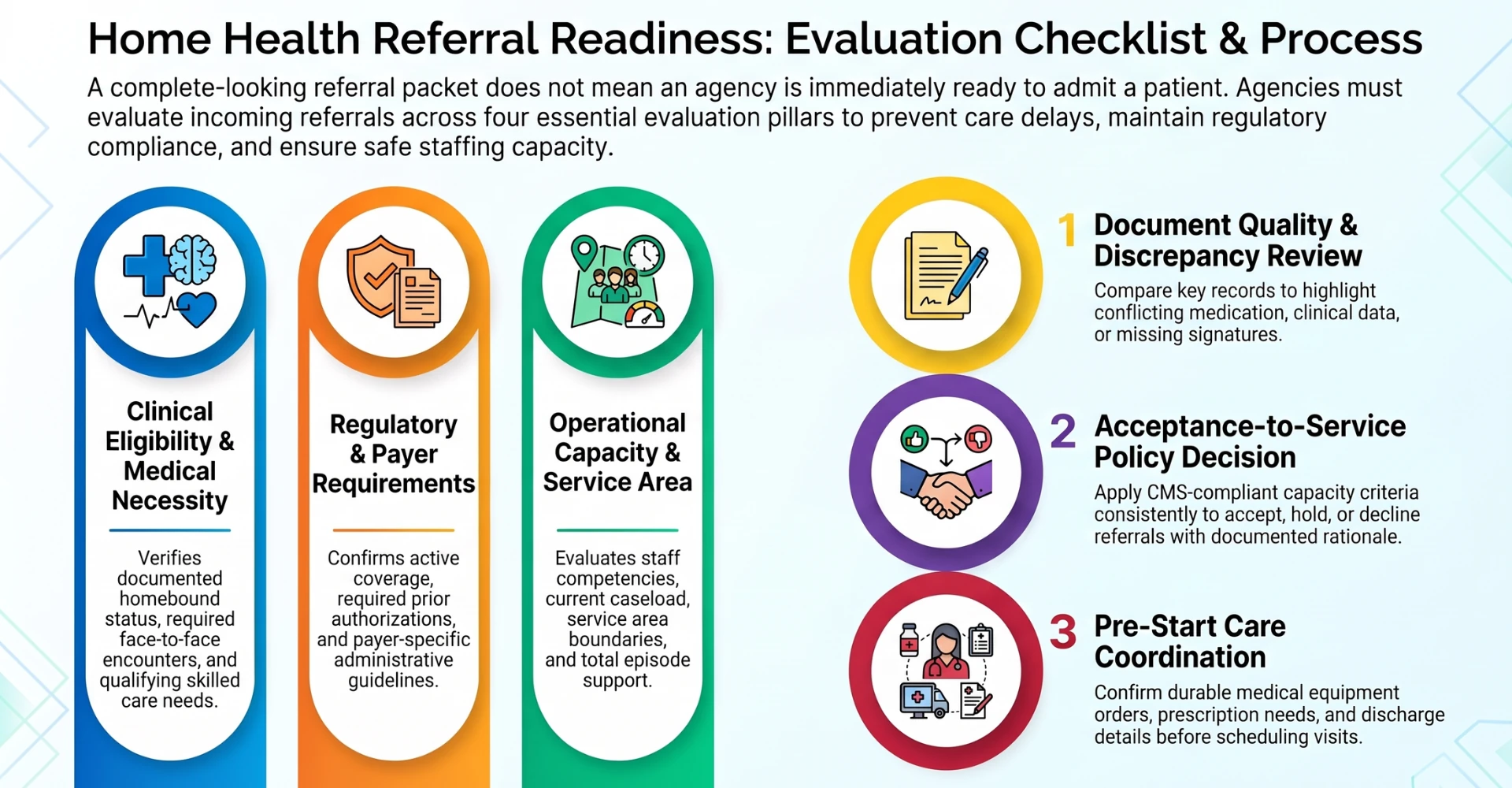
Review clinical eligibility, payer requirements, agency capacity, and documentation before moving a referral to the next stage.
How Can Agencies Create a Practical Home Health Referral-Readiness Checklist?
A checklist should help intake staff determine what is complete, what remains unresolved, and who needs to act next.
The following framework can be adapted to the agency's payer mix, services, policies, and regulatory requirements.
| Review area | What to check | Possible status |
|---|---|---|
| Patient and referral details | Identity, address, referral source, requested services | Complete / Needs information |
| Clinical review | Documented skilled need, relevant clinical history, homebound support when applicable | Ready for review / Needs clarification |
| Orders and certification | Required orders, provider details, certification and encounter documentation as applicable | Complete / Outstanding |
| Payer verification | Coverage, network requirements, authorization, and applicable financial responsibility | Verified / Pending |
| Documentation quality | Legibility, consistency, missing pages, conflicting details | Complete / Needs follow-up |
| Staffing and service area | Required disciplines, staff competency, caseload, geographic coverage | Capacity confirmed / Escalation needed |
| Start-of-care coordination | Scheduling, equipment, prescriptions, patient or caregiver communication as applicable | Ready / Coordination pending |
| Acceptance decision | Review under the agency's acceptance-to-service policy | Accept / Hold / Decline with documented rationale |
The checklist should distinguish between a referral that is ready for an initial review and one that has satisfied all applicable requirements to proceed.
It should also avoid using a single “complete” status to conceal unresolved issues. A referral may have complete documentation but pending authorization, or confirmed coverage but insufficient clinical information.
How Can AI Help Determine Whether a Home Health Referral Is Ready for Admission?
AI can help intake teams review large fax and PDF packets, organize the information, and identify potential gaps before the referral advances.
Depending on the system's validated capabilities, AI-enabled referral workflows can support:
- Document classification: Identifying discharge summaries, medication lists, orders, clinical notes, and insurance records within a multipage packet.
- Information extraction: Capturing patient details, diagnoses, provider information, and payer data into structured fields.
- Completeness checks: Flagging documents or fields that appear to be missing based on the agency's checklist.
- Discrepancy detection: Highlighting inconsistent patient identifiers, dates, medications, or other information.
- Referral summaries: Giving intake staff a concise overview of the patient's needs and available records.
- Workflow routing: Sending unresolved documentation issues to the appropriate person or team.
- Status tracking: Recording outstanding items and helping staff monitor follow-up.
Consider a referral that arrives as a 60-page fax. The intake coordinator may otherwise need to search the packet manually for patient details, the discharge summary, medication information, orders, and insurance records.
An AI-assisted workflow could organize those documents, extract key information, and flag a missing order or an inconsistency for review. Staff could then focus on resolving the issue instead of locating every detail from scratch.
However, extracted information should not be treated as automatically correct. Poor scan quality, handwriting, duplicate records, and conflicting clinical information can affect accuracy.
Human review remains important, especially when a finding affects clinical care, eligibility, or payment.
AI can help make referral review faster and more consistent. It cannot independently replace required provider certification, payer verification, clinical judgment, or the agency's acceptance-to-service decision.
How Long Does It Usually Take for a Home Health Referral to Be Approved?
There is no single approval timeline that applies to every home health referral.
The time required depends on the completeness of the referral, the need for clinical review, the responsiveness of the referring provider, payer-specific requirements, authorization processes, staffing availability, and the patient's circumstances.
A referral with complete records and no outstanding administrative issues may move through the initial review more quickly than one requiring several documents or provider clarifications.
Agencies can improve visibility by tracking separate milestones:
- Time from referral receipt to initial review.
- Time to identify and request missing information.
- Time waiting for provider documentation or clarification.
- Time to complete applicable coverage and authorization checks.
- Time from review completion to the admission decision.
- Time from acceptance to the scheduled start of care.
These milestones help agencies identify the source of delays rather than treating every delay as a single intake problem.
Agencies should set internal service-level targets that reflect their processes and applicable requirements. They should not promise a universal approval timeframe when key steps depend on external providers, payers, or patient needs.
What Are the CMS Guidelines for Accepting a Home Health Referral?
CMS requirements address both the patient's eligibility for covered services and the agency's responsibility to determine whether it can provide appropriate care.
For Medicare home health, agencies must evaluate applicable eligibility, certification, plan-of-care, face-to-face encounter, and supporting documentation requirements. The patient's records must support the need for qualifying skilled services and homebound status. CMS Home Health Services guidance.
Separately, the home health Conditions of Participation require an acceptance-to-service policy under 42 CFR § 484.105(i). The policy must be applied consistently and address the agency's capacity to care for prospective patients, including:
- Anticipated patient needs.
- Current caseload and case mix.
- Staffing levels.
- Staff skills and competencies.
The agency must review this policy annually and make accurate information about its services and relevant limitations available to the public, consistent with the regulation. CMS acceptance-to-service guidance.
These requirements serve different purposes. Medicare eligibility determines whether the patient meets the applicable benefit criteria; the acceptance-to-service policy helps the agency assess whether it can safely and appropriately provide the needed care.
Payer-specific authorization and administrative requirements must also be considered where applicable.
What Are the Steps in the Home Health Referral Process?
A structured referral process helps the agency move from receiving a packet to making a documented decision.
- Step 1: Receive and register the referral. Capture the patient's identifying details, referral source, requested services, and receipt date.
- Step 2: Review the documents. Identify the records received, check their legibility, and flag missing or conflicting information.
- Step 3: Conduct the initial clinical review. Determine whether the available documentation supports further assessment of the requested services and identify questions for the clinical reviewer or referring provider.
- Step 4: Verify payer requirements. Confirm applicable coverage, network, authorization, and documentation requirements.
- Step 5: Evaluate agency capacity. Review the patient's anticipated needs against staffing, staff competencies, caseload, case mix, and service-area coverage under the acceptance-to-service policy.
- Step 6: Resolve outstanding requirements. Request missing documents, obtain clarification, and coordinate equipment or other arrangements when relevant.
- Step 7: Document the acceptance decision. Record whether the referral can proceed, must remain on hold, or cannot be accepted under the agency's established criteria.
- Step 8: Coordinate admission and start of care. Confirm the necessary arrangements, communicate with the patient or family as appropriate, and complete the required clinical and administrative steps.
The sequence may vary depending on the referral, payer, and urgency of the patient's needs. Some administrative checks can occur in parallel, while other decisions must wait for clinical clarification or required documentation.
How Can Agencies Improve Referral Readiness Without Adding More Manual Work?
A consistent process helps agencies see where referrals are getting stuck and why.
Start by establishing a shared checklist, defining referral statuses, and assigning clear ownership for each outstanding item. Track whether delays are caused by incomplete records, payer requirements, staffing constraints, or coordination problems.
Agencies receiving high volumes of faxed referrals can also consider automation that extracts information, organizes documents, and flags potential gaps for review.
The goal is not to accept every referral faster regardless of the circumstances. It is to reduce avoidable administrative work while ensuring the agency has the information, authorization, clinical support, and capacity needed to provide appropriate care.
A referral is ready to move forward when the agency understands the patient's needs, has assessed its ability to provide the requested services, has addressed the applicable requirements, and knows exactly what remains before care can begin.
That is what turns referral intake from a paperwork exercise into a consistent admission-readiness process.
Related reading
What Should I Document? 100 OASIS Situations Home Health Nurses Face Every Day
100 real OASIS scenarios, worked end to end — clinical situation, common mistake, better approach, and key takeaway. Built around OASIS-E2 (effective April 1, 2026) to turn what you assess into accurate, defensible documentation.
Bottom Line
A referral is ready to move forward when the agency understands the patient's needs, has assessed its ability to provide the requested services, has addressed the applicable requirements, and knows exactly what remains before care can begin.
Inside Home Health Podcast
Clinician Burnout is the Patient Experience Problem | AI in Healthcare, Caregiver Crisis

Arvind Sarin is the founder of Copper Digital. He works inside home health agencies to build AI documentation workflows that help clinicians finish OASIS and visit notes sooner, with a nurse reviewing and approving every note. He writes about home health documentation, Medicare compliance, and applying AI responsibly in clinical workflows.
Frequently asked
Frequently asked questions
A home health referral is a request for a qualified home health agency to evaluate and potentially provide care to a patient at home. It typically comes from a physician, hospital, skilled nursing facility, or another healthcare provider and includes information about the patient's condition, care needs, and requested services.
Join the conversation
Leave a comment
No comments yet. Be the first to share your thoughts.
Related reading
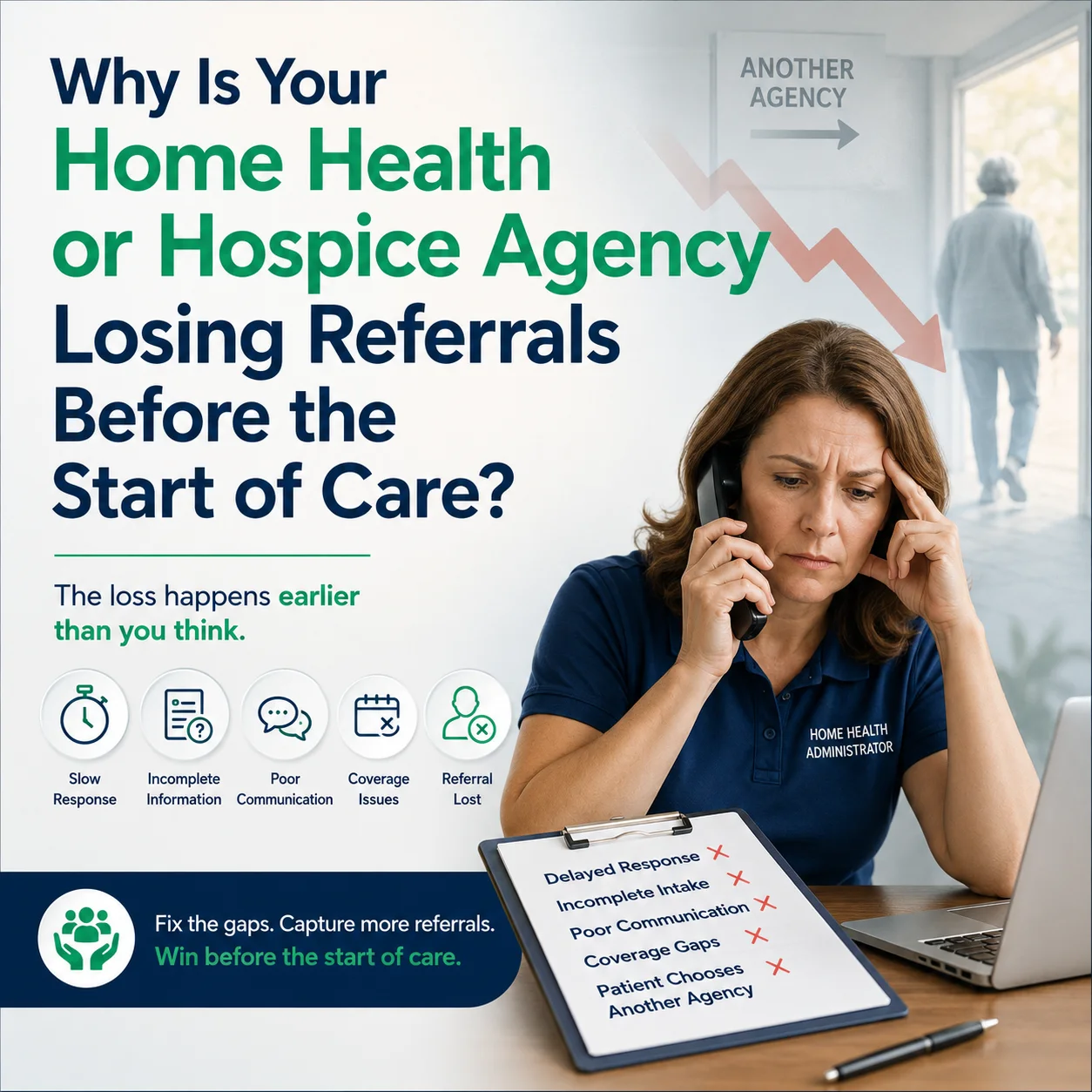
Why Is Your Home Health or Hospice Agency Losing Referrals Before the Start of Care?
A referral is not an admission. Learn where referrals stall between intake and Start of Care, and how ownership, visibility, and follow-up can prevent avoidable losses.
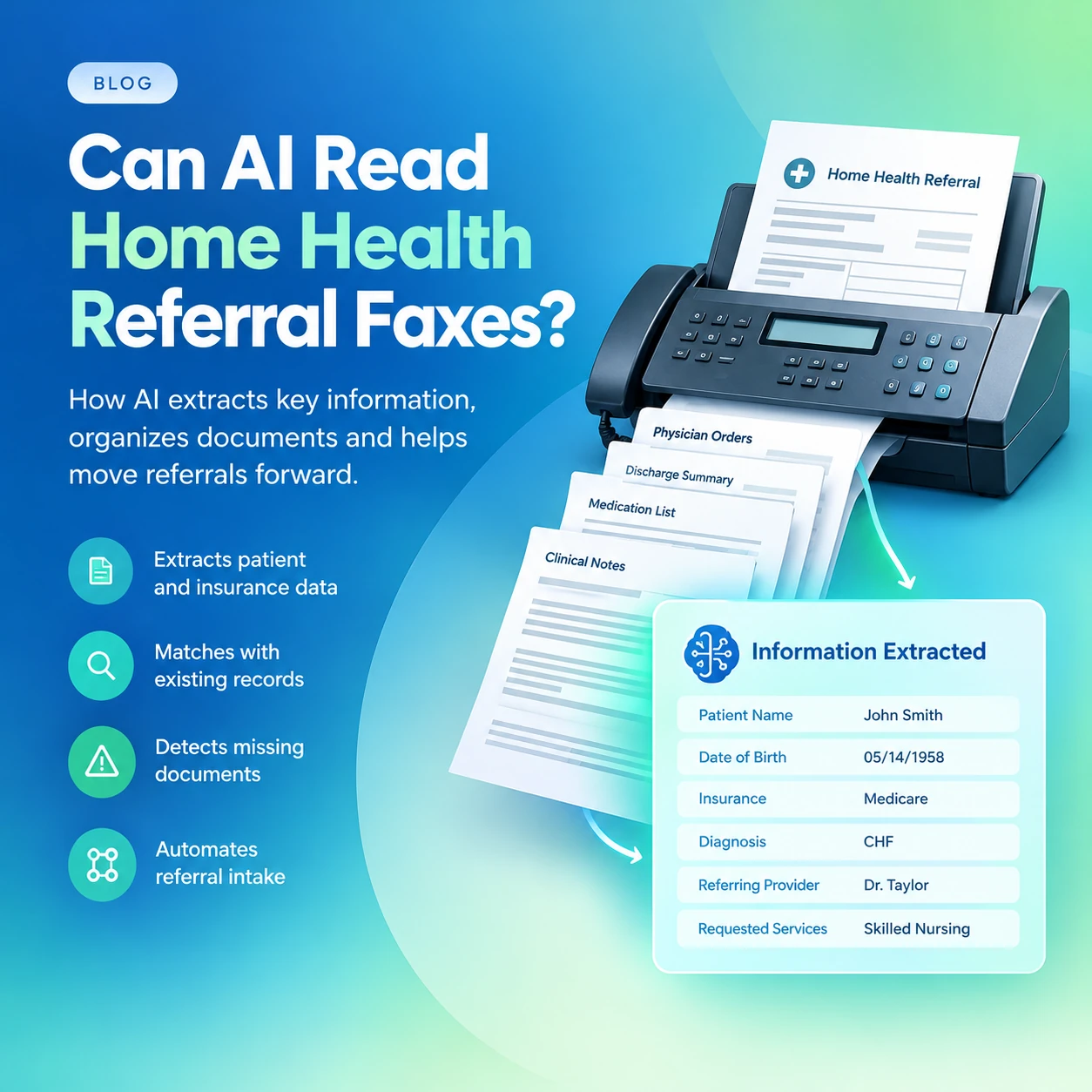
Can AI Read Home Health Referral Faxes?
How AI reads referral faxes, extracts patient information, flags missing records, supports patient matching, and routes home health intake tasks for human review.
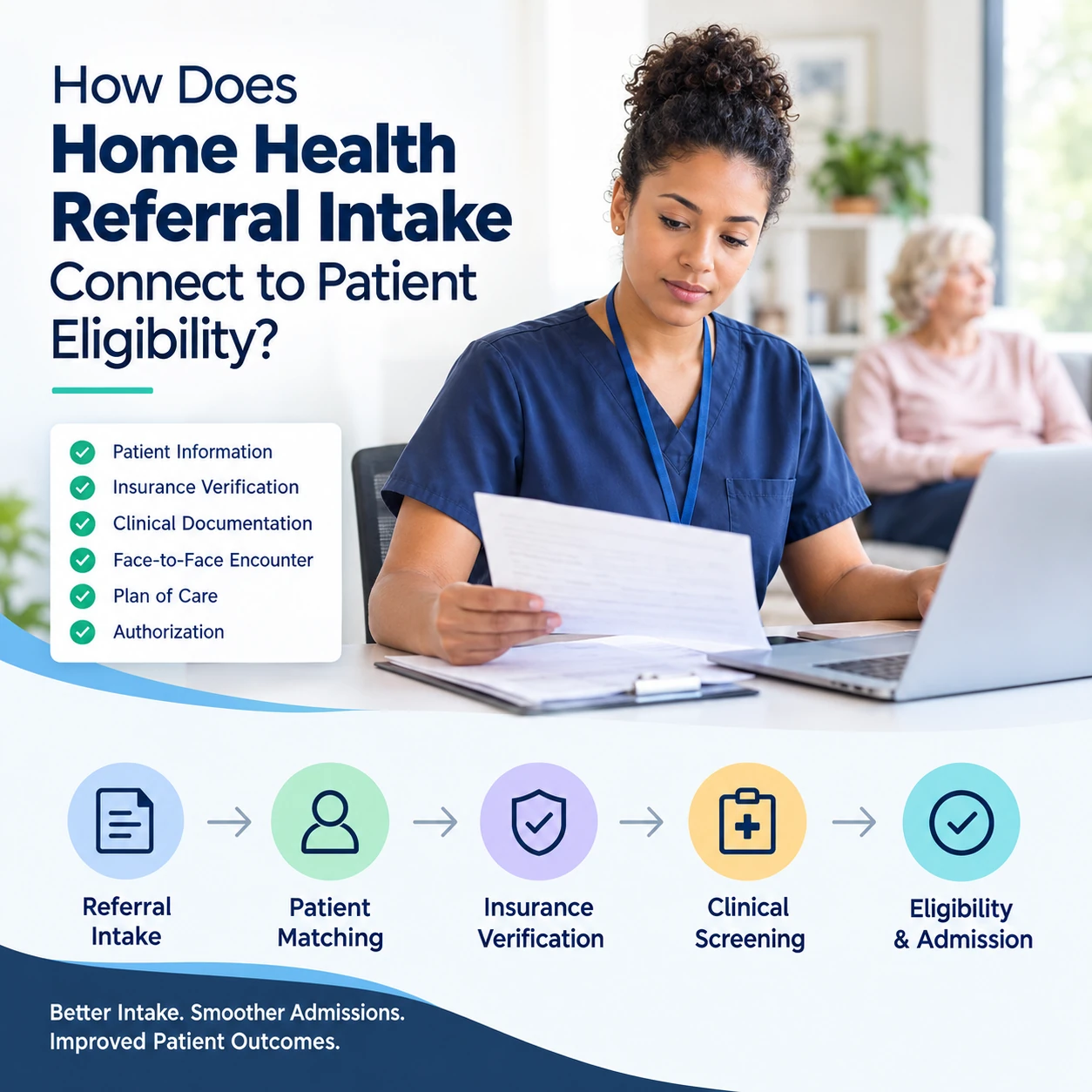
How Does Home Health Referral Intake Connect to Patient Eligibility?
How referral intake connects patient matching, insurance verification, clinical screening, face-to-face documentation, authorization, and the requirements for home health admission.