
How Does Home Health Referral Intake Connect to Patient Eligibility?
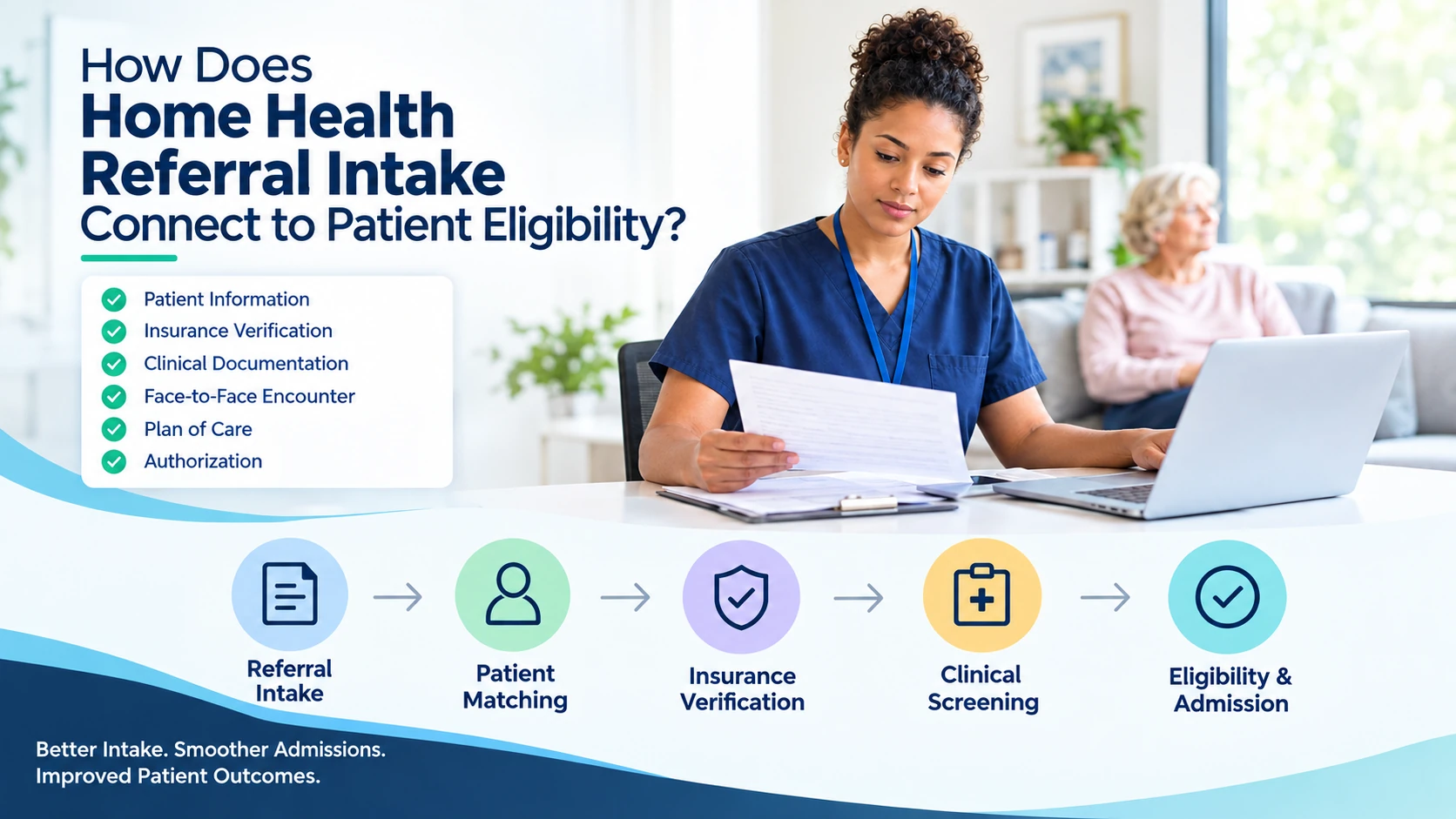
How referral intake connects patient matching, insurance verification, clinical screening, face-to-face documentation, authorization, and the requirements for home health admission.
Key Takeaways
- Eligibility screening starts when a referral arrives, but receiving a referral does not confirm eligibility.
- Keep insurance verification, prior authorization, clinical review, plan-of-care requirements, and certification separate and clearly tracked.
- Identify missing or conflicting records early, assign follow-up ownership, and escalate clinical questions to the appropriate reviewer.
- Medicare eligibility requires supporting documentation, not just a diagnosis, an order, or active coverage.
- AI can organize documents and flag gaps; it should not independently certify eligibility or invent missing clinical information.
What Is the Connection Between Home Health Referral Intake and Patient Eligibility?
Home health referral intake is the process of receiving, reviewing, and organizing information about a patient who may need care at home. Patient eligibility is the determination of whether that patient meets the applicable clinical, coverage, and program requirements for the requested services.
The two processes are closely connected because eligibility screening begins when a referral arrives, not when the first home visit takes place.
Intake teams may receive referrals from hospitals, skilled nursing facilities, primary care providers, specialists, discharge planners, and other referral partners. These referrals often contain a mixture of clinical records, demographics, physician orders, insurance information, and discharge instructions.
The intake team must organize this information and identify what is available, what is missing, and what needs verification before the agency proceeds.
For Medicare home health, eligibility generally involves requirements such as the patient's homebound status, need for qualifying skilled services, care under an authorized physician or allowed practitioner, an established plan of care, and the required certification and face-to-face documentation. CMS's Home Health Services guidance outlines these requirements.
A well-designed intake process helps agencies identify potential eligibility issues early, request missing records, and coordinate the next steps without confusing a promising referral with a confirmed eligible admission.
Why Is Eligibility Screening Important During Home Health Referral Intake?
Eligibility screening helps an agency determine whether a referral appears appropriate for its services and what must be verified before admission and billing.
Without an organized screening process, an agency may schedule visits before reviewing key documentation, discover missing records after care has started, or misunderstand a patient's coverage requirements.
Early screening can help teams:
- Identify incomplete referrals before they move further into the admission workflow.
- Confirm that the requested services align with the patient's documented clinical needs.
- Flag potential gaps in homebound-status or skilled-need documentation.
- Verify insurance coverage and identify payer-specific authorization requirements.
- Request missing orders, encounter notes, or discharge records.
- Route clinical questions to the appropriate reviewer.
- Reduce avoidable delays, rework, and preventable billing problems.
Screening is not a substitute for clinical judgment or formal eligibility certification. It is an early control that helps the agency identify questions that need to be resolved.
What Information Should Intake Teams Review to Screen for Home Health Eligibility?
Intake teams need enough information to identify the patient, understand the referral, assess whether it appears appropriate for the agency, and determine which requirements still need confirmation.
The exact documents vary by referral source, payer, and patient circumstances. Common items include:
- Patient demographics: Full name, date of birth, address, contact details, and other identifiers needed for accurate record matching.
- Insurance information: Primary and secondary coverage, member or Medicare identifiers, plan details, and effective dates.
- Referral or physician orders: The requested home health services and relevant ordering-provider information.
- Clinical records: Recent progress notes, discharge summaries, diagnoses, medication information, and other records supporting the referral.
- Skilled-care information: Documentation explaining the need for nursing, therapy, or other covered services.
- Homebound-status information: Clinical facts describing the patient's ability to leave home and any relevant assistance or restrictions.
- Face-to-face encounter documentation: Where applicable, the encounter note and related certification information required for Medicare.
- Plan-of-care information: Available orders and details needed to establish or complete the applicable plan of care.
- Payer requirements: Prior authorization, network, referral, or other requirements specific to the patient's coverage.
Receiving a document is not the same as verifying that it is complete, accurate, current, and sufficient. Intake teams should track the status of important requirements rather than simply marking a referral as received.
How Does Document Capture and Patient Matching Work During Home Health Intake?
Document capture and patient matching help intake staff connect incoming records to the correct patient and referral.
A hospital may send a discharge summary, a primary care provider may send an order, and a payer portal may provide coverage details. These records may arrive separately, use different identifiers, or contain inconsistent demographic information.
A structured workflow should:
- Capture documents from approved channels, such as referral portals, secure fax, or electronic interfaces.
- Extract key details, including patient name, date of birth, diagnoses, provider information, and insurance identifiers.
- Match the documents to the correct patient and referral using appropriate identifiers.
- Flag mismatches, missing fields, duplicate records, and unreadable documents.
- Route uncertain matches for staff review rather than attaching records automatically.
- Maintain a record of what was received, verified, requested, and resolved.
For example, if a discharge summary and physician order contain different patient identifiers, the discrepancy should be resolved before the records are treated as a confirmed match.
Automation can help extract and organize information, but uncertain matches and clinically significant discrepancies require appropriate human review.
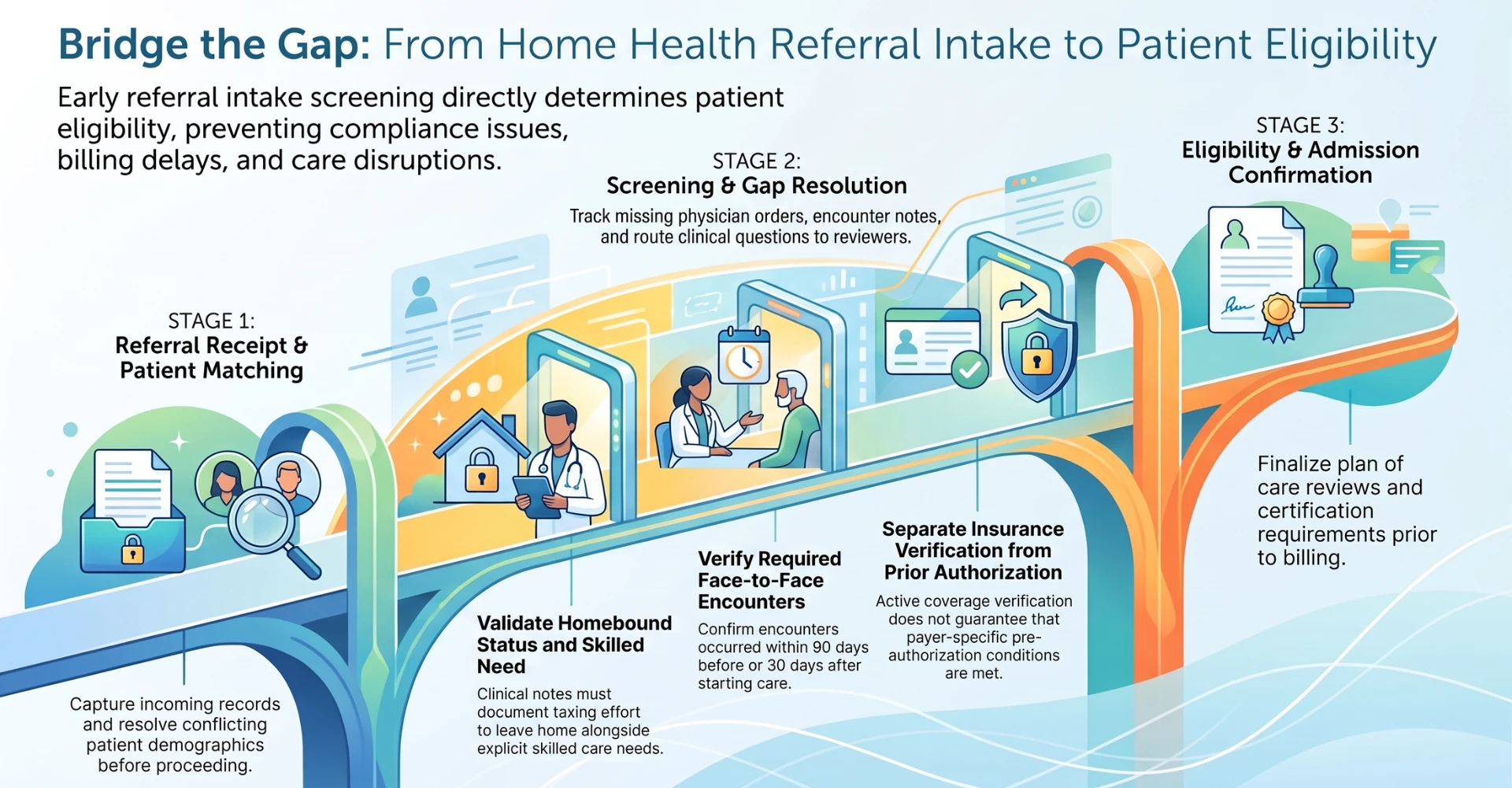
Intake screening supports, but does not replace, clinical eligibility review and required certification.
How Does Medicare Home Health Eligibility Affect Referral Intake?
Medicare home health eligibility should be considered early because the agency needs to evaluate more than whether a patient has Medicare coverage or a physician referral.
Under the Medicare home health benefit, the patient's circumstances must satisfy applicable coverage requirements. These generally include:
- The patient is under the care of a physician or allowed practitioner.
- A qualifying need for covered home health services exists.
- The patient meets Medicare's homebound requirements.
- A plan of care is established and reviewed as required.
- Required certification and face-to-face encounter conditions are met.
Medicare's qualifying skilled-service requirements include intermittent skilled nursing, physical therapy, speech-language pathology, or a continuing need for occupational therapy under the applicable rules. Occupational therapy alone does not necessarily establish initial eligibility when the other requirements for starting the Medicare home health benefit have not been met.
Intake staff can use these criteria to identify documentation gaps and refer clinical questions to the appropriate reviewer. The intake team should not treat a diagnosis, an order, or the presence of Medicare coverage alone as proof of eligibility.
For official guidance, see the CMS Home Health Services compliance guidance and the Medicare Benefit Policy Manual, Chapter 7.
How Does Homebound Status Connect to Referral Intake?
Homebound status is a key part of Medicare home health eligibility, so intake teams should look for clinical documentation that supports the patient's circumstances rather than relying on a checkbox or a general statement that the patient needs help.
Medicare's homebound criteria consider factors such as whether illness or injury makes it medically inadvisable to leave home, whether the patient needs assistance or supportive devices to leave, and whether leaving home requires a considerable and taxing effort, subject to the applicable rules and exceptions.
Intake staff should look for relevant information in clinical notes, discharge summaries, and other supporting records. If the referral simply states that the patient is homebound without sufficient supporting context, the team may need to request additional documentation.
The goal is not for intake staff to make an unsupported clinical determination. It is to identify whether the available records appear to support the requirement and whether additional review is needed.
How Does the Need for Skilled Care Affect Home Health Eligibility?
A referral should explain why the patient needs the requested home health services and what skilled care is expected to accomplish.
A diagnosis by itself does not necessarily demonstrate that home health services are covered. The clinical record should support the need for the services being requested and show how those services relate to the patient's condition.
Depending on the circumstances, supporting records may describe:
- Skilled nursing needs and the clinical complexity of care.
- Functional limitations and rehabilitation needs.
- Changes in the patient's condition.
- The need for skilled assessment, intervention, or teaching.
- Therapy needs and the expected role of the requested services.
- Why the care is reasonable and necessary under the applicable coverage rules.
If a referral lists a diagnosis but does not explain the skilled-care need, intake should flag the gap and request clarification through the agency's established process.
Clinical reviewers should determine whether the documentation supports the services. Intake screening can identify missing evidence, but it should not replace the clinical evaluation.
What Is the Medicare Face-to-Face Encounter Requirement for Home Health?
For Medicare home health, a qualifying face-to-face encounter must meet the applicable timing, provider, and documentation requirements.
CMS guidance generally specifies that the encounter occur no more than 90 days before the start of care or within 30 days after the start of care. The encounter must relate to the primary reason the patient requires home health services, and the required documentation must support the certification process.
The agency should verify that the available records address the relevant requirements, including:
- The encounter date.
- The clinical note or other required supporting record.
- The relationship between the encounter and the reason for home health care.
- The applicable provider requirements.
- The required certification and documentation.
CMS finalized changes to the face-to-face encounter policy for calendar year 2026, so agencies should consult current CMS guidance rather than rely solely on older checklists or outdated provider assumptions.
See CMS Home Health Services and the CY 2026 Home Health Prospective Payment System final rule.
What Happens if Face-to-Face Documentation Is Missing From a Home Health Referral?
Missing face-to-face documentation should trigger a follow-up process, not an assumption that the referral is automatically approved or automatically denied.
The agency should determine whether the required encounter occurred, whether the supporting records are available elsewhere, and whether the applicable timing and documentation requirements have been met.
Depending on the situation, intake or clinical staff may need to:
- Request the encounter note or relevant medical records.
- Confirm the encounter date and whether it falls within the applicable timeframe.
- Verify that the documentation relates to the primary reason for home health services.
- Obtain clarification from the certifying practitioner or other appropriate source.
- Escalate unresolved gaps before proceeding with decisions that depend on eligibility.
- Document follow-up efforts and the final review outcome.
Insufficient documentation can put Medicare coverage and payment at risk. However, the consequences depend on the facts, the applicable requirements, and the documentation available for review.
Agencies should not describe every missing document as an automatic denial.
CMS explains the relationship between certification documentation and payment risk in its Home Health Care: Proper Certification Required guidance.
How Does the Plan of Care Connect to Referral Intake and Eligibility?
The plan of care connects the patient's assessed needs with the services the home health agency will provide.
During referral intake, staff may receive an order or preliminary service request, but that document is not necessarily the complete plan of care required for the patient's services.
The workflow should identify which orders and clinical details are already available, which items need clarification, and who is responsible for completing and reviewing the plan of care.
For Medicare, the plan of care must meet applicable requirements, including establishment and periodic review by the appropriate physician or allowed practitioner. Certification must also be completed in accordance with Medicare requirements before the agency bills for covered services.
A structured intake process helps the agency track these requirements without confusing referral receipt, order collection, plan-of-care completion, and certification as interchangeable steps.
For more detail, see the Medicare Benefit Policy Manual, Chapter 7.
What Is the Difference Between Home Health Eligibility Verification and Prior Authorization?
Eligibility verification and prior authorization address different questions.
Eligibility verification checks whether a patient has active coverage and whether the relevant benefit and coverage conditions may apply.
Prior authorization is a payer-specific process that may require approval before certain services are provided. Whether it applies depends on the patient's plan, the requested services, and the applicable payer rules.
Neither step should be treated as a substitute for the other. A patient may have active insurance while a particular service still requires authorization.
Conversely, obtaining an authorization does not automatically establish that every Medicare or payer coverage requirement has been satisfied.
Intake teams should confirm:
- Which payer is responsible for the requested services.
- Whether coverage is active for the relevant period.
- Whether the agency and requested services meet applicable network or benefit requirements.
- Whether prior authorization or another approval is required.
- Whether authorization has been obtained and documented.
- Whether clinical and certification requirements still need review.
The agency should maintain separate status fields for coverage verification, authorization, clinical eligibility review, and required documentation.
Can a Home Health Agency Determine Eligibility From a Referral Alone?
A referral can provide the information needed to begin screening, but it may not contain enough evidence to confirm eligibility.
For example, a referral may include a diagnosis, an order for nursing services, and insurance information but omit the clinical details supporting homebound status or the documentation required for certification.
The agency should distinguish between three stages:
- Referral received: The agency has received the request and available documents.
- Screening completed: The information has been reviewed, gaps identified, and required follow-up initiated.
- Eligibility and admission requirements confirmed: The appropriate clinical, administrative, payer, and certification requirements have been addressed for the case.
These stages should not be collapsed into a single “eligible” status.
An agency may begin appropriate intake and coordination before every requirement has been resolved, but it should follow its policies and applicable rules when deciding whether to accept the referral, schedule care, start services, and bill for them.
What Happens When a Home Health Referral Is Missing Eligibility Documentation?
Incomplete documentation can slow admission, create additional administrative work, and increase the risk of coverage or payment problems.
The best response is to identify the missing item, assign responsibility for obtaining it, and track the issue until it is resolved or the referral outcome is documented.
A referral follow-up process can include:
- A checklist of required and payer-specific documents.
- A clear status for each requirement.
- A designated person or team responsible for follow-up.
- A record of requests sent to referral sources or practitioners.
- Escalation for time-sensitive or unresolved clinical questions.
- Documentation of whether the issue was resolved, remains pending, or affects the admission decision.
Agencies should also analyze recurring gaps. If the same referral source regularly omits orders or discharge notes, a standardized referral checklist or a direct communication process may prevent repeated delays.
How Can Incomplete Referral Intake Lead to Eligibility Problems or Denials?
Incomplete intake can contribute to eligibility and billing problems when important requirements remain unverified or the supporting record does not establish the basis for covered services.
Examples include:
- Patient or insurance information that does not match the correct record.
- Missing or unclear orders.
- Clinical documentation that does not sufficiently support the need for skilled care.
- Inadequate support for homebound status.
- Missing or incomplete face-to-face encounter documentation where required.
- Unresolved plan-of-care or certification requirements.
- Failure to identify applicable authorization or payer conditions.
These gaps do not all have the same consequence. Some can be resolved by obtaining additional records; others may require clinical clarification or a different admission decision.
A consistent screening workflow helps agencies identify potential problems earlier, but no intake checklist can guarantee coverage or prevent every denial. The underlying documentation and applicable payer rules remain decisive.
How Does Insurance Verification Differ Across Medicare, Medicaid, and Private Insurance?
The intake process should account for the patient's actual coverage rather than apply one set of assumptions to every payer.
For Medicare, agencies must consider the applicable home health benefit requirements, including qualifying skilled need, homebound status, practitioner care, plan-of-care requirements, and certification.
Medicaid requirements can vary by state and program. Managed care arrangements may also introduce plan-specific processes.
Commercial insurance plans can have their own benefit limits, network rules, referral requirements, medical-necessity criteria, and prior authorization processes.
Intake staff should therefore verify:
- The active payer and relevant coverage dates.
- The applicable home health benefit.
- Agency participation and network status, where relevant.
- Required referrals or prior authorization.
- Documentation and medical-necessity requirements.
- Any applicable service limits or plan-specific conditions.
Insurance verification establishes important administrative facts, but it does not replace the clinical and regulatory review required for the requested services.
Who Is Responsible for Confirming Home Health Eligibility During Intake?
Eligibility screening is a coordinated process involving intake, clinical staff, billing or authorization teams, and the appropriate ordering or certifying practitioner.
The exact responsibilities depend on the agency's workflow and applicable requirements.
- Intake staff collect documents, match patient records, identify missing information, and coordinate follow-up.
- Clinical reviewers evaluate whether the available clinical information supports the requested services and flag issues requiring further assessment.
- Authorization or billing staff verify payer-specific requirements and maintain appropriate coverage and authorization records.
- Physicians or allowed practitioners fulfill applicable ordering, certification, and plan-of-care responsibilities.
- Agency leadership and compliance personnel establish procedures, monitor exceptions, and address recurring process failures.
Automation can help route tasks and surface incomplete records, but it should not obscure who is accountable for the final clinical or administrative decision.
How Can AI Improve Home Health Referral Intake and Eligibility Screening?
AI can help reduce manual work involved in collecting, organizing, and reviewing referral documents.
For example, AI-powered tools may be used to extract patient demographics, diagnoses, provider details, insurance information, and other fields from incoming documents. They can also compare extracted information with required-field checklists, flag apparent inconsistencies, and route unresolved issues to staff.
Useful capabilities may include:
- Document extraction: Capture key information from referral packets, orders, and discharge summaries.
- Patient matching support: Identify possible matches and flag conflicting identifiers for review.
- Missing-document detection: Highlight records that appear to be absent from the expected intake package.
- Workflow routing: Assign unresolved items to intake, clinical, authorization, or billing teams.
- Status tracking: Show which requirements are complete, pending, or awaiting clarification.
- Audit trails: Record relevant actions, status changes, and human decisions.
These capabilities should be implemented with appropriate safeguards. Extracted information can be incomplete or incorrect, and a document that contains a keyword is not necessarily sufficient evidence of eligibility.
AI should support staff review, not independently certify eligibility, invent missing clinical information, or treat a preliminary screening result as a definitive coverage decision. Agencies should also evaluate privacy, access controls, security, auditability, and applicable contractual requirements when choosing an AI solution.
How Can Home Health Agencies Connect Referral Intake, Eligibility, and Admission Workflows?
The goal is to create one coordinated workflow rather than separate processes that repeatedly collect the same information.
A practical workflow can follow these steps:
- Receive the referral: Capture the request and record its source, arrival time, and available documents.
- Match the patient: Verify key identifiers and resolve potential duplicate or conflicting records.
- Review coverage: Identify the payer, verify coverage details, and check applicable authorization requirements.
- Screen clinical information: Review the referral and supporting records for information relevant to the requested services.
- Check documentation: Identify missing orders, clinical notes, face-to-face documentation, or other required items.
- Route unresolved questions: Assign clinical questions to clinical reviewers and administrative issues to the appropriate team.
- Track completion: Maintain clear statuses for documents, verification, authorization, and eligibility review.
- Coordinate the next step: Proceed according to agency policy and applicable requirements, whether that means additional follow-up, assessment scheduling, admission, or a documented decision not to proceed.
The workflow should preserve distinctions between referral acceptance, eligibility review, authorization, start of care, and billing readiness. Each stage has a different purpose and may have different requirements.
How Can Agencies Measure the Effectiveness of Referral Intake and Eligibility Screening?
Agencies should measure both operational efficiency and the quality of the screening process.
Useful metrics include:
- Referral completeness rate: The percentage of incoming referrals that contain the expected information at first receipt.
- Time to initial review: How long it takes for a referral to receive its first structured review.
- Time to resolve missing documents: How long outstanding documentation requests remain open.
- First-pass verification rate: The percentage of referrals whose key patient and coverage details are verified without rework.
- Authorization turnaround time: The time needed to complete required payer authorization steps.
- Referral-to-admission conversion: The percentage of referrals that proceed to admission, interpreted alongside clinical suitability and agency capacity.
- Documentation-related denial rate: The proportion of relevant claims denied for documentation-related reasons, where reliable categorization is available.
- Staff rework: The amount of duplicate data entry, repeated requests, or avoidable manual correction.
Metrics should be interpreted together. A high referral-to-admission rate is not necessarily a sign of success if unsuitable referrals are being accepted, and a fast intake process is not effective if it leaves critical requirements unresolved.
How Can Home Health Agencies Improve Referral Intake Without Compromising Eligibility Review?
Improvement begins with standardizing what is collected, what is verified, and what happens when information is missing.
Agencies can strengthen the process by:
- Using consistent referral checklists tailored to relevant payers and service types.
- Defining clear ownership for each verification and follow-up task.
- Establishing procedures for mismatched patient identifiers and conflicting records.
- Separating insurance verification from clinical eligibility and authorization review.
- Tracking missing documentation instead of relying on email threads or informal notes.
- Providing referral partners with clear instructions about required records.
- Reviewing recurring intake gaps and addressing their root causes.
- Using automation for repetitive extraction and routing while retaining appropriate human oversight.
- Auditing completed cases to identify workflow weaknesses and improve staff training.
The aim is not simply to process referrals faster. It is to move appropriate referrals through the workflow with fewer avoidable delays while maintaining the documentation and review needed for sound admission and coverage decisions.
What Is the Key Takeaway About Home Health Referral Intake and Eligibility?
Home health referral intake is the first opportunity to identify whether the information needed for an appropriate admission and eligibility review is available.
A strong process connects document collection, patient matching, insurance verification, clinical screening, face-to-face documentation, plan-of-care requirements, and authorization checks without treating them as interchangeable steps.
Standardized workflows and carefully implemented automation can help teams identify gaps earlier and reduce repetitive administrative work. Clinical judgment, applicable payer rules, and required certification remain essential to the final decision.
When intake and eligibility screening work together, home health agencies are better positioned to coordinate timely care, manage documentation requirements, and reduce avoidable administrative and billing problems.
Official CMS resources
What Should I Document? 100 OASIS Situations Home Health Nurses Face Every Day
100 real OASIS scenarios, worked end to end — clinical situation, common mistake, better approach, and key takeaway. Built around OASIS-E2 (effective April 1, 2026) to turn what you assess into accurate, defensible documentation.
Bottom Line
A strong referral-intake process identifies missing information early and coordinates the reviews needed for admission and coverage decisions, while preserving clinical judgment and required certification.
Inside Home Health Podcast
Building Healthcare AI Without Trust is a Mistake | Jeanette Yates

Arvind Sarin is the founder of Copper Digital. He works inside home health agencies to build AI documentation workflows that help clinicians finish OASIS and visit notes sooner, with a nurse reviewing and approving every note. He writes about home health documentation, Medicare compliance, and applying AI responsibly in clinical workflows.
Frequently asked
Frequently asked questions
Intake staff should collect the referral and supporting records needed to evaluate the patient's identity, clinical needs, coverage, and required admission documentation. Depending on the referral, these may include physician or allowed practitioner orders, discharge summaries, recent clinical notes, diagnoses, medication information, demographic details, insurance information, and face-to-face encounter documentation.
The exact requirements depend on the payer and the patient's circumstances. Staff should distinguish between documents needed for preliminary screening and those required to support certification, coverage, and admission.
Join the conversation
Leave a comment
No comments yet. Be the first to share your thoughts.
Related reading
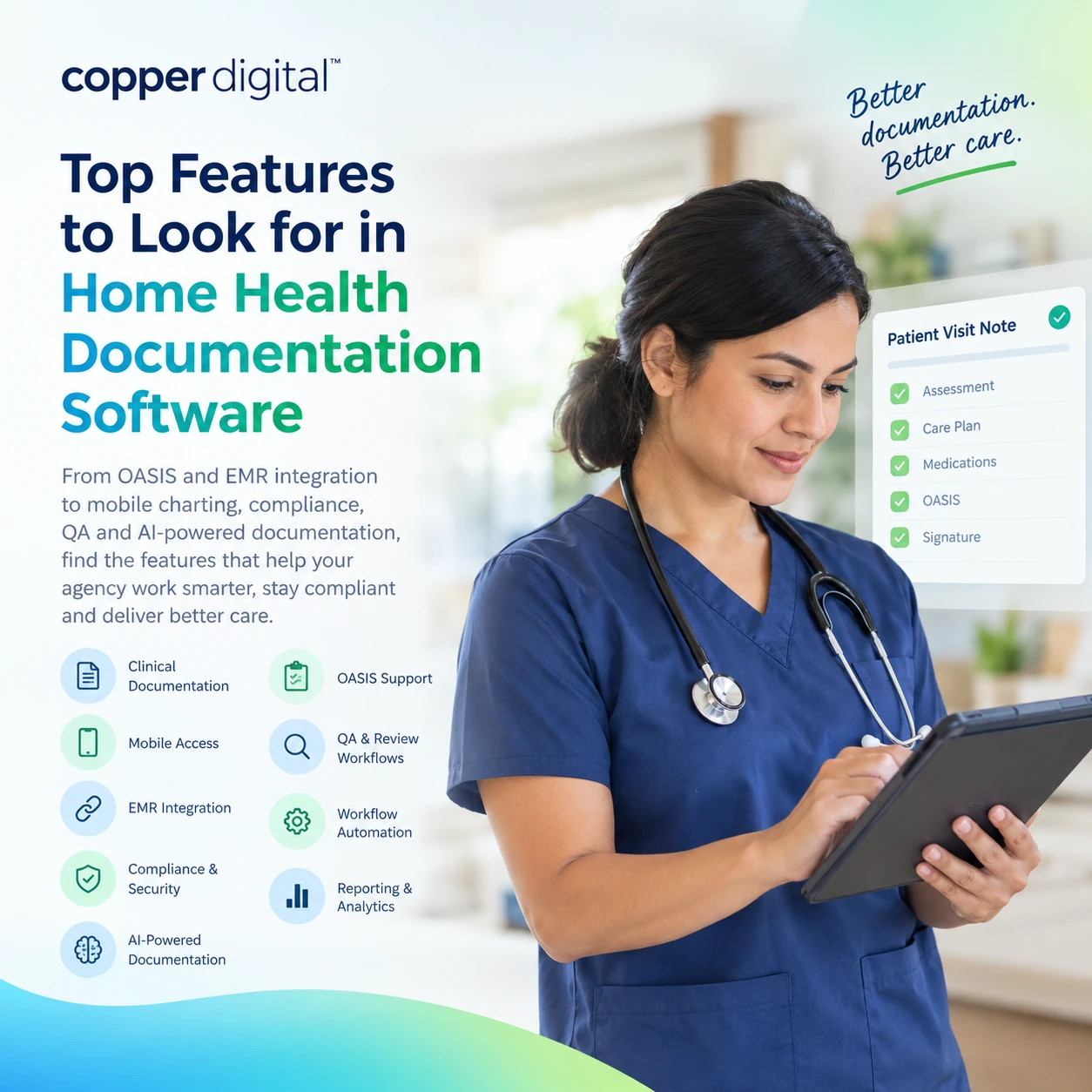
Top Features to Look for in Home Health Documentation Software
A practical guide to evaluating home health documentation software, including OASIS support, mobile charting, EMR integration, QA, security, workflow automation, and clinician-reviewed AI.
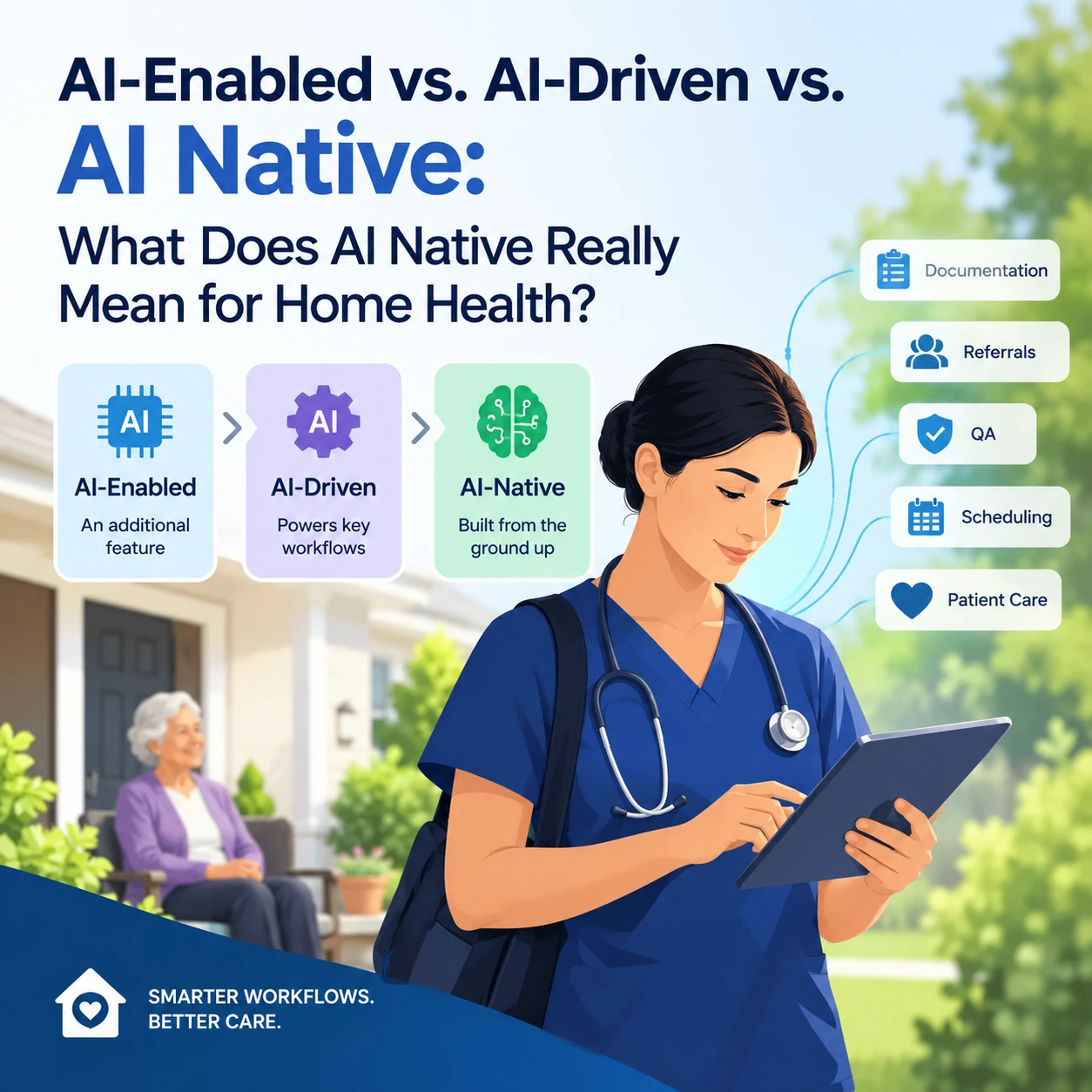
AI-Enabled vs. AI-Driven vs. AI Native: What Does AI Native Really Mean for Home Health?
Understand the difference between AI-enabled, AI-driven, and AI-native home health software—and how to evaluate architecture, connected workflows, governance, and real work reduction.
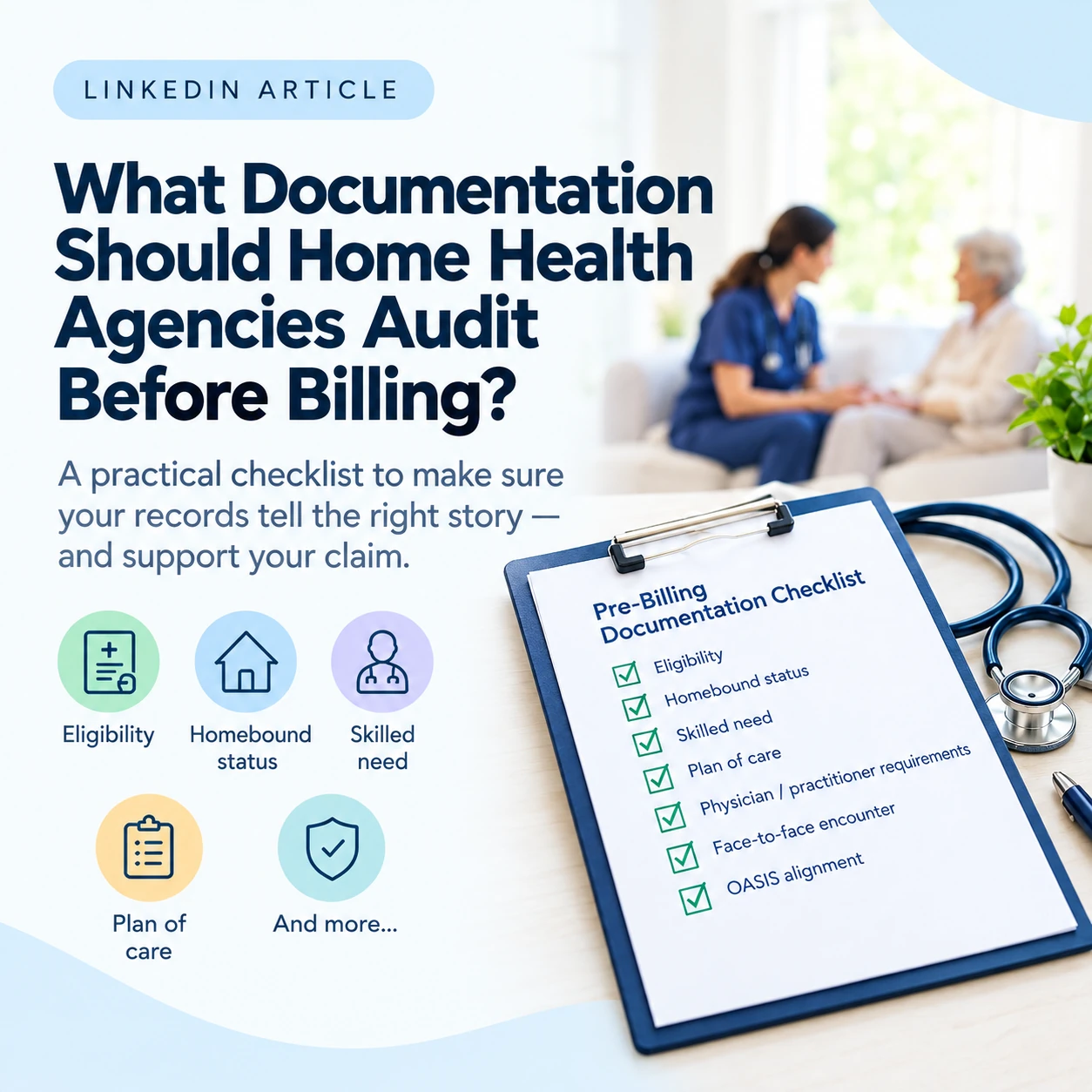
What Documentation Should Home Health Agencies Audit Before Billing?
Before billing, confirm that eligibility, medical necessity, orders, OASIS-E2, coding, and visit documentation tell a consistent story and support the services on the claim.