
PDGM Documentation Strategies for Home Health Agencies
Under PDGM, documentation establishes the clinical picture that supports classification, medical necessity, coding, and payment. This guide breaks down 15 PDGM documentation strategies, a documentation-to-payment framework, weak-vs-strong examples, and a closed-loop workflow to keep charts consistent and audit-ready.
Key Takeaways
- PDGM documentation should create one consistent clinical story from referral through OASIS, Plan of Care, visit notes, coding, and billing.
- The principal diagnosis reported on the claim determines the PDGM clinical grouping.
- OASIS information contributes to the patient's functional impairment level.
- Relevant secondary diagnoses can contribute to a comorbidity adjustment when they meet PDGM criteria.
- Functional documentation should describe actual performance, not simply what the patient could potentially do.
- Every diagnosis used for billing should be supported by appropriate clinical documentation.
- The goal is accurate documentation that captures the patient's condition, not reimbursement maximization.
- CMS reported that insufficient documentation accounted for 51.4% of home health improper payments in the 2024 reporting period.
💡 Quick Answer: PDGM documentation strategy is about telling one consistent clinical story from referral through OASIS, Plan of Care, visit notes, coding, and the claim. Payment is driven by admission source, timing, the principal diagnosis (clinical grouping), OASIS-derived functional level, and qualifying comorbidities, so every part of the chart must support the same picture. The goal isn't more documentation or higher payment; it's accurate, specific, consistent documentation that captures the patient's real condition.
The Patient-Driven Groupings Model (PDGM) fundamentally changed how Medicare home health services are reimbursed. Instead of relying primarily on the number of therapy visits, PDGM uses patient and clinical characteristics to place each 30-day period into a case-mix group. That makes documentation more than a compliance requirement, it establishes the clinical picture that supports the patient's classification, medical necessity, coding, and payment.
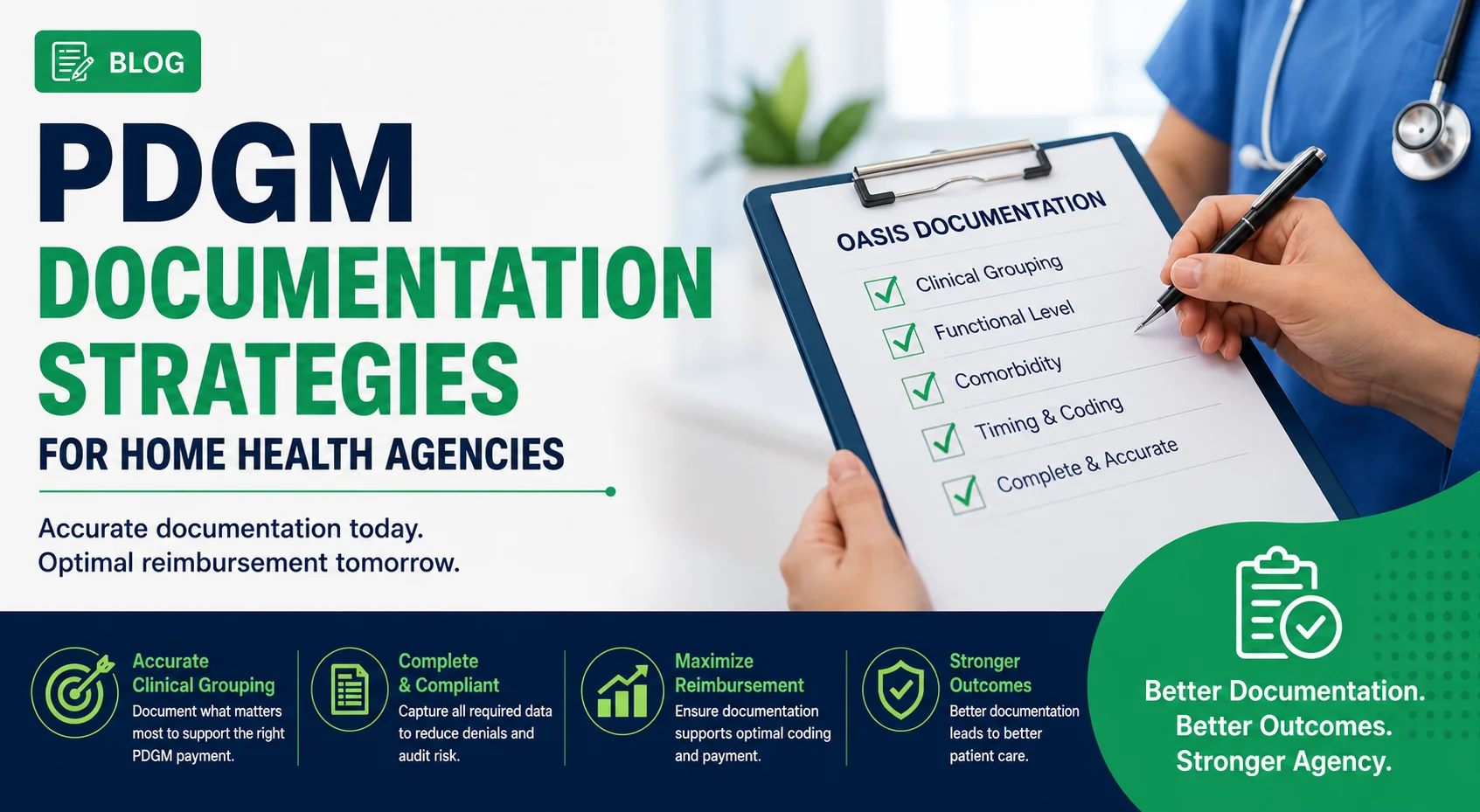
A complete PDGM documentation strategy connects clinical grouping, functional level, comorbidities, timing, and coding into one consistent, audit-ready record.
A complete PDGM documentation strategy connects the whole record into a single clinical story:
➡️ Patient condition → OASIS → Diagnosis → Clinical Grouping → Functional Status → Comorbidities → Plan of Care → Skilled Services → Claim
When those elements tell the same story, agencies are better positioned to support accurate reimbursement and withstand medical review. When they don't, the agency can face rework, payment issues, additional documentation requests, denials, or audit exposure.
📊 CMS 2024 home health improper-payment data: insufficient documentation accounted for 51.4% of improper payments, and medical necessity accounted for another 33.7%, more than four of five improper-payment dollars trace back to documentation.
Understanding How PDGM Uses Documentation
PDGM places every 30-day period into a case-mix group using several major classification factors: (1) admission source (community or institutional), (2) timing (early or late), (3) clinical grouping (determined by the principal diagnosis on the claim), (4) functional impairment level (derived from OASIS), and (5) comorbidity adjustment (based on qualifying secondary diagnoses). PDGM currently uses 432 possible case-mix groups.
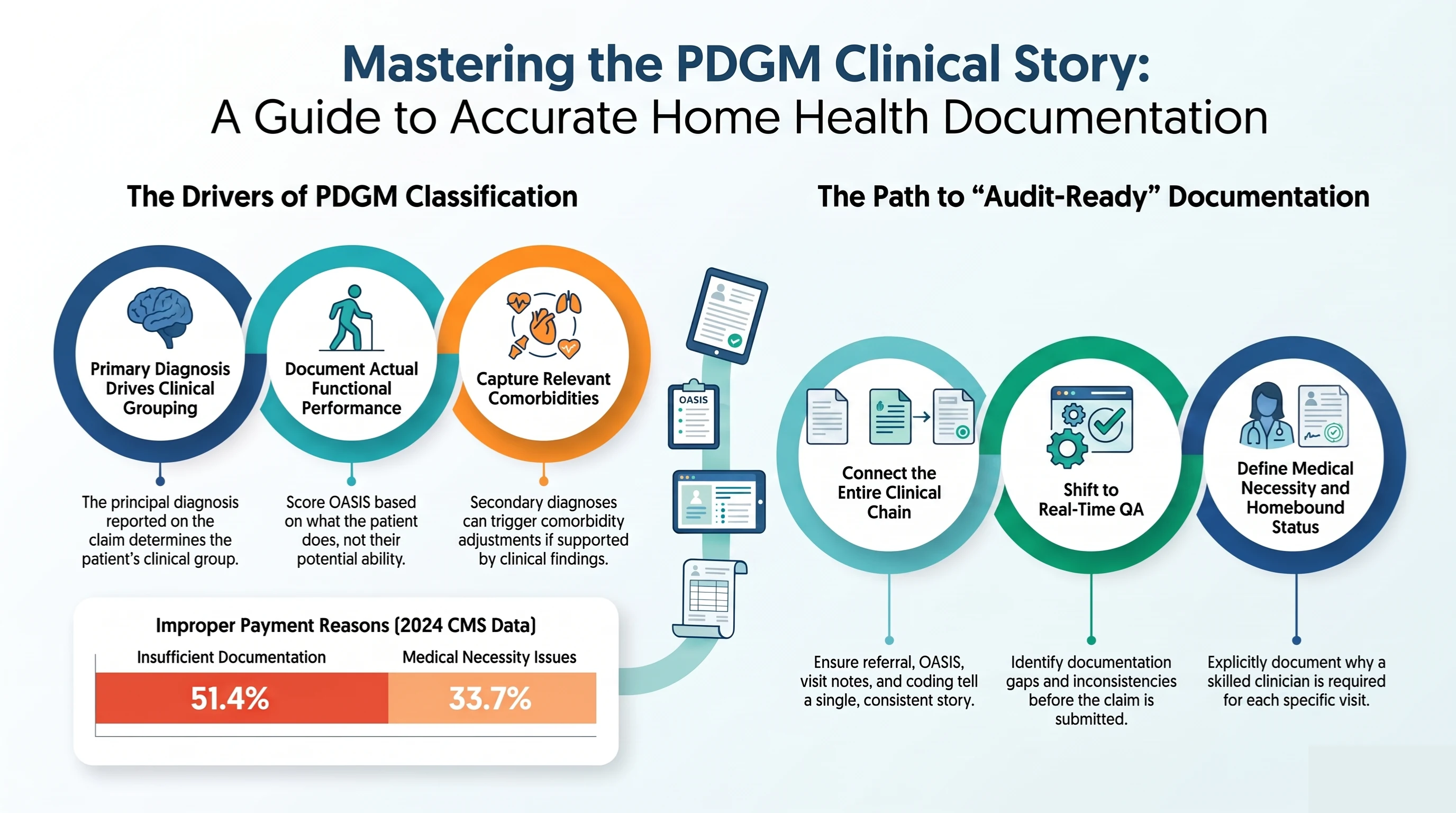
The drivers of PDGM classification and the path to audit-ready documentation, with the CMS 2024 improper-payment breakdown.
The documentation-to-payment framework
| PDGM Factor | Primary Documentation Source | What Agencies Should Focus On |
|---|---|---|
| Admission Source | Claim / episode history | Accurately establish admission circumstances |
| Timing | Claim / episode history | Ensure episode timing is correctly represented |
| Clinical Grouping | Principal diagnosis on claim | Ensure primary diagnosis matches the clinical picture |
| Functional Level | OASIS | Accurately document actual functional performance |
| Comorbidity Adjustment | Secondary diagnoses on the claim | Capture clinically supported qualifying comorbidities |
| Overall Support | Entire medical record | Maintain consistency across the chart |
Strategy #1: Make the Clinical Story Consistent
The strongest PDGM documentation strategy is simple: every part of the chart should tell the same clinical story. A reviewer should be able to move across the record without finding unexplained contradictions:
➡️ Referral → Face-to-Face → OASIS → Plan of Care → Visit Notes → Coding → Claim
Common inconsistencies include OASIS conflicting with the narrative, a primary diagnosis that doesn't match the reason for care, functional scores unsupported by the narrative, visit notes focused on a condition absent from the coding, and a diagnosis on the claim that isn't supported elsewhere. PDGM documentation should be consistent, not unnecessarily repetitive.
Strategy #2: Document the Primary Reason for Home Health
Clinical grouping is based on the principal diagnosis reported on the claim, so it's one of the most important pieces of the documentation and coding workflow. Clinicians and coders should be able to answer: why is this patient receiving home health services? The record should support the primary condition, relevant findings, current problems, the skilled services required, and the relationship between the condition and those services. A useful review question: does the primary diagnosis accurately represent the primary reason this patient is receiving home health care?
Strategy #3: Strengthen Clinical Grouping Documentation
The principal diagnosis determines the PDGM clinical group, areas such as musculoskeletal rehab, neuro/stroke rehab, wounds, surgical aftercare, cardiac and circulatory, endocrine, respiratory, behavioral health, complex nursing, and MMTA. QA should ask: does the principal diagnosis match the clinical picture, does OASIS support the condition, does the Plan of Care address it, do visit notes demonstrate related services, and is the diagnosis supported by clinical findings? A mismatch should trigger review before billing.
Strategy #4: Document Functional Status Based on Actual Performance
Functional impairment is derived from OASIS. The key principle: document what the patient actually does, not simply what the patient could potentially do. Consider actual performance, level of assistance, assistive-device use, safety, mobility, self-care, and transfers. Instead of "patient has difficulty ambulating," document the assistance needs, device use, safety concerns, or distance tolerated. The narrative should support the OASIS responses, and the functional score should make sense against the rest of the chart.
Strategy #5: Capture Comorbidities That Affect Care
PDGM includes a comorbidity adjustment based on secondary diagnoses; a 30-day period can receive no, low, or high adjustment. Not every secondary diagnosis produces an adjustment, but clinically relevant conditions shouldn't be overlooked simply because they aren't the principal diagnosis. For each relevant condition, document the condition, relevant findings, how it affects care, monitoring, treatment, medication management, and added complexity. Ask: how does this condition affect the patient's home health care? The answer should be visible in the record.
Strategy #6: Don't Ignore Admission Source and Timing
PDGM also considers admission source (community vs institutional) and timing (early vs late). Verify where the patient came from, whether the admission follows an institutional stay, whether episode timing is accurate, and whether referral and admission information is consistent. Strong intake processes prevent downstream billing problems.
Strategy #7: Document Medical Necessity Clearly
A diagnosis alone does not explain why skilled home health care is necessary. Strong documentation connects the full chain:
➡️ Condition → Clinical Problem → Skilled Need → Intervention → Response → Plan
Weak: "Patient seen for CHF. Education provided." Stronger documentation establishes the relevant findings, what the clinician assessed or treated, why skilled intervention was required, what was done, how the patient responded, and follow-up. The question to ask: why did this patient require a skilled clinician today?
Strategy #8: Strengthen Homebound Documentation
Homebound status is a fundamental eligibility requirement. Avoid relying only on "patient is homebound" or "limited mobility." Instead, document the circumstances that support the inability to leave home normally and the effort or assistance involved, need for assistance from another person, walker or wheelchair use, significant weakness, shortness of breath, transfer difficulty, safety concerns, and the considerable effort required to leave home.
Strategy #9: Keep the Plan of Care Connected to the Clinical Record
The Plan of Care shouldn't exist separately from the rest of the chart, it should reflect the patient's diagnoses, current condition, skilled needs, goals, interventions, visit frequency, expected outcomes, and changes in condition. Compare it against the OASIS, visit notes, diagnoses, and clinical findings; if those describe substantially different situations, investigate the discrepancy.
Strategy #10: Document Changes in Patient Condition
PDGM documentation should demonstrate the patient's clinical trajectory, avoid making every visit look identical. Look for meaningful changes (improvement, decline, new symptoms, medication changes, new wounds, functional changes, response to treatment) and ask three questions each visit: what changed, what did the clinician do, and how did the patient respond?
Strategy #11: Avoid Copy-Forward Documentation
Templates can improve consistency, but copy-forward documentation creates problems when information is no longer accurate. A note that repeatedly says the patient has the exact same condition, response, and functional status may fail to demonstrate what happened during the current visit. Use templates for structure, not for clinical thinking, and verify current symptoms, findings, medications, functional status, interventions, response, and plan.
Strategy #12: Align Coding With Clinical Documentation
Coding should follow the clinical record, not the other way around. Before finalizing a claim, compare:
➡️ Primary Diagnosis → OASIS → Clinical Narrative → Plan of Care → Services Provided
Then review secondary diagnoses and their clinical support: is the primary diagnosis supported and does it reflect the reason for care, are relevant secondary diagnoses captured and supported, and do the Plan of Care and visit notes demonstrate care related to the diagnoses?
Strategy #13: Build Real-Time OASIS and Documentation QA
Traditional QA often identifies problems after the documentation is complete. A stronger process identifies potential problems while the clinician can still correct them, flagging OASIS/narrative inconsistencies, unsupported functional scores, missing clinical details, potential diagnosis mismatches, and missing skilled-need rationale. The workflow changes from a costly rework loop to a clean one:
➡️ From: Document → Submit → Find Error — To: Document → Identify Gap → Clinician Review → Finalize
Strategy #14: Use a Pre-Bill Documentation Check
Before submitting a claim, verify that the record supports the services billed. Risk-based QA can prioritize charts with potential inconsistencies rather than manually examining every chart the same way. Use a pre-bill checklist:
- Patient eligibility and homebound status supported
- Skilled-need documentation present
- Face-to-face requirements satisfied
- Plan of Care complete
- OASIS consistent with clinical findings and functional scoring supported
- Primary and relevant secondary diagnoses supported
- Clinical grouping makes sense
- Required signatures present and visit documentation complete
- Coding aligns with documentation
Strategy #15: Prepare for ADRs and Audits Before They Happen
A good documentation process should be audit-ready before an ADR arrives. Ask: if Medicare requested this chart tomorrow, could we quickly demonstrate why this patient qualified and why the services billed were medically necessary? With insufficient documentation the largest reported category of improper payments, audit readiness should be built into the normal workflow, not treated as a special project after an ADR arrives.
Weak vs. Stronger PDGM Documentation
The difference between a denial and a defensible claim is usually specificity. A quick comparison:
| Documentation Area | Weak | Stronger |
|---|---|---|
| Skilled need | "Patient seen for CHF. Education provided." | Findings, what was assessed/treated, why skilled care was required, what was done, and the patient's response. |
| Homebound status | "Patient is homebound." | Assistance needed, walker/wheelchair use, weakness, shortness of breath, transfer difficulty, and effort to leave home. |
| Functional status | "Patient has difficulty ambulating." | Actual assistance needs, device use, safety concerns, and distance tolerated, consistent with the OASIS response. |
| Diagnosis / coding | A code listed with no supporting findings. | Diagnosis supported by clinical findings, monitoring, and treatment, matching OASIS, POC, and visit notes. |
Common PDGM Documentation Mistakes That Can Cost Agencies
- Unsupported primary diagnosis (the claim doesn't match the record)
- Missing relevant comorbidities
- Functional scores that don't match the narrative
- Generic skilled-need language
- Weak homebound documentation
- Copy-forward notes that don't reflect the current condition
- A diagnosis without clinical evidence
- OASIS / Plan of Care / visit-note inconsistencies
- Admission source or timing errors
- QA that happens too late, after billing instead of before
How Technology and AI Can Support PDGM Documentation
AI-powered documentation tools can support clinical documentation (voice capture, structured notes, point-of-care capture), OASIS (cross-checking narrative against OASIS, flagging inconsistencies), coding (surfacing relevant diagnoses and gaps), and QA (finding inconsistencies before submission and prioritizing charts). The most effective approach keeps the clinician in control:
➡️ Not: AI decides → Claim gets submitted — Instead: Clinician documents → AI assists → AI identifies potential gaps → Clinician reviews → QA validates → Claim is submitted
AI's bigger opportunity isn't generating notes faster, it's helping capture more complete, consistent information, for example, flagging that a relevant comorbidity appears in the clinical conversation but not the documentation, or that a functional description doesn't align with an OASIS response. These are review prompts, not automatic clinical decisions; the clinician and coding/QA professionals remain responsible. When evaluating vendors, weigh security, privacy, and human oversight, and note you may not need to replace your EMR to improve documentation.
PDGM Documentation and Appropriate Reimbursement
There's an important distinction between appropriate reimbursement and reimbursement maximization. Agencies should never document, score, or code a patient a particular way simply because it could increase payment. The correct objective:
➡️ Accurate documentation → Accurate assessment → Accurate coding → Appropriate PDGM classification → Appropriate reimbursement
If a patient's condition supports a particular classification, the documentation should make that clinical reality clear. If it doesn't, the agency shouldn't attempt to manufacture support after the fact.
How to Build a PDGM Documentation Workflow
A modern, closed-loop documentation workflow, instead of treating documentation as something nurses complete after the real work is finished, looks like this:
- Referral
- Eligibility and clinical review
- Admission source verification
- Face-to-face verification
- SOC / OASIS assessment
- Primary and secondary diagnosis review
- Plan of Care
- Point-of-care documentation
- Functional / OASIS consistency check
- AI-assisted QA
- Human clinical review
- Coding validation
- Pre-bill QA
- Claim submission
- Ongoing monitoring
Final Takeaway
PDGM documentation isn't about writing longer notes, it's about making the patient's clinical story clear, accurate, and consistent. A strong strategy connects the whole chain:
➡️ Admission → Clinical Condition → Primary Diagnosis → Clinical Grouping → Functional Status → Comorbidities → Skilled Need → Plan of Care → Services → Coding → Claim
When those elements align, agencies are better positioned to support appropriate reimbursement, reduce avoidable documentation problems, improve compliance, and respond confidently to medical review. And as CMS continues to update PDGM parameters, including 2026 updates to case-mix weights, functional levels, comorbidity subgroups, and LUPA thresholds, agencies should treat documentation quality as an ongoing operational priority. For related failure points, see why Medicare home health claims get denied and SOC vs ROC vs Recertification.
🚀 Turn documentation into audit-ready claims. Copper Digital's AI Documentation Agent captures the visit by voice, photo, and tap, drafts OASIS and visit notes, and cross-checks OASIS vs narrative, functional scoring, coding, and skilled-need rationale, flagging gaps before billing, with a nurse reviewing and approving every record. Explore AI tools for home health nurses, review your compliance workflows, or book a demo.
📘 Free download: The Home Health Documentation Playbook, a 232-page guide to OASIS-E, Medicare compliance, PDGM, and AI-assisted documentation, with 150+ point-of-care checklists.
Home Health Documentation Playbook
The complete guide to OASIS-E, Medicare compliance, PDGM, and AI-assisted documentation. Learn how top agencies reduce documentation time without sacrificing compliance.
Bottom Line
PDGM documentation strategy comes down to one consistent clinical story: admission source, timing, principal diagnosis (clinical grouping), OASIS-derived functional level, and qualifying comorbidities must all point to the same picture across referral, OASIS, Plan of Care, visit notes, coding, and claim. Build real-time and pre-bill QA into the workflow so gaps are caught before billing, and aim for accurate documentation that captures the patient's real condition, not payment maximization.

Arvind Sarin is the founder of Copper Digital. For the past year he has spent three days a week inside a 500+ census Texas home health agency, building AI documentation that finishes OASIS and visit notes the same day, with a nurse reviewing and approving every note. He writes about home health documentation, OASIS, Medicare compliance, and applying AI responsibly in clinical workflows.
Frequently asked
Frequently asked questions
PDGM documentation is the collection of clinical, assessment, certification, care-plan, coding, and billing records used to support Medicare home health services under the Patient-Driven Groupings Model.
Join the conversation
Leave a comment
Related reading
Why Home Health Agencies Lose Money on Incomplete Visit Notes
An incomplete visit note rarely creates just one problem, it moves downstream into QA rework, billing holds, denials, and audit risk. This guide breaks down the 7 most common documentation gaps, how they drain revenue, and the workflow (frameworks, real-time QA, prompts, and clinician-reviewed AI) that helps nurses finish accurate notes the first time.
Why Medicare Home Health Claims Get Denied
Medicare home health claim denials are revenue leaks, not just billing issues. This guide breaks down the ten most common reasons claims get denied, from OASIS gaps and late NOAs to coding and medical-necessity problems, and how to prevent them to get paid faster.

Common OASIS Documentation Mistakes That Lead to Payment Delays
Common OASIS documentation mistakes, such as incomplete assessments, incorrect diagnosis coding, inaccurate Section GG scoring, medication and homebound-status errors, weak skilled-need documentation, and missing physician signatures, are among the biggest causes of home health payment delays. Because OASIS data drives PDGM reimbursement, most of these errors are preventable with point-of-care charting, strong QA, and AI-powered documentation validation.