
OASIS Documentation Compliance Tips for Home Health Agencies
OASIS compliance isn't just filling in every field, it's making the assessment tell a consistent, clinically supported story that agrees with the rest of the record. This guide covers 12 practical compliance tips, 9 common errors, a pre-submission checklist, what's new in OASIS-E2, and where AI helps (and where it must not).
Key Takeaways
- OASIS compliance means the data accurately reflects the patient's status at the assessment time point and is consistent with the supporting clinical record, not just that every field is filled in.
- Compliant OASIS documentation is accurate, complete, patient-specific, consistent, clinically supported, current, and reviewable.
- Document what you actually assessed, and connect each finding to the skilled service provided and the patient's response.
- Contradictions and copy-forward errors are the easiest problems for a reviewer to find; QA should ask 'does everything agree?' not just 'is it complete?'
- 'Not assessed' is not the same as 'normal', follow item-specific OASIS guidance.
- OASIS-E2 is the current data set, effective April 1, 2026; don't rely on older OASIS materials without checking they still apply.
- AI can organize information and flag gaps, but the clinician must determine and validate the patient's actual clinical status (human-in-the-loop).
💡 Quick Answer: OASIS documentation compliance means ensuring OASIS data accurately reflects the patient's status at the time of assessment and is supported by, and consistent with, the broader clinical record. It isn't just completing every item; the assessment must tell a coherent, clinically credible story about the patient, and align with visit notes, the medication list, the Plan of Care, and physician orders. This matters even more now that OASIS-E2 is the current data set, effective April 1, 2026.
OASIS Documentation Compliance: The Short Answer
OASIS documentation compliance means ensuring that OASIS data accurately reflects the patient's status at the time of assessment and is supported by the broader clinical record. For home health agencies, compliance isn't simply about completing every OASIS item. The assessment needs to tell a consistent, clinically credible story about the patient. That means documentation should accurately capture the patient's:
- Current clinical condition
- Functional status
- Symptoms and risks
- Medications
- Care needs
- Changes from baseline
- Response to interventions
- Need for skilled services
CMS specifically states that encoded OASIS data must accurately reflect the patient's status at the time of assessment. CMS guidance also emphasizes the importance of accurate and complete OASIS data because the information is used for quality reporting and other purposes, including payment-related functions. And this matters even more now that OASIS-E2 is the current OASIS data set, effective April 1, 2026.
What is OASIS Documentation Compliance?
OASIS, or the Outcome and Assessment Information Set, is a standardized assessment used in home health to capture information about patients receiving qualifying home health services. OASIS data supports several functions across the home health system, including quality measurement and reporting. CMS notes that OASIS-based information contributes to quality reports and measures, while certain OASIS data elements are also used in payment-related calculations.
But OASIS shouldn't be viewed as a standalone form. It is part of a much larger clinical documentation ecosystem. A patient's OASIS assessment may need to make sense alongside:
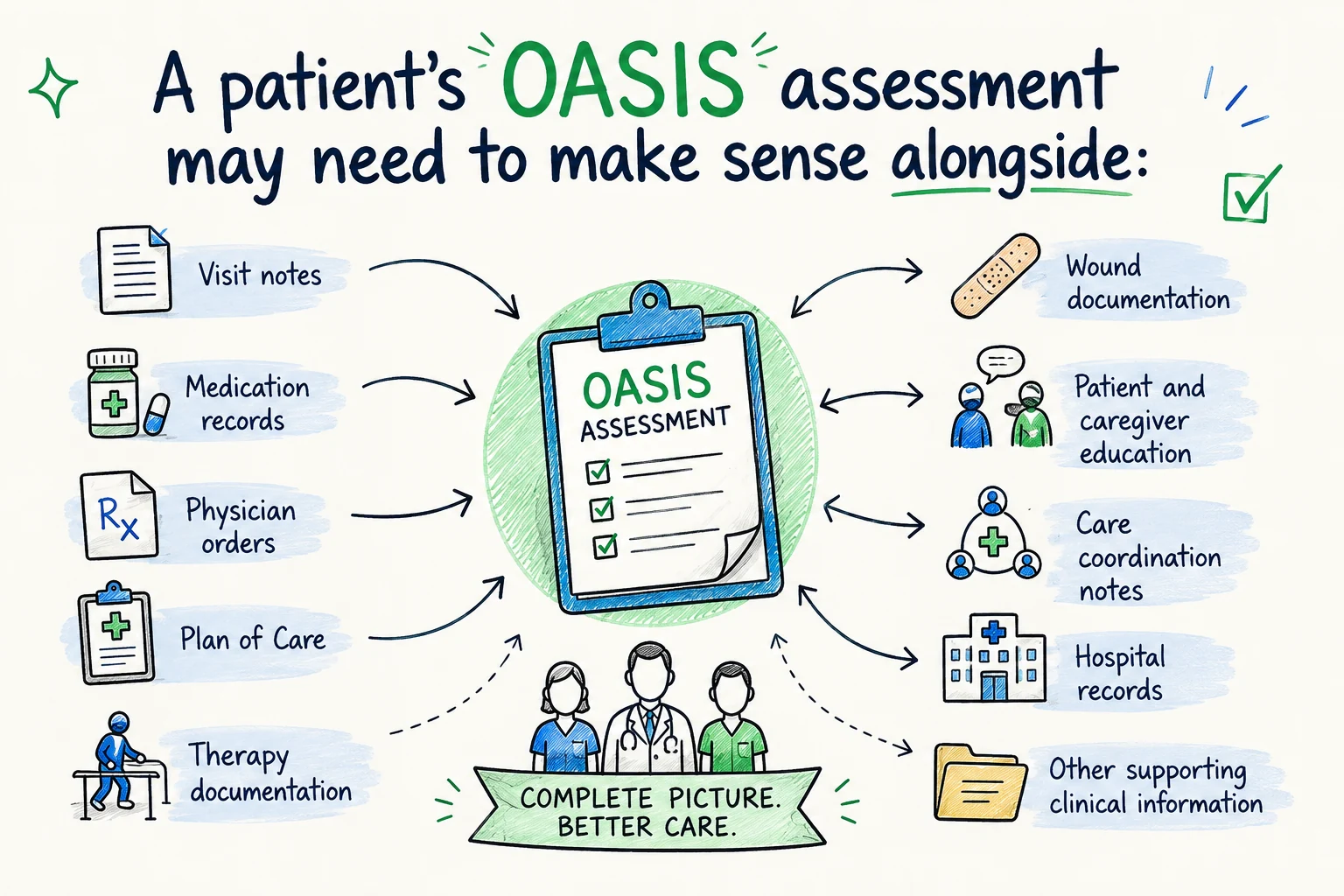
OASIS isn't a standalone form, it has to make sense alongside the rest of the clinical record. Complete picture, better care.
- Visit notes
- Medication records
- Physician orders
- Plan of Care
- Therapy documentation
- Wound documentation
- Patient and caregiver education
- Care coordination notes
- Hospital records
- Other supporting clinical information
When these pieces tell different stories, the agency can have a documentation problem even if every field in the OASIS assessment has been completed.
🎯 The goal is consistency. The OASIS should reflect what the clinician actually assessed, not what the clinician assumes, remembers from a previous visit, or believes the patient probably experiences.
Why OASIS Documentation Compliance Matters
OASIS documentation affects more than administrative completion. It can influence how an agency understands patient needs, monitors outcomes, supports quality improvement, and demonstrates that care was appropriate. CMS describes OASIS data as a foundation for home health quality measurement and notes that agencies receive quality reports that can be used for quality improvement. OASIS-based information also contributes to publicly reported home health quality information. For agencies, poor documentation can create several problems.
1. It can weaken the clinical story
A patient may genuinely require skilled care, but weak documentation may fail to explain why.
2. It can create inconsistencies
An OASIS response may conflict with a visit note, medication list, or functional assessment.
3. It can complicate audits
When reviewers cannot clearly connect assessment findings to the care provided, agencies may face additional scrutiny.
4. It can affect quality reporting
OASIS data contributes to quality measures and reporting.
5. It can increase administrative workload
Errors discovered later often require additional review, clarification, correction, and coordination.
6. It can increase the burden on nurses
The more documentation that has to be corrected or reconstructed later, the more time clinicians spend away from patients.
12 OASIS Documentation Compliance Tips for Home Health
1. Document What You Actually Assess
One of the most important OASIS documentation principles is simple: document what you actually assessed. An OASIS response should be based on the patient's observed or otherwise appropriately assessed status at the relevant time point. Avoid selecting a response because:
- It was selected on the previous assessment.
- It "usually" applies to the patient.
- The referral suggested it.
- Another clinician documented it.
- The patient probably has that limitation.
- It seems like the safest answer.
The clinician should gather the information needed to support the assessment and then select the response that accurately reflects the patient's status. This is especially important when assessing functional abilities. The question isn't "what do I think this patient can probably do?" The question is "what did the assessment establish about this patient's current status?"
2. Make Documentation Patient-Specific
Generic documentation can make it difficult to understand what actually happened during a visit. Compare:
Weak:
Patient tolerated treatment well. Education provided.
Stronger:
Patient demonstrated increased shortness of breath while ambulating from bedroom to kitchen. Oxygen saturation decreased from baseline during activity. Nurse reinforced energy-conservation techniques and instructed patient to rest between activities. Patient verbalized understanding and demonstrated the recommended breathing technique.
The second example provides context. It tells the reader what happened, what the nurse observed, what intervention occurred, and how the patient responded. Patient-specific documentation makes the clinical record easier to understand and review.
3. Keep OASIS Consistent With the Clinical Record
Think of the patient's documentation as one connected story. The OASIS shouldn't say one thing while the visit notes say another. For example:
OASIS: Patient is independent with ambulation. Visit note: Patient requires assistance from caregiver to safely ambulate to bathroom.
That discrepancy should trigger a review. The same principle applies to medication status, wounds, falls, functional limitations, cognitive status, pain, dyspnea, caregiver assistance, ADLs, and skilled interventions. CMS guidance emphasizes OASIS accuracy, and CMS survey guidance states that encoded OASIS data must accurately reflect the patient's status at the time of assessment.
4. Support Clinical Findings With Objective Information
Whenever appropriate, use measurable or observable information. Instead of "patient's wound looks better," consider documenting relevant findings such as wound dimensions, drainage, tissue characteristics, periwound condition, pain, and relevant changes from the previous assessment.
Similarly, instead of "patient seems weaker," describe what was observed: "patient required increased assistance with transfer from chair to standing compared with previous visit." Objective documentation doesn't mean every note needs to become excessively long. It means the documentation should contain enough meaningful information to support the clinical observation.
5. Document Functional Status Clearly
Functional documentation is particularly important in home health because the patient's ability to safely perform activities can directly relate to care needs. Don't simply write "needs assistance with bathing." Explain the relevant circumstances. For example: "patient requires caregiver assistance with bathing due to decreased standing tolerance and difficulty safely transferring into the shower." This provides considerably more clinical context. When documenting functional status, consider:
- What the patient can do independently
- What requires supervision
- What requires assistance
- What type of assistance is needed
- Why assistance is required
- Whether the ability has changed
6. Don't Confuse "Not Assessed" With "Normal"
One documentation mistake is assuming that if something wasn't observed or assessed, it can simply be treated as normal. Those are not the same thing. Normal implies that an assessment established a normal finding. Not assessed means the information wasn't obtained. Clinicians should follow the applicable OASIS guidance and item-specific instructions when determining the appropriate response. This distinction is one reason standardized OASIS training matters. CMS provides an OASIS guidance manual specifically to help agencies collect accurate data, including general conventions and item-specific guidance.
7. Document Changes From the Patient's Baseline
Home health clinicians often develop a detailed understanding of what is normal for a particular patient. That makes changes especially important. Consider a patient who has been receiving services for several weeks. The nurse notices the patient is less mobile, appetite has decreased, the patient is more confused, the caregiver reports a change in behavior, or the patient becomes short of breath with less activity. These changes may be clinically meaningful even when an individual vital sign isn't dramatically abnormal. Documentation should make the change understandable. A useful structure is:
➡️ Previous status → Current status → Clinical significance → Intervention → Response → Plan
This helps establish the progression of the patient's condition.
8. Connect Findings to Skilled Care
One of the most important questions a reviewer should be able to answer is: why did this patient require the skilled service that was provided? The documentation should connect assessment findings to clinical action. For example:
➡️ Assessment: Patient has difficulty managing newly prescribed insulin regimen. → Clinical concern: Patient unable to accurately describe dosing schedule. → Skilled intervention: Nurse provided medication education and demonstrated administration technique. → Response: Patient performed return demonstration with verbal prompting. → Plan: Continue education and reassess technique during next visit.
This is much stronger than "diabetic teaching completed." The goal isn't to write more. The goal is to connect the dots.
9. Avoid Contradictions Across Documentation
Contradictions are among the easiest problems for an internal QA reviewer to identify. Look for inconsistencies involving OASIS responses, visit narratives, medication lists, functional status, wound measurements, pain, cognition, caregiver support, hospitalizations, and physician orders. A QA process should not only ask "is the note complete?" It should also ask "does everything agree?" A documentation record can be complete and still be internally inconsistent.
10. Avoid Cloning Previous Documentation
Copy-forward functionality can save time, but it can also introduce errors when information is no longer current. For example, "patient denies pain" may have been accurate last week. If the patient reports significant pain today and the old statement remains in the note, the record becomes internally inconsistent. Before carrying forward information, clinicians should verify that it remains accurate. A useful rule is: copy structure, not facts. The structure of a note can remain consistent. The patient's clinical information needs to remain current.
11. Review OASIS Documentation Before Submission
A strong QA process doesn't wait for an audit to discover documentation problems. Agencies can establish internal review processes that look for missing information, contradictory responses, unsupported findings, documentation inconsistencies, functional status discrepancies, medication discrepancies, and unclear skilled rationale. CMS has specifically recommended that HHAs develop internal systems for monitoring OASIS data accuracy, including activities such as clinical record audits and data-entry audits. A practical review process can ask:
- Does the OASIS reflect the patient?
- Does the clinical record support the OASIS?
- Does the Plan of Care make sense based on the assessment?
- Does the visit documentation support the services provided?
12. Train Nurses on the "Why," Not Just the "What"
OASIS training shouldn't become a memorization exercise. Nurses need to understand the clinical reasoning behind the assessment. Instead of teaching "select this response when X happens," teach "what are you actually assessing, and what evidence supports your response?" This encourages clinicians to think about the patient's baseline, current condition, functional ability, clinical findings, risk, changes, and care needs. CMS maintains OASIS resources and designated OASIS Education Coordinators to support training on administration of the OASIS instrument and integration into agency record systems.
Common OASIS Documentation Errors to Watch For
Even well-trained clinicians can make documentation mistakes when workloads are high. Some recurring problem areas include:
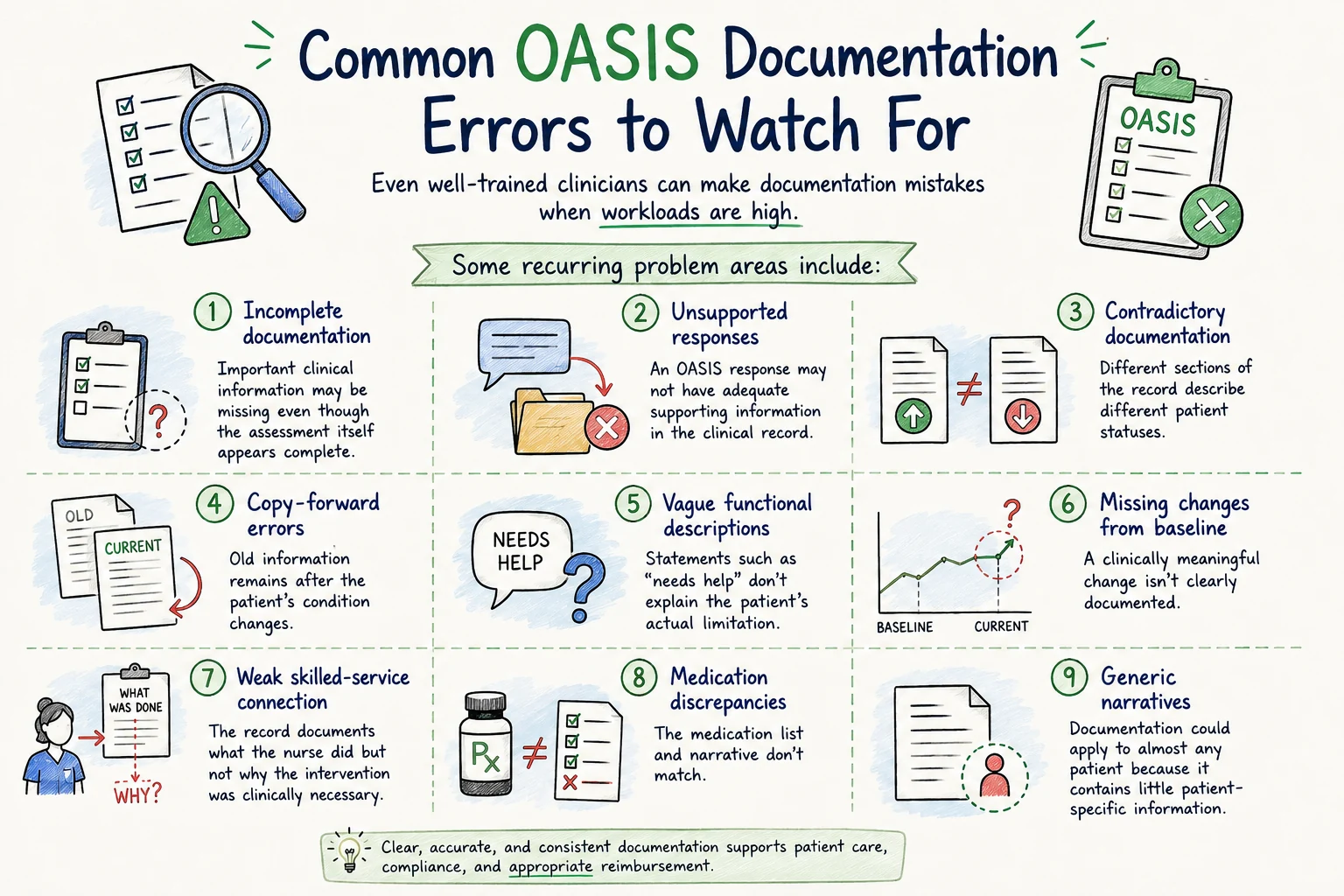
Nine recurring OASIS documentation errors, clear, accurate, consistent documentation supports care, compliance, and appropriate reimbursement.
- Incomplete documentation — important clinical information may be missing even though the assessment itself appears complete.
- Unsupported responses — an OASIS response may not have adequate supporting information in the clinical record.
- Contradictory documentation — different sections of the record describe different patient statuses.
- Copy-forward errors — old information remains after the patient's condition changes.
- Vague functional descriptions — statements such as "needs help" don't explain the patient's actual limitation.
- Missing changes from baseline — a clinically meaningful change isn't clearly documented.
- Weak skilled-service connection — the record documents what the nurse did but not why the intervention was clinically necessary.
- Medication discrepancies — the medication list and narrative don't match.
- Generic narratives — documentation could apply to almost any patient because it contains little patient-specific information.
OASIS Documentation Compliance Checklist
Before finalizing an OASIS assessment, ask:
| Area | Before finalizing, confirm |
|---|---|
| Patient accuracy | Does the assessment accurately reflect the patient's current status? |
| Clinical support | Are important responses supported by assessment findings? |
| Functional status | Are functional abilities and limitations clearly documented? |
| Changes | Are meaningful changes from baseline identified? |
| Consistency | Does the OASIS agree with the clinical record? |
| Medications | Has medication information been reviewed and reconciled appropriately? |
| Skilled care | Does the documentation explain the clinical need for skilled services? |
| Care plan | Is the Plan of Care consistent with the patient's assessed needs? |
| Quality review | Has the assessment been reviewed for omissions and contradictions? |
| Final validation | Has the clinician reviewed and validated the information before finalization? |
How AI Can Support OASIS Documentation Compliance
AI is increasingly being used to reduce the administrative burden associated with clinical documentation. But there's an important distinction: AI should support documentation, not manufacture clinical information. A well-designed AI documentation workflow can potentially help clinicians capture information through voice, organize clinical observations, structure narratives, identify potential documentation gaps, detect inconsistencies, reduce repetitive writing, prepare documentation for review, and reduce time spent finishing charts.
For example, a nurse might provide a voice-based summary of a visit. AI can organize that information into a structured draft. The system might then identify a potential gap: "the documentation describes a change in mobility, was an intervention or patient response documented?" The nurse can then determine whether additional information is appropriate. That's fundamentally different from an AI system simply inventing an answer. (For more on this, see AI vs. ambient scribe for home health nurses.)
AI Should Not Determine Clinical Answers for the Nurse
This distinction is particularly important for OASIS. AI can help organize information, identify potential gaps, and make documentation easier to review. But the clinician remains responsible for determining the patient's actual clinical status. A safe workflow is:
➡️ Nurse assesses patient → Nurse provides clinical information → AI structures documentation → AI identifies potential gaps or inconsistencies → Nurse reviews → Nurse corrects or rejects AI-generated content → Nurse validates final documentation
This is the human-in-the-loop model. The technology assists the clinician without taking ownership of clinical judgment.
OASIS-E2: What Agencies Need to Know
One important update for anyone reading an older OASIS compliance article: OASIS-E2 is now the current OASIS data set. CMS states that the final OASIS-E2 instruments became effective April 1, 2026, replacing the previous OASIS-E1 version. CMS also provides the final OASIS-E2 Guidance Manual and Questions & Answers. Agencies should therefore avoid relying on older OASIS materials without checking whether the guidance and item set remain applicable. CMS's current OASIS resources include:
- OASIS-E2 instruments
- OASIS-E2 Guidance Manual
- OASIS-E2 Q&As
- Data specifications
- Change tables
- Error message references
- Quarterly Q&As
CMS also maintains an OASIS User Manuals page and QTSO provides current HHA reference materials. Best practice: make CMS's current OASIS resources part of your agency's documentation and QA workflow rather than relying exclusively on static training materials. (For a primer, see OASIS-E1 vs. OASIS-E2 and our OASIS-E guide.)
OASIS Compliance is About More Than Completing the Assessment
One of the biggest misconceptions about OASIS documentation is that compliance means "every field is filled out." That's only the beginning. A strong OASIS assessment should contribute to a coherent clinical story. Think of the documentation as a chain:
🔗 Patient condition → Assessment → Clinical findings → Care needs → Skilled intervention → Patient response → Plan
When those pieces connect, the documentation becomes much easier for another clinician, reviewer, auditor, or surveyor to understand. (Many of these gaps overlap with the most common gaps in home health visit notes and PDGM documentation strategy.)
The Future of OASIS Documentation: Less Administrative Work, More Clinical Focus
Home health documentation isn't going away. The need for accurate clinical information isn't going away either. What can change is how much time nurses spend producing that information. AI can potentially reduce repetitive administrative work while helping agencies build stronger documentation workflows. The goal shouldn't be "get nurses to document faster." The better goal is "give nurses more time to assess, think, communicate, and care, while making documentation easier to complete accurately." That distinction matters, because a nurse shouldn't have to choose between being fully present with a patient and keeping up with documentation. (Documentation burden is also a major driver of nurse burnout.)
Final Takeaway
OASIS documentation compliance starts with accuracy, but it doesn't end there. Home health agencies should build documentation workflows that encourage clinicians to assess the patient accurately, document what they actually observe, use patient-specific information, clearly describe functional status, capture meaningful changes from baseline, connect findings to skilled interventions, maintain consistency across the clinical record, avoid copy-forward errors, review documentation before submission, stay current with CMS OASIS guidance, use QA to identify recurring documentation problems, and use technology to reduce administrative burden without replacing clinical judgment.
The strongest documentation isn't necessarily the longest documentation. It's the documentation that makes the patient's clinical story clear.
Home Health Documentation Playbook
The complete guide to OASIS-E, Medicare compliance, PDGM, and AI-assisted documentation. Learn how top agencies reduce documentation time without sacrificing compliance.
Bottom Line
OASIS documentation compliance starts with accuracy but doesn't end there: the OASIS must tell a consistent, clinically supported story that agrees with the visit notes, medication list, Plan of Care, and orders, reflects the patient's current status (under OASIS-E2, effective April 1, 2026), and connects findings to skilled care. Build QA that checks for contradictions and copy-forward errors, train nurses on the clinical 'why,' and use AI to reduce administrative burden, never to determine or fabricate clinical answers.

Arvind Sarin is the founder of Copper Digital. For the past year he has spent three days a week inside a 500+ census Texas home health agency, building AI documentation that finishes OASIS and visit notes the same day, with a nurse reviewing and approving every note. He writes about home health documentation, OASIS, Medicare compliance, and applying AI responsibly in clinical workflows.
Frequently asked
Frequently asked questions
OASIS documentation compliance means ensuring that OASIS data accurately reflects the patient's status at the applicable assessment time point and is consistent with the supporting clinical record. CMS specifically states that encoded OASIS data must accurately reflect the patient's status at the time of assessment.
Join the conversation
Leave a comment
Related reading
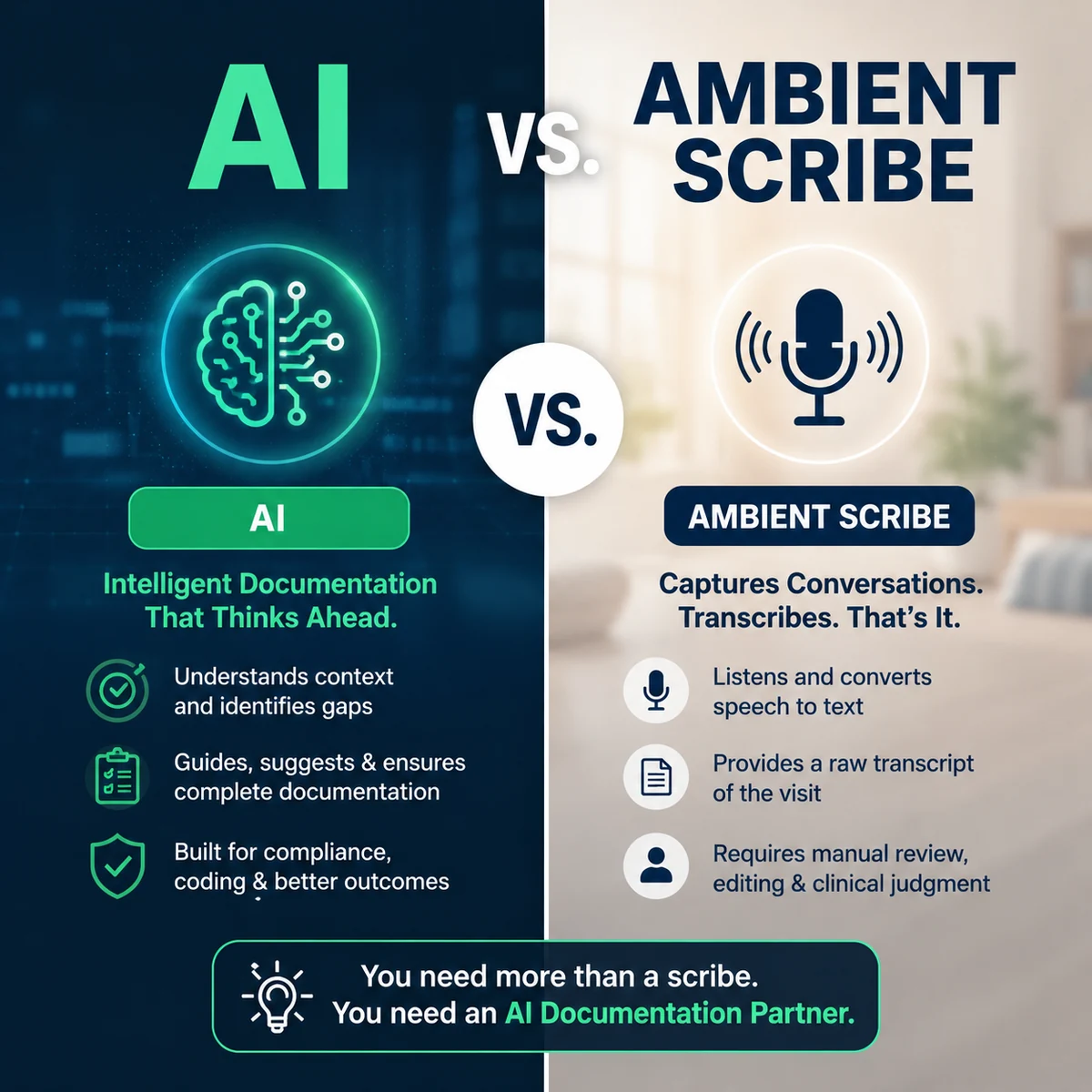
AI vs. Ambient Scribe for Home Health Nurses: What's the Difference?
An ambient scribe listens and drafts a note from the conversation; AI documentation supports a broader capture-to-approval workflow. This guide breaks down the difference, why it matters more in home health (where much of the clinical story is observed, not spoken), a side-by-side comparison, OASIS considerations, and the questions to ask AI vendors.
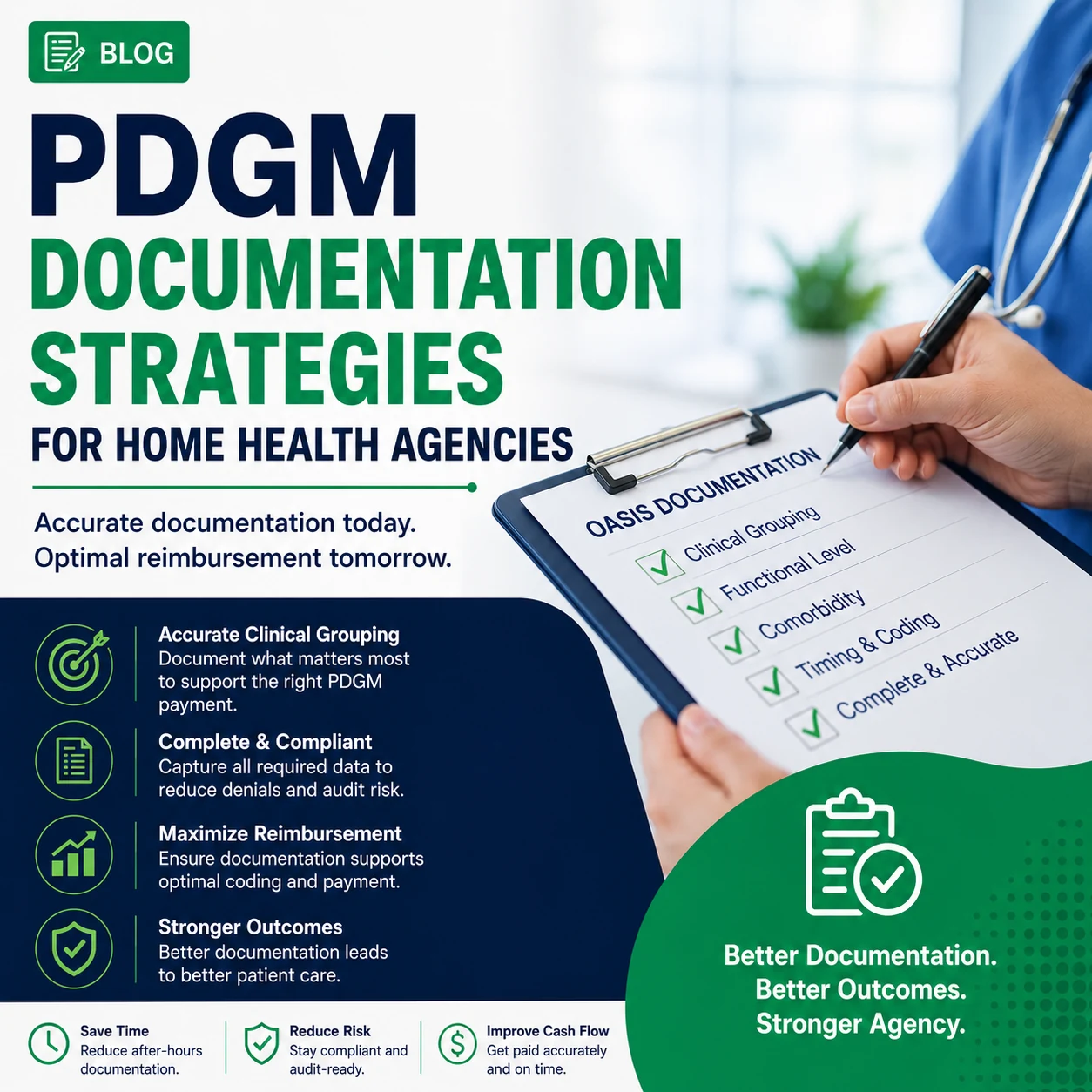
PDGM Documentation Strategies for Home Health Agencies
Under PDGM, documentation establishes the clinical picture that supports classification, medical necessity, coding, and payment. This guide breaks down 15 PDGM documentation strategies, a documentation-to-payment framework, weak-vs-strong examples, and a closed-loop workflow to keep charts consistent and audit-ready.
What Is OASIS-E? The Complete Guide for Home Health Agencies (2026)
OASIS-E is the CMS-required standardized assessment behind home health reimbursement, quality, and compliance. This complete guide covers what OASIS-E is, how it differs from D1/E1/E2, the five assessment time points, Section GG, PDGM impact, and documentation best practices.