
AI vs. Manual Charting in Home Health: An Honest Comparison
Manual charting has been the home health standard for decades, but AI-assisted documentation is changing how notes get done. This honest comparison weighs both across time, accuracy, compliance, cost, clinician experience, and patient care, and explains why the best workflows combine AI efficiency with clinician judgment.
Key Takeaways
- Manual charting gives clinicians full control but is time-consuming and relies on memory, often pushing work after hours.
- AI-assisted charting drafts structured documentation for clinician review, improving speed, consistency, and completeness.
- AI supports clinical judgment, it does not replace it: every note is reviewed and approved by the clinician before submission.
- Beyond software cost, manual charting carries hidden costs like overtime, rework, delayed billing, denials, and burnout.
- AI delivers the most value for agencies with high SOC and patient volumes that want less after-hours charting and better consistency.
- For most agencies the future isn't AI or manual charting, but a thoughtful combination of both.
💡 Quick Answer: AI-assisted charting and manual charting each have a place in home health. Manual charting gives clinicians full control but is time-consuming and relies on memory; AI-assisted charting drafts structured documentation for clinician review, improving speed, consistency, and completeness. The strongest approach combines AI efficiency with clinician judgment, with a nurse reviewing and approving every note before submission.
Documentation has always been at the heart of home health care. Every visit note, assessment, and OASIS response tells the patient's story, supports medical necessity, and ensures agencies receive appropriate reimbursement.
But how documentation gets completed is changing.
For decades, manual charting has been the standard. Today, AI-assisted documentation is helping agencies reduce administrative work, improve documentation consistency, and give clinicians more time for patient care.
So, which approach is better?
The answer isn't simply AI versus humans. The most effective documentation combines the efficiency of AI with the clinical expertise and judgment of experienced healthcare professionals.
In this guide, we'll compare AI-assisted documentation and manual charting across the areas that matter most to home health agencies: time, accuracy, compliance, cost, clinician experience, and patient care.
The Current State of Home Health Documentation
Manual charting has served home health agencies for decades. Clinicians complete patient visits and then document their findings—sometimes immediately after the visit, but often later in the day or after regular working hours.
While this approach is familiar, it presents several challenges.
Documentation completed hours after a visit may rely on memory rather than real-time observations. Administrative work often extends into evenings, contributing to clinician fatigue and burnout. Delays in documentation can also slow billing, increase quality assurance workloads, and create additional compliance challenges.
AI-assisted documentation introduces a different workflow.
Instead of relying solely on manual data entry, AI helps organise information collected during or immediately after the patient encounter, generating structured documentation that clinicians review, edit if needed, and approve before submission.
The goal is not to replace clinicians—it's to reduce repetitive administrative tasks while supporting more complete and consistent documentation.
What is Manual Charting?
Manual charting is the traditional process in which clinicians create clinical documentation themselves. This typically includes:
- Visit notes
- OASIS assessments
- Care plans
- Medication documentation
- Progress notes
- Discharge summaries
Documentation may be completed during the visit, between visits, or after the workday has ended. Although manual charting provides clinicians with complete control over their documentation, it can also be one of the most time-consuming aspects of home health care.
What is AI-Assisted Charting?
AI-assisted charting uses artificial intelligence to help clinicians document patient encounters more efficiently. Depending on the solution, AI may:
- Convert voice conversations into structured documentation
- Generate visit notes
- Organise OASIS documentation
- Suggest ICD-10 diagnosis codes
- Identify missing documentation
- Flag inconsistencies before submission
- Recommend care goals or interventions
Importantly, AI supports the clinician—it does not replace clinical judgment. Every AI-generated note should be reviewed and approved by the clinician before becoming part of the patient's permanent medical record.
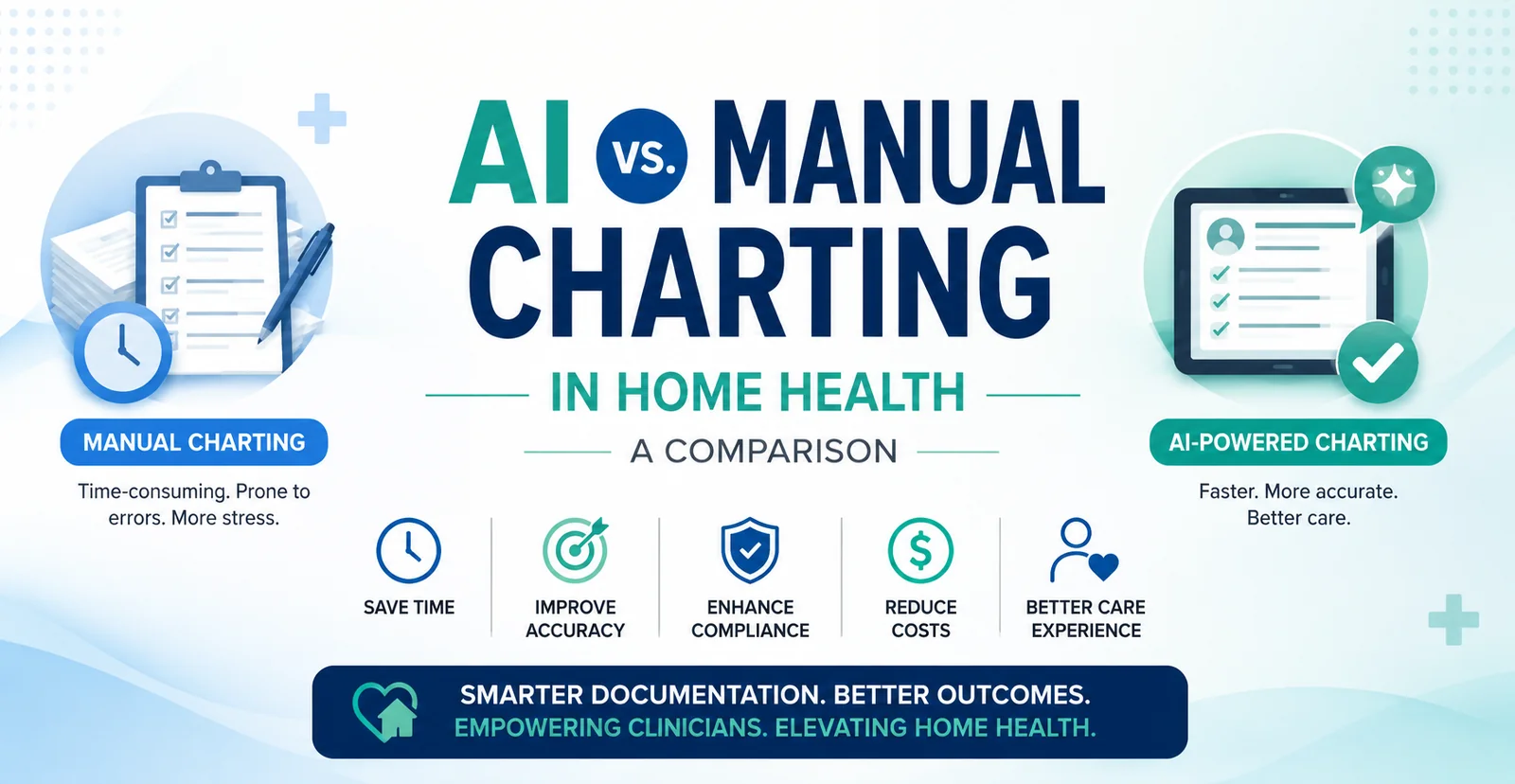
Manual charting: time-consuming, error-prone, more stress. AI-powered charting: faster, more accurate, better care, with the clinician still in control.
AI vs. Manual Charting: Side-by-Side Comparison
| Feature | Manual Charting | AI-Assisted Charting |
|---|---|---|
| Documentation Time | Often requires significant time after patient visits | Generates draft documentation for clinician review, reducing manual entry |
| Accuracy | Depends on documentation habits and memory | Helps organise information consistently while still requiring clinician validation |
| Documentation Completeness | May vary between clinicians | Can identify missing documentation and required fields |
| Compliance Support | Manual review required | Can flag documentation gaps and inconsistencies before submission |
| OASIS Documentation | Completed manually | Can assist with organisation and completeness |
| ICD-10 Coding | Manual code selection | May suggest codes based on documented clinical information |
| Quality Assurance | More manual review and rework | May reduce rework through earlier identification of documentation issues |
| Clinician Experience | Greater administrative burden | Reduced repetitive documentation tasks |
| Patient Interaction | Documentation may reduce face-to-face time | Less administrative work may allow greater focus on patient care |
Time Efficiency: Where AI Can Make the Biggest Difference
Documentation is one of the most time-intensive responsibilities in home health, particularly during Start of Care (SOC) visits and OASIS assessments.
With manual charting, clinicians often spend additional time after each visit completing documentation, organising notes, and preparing records for submission. When this work extends beyond scheduled hours, it can contribute to overtime and documentation fatigue.
AI-assisted documentation streamlines this process by creating structured documentation from clinician inputs such as voice recordings or guided documentation workflows. Instead of writing every note from scratch, clinicians review, edit where necessary, and approve the documentation.
Although the amount of time saved varies by workflow and implementation, reducing repetitive documentation tasks can improve productivity and help clinicians spend more time with patients rather than paperwork.
Accuracy: Reducing the Memory Gap
One of the biggest limitations of manual charting is reliance on memory. When clinicians document multiple visits at the end of the day, subtle observations, patient comments, and assessment findings may be forgotten or recorded with less precision.
This "memory gap" can affect documentation quality. AI-assisted documentation helps minimise this challenge by organising information closer to the point of care.
For OASIS assessments, documenting functional status, mobility, cognitive observations, and skilled interventions as close to the visit as possible can improve documentation accuracy and consistency. Regardless of how documentation is created, clinicians remain responsible for confirming that every note accurately reflects the patient's condition.
Compliance and Audit Readiness
Strong documentation supports more than reimbursement—it helps agencies demonstrate compliance with Medicare requirements. Manual documentation quality often varies between clinicians, creating inconsistencies that require additional quality assurance review.
AI-assisted documentation can help standardise documentation by:
- Prompting for required documentation elements
- Identifying incomplete sections
- Highlighting inconsistencies
- Supporting documentation completeness
- Encouraging consistent documentation practices
While AI can support compliance, agencies remain responsible for ensuring that documentation accurately reflects the services provided and meets Medicare documentation requirements.
Looking Beyond Software Costs
Comparing AI and manual charting isn't simply about the cost of software. Manual documentation also carries indirect operational costs, including:
- After-hours documentation
- Clinician overtime
- Administrative rework
- Additional quality assurance reviews
- Delayed billing
- Claim denials caused by incomplete documentation
- Staff burnout and turnover
AI-assisted documentation introduces implementation and subscription costs but may reduce many of these hidden expenses by improving documentation efficiency and consistency. Each agency should evaluate both direct and indirect costs when considering documentation technology.
Clinician Experience and Retention
Documentation burden is consistently identified as one of the leading contributors to clinician burnout in home health. Many clinicians enter the profession to care for patients, yet spend a significant portion of their day completing paperwork.
Reducing repetitive documentation tasks may improve:
- Work-life balance
- Job satisfaction
- Documentation confidence
- Time available for patient care
- Long-term clinician retention
For agencies facing staffing shortages, improving the documentation experience can become an important recruitment and retention strategy.
Patient Care: More Time Where It Matters
Every minute spent documenting is a minute that cannot be spent interacting with patients. When documentation becomes more efficient, clinicians may have more opportunities to:
- Educate patients and caregivers
- Observe subtle clinical changes
- Answer patient questions
- Strengthen therapeutic relationships
- Focus on clinical decision-making
Technology should support—not replace—the human connection that defines quality home health care.
When Manual Charting Still Makes Sense
Manual charting continues to be appropriate in several situations, including:
- Complex or unusual clinical cases
- Agencies with limited technology infrastructure
- Organisations transitioning to digital workflows
- Clinicians who prefer traditional documentation methods while adapting to new technology
For some agencies, a hybrid approach that combines manual documentation with AI-assisted workflows may provide the greatest flexibility.
When AI Delivers the Greatest Value
AI-assisted documentation often provides the greatest benefits for agencies that:
- Complete large numbers of Start of Care visits
- Manage high patient volumes
- Want to reduce after-hours documentation
- Need greater documentation consistency
- Are focused on reducing clinician burnout
- Want to strengthen compliance workflows
- Are looking to improve operational efficiency
The greatest value comes when AI is integrated into existing clinical workflows and supports—not disrupts—the clinician's work.
Choosing the Right Documentation Approach
There is no universal solution for every home health agency. Manual charting offers familiarity and complete clinician control. AI-assisted documentation offers opportunities to reduce administrative burden, improve consistency, and streamline documentation workflows.
Rather than replacing clinicians, AI works best as a documentation assistant. Clinicians continue to assess patients, make clinical decisions, validate documentation, and ensure compliance. AI helps reduce repetitive administrative work, allowing healthcare professionals to spend more time on what matters most—delivering high-quality patient care.
For many agencies, the future isn't AI or manual charting—it's a thoughtful combination of both.
Manual charting has supported home health care for decades, but it also contributes to administrative burden, documentation variability, and after-hours work.
AI-assisted documentation offers an opportunity to streamline charting, improve consistency, support compliance, and reduce repetitive tasks while keeping clinicians in control of the final documentation.
The strongest documentation workflows don't replace clinical expertise—they enhance it. By combining AI with clinician judgment, home health agencies can improve operational efficiency, strengthen documentation quality, and allow clinicians to spend more time where they have the greatest impact: caring for patients.
🚀 See AI-assisted charting with the clinician in control. Copper Digital's AI Documentation Agent captures the visit by voice, photo, or tap and drafts notes and OASIS-E in real time, flagging gaps and inconsistencies, with a nurse reviewing and approving every record before it reaches billing. Explore AI tools for home health nurses, or book a demo.
🎓 Go deeper with peers. Join our Home Health Mastermind Skool community for training on AI documentation, OASIS accuracy, ICD-10 coding, and reducing charting burden.
Home Health Documentation Playbook
The complete guide to OASIS-E, Medicare compliance, PDGM, and AI-assisted documentation. Learn how top agencies reduce documentation time without sacrificing compliance.
Bottom Line
AI vs. manual charting in home health is not really an either-or: manual charting offers control but is slow and memory-dependent, while AI-assisted charting drafts documentation for clinician review to save time and improve consistency. The strongest approach combines AI efficiency with clinician judgment, with a nurse approving every note.

Arvind Sarin is the founder of Copper Digital. For the past year he has spent three days a week inside a 500+ census Texas home health agency, building AI documentation that finishes OASIS and visit notes the same day, with a nurse reviewing and approving every note. He writes about home health documentation, OASIS, Medicare compliance, and applying AI responsibly in clinical workflows.
Frequently asked
Frequently asked questions
AI can improve documentation efficiency, consistency, and completeness, while manual charting provides complete clinician control. Many agencies find the best results by combining AI assistance with clinician review and approval.
Join the conversation
Leave a comment
Related reading
Home Health Documentation Workflow: What Actually Slows Nurses Down?
Home health documentation is one of the biggest administrative burdens clinicians carry, but it is rarely slow for the reasons people assume. The problem usually isnt the nurse, its the workflow surrounding the note: medication reconciliation, OASIS, duplicate entry across disconnected systems, interruptions, and after-hours charting. Here is what actually slows nurses down and how to fix it.

The Biggest Documentation Challenges Home Health Nurses Face
Home health nurses face heavy documentation challenges: delayed point-of-care charting, excessive administrative time, clunky EHRs, OASIS complexity, strict reimbursement rules, working in isolation, endless QA corrections, and after-hours charting that drives burnout. Reducing documentation burden is now essential for clinician retention, patient outcomes, and agency financial performance.
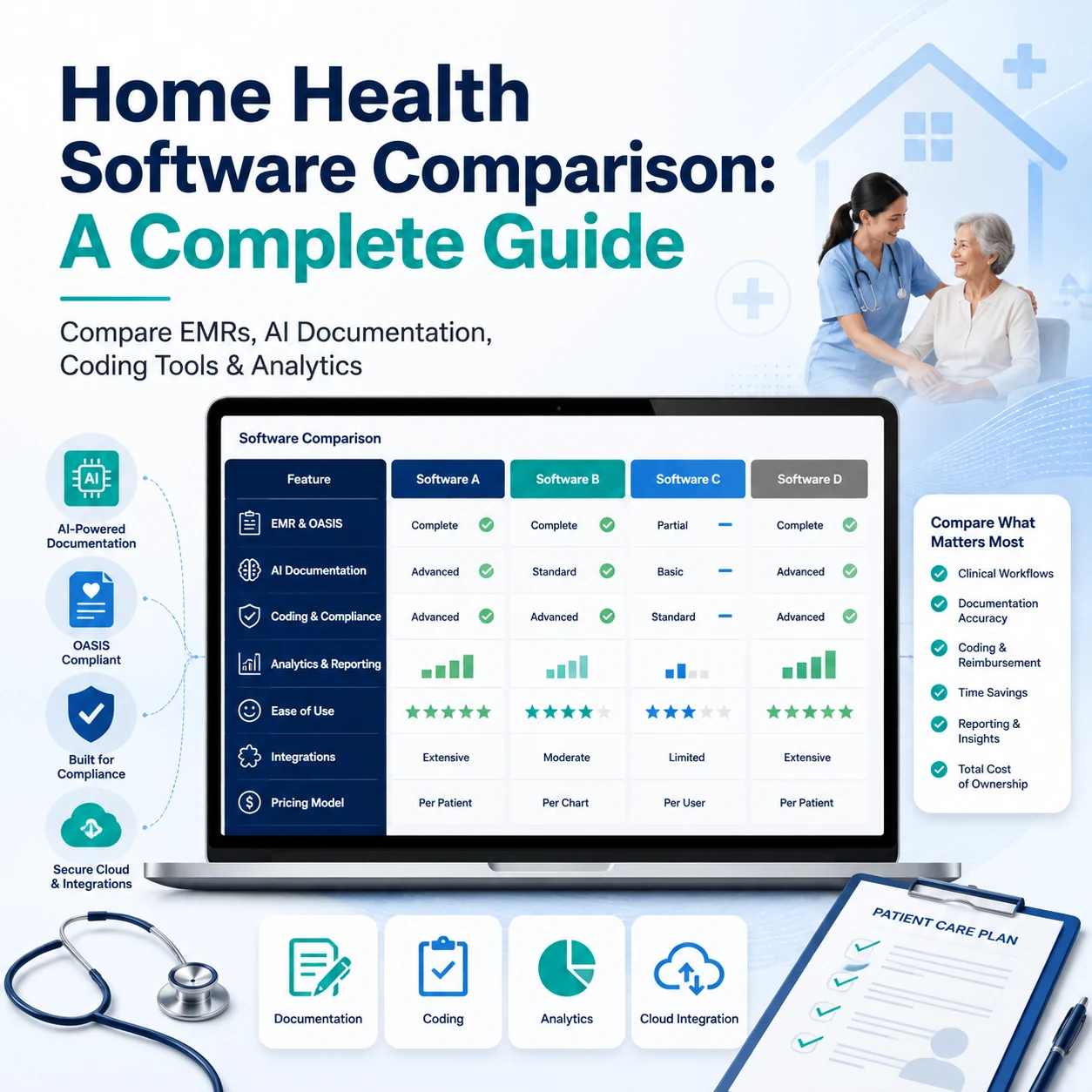
Home Health Software Comparison: A Complete Guide (2026)
The best home health software in 2026 isn't one platform, it's a stack. This guide compares EMRs, AI documentation, coding, OASIS QA, and analytics, with vendor strengths and limitations, comparison tables, and a build-your-stack checklist.