
ICD-10 Coding Best Practices for Home Health Agencies
Accurate ICD-10 coding shapes PDGM reimbursement, claim denials, and Medicare compliance in home health. This guide walks through the eight best practices every agency should follow, from selecting the correct primary diagnosis and capturing comorbidities to coding specificity, OASIS alignment, annual updates, audits, and using AI as a coding support tool.
Key Takeaways
- The primary diagnosis should be the main reason the patient needs skilled home health and drives PDGM clinical grouping.
- Capture all relevant secondary diagnoses, since eligible comorbidities affect PDGM comorbidity adjustments.
- Code to the highest level of specificity supported by documentation instead of defaulting to unspecified codes.
- Every code must be backed by clinical documentation and stay consistent with the OASIS assessment.
- Stay current with annual ICD-10 updates and run regular coding audits to catch errors before they cost reimbursement.
- Use AI as a coding decision-support tool, but every code must be reviewed and validated by a clinician or certified coder.
💡 Quick Answer: ICD-10 coding best practices for home health agencies center on choosing the correct primary diagnosis, capturing all relevant secondary diagnoses, coding to the highest level of specificity supported by documentation, aligning codes with OASIS, staying current with annual updates, and auditing regularly. Accurate coding drives correct PDGM reimbursement, fewer denials, and stronger Medicare compliance, with clinicians and coders documenting to support every code.
Accurate ICD-10 coding is one of the most important factors influencing reimbursement, compliance, and quality reporting in home health. Every diagnosis entered into a patient's record shapes the plan of care, affects the Patient-Driven Groupings Model (PDGM), and helps determine Medicare reimbursement.
A single coding error can result in claim denials, payment delays, additional documentation requests, or compliance risks. Conversely, accurate and well-supported coding ensures that agencies are appropriately reimbursed for the care they provide while maintaining regulatory compliance. This guide outlines the best practices every home health agency should follow to improve coding accuracy and operational efficiency.
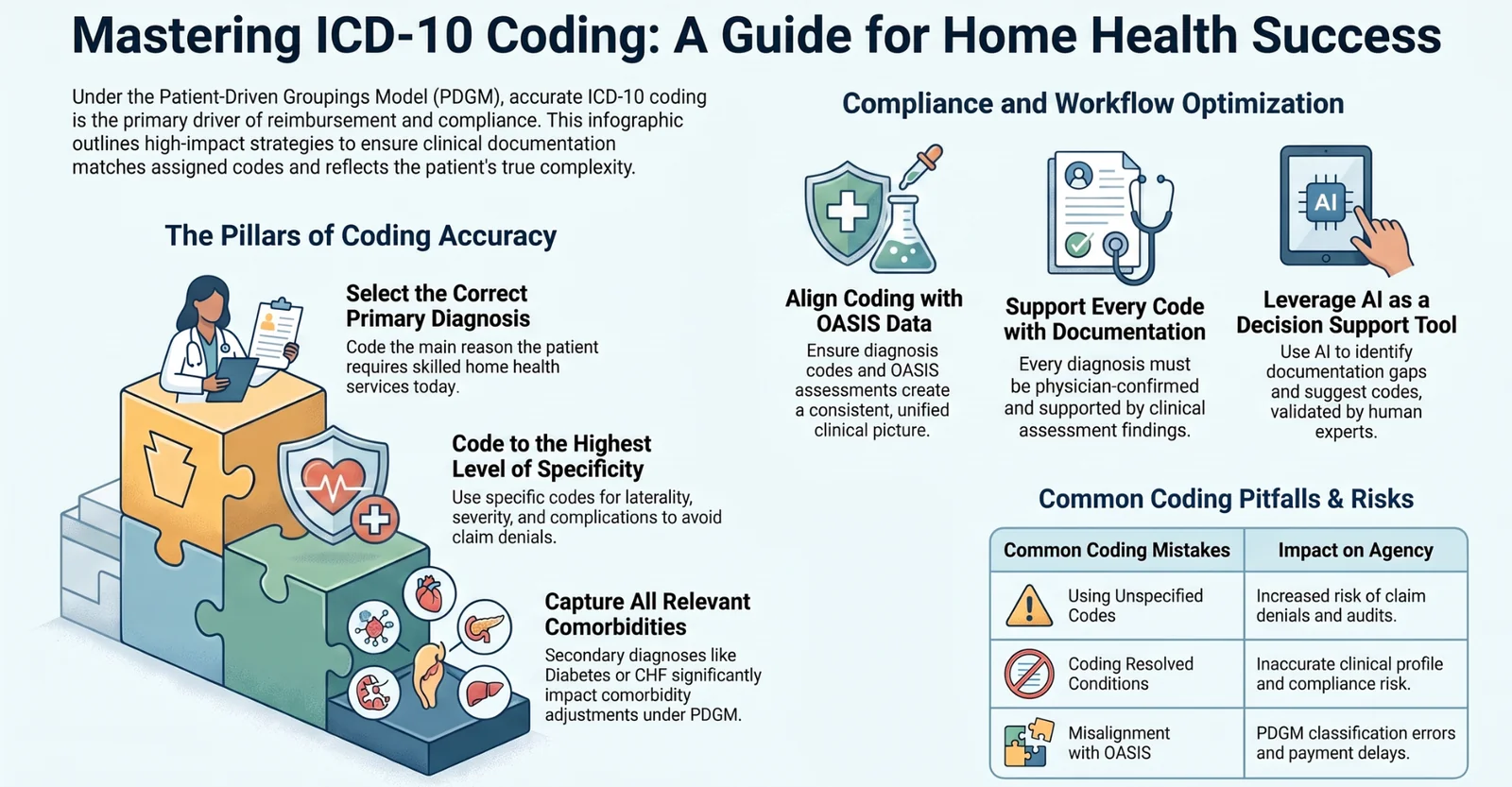
The pillars of coding accuracy, compliance and workflow optimization, and the common pitfalls that create claim denials and PDGM classification errors.
Why Accurate ICD-10 Coding Matters
ICD-10 coding is more than a billing requirement, it provides a standardized way to communicate a patient's clinical condition across the healthcare continuum. For home health agencies, accurate coding helps:
- Support medical necessity
- Improve PDGM reimbursement accuracy
- Reduce claim denials
- Strengthen audit readiness
- Enhance quality reporting
- Improve care planning
- Reflect the patient's true clinical complexity
Because diagnosis codes influence both reimbursement and patient care, coding should always be based on complete and accurate clinical documentation.
Understanding the Role of ICD-10 Under PDGM
The Patient-Driven Groupings Model (PDGM) uses diagnosis codes to categorize patients into clinical groups that determine reimbursement. Your selected diagnoses influence clinical grouping, functional impairment adjustment, comorbidity adjustment, case-mix weight, and Medicare payment.
Choosing the correct primary diagnosis and accurately capturing all relevant secondary diagnoses helps ensure reimbursement reflects the patient's actual care needs. The goal is never to overcode or undercode, but to accurately represent the patient's condition based on clinical documentation.
Best Practice #1: Select the Correct Primary Diagnosis
The primary diagnosis should represent the main reason the patient requires skilled home health services. Ask yourself: why is the patient receiving home health today? The answer should align with physician documentation, the plan of care, skilled nursing services, therapy goals, and the OASIS assessment. An incorrect primary diagnosis may affect PDGM grouping, delay reimbursement, or trigger additional claim review.
Best Practice #2: Capture Relevant Secondary Diagnoses
Secondary diagnoses provide a complete picture of the patient's health status. Conditions such as diabetes, congestive heart failure, COPD, chronic kidney disease, hypertension, dementia, and Parkinson's disease should be coded when they require monitoring, medication management, patient education, or influence the current episode of care. Appropriate secondary diagnoses can affect comorbidity adjustments under PDGM and improve the accuracy of the patient's clinical profile.
Best Practice #3: Code to the Highest Level of Specificity
ICD-10 offers a high level of diagnostic specificity, allowing clinicians and coders to describe conditions more accurately. Whenever documentation supports it, use the most specific diagnosis code available rather than an unspecified code. Documenting the type, location, severity, laterality, or associated complications often allows for a more precise code selection, improving both reimbursement accuracy and clinical reporting.
Best Practice #4: Ensure Documentation Supports Every Diagnosis
Every ICD-10 code must be supported by clinical documentation. Documentation should clearly include the physician-confirmed diagnosis, clinical findings, patient symptoms, skilled interventions, ongoing assessment, treatment plan, and patient response.
Assigning codes that are not supported by documentation increases compliance risk and may result in claim denials or audit findings. Strong collaboration between clinicians and coders is essential to maintain documentation integrity.
Best Practice #5: Align ICD-10 Coding with OASIS Documentation
OASIS and ICD-10 coding work together to create an accurate clinical picture of the patient. Consistent documentation between the OASIS assessment and assigned diagnosis codes helps improve assessment accuracy, support quality measures, strengthen PDGM classification, reduce documentation discrepancies, and improve audit readiness. Reviewing OASIS responses alongside diagnosis coding can help identify missing or inconsistent information before submission, which is where many OASIS documentation mistakes that lead to payment delays originate.
Best Practice #6: Stay Current with Annual ICD-10 Updates
ICD-10-CM codes are updated annually, with new, revised, and deleted codes introduced each year. Agencies should review annual code updates, educate clinicians and coders, update coding resources, revise internal workflows, and conduct refresher training. Keeping coding teams informed helps maintain compliance and reduce avoidable errors. The same principle applies to assessment updates such as the transition from OASIS-E1 to OASIS-E2.
Best Practice #7: Conduct Regular Coding Audits
Routine coding audits help identify opportunities for improvement before they impact reimbursement or compliance. Internal audits should review diagnosis sequencing, documentation completeness, coding specificity, physician documentation, OASIS consistency, and claim denial trends. Audit findings can be used to improve training, standardize processes, and strengthen coding quality across the agency.
Best Practice #8: Leverage AI as a Coding Support Tool
Artificial intelligence is increasingly being used to streamline home health documentation and coding workflows. Modern AI-powered solutions can analyze clinical documentation, suggest relevant ICD-10 codes, identify missing diagnoses, flag documentation gaps, highlight coding inconsistencies, and improve coding efficiency.
However, AI should support, not replace, clinical judgment. Every suggested diagnosis code should be reviewed and validated by qualified clinicians or certified coders before submission.
Common ICD-10 Coding Mistakes to Avoid
Even experienced teams can encounter coding errors that affect reimbursement and compliance. Some of the most common mistakes include:
- Selecting the wrong primary diagnosis
- Using unspecified codes when documentation supports greater specificity
- Missing relevant comorbidities
- Coding resolved conditions as active diagnoses
- Incorrect diagnosis sequencing
- Assigning diagnoses not supported by documentation
- Failing to update diagnoses after hospitalization
- Overlooking annual ICD-10 updates
Implementing standardized coding processes and regular education can significantly reduce these errors.
Building a Culture of Coding Excellence
Accurate coding is a collaborative effort involving clinicians, coders, quality assurance teams, and physicians. Successful home health agencies foster a culture where documentation is complete and timely, clinicians understand the importance of coding specificity, coders communicate proactively with clinical staff, quality reviews are part of routine operations, and continuous education is encouraged.
When every team member understands their role in the coding process, agencies are better positioned to improve reimbursement, maintain compliance, and deliver high-quality patient care.
🚀 Support accurate coding at the point of care. Copper Digital's AI Documentation Agent captures the visit and drafts notes and OASIS-E in real time, flagging documentation gaps that lead to unspecified codes and denials, with a nurse reviewing and approving every record before it reaches billing and coding. Explore AI tools for home health nurses, or book a demo.
🎓 Go deeper with peers. Join our Home Health Mastermind Skool community for training on ICD-10 coding, PDGM diagnosis sequencing, OASIS accuracy, and audit-ready documentation.
Home Health Documentation Playbook
The complete guide to OASIS-E, Medicare compliance, PDGM, and AI-assisted documentation. Learn how top agencies reduce documentation time without sacrificing compliance.
Bottom Line
ICD-10 coding best practices for home health come down to accuracy and documentation: pick the correct primary diagnosis, capture relevant comorbidities, code to the highest supported specificity, keep codes consistent with OASIS, stay current with annual updates, and audit regularly. Done well, coding drives correct PDGM reimbursement, fewer denials, and audit-ready compliance.

Arvind Sarin is the founder of Copper Digital. For the past year he has spent three days a week inside a 500+ census Texas home health agency, building AI documentation that finishes OASIS and visit notes the same day, with a nurse reviewing and approving every note. He writes about home health documentation, OASIS, Medicare compliance, and applying AI responsibly in clinical workflows.
Frequently asked
Frequently asked questions
ICD-10-CM coding is the process of assigning standardized diagnosis codes that accurately describe a patient's medical conditions. In home health, these codes support medical necessity, guide the plan of care, influence PDGM reimbursement, and ensure Medicare compliance.
Join the conversation
Leave a comment
Related reading
Why Medicare Home Health Claims Get Denied
Medicare home health claim denials are revenue leaks, not just billing issues. This guide breaks down the ten most common reasons claims get denied, from OASIS gaps and late NOAs to coding and medical-necessity problems, and how to prevent them to get paid faster.
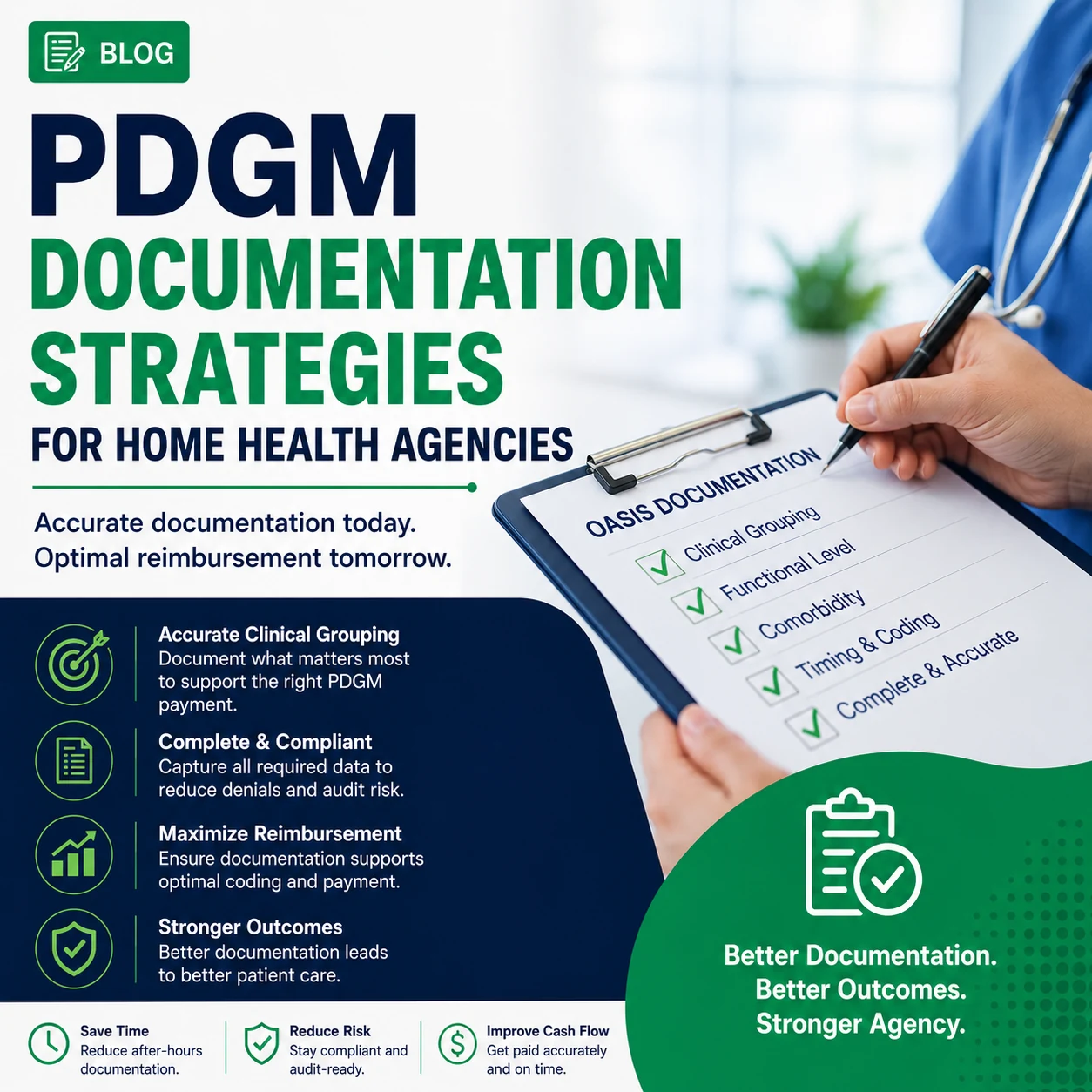
PDGM Documentation Strategies for Home Health Agencies
Under PDGM, documentation establishes the clinical picture that supports classification, medical necessity, coding, and payment. This guide breaks down 15 PDGM documentation strategies, a documentation-to-payment framework, weak-vs-strong examples, and a closed-loop workflow to keep charts consistent and audit-ready.
Top 10 Reasons Medicare ADRs Get Denied and How to Prevent Them
A Medicare ADR can turn a routine claim into a major administrative project, and the problem usually isn't the care, it's the documentation. This guide breaks down the 10 most common Medicare ADR denial patterns for home health and hospice, with a practical prevention strategy for each.