
Home Health Software Comparison: A Complete Guide (2026)
The best home health software in 2026 isn't one platform, it's a stack. This guide compares EMRs, AI documentation, coding, OASIS QA, and analytics, with vendor strengths and limitations, comparison tables, and a build-your-stack checklist.
Key Takeaways
- Every Medicare-certified home health agency requires an EMR to manage operations, billing, scheduling, and CMS submissions.
- Most agencies now supplement their EMR with AI documentation software, coding tools, OASIS QA platforms, and analytics.
- AI documentation software reduces after-hours charting, improves accuracy, and decreases clinician burnout.
- Coding software helps maximize PDGM reimbursement through accurate ICD-10 coding.
- OASIS QA software reduces compliance risk by identifying documentation issues before submission.
- Analytics platforms surface insights into Star Ratings, HHVBP, reimbursement trends, and productivity.
- The most effective technology stack combines multiple specialized platforms rather than one all-in-one solution.
💡 Quick Answer: The best home health software in 2026 isn't one platform, it's a stack. Most agencies run an EMR (WellSky, Homecare Homebase, Axxess, MatrixCare, or KanTime) for operations, then layer on AI documentation, coding tools, OASIS QA, and analytics. The right combination depends on your biggest operational bottleneck, not the longest feature list.
The average home health agency no longer relies on a single software platform to operate efficiently. As documentation requirements become more demanding and CMS scrutiny increases, agencies are building technology stacks that combine several specialized tools.
A modern home health technology stack typically includes an Electronic Medical Record (EMR) for operations, AI documentation software to reduce charting time, coding tools to optimize reimbursement, OASIS quality assurance to protect compliance, and analytics to monitor performance.
Choosing the right combination of home health software has become one of the most important technology decisions for agency owners. The wrong software can slow clinicians down, increase burnout, and delay billing; the right stack does the opposite.
Whether you're evaluating WellSky, Homecare Homebase (HCHB), Axxess, MatrixCare, KanTime, or exploring AI documentation platforms like Copper AI, this guide compares the major categories of home health software available in 2026, what each does, its strengths and limitations, and how to build the right stack for your agency.
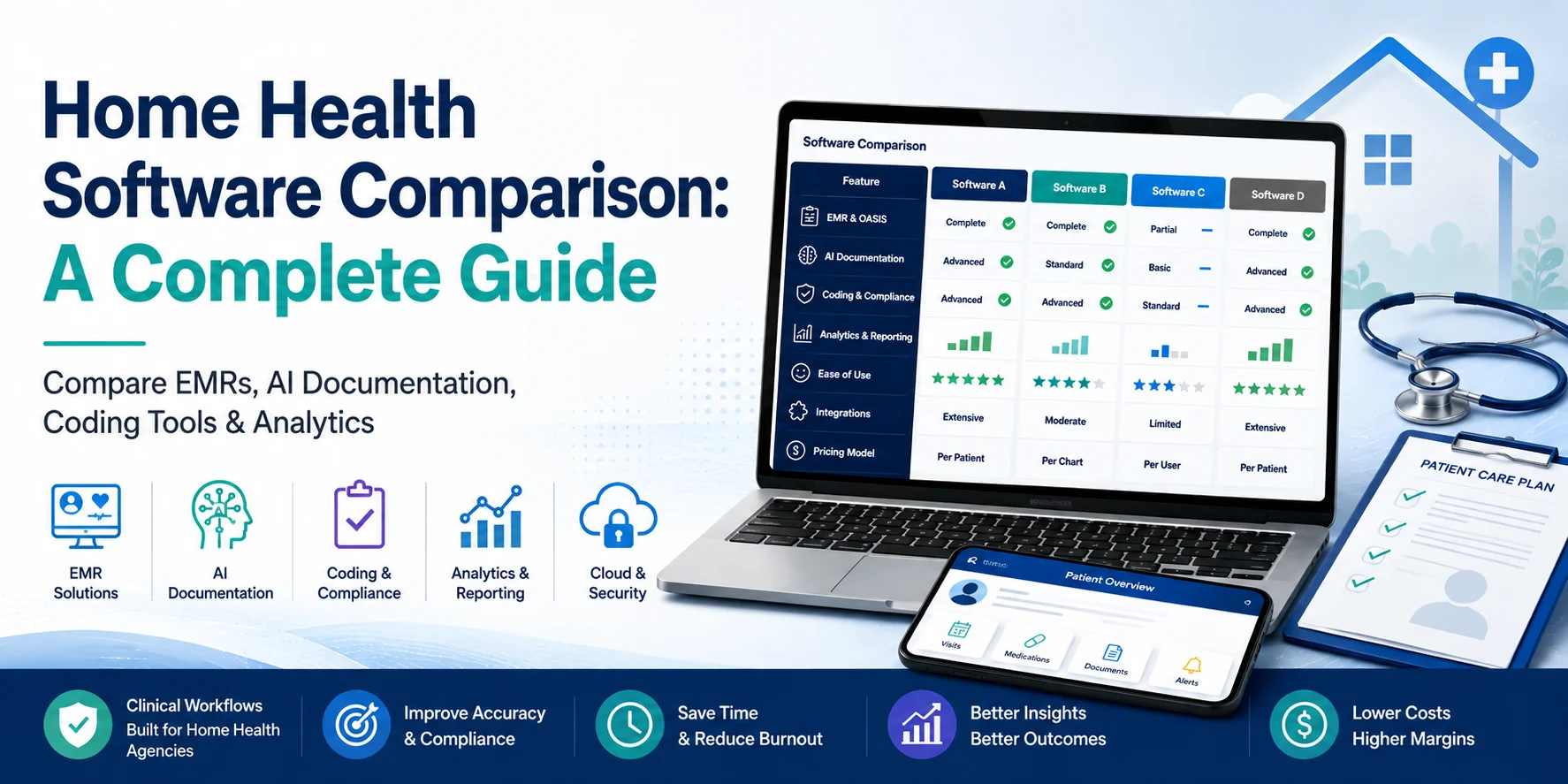
The five layers of a modern home health software stack, EMR, AI documentation, coding, OASIS QA, and analytics, and what to compare across them.
Why Home Health Agencies Need More Than an EMR
For many years, home health agencies relied almost exclusively on their EMR to manage every aspect of patient care, scheduling, billing, and compliance. Unfortunately, traditional EMRs were never designed to solve many of today's biggest challenges. Most platforms excel at storing clinical information and managing operations, but still rely heavily on manual clinical documentation.
As a result, home health agencies are increasingly adopting specialized software that works alongside their EMR rather than replacing it. AI documentation reduces charting time, coding tools optimize reimbursement, QA platforms protect compliance, and analytics turn data into decisions.
The future of home health technology is no longer about finding one platform that does everything. It's about building an integrated technology stack where each tool specializes in what it does best.
The Five Major Categories of Home Health Software
Instead of asking "What's the best home health software?" agencies should first ask "Which operational problem are we trying to solve?" Most agencies today use technology from the following five categories:
- Home Health EMR systems — the operational backbone: patient records, scheduling, physician orders, care plans, billing, compliance, and CMS submissions.
- AI documentation platforms — reduce clinician documentation time by generating compliant notes from voice, structured inputs, photos, and mobile workflows.
- Coding solutions — assign accurate ICD-10 codes, capture comorbidities, and improve PDGM reimbursement.
- OASIS Quality Assurance (QA) software — review OASIS for missing information, inconsistencies, and compliance risks before submission.
- Analytics & benchmarking platforms — monitor Star Ratings, HHVBP, productivity, referral trends, and financial performance.
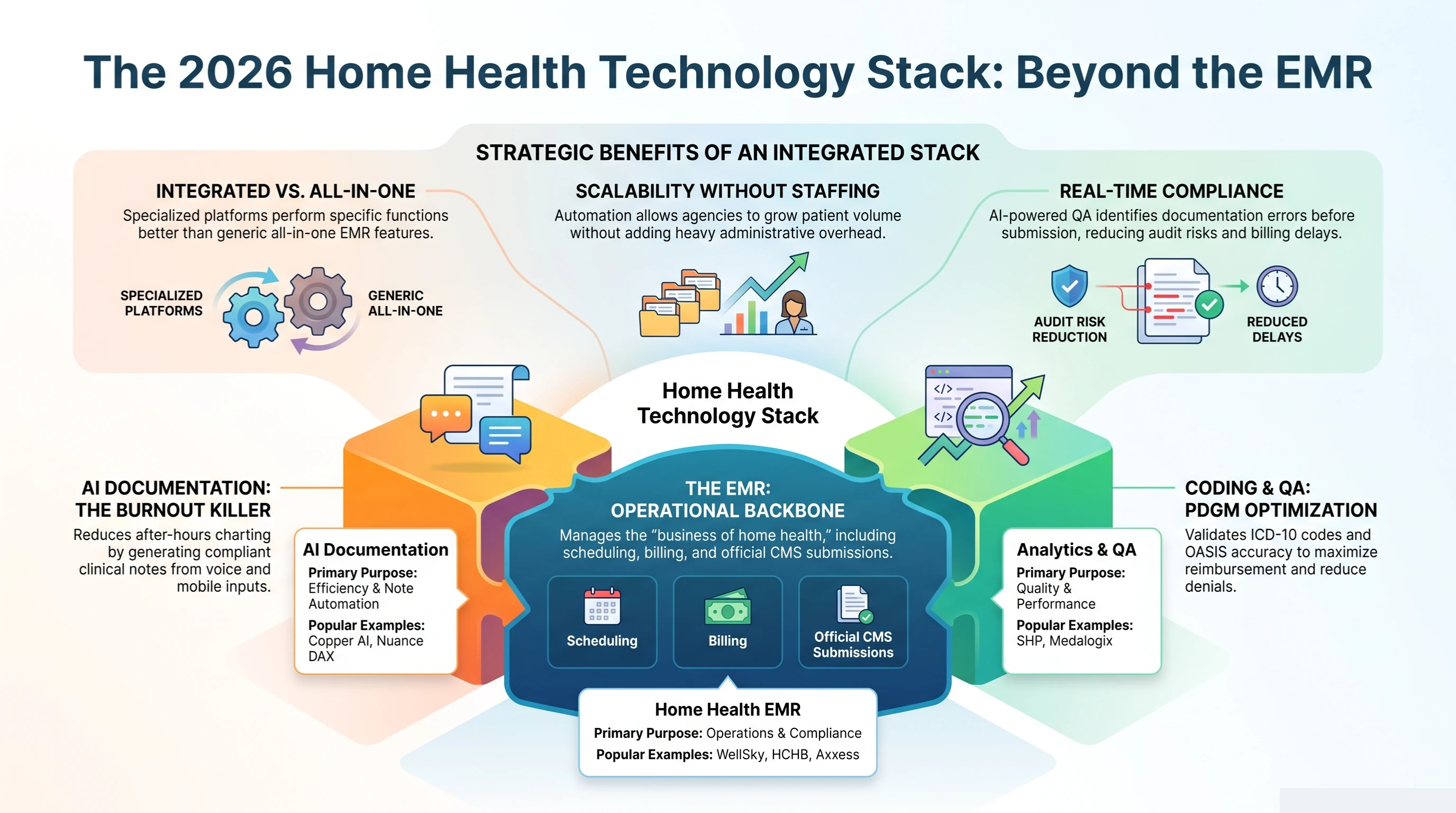
The 2026 home health technology stack: the EMR is the operational backbone, with AI documentation, coding, QA, and analytics layered on top rather than replacing it.
Although these categories are distinct, they work best when integrated into a single ecosystem. By combining specialized software rather than depending solely on an EMR, agencies can improve documentation speed, reduce administrative burden, strengthen compliance, and scale.
Category 1: Home Health EMR Systems
What Is a Home Health EMR?
An Electronic Medical Record (EMR) is the operational backbone of every Medicare-certified home health agency. It serves as the central system for managing patient records, scheduling, physician orders, care plans, billing, compliance, and CMS submissions. Although today's leading EMRs have become significantly more sophisticated, many agencies still struggle with documentation efficiency because most platforms still rely on manual clinical charting.
Popular Home Health EMRs
Several EMR vendors dominate the home health market, each serving different agency sizes and operational needs. For a deeper vendor-by-vendor look, see our Homecare Homebase vs Kinnser vs Axxess comparison.
WellSky Home Health (formerly Kinnser)
One of the most widely used home health EMRs in the United States, WellSky is popular among Medicare-certified agencies for its comprehensive billing and scheduling.
Best for: Small to large Medicare-certified agencies, Multi-location organizations, Agencies with established workflows.
Strengths: Mature Medicare billing workflows; Strong scheduling functionality; Extensive reporting; Large user community; Broad third-party integrations.
Potential limitations: Documentation can require significant manual entry; Interface may feel dated compared to newer platforms; Learning curve for new clinicians.
Homecare Homebase (HCHB)
Widely adopted by medium and large organizations that require sophisticated operational workflows and enterprise-level scale.
Best for: Large agencies, Enterprise organizations, Multi-state operations.
Strengths: Strong operational workflows; Medicare compliance; Comprehensive billing; Enterprise reporting; Robust scheduling.
Potential limitations: Longer implementation; Steeper learning curve; Extensive staff training often required.
Axxess
One of the fastest-growing cloud-based home health EMRs thanks to its user-friendly interface and relatively quick onboarding.
Best for: Small to medium agencies, Fast-growing organizations, Agencies seeking intuitive workflows.
Strengths: Modern interface; Cloud-based architecture; Easy clinician adoption; Good mobile experience.
Potential limitations: Advanced reporting can become complex; Larger organizations may require additional customization.
MatrixCare
Serves organizations across multiple post-acute care settings, including home health, hospice, skilled nursing, and senior living.
Best for: Multi-service organizations, Agencies operating across care settings.
Strengths: Cross-continuum care management; Strong compliance tools; Enterprise functionality.
Potential limitations: Interface complexity; Manual documentation workload remains high.
KanTime
Well known for serving agencies experiencing rapid growth while supporting home health, hospice, pediatric care, and private duty services.
Best for: Rapidly growing agencies, Multi-service organizations.
Strengths: High scalability; Strong automation; Mobile workflows; Comprehensive scheduling.
Potential limitations: More complex implementation; Higher setup costs.
Where Traditional EMRs Fall Short
Despite being essential, most EMRs still rely heavily on manual clinical documentation. Nurses frequently spend hours completing OASIS assessments, typing visit narratives, re-entering patient information, and reviewing charts after visits. This manual workflow contributes directly to documentation backlog, nurse burnout, after-hours charting, and billing delays. The EMR isn't broken, it simply wasn't designed to automate clinical documentation.
Category 2: AI Documentation Platforms
What Is AI Documentation Software?
AI documentation software is one of the biggest technological advances in home health in years. Instead of requiring nurses to manually type every assessment and OASIS response after visits, AI documentation platforms capture clinical information during or immediately after the visit and generate structured, compliant documentation. Unlike traditional EMRs, they're designed specifically to reduce documentation burden, not replace clinical judgment: the clinician reviews, edits, and approves every note before it enters the record.
Popular AI Documentation Platforms
Leading AI documentation solutions include Copper AI, Nuance DAX, Suki AI, DeepScribe, and Sunoh AI. While many serve hospitals and physician practices, only a handful are purpose-built for home health workflows such as OASIS, Start of Care (SOC), Resumption of Care (ROC), Recertifications, and skilled nursing visit notes. (New to those assessment types? See SOC vs ROC vs Recertification.)
What AI Documentation Software Does Well
- Voice documentation and ambient AI
- OASIS automation
- SOC, ROC, and Recertification documentation
- Medication reconciliation support
- Clinical summaries and photo documentation
- Gap detection and documentation quality review
- Coding suggestions
- EMR integration
Instead of documenting from memory after visiting multiple patients, clinicians can complete documentation while details are still fresh, improving both efficiency and accuracy. The result isn't simply faster documentation; it's giving nurses more time to focus on patients.
Limitations of AI Documentation Software
AI documentation is designed to complement, not replace, the EMR. EMR integration is essential, clinician review should always remain part of the workflow, and change management matters for adoption. Generic AI scribes may not understand home health-specific documentation such as OASIS, PDGM, or post-acute workflows, so agencies should prioritize platforms built specifically for home health.
Category 3: Coding Solutions
Every diagnosis documented during an episode directly influences Medicare reimbursement under PDGM. Accurate ICD-10 coding determines payment and supports medical necessity, risk adjustment, compliance, and audit readiness. Even with excellent care, incomplete or inaccurate coding can result in claim denials, lower reimbursement, and delayed payments.
Most agencies choose one of three approaches:
- In-house coding teams — certified coders review documentation and assign codes. Best for large, multi-location agencies with high census.
- Outsourced coding services — third-party coders review completed documentation before billing. Best for small agencies without certified coders.
- AI-assisted coding platforms — AI suggests ICD-10 codes and highlights missing documentation to speed certified-coder review. Best for agencies reducing billing delays.
Outsourced coding may add 24-72 hours before billing, internal coding requires certified staff, and AI-generated coding should always be reviewed by qualified coders. The most effective agencies combine AI-assisted coding with human review to balance speed, accuracy, and compliance.
Category 4: OASIS Quality Assurance (QA) Software
OASIS influences almost every major performance metric: Medicare reimbursement, PDGM case-mix, Star Ratings, HHVBP, QRP measures, and CMS compliance. Even small inconsistencies, missing responses, conflicting assessments, unsupported diagnoses, or inaccurate functional scoring, can delay billing, reduce reimbursement, and increase audit risk. OASIS QA software reviews assessments before submission to catch these issues early.
QA platforms typically review missing OASIS responses, clinical inconsistencies, Section GG validation, diagnosis support, medication reconciliation, narrative completeness, coding alignment, and CMS compliance requirements.
Traditional QA vs AI QA
Traditional QA is usually performed after documentation is complete, bringing human expertise and clinical judgment but with delayed feedback, additional staffing, and longer billing cycles. AI-powered QA provides real-time feedback while documentation is still being completed, enabling immediate corrections, faster submissions, reduced overtime, and lower compliance risk. Whether internal, outsourced, or AI-supported, QA is no longer optional.
Category 5: Analytics & Benchmarking Platforms
Every visit, OASIS assessment, claim, and referral generates data, but collecting data alone doesn't improve performance. Analytics platforms turn raw data into insights that help leaders monitor Star Ratings, HHVBP performance, hospitalization rates, referral sources, clinician productivity, revenue, and case-mix trends. Popular solutions include SHP, Medalogix, WellSky Analytics, and Homecare Homebase Reporting.
Analytics platforms are powerful, but they rely on accurate data from other systems. Poor documentation, incomplete coding, or inconsistent OASIS assessments reduce the value of reporting, analytics identify problems, but improving outcomes still requires strong documentation workflows and clinical leadership.
Bringing It All Together
Each category solves a different challenge: EMRs manage operations, AI documentation reduces charting time, coding solutions maximize reimbursement accuracy, OASIS QA protects compliance, and analytics provide the insights for continuous improvement. Rather than replacing one another, these technologies work best as an integrated ecosystem.
Side-by-Side Home Health Software Comparison
| Software Category | Primary Purpose | Popular Platforms | Best For |
|---|---|---|---|
| Home Health EMR | Patient records, scheduling, billing, compliance | WellSky, HCHB, Axxess, MatrixCare, KanTime | Every Medicare-certified agency |
| AI Documentation | Voice documentation, OASIS automation, visit notes | Copper AI, Nuance DAX, Suki, DeepScribe, Sunoh | Agencies reducing charting time |
| Coding Software | ICD-10 coding, PDGM optimization | In-house, outsourced, or AI coding | Improving reimbursement |
| OASIS QA | Documentation review & compliance | AI QA, internal QA, outsourced QA | Improving OASIS accuracy |
| Analytics | Quality reporting & benchmarking | SHP, Medalogix, WellSky Analytics | Operational improvement |
How to Build the Ideal Home Health Technology Stack
There is no single "best" platform because agencies have different needs, staffing models, and growth goals. Successful agencies build an integrated stack where each platform specializes in a particular function:
| Technology Layer | Primary Function | Example |
|---|---|---|
| EMR | Scheduling, billing, patient records, compliance | WellSky, Axxess, HCHB |
| AI Documentation | Voice capture, OASIS automation, visit documentation | Copper AI |
| Coding | ICD-10 coding & PDGM optimization | AI-assisted coding or certified coders |
| OASIS QA | Documentation validation & compliance | AI QA platforms |
| Analytics | Performance monitoring & benchmarking | SHP, Medalogix |
Which Software Does Your Agency Actually Need?
Choosing the right software starts with identifying your biggest operational bottleneck rather than buying the platform with the longest feature list.
- Nurses charting after hours → AI documentation with voice, mobile charting, OASIS automation, and human review before EMR submission.
- Documentation errors delaying billing → OASIS QA, AI documentation, and coding software.
- Low Medicare reimbursement → coding solutions, OASIS QA, and documentation quality.
- Agency growth → a scalable EMR, AI documentation, analytics, and referral management.
- Compliance concerns → HIPAA compliance, SOC 2 Type II, audit logs, role-based permissions, and a signed BAA.
Home Health Software Evaluation Checklist
Evaluate vendors using real-world clinical workflows, not just feature demos. Use this checklist during every demo:
- Supports SOC, ROC, and Recertification documentation
- OASIS-E2 compatible
- Mobile iPad documentation, voice, and photo capture
- Human review before EMR submission
- Direct EMR integration (WellSky/Kinnser, HCHB, Axxess, MatrixCare, KanTime)
- ICD-10 coding support and OASIS QA
- Referral, billing, and physician-order workflow support
- HIPAA compliant, SOC 2 Type II certified, signed BAA
- Audit logs, role-based access controls, data encryption
- Implementation support, staff training, and a dedicated customer success team
The home health software landscape has evolved far beyond traditional EMRs. Today's highest-performing agencies combine EMRs, AI documentation, coding solutions, OASIS QA, and analytics into a connected ecosystem that improves documentation quality, accelerates billing, strengthens compliance, and reduces clinician burnout. As requirements grow under OASIS-E2 and PDGM, the right technology stack isn't just about efficiency, it's about improving patient care, supporting clinicians, and protecting reimbursement.
🚀 See where AI documentation fits in your stack. Copper AI works alongside your existing EMR, WellSky (Kinnser) and others, capturing the visit by voice, photo, and tap, drafting the OASIS and visit note, and keeping a nurse reviewing every record before it's pushed to the EMR. Explore AI tools for home health nurses, review our compliance approach, or book a demo.
📘 Free download: The Home Health Documentation Playbook, a 232-page guide to OASIS-E, Medicare compliance, PDGM, and AI-assisted documentation, with 150+ point-of-care checklists.
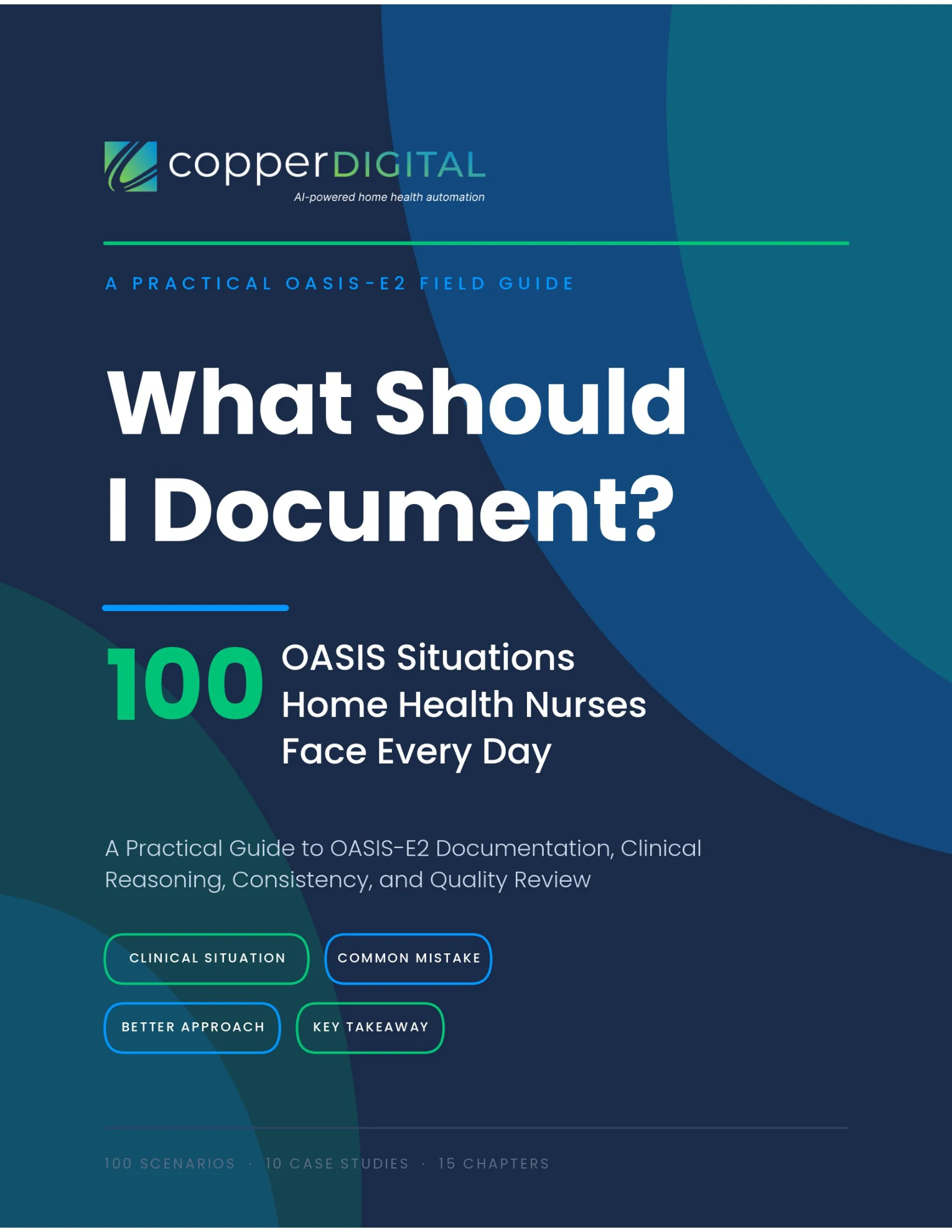
What Should I Document? 100 OASIS Situations Home Health Nurses Face Every Day
100 real OASIS scenarios, worked end to end — clinical situation, common mistake, better approach, and key takeaway. Built around OASIS-E2 (effective April 1, 2026) to turn what you assess into accurate, defensible documentation.
Bottom Line
There is no single best home health software, only the right stack. Every agency needs an EMR (WellSky, HCHB, Axxess, MatrixCare, or KanTime) for operations, and most now layer on AI documentation, coding, OASIS QA, and analytics. Start from your biggest operational bottleneck, prioritize home-health-specific tools that integrate with your EMR, and keep a clinician reviewing every AI-generated note.

Arvind Sarin is the founder of Copper Digital. For the past year he has spent three days a week inside a 500+ census Texas home health agency, building AI documentation that finishes OASIS and visit notes the same day, with a nurse reviewing and approving every note. He writes about home health documentation, OASIS, Medicare compliance, and applying AI responsibly in clinical workflows.
Frequently asked
Frequently asked questions
The best home health software depends on your agency's size, workflow, and operational goals. Most agencies use a combination of an EMR, AI documentation software, coding tools, OASIS QA, and analytics rather than relying on a single platform.
Join the conversation
Leave a comment
Related reading
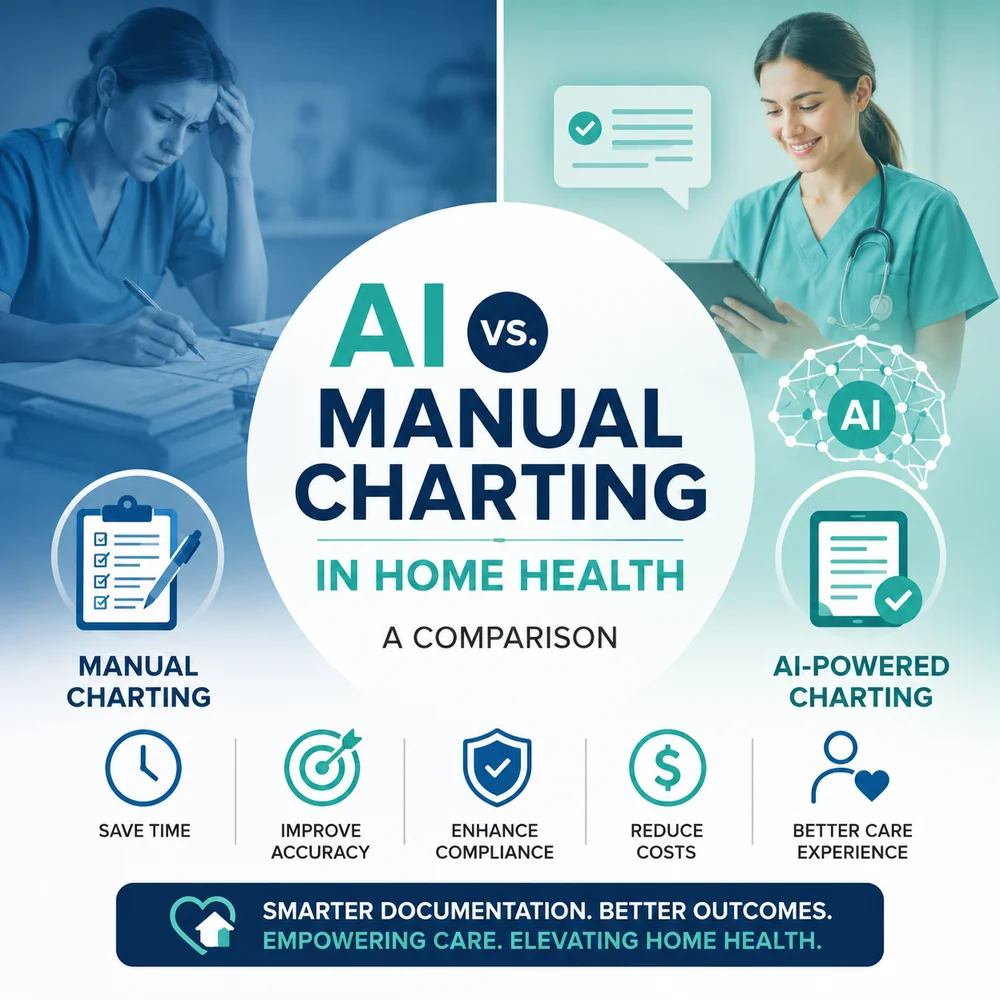
AI vs. Manual Charting in Home Health: An Honest Comparison
Manual charting has been the home health standard for decades, but AI-assisted documentation is changing how notes get done. This honest comparison weighs both across time, accuracy, compliance, cost, clinician experience, and patient care, and explains why the best workflows combine AI efficiency with clinician judgment.
Home Health Documentation Workflow: What Actually Slows Nurses Down?
Home health documentation is one of the biggest administrative burdens clinicians carry, but it is rarely slow for the reasons people assume. The problem usually isnt the nurse, its the workflow surrounding the note: medication reconciliation, OASIS, duplicate entry across disconnected systems, interruptions, and after-hours charting. Here is what actually slows nurses down and how to fix it.
Homecare Homebase vs WellSky (Kinnser) vs Axxess: Which Home Health EMR Is Best for Documentation?
Choosing a home health EMR shapes how nurses document, how fast claims go out, and how efficiently your agency runs. Homecare Homebase, WellSky (Kinnser), and Axxess all support OASIS-E and Medicare compliance, but they differ in usability, scalability, and workflow design. This guide compares all three across documentation, OASIS-E, mobile, compliance, AI, and agency size to help you choose.