
PDGM vs. PPS: What's Changed for Home Health?
PDGM did not replace Medicare's Home Health Prospective Payment System. It changed the case-mix methodology inside HH PPS, and reshaped payment periods, coding, OASIS, LUPA monitoring, billing, and cash flow.
Key Takeaways
- PPS is Medicare's broader home health payment framework; PDGM is the case-mix methodology used within it.
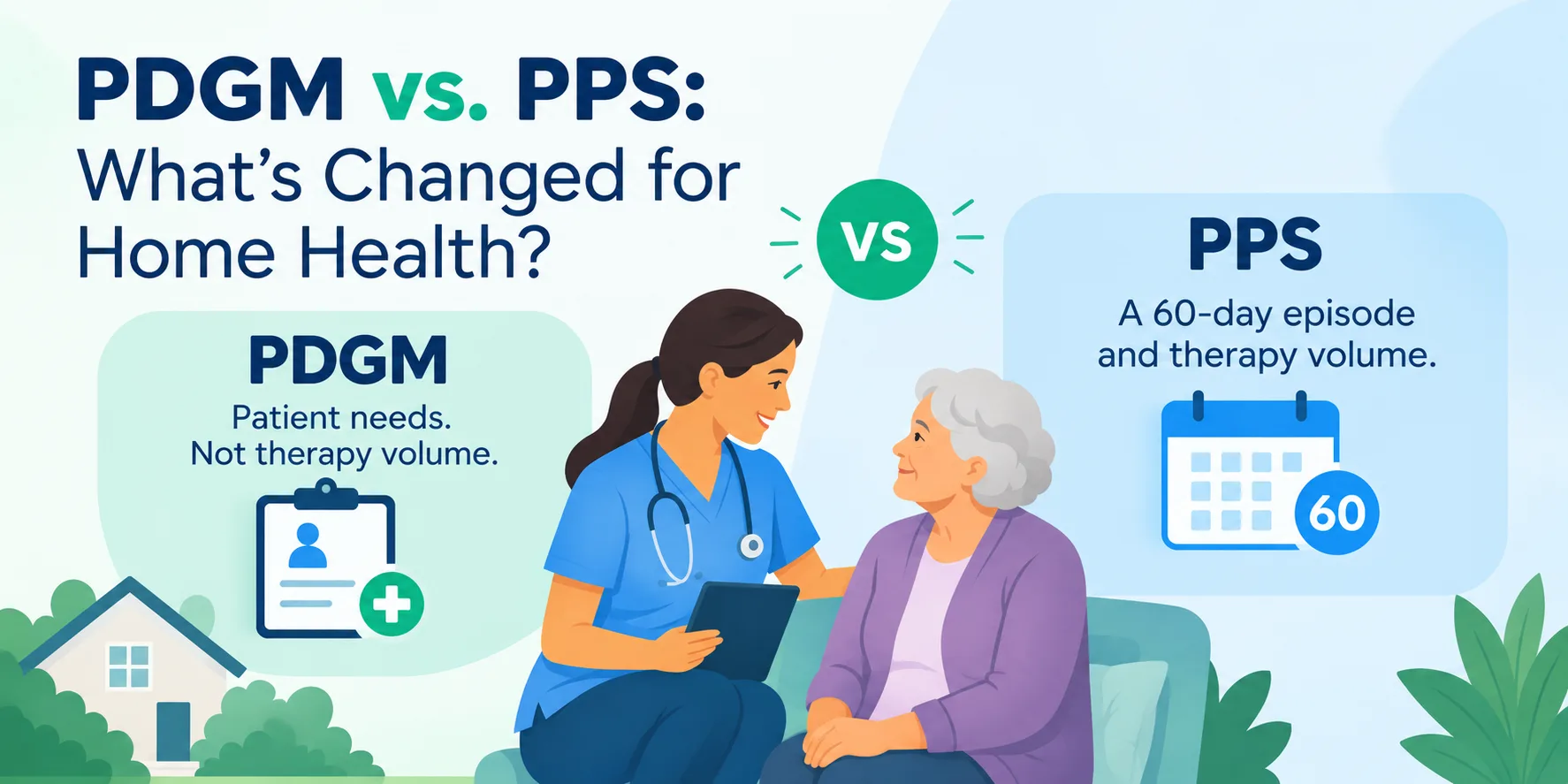
- PDGM changed the payment unit from a 60-day episode to a 30-day period beginning January 1, 2020, without changing the 60-day certification cycle.
- Therapy visit thresholds no longer drive case-mix payment; therapy remains covered when it is clinically necessary and included in the plan of care.
- Five dimensions (admission source, timing, clinical group, functional impairment, and comorbidity adjustment) create 432 possible PDGM case-mix groups.
- OASIS-derived functional information and claim-reported diagnoses must align with the clinical record to support accurate classification.
- RAP payments ended in 2021, and the one-time Notice of Admission process replaced recurring RAP submissions in 2022.
- PDGM parameters continue to change through annual rulemaking and CMS Grouper software updates.
✓ Quick answer: PPS is Medicare's broader home health payment system. PDGM is the case-mix methodology used within that system. PDGM did not replace HH PPS; it changed how Medicare classifies and pays 30-day periods of home health care.
For home health agencies, few payment changes have been as significant as the transition from the traditional Medicare Home Health Prospective Payment System methodology to the Patient-Driven Groupings Model.
Beginning January 1, 2020, Medicare moved from a 60-day unit of payment to a 30-day period of care and eliminated therapy visit thresholds from the case-mix adjustment. PDGM instead places greater emphasis on the patient's clinical characteristics, functional status, admission source, timing, and comorbidities.
For agencies, this affected far more than the billing calendar. It changed how clinical teams, coders, OASIS reviewers, billers, and administrators think about OASIS, diagnosis coding, case-mix management, LUPA, billing, and cash flow.
ℹ️ Scope: This article explains Original Medicare fee-for-service home health payment. Medicare Advantage, Medicaid, and commercial payer requirements may differ. Always verify current CMS, Medicare Administrative Contractor, and payer guidance for a specific claim or workflow.
PDGM vs. PPS: What Is the Difference?
If you work in home health, you may hear PPS and PDGM used interchangeably. They are closely related, but they are not the same thing.
PPS stands for Prospective Payment System. For Medicare home health, HH PPS is the broader payment framework.
PDGM stands for Patient-Driven Groupings Model. It is the case-mix methodology CMS implemented within HH PPS for periods beginning January 1, 2020.
PPS is the payment system. PDGM is the case-mix methodology used within that system.
What Is PPS in Home Health?
A prospective payment system establishes predetermined payment amounts for healthcare services using a defined classification methodology. Medicare uses separate prospective payment systems for different healthcare settings.
For home health, Medicare uses the Home Health Prospective Payment System. Under the current HH PPS, Medicare generally pays a national standardized amount for a 30-day period of care, adjusted for case mix and geographic wage differences. CMS's Home Health PPS overview explains that HH PPS originally used 60-day episodes and moved to 30-day payment periods with PDGM in 2020.
What Is PDGM?
PDGM is Medicare's current home health case-mix classification methodology. CMS designed it to move payment away from a service dimension driven partly by therapy visit thresholds and toward patient characteristics and expected resource needs.
Under PDGM, every 30-day period is classified across five dimensions:
- Admission source: community or institutional.
- Timing: early or late.
- Clinical grouping: one of 12 groups based primarily on the principal diagnosis.
- Functional impairment: low, medium, or high using designated OASIS information.
- Comorbidity adjustment: none, low, or high based on qualifying secondary diagnoses.
These combinations create 432 possible case-mix groups. CMS's PDGM overview describes the calculation as 2 × 2 × 12 × 3 × 3 = 432.
PDGM vs. Traditional Home Health PPS at a Glance
| Feature | Traditional HH PPS methodology | PDGM methodology |
|---|---|---|
| Payment unit | 60-day episode | 30-day period |
| Therapy thresholds | Used in case-mix adjustment | Eliminated from case-mix adjustment |
| Case-mix focus | Clinical, functional, and service dimensions | Patient characteristics and expected resource needs |
| Clinical grouping | Previous HHRG methodology | 12 clinical groups |
| Payment groups | Previous HHRG categories | 432 possible PDGM case-mix groups |
| Functional status | Part of the prior methodology | Low, medium, or high |
| Comorbidity | Addressed through the prior methodology | None, low, or high adjustment |
| Admission source | Not a standalone dimension in the same form | Community or institutional |
| Timing | Not a standalone dimension in the same form | Early or late |
| RAP process | Upfront split-percentage payment | 20% RAP in 2020; no-pay RAP in 2021; NOA since 2022 |
| LUPA | Applied under the prior PPS structure | Continues with group-specific thresholds for each 30-day period |
1. The Payment Unit Changed From 60 Days to 30 Days
Under the traditional methodology, Medicare home health payment was organized around a 60-day episode. For periods beginning January 1, 2020, PDGM changed the payment unit to a 30-day period of care.
That change did not turn every home health timeline into 30 days. CMS specifically notes that the payment unit is 30 days while eligibility recertification and plan-of-care review generally continue on 60-day timelines.
⚠️ Do not confuse the timelines: a 30-day payment period is not a 30-day certification period.
2. Therapy Visit Thresholds Were Eliminated
The traditional HH PPS case-mix methodology included a service dimension in which payment could increase when specified therapy visit thresholds were met. PDGM eliminated therapy thresholds from case-mix payment classification.
This does not mean therapy became less important or stopped being covered. It means therapy volume is no longer used in the same way to determine the case-mix-adjusted payment.
Therapy services should continue to reflect the patient's clinical needs, goals, orders, and plan of care.
3. PDGM Focuses More Heavily on Patient Characteristics
CMS describes PDGM as relying more heavily on clinical characteristics and other patient information to place periods into meaningful payment categories. That is the practical meaning of “patient-driven”: the classification is based on the patient's condition and expected resource needs rather than a therapy-volume threshold.
- Clinical characteristics and the principal reason for home health.
- Functional impairment based on designated OASIS items.
- Whether the admission source is community or institutional.
- Whether the period is early or late.
- Qualifying secondary diagnoses and comorbidity interactions.
4. PDGM Uses 432 Case-Mix Groups
A 30-day period can fall into one of 432 possible case-mix groups. The five classification dimensions work together; no single factor tells the entire payment story.
Admission source
The period is classified as community or institutional based on applicable claims information and the patient's recent healthcare setting.
Timing
The first 30-day period in a sequence is early. Subsequent contiguous periods are generally late, subject to CMS's sequencing rules.
Clinical group
The principal diagnosis helps place the period into one of 12 clinical groups that describe the primary reason for home health services.
Functional impairment
Designated OASIS responses contribute to a low, medium, or high functional impairment level.
Comorbidity adjustment
Qualifying secondary diagnoses may produce no, low, or high comorbidity adjustment, depending on the applicable CMS grouping logic.
5. Diagnosis Coding Became Even More Important
The principal diagnosis reported on the home health claim contributes to the clinical grouping. Certain secondary diagnoses may contribute to the comorbidity adjustment.
Diagnosis coding therefore connects directly to case-mix classification; it is not merely a back-office billing task.
CMS identifies 12 clinical groups: musculoskeletal rehabilitation; neuro/stroke rehabilitation; wounds; MMTA surgical aftercare; MMTA cardiac and circulatory; MMTA endocrine; MMTA gastrointestinal tract and genitourinary; MMTA infectious disease, neoplasms, and blood-forming diseases; MMTA respiratory; MMTA other; behavioral health; and complex nursing interventions.
What is a PDGM diagnosis?
There is no standalone “PDGM diagnosis code.” The phrase usually refers to diagnosis information used in the PDGM classification process. The compliant question is not which diagnosis produces the highest payment; it is which diagnosis accurately represents the reason for home health services and is supported by the clinical record.
For a deeper coding workflow, see ICD-10 coding best practices for home health agencies.
6. OASIS Is Closely Connected to Payment Classification
PDGM did not turn OASIS into a billing code. However, designated OASIS items contribute to the functional impairment dimension.
That creates a direct operational chain:
Patient assessment → OASIS → functional impairment level → PDGM case mix → payment classification
If OASIS responses conflict with the clinical narrative, functional observations, or other records, the classification may be difficult to support. Documentation should reflect the patient's actual condition rather than a desired payment result.
Learn more in the complete OASIS-E guide.
7. What Codes and Data Does PDGM Use?
PDGM is not a standalone code set. Several types of information work together:
- ICD-10-CM diagnosis codes: the principal diagnosis contributes to clinical grouping, and qualifying secondary diagnoses may contribute to comorbidity adjustment.
- OASIS information: designated assessment items contribute to the functional impairment level.
- Claim information: admission source, timing, diagnoses, and other claim data contribute to classification.
- HIPPS codes: represent the payment classification reported through the applicable institutional-claim process.
When someone asks for “PDGM codes,” the more accurate answer is that PDGM combines diagnosis codes, OASIS-derived information, claim data, and HIPPS classification rather than using one independent code set.
8. RAP Payments Ended and the NOA Process Began
Under the older HH PPS process, Requests for Anticipated Payment helped provide upfront cash flow. The initial 60-day episode generally used a 60/40 split, while subsequent continuous episodes generally used a 50/50 split.
CMS reduced the split-percentage payment to 20/80 for eligible existing agencies in 2020. Newly enrolled agencies were already subject to a no-pay RAP approach.
In 2021, CMS eliminated upfront RAP payments for all agencies, while requiring no-pay RAP submissions during that transition year.
Beginning in 2022, the one-time Notice of Admission replaced recurring RAP submissions. CMS's CY 2020 payment policy fact sheet documents the 2020 and 2021 phaseout and the move to the NOA process.
9. PDGM Changed Home Health Cash Flow
Once upfront RAP payments ended, agencies could no longer rely on the same advance Medicare cash receipt. The operational sequence became increasingly important: provide care → complete documentation and coding → satisfy admission requirements → submit the final claim → receive payment.
- Timely, complete clinical documentation.
- Accurate coding and OASIS review.
- Efficient billing and clean claim submission.
- Fast resolution of edits, denials, and requests for documentation.
- Active accounts-receivable and cash-flow management.
Smaller agencies may feel delays more acutely because payroll and operating expenses continue while a claim waits on missing documentation or correction. The home health billing cheat sheet connects these upstream and downstream steps.
10. How Does LUPA Work Under PDGM?
Under PDGM, each 30-day case-mix group has an applicable Low-Utilization Payment Adjustment threshold. When a period has fewer visits than its applicable threshold, Medicare generally pays per visit instead of paying the full case-mix-adjusted 30-day amount.
The threshold is not one universal number. It varies by payment group and can change through annual payment updates.
CMS's PDGM payment overview explains the group-specific approach.
- Monitor expected and completed visits by 30-day period.
- Review patient needs, clinical changes, and scheduling barriers.
- Analyze LUPA patterns by clinical group, referral source, clinician, and branch.
- Confirm that documentation supports every skilled service provided.
- Never add unnecessary visits solely to avoid a LUPA.
For a focused operational guide, read LUPA explained for home health agencies.
11. Documentation Now Has an Even More Visible Payment Connection
Accurate documentation was essential before PDGM, but the current methodology makes the classification chain easier to see:
Assessment → OASIS → diagnosis coding → clinical grouping → functional impairment → comorbidity adjustment → PDGM case-mix group → HIPPS classification → claim
When those parts do not align, the agency may have difficulty supporting the classification or responding to a payment review. Documentation is not an after-the-fact clerical task; it is part of the infrastructure supporting care coordination, coding, compliance, and payment.
See PDGM documentation strategies for home health agencies for practical controls.
What Did Not Change Under PDGM?
PDGM changed the payment methodology. It did not remove the underlying requirements for covered, medically necessary, properly ordered, and appropriately documented home health services.
- Medicare eligibility and homebound status.
- Need for qualifying skilled services.
- Physician or allowed-practitioner orders and certification requirements.
- An individualized plan of care.
- A comprehensive assessment and applicable OASIS submission.
- Clinical documentation supporting medical necessity and services provided.
- Accurate, timely billing.
Why PDGM Still Matters in 2026
PDGM began in 2020, but its payment parameters continue to evolve. For CY 2026, CMS finalized a 2.4% payment update, a final case-mix budget-neutrality factor of 1.0052, a -1.023% permanent adjustment, and a -3.0% temporary adjustment to the base payment rate.
The exact effect on an agency depends on its circumstances and other payment factors.
CMS also continues to maintain the HH PPS Grouper software. The October 2026 Grouper release, version 07.2.26, is available for claims beginning October 1, 2026 and updates diagnosis-code tables affecting grouping and HIPPS assignments.
The CY 2026 HH PPS final-rule fact sheet summarizes the current payment adjustments. Agencies should treat PDGM as an active annual operational responsibility, not as a one-time historical transition.
What Should Home Health Agencies Do Differently?
- Strengthen diagnosis documentation. Confirm that the principal diagnosis accurately represents the reason for skilled home health and is supported throughout the record.
- Keep OASIS and clinical notes consistent. Functional status, limitations, interventions, and patient response should tell the same clinical story.
- Capture supported comorbidities. Report relevant secondary diagnoses accurately without coding toward a preferred payment outcome.
- Track LUPA patterns. Review recurring and unexpected LUPAs for clinical, scheduling, staffing, referral, and workflow causes.
- Monitor billing timeliness. Track the time from visit completion to documentation, coding, QA, claim submission, and payment.
- Educate clinicians on the payment connection. Clinicians do not need to become billers, but they should understand why complete assessment and documentation matter.
- Align clinical, coding, QA, and billing teams. Each team sees a different part of one payment story; build checks that make contradictions visible before claim submission.
📘 Free resource: The Home Health Documentation Playbook connects OASIS, Medicare compliance, PDGM, and clinical documentation with practical point-of-care checklists.
Editorial Review and Official CMS Sources
This article was reviewed against CMS materials available on September 8, 2026. Payment rules, Grouper tables, case-mix weights, LUPA thresholds, and payer requirements can change; verify the sources applicable to the service date and claim.
- CMS: Home Health Prospective Payment System.
- CMS: Home Health Patient-Driven Groupings Model.
- CMS: Medicare Payment Systems—Home Health.
- CMS: CY 2026 Home Health PPS Final Rule Fact Sheet.
- CMS: Home Health PPS Grouper Software.
- CMS: CY 2020 Payment Policy and RAP Phaseout.
📝 Editorial and regulatory disclaimer: This article is for educational purposes only. It is not billing, coding, legal, compliance, clinical, or reimbursement advice. Always verify current CMS instructions, the applicable Medicare Administrative Contractor guidance, and payer-specific requirements before making claim or care decisions.
What Should I Document? 100 OASIS Situations Home Health Nurses Face Every Day
100 real OASIS scenarios, worked end to end — clinical situation, common mistake, better approach, and key takeaway. Built around OASIS-E2 (effective April 1, 2026) to turn what you assess into accurate, defensible documentation.
Bottom Line
PPS is the Medicare home health payment framework, while PDGM is the case-mix methodology inside it: PDGM classifies each 30-day payment period using admission source, timing, clinical group, OASIS-derived functional impairment, and comorbidities, making accurate assessment, coding, documentation, and billing alignment essential.
Inside Home Health Podcast
Why OASIS Is Every Nurse's Biggest Nightmare

Arvind Sarin is the founder of Copper Digital. For the past year he has spent three days a week inside a 500+ census Texas home health agency, building AI documentation that finishes OASIS and visit notes the same day, with a nurse reviewing and approving every note. He writes about home health documentation, OASIS, Medicare compliance, and applying AI responsibly in clinical workflows.
Frequently asked
Frequently asked questions
PPS stands for Prospective Payment System. In Medicare home health, the Home Health Prospective Payment System is the broader framework CMS uses to pay for covered home health services.
Join the conversation
Leave a comment
No comments yet. Be the first to share your thoughts.
Related reading
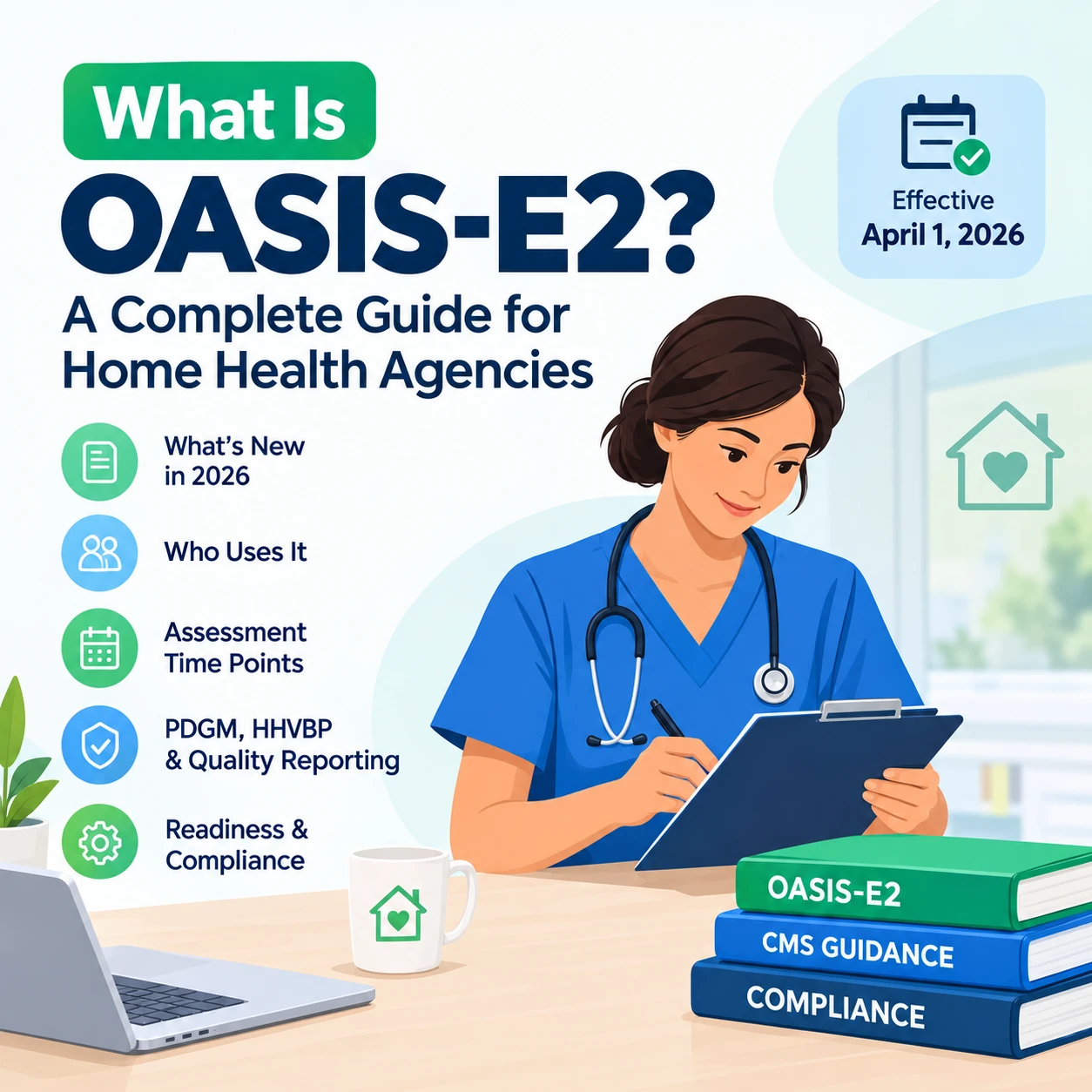
What Is OASIS-E2? A Complete Guide for Home Health Agencies
A practical guide to OASIS-E2: assessment changes, time points, quality and payment uses, EHR and iQIES readiness, and AI support that keeps clinicians in control.
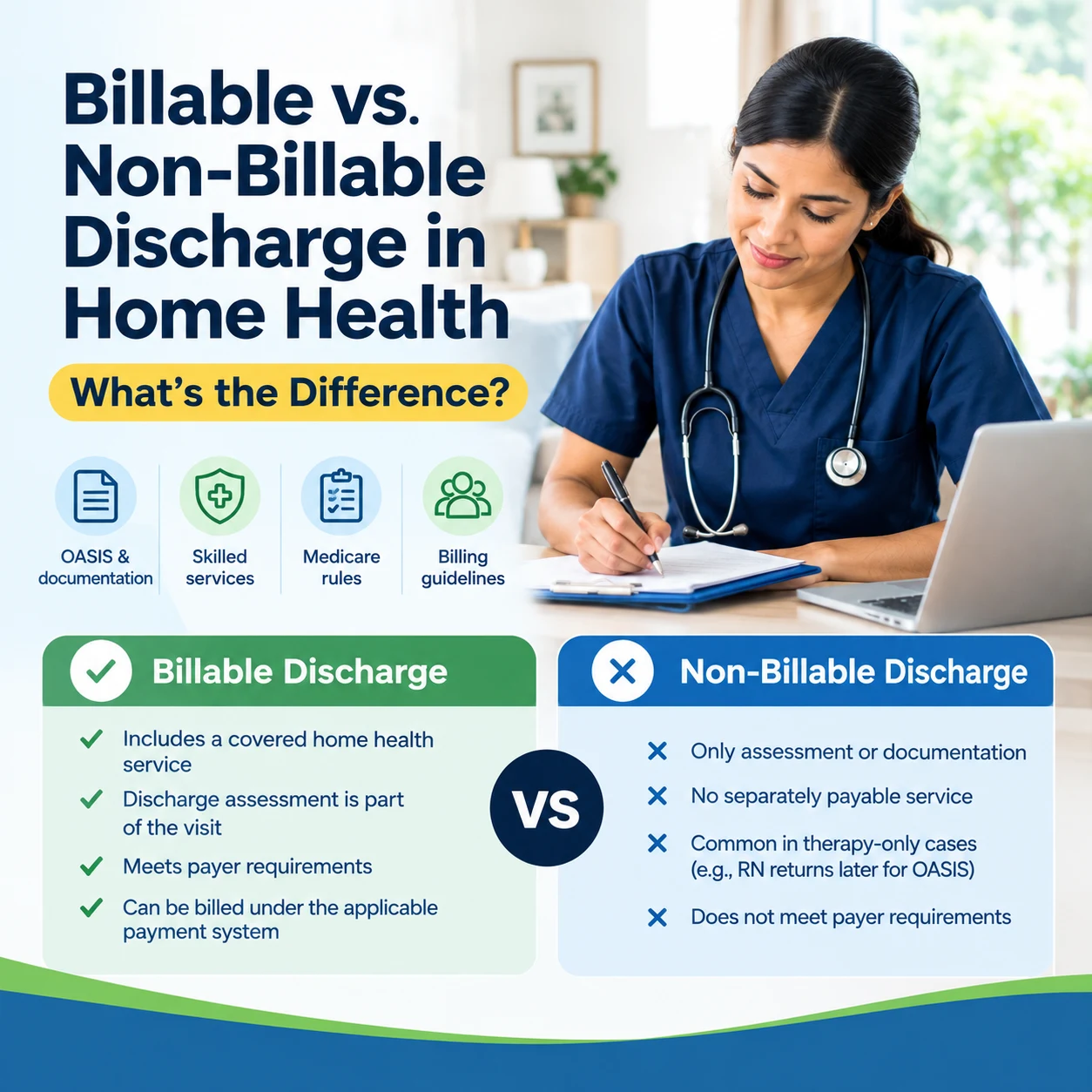
Billable vs. Non-Billable Discharge in Home Health: What's the Difference?
A discharge OASIS does not automatically make a home health visit billable. Learn how covered skilled services, payer rules, documentation, and the final clinician determine whether a discharge encounter may be payable.

What Documentation Should Home Health Agencies Audit Before Billing?
Before billing, confirm that eligibility, medical necessity, orders, OASIS-E2, coding, and visit documentation tell a consistent story and support the services on the claim.