
Human-in-the-Loop vs. Human-on-the-Loop: What's the Difference in Healthcare AI?
As healthcare adopts more AI, the key question isn't humans vs. AI — it's where the human belongs in the workflow. This guide explains human-in-the-loop vs. human-on-the-loop AI: how each works, the trade-offs, the risks (including automation bias), and how to match human oversight to clinical risk.
Key Takeaways
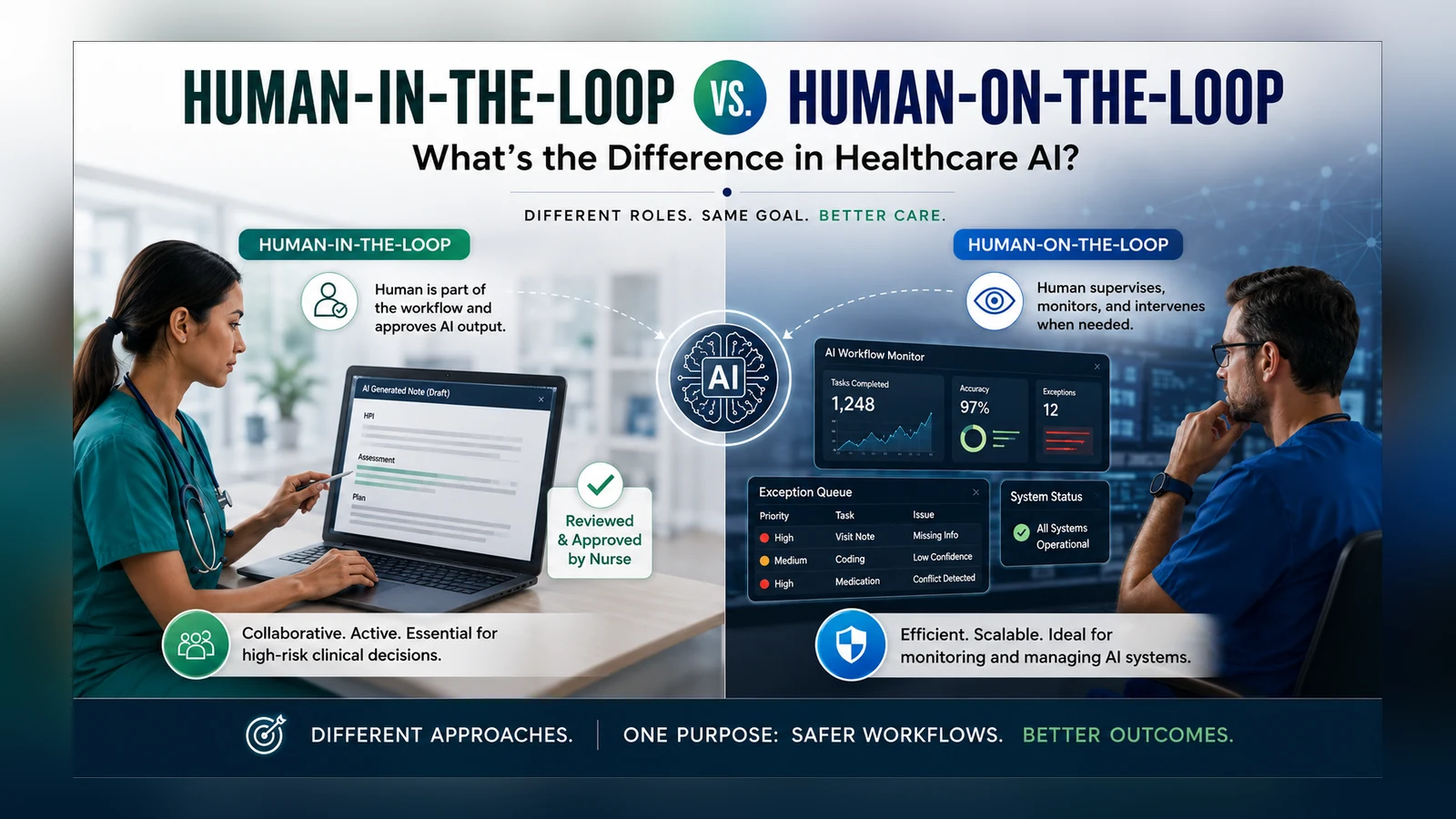
- Human-in-the-loop (HITL) AI: a human reviews or validates AI outputs before the workflow proceeds.
- Human-on-the-loop (HOTL) AI: the AI operates with greater autonomy while a human supervises and intervenes.
- Neither model is automatically better — match the level of human oversight to the consequences of an error.
- HITL fits high-risk, context-heavy work like clinical documentation; HOTL fits high-volume, lower-risk monitoring and routing.
- "Human oversight" is meaningless as a checkbox — what matters is whether the human can understand, edit, override, and audit the AI.
- Human review can still fail through rushing, alert fatigue, and automation bias, so oversight must be designed into the workflow.
- For clinical documentation, AI can create the record, but the clinician should stay able to confirm it reflects the care delivered.
💡 Quick Answer: Human-in-the-loop (HITL) AI means a person actively reviews, corrects, or approves an AI output before the workflow moves forward. Human-on-the-loop (HOTL) AI means the AI operates more independently while a human supervises the system and intervenes when needed. In healthcare, HITL fits high-risk, context-heavy work like clinical documentation; HOTL fits high-volume, lower-risk monitoring and routing. Neither is automatically better — the right model depends on the consequences of an error.
AI is becoming part of everyday healthcare workflows — clinical documentation, patient monitoring, decision support, scheduling, coding, and administrative automation. But as organizations adopt more AI, one question becomes increasingly important: where does the human fit into the workflow? That question separates two approaches: human-in-the-loop (HITL) and human-on-the-loop (HOTL). The difference sounds subtle, but it has major implications.
With human-in-the-loop AI, a person actively participates in reviewing, correcting, approving, or guiding an AI-generated output before the workflow proceeds. With human-on-the-loop AI, the AI performs the task more independently while a human supervises the system, monitors its performance, and intervenes when necessary. The FDA's AI terminology resources describe human-in-the-loop machine learning as an approach where humans interact with models to improve accuracy and trust, particularly when a model needs human verification. In healthcare, the right approach depends on what the AI is doing, how much risk is involved, and what happens if the AI gets something wrong.
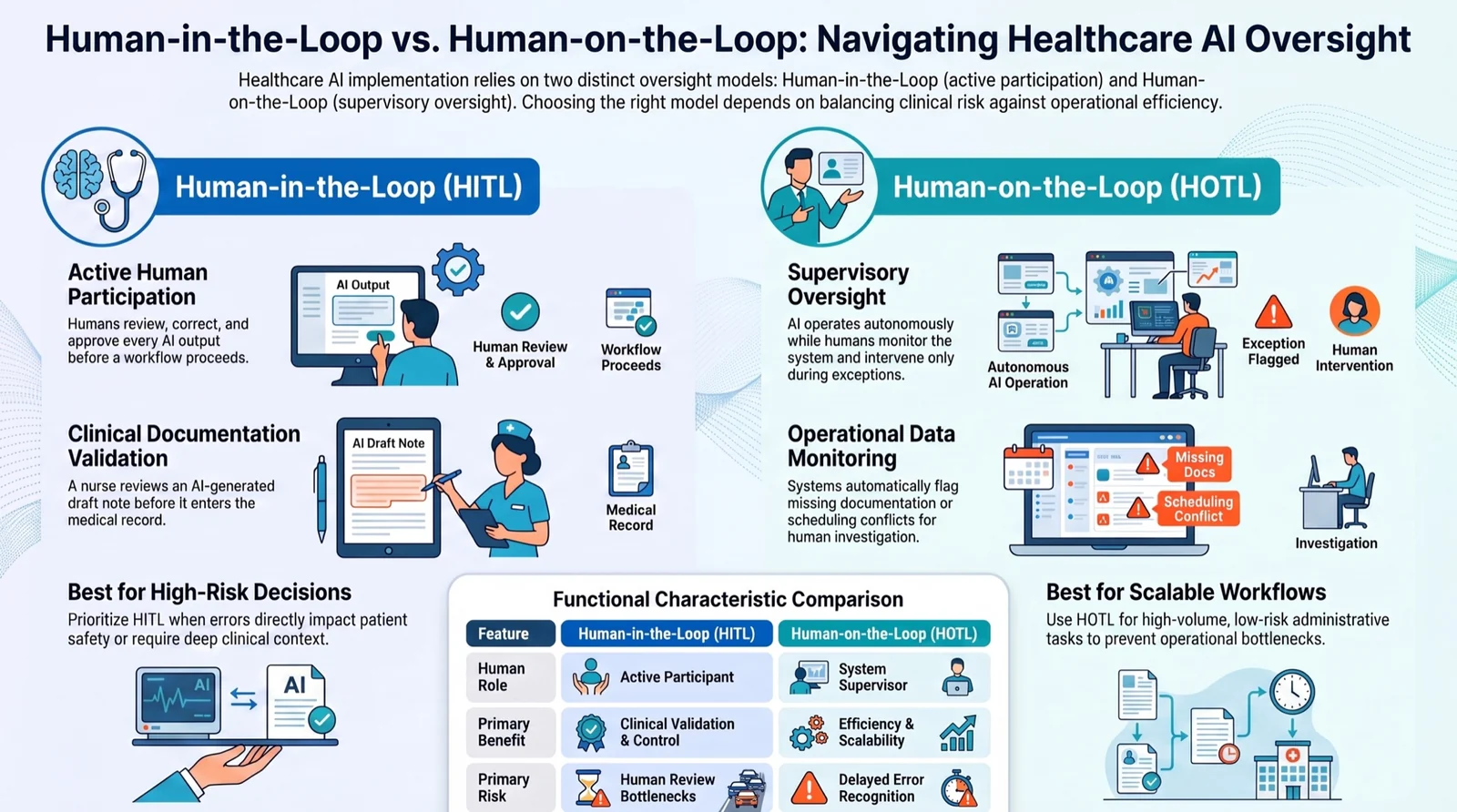
Two oversight models: HITL puts the human inside the workflow; HOTL puts the human above it. The choice balances clinical risk against operational efficiency.
What Is Human-in-the-Loop AI?
Human-in-the-loop AI is a collaborative model in which humans actively interact with AI outputs. The AI may perform the repetitive or computational work, but a human remains responsible for reviewing or guiding the result. The FDA defines human-in-the-loop machine learning around this kind of iterative human interaction, particularly where human verification can improve model accuracy and end-user trust. In healthcare, this is valuable because clinical information is often incomplete, contextual, and highly individualized — an AI model may recognize patterns in a patient's documentation, but the clinician understands the patient behind those patterns.
Example: AI clinical documentation
Consider a home health nurse completing a Start of Care visit. Instead of manually creating the entire clinical narrative, an AI documentation system could capture the nurse's voice or structured input, extract relevant clinical information, organize it into the appropriate sections, identify missing information, generate a draft, present it to the nurse, allow review and correction, and finalize only after human validation. The AI does the heavy administrative work; the nurse remains in control of the clinical record. That's a practical example of human-in-the-loop AI — the same principle behind AI vs. an ambient scribe for home health nurses.
What Is Human-on-the-Loop AI?
Human-on-the-loop AI gives the AI greater operational autonomy. Instead of requiring a person to approve every individual output, the AI executes predefined workflows while humans monitor the system at a higher level — monitoring performance, reviewing exceptions, investigating anomalies, overriding AI decisions, adjusting rules, auditing outputs, and intervening when predefined thresholds are exceeded.
This makes sense when AI handles high-volume, repetitive, lower-risk activities where requiring human approval for every transaction would eliminate much of the efficiency gained from automation. Note that "human-on-the-loop" isn't as standardized a term as human-in-the-loop; some literature uses "human-over-the-loop" for supervisory oversight. The underlying distinction is the same: the human supervises rather than participating directly in every individual AI decision.
Human-in-the-Loop vs. Human-on-the-Loop
| Feature | Human-in-the-Loop | Human-on-the-Loop |
|---|---|---|
| Human role | Active participant | Supervisor |
| AI autonomy | Lower | Higher |
| Reviews individual outputs | Usually | Not necessarily |
| Human intervention | Built into the workflow | Triggered by exceptions or monitoring |
| Best suited for | Higher-risk or context-heavy decisions | Repetitive, scalable workflows |
| Example | Nurse reviews an AI-generated clinical note | System auto-routes routine documentation |
| Primary benefit | Control and clinical validation | Efficiency and scalability |
| Primary risk | Human review can become a bottleneck | Humans may miss AI errors |
| Healthcare fit | Clinical documentation, decision support | Monitoring, routing, administrative workflows |
The important point is that neither model is automatically better. The appropriate model depends on the consequences of an error.
Why Human Oversight Matters in Healthcare AI
Healthcare isn't a typical automation environment. A recommendation that's slightly wrong in a low-risk administrative workflow may be inconvenient; a wrong clinical interpretation can potentially affect patient care. That's why healthcare AI needs to be designed around more than accuracy — organizations need to consider patient safety, clinical context, transparency, accountability, data quality, privacy, bias, human factors, auditability, and appropriate escalation. The FDA's transparency principles for machine-learning-enabled medical devices specifically emphasize the performance of the human-AI team and giving users the information they need to understand and appropriately use AI outputs. The goal isn't simply to build a smarter AI model; it's to build a better human-AI system.
Human-in-the-Loop AI in Home Health
Home health is a particularly interesting environment for HITL. A home health nurse doesn't work in a controlled hospital room — they may walk into a patient's home and encounter information that isn't neatly represented in an EHR. The patient's living environment, medication setup, caregiver availability, functional limitations, behavior, skin condition, mental status, home safety, and ability to follow instructions can all influence the clinical picture. Some of those observations are difficult to reduce to structured data — which is exactly where human judgment remains essential.
AI can help with the documentation burden
A human-in-the-loop documentation workflow could let AI transcribe voice input, structure clinical information, draft visit notes, extract medications, organize assessment information, identify potentially missing documentation, suggest areas needing clarification, generate patient-education drafts, and support coding — with the nurse reviewing the output. That creates a clear division of labor: AI handles documentation complexity; the nurse handles clinical judgment. It's the same idea explored in how AI and voice technology improve caregiver documentation.
Human-on-the-Loop AI in Home Health
Some home health workflows suit a more supervisory model. An organization could use AI to monitor large volumes of operational data and flag unusual patterns — missing documentation, unusual utilization, delayed documentation, workflow exceptions, scheduling conflicts, potential compliance issues, or patients requiring additional review. Rather than requiring a nurse or administrator to manually inspect every record, the system surfaces exceptions and the human investigates the cases that need attention. This is where human-on-the-loop approaches provide significant scalability.
Which Is Safer?
There isn't a universal answer. HITL generally provides more direct human control because the person participates before an output is finalized. But that doesn't automatically make every HITL system safer, because human review itself can fail. A clinician may be rushed, miss an AI error, become overly dependent on the system, approve outputs without adequate review, experience alert fatigue, or assume the AI is more accurate than it is — sometimes called automation bias. On the other hand, HOTL systems introduce a different risk: the human may be too far removed from individual decisions to recognize an error quickly enough. That's why oversight needs to be designed into the workflow rather than added as an afterthought. It's one reason nurses stop trusting AI tools when the oversight model is poorly designed.
The Biggest Mistake: Treating "Human Oversight" as a Checkbox
Saying an AI system has "human oversight" isn't enough. The important question is: what does the human actually do? "A nurse reviews the AI output" sounds reassuring — but what does "review" mean? Does the nurse see the original information, know what the AI changed, have enough time, understand the system's limitations, know when the AI is uncertain, have the ability to edit, have the authority to reject, know what happens after rejection, and have an audit trail? Those questions are far more important than simply saying "human-in-the-loop." The FDA's clinical decision-support framework similarly emphasizes that healthcare professionals should be able to independently review the basis for certain recommendations rather than simply relying on the software.
Human-in-the-Loop Is Not the Same as Human-on-the-Loop
It's easy to confuse the two because both involve human oversight, but the distinction is simple. Human-in-the-loop: the human participates before the decision is completed. Human-on-the-loop: the AI operates, and the human supervises the system. Think of it like driving — in human-in-the-loop, the AI assists but the driver actively participates in decisions and control; in human-on-the-loop, the automated system drives while a human supervises and is prepared to intervene. The level of autonomy is different.
When Should Healthcare Organizations Use Human-in-the-Loop AI?
HITL is especially appropriate when the AI output directly affects patient care, the information is highly contextual, errors could have significant consequences, the AI is generating clinical documentation (which represents what happened during care, not just data entry), or the system is still being evaluated and human interaction provides valuable feedback about where it performs well and where it struggles.
When Can Human-on-the-Loop AI Make Sense?
A supervisory approach may be more appropriate for administrative workflows (AI routes, categorizes, or prioritizes while humans monitor exceptions), high-volume processes (where manual approval of thousands of low-risk events creates bottlenecks), monitoring systems (AI continuously watches large datasets and alerts humans when conditions are met), and workflow optimization (AI identifies operational patterns needing management attention). The key is risk-based automation — not every task needs the same level of human involvement.
The Future Isn't Human vs. AI
The more important question isn't "should humans or AI make the decision?" — it's "what should AI do, and what should humans do?" AI is particularly good at processing large amounts of information, recognizing patterns, summarizing, automating repetitive tasks, structuring unstructured information, monitoring workflows, and performing consistent calculations. Humans remain essential for context, empathy, clinical reasoning, ethical judgment, patient relationships, communication, ambiguous situations, and accountability. The strongest systems don't force humans and AI to compete; they give each the work it's best suited to perform.
A Better Framework: Match Human Oversight to Risk
Healthcare organizations evaluating AI can ask five questions:
- What happens if the AI is wrong? If "nothing significant," more automation may be reasonable. If patient safety, clinical decisions, or regulatory consequences are involved, stronger human involvement is warranted.
- Can the human understand the AI's output? Users should have enough information to evaluate whether the output makes sense.
- Can the human override the AI? Oversight isn't meaningful if the human can't actually intervene.
- Is the review happening at the right point? A human reviewing a decision after the patient has been affected is very different from validating it before it is acted upon.
- Is there an audit trail? Organizations should understand what the AI produced, what the human changed, and what ultimately happened.
Human-in-the-Loop AI and Nurse Autonomy
For nurses, this distinction is particularly important: technology should reduce administrative burden without reducing clinical autonomy. A nurse completing a home health visit sees the patient, evaluates the environment, observes changes, asks questions, assesses symptoms, provides education, and uses clinical judgment. AI can then help transform that information into structured documentation — so the nurse doesn't have to spend another hour reconstructing the visit from memory. A well-designed human-in-the-loop workflow gives nurses something valuable back: cognitive space. Instead of typing, searching fields, and formatting, nurses can spend more attention on the patient and on reviewing whether the resulting documentation is accurate.
AI Shouldn't Remove the Human From Healthcare
The biggest opportunity in healthcare AI may not be replacing human work — it may be removing the work that prevents humans from doing their most important work. That means using AI to take on repetitive administrative tasks while preserving human involvement where context, judgment, and accountability matter. The FDA's ongoing work around AI-enabled medical devices continues to emphasize safety, effectiveness, transparency, lifecycle management, and post-market monitoring — a sign that AI implementation requires more than simply deploying a model. The goal shouldn't be "automate everything" or "keep a human involved in everything." It should be: put the human in the right place.
Final Takeaway
Human-in-the-loop and human-on-the-loop aren't competing philosophies — they're different levels of human involvement in AI-enabled workflows. HITL keeps people directly involved in individual AI outputs; HOTL gives AI more autonomy while keeping humans responsible for supervision and intervention. For healthcare, the right answer is rarely maximum automation or maximum human intervention — it's appropriate automation with appropriate human oversight. And for clinical documentation in particular, that distinction matters: AI can help create the record, but the clinician should remain able to determine whether the record accurately represents the care that was delivered. Getting this wrong shows up as documentation errors; getting it right is the heart of good OASIS documentation.
📝 Sources & further reading: FDA Digital Health and Artificial Intelligence Glossary; FDA — Transparency for Machine Learning-Enabled Medical Devices; FDA — Artificial Intelligence-Enabled Medical Devices; FDA — Clinical Decision Support Software; FDA — Good Machine Learning Practice for Medical Device Development. This article is educational and is not legal, clinical, or regulatory advice; always verify against current FDA and CMS guidance and your organization's policies.

Home Health Documentation Playbook
The complete guide to OASIS-E, Medicare compliance, PDGM, and AI-assisted documentation. Learn how top agencies reduce documentation time without sacrificing compliance.
Bottom Line
Human-in-the-loop and human-on-the-loop aren't competing philosophies — they're different levels of human involvement in AI workflows. HITL keeps people inside individual AI outputs; HOTL gives AI more autonomy while humans supervise and intervene. In healthcare the right answer is rarely maximum automation or maximum human intervention; it's appropriate automation with appropriate oversight. For clinical documentation especially, AI can help create the record, but the clinician should remain able to confirm it accurately represents the care delivered. The goal isn't to automate everything or keep a human in everything — it's to put the human in the right place.

Arvind Sarin is the founder of Copper Digital. For the past year he has spent three days a week inside a 500+ census Texas home health agency, building AI documentation that finishes OASIS and visit notes the same day, with a nurse reviewing and approving every note. He writes about home health documentation, OASIS, Medicare compliance, and applying AI responsibly in clinical workflows.
Frequently asked
Frequently asked questions
Human-in-the-loop AI is an approach where a human actively participates in the AI workflow by reviewing, validating, correcting, or guiding AI outputs. The FDA describes human-in-the-loop machine learning as involving human interaction with models to improve accuracy and trust, including verification when needed.
Join the conversation
Leave a comment
Related reading

How Ambient AI Is Changing Clinical Documentation
Ambient AI passively listens to patient-clinician conversations and automatically generates structured clinical documentation, using speech recognition, NLP, and large language models to capture symptoms, diagnoses, medications, and plans. It reduces after-hours charting and burnout while the clinician reviews and approves every note. In home health, it works best paired with an AI documentation agent that understands OASIS and referral workflows.
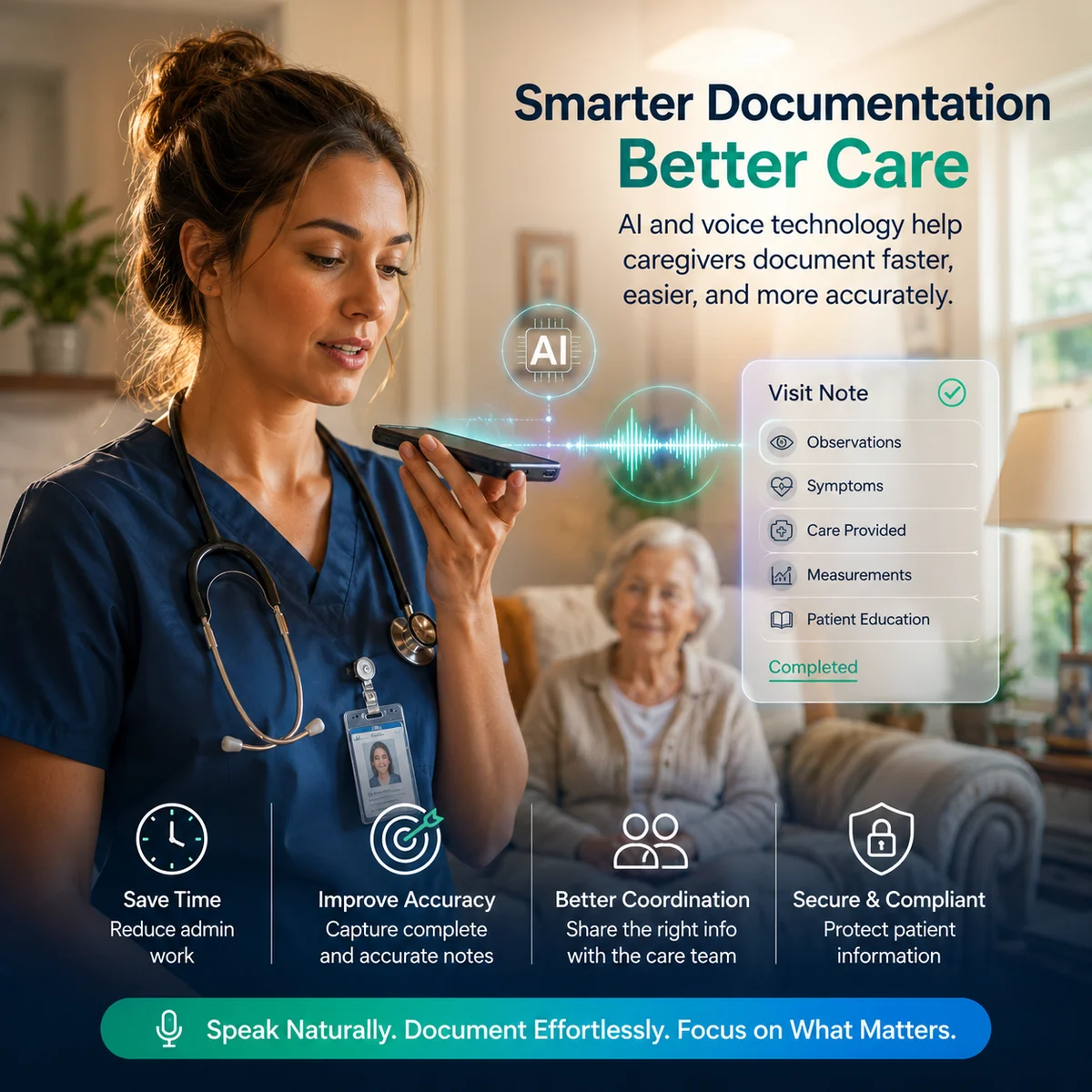
How AI and Voice Technology Improve Caregiver Documentation in Home Health
Documentation can eat a caregiver's day. AI and voice technology let caregivers speak their observations while a visit is fresh, then help organize the information into structured documentation — reducing typing, after-hours charting, and errors, while the caregiver reviews and stays accountable for the final record.
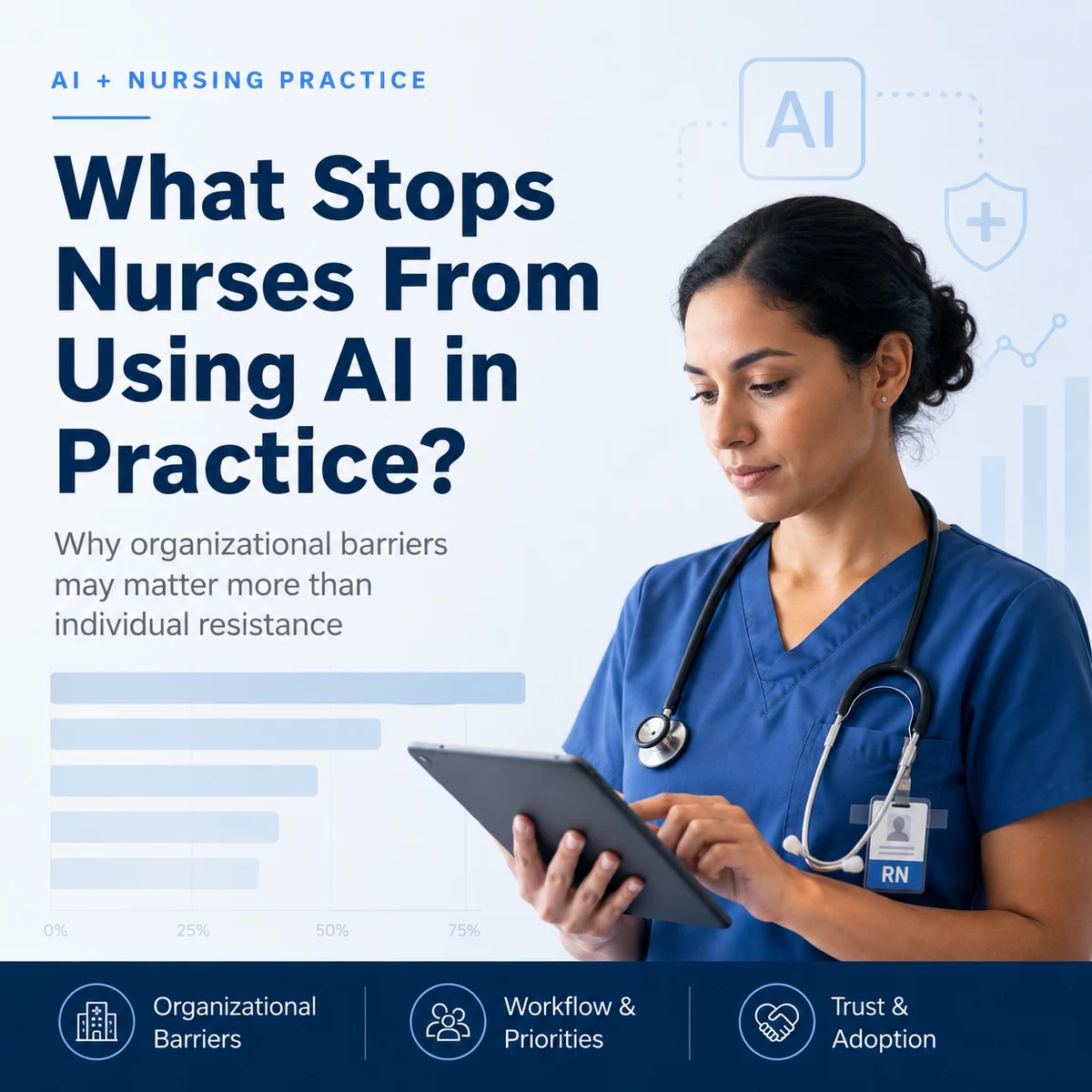
What Stops Nurses From Using AI in Practice?
AI adoption is usually framed as a clinician problem, but a 42-nurse course evaluation found the top barrier was organizational policy and IT restrictions (21 of 42), not distrust or fear. This guide breaks down 12 real barriers (governance, patient trust, competing priorities, time, workflow friction, privacy, burnout, and more) and the seven conditions that make nurses actually adopt AI.