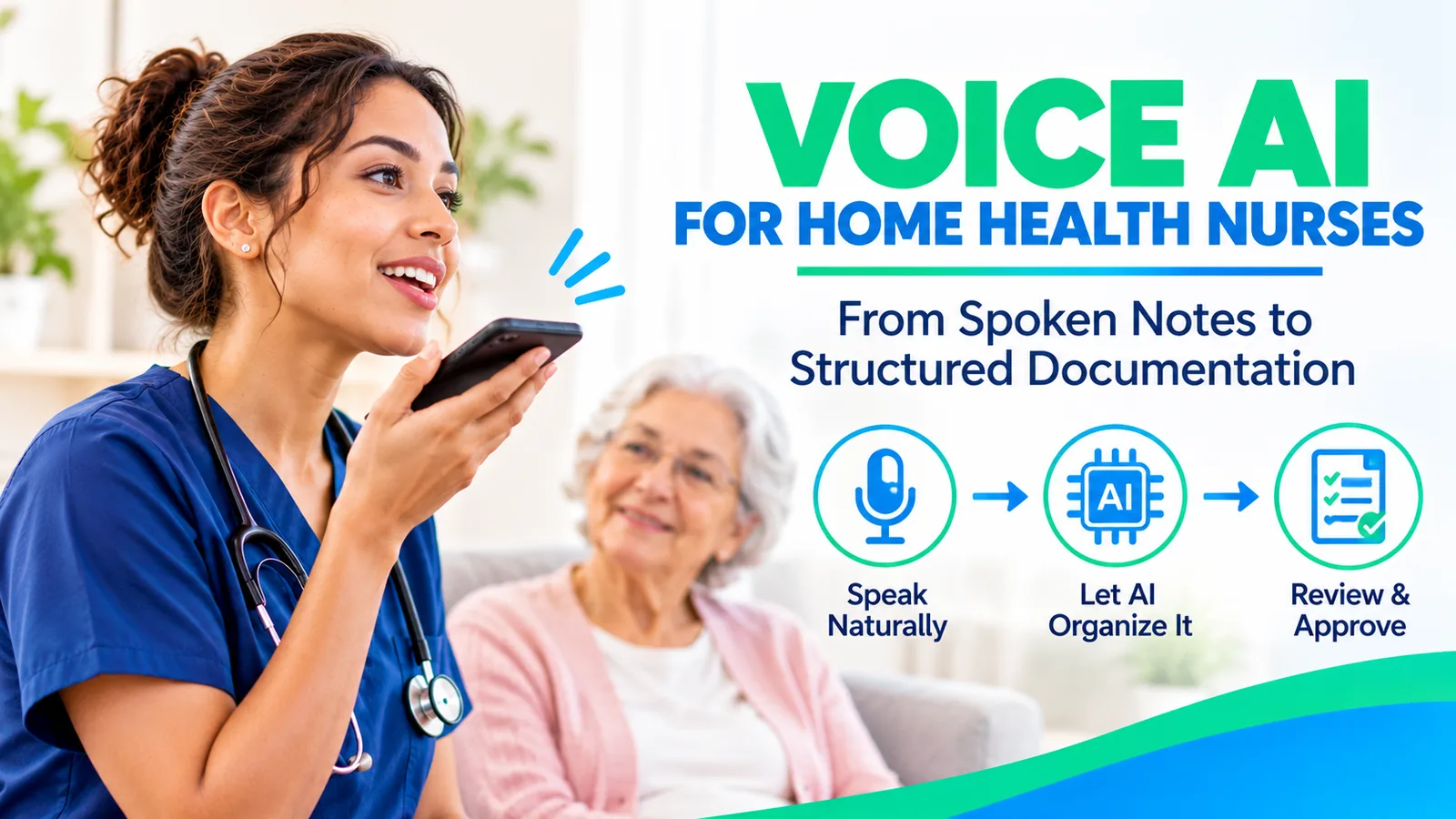
A home health nurse finishes a patient visit. The assessment is complete. Vital signs have been checked. Medications have been reviewed. Wound care, patient education, and follow-up instructions have all been addressed.
But the work isn't finished.
The nurse still has to document the visit, organize clinical observations, complete the required fields, and make sure the record accurately reflects what happened in the home.
For many home health nurses, this documentation happens after the visit, sometimes at the end of an already long day.
What if the nurse could simply describe the visit in their own words and have AI turn that spoken information into structured clinical documentation?
That's the idea behind voice AI for home health nurses.
Voice AI combines speech recognition and artificial intelligence to transform free-form spoken notes and clinical observations into organized documentation. Instead of typing every detail into multiple fields, a nurse can narrate the visit naturally. AI helps convert that narrative into a structured draft that the clinician can review, correct, and approve.
But how does this process actually work? What happens between the nurse speaking and the final clinical note appearing in the documentation system?
What Is Voice AI for Home Health Nurses?
Voice AI for home health nurses is technology that uses speech recognition and AI to help convert spoken clinical information into written and structured documentation.
A nurse can describe what happened during a patient visit using natural language. The system processes the spoken information, identifies relevant clinical details, and organizes them into a documentation format.
For example, a nurse might say:
The patient was sitting in the living room when I arrived. She was using her walker and appeared slightly short of breath after walking from the bedroom. I checked her vital signs, reviewed her medications, assessed the lower-extremity wound, and reinforced instructions about keeping the dressing clean and dry.
A basic speech-to-text tool would convert those words into a written paragraph.
Clinical voice AI can go further by helping organize the information into relevant sections, such as:
- Patient condition and general observations.
- Mobility and functional status.
- Respiratory assessment.
- Wound assessment and care.
- Medication review.
- Patient and caregiver education.
- Follow-up instructions.
The goal is not simply to capture speech. It is to make the information easier to use in the clinical documentation workflow.
Why Is Documentation Still a Burden for Home Health Nurses?
Home health documentation is different from documentation in many facility-based settings.
Nurses travel between patient homes, work in different environments, and often manage several visits in a day. They must capture the details of each encounter while also keeping up with assessments, care plans, medication information, physician communication, and agency documentation requirements.
The challenge is not just the amount of information. It is when and how that information has to be entered.
A nurse may remember the details of a visit clearly while still in the patient's home. But once the nurse has travelled to the next visit, completed another assessment, or returned home, documenting the earlier encounter can become another task competing for attention.
This creates several challenges:
- After-hours charting: Documentation may continue after scheduled patient visits are over.
- Repeated data entry: Information may need to be entered into multiple sections or systems.
- Context switching: Nurses move between clinical care, notes, forms, and administrative tasks.
- Incomplete details: Important observations may be harder to recall when documentation is delayed.
- Documentation fatigue: Repetitive typing and administrative work can take time away from rest and personal life.
The solution should not be to make nurses type faster. It should be to make documentation fit more naturally into the way they already work.
How Does Voice AI Turn Spoken Notes Into Structured Clinical Documentation?
Turning a spoken narrative into a structured clinical note involves several stages. The process goes beyond recording audio or converting speech into text.
How Are Spoken Notes Captured and Converted Into Text?
The process begins when the nurse speaks into a mobile device or another supported recording interface during or immediately after a home visit.
The nurse can describe the patient's condition, assessment findings, interventions, and response to care in their own words.
Automatic Speech Recognition (ASR) converts the spoken audio into raw text.
A clinical voice AI system needs to handle more than everyday conversation. It should be able to process clinical terminology, medication names, abbreviations, measurements, and the language commonly used during patient visits.
For example, the system needs to distinguish between similar-sounding clinical terms and accurately capture details such as blood pressure readings, wound measurements, and medication names.
Speech recognition is the first step, not the finished documentation. The resulting text still needs to be interpreted and organized.
How Does AI Understand Clinical Language and Context?
Once speech has been converted into text, Natural Language Processing (NLP) and other AI techniques can help identify relevant information within the narrative.
The system may recognize clinical entities and details such as:
- Vital signs and measurements.
- Symptoms and changes in condition.
- Wound observations.
- Medication-related information.
- Interventions performed.
- Patient and caregiver responses.
- Education and follow-up instructions.
For example, consider the statement:
Blood pressure was elevated today. The patient said she missed her morning medication.
A clinical documentation system should preserve both pieces of information: the elevated blood pressure and the patient's report of a missed medication dose.
It should not automatically conclude that the missed medication caused the elevated reading. That would be a clinical interpretation requiring appropriate evidence and clinician judgment.
The distinction matters. AI should organize and preserve the information provided by the nurse without inventing findings or making unsupported clinical conclusions.
Some voice systems also support speaker diarization, which helps distinguish between different speakers in an audio recording. This can be useful when a recording includes both a clinician and a patient or caregiver. However, speaker identification is a separate capability and is not required in every voice-dictation workflow.
How Does AI Generate a Structured Clinical Note?
A spoken narrative is usually conversational. A clinical record, on the other hand, follows a defined format.
This is where language models can help.
A Large Language Model (LLM), combined with appropriate clinical instructions and documentation rules, can help organize the extracted information into a structured note.
Depending on the system and workflow, this may include formats such as:
- SOAP notes: Subjective, Objective, Assessment, and Plan.
- Visit summaries.
- Clinical assessment sections.
- Intervention and response documentation.
- Patient education and follow-up sections.
- Structured information that supports applicable OASIS documentation workflows.
The nurse should not have to speak in the exact order of the documentation template. The system can help arrange the information into the appropriate sections.
For example:
| Spoken information | Possible documentation section |
|---|---|
| Patient reported pain in the right knee | Subjective information |
| Blood pressure and other vital signs recorded | Objective findings |
| Wound assessed and dressing changed | Assessment and interventions |
| Patient instructed on dressing care | Patient education |
| Follow-up assessment planned | Plan and follow-up |
The final structure depends on the agency's documentation requirements and the capabilities of the system.
Importantly, a structured note is not automatically a complete OASIS assessment. OASIS includes specific assessment items, response options, time-point requirements, and coding instructions. AI can help organize relevant information, but required clinical assessment and item-level validation remain the responsibility of qualified clinicians.
How Does the Nurse Review and Approve the Documentation?
The generated note should be presented to the clinician as a draft.
Before it becomes part of the final clinical record, the nurse needs to be able to:
- Review the transcript and structured sections.
- Correct speech-recognition errors.
- Verify clinical terms, measurements, and medication details.
- Add information that was not captured.
- Remove information that does not accurately reflect the visit.
- Confirm that the documentation is consistent with the clinical record.
- Approve the final documentation.
Where supported, the approved information can then be transferred or synced into the agency's EMR workflow.
This final stage is essential. AI prepares the documentation draft; the clinician remains responsible for reviewing, correcting, and approving the clinical record.
What Is the Difference Between Voice-to-Text and Clinical Voice AI?
Voice-to-text and clinical voice AI are related, but they are not the same.
Voice-to-text primarily converts spoken words into written text. Clinical voice AI can also help interpret and organize the resulting information into a structured clinical documentation format.
| Capability | Basic voice-to-text | Clinical voice AI |
|---|---|---|
| Converts speech into text | Yes | Yes |
| Captures natural spoken language | Yes | Yes |
| Recognizes clinical terminology | Depends on the tool | Designed to support clinical language |
| Organizes information into clinical sections | Usually requires manual work | Can assist with structuring |
| Prepares structured documentation | Not typically | Can prepare a draft |
| Requires clinician review | Yes | Yes |
A transcript alone does not automatically become a complete clinical note.
For home health agencies, the more useful question is not whether a tool can recognize a nurse's voice. It is whether it can help turn the information into documentation that fits the agency's clinical workflow.
Can Home Health Nurses Speak Naturally Instead of Following a Script?
They should be able to.
A useful voice AI workflow should accommodate the way nurses naturally describe a patient visit. Clinicians should not have to memorize a long list of commands or speak in a rigid sequence just to generate a note.
For example, a nurse might describe the visit in this order:
- The patient's condition on arrival.
- Mobility and safety observations.
- Vital signs and assessment findings.
- Wound care and interventions.
- Medication review.
- Education and follow-up.
Another nurse may describe the same information in a different order.
AI can help organize the narrative into the appropriate sections, provided the information is clear and sufficiently detailed.
This flexibility matters in home health because visits happen in real homes, not controlled documentation environments.
Can Voice AI Support Spanish-Speaking Home Health Nurses?
Voice-enabled AI can also help with multilingual documentation workflows.
For example, a nurse may prefer to describe a visit in Spanish while the agency requires the clinical documentation to be prepared in English.
A system designed for this workflow can process the spoken Spanish narrative and prepare an English documentation draft for the nurse to review.
This can help reduce the extra effort involved in translating clinical observations while documenting the visit.
However, translation accuracy matters. Clinical terms, medication names, measurements, and patient statements must retain their intended meaning. The clinician must be able to review and correct the translated documentation before approval.
Copper AI supports a Spanish-to-English spoken documentation workflow through its voice documentation experience.
Can Voice AI Work With an Agency's Existing EMR?
Home health agencies should not have to rebuild their entire documentation process just to use voice AI.
Before adopting a solution, agencies should understand how it works with their current EMR and documentation workflow.
Important questions include:
- Can it use information already entered into the existing patient record?
- Can it organize spoken notes into the agency's required documentation format?
- Does it support the agency's existing EMR?
- Can clinicians review and correct the draft before it is finalized?
- Does it require duplicate data entry?
- What happens when a required clinical detail is missing?
- How are approved notes transferred or made available in the existing workflow?
Integration capabilities vary between products and EMR environments. Agencies should verify the supported workflow rather than assume every voice AI tool connects to every EMR.
The objective should be to reduce repetitive work, not introduce another disconnected system.
What Benefits Can Voice AI Bring to Home Health Nurses?
When implemented appropriately, voice AI can help reduce the administrative effort involved in preparing clinical documentation.
Can Voice AI Help Reduce Documentation Time?
Speaking naturally can be faster than typing a detailed visit narrative, particularly when the clinician has several observations and interventions to document.
By converting spoken information into a structured draft, voice AI can reduce the amount of manual typing and formatting required.
The actual time saved depends on the accuracy of the system, the complexity of the visit, the amount of editing required, and the agency's existing workflow.
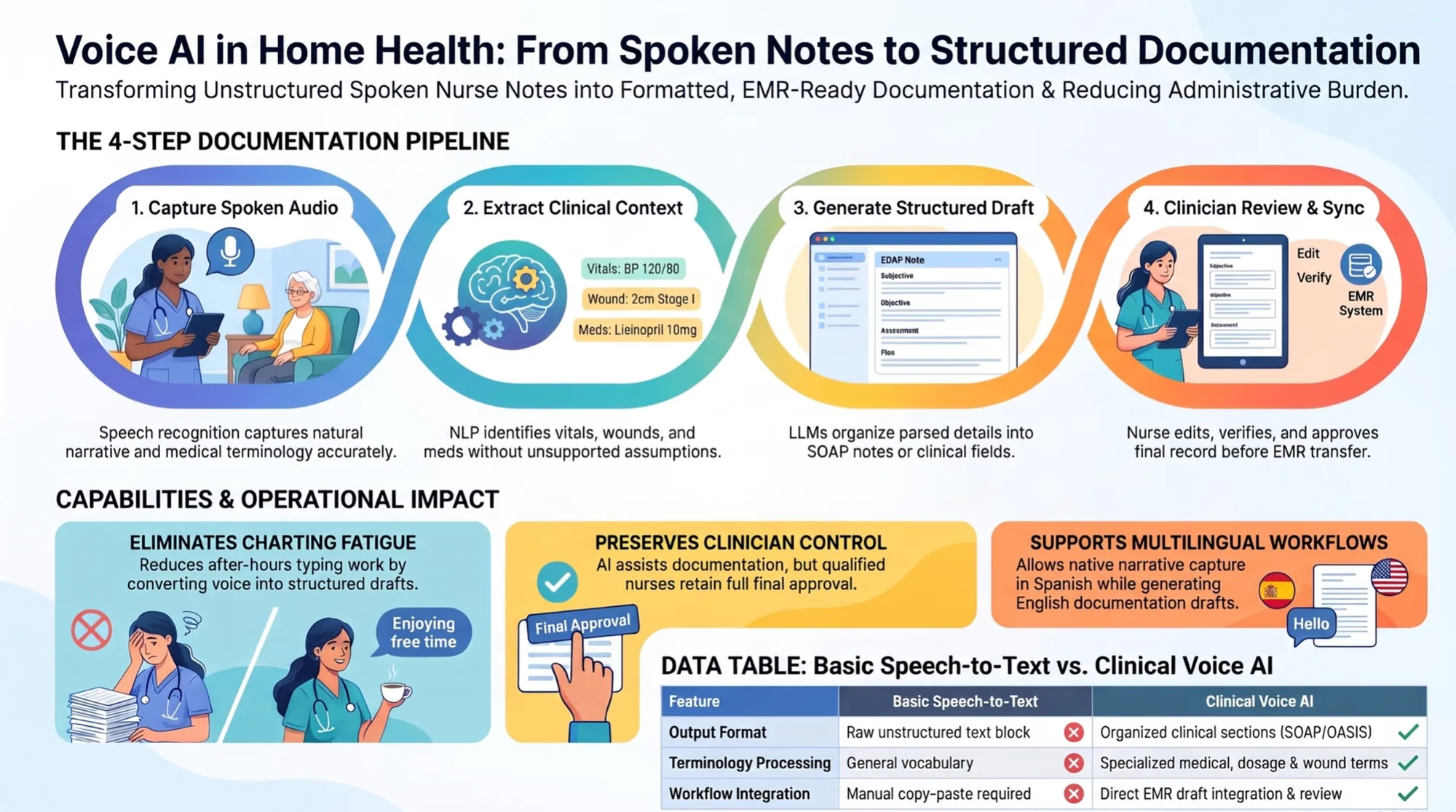
Clinical voice AI goes beyond transcription: it structures the narrative into a draft the nurse reviews, corrects, and approves.
Can Voice AI Help Reduce Documentation Errors?
AI-assisted documentation can help reduce certain manual transcription and data-entry errors. It may also help identify information that appears incomplete or inconsistent, depending on the system's capabilities.
However, AI can also introduce errors through inaccurate speech recognition or incorrect interpretation.
That is why clinical review is essential. The objective should be to make errors easier to identify and correct, not to assume that an AI-generated note is automatically accurate.
Can Voice AI Help Nurses Finish Documentation Earlier?
When nurses can capture visit information through speech and receive an organized draft, they may spend less time starting notes from a blank screen.
This can help reduce the documentation work that follows them after scheduled visits.
Agencies can evaluate the impact by tracking documentation time per visit, after-hours charting, correction rates, and clinician feedback.
Can Voice AI Support Better Continuity of Care?
Clear, organized documentation helps other members of the care team understand what happened during a visit.
When relevant observations, interventions, patient responses, and follow-up instructions are captured accurately, the record can better support communication across the care team.
Voice AI can help organize this information, but it should not replace the agency's established handoff, care coordination, or communication procedures.
What Should Home Health Agencies Look for in a Voice AI Documentation Solution?
Not every voice AI tool is designed for home health.
A general-purpose transcription application may capture a conversation, but home health documentation involves clinical assessments, structured fields, patient information, and agency-specific workflows.
Before choosing a solution, agencies should evaluate the following capabilities.
Does It Understand Home Health Documentation?
The system should be designed around the language and documentation needs of home health clinicians, not just general conversation.
Can It Organize Spoken Notes Into Structured Sections?
The value comes from turning a narrative into a usable documentation draft, rather than leaving nurses with another paragraph to format manually.
Can Nurses Review and Approve the Final Note?
Clinicians must retain control over clinical documentation. The system should support review, correction, and approval rather than automatically submitting unverified information.
Does It Handle Clinical Terminology Accurately?
Agencies should test the system using realistic visit narratives, including medication names, wound descriptions, abbreviations, measurements, and commonly used clinical terms.
Does It Support Multilingual Workflows?
For agencies with multilingual teams, language support can make documentation more accessible. The quality of clinical translation should be evaluated before deployment.
Does It Fit the Existing EMR Workflow?
A voice AI solution should be assessed for compatibility with the agency's current systems and processes.
Does It Protect Patient Information?
Agencies should review the vendor's security practices, HIPAA-related safeguards, business associate agreement (BAA), data handling, access controls, and audit capabilities before using the technology with protected health information.
How Does Copper AI Help Home Health Nurses Turn Spoken Notes Into Structured Documentation?
Copper AI is designed to help home health agencies reduce repetitive clinical documentation work while keeping clinicians in control.
Its voice agent, Joy, allows nurses to describe a patient visit conversationally. Joy turns the spoken narrative into a structured clinical documentation draft that the nurse can review, correct, and approve.
Instead of requiring the clinician to type every detail from scratch, the workflow helps organize the information already captured during the visit.
For example, a nurse can describe:
- The patient's condition on arrival.
- Mobility and safety observations.
- Vital signs and assessment findings.
- Wound care and interventions.
- Medication review.
- Patient and caregiver education.
- Follow-up instructions.
Joy helps organize those details into the relevant documentation sections.
The workflow is built around three important principles:
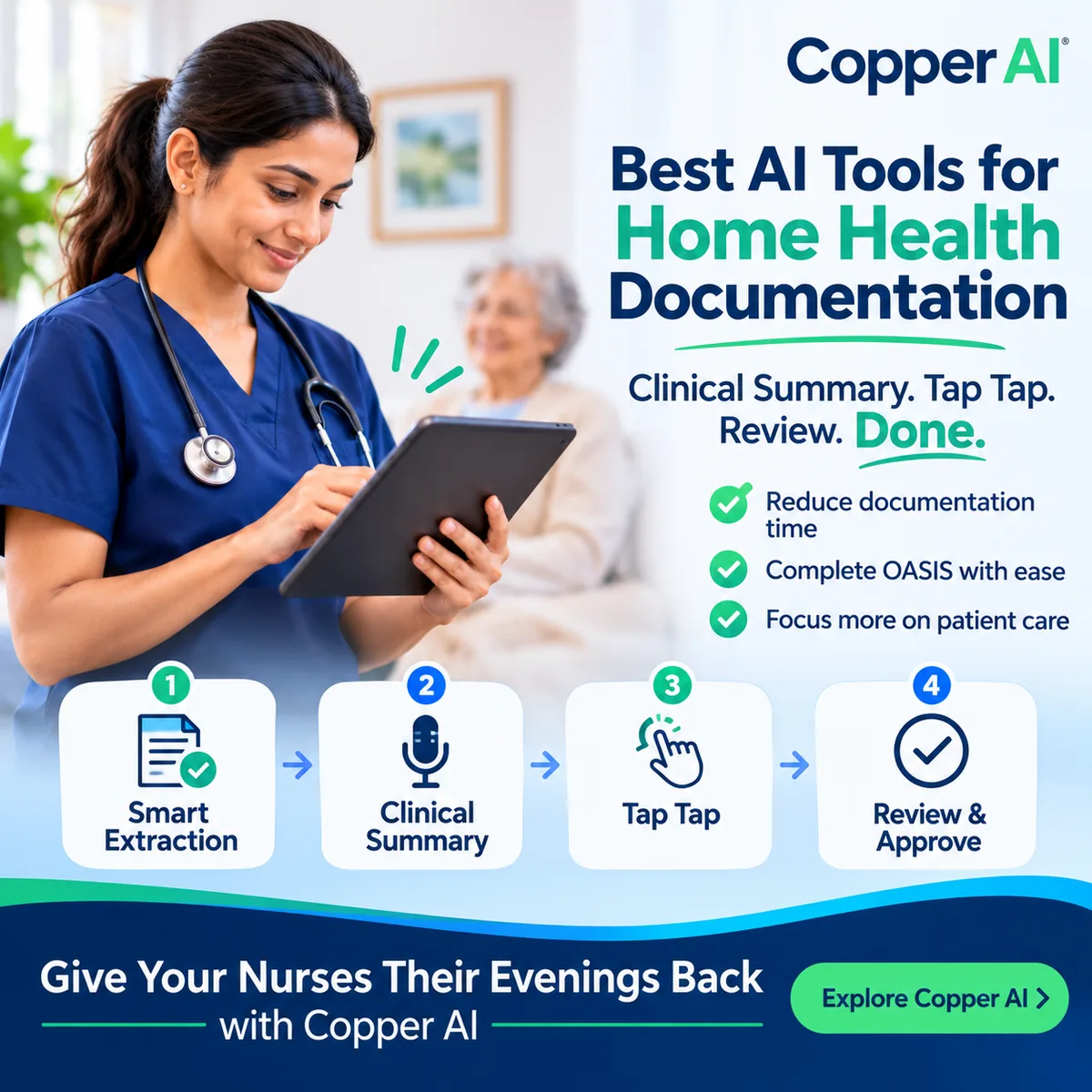
Speak naturally. Nurses can describe the visit in their own words instead of following rigid voice commands.
Structure the information. AI helps turn the spoken narrative into organized clinical documentation.
Keep the clinician in control. The nurse reviews, corrects, and approves the final record. Copper AI does not remove the need for clinical judgment or clinician sign-off.
Copper AI also supports a Spanish-to-English spoken documentation workflow, helping clinicians describe visits in Spanish while preparing an English draft for review.
The larger goal is to work around the way clinicians already work, rather than asking them to change their entire documentation process to accommodate AI.
Nurses already have enough to manage during a visit. They should not have to spend the rest of the day recreating that visit in the EMR.
How Can Agencies Measure the Impact of Voice AI?
Adopting voice AI should be about measurable workflow improvement, not simply adding another technology to the agency.
Agencies can compare their documentation process before and after implementation using indicators such as:
- Average time spent documenting each visit.
- Time between the end of a visit and completion of its note.
- Amount of documentation completed after scheduled working hours.
- Number of notes returned for correction.
- Frequency of missing or inconsistent information.
- Clinician adoption and satisfaction.
- Amount of duplicate data entry.
These measures help agencies determine whether voice AI is actually reducing administrative effort and improving the documentation workflow.
The technology should make the process easier for clinicians, not create another layer of review and correction.
What Does the Future of Voice AI in Home Health Look Like?
Voice AI is changing how clinicians can interact with documentation systems.
Instead of treating every clinical note as a typing task, agencies can begin thinking about documentation as a process of capturing, organizing, reviewing, and approving information.
For home health, that shift matters.
Nurses work in patient homes, move between visits, and make clinical observations in environments where typing may not always be practical. A voice-enabled workflow can make it easier to capture those observations in a natural way.
But successful adoption will depend on more than speech recognition. It will require clinical context, reliable structuring, appropriate integration, patient-data protection, and clear clinician accountability.
AI should adapt to the way nurses work. Nurses should not have to change their entire workflow to accommodate AI.
Care happens in the home. Documentation should not follow nurses home every night.
About Copper AI
Copper AI builds AI-powered solutions for home health agencies, helping reduce repetitive clinical and administrative work while supporting existing workflows. Its voice agent, Joy, helps turn spoken visit narratives into structured documentation drafts for clinician review and approval.
Book a demo to see how Joy works with your agency's documentation workflow.