
Why Medicare Home Health Claims Get Denied
Medicare home health claim denials are revenue leaks, not just billing issues. This guide breaks down the ten most common reasons claims get denied, from OASIS gaps and late NOAs to coding and medical-necessity problems, and how to prevent them to get paid faster.
Key Takeaways
- Most Medicare home health claim denials are preventable.
- Accurate OASIS documentation is essential for reimbursement.
- Timely NOA submission protects agency revenue.
- Strong ICD-10 coding supports PDGM payment accuracy.
- Documentation must clearly demonstrate skilled need and homebound status.
- Physician signatures and certifications should never delay billing.
- Internal QA processes reduce costly claim corrections.
- AI-assisted documentation can improve documentation quality and accelerate reimbursement.
💡 Quick Answer: Medicare home health claims get denied mostly for preventable reasons: incomplete or inconsistent OASIS documentation, missing face-to-face encounter records, late Notice of Admission (NOA), incorrect ICD-10 coding, missing physician signatures, and documentation that fails to prove medical necessity or homebound status. Strong internal QA and AI-assisted documentation review catch these gaps before claims are submitted.
For most home health agencies, Medicare claim denials aren't simply billing issues; they're revenue leaks that affect cash flow, clinician productivity, compliance, and long-term profitability. Every denied claim means additional administrative work, delayed reimbursement, increased audit risk, and valuable staff time spent correcting preventable documentation errors instead of caring for patients.
As Medicare regulations become increasingly complex under PDGM (Patient-Driven Groupings Model), agencies must ensure every claim is supported by accurate clinical documentation, complete OASIS assessments, timely physician signatures, and proper coding. Even a seemingly minor mistake such as an incorrect diagnosis sequence, missing face-to-face documentation, or a late Notice of Admission (NOA) can delay payment for weeks or even months.
The financial impact extends beyond a single denied claim. Agencies experiencing frequent Medicare denials often struggle with slower revenue cycles, increased accounts receivable (A/R), higher administrative costs, and additional scrutiny during Medicare audits. Meanwhile, clinicians face growing documentation burdens as they revisit charts, answer billing queries, and complete corrections after patient visits.
Understanding why Medicare home health claims get denied is the first step toward building a stronger revenue cycle. In this guide, we'll explore the most common reasons Medicare denies home health claims, explain how these denials affect agencies, and share practical strategies to reduce billing errors, improve documentation quality, and accelerate reimbursement.
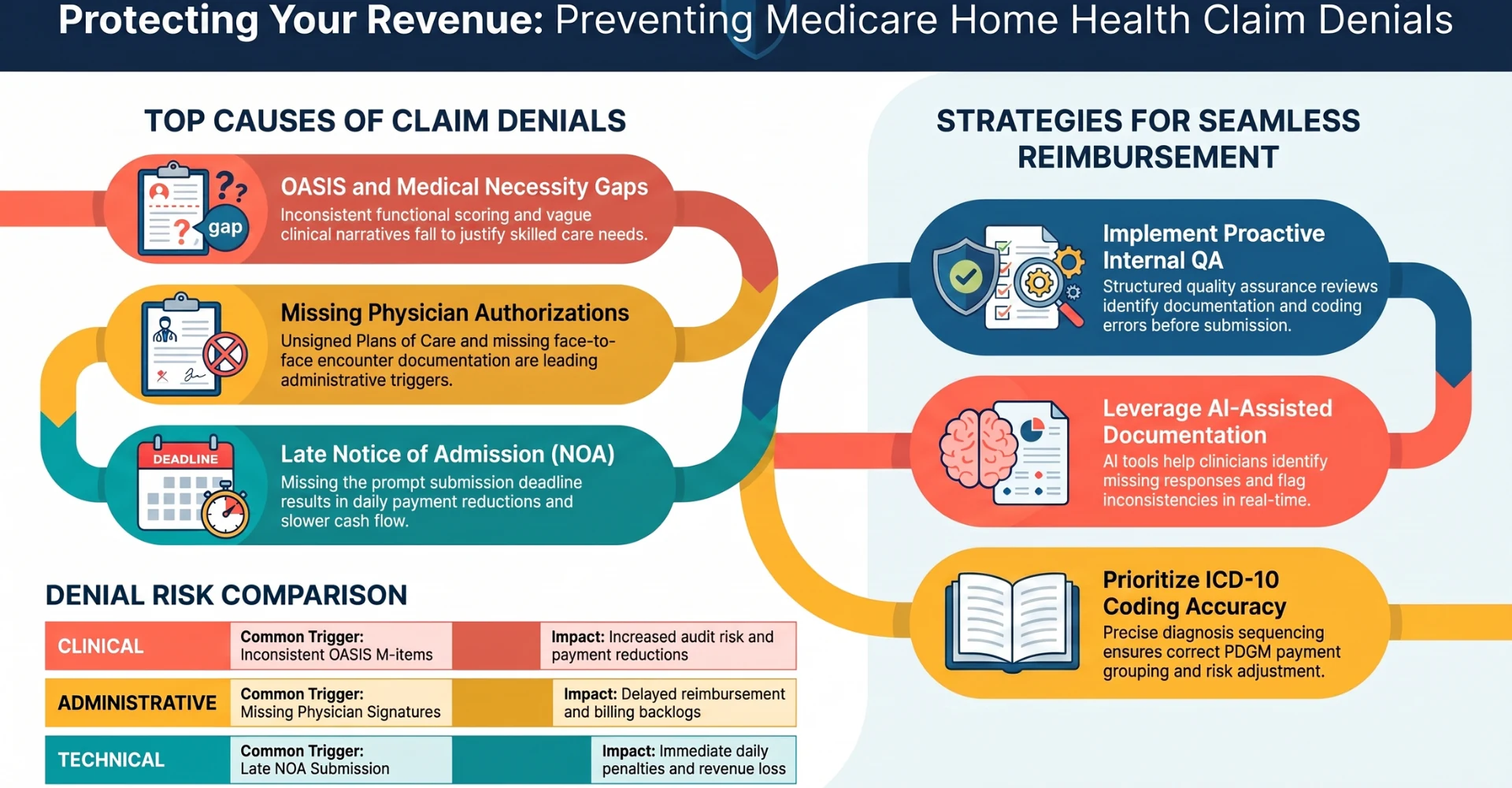
The top causes of Medicare home health claim denials, the strategies that prevent them, and how clinical, administrative, and technical triggers each impact reimbursement.
Why Medicare Claim Denials Matter
Many agencies focus only on getting claims submitted. Successful agencies focus on getting claims paid the first time.
Every denied Medicare claim creates a ripple effect across your organization:
- Cash flow slows.
- Billing teams spend hours correcting claims.
- Nurses receive documentation queries.
- Administrators chase physician signatures.
- Revenue becomes unpredictable.
- Audit exposure increases.
Preventing denials is significantly less expensive than fixing them afterward.
1. Incomplete or Inaccurate OASIS Documentation
OASIS is one of the most important clinical documents in home health because it directly influences PDGM reimbursement, quality reporting, Star Ratings, care planning, and Medicare payment eligibility. Since OASIS drives both clinical and financial outcomes, even small documentation inconsistencies can result in claim denials, Requests for Additional Documentation (ADR), payment reductions, or delayed reimbursement.
Many claim denials begin long before the billing department submits a claim. They originate during the Start of Care (SOC), Recertification, Resumption of Care (ROC), or Discharge assessment when required OASIS fields are incomplete, conflicting, or unsupported by the clinical narrative. Missing functional assessments, incorrect M-items, inaccurate Section GG responses, or inconsistent diagnosis coding all increase the likelihood that Medicare reviewers question the medical necessity of services.
Common OASIS errors include:
- Missing assessment items
- Inconsistent functional scoring
- Unsupported diagnoses
- Incorrect timing of assessments
- Missing clinician narratives
- Documentation that doesn't support skilled need
Accurate OASIS documentation protects both reimbursement and compliance. For a deeper look, see the common OASIS documentation mistakes that lead to payment delays.
2. Missing Face-to-Face Documentation
Medicare requires documentation showing that the patient had a qualifying face-to-face encounter with an approved healthcare provider before receiving home health services. This requirement establishes medical necessity and confirms that home health care is appropriate based on the patient's condition. Without complete face-to-face documentation, Medicare may determine that the patient was never eligible for covered home health services, even if excellent clinical care was provided afterward.
Agencies often encounter delays because physician documentation is incomplete, missing required elements, or received after billing deadlines. If the encounter doesn't clearly support homebound status and the need for skilled care, claims may be denied regardless of the quality of subsequent documentation.
Common issues include:
- Missing physician encounter documentation
- Incorrect encounter dates
- Documentation that doesn't establish homebound status
- Missing certification language
3. Late Notice of Admission (NOA)
The Notice of Admission (NOA) is one of the first administrative steps in the Medicare home health billing process, and missing the submission deadline can have immediate financial consequences. CMS requires agencies to submit the NOA promptly after the start of care. Delays can reduce reimbursement because payment may be adjusted for every day the NOA is late.
Although submitting the NOA appears administrative, it depends heavily on timely clinical documentation, completed patient information, and coordinated communication between intake, clinicians, and billing teams. When documentation backlogs delay the NOA, agencies often experience unnecessary payment reductions and slower cash flow.
Late NOAs can result in:
- Payment reductions
- Delayed reimbursement
- Administrative corrections
- Cash flow disruptions
4. Incorrect ICD-10 Coding
Accurate ICD-10 coding is the foundation of successful Medicare home health reimbursement. Under PDGM, diagnosis coding influences payment grouping, risk adjustment, and clinical categorization. If diagnoses are incomplete, sequenced incorrectly, or unsupported by documentation, Medicare may reject or deny the claim.
Coding errors often occur when clinicians document vague clinical information or when coding staff lack sufficient specificity to assign the most accurate diagnosis. The result is increased claim edits, payment delays, and additional work for both coding and clinical teams. Our guide to ICD-10 coding best practices for home health agencies covers how to avoid these errors.
Frequent coding issues include:
- Unsupported primary diagnoses
- Incorrect diagnosis sequencing
- Missing comorbidities
- Lack of specificity
- Documentation that doesn't support coding choices
5. Missing Physician Signatures and Orders
Home health care is highly dependent on physician certification and signed orders. Medicare requires agencies to maintain complete documentation showing that physicians reviewed, approved, and certified the patient's plan of care. Missing signatures or unsigned verbal orders are among the most common administrative reasons claims are delayed or denied.
Many agencies lose valuable billing time waiting for signed orders to return from physician offices. Even when clinical documentation is complete, claims frequently cannot move forward until all required signatures have been obtained.
Common problems include:
- Unsigned Plans of Care
- Missing physician certifications
- Unsigned verbal orders
- Expired certifications
- Delayed physician responses
6. Documentation Doesn't Support Medical Necessity
One of the most common reasons Medicare denies home health claims is the inability to demonstrate medical necessity. Medicare doesn't reimburse services simply because they were provided; it pays only when documentation clearly shows that skilled nursing or therapy services were medically necessary, reasonable, and directly related to the patient's condition.
Clinical notes must tell a complete patient story. Generic statements, repetitive narratives, or copied documentation rarely provide enough evidence to justify ongoing skilled care. Reviewers expect objective findings, measurable progress, and clear clinical reasoning throughout the episode of care.
Documentation should clearly explain:
- Why skilled care is needed
- Why the patient is homebound
- Clinical progress
- Ongoing assessment
- Skilled interventions performed
7. Inconsistent Clinical Documentation
Consistency across the medical record is essential for Medicare reimbursement. Every document, including OASIS assessments, visit notes, physician orders, medication records, care plans, and billing information, should support the same clinical picture. When documentation conflicts across these records, Medicare reviewers often question the accuracy of the claim.
For example, if OASIS indicates the patient requires extensive assistance with mobility but routine nursing notes describe the patient as fully independent, the inconsistency may trigger additional review or denial.
Examples include:
- OASIS conflicts with visit notes
- Medication inconsistencies
- Different diagnoses across documents
- Conflicting functional assessments
- Missing narrative support
8. Poor Documentation of Homebound Status
Homebound status is one of Medicare's core eligibility requirements for receiving home health benefits. However, many agencies rely on vague statements such as "patient is homebound" without explaining why leaving home requires considerable effort or assistance. Medicare expects detailed clinical evidence, not conclusions.
Effective documentation should connect the patient's diagnoses, functional limitations, mobility restrictions, and safety concerns to their inability to leave home without significant difficulty.
Strong documentation should describe:
- Functional limitations
- Safety concerns
- Assistance required
- Frequency of leaving home
- Medical reasons supporting homebound status
9. Billing Errors and Administrative Mistakes
Not every denial originates from clinical documentation. Many Medicare claims are rejected because of preventable billing or administrative errors. Incorrect patient information, invalid billing codes, duplicate submissions, or simple data-entry mistakes can delay payment even when the clinical record is complete.
A strong quality assurance process before claim submission can significantly reduce these avoidable denials.
Common administrative issues include:
- Wrong beneficiary information
- Incorrect dates
- Duplicate claims
- Invalid billing codes
- Missing claim information
10. Lack of Internal Quality Assurance (QA)
The strongest home health agencies treat quality assurance as a proactive safeguard rather than a final billing checkpoint. Without structured QA processes, documentation errors, coding issues, and missing compliance elements often reach Medicare reviewers before anyone inside the agency notices them.
Modern QA workflows combine clinical review, coding validation, documentation completeness checks, and technology-assisted gap detection to identify problems before claims are submitted.
A strong QA program reviews:
- Documentation completeness
- Coding accuracy
- OASIS consistency
- Physician signatures
- Compliance requirements
- Billing readiness
How AI Is Helping Reduce Medicare Claim Denials
Many home health agencies are adopting AI-assisted documentation to improve both clinical accuracy and billing performance. Rather than replacing clinicians, AI supports them by identifying documentation gaps, organizing clinical narratives, and helping ensure records are complete before reaching the EMR.
Modern AI documentation platforms can help agencies:
- Detect missing OASIS responses
- Identify documentation inconsistencies
- Flag incomplete physician orders
- Improve narrative quality
- Reduce after-hours charting
- Speed QA review
- Support cleaner Medicare claims
- Improve revenue cycle performance
When combined with human review, AI can reduce preventable documentation errors while allowing nurses to spend more time focused on patient care.
🚀 Turn documentation into cleaner claims. Copper Digital's AI Documentation Agent drafts visit notes and OASIS-E from voice, photo, and tap input, runs hundreds of automated completeness and consistency checks, and flags missing signatures and coding gaps, with a nurse reviewing and approving every record before it reaches billing. Explore AI tools for home health nurses, review your compliance workflows, or book a demo.
🎓 Go deeper with peers. Join our Home Health Mastermind Skool community for training on OASIS accuracy, ICD-10 coding, NOA timeliness, and reducing preventable Medicare denials.
What Should I Document? 100 OASIS Situations Home Health Nurses Face Every Day
100 real OASIS scenarios, worked end to end — clinical situation, common mistake, better approach, and key takeaway. Built around OASIS-E2 (effective April 1, 2026) to turn what you assess into accurate, defensible documentation.
Bottom Line
Medicare home health claims get denied mostly for preventable reasons: incomplete or inconsistent OASIS documentation, missing face-to-face records, late NOA submission, incorrect ICD-10 coding, missing physician signatures, and documentation that fails to prove medical necessity or homebound status. Agencies that pair strong internal QA with human-in-the-loop AI documentation catch these gaps before submission, get paid the first time, and protect their revenue cycle.

Arvind Sarin is the founder of Copper Digital. For the past year he has spent three days a week inside a 500+ census Texas home health agency, building AI documentation that finishes OASIS and visit notes the same day, with a nurse reviewing and approving every note. He writes about home health documentation, OASIS, Medicare compliance, and applying AI responsibly in clinical workflows.
Frequently asked
Frequently asked questions
The most common reasons include incomplete OASIS documentation, missing physician certifications, incorrect ICD-10 coding, failure to demonstrate medical necessity, late NOA submissions, incomplete homebound documentation, and billing errors.
Join the conversation
Leave a comment
Related reading
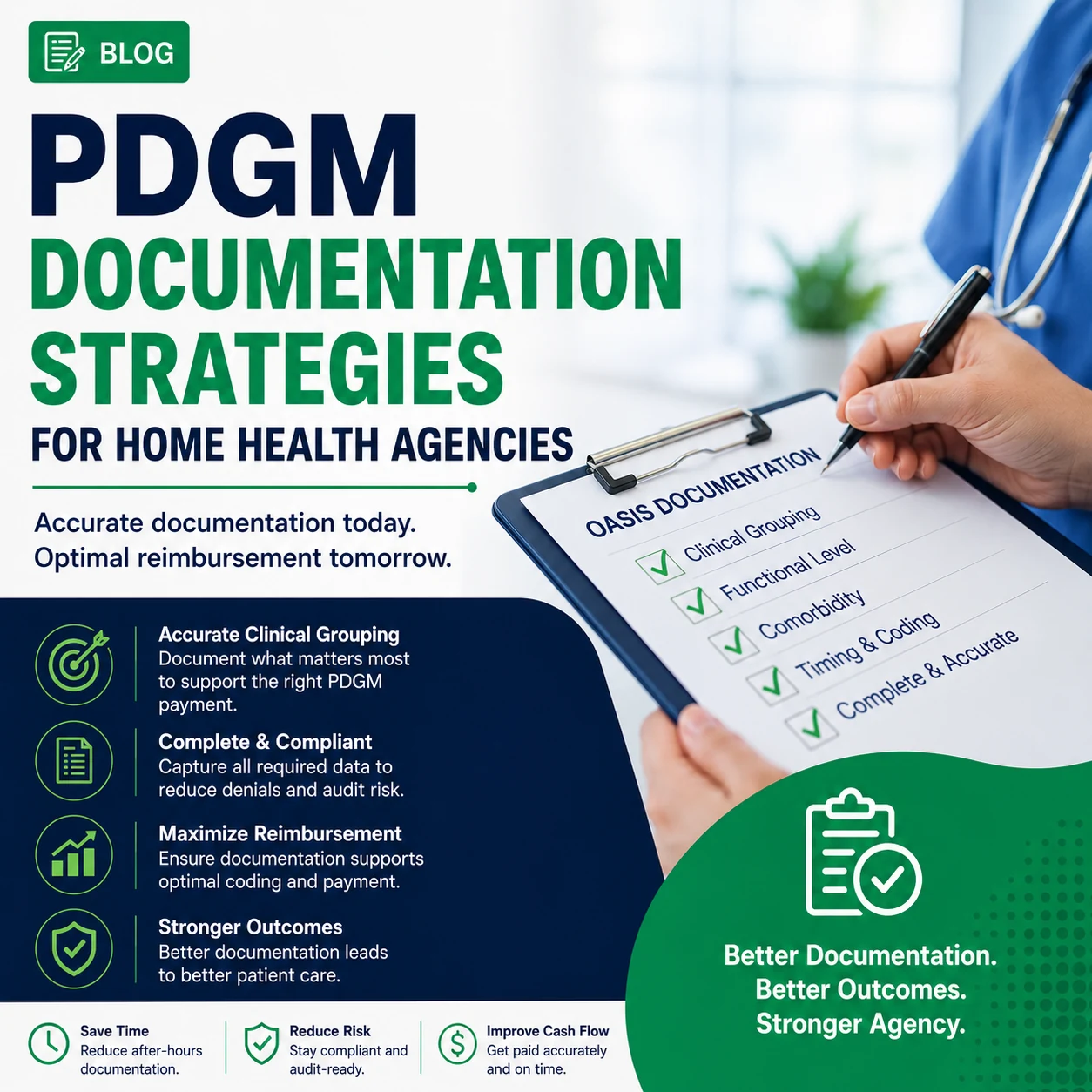
PDGM Documentation Strategies for Home Health Agencies
Under PDGM, documentation establishes the clinical picture that supports classification, medical necessity, coding, and payment. This guide breaks down 15 PDGM documentation strategies, a documentation-to-payment framework, weak-vs-strong examples, and a closed-loop workflow to keep charts consistent and audit-ready.
ICD-10 Coding Best Practices for Home Health Agencies
Accurate ICD-10 coding shapes PDGM reimbursement, claim denials, and Medicare compliance in home health. This guide walks through the eight best practices every agency should follow, from selecting the correct primary diagnosis and capturing comorbidities to coding specificity, OASIS alignment, annual updates, audits, and using AI as a coding support tool.

Common OASIS Documentation Mistakes That Lead to Payment Delays
Common OASIS documentation mistakes, such as incomplete assessments, incorrect diagnosis coding, inaccurate Section GG scoring, medication and homebound-status errors, weak skilled-need documentation, and missing physician signatures, are among the biggest causes of home health payment delays. Because OASIS data drives PDGM reimbursement, most of these errors are preventable with point-of-care charting, strong QA, and AI-powered documentation validation.