
Documentation Best Practices
Documentation Best Practices are proven methods that help clinicians produce clear, consistent, compliant, and defensible clinical records.
Definition
Documentation Best Practices are proven methods that help clinicians produce clear, consistent, compliant, and defensible clinical records.
Why it matters
Documentation Best Practices is part of the Compliance vocabulary used across home health operations, documentation, and revenue cycle. Understanding it helps clinicians, QA leads, and administrators stay aligned on care quality and compliance.
Home Health Documentation Playbook
The complete guide to OASIS-E, Medicare compliance, PDGM, and AI-assisted documentation. Learn how top agencies reduce documentation time without sacrificing compliance.
Related terms
Listen While You Read
Conversations on compliance
Episodes from Inside Home Health that put Documentation Best Practices in operational context.




Related Blogs

Common OASIS Documentation Mistakes That Lead to Payment Delays
Common OASIS documentation mistakes, such as incomplete assessments, incorrect diagnosis coding, inaccurate Section GG scoring, medication and homebound-status errors, weak skilled-need documentation, and missing physician signatures, are among the biggest causes of home health payment delays. Because OASIS data drives PDGM reimbursement, most of these errors are preventable with point-of-care charting, strong QA, and AI-powered documentation validation.
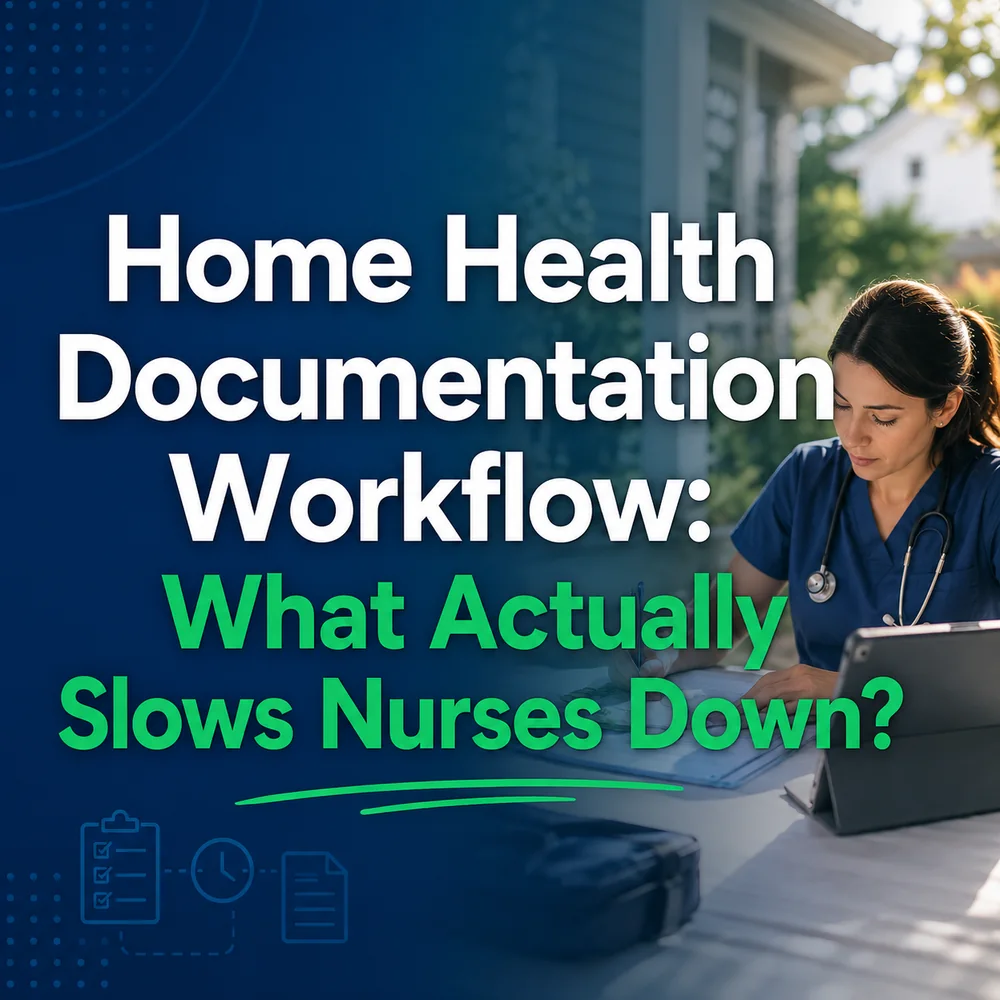
Home Health Documentation Workflow: What Actually Slows Nurses Down?
Home health documentation is one of the biggest administrative burdens clinicians carry, but it is rarely slow for the reasons people assume. The problem usually isnt the nurse, its the workflow surrounding the note: medication reconciliation, OASIS, duplicate entry across disconnected systems, interruptions, and after-hours charting. Here is what actually slows nurses down and how to fix it.

The Hidden Cost of Late Nursing Documentation
Late nursing documentation is far more than an administrative inconvenience. Delayed charting increases patient safety risks, creates handoff gaps, triggers claim denials and undercoding, raises legal and audit exposure, and accelerates nurse burnout and turnover, costing healthcare organizations millions. Most delays happen because nurses lack time to chart in real time, and AI and point-of-care documentation tools can give that time back.