When a patient decides to move from one home health agency to another, the transition involves more than closing a patient chart and sending records.
The transferring agency must document the end of its services, communicate relevant clinical information, and support continuity of care. The receiving agency needs enough information to understand the patient's current condition, treatment history, medications, and ongoing care needs.
For home health agencies, this process also involves understanding the difference between a transfer to another home health agency and a transfer to an inpatient facility. These situations have different OASIS assessment requirements.
Under the current OASIS-E2 guidance, a patient moving to another home health agency is generally documented as a discharge from the current agency using Reason for Assessment (RFA) 9, rather than an inpatient facility transfer using RFA 6 or RFA 7.
A complete transfer process should also address patient choice, communication with the receiving agency, medication reconciliation, pending clinical items, and equipment arrangements.
So, what should agencies document, which OASIS items apply, and how can they avoid gaps during the transition?
This guide explains the process step by step.
What Does It Mean When a Patient Transfers to Another Home Health Agency?
A patient transfer to another home health agency occurs when the patient chooses, or otherwise arranges, to receive home health services from a different agency.
For example, a patient receiving skilled nursing and physical therapy from Agency A may decide to move to Agency B because:
- The patient is relocating to another service area.
- The patient prefers a different agency.
- The current agency can no longer meet the patient's needs.
- The patient or family requests a change in providers.
- The patient wants to continue services with an agency that better fits their preferences.
Under Medicare, beneficiaries have the right to choose their home health provider. The transferring agency and receiving agency should coordinate the transition appropriately.
The original agency is responsible for documenting its discharge and providing the necessary information for continuity of care. The receiving agency is responsible for establishing its own admission process and plan of care.
Is a Transfer to Another Home Health Agency the Same as a Transfer to a Hospital?
No. This is one of the most important distinctions in home health transfer documentation.
A transfer to another home health agency is generally treated as a discharge from the current agency.
A transfer to an inpatient facility, such as a hospital, involves a different OASIS assessment reason.
| Situation | OASIS reason for assessment |
|---|---|
| Patient moves to another home health agency | RFA 9 – Discharge from agency |
| Patient is transferred to an inpatient facility and remains with the agency | RFA 6 – Transfer to inpatient facility, not discharged from agency |
| Patient is transferred to an inpatient facility and is discharged from the agency | RFA 7 – Transfer to inpatient facility, discharged from agency |
| Patient is discharged for another reason, not an inpatient transfer or death at home | RFA 9 – Discharge from agency |
Under the OASIS-E2 manual, RFA 9 specifically includes transfer and discharge to another home health agency.
Using the wrong reason for assessment can result in incorrect OASIS coding and submission errors.
How Should Agencies Document the Patient's Choice to Transfer?
The transfer record should explain why services with the current agency are ending and establish whether the patient or authorized representative requested the change.
The documentation should include:
- Whether the patient or legal representative requested the transfer.
- Whether the patient was informed of their right to choose a home health provider.
- The reason for the requested change, if provided.
- The date the request was received.
- Relevant discussions with the patient, family, or representative.
- Any concerns or questions raised during the transition.
If a legal representative is making the decision, document their name and relationship to the patient, along with the basis of their authority when relevant.
What about consent and authorization forms?
Agencies should follow their policies and applicable legal requirements for documenting patient consent and sharing records.
A separate signed transfer consent or HIPAA authorization is not universally required for every treatment-related disclosure. HIPAA generally permits covered entities to share protected health information with another healthcare provider for treatment purposes without obtaining a separate authorization.
However, other circumstances, state laws, agency policies, or the type of information being disclosed may require additional documentation or authorization.
The important point is to document the patient's request appropriately and ensure records are shared through permitted and secure channels.
Does a Home Health Agency Need a Physician Order Before Transferring a Patient?
Not every patient-elected transfer requires a separate physician order specifically authorizing the change of agency.
The transferring agency should review the circumstances of the discharge, applicable Medicare requirements, existing practitioner orders, and its discharge policies.
When a discharge order or practitioner communication is required, the agency should obtain and document it according to the applicable requirements.
The record should make clear:
- Whether a practitioner order was obtained.
- The date the order was received.
- The practitioner who issued it.
- Any relevant instructions or conditions.
- Any outstanding orders or clinical matters requiring follow-up.
Agencies should not delay documenting a patient-elected transfer simply because they assume a separate order is always required. They should follow the applicable discharge and documentation requirements for the specific situation.
What Information Should Agencies Confirm With the Receiving Home Health Agency?
A smooth transfer requires coordination between the current and receiving agencies.
When the receiving agency is known, the transferring agency should document the relevant contact information and transition arrangements.
Include:
- Receiving agency's full name.
- Contact person's name and designation.
- Phone number.
- Fax number or approved secure communication method.
- Anticipated Start of Care (SOC) date.
- Confirmation of the planned transition, when available.
- Records requested by the receiving agency.
- Any pending information that still needs to be shared.
The expected SOC date should be confirmed with the receiving agency rather than assumed.
The transferring agency should also document whether the receiving provider has acknowledged the handoff, when confirmation is available.
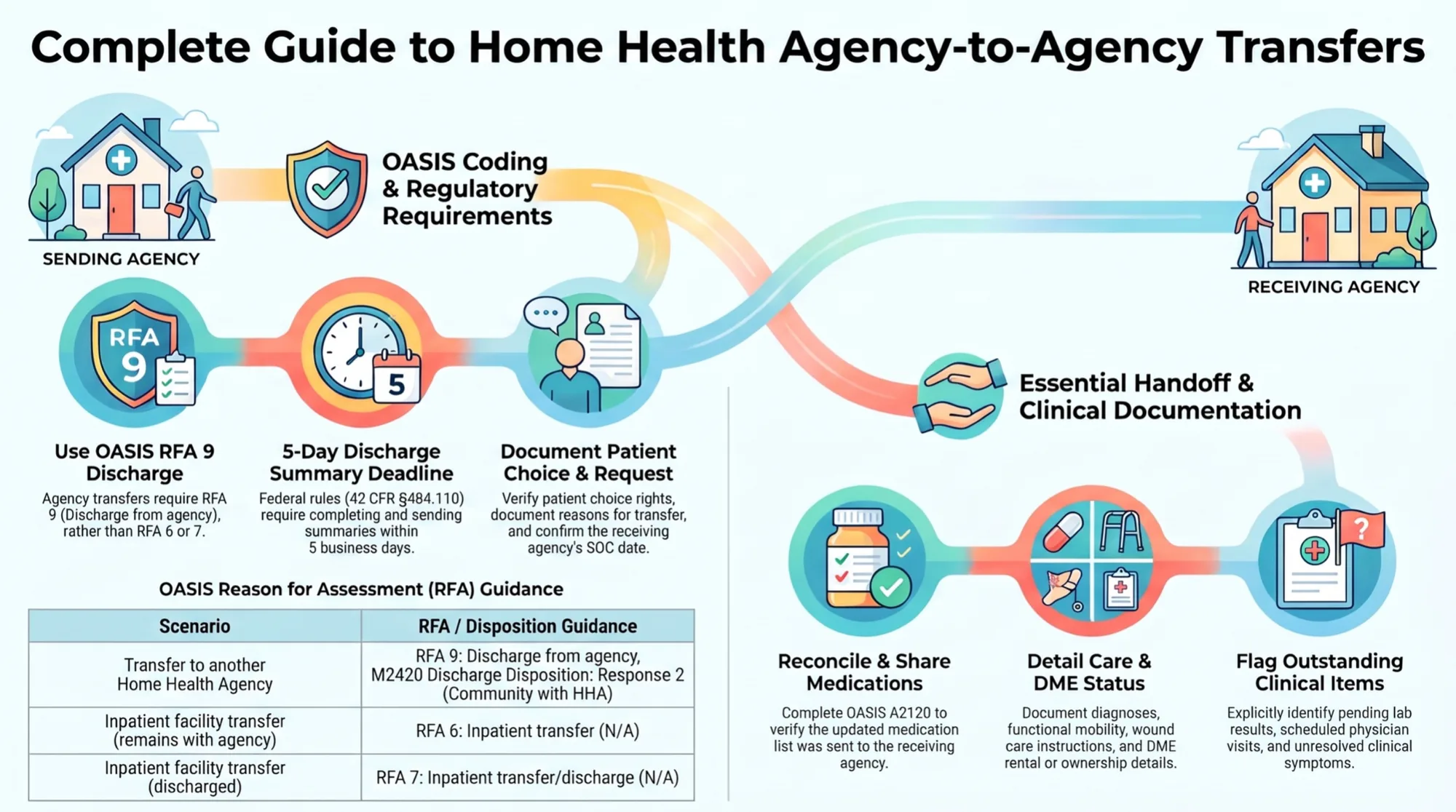
A transfer to another home health agency is a discharge (RFA 9), not an inpatient transfer. The handoff should carry medications, equipment, and pending clinical items.
Why Does the Effective Transfer Date Matter?
The effective date helps establish when services with the original agency end and when the receiving agency is expected to assume care.
It also helps agencies coordinate their records, OASIS assessments, and Medicare billing responsibilities.
Medicare generally has one responsible home health agency for the beneficiary's covered home health services during an applicable period. Agencies should coordinate the effective transfer date to avoid overlapping billing or confusion about which provider is responsible for the services.
The record should clearly distinguish the date the patient requested a transfer, the date the original agency's services ended, and the receiving agency's actual SOC date when these dates differ.
What Information Should Be Included in a Home Health Patient Transfer Record?
A complete transfer record should give the receiving provider a clear picture of the patient's current condition and care needs.
The information shared should be relevant to the patient's current course of illness and treatment, post-discharge goals, and treatment preferences.
The following areas are useful to review.
What Patient and Agency Information Should Be Documented?
Include:
- Patient's full name and identifying information.
- Date of birth.
- Current address and contact details.
- Patient representative or primary caregiver information, where applicable.
- Name of the transferring home health agency.
- Name and contact details of the receiving agency, if known.
- Primary care practitioner and ordering practitioner information.
- Effective discharge date.
Verify that patient identifiers are accurate before sending records.
What Clinical Information Should Be Shared With the Receiving Agency?
The receiving agency needs enough information to understand the patient's condition and continue appropriate care.
Include relevant details such as:
- Primary and secondary diagnoses.
- Reason the patient originally started home health services.
- Current medical condition.
- Recent changes in health status.
- Relevant assessment findings.
- Current vital signs, when clinically relevant.
- Active symptoms and clinical concerns.
- Skilled nursing and therapy services provided.
- Visit frequency and duration.
- Treatments and interventions.
- Wound status and wound care instructions, if applicable.
- Functional abilities and limitations.
- Mobility level and assistance required.
- Relevant laboratory or diagnostic information.
- Progress toward established goals.
- Outstanding clinical concerns or follow-up needs.
Use objective language when describing the patient's condition. For example, document the patient's actual mobility status, symptoms, or wound findings rather than relying on vague statements such as "doing well."
The goal is not to send every historical detail without context. It is to provide accurate, relevant information that supports the next provider's care decisions.
What Medication Information Should Be Included?
Medication information is particularly important during a transition between agencies.
The transferring agency should review the current medication record and provide the appropriate reconciled medication information.
Include, as applicable:
- Current medication name.
- Dosage and frequency.
- Route of administration.
- Recent medication changes.
- Discontinued medications.
- Known medication allergies.
- Medication-related concerns.
- Special administration instructions.
- Relevant patient or caregiver education.
- Outstanding medication reconciliation issues.
Under the OASIS-E2 framework, A2121 relates to providing a current reconciled medication list to the patient, family, or caregiver at discharge. A2120 relates to providing a current reconciled medication list to a subsequent provider at transfer.
For a transfer to another Medicare-certified home health agency, the agency should review the applicable OASIS-E2 instructions and document whether the current reconciled medication list was provided to the subsequent provider.
What Care Plan and Treatment Information Should Be Shared?
The receiving agency should be able to understand what care was being provided and what needs to be addressed next.
Relevant information may include:
- Current plan of care.
- Practitioner orders.
- Skilled services being provided.
- Frequency and duration of ordered visits.
- Treatments and procedures.
- Wound care instructions and current wound status.
- Therapy goals and progress.
- Patient-specific goals.
- Progress toward goals.
- Pending orders or clarifications.
- Upcoming appointments or follow-up needs.
The receiving agency will establish its own admission and care planning process. The transferring agency's documentation should support that process rather than assume the existing plan automatically carries over.
Should Agencies Document DME, Medical Equipment, and Supplies During a Patient Transfer?
Yes. Equipment and supply arrangements can affect the patient's ability to continue receiving care safely at home.
The transferring agency should identify relevant durable medical equipment (DME) and clinical supplies in the home and communicate any arrangements that could affect the transition.
Examples include:
- Oxygen equipment.
- Hospital beds.
- Wheelchairs and mobility devices.
- Walkers and other assistive devices.
- Negative pressure wound therapy equipment.
- Respiratory equipment.
- Other patient-specific medical equipment.
Where relevant, document whether equipment is:
- Owned by the patient.
- Rented through a DME company.
- Provided through the original agency.
- Arranged through another supplier.
Also document relevant supplies left in the home, such as wound dressings or other clinical supplies, including their intended use when known.
The transferring agency should communicate equipment and supply information to the receiving agency. It should not assume that equipment ownership, rental responsibility, or supply arrangements automatically transfer with the patient.
If an item requires a separate supplier arrangement, that should be clarified rather than left unresolved.
What Pending Clinical Items Should Be Included in the Transfer Handoff?
A transfer summary should identify outstanding clinical matters that the receiving agency may need to follow up on.
These may include:
- Pending laboratory results.
- Outstanding diagnostic tests.
- Scheduled physician appointments.
- Pending practitioner orders.
- Wound care follow-ups.
- Medication-related concerns.
- Unresolved clinical symptoms.
- Equipment or supply arrangements still being coordinated.
- Referrals or consultations awaiting completion.
For each relevant item, document its current status and any known follow-up instructions.
For example, if a laboratory result is pending, identify the test, the date it was ordered or collected, and the provider or team expected to follow up.
Do not simply write "pending labs" without enough detail to help the next care team understand what remains outstanding.
How Should the Discharge Summary Be Written When a Patient Moves to Another Home Health Agency?
The discharge summary should clearly explain why services with the current agency are ending and provide an accurate account of the patient's condition and care at discharge.
A useful discharge summary generally includes:
- Admission and discharge dates.
- Reason for admission.
- Reason for discharge or transfer.
- Patient's choice or relevant transfer request, when applicable.
- Primary and secondary diagnoses.
- Services provided and visit frequency.
- Significant clinical events during the episode.
- Patient's condition at discharge.
- Relevant vital signs and functional status.
- Progress toward goals and outcomes.
- Current medication information.
- Wound care and treatment information, when applicable.
- DME and supply arrangements, where relevant.
- Pending clinical items and follow-up needs.
- Relevant patient and caregiver instructions.
- Name or contact information of the next provider, when available.
- Relevant communication with the receiving agency.
The summary should be factual and specific.
What does a weak discharge entry look like?
Patient transferred to another agency. Discharged in stable condition.
That statement does not explain the patient's status, the care provided, or what the next provider needs to know.
What should a stronger entry include?
A stronger entry would explain the patient's request to move to another agency, the effective discharge date, the patient's current clinical and functional status, services provided, progress toward goals, and relevant information communicated to the receiving agency.
The discharge summary should not introduce unsupported clinical conclusions or assume that goals have been met simply because the patient is leaving the agency.
What Is the Deadline for Sending a Home Health Discharge or Transfer Summary?
The applicable federal requirements are found in 42 CFR §484.110(a)(6).
The regulation establishes the following timeframes:
| Documentation | Required timeframe |
|---|---|
| Discharge summary | Within 5 business days of the patient's discharge |
| Planned transfer summary when care immediately continues in a healthcare facility | Within 2 business days of the planned transfer |
| Unplanned transfer summary when the patient is still receiving care in a healthcare facility | Within 2 business days of the agency becoming aware of the transfer |
There is an important distinction here.
The 2-business-day transfer-summary deadlines specifically address transfers to a healthcare facility. They should not automatically be applied to a patient moving from one home health agency to another in the community.
For a discharge to another home health agency, the transferring agency should complete and send the discharge summary within the applicable 5-business-day timeframe. It must also share the necessary medical information with the receiving agency to support a safe and effective transition.
Agencies should avoid waiting until the end of the permitted timeframe when earlier communication is needed for continuity of care.
Which OASIS Codes Apply When a Patient Transfers to Another Home Health Agency?
Under the current OASIS-E2 guidance, the transferring agency generally completes the discharge assessment using:
M0100 – Reason for Assessment: RFA 9, Discharge from agency.
RFA 9 applies when the patient is discharged for a reason other than transfer to an inpatient facility or death at home. CMS specifically includes transfer and discharge to another home health agency within this category.
The agency should also review:
- M0906: Discharge/Transfer/Death Date.
- M2420: Discharge Disposition.
- A2121: Provision of a Current Reconciled Medication List to the Patient at Discharge, when applicable.
- A2120: Provision of a Current Reconciled Medication List to a Subsequent Provider at Transfer, when applicable.
For M2420, when the patient remains in the community and receives skilled services from another Medicare-certified home health agency, the applicable response is:
Response 2 – Patient remained in the community with skilled services from a Medicare-certified HHA.
The agency should follow the full OASIS-E2 item-specific instructions and applicable submission requirements when completing the assessment.
Does the Receiving Home Health Agency Complete a New Start of Care Assessment?
Yes. The receiving agency establishes its own admission and plan of care process.
For a beneficiary-elected Medicare transfer, the receiving agency establishes a new Start of Care date and plan of care. It should complete the applicable SOC assessment and OASIS requirements.
The receiving agency should also verify the patient's current condition, reconcile medications, review available clinical records, and determine the services needed.
The transferring agency's documentation supports the transition, but it does not replace the receiving agency's own assessment responsibilities.
What Should Agencies Document About Communication With the Receiving Home Health Agency?
Sending records is only one part of the transition. Agencies should also maintain a record of relevant communication.
Document:
- Date and time of contact.
- Name and role of the person contacted.
- Receiving agency's name.
- Information requested by the receiving agency.
- Records or documents transmitted.
- Method of transmission.
- Confirmation of receipt, when available.
- Any pending information or follow-up.
- Any barriers to completing the handoff.
- Communication about equipment, supplies, and pending clinical matters.
If the receiving agency requests additional clinical information necessary for treatment, the transferring agency must comply with the request under the discharge planning requirements in 42 CFR §484.58.
A communication record helps establish what information was shared, when it was shared, and whether any outstanding issues remain.
What Should the Final Discharge Entry Include?
The final entry should clearly establish when the original agency's services ended and who completed and authenticated the documentation.
Include:
- Effective discharge date.
- Time of discharge, when required or relevant to the agency's record.
- Reason for discharge.
- Summary of the patient's condition.
- Relevant clinical handoff information.
- Records and medication information shared.
- Communication with the receiving agency.
- Any outstanding follow-up items.
- Name and designation of the documenting professional.
- Date and time of authentication.
The person completing the entry should sign and authenticate it according to applicable federal requirements, state law, and agency policy.
The professional's credentials and designation should be clear. For example, an RN or case manager should be identified accurately.
Avoid backdating entries or documenting a transfer as completed before it actually takes effect. If information is entered after the event, the record should accurately reflect the date and time of the entry and the event being documented.
What Are the Most Common Documentation Mistakes During a Home Health Agency Transfer?
Transfer documentation can become incomplete when agencies focus only on closing the episode.
Some common mistakes include:
1. Using the wrong OASIS reason for assessment
A transfer to another home health agency should not automatically be coded as an inpatient facility transfer. RFA 9 generally applies.
2. Failing to document patient choice
The record should explain the patient's or authorized representative's request and relevant communication.
3. Missing the effective discharge date
The date in the discharge documentation and applicable OASIS date fields should be accurate and consistent.
4. Sending an incomplete discharge summary
A brief statement that the patient transferred does not provide enough information for continuity of care.
5. Leaving medication information outdated
The medication list should reflect the patient's current reconciled medication information, including relevant changes and discontinued medications.
6. Failing to document equipment arrangements
The receiving agency should know about relevant equipment, supplies, ownership, and rental arrangements.
7. Not communicating pending clinical items
Pending tests, orders, and follow-up needs should not disappear during the transition.
8. Failing to document communication
The record should show what was shared with the receiving agency and when.
9. Not documenting the patient's condition at discharge
The summary should describe the patient's actual clinical and functional status rather than relying on generic phrases.
10. Confusing an agency transfer with an inpatient transfer
These situations have different OASIS assessment reasons and should be handled according to the correct CMS guidance.
What Checklist Should QA Teams Use Before Closing a Patient Transfer?
Before finalizing the record, QA teams can use the following checklist.
What Should Be Verified Before the Transfer Record Is Closed?
- Patient identity and demographic information are correct.
- Patient or representative's transfer request or relevant reason is documented.
- Patient choice and applicable consent documentation are recorded.
- Receiving agency information is recorded, when available.
- Contact person and communication details are documented.
- Anticipated SOC date is confirmed with the receiving agency, when available.
- Applicable practitioner orders and communications are reviewed.
- Effective discharge date is documented.
- Reason for discharge is clearly stated.
- Current clinical condition and relevant vital signs are summarized.
- Functional and mobility status are documented.
- Services provided and visit frequency are documented.
- Progress toward care plan goals is recorded.
- Current medication information is reviewed.
- Recent medication changes and discontinued drugs are included, when relevant.
- Relevant orders and treatment information are included.
- Wound care status and instructions are documented, when applicable.
- DME ownership, rental, and supply arrangements are reviewed.
- Pending labs, tests, appointments, and follow-up needs are identified.
- OASIS RFA 9 is used when applicable.
- M2420 discharge disposition is coded correctly.
- Applicable medication-list provision items are completed.
- Discharge summary is completed within the required timeframe.
- Necessary medical information is shared with the receiving agency.
- Communication and record transmission are documented.
- Final discharge entry is signed and authenticated appropriately.
A consistent QA checklist helps agencies catch missing information before the record is finalized.
How Can AI Help Reduce Errors in Home Health Transfer Documentation?
Home health transfer documentation often requires information from multiple parts of the clinical record, including visit notes, medication lists, assessments, orders, and care plans.
Reviewing these records manually can take time, particularly when information is spread across multiple documents or systems.
AI-supported documentation tools can help agencies organize and review this information.
For example, AI can assist with:
- Extracting relevant patient information from clinical records.
- Preparing structured discharge documentation for clinician review.
- Identifying missing information in a discharge summary.
- Flagging inconsistencies between clinical notes and assessment responses.
- Organizing medication information for reconciliation.
- Helping QA teams identify charts that need additional attention.
However, AI should not independently decide that a patient is clinically ready for transfer or create unsupported clinical conclusions.
The clinician and authorized agency personnel remain responsible for reviewing the patient's record, correcting inaccuracies, and approving the final documentation.
At Copper Digital, we believe AI should reduce repetitive administrative work while keeping clinical decisions in the hands of healthcare professionals. The objective is to make documentation easier to complete and review, without compromising accuracy or patient safety.
How Can Agencies Make Patient Transfers Safer and More Consistent?
A patient moving to another home health agency should not mean that important clinical information gets lost between providers.
The transferring agency needs to close its record accurately, document the patient's choice, coordinate with the receiving agency, communicate relevant clinical information, and address outstanding equipment or follow-up needs.
The receiving agency needs to understand the patient's current needs and establish an appropriate plan of care.
A clear transfer process, accurate OASIS coding, timely discharge summaries, medication reconciliation, and consistent QA review all contribute to a smoother transition.
The goal is simple: the patient should experience a change in agency, not a gap in care.
Related Reading
- How to Close a Home Health Episode Without Missing Documentation.
- OASIS Discharge Assessment: When Is It Required and When Can It Be Skipped?.
- How to Write a Strong Home Health Discharge Narrative: A Complete Guide for Clinicians.
- Home Health Recertification vs Discharge: What Are the Key Differences?.